WRITING COMPETENCES/ HOW TO
     WRITE A COMPETENCE.


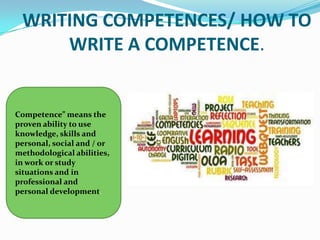
Competence” means the
proven ability to use
knowledge, skills and
personal, social and / or
methodological abilities,
in work or study
situations and in
professional and
personal development.
Competence is also written as
   competency (Plural:
competences, competencies
Competences are obtained or developed during the
process of learning by the student/learner.

They represent a dynamic combination of knowledge,
understanding, skills and abilities.

Competences will be formed in various course units and
assessed at different stages.

Time and attention should also be devoted to the
development of generic competences or transferable skills
WHY ARE COMPETENCIES SO
     IMPORTANT TODAY?

 Globalisation and modernisation are creating an
 increasingly diverse and interconnected world. To
 make sense of and function well in this world,
 individuals need.
STRUCTURE OF A COMPETENCY
 Competencies can be written by building their
  structure upon Bloom’s taxonomy; from the lowest
  to highest level in the cognitive, psychomotor and
  affective domains.
 Each individual competency should be specific.
 It should start with an action verb followed by an
  object.
 Competencies should be performance based and
  measurable.
TIPS FOR WRITING COMPETENCIES
 Define competencies simply and clearly.
 Make sure competencies embody a single, readily
  identifiable characteristic.
 Avoid making the competency too specific.
 Make the competency definition behaviorally-
  based.
 Remove unnecessary qualifiers
Opportunity for   Include your
you to promote      personal
   yourself.      involvement


             Each
         competency is
            equally
           important
What is a competence?
Generic      competencies       are      transferable
multifunctional knowledge, skills and attitudes that
people could learn and develop in different ways and
learning environments.
TUNING DISTINGUISHES THREE
TYPES OF GENERIC COMPETENCES
 Instrumental competences: cognitive abilities,
  methodological abilities, technological abilities
  and linguistic abilities.
 Interpersonal competences: individual abilities
  like social skills (social interaction and co-
  operation);
 Systemic competences: abilities and skills
  concerning whole systems (combination of
  understanding, sensibility and knowledge; prior
  acquisition of instrumental and interpersonal
  competences required).
TUNING PROJECT
 lStructures in Europe was
  initiated in 2000. In this
  project, the term competence is
  defined as follows:

“Competences       represent     a
 dynamic      combination       of
 knowledge,        understanding,
 skills . and abilities. Fostering
 competences is the object of
 educational         programmes.
 Competences are formed in
 various course units and
 assessed at different stages”
EXAMPLES OF GENERIC
   COMPETENCES.

Writing competences

  • 1.
    WRITING COMPETENCES/ HOWTO WRITE A COMPETENCE. Competence” means the proven ability to use knowledge, skills and personal, social and / or methodological abilities, in work or study situations and in professional and personal development.
  • 2.
    Competence is alsowritten as competency (Plural: competences, competencies
  • 3.
    Competences are obtainedor developed during the process of learning by the student/learner. They represent a dynamic combination of knowledge, understanding, skills and abilities. Competences will be formed in various course units and assessed at different stages. Time and attention should also be devoted to the development of generic competences or transferable skills
  • 4.
    WHY ARE COMPETENCIESSO IMPORTANT TODAY?  Globalisation and modernisation are creating an increasingly diverse and interconnected world. To make sense of and function well in this world, individuals need.
  • 5.
    STRUCTURE OF ACOMPETENCY  Competencies can be written by building their structure upon Bloom’s taxonomy; from the lowest to highest level in the cognitive, psychomotor and affective domains.  Each individual competency should be specific.  It should start with an action verb followed by an object.  Competencies should be performance based and measurable.
  • 6.
    TIPS FOR WRITINGCOMPETENCIES  Define competencies simply and clearly.  Make sure competencies embody a single, readily identifiable characteristic.  Avoid making the competency too specific.  Make the competency definition behaviorally- based.  Remove unnecessary qualifiers
  • 7.
    Opportunity for Include your you to promote personal yourself. involvement Each competency is equally important
  • 8.
    What is acompetence?
  • 9.
    Generic competencies are transferable multifunctional knowledge, skills and attitudes that people could learn and develop in different ways and learning environments.
  • 10.
    TUNING DISTINGUISHES THREE TYPESOF GENERIC COMPETENCES  Instrumental competences: cognitive abilities, methodological abilities, technological abilities and linguistic abilities.  Interpersonal competences: individual abilities like social skills (social interaction and co- operation);  Systemic competences: abilities and skills concerning whole systems (combination of understanding, sensibility and knowledge; prior acquisition of instrumental and interpersonal competences required).
  • 11.
    TUNING PROJECT  lStructuresin Europe was initiated in 2000. In this project, the term competence is defined as follows: “Competences represent a dynamic combination of knowledge, understanding, skills . and abilities. Fostering competences is the object of educational programmes. Competences are formed in various course units and assessed at different stages”
  • 12.