Developing Project
Control Competences
11 April 2019
Dawn Thompson, ECITB
ECITB.org.uk
Engineering Construction Industry Training
Board
2
• Statutory skills organisation for the Engineering Construction Industry in Great Britain.
• A non-departmental public body sponsored by the Department for Education.
• Our mission is to lead the industry in training and developing a highly skilled workforce.
• Our vision is to be the industry authority on engineering construction skills, working in partnership with business and
government to deliver a diverse and highly skilled workforce, offering value by enabling industry to compete globally.
• In 2017 we invested £25m in skills - £12m for Management & Professional training including Project Control.
• We work with employers to attract, develop and qualify the engineering construction workforce in a wide range of craft,
technical and professional disciplines.
• Employer-led, we invest in training to enhance skills across the engineering construction industry, with a forecast spend of
around £24m in direct training expenditure.
• Regionally represented by employers and training providers
ECITB.org.uk
Project Control Skills Gap – The Realisation
3
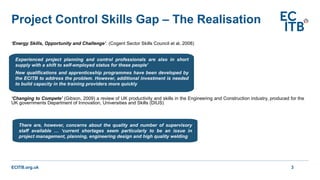
‘Energy Skills, Opportunity and Challenge’. (Cogent Sector Skills Council et al, 2008)
‘Changing to Compete’ (Gibson, 2009) a review of UK productivity and skills in the Engineering and Construction industry, produced for the
UK governments Department of Innovation, Universities and Skills (DIUS)
Experienced project planning and control professionals are also in short
supply with a shift to self-employed status for these people’
New qualifications and apprenticeship programmes have been developed by
the ECITB to address the problem. However, additional investment is needed
to build capacity in the training providers more quickly
There are, however, concerns about the quality and number of supervisory
staff available … ‘current shortages seem particularly to be an issue in
project management, planning, engineering design and high quality welding
ECITB.org.uk
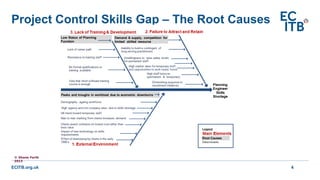
Project Control Skills Gap – The Root Causes
4
© Shane Forth
2013
ECITB.org.uk
Action: Project Control Trailblazer
5
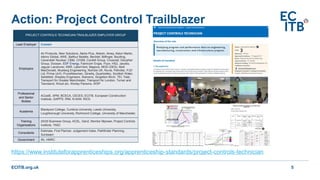
PROJECT CONTROLS TECHNICIAN TRAILBLAZER EMPLOYER GROUP
Lead Employer Costain
Employers
Air Products, Aker Solutions, Alpha Plus, Alstom, Amey, Aston Martin,
Atkins Global, AWE, Balfour Beattie, Bechtel, Bilfinger, Boulting,
Cavendish Nuclear, CB&I, CH2M, Cordell Group, Crossrail, Decipher
Group, Doosan, EDF Energy, Fabricom Engie, Fluor, HS2, Jacobs,
Jaguar Landrover, KBR, LakerVent, Magnox, MOD (DES), Mott
MacDonald, Mustang Engineering, Nichols UK, Nuvia, Petrofac, PJD
Ltd, Prima UnO, PruceNewman, Qinetiq, Quartzeltec, Scottish Water,
Sellafield, Shepley Engineers, Siemens, Singleton Birch, TEI, Total,
Transport for Greater Manchester, Transport for London, Turner and
Townsend, Wood plc, Worley Parsons, WSP
Professional
and Sector
Bodies
ACostE, APM, BCECA, CECES, ECITB, European Construction
Institute, GAPPS, IRM, N-SAN. RICS
Academia
Blackpool College, Cumbria University, Leeds University,
Loughborough University, Richmond College, University of Manchester,
Training
Organisations
20/20 Business Group, ACSL, Gen2, Monitor Mpower, Project Controls
Institute, TASC
Consultants
Estimata, First Planner, Judgement Index, Pathfinder Planning,
Sunbeam
Government IfA, HMRC
https://www.instituteforapprenticeships.org/apprenticeship-standards/project-controls-technician
ECITB Project Controls Training Courses
and Standards
ECITB has supported the industry-led Project
Controls Working Group since 2007
Together, have developed a number of project
controls training courses and training standards
ECITB’s skills arm quality audits training
companies that deliver training to Engineering
construction companies – these training
companies become approved ECITB training
suppliers.
Level 3 & 5 Project Control Vocational Qualifications
Project Document Managers Course
Estimating Methodology Course
Commercial Awareness
Introduction to Project Control
Certificate in Project Control
Qualifications
L3 Diploma in Project Controls Practice & Techniques:
Modular qualification with 13 units including:
• scope interpretation and project controls planning;
• work and cost breakdown and coding structures;
• scheduling;
• estimating;
• developing the initial budget and baseline;
• tracking progress and managing detailed controls data;
• risk and opportunity management;
• procurement activities;
This qualification includes the use of approved simulation and online
knowledge testing. It is accessible to candidates throughout The UK and
enables those who wish to move into project controls to achieve this
qualification.
Mandated in L3 Project Control Technician Apprenticeship Standard
ECITB.org.uk 7
ECITB Certificate in Project Controls L2
A comprehensive programme covering all aspects of project controls.
Learners are taught through a blend of classroom workshops, assessments
and simulated project work over a period of 9 months.
The programme takes the learners through:
• an introduction to projects
• appreciation of project management and project control
• project initiation; risk and change
• estimating and scope definition
• procurement and
• document control
• planning and scheduling
• cost control
• progress monitoring and control
• and jobsite management
On completion of the modules the learners bring together all the assignments
they have completed as part of the simulated industry case study to create
the final outcome of the course – a Project Execution Plan (PEP).Learners
present their final PEP to employers at the end of the programme.
Training Courses
Introduction to Project Controls:
This course provides a comprehensive and detailed insight into the fundamentals of Project Controls including planning,
estimating and cost engineering. It is applicable to both onshore and offshore environments.
Audience: New to project controls or no formal training Duration: 4 days
Estimating Methodology & Practice:
The course has been designed to provide an overview of the principles and practices of estimating. The breadth of skills &
knowledge extend to a range of interpersonal skills as well as the technical abilities associated with preparing an estimate.
Learning outcomes include; preparing a cash flow for the design, procure, and construct phases of a project; operate an
estimate documentation and version control system; and understand the principles involved in the use of capital and operating
cost estimates together with revenue estimation to carry out economic evaluation using net present value and other methods.
Audience: New to estimating and current practitioners Duration: 3 days
Project Document Managers’ Course
The management of documents is at the centre of every project. Document management processes are different on every
project due to the need to integrate the document management requirements of client, contractor and major
vendors/subcontractors. This training focuses on the principles underlying the function in order for it to be transferable across
companies. The course covers four main areas; Setting the Scene, Understanding the Requirements, Setting up Project
Processes and Leading the Document Management Function.
Audience: Experienced document controllers Duration: 2 days
ECITB.org.uk 8
Training Standards
ECITB Training Standards: Project Controls, Estimating, Planning and Cost Engineering
The industry-led Project Controls Working Group has developed a set of agreed industry training standards to ensure
consistent, high quality training which meets their needs.
The training standards detail what a project controller, estimator, scheduler or cost controller should know and the skills that
they should have in order to be able to do specific techniques, such as the standards provide a ‘curriculum’ from which to
develop training form.
There are 51 training standards ranging from introductory to advanced and for skills, including developing breakdown and
coding structures; estimating practice; scheduling practice; risk analysis; monitoring, tracking and forecasting; optimisation;
and commercial awareness, bids and tenders.
Companies and training providers can use the standards to develop their own bespoke training that meets industry
requirements. Courses developed from one or more of the standards can be submitted to ECITB to gain the quality of seal
approval for the course. Each training standard links to existing vocational qualifications and details the training necessary to
develop the skills needed from trainee project controller up to competent senior project controller or technical lead (i.e. lead
estimator, lead planner, lead scheduler, lead cost engineer).
Audience: Project controls training managers and approved training providers
ECITB.org.uk 9
Linking with Professional Bodies
ECITB.org.uk 10
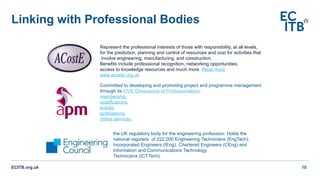
Represent the professional interests of those with responsibility, at all levels,
for the prediction, planning and control of resources and cost for activities that
involve engineering, manufacturing, and construction.
Benefits include professional recognition, networking opportunities,
access to knowledge resources and much more. Read more
www.acoste.org.uk
Committed to developing and promoting project and programme management
through its FIVE Dimensions of Professionalism:
membership,
qualifications,
events,
publications,
online services.
the UK regulatory body for the engineering profession. Holds the
national registers of 222,000 Engineering Technicians (EngTech),
Incorporated Engineers (IEng), Chartered Engineers (CEng) and
Information and Communications Technology
Technicians (ICTTech).
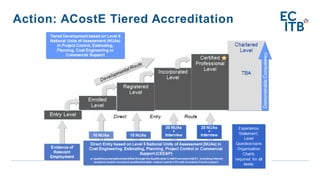
Action: ACostE Tiered Accreditation
Action: Raising the Profile
http://careers.ecitb.org.uk/desktop/index.htm
Project controls apprentice standard
- marketing materials
Available for you to use and tailor to use to encourage applicants into the project
controls apprenticeship :
Videos: https://vimeo.com/15802690 (6.30)
The apprentice standard flyer
Photos and also quotes on ‘why work in project controls’ from many members of
the Trailblazer Group
A document on available project controls training and qualifications from the
ECITB:
https://www.ecitb.org.uk/About-Us/Media-Centre/Publications/project-controls-
programmes-2016
The career profile document
Case studies on the careers website: http://careers.ecitb.org.uk/
Detailed case studies from ACostE
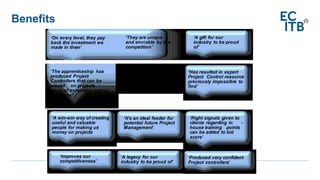
Benefits
Driving Forwards – Maintaining Momentum
ECITB.org.uk 15
 Raising the profile of the profession
 Project controls as a rewarding, long-term career
 Awareness of the skills and professional pathway
 Increase those with nationally recognised qualifications in
project controls
 Expanding the reach of the working group
 Encouraging investment in project controls training and
apprenticeships
 Closer links to and with professional bodies
 Level 6 Apprenticeship Standard
 L6 Project Control Vocational Qualification
Any questions?
16ECITB.org.uk

Dawn Thompson

  • 1.
    Developing Project Control Competences 11April 2019 Dawn Thompson, ECITB
  • 2.
    ECITB.org.uk Engineering Construction IndustryTraining Board 2 • Statutory skills organisation for the Engineering Construction Industry in Great Britain. • A non-departmental public body sponsored by the Department for Education. • Our mission is to lead the industry in training and developing a highly skilled workforce. • Our vision is to be the industry authority on engineering construction skills, working in partnership with business and government to deliver a diverse and highly skilled workforce, offering value by enabling industry to compete globally. • In 2017 we invested £25m in skills - £12m for Management & Professional training including Project Control. • We work with employers to attract, develop and qualify the engineering construction workforce in a wide range of craft, technical and professional disciplines. • Employer-led, we invest in training to enhance skills across the engineering construction industry, with a forecast spend of around £24m in direct training expenditure. • Regionally represented by employers and training providers
  • 3.
    ECITB.org.uk Project Control SkillsGap – The Realisation 3 ‘Energy Skills, Opportunity and Challenge’. (Cogent Sector Skills Council et al, 2008) ‘Changing to Compete’ (Gibson, 2009) a review of UK productivity and skills in the Engineering and Construction industry, produced for the UK governments Department of Innovation, Universities and Skills (DIUS) Experienced project planning and control professionals are also in short supply with a shift to self-employed status for these people’ New qualifications and apprenticeship programmes have been developed by the ECITB to address the problem. However, additional investment is needed to build capacity in the training providers more quickly There are, however, concerns about the quality and number of supervisory staff available … ‘current shortages seem particularly to be an issue in project management, planning, engineering design and high quality welding
  • 4.
    ECITB.org.uk Project Control SkillsGap – The Root Causes 4 © Shane Forth 2013
  • 5.
    ECITB.org.uk Action: Project ControlTrailblazer 5 PROJECT CONTROLS TECHNICIAN TRAILBLAZER EMPLOYER GROUP Lead Employer Costain Employers Air Products, Aker Solutions, Alpha Plus, Alstom, Amey, Aston Martin, Atkins Global, AWE, Balfour Beattie, Bechtel, Bilfinger, Boulting, Cavendish Nuclear, CB&I, CH2M, Cordell Group, Crossrail, Decipher Group, Doosan, EDF Energy, Fabricom Engie, Fluor, HS2, Jacobs, Jaguar Landrover, KBR, LakerVent, Magnox, MOD (DES), Mott MacDonald, Mustang Engineering, Nichols UK, Nuvia, Petrofac, PJD Ltd, Prima UnO, PruceNewman, Qinetiq, Quartzeltec, Scottish Water, Sellafield, Shepley Engineers, Siemens, Singleton Birch, TEI, Total, Transport for Greater Manchester, Transport for London, Turner and Townsend, Wood plc, Worley Parsons, WSP Professional and Sector Bodies ACostE, APM, BCECA, CECES, ECITB, European Construction Institute, GAPPS, IRM, N-SAN. RICS Academia Blackpool College, Cumbria University, Leeds University, Loughborough University, Richmond College, University of Manchester, Training Organisations 20/20 Business Group, ACSL, Gen2, Monitor Mpower, Project Controls Institute, TASC Consultants Estimata, First Planner, Judgement Index, Pathfinder Planning, Sunbeam Government IfA, HMRC https://www.instituteforapprenticeships.org/apprenticeship-standards/project-controls-technician
  • 6.
    ECITB Project ControlsTraining Courses and Standards ECITB has supported the industry-led Project Controls Working Group since 2007 Together, have developed a number of project controls training courses and training standards ECITB’s skills arm quality audits training companies that deliver training to Engineering construction companies – these training companies become approved ECITB training suppliers. Level 3 & 5 Project Control Vocational Qualifications Project Document Managers Course Estimating Methodology Course Commercial Awareness Introduction to Project Control Certificate in Project Control
  • 7.
    Qualifications L3 Diploma inProject Controls Practice & Techniques: Modular qualification with 13 units including: • scope interpretation and project controls planning; • work and cost breakdown and coding structures; • scheduling; • estimating; • developing the initial budget and baseline; • tracking progress and managing detailed controls data; • risk and opportunity management; • procurement activities; This qualification includes the use of approved simulation and online knowledge testing. It is accessible to candidates throughout The UK and enables those who wish to move into project controls to achieve this qualification. Mandated in L3 Project Control Technician Apprenticeship Standard ECITB.org.uk 7 ECITB Certificate in Project Controls L2 A comprehensive programme covering all aspects of project controls. Learners are taught through a blend of classroom workshops, assessments and simulated project work over a period of 9 months. The programme takes the learners through: • an introduction to projects • appreciation of project management and project control • project initiation; risk and change • estimating and scope definition • procurement and • document control • planning and scheduling • cost control • progress monitoring and control • and jobsite management On completion of the modules the learners bring together all the assignments they have completed as part of the simulated industry case study to create the final outcome of the course – a Project Execution Plan (PEP).Learners present their final PEP to employers at the end of the programme.
  • 8.
    Training Courses Introduction toProject Controls: This course provides a comprehensive and detailed insight into the fundamentals of Project Controls including planning, estimating and cost engineering. It is applicable to both onshore and offshore environments. Audience: New to project controls or no formal training Duration: 4 days Estimating Methodology & Practice: The course has been designed to provide an overview of the principles and practices of estimating. The breadth of skills & knowledge extend to a range of interpersonal skills as well as the technical abilities associated with preparing an estimate. Learning outcomes include; preparing a cash flow for the design, procure, and construct phases of a project; operate an estimate documentation and version control system; and understand the principles involved in the use of capital and operating cost estimates together with revenue estimation to carry out economic evaluation using net present value and other methods. Audience: New to estimating and current practitioners Duration: 3 days Project Document Managers’ Course The management of documents is at the centre of every project. Document management processes are different on every project due to the need to integrate the document management requirements of client, contractor and major vendors/subcontractors. This training focuses on the principles underlying the function in order for it to be transferable across companies. The course covers four main areas; Setting the Scene, Understanding the Requirements, Setting up Project Processes and Leading the Document Management Function. Audience: Experienced document controllers Duration: 2 days ECITB.org.uk 8
  • 9.
    Training Standards ECITB TrainingStandards: Project Controls, Estimating, Planning and Cost Engineering The industry-led Project Controls Working Group has developed a set of agreed industry training standards to ensure consistent, high quality training which meets their needs. The training standards detail what a project controller, estimator, scheduler or cost controller should know and the skills that they should have in order to be able to do specific techniques, such as the standards provide a ‘curriculum’ from which to develop training form. There are 51 training standards ranging from introductory to advanced and for skills, including developing breakdown and coding structures; estimating practice; scheduling practice; risk analysis; monitoring, tracking and forecasting; optimisation; and commercial awareness, bids and tenders. Companies and training providers can use the standards to develop their own bespoke training that meets industry requirements. Courses developed from one or more of the standards can be submitted to ECITB to gain the quality of seal approval for the course. Each training standard links to existing vocational qualifications and details the training necessary to develop the skills needed from trainee project controller up to competent senior project controller or technical lead (i.e. lead estimator, lead planner, lead scheduler, lead cost engineer). Audience: Project controls training managers and approved training providers ECITB.org.uk 9
  • 10.
    Linking with ProfessionalBodies ECITB.org.uk 10 Represent the professional interests of those with responsibility, at all levels, for the prediction, planning and control of resources and cost for activities that involve engineering, manufacturing, and construction. Benefits include professional recognition, networking opportunities, access to knowledge resources and much more. Read more www.acoste.org.uk Committed to developing and promoting project and programme management through its FIVE Dimensions of Professionalism: membership, qualifications, events, publications, online services. the UK regulatory body for the engineering profession. Holds the national registers of 222,000 Engineering Technicians (EngTech), Incorporated Engineers (IEng), Chartered Engineers (CEng) and Information and Communications Technology Technicians (ICTTech).
  • 11.
    Action: ACostE TieredAccreditation
  • 12.
    Action: Raising theProfile http://careers.ecitb.org.uk/desktop/index.htm
  • 13.
    Project controls apprenticestandard - marketing materials Available for you to use and tailor to use to encourage applicants into the project controls apprenticeship : Videos: https://vimeo.com/15802690 (6.30) The apprentice standard flyer Photos and also quotes on ‘why work in project controls’ from many members of the Trailblazer Group A document on available project controls training and qualifications from the ECITB: https://www.ecitb.org.uk/About-Us/Media-Centre/Publications/project-controls- programmes-2016 The career profile document Case studies on the careers website: http://careers.ecitb.org.uk/ Detailed case studies from ACostE
  • 14.
  • 15.
    Driving Forwards –Maintaining Momentum ECITB.org.uk 15  Raising the profile of the profession  Project controls as a rewarding, long-term career  Awareness of the skills and professional pathway  Increase those with nationally recognised qualifications in project controls  Expanding the reach of the working group  Encouraging investment in project controls training and apprenticeships  Closer links to and with professional bodies  Level 6 Apprenticeship Standard  L6 Project Control Vocational Qualification
  • 16.