Chapter 4
Stacks
www.asyrani.com
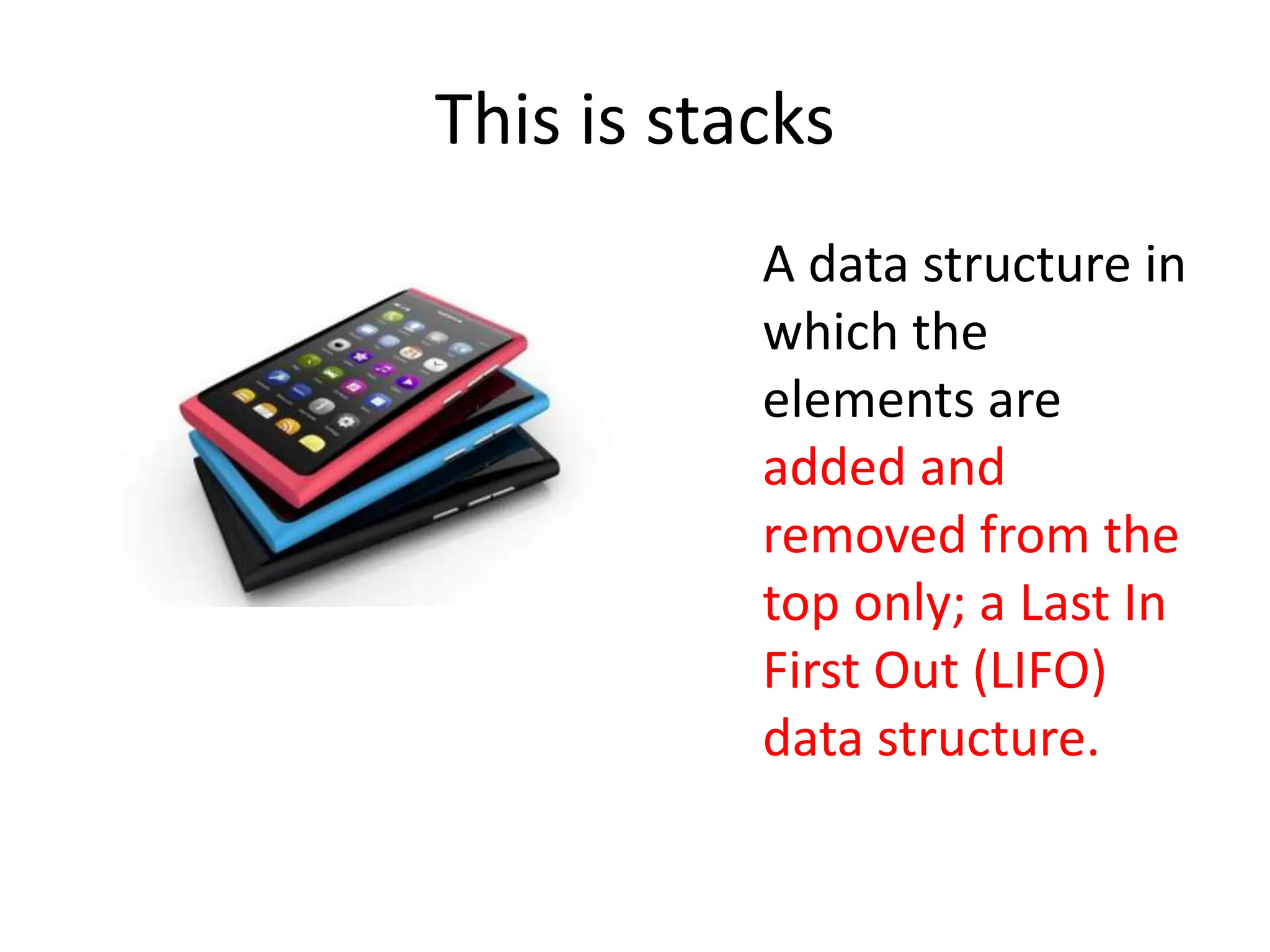
This is stacks
A data structure in
which the
elements are
added and
removed from the
top only; a Last In
First Out (LIFO)
data structure.
Why People use stacks?
Say you are writing a notepad application. A
good use for a stack would be the undo/redo
feature. Every time the user enters
something, save the state (in this case, the
text) on a stack and if you need to reverse
something, just pop it off the top of the undo
stack and push it onto the redo stack.
Stacks are also used for reversing things. If
you push something, say a String onto a Stack
one character at a time, and then construct a
String from the members popped off the
Stack, then the String is reversed.
Last In First Out
B
A
D
C
B
A
C
B
A
D
C
B
A
E
D
C
B
A
top
top
top
top
top
A
Stacks
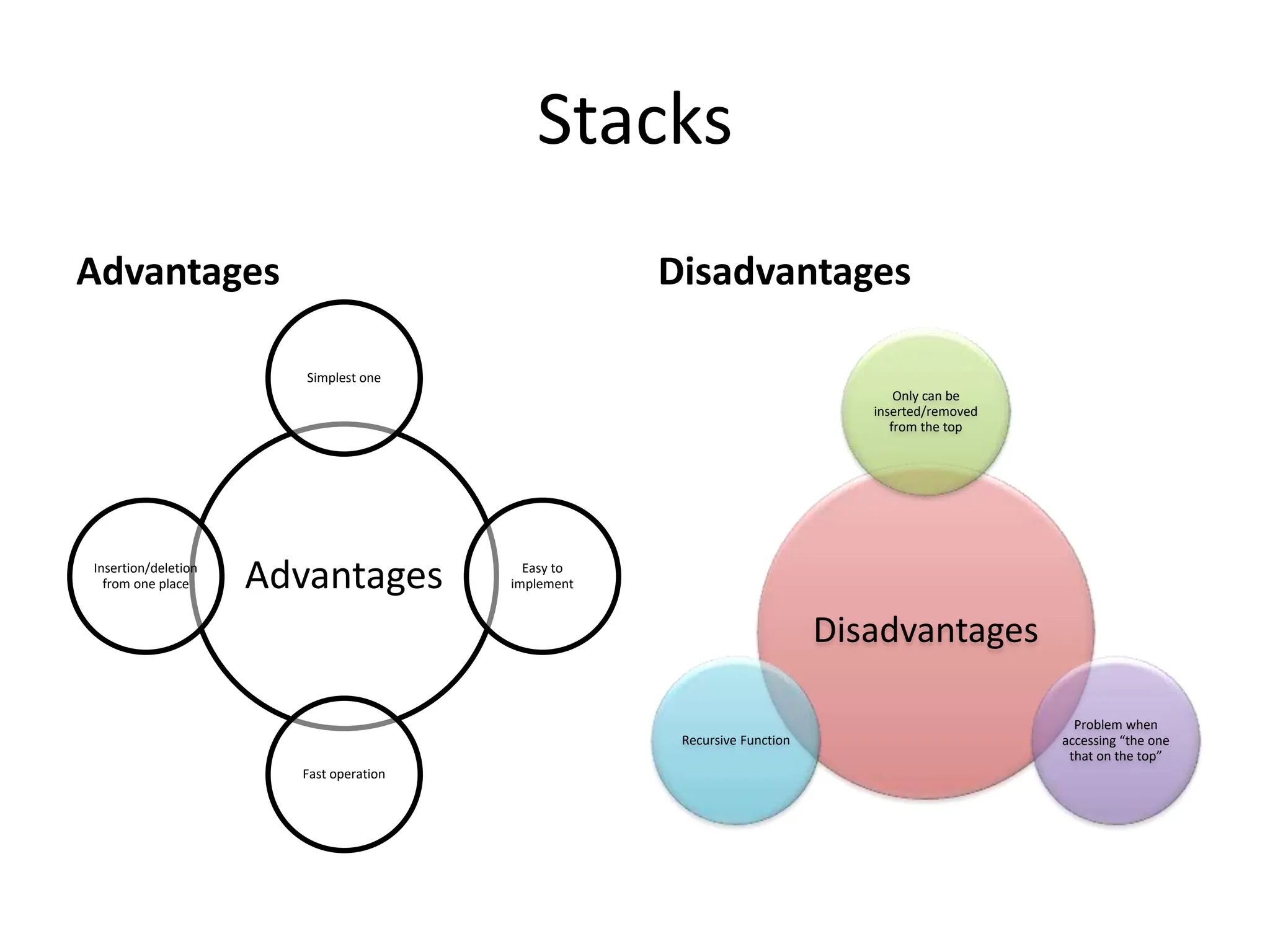
Advantages
Advantages
Simplest one
Easy to
implement
Fast operation
Insertion/deletion
from one place
Disadvantages
Disadvantages
Only can be
inserted/removed
from the top
Problem when
accessing “the one
that on the top”
Recursive Function
BASIC OPERATION
BASIC
OPERATION
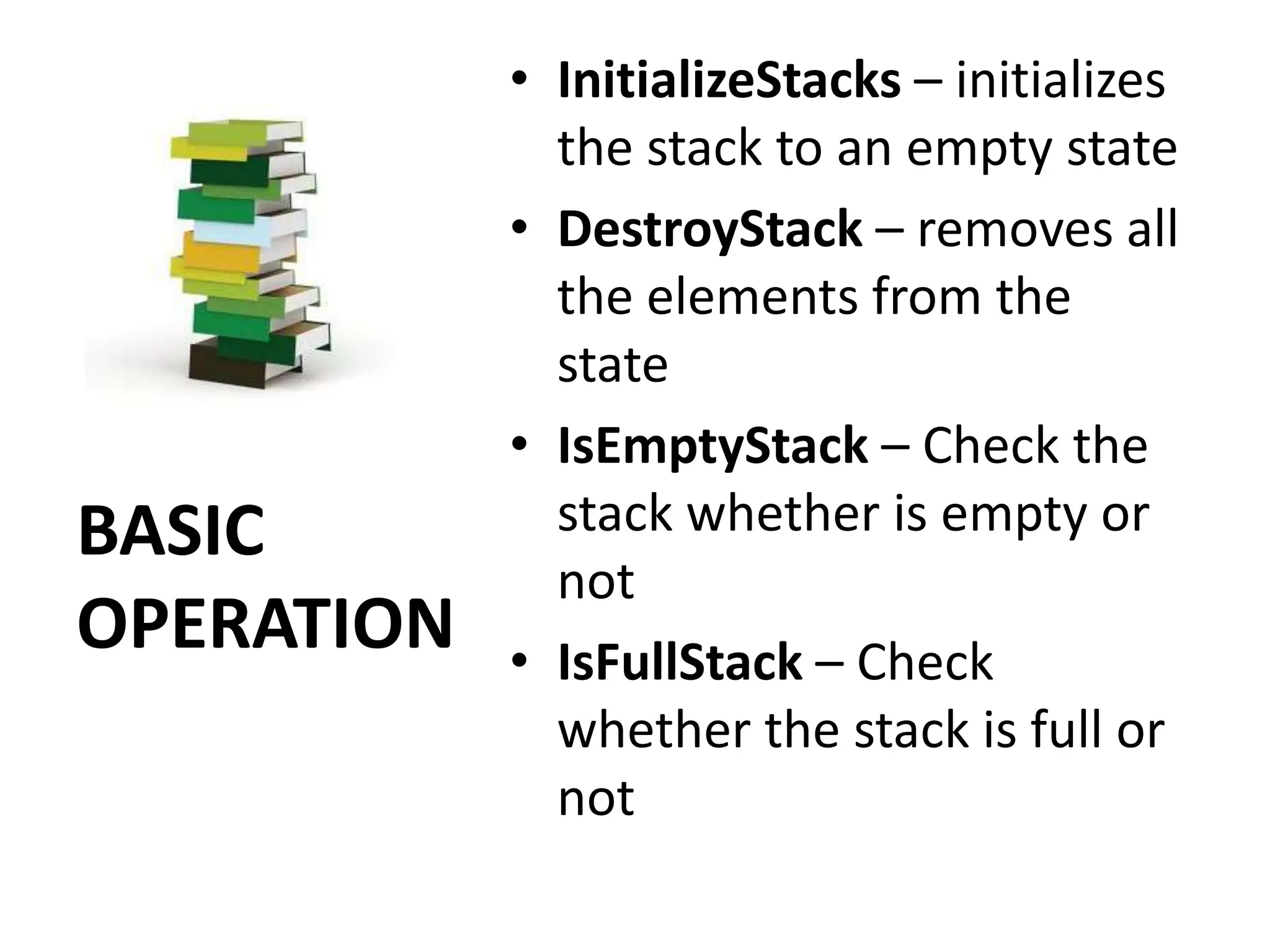
• InitializeStacks – initializes
the stack to an empty state
• DestroyStack – removes all
the elements from the
state
• IsEmptyStack – Check the
stack whether is empty or
not
• IsFullStack – Check
whether the stack is full or
not
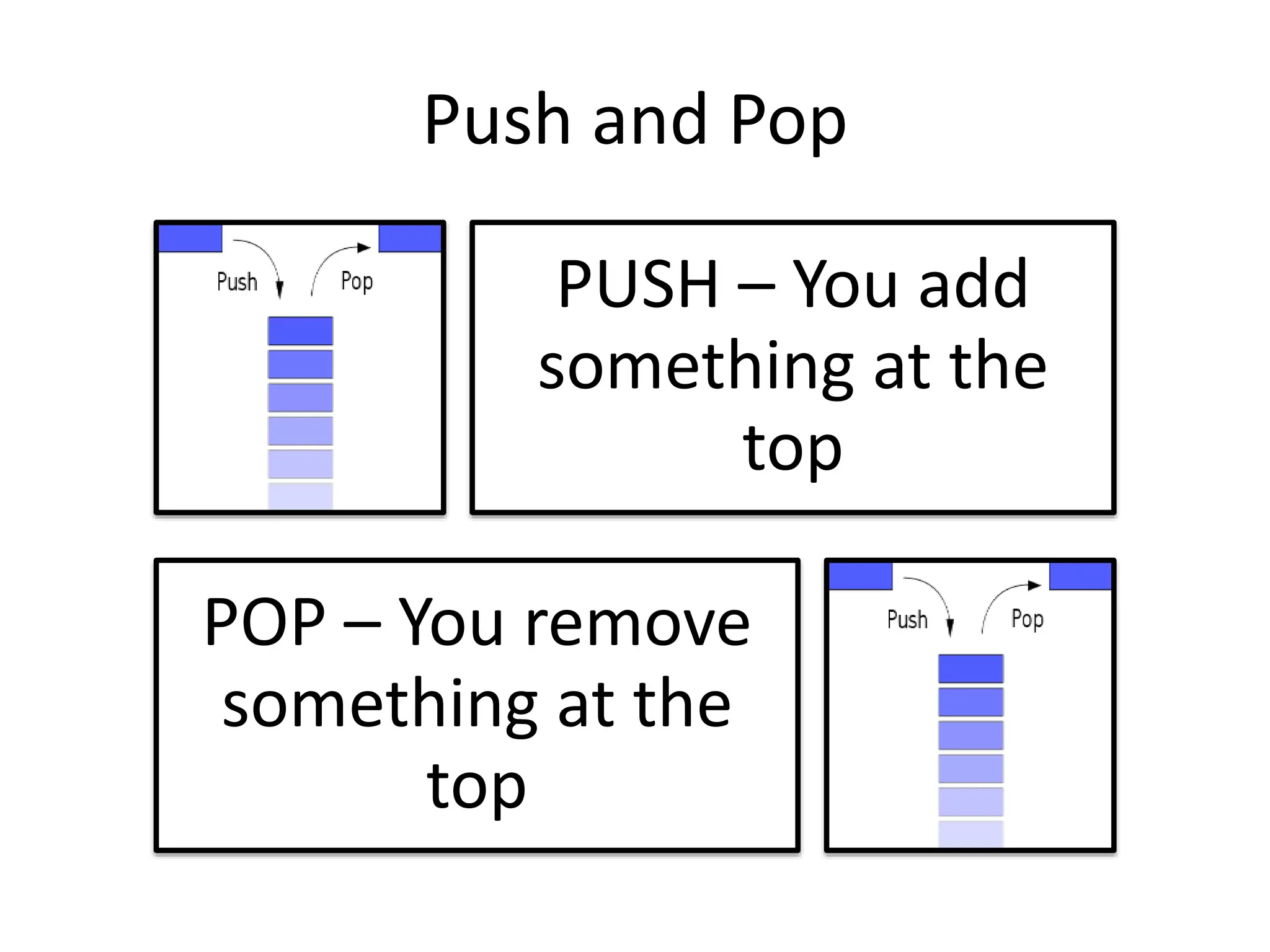
Push and Pop
PUSH – You add
something at the
top
POP – You remove
something at the
top
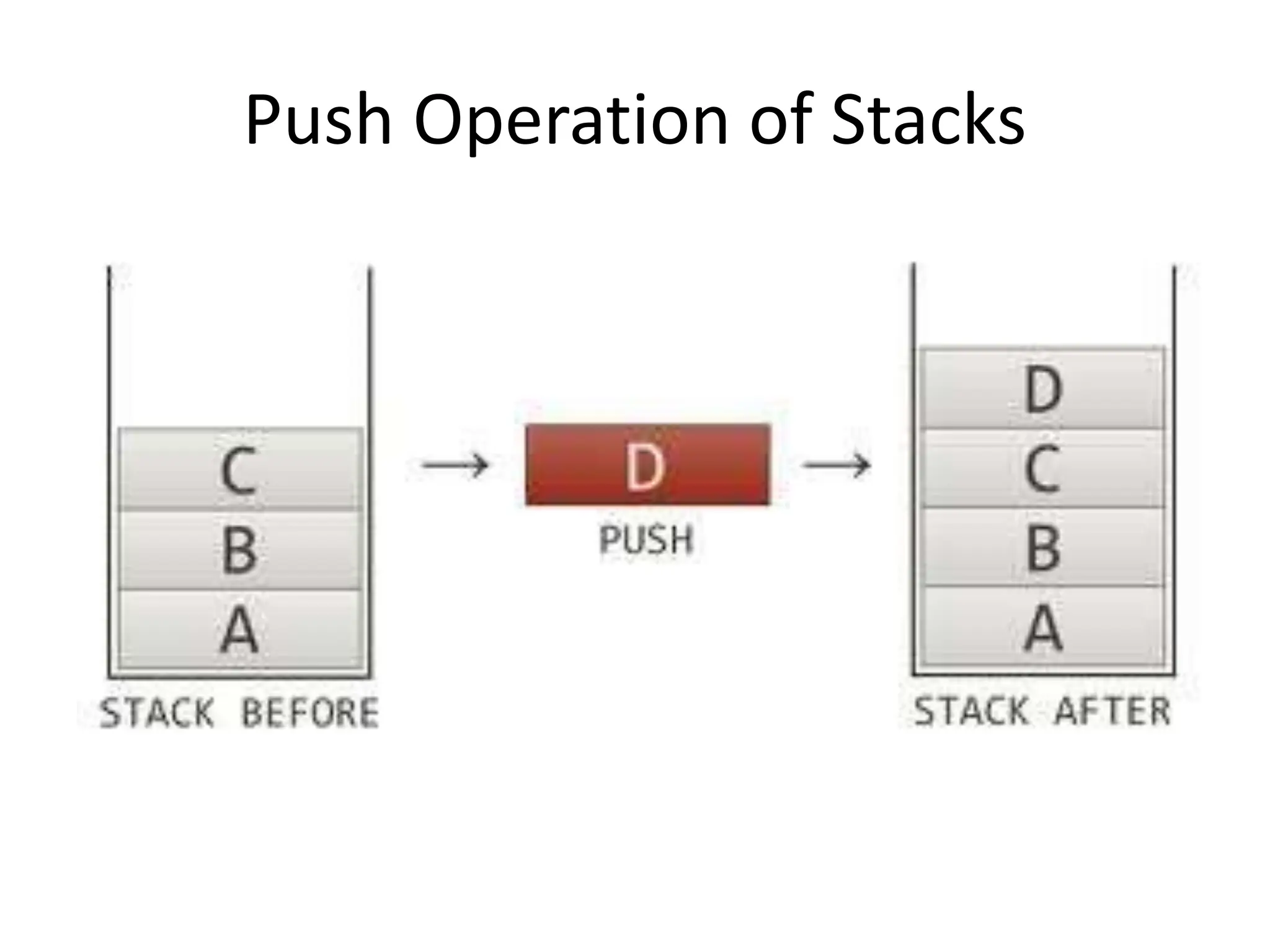
Push Operation of Stacks
Pop Operation
Simple Example
Let us Implement Stacks
First, as usual we need to define some maximum stack
content to put our data
Let us Implement Stacks
Then, we use Class system called “stack”
Let us Implement Stacks
We declare a private inside “stack” class
- arr[MAX] : this is where we put all the data
- top : we assign our “leader” here.
Let us Implement Stacks
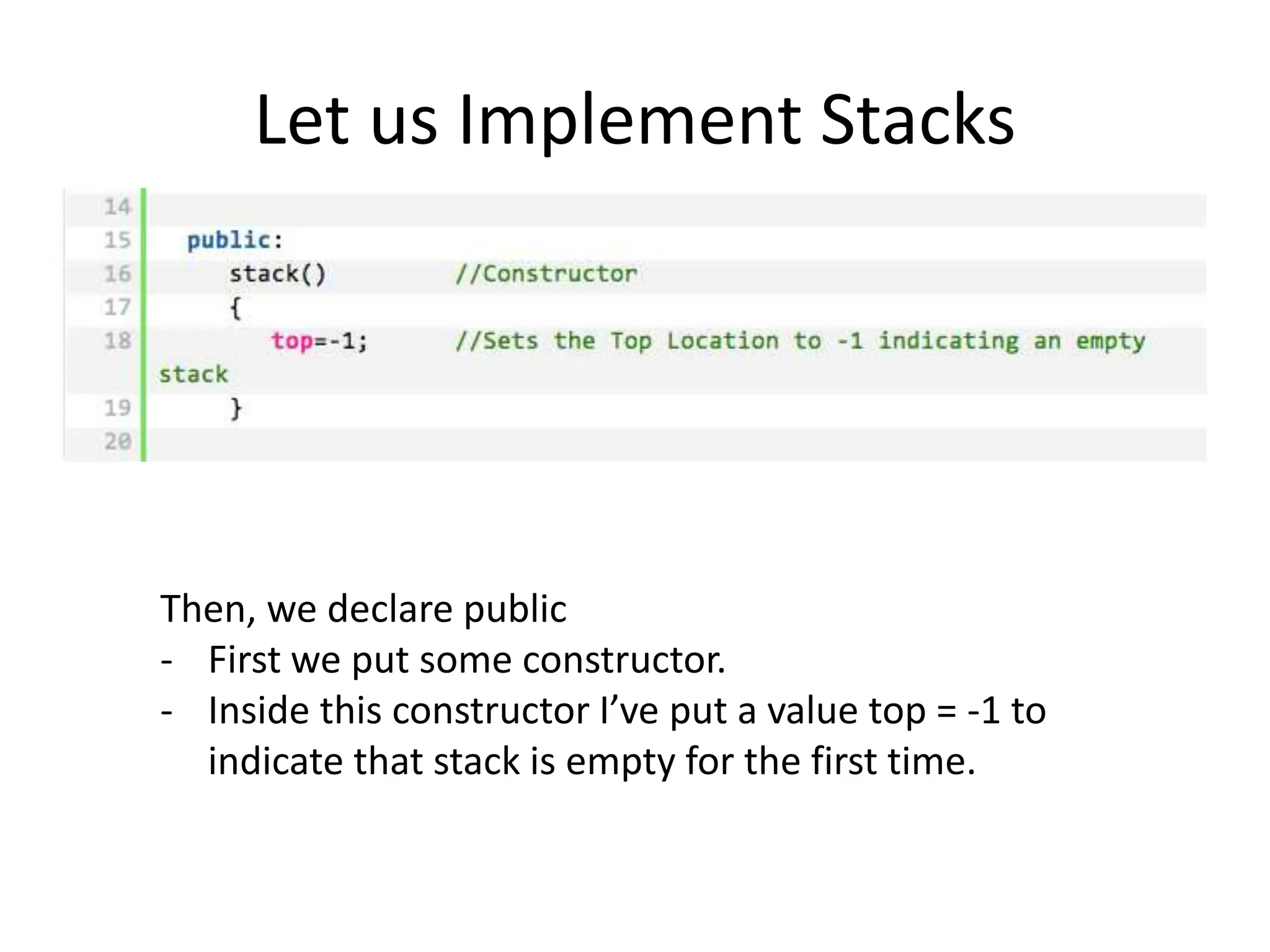
Then, we declare public
- First we put some constructor.
- Inside this constructor I’ve put a value top = -1 to
indicate that stack is empty for the first time.
Let us Implement Stacks
Now, push operation.
- We go through one by one here
Let us Implement Stacks
1st – This is where this operation get a value which is
integer type
So, inside main function, we will call using
“push(40)” for example
So, 40 is an integer
Let us Implement Stacks
Top++, we increment first because this is top
operation, so we updates the current position from -
1 to 0. (the computer always starts with “0” and not
“1”. So, top is 0 right now
Let us Implement Stacks
Then, we check whether top is still lower than MAX.
If the top still lower than MAX, we continue to insert
data at the position according to the top position
arr[0] = 40 (recall that top = 0).
Let us Implement Stacks
If it is not, we create a message to display “Stack
Full”.
Remember to set the top back to top– since we
already add top++ at first line of this function.
Example push(40)
4
2
12
32
54
5
top = 6
top++
- top = 6
(before this top is equal to 5, top = 5)
Example push(40)
4
2
12
32
54
5
top = 6
if(top<MAX)
{
arr[top]=a;
}
- Yes, top is still lower than
MAX which is 10.
- So, arr[6] = 40
(since we receive a = 40)
Example push(40)
212
21
23
40
4
2
12
32
54
5
top = 9
else
{
cout<<"STACK FULL!!"<<endl;
top--;
}
- But if top is equal to 10 (already full after top++),
then we put message STACK FULL, and set it back
to top--
Let us Implement Stacks
Now, pop operation. We use function type integer (not
void)
- We go through one by one here
Let us Implement Stacks
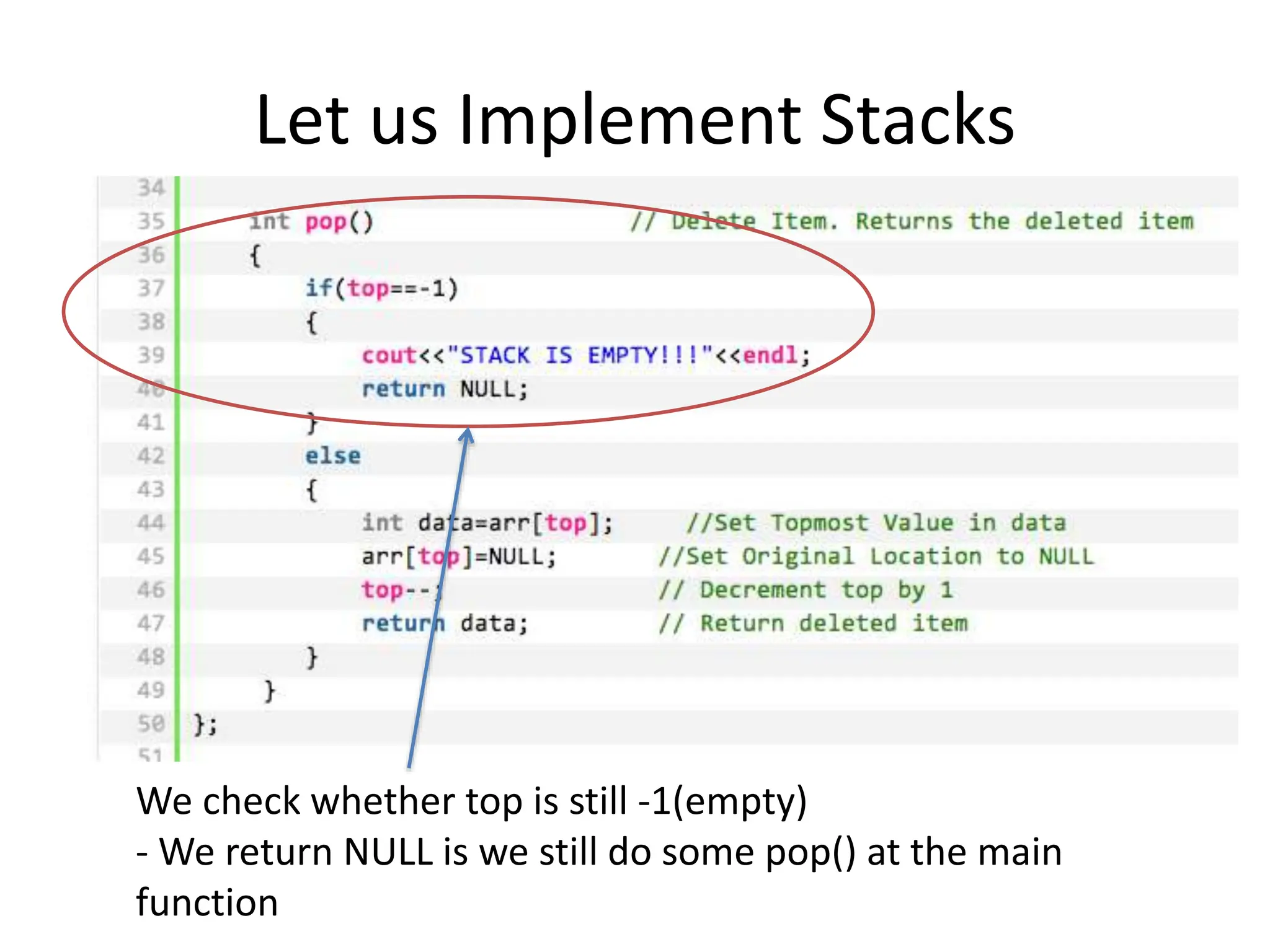
We check whether top is still -1(empty)
- We return NULL is we still do some pop() at the main
function
Let us Implement Stacks
If it is not
- We give any topmost data inside arr[top] to local
variable int data
- Then, we set the arr[top] = NULL since we actually
remove the data
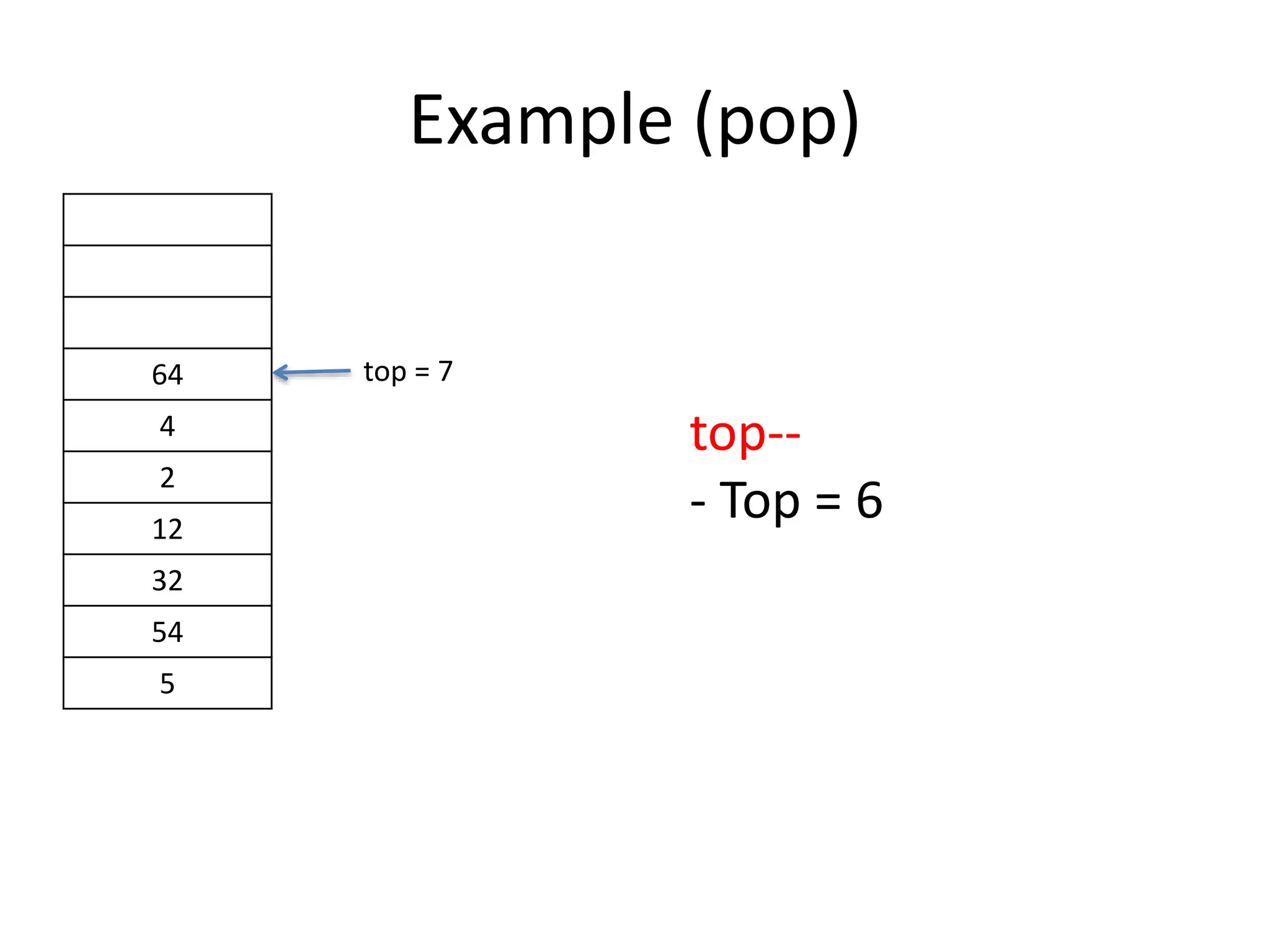
- We set back the top to top--. Example if top = 5, then
top now is 4.
- We will return the int data
Example (pop)
5
64
4
2
12
32
54
5
top = 7
int data = arr[top]
- int data = arr[7]=5
Example (pop)
64
4
2
12
32
54
5
top = 7
arr[top]= NULL
- arr[7] = NOTHING
INSIDE
Example (pop)
64
4
2
12
32
54
5
top = 7
top--
- Top = 6
Example (pop)
64
4
2
12
32
54
5
top = 7
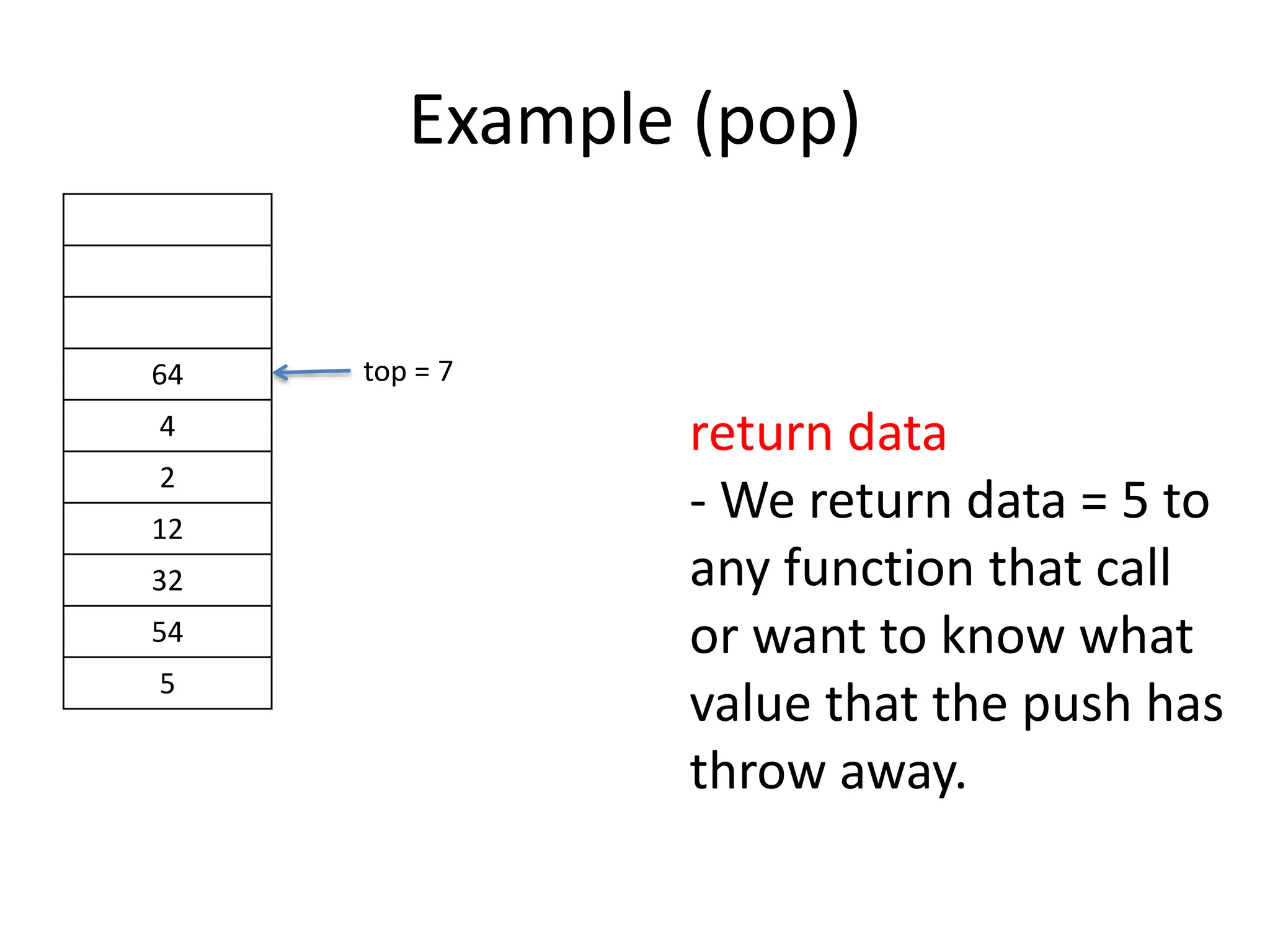
return data
- We return data = 5 to
any function that call
or want to know what
value that the push has
throw away.
FULL SOURCE CODE
#include <iostream>
using namespace std;
#define MAX 10 // MAXIMUM STACK CONTENT
class stack
{
private:
int arr[MAX]; // Contains all the Data
int top; //Contains location of Topmost Data pushed onto Stack
public:
stack() //Constructor
{
top=-1; //Sets the Top Location to -1 indicating an empty
stack
}
void push(int a) // Push ie. Add Value Function
{
top++; // increment to by 1
if(top<MAX)
{
arr[top]=a; //If Stack is Vacant store Value in Array
}
else
{
cout<<"STACK FULL!!"<<endl;
top--;
}
}
int pop() // Delete Item. Returns the deleted
item
{
if(top==-1)
{
cout<<"STACK IS EMPTY!!!"<<endl;
return NULL;
}
else
{
int data=arr[top]; //Set Topmost Value in data
arr[top]=NULL; //Set Original Location to NULL
top--; // Decrement top by 1
return data; // Return deleted item
}
}
};
int main()
{
stack a;
a.push(3);
cout<<"3 is Pushedn";
a.push(10);
cout<<"10 is Pushedn";
a.push(1);
cout<<"1 is Pushednn";
cout<<a.pop()<<" is Poppedn";
return 0;
}
APPLICATION
ALGORITHM CONVERTING
DECIMAL TO BINARY
How it works
• Let say you have a number: 148
Is 148 >= 128? Yes, so the 128 bit must be 1. 148 – 128 =
20, which means we need to find bits worth 20 more.
Is 20 >= 64? No, so the 64 bit must be 0.
Is 20 >= 32? No, so the 32 bit must be 0.
Is 20 >= 16? Yes, so the 16 bit must be 1. 20 – 16 = 4,
which means we need to find bits worth 4 more.
How it works
• Let say you have a number: 148
Is 4 >= 8? No, so the 8 bit must be 0.
Is 4 >= 4? Yes, so the 4 bit must be 1. 4 – 4 = 0, which
means all the rest of the bits must be 0.
How it works
• Let say you have a number: 148
148 = (1 * 128) + (0 * 64) + (0 * 32) + (1 * 16) + (0 * 8) +
(1 * 4) + (0 * 2) + (0 * 1) = 1001 0100
Coding
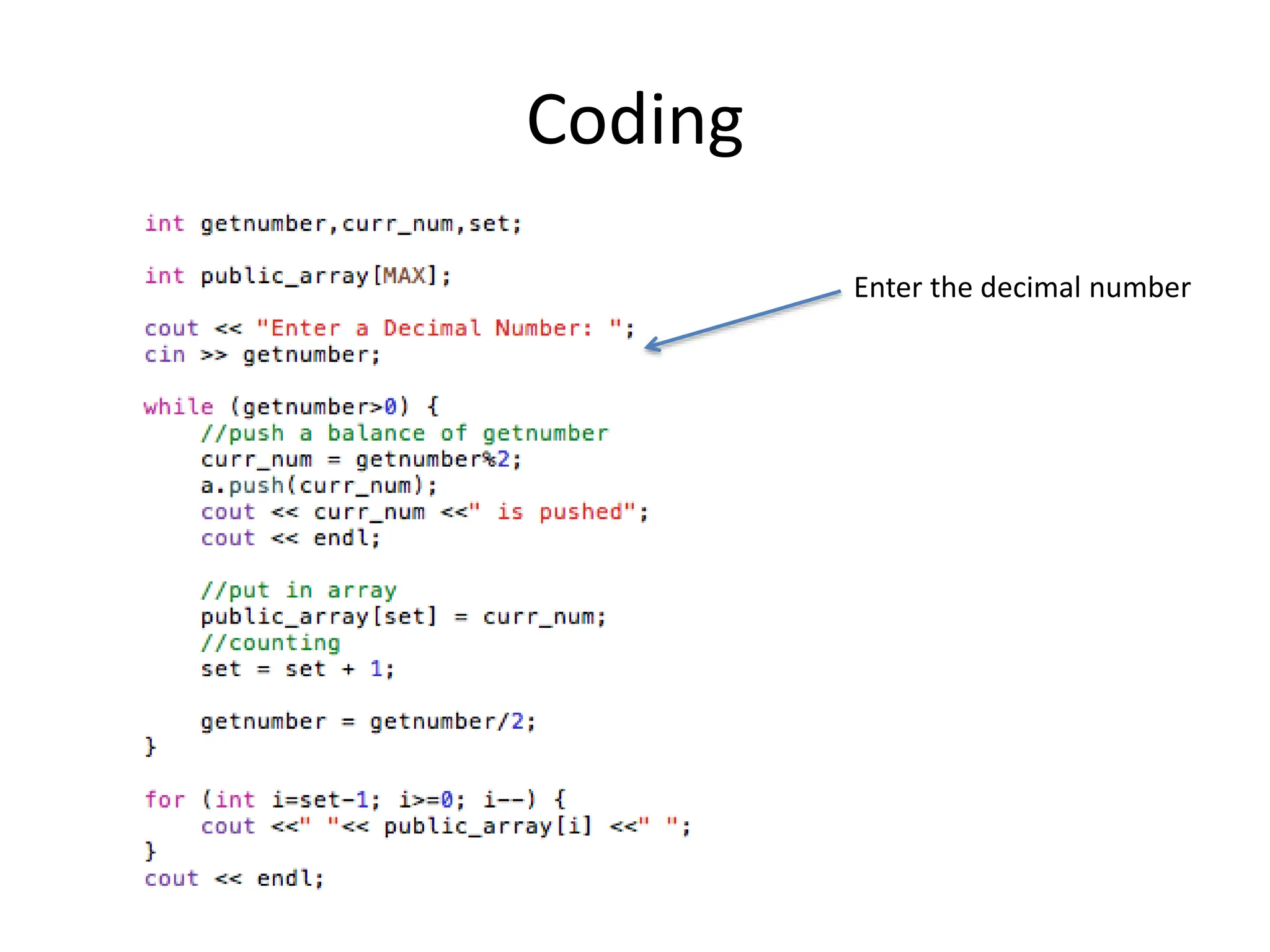
Enter the decimal number
Coding
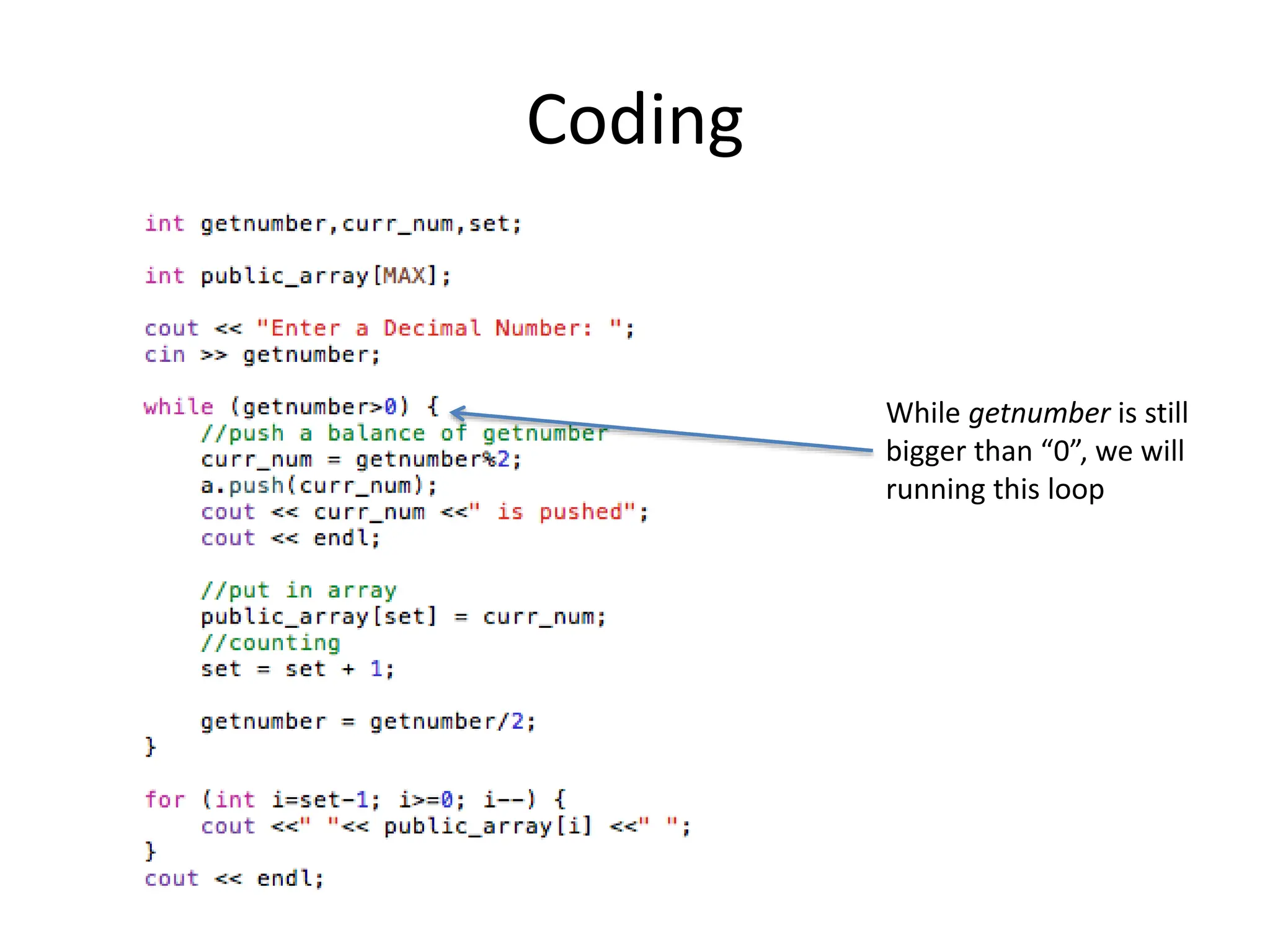
While getnumber is still
bigger than “0”, we will
running this loop
Coding
This is to get the remaining
balance after division
Coding
Push the balance (which is
the balance of division)
into stack
Coding
Save in public array too
Coding
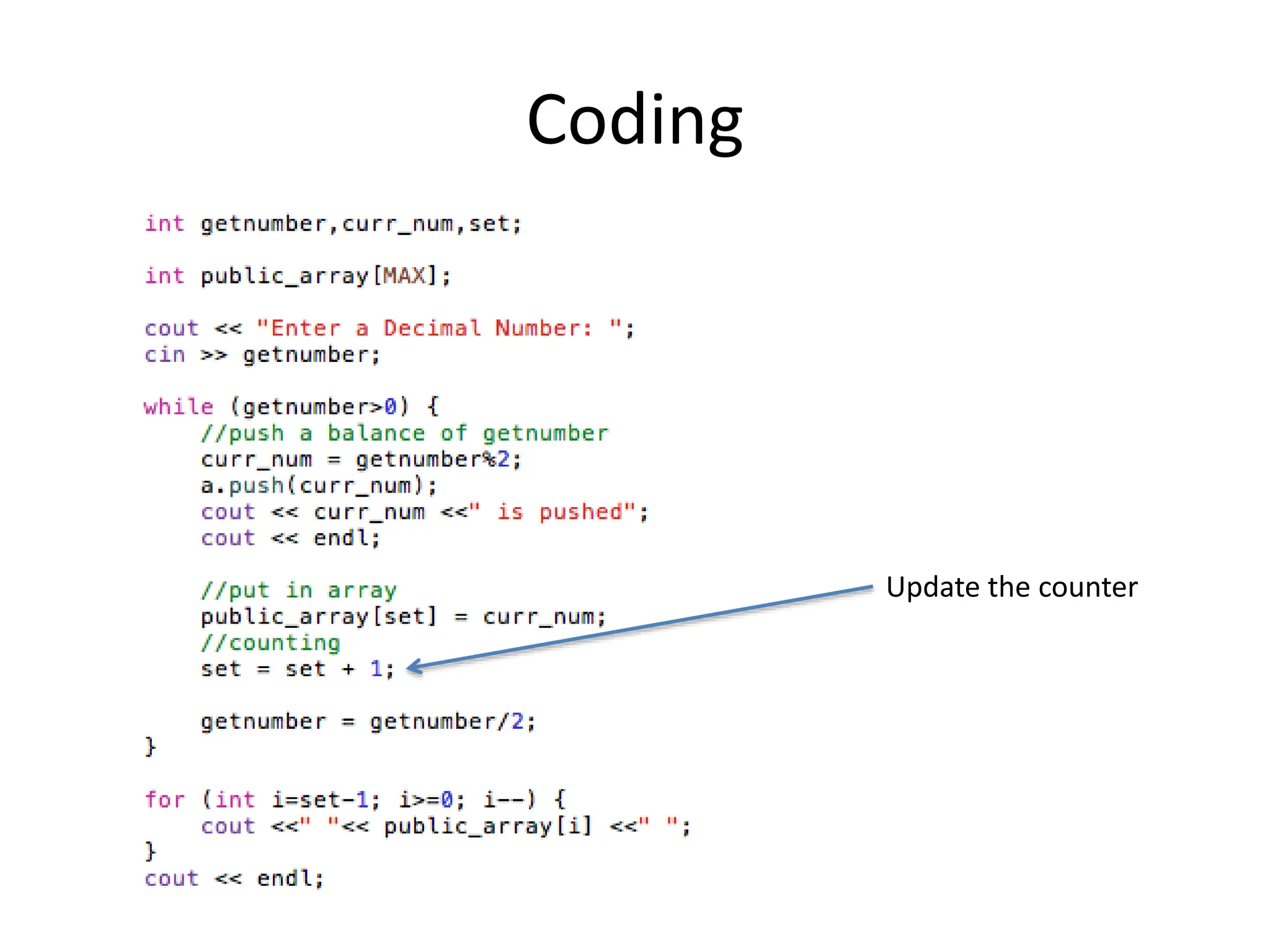
Update the counter
Coding
Get the result of division
using integer (not
double/floating number)
Coding
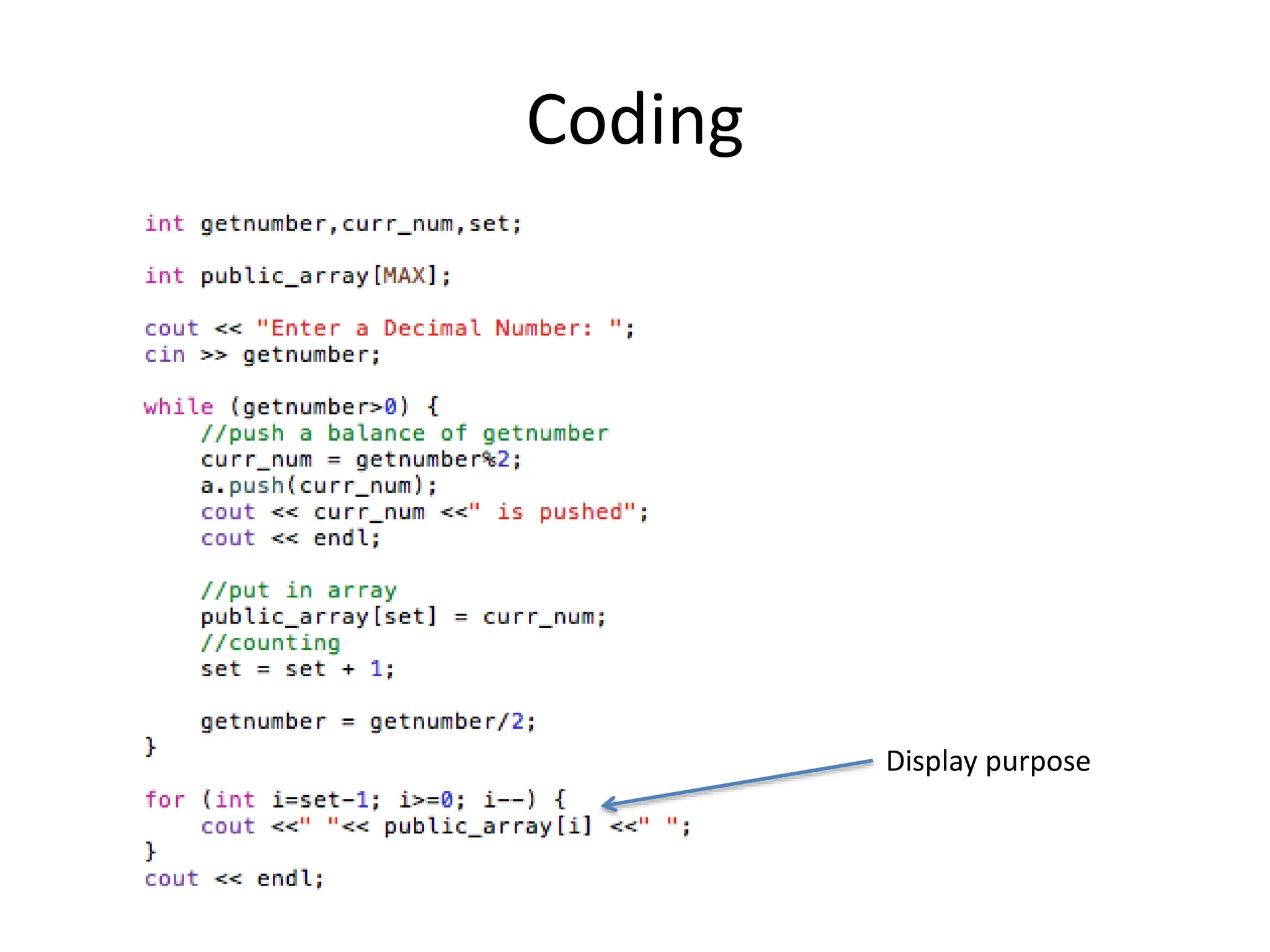
Display purpose
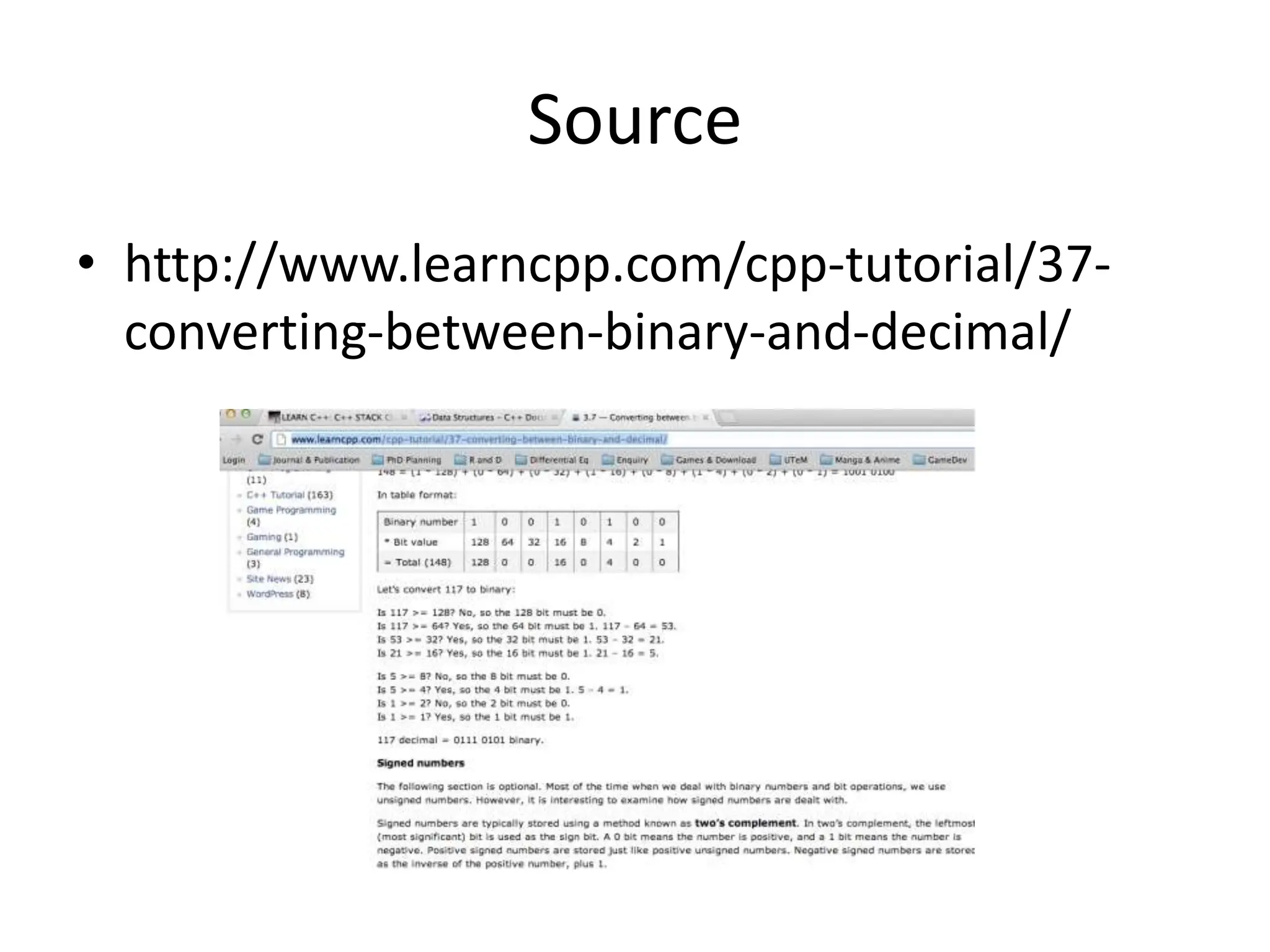
Source
• http://www.learncpp.com/cpp-tutorial/37-
converting-between-binary-and-decimal/
CONVERTING INFIX TO POSTFIX AND
PREFIX NOTATION
What is…
• Infix is
A*B
• Postfix is
AB*
• Prefix is
*AB
Infix to Postfix
• Let use an example
a+b*c-e
Infix to postfix Process
a+b*c-e
a
Postfix String
Our Stack
At first, “a” is found and
inserted into Postfix String
Infix to postfix Process
+
a+b*c-e
a
Postfix String
Our Stack
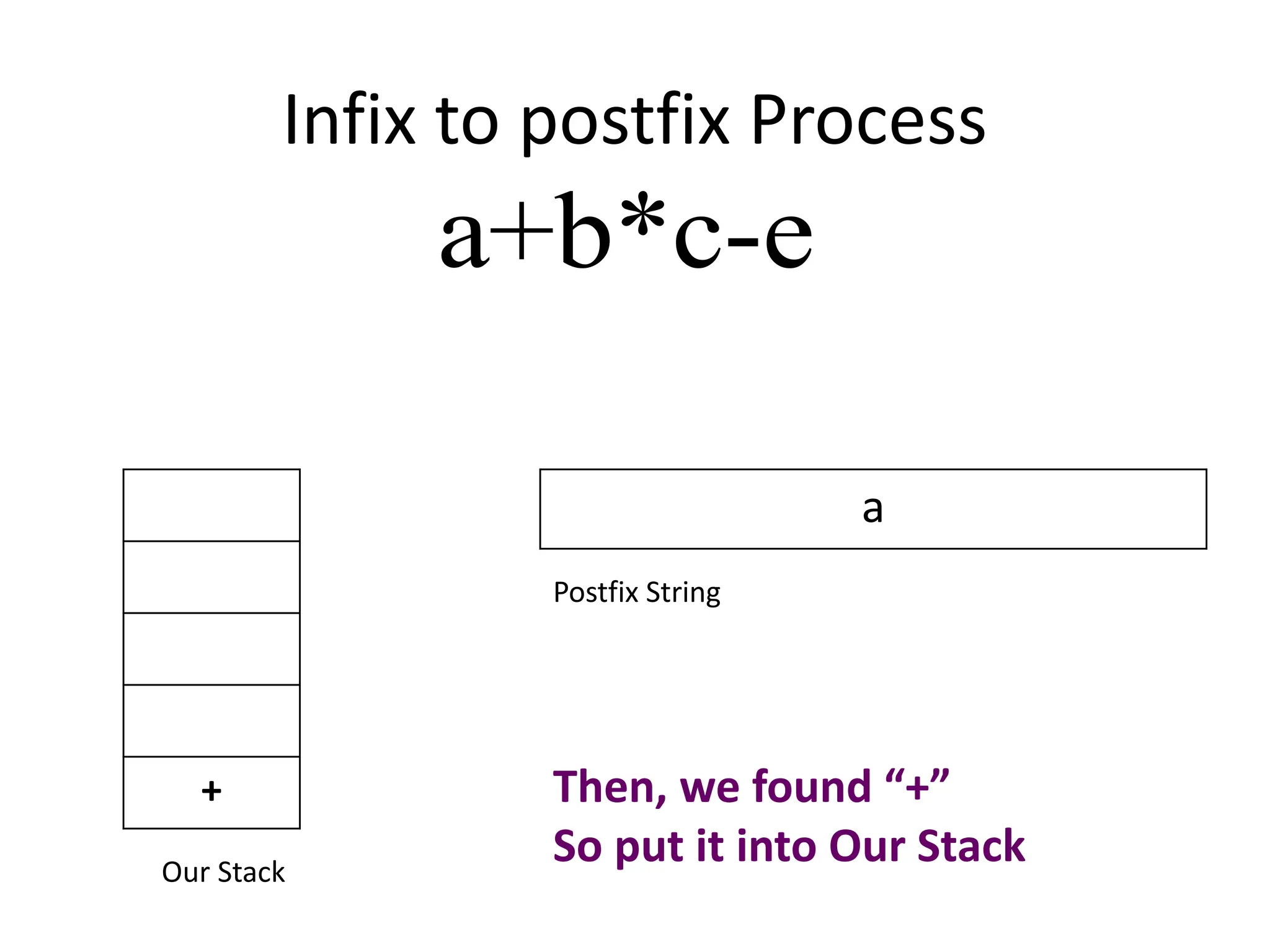
Then, we found “+”
So put it into Our Stack
Infix to postfix Process
+
a+b*c-e
ab
Postfix String
Our Stack
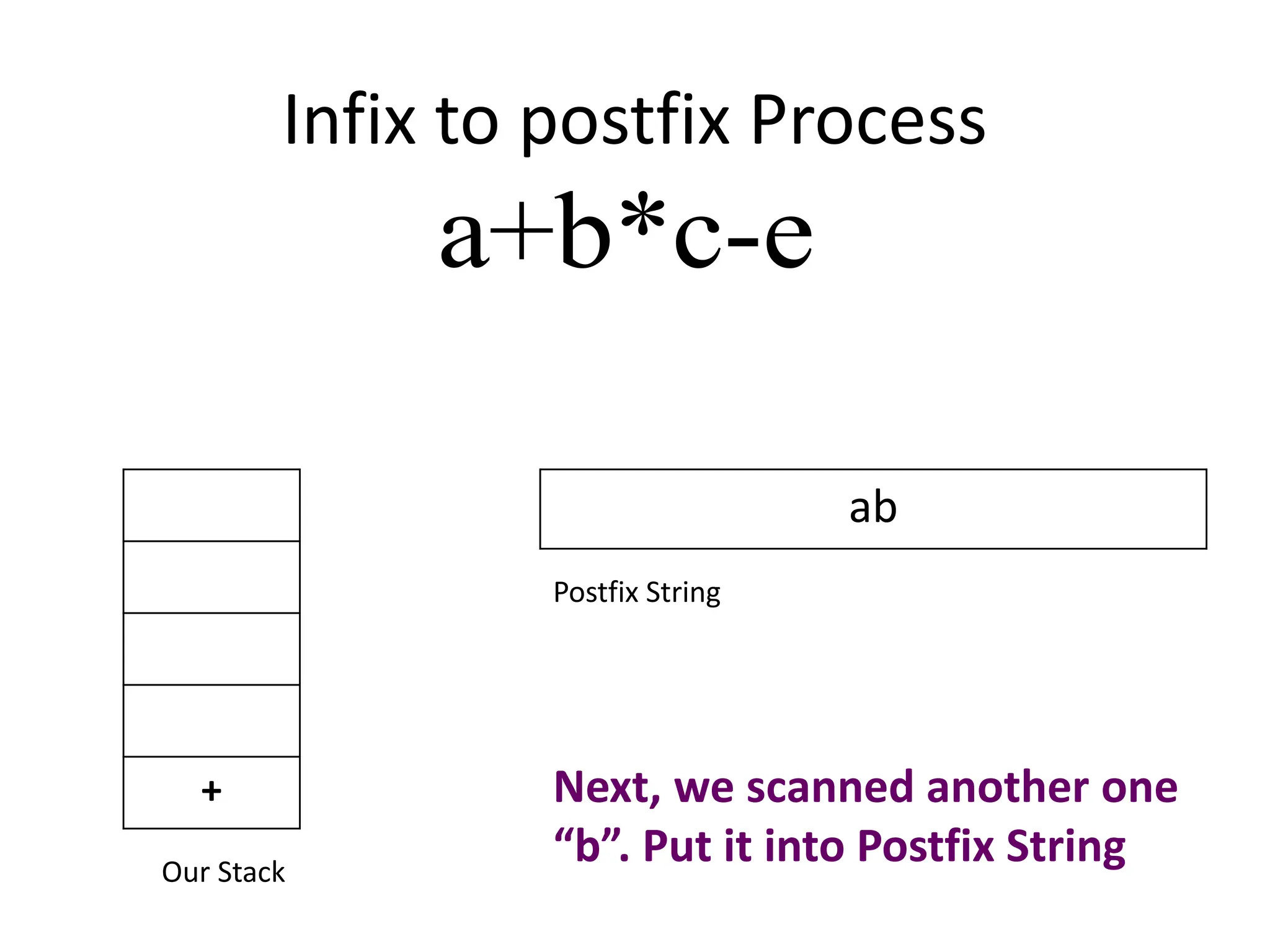
Next, we scanned another one
“b”. Put it into Postfix String
Infix to postfix Process
*
+
a+b*c-e
ab
Postfix String
Our Stack
Then, we found “ * ”. We put
into Our Stack
Infix to postfix Process
*
+
a+b*c-e
abc
Postfix String
Our Stack
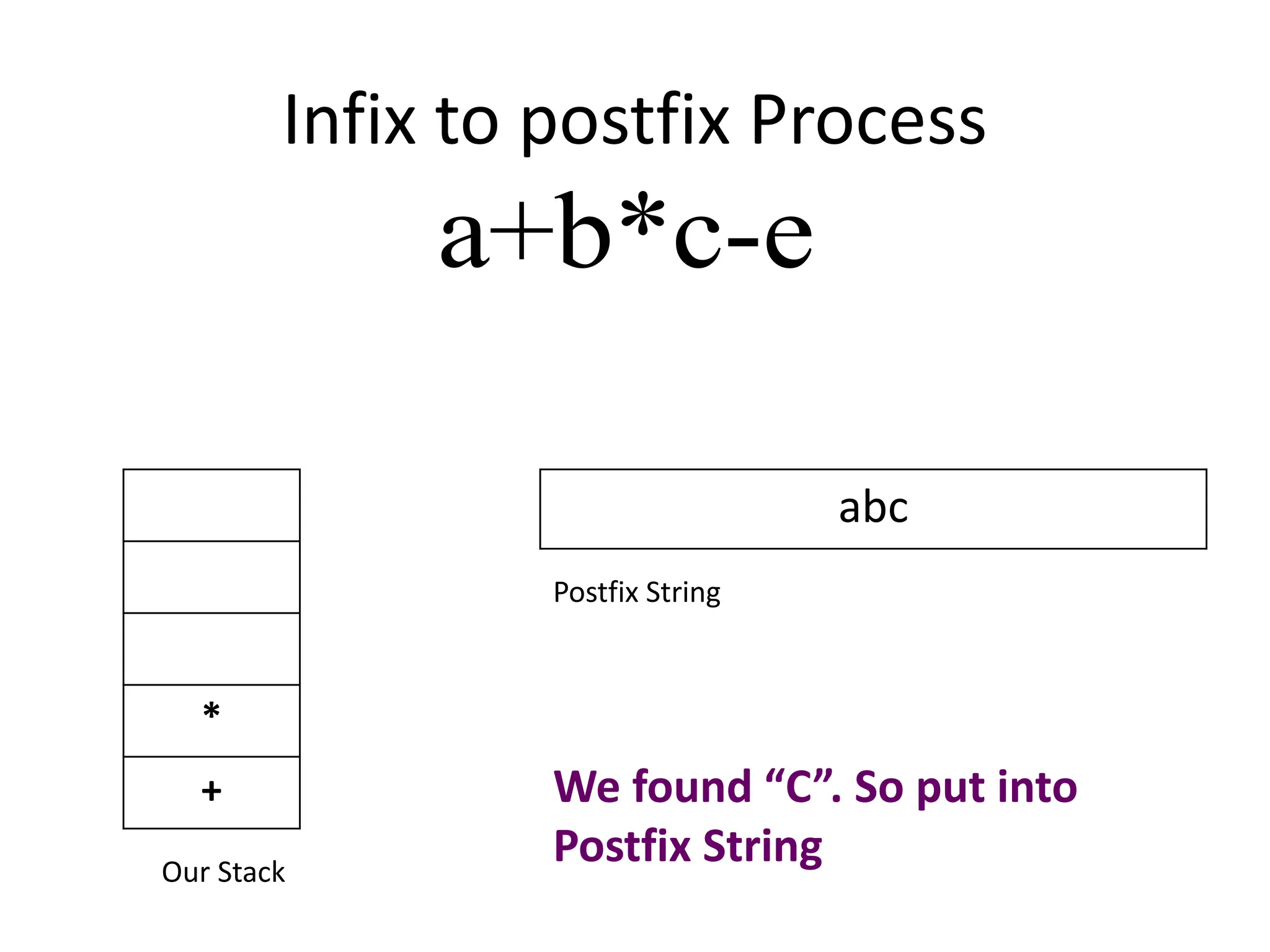
We found “C”. So put into
Postfix String
Infix to postfix Process
-
+
a+b*c-e
abc*
Postfix String
Our Stack
Next character scanned is '-'. The topmost character in
the stack is '*' which has a higher precedence than '-'.
Thus '*' will be popped out from the stack and added to
the Postfix string.
Infix to postfix Process
-
a+b*c-e
abc*+
Postfix String
Our Stack
Even now the stack is not empty. Now the topmost
element of the stack is '+' which has equal priority to '-'.
So pop the '+' from the stack and add it to the Postfix
string. The '-' will be pushed to the stack.
Infix to postfix Process
-
a+b*c-e
abc*+e
Postfix String
Our Stack
We found “e”. So put into
Postfix String
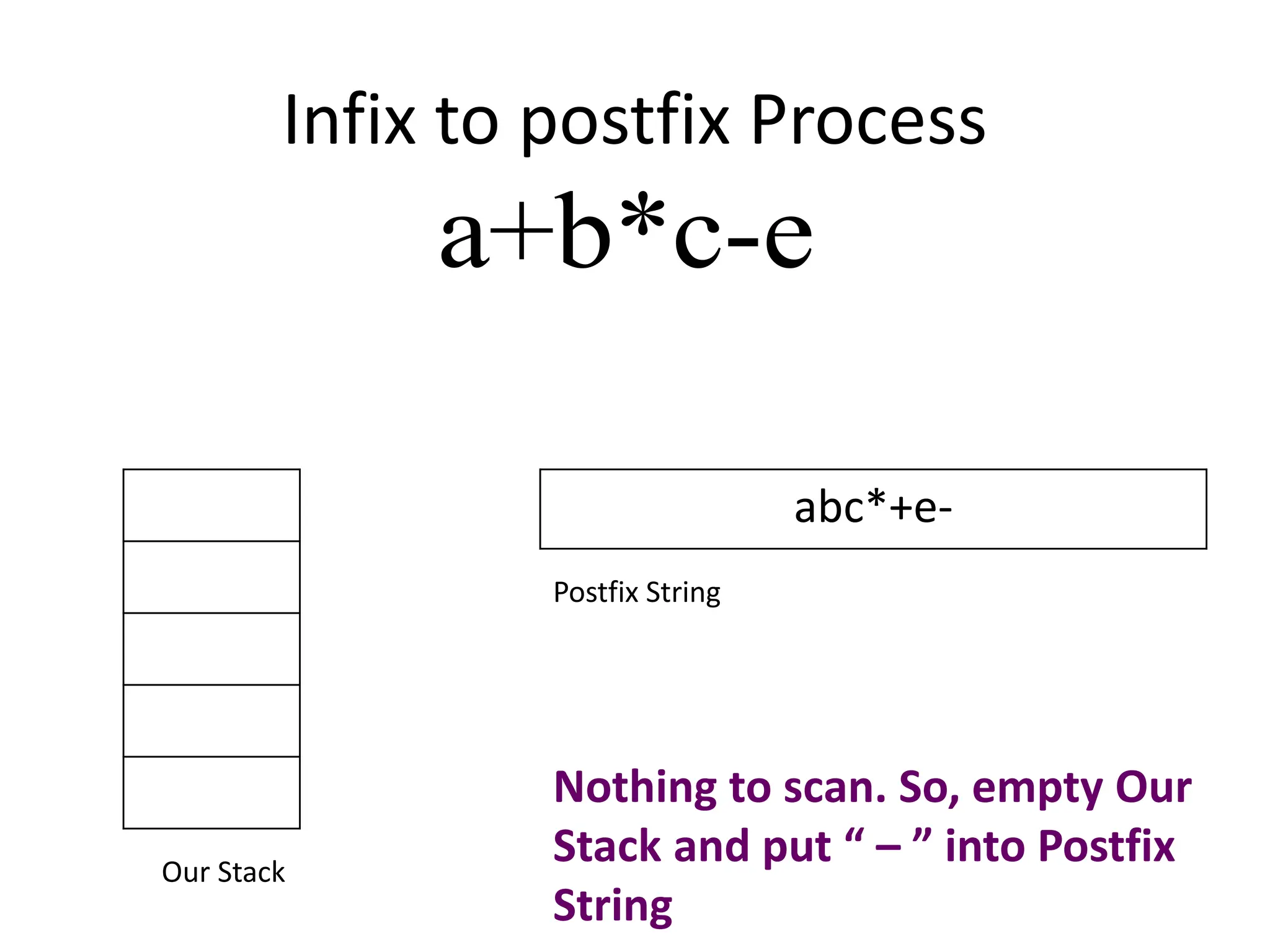
Infix to postfix Process
a+b*c-e
abc*+e-
Postfix String
Our Stack
Nothing to scan. So, empty Our
Stack and put “ – ” into Postfix
String
But
• How to program???
• Let’s code
Our main components
• We must have a function to get a input
• Then, we need to have a function to read it in
character form
• And, we need a function to convert it into
postfix
• Of course last one is we want to display the
output
Our main components
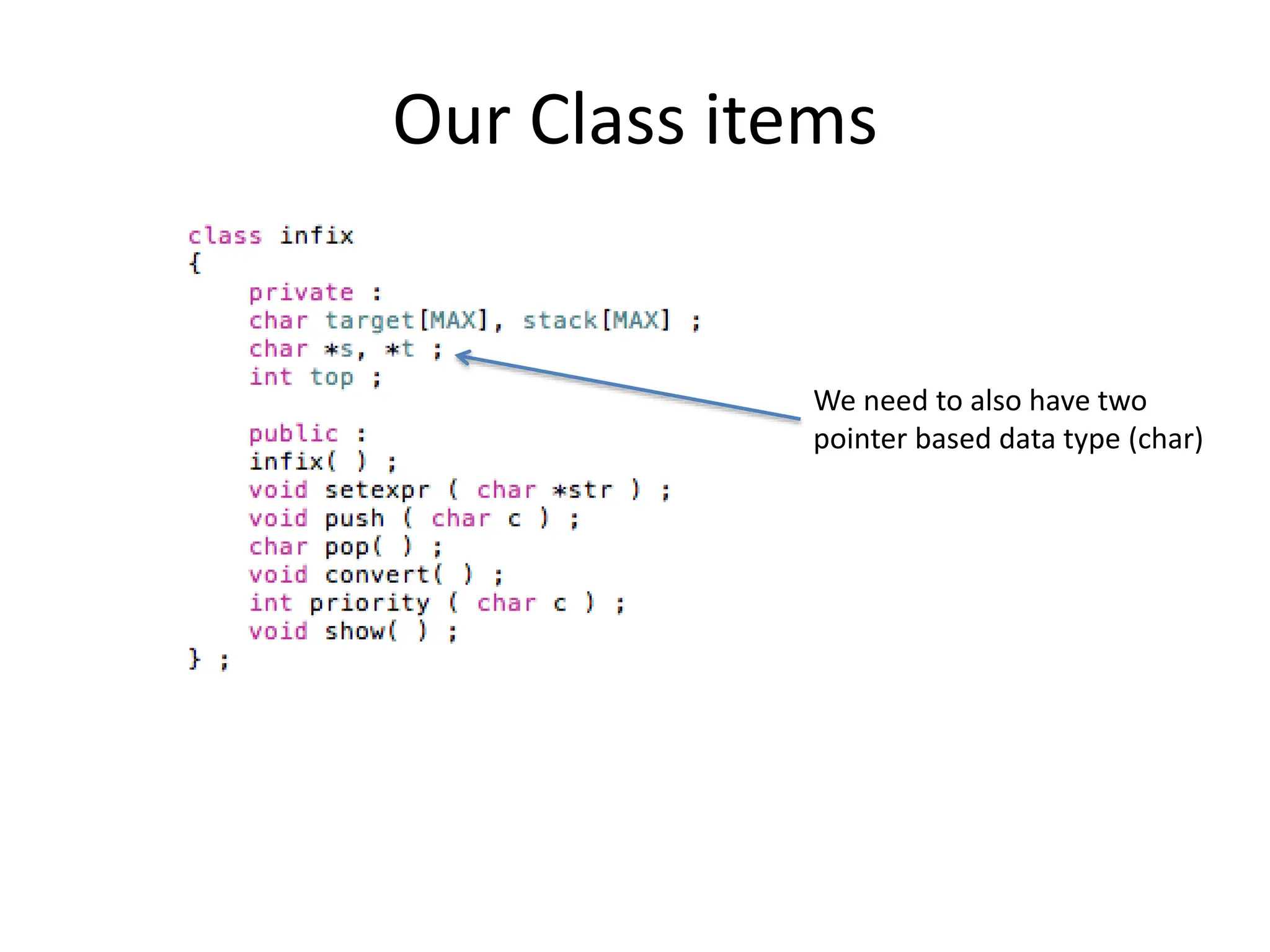
Our Class items
Our Class items
We must have two array of stack
(i) One for the *, / , +, and –
(ii) Another one for alphabetic
Our Class items
We need to also have two
pointer based data type (char)
Our Class items
Set our initial value
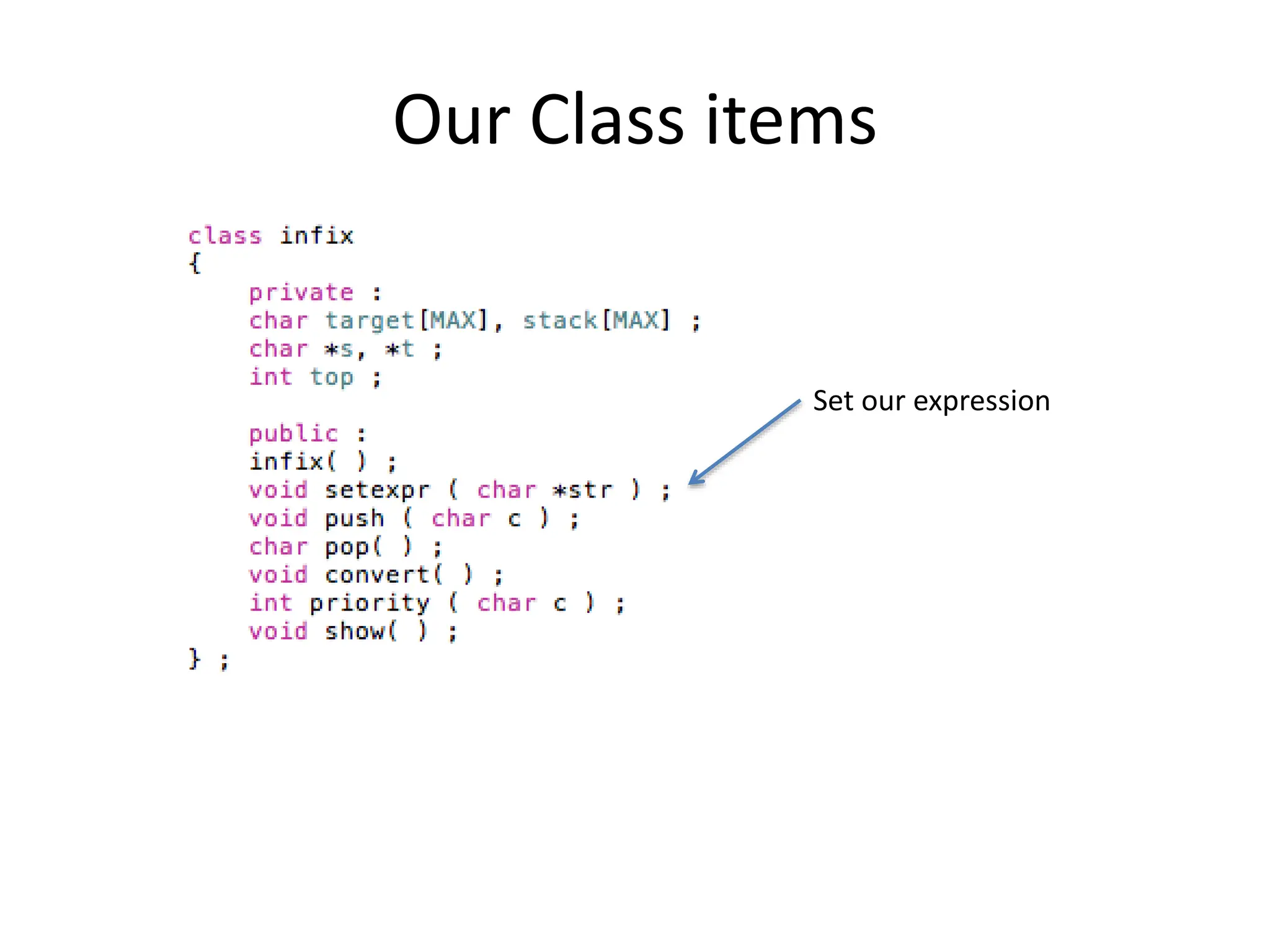
Our Class items
Set our expression
Our Class items
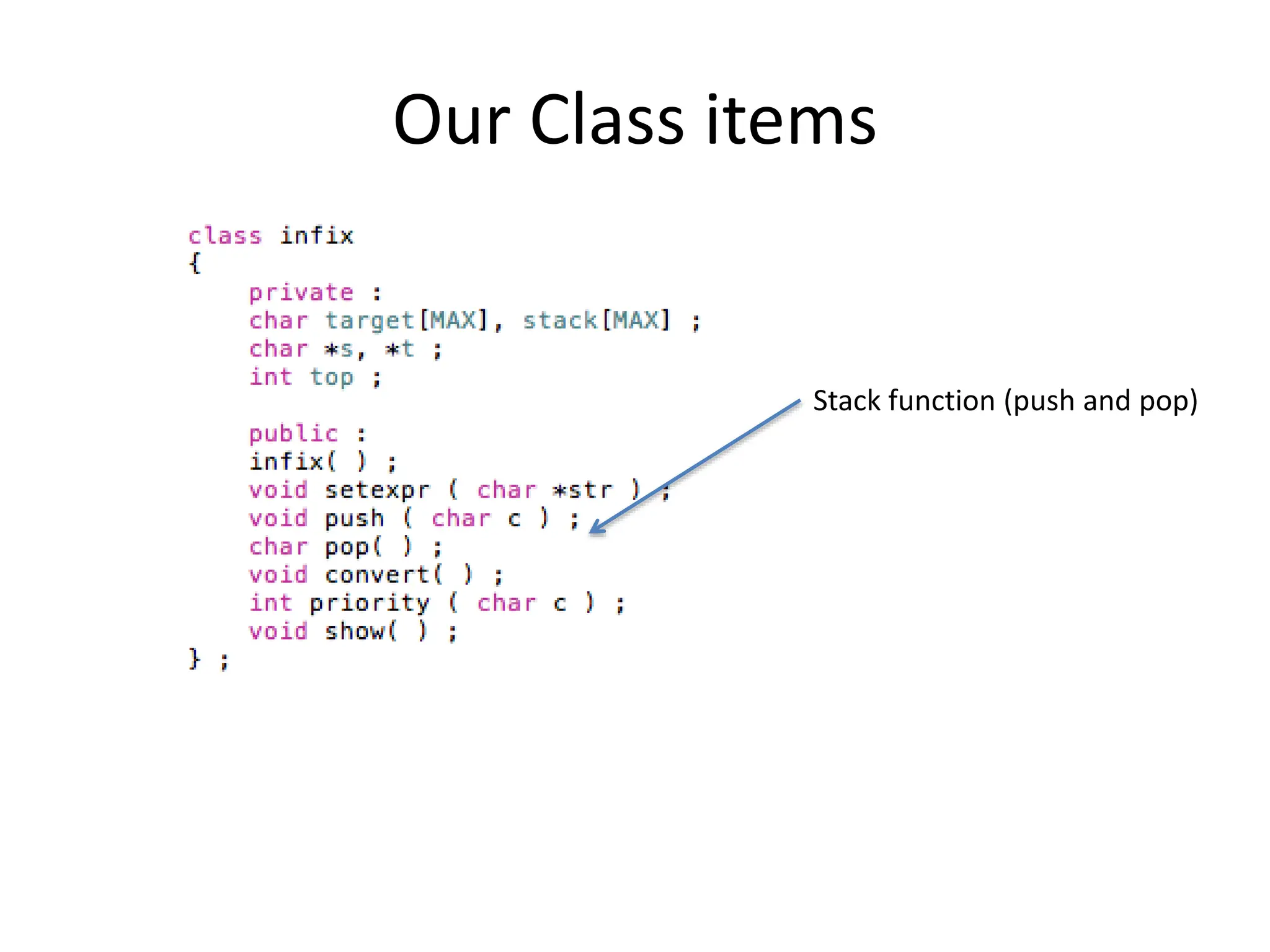
Stack function (push and pop)
Our Class items
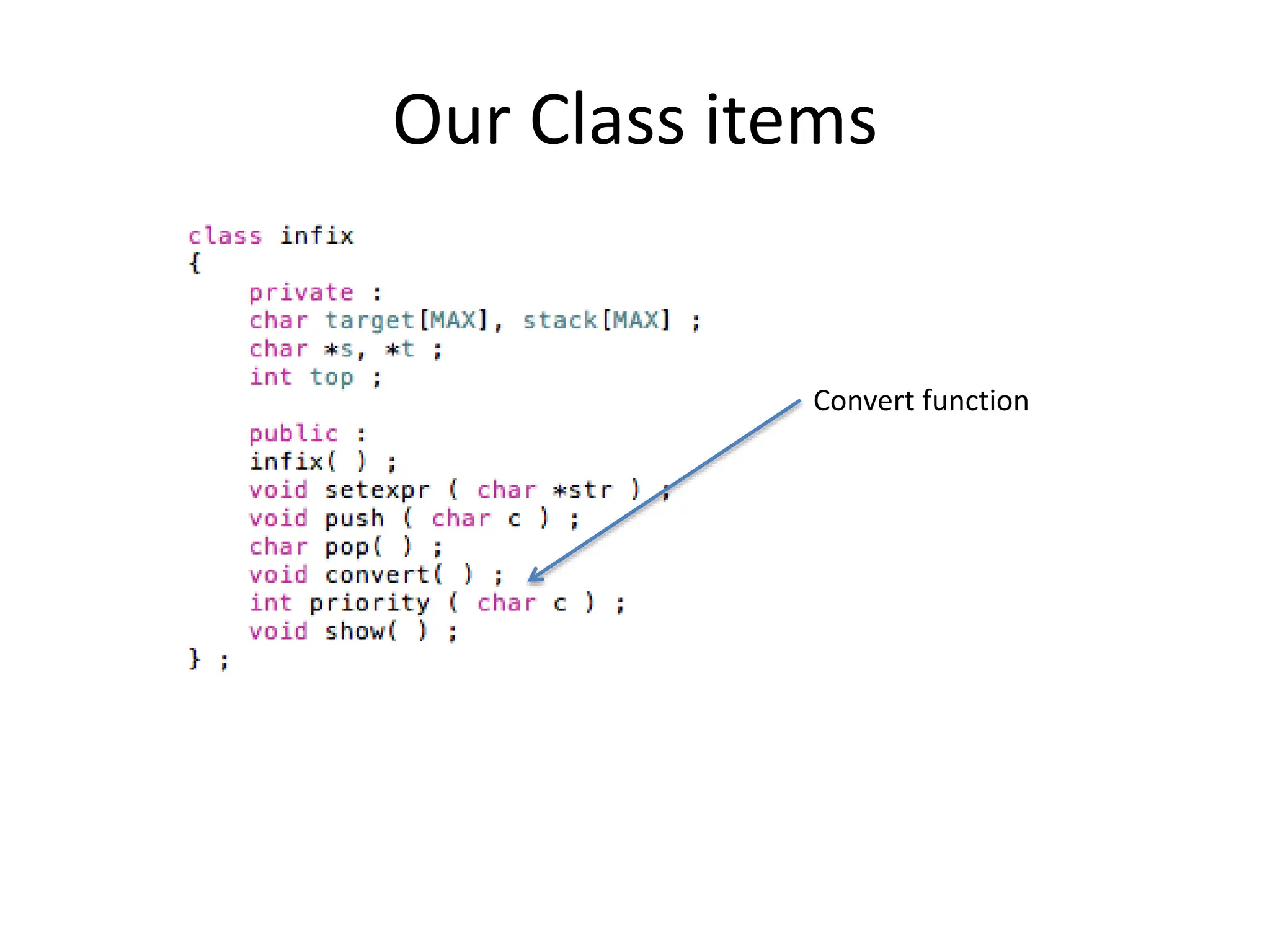
Convert function
Our Class items
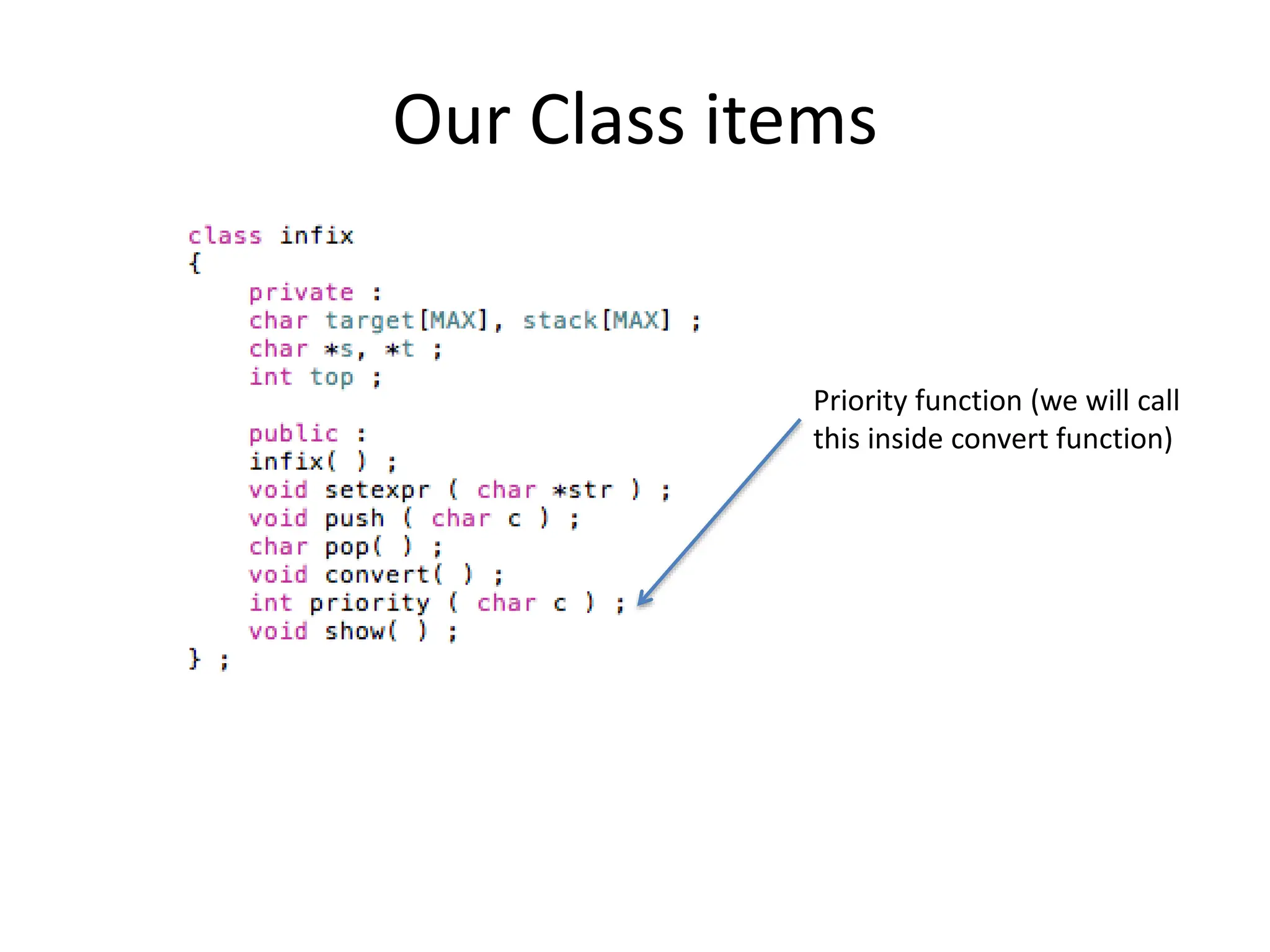
Priority function (we will call
this inside convert function)
CONCLUSION OF IN/PRE/POST-FIX
Source
• http://scriptasylum.com/tutorials/infix_postfi
x/algorithms/infix-postfix/index.htm
• http://electrofriends.com/source-
codes/software-programs/cpp-programs/cpp-
data-structure/c-program-to-convert-an-
expression-from-infix-form-to-postfix-form/
• http://www.cs.man.ac.uk/~pjj/cs212/fix.html
A Legend
The Towers of Hanoi
• In the great temple of Brahma in Benares, on a brass plate
under the dome that marks the center of the world, there are
64 disks of pure gold that the priests carry one at a time
between these diamond needles according to Brahma's
immutable law: No disk may be placed on a smaller disk. In
the begging of the world all 64 disks formed the Tower of
Brahma on one needle. Now, however, the process of transfer
of the tower from one needle to another is in mid course.
When the last disk is finally in place, once again forming the
Tower of Brahma but on a different needle, then will come the
end of the world and all will turn to dust.
The Towers of Hanoi
A Stack-based Application
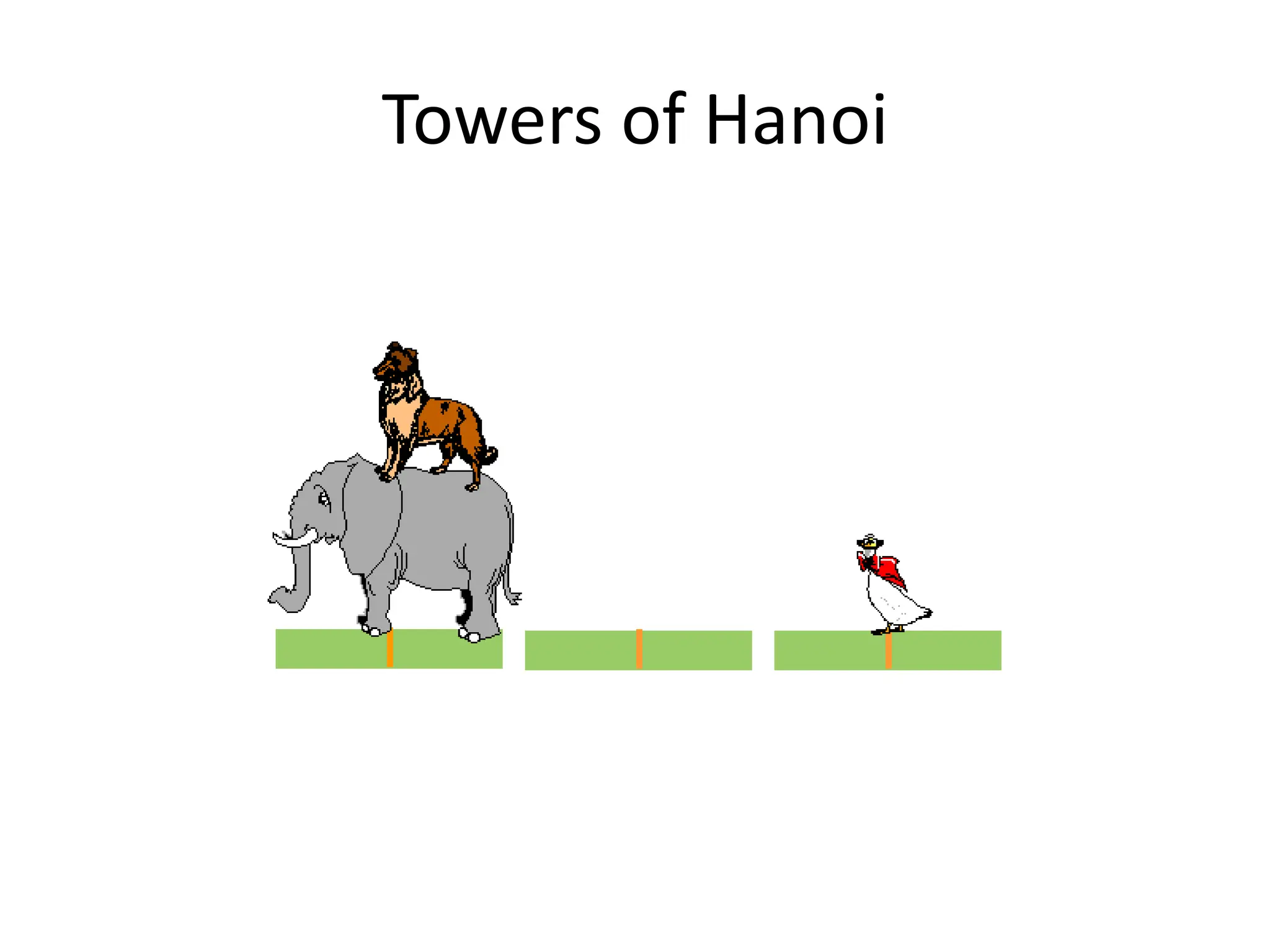
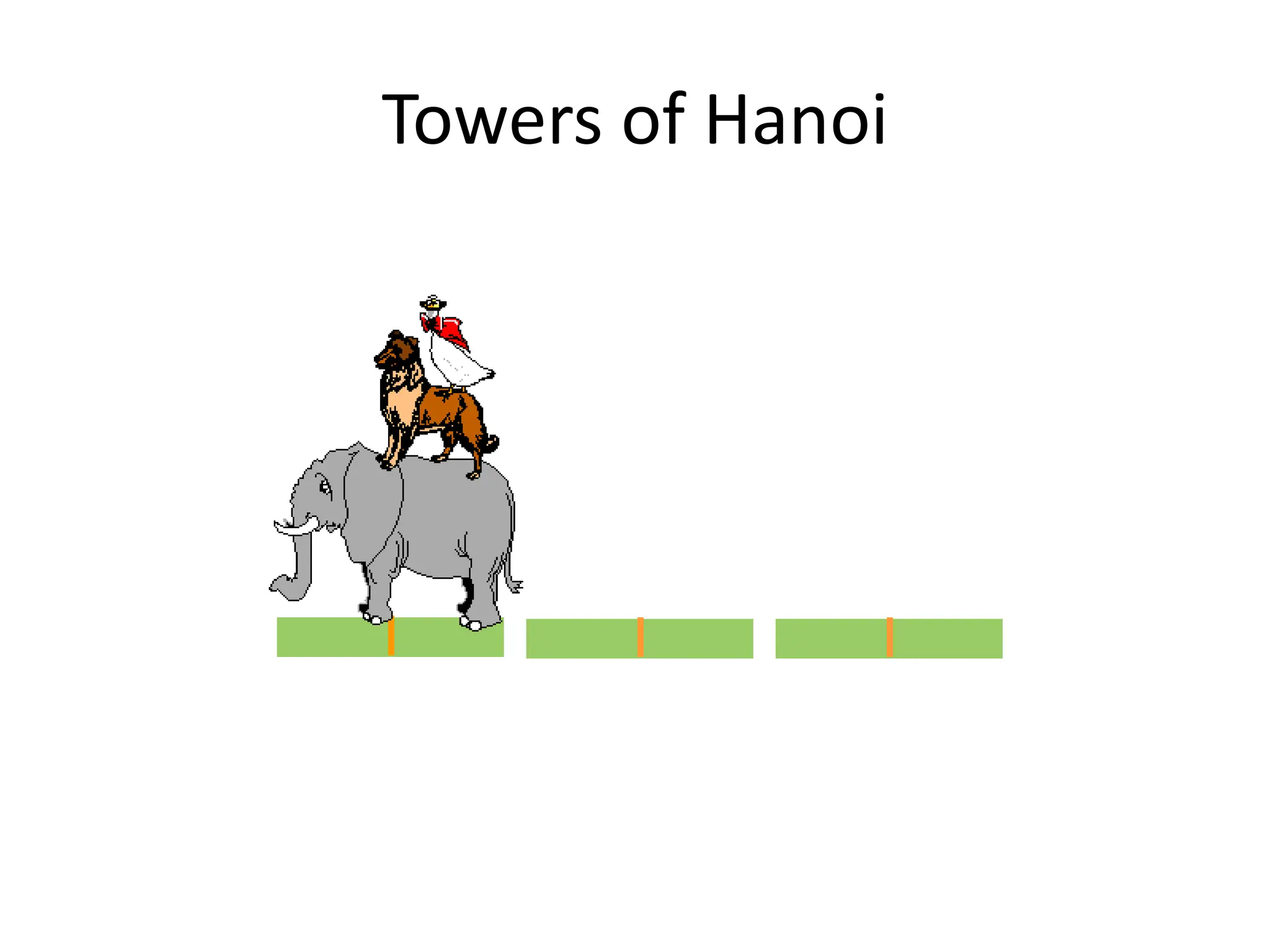
– GIVEN: three poles
– a set of discs on the first pole, discs of different sizes, the smallest
discs at the top
– GOAL: move all the discs from the left pole to the right one.
– CONDITIONS: only one disc may be moved at a time.
– A disc can be placed either on an empty pole or on top of a larger
disc.
Towers of Hanoi
Towers of Hanoi
Towers of Hanoi
Towers of Hanoi
Towers of Hanoi
Towers of Hanoi
Towers of Hanoi
Towers of Hanoi
ADDITION TWO INTEGER NUMBERS
12650891 (1).ppthhhhhhhhhhhhhhhhhhhhhhhhhhhhhhhhhh

12650891 (1).ppthhhhhhhhhhhhhhhhhhhhhhhhhhhhhhhhhh

  • 1.
  • 2.
    This is stacks Adata structure in which the elements are added and removed from the top only; a Last In First Out (LIFO) data structure.
  • 3.
    Why People usestacks? Say you are writing a notepad application. A good use for a stack would be the undo/redo feature. Every time the user enters something, save the state (in this case, the text) on a stack and if you need to reverse something, just pop it off the top of the undo stack and push it onto the redo stack. Stacks are also used for reversing things. If you push something, say a String onto a Stack one character at a time, and then construct a String from the members popped off the Stack, then the String is reversed.
  • 4.
    Last In FirstOut B A D C B A C B A D C B A E D C B A top top top top top A
  • 5.
    Stacks Advantages Advantages Simplest one Easy to implement Fastoperation Insertion/deletion from one place Disadvantages Disadvantages Only can be inserted/removed from the top Problem when accessing “the one that on the top” Recursive Function
  • 6.
  • 7.
    BASIC OPERATION • InitializeStacks –initializes the stack to an empty state • DestroyStack – removes all the elements from the state • IsEmptyStack – Check the stack whether is empty or not • IsFullStack – Check whether the stack is full or not
  • 8.
    Push and Pop PUSH– You add something at the top POP – You remove something at the top
  • 9.
  • 10.
  • 11.
  • 12.
    Let us ImplementStacks First, as usual we need to define some maximum stack content to put our data
  • 13.
    Let us ImplementStacks Then, we use Class system called “stack”
  • 14.
    Let us ImplementStacks We declare a private inside “stack” class - arr[MAX] : this is where we put all the data - top : we assign our “leader” here.
  • 15.
    Let us ImplementStacks Then, we declare public - First we put some constructor. - Inside this constructor I’ve put a value top = -1 to indicate that stack is empty for the first time.
  • 16.
    Let us ImplementStacks Now, push operation. - We go through one by one here
  • 17.
    Let us ImplementStacks 1st – This is where this operation get a value which is integer type So, inside main function, we will call using “push(40)” for example So, 40 is an integer
  • 18.
    Let us ImplementStacks Top++, we increment first because this is top operation, so we updates the current position from - 1 to 0. (the computer always starts with “0” and not “1”. So, top is 0 right now
  • 19.
    Let us ImplementStacks Then, we check whether top is still lower than MAX. If the top still lower than MAX, we continue to insert data at the position according to the top position arr[0] = 40 (recall that top = 0).
  • 20.
    Let us ImplementStacks If it is not, we create a message to display “Stack Full”. Remember to set the top back to top– since we already add top++ at first line of this function.
  • 21.
    Example push(40) 4 2 12 32 54 5 top =6 top++ - top = 6 (before this top is equal to 5, top = 5)
  • 22.
    Example push(40) 4 2 12 32 54 5 top =6 if(top<MAX) { arr[top]=a; } - Yes, top is still lower than MAX which is 10. - So, arr[6] = 40 (since we receive a = 40)
  • 23.
    Example push(40) 212 21 23 40 4 2 12 32 54 5 top =9 else { cout<<"STACK FULL!!"<<endl; top--; } - But if top is equal to 10 (already full after top++), then we put message STACK FULL, and set it back to top--
  • 24.
    Let us ImplementStacks Now, pop operation. We use function type integer (not void) - We go through one by one here
  • 25.
    Let us ImplementStacks We check whether top is still -1(empty) - We return NULL is we still do some pop() at the main function
  • 26.
    Let us ImplementStacks If it is not - We give any topmost data inside arr[top] to local variable int data - Then, we set the arr[top] = NULL since we actually remove the data - We set back the top to top--. Example if top = 5, then top now is 4. - We will return the int data
  • 27.
    Example (pop) 5 64 4 2 12 32 54 5 top =7 int data = arr[top] - int data = arr[7]=5
  • 28.
    Example (pop) 64 4 2 12 32 54 5 top =7 arr[top]= NULL - arr[7] = NOTHING INSIDE
  • 29.
  • 30.
    Example (pop) 64 4 2 12 32 54 5 top =7 return data - We return data = 5 to any function that call or want to know what value that the push has throw away.
  • 31.
  • 32.
    #include <iostream> using namespacestd; #define MAX 10 // MAXIMUM STACK CONTENT class stack { private: int arr[MAX]; // Contains all the Data int top; //Contains location of Topmost Data pushed onto Stack public: stack() //Constructor { top=-1; //Sets the Top Location to -1 indicating an empty stack }
  • 33.
    void push(int a)// Push ie. Add Value Function { top++; // increment to by 1 if(top<MAX) { arr[top]=a; //If Stack is Vacant store Value in Array } else { cout<<"STACK FULL!!"<<endl; top--; } }
  • 34.
    int pop() //Delete Item. Returns the deleted item { if(top==-1) { cout<<"STACK IS EMPTY!!!"<<endl; return NULL; } else { int data=arr[top]; //Set Topmost Value in data arr[top]=NULL; //Set Original Location to NULL top--; // Decrement top by 1 return data; // Return deleted item } } };
  • 35.
    int main() { stack a; a.push(3); cout<<"3is Pushedn"; a.push(10); cout<<"10 is Pushedn"; a.push(1); cout<<"1 is Pushednn"; cout<<a.pop()<<" is Poppedn"; cout<<a.pop()<<" is Poppedn"; cout<<a.pop()<<" is Poppedn"; return 0; }
  • 36.
  • 37.
  • 38.
    How it works •Let say you have a number: 148 Is 148 >= 128? Yes, so the 128 bit must be 1. 148 – 128 = 20, which means we need to find bits worth 20 more. Is 20 >= 64? No, so the 64 bit must be 0. Is 20 >= 32? No, so the 32 bit must be 0. Is 20 >= 16? Yes, so the 16 bit must be 1. 20 – 16 = 4, which means we need to find bits worth 4 more.
  • 39.
    How it works •Let say you have a number: 148 Is 4 >= 8? No, so the 8 bit must be 0. Is 4 >= 4? Yes, so the 4 bit must be 1. 4 – 4 = 0, which means all the rest of the bits must be 0.
  • 40.
    How it works •Let say you have a number: 148 148 = (1 * 128) + (0 * 64) + (0 * 32) + (1 * 16) + (0 * 8) + (1 * 4) + (0 * 2) + (0 * 1) = 1001 0100
  • 41.
  • 42.
    Coding While getnumber isstill bigger than “0”, we will running this loop
  • 43.
    Coding This is toget the remaining balance after division
  • 44.
    Coding Push the balance(which is the balance of division) into stack
  • 45.
  • 46.
  • 47.
    Coding Get the resultof division using integer (not double/floating number)
  • 48.
  • 49.
  • 50.
    CONVERTING INFIX TOPOSTFIX AND PREFIX NOTATION
  • 51.
    What is… • Infixis A*B • Postfix is AB* • Prefix is *AB
  • 52.
    Infix to Postfix •Let use an example a+b*c-e
  • 53.
    Infix to postfixProcess a+b*c-e a Postfix String Our Stack At first, “a” is found and inserted into Postfix String
  • 54.
    Infix to postfixProcess + a+b*c-e a Postfix String Our Stack Then, we found “+” So put it into Our Stack
  • 55.
    Infix to postfixProcess + a+b*c-e ab Postfix String Our Stack Next, we scanned another one “b”. Put it into Postfix String
  • 56.
    Infix to postfixProcess * + a+b*c-e ab Postfix String Our Stack Then, we found “ * ”. We put into Our Stack
  • 57.
    Infix to postfixProcess * + a+b*c-e abc Postfix String Our Stack We found “C”. So put into Postfix String
  • 58.
    Infix to postfixProcess - + a+b*c-e abc* Postfix String Our Stack Next character scanned is '-'. The topmost character in the stack is '*' which has a higher precedence than '-'. Thus '*' will be popped out from the stack and added to the Postfix string.
  • 59.
    Infix to postfixProcess - a+b*c-e abc*+ Postfix String Our Stack Even now the stack is not empty. Now the topmost element of the stack is '+' which has equal priority to '-'. So pop the '+' from the stack and add it to the Postfix string. The '-' will be pushed to the stack.
  • 60.
    Infix to postfixProcess - a+b*c-e abc*+e Postfix String Our Stack We found “e”. So put into Postfix String
  • 61.
    Infix to postfixProcess a+b*c-e abc*+e- Postfix String Our Stack Nothing to scan. So, empty Our Stack and put “ – ” into Postfix String
  • 62.
    But • How toprogram??? • Let’s code
  • 63.
    Our main components •We must have a function to get a input • Then, we need to have a function to read it in character form • And, we need a function to convert it into postfix • Of course last one is we want to display the output
  • 64.
  • 65.
  • 66.
    Our Class items Wemust have two array of stack (i) One for the *, / , +, and – (ii) Another one for alphabetic
  • 67.
    Our Class items Weneed to also have two pointer based data type (char)
  • 68.
    Our Class items Setour initial value
  • 69.
    Our Class items Setour expression
  • 70.
    Our Class items Stackfunction (push and pop)
  • 71.
  • 72.
    Our Class items Priorityfunction (we will call this inside convert function)
  • 73.
  • 74.
  • 75.
    A Legend The Towersof Hanoi • In the great temple of Brahma in Benares, on a brass plate under the dome that marks the center of the world, there are 64 disks of pure gold that the priests carry one at a time between these diamond needles according to Brahma's immutable law: No disk may be placed on a smaller disk. In the begging of the world all 64 disks formed the Tower of Brahma on one needle. Now, however, the process of transfer of the tower from one needle to another is in mid course. When the last disk is finally in place, once again forming the Tower of Brahma but on a different needle, then will come the end of the world and all will turn to dust.
  • 76.
    The Towers ofHanoi A Stack-based Application – GIVEN: three poles – a set of discs on the first pole, discs of different sizes, the smallest discs at the top – GOAL: move all the discs from the left pole to the right one. – CONDITIONS: only one disc may be moved at a time. – A disc can be placed either on an empty pole or on top of a larger disc.
  • 77.
  • 78.
  • 79.
  • 80.
  • 81.
  • 82.
  • 83.
  • 84.
  • 85.