Leadership
Agenda
– Introduction
– Three traits every successful leader must have
– Leadership styles

Trainings by Vidya Bhagwat
Leadership Skills
• Leadership skills are the tools, behaviours, and capabilities
that a person needs in order to be successful at motivating
and directing others.
• Yet true leadership skills involve something more; the ability
to help people grow in their own abilities. It can be said that
the most successful leaders are those that drive others to
achieve their own success.
Trainings by Vidya Bhagwat
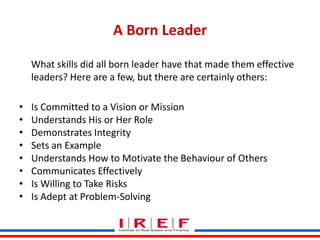
A Born Leader
What skills did all born leader have that made them effective
leaders? Here are a few, but there are certainly others:
•
•
•
•
•
•
•
•

Is Committed to a Vision or Mission
Understands His or Her Role
Demonstrates Integrity
Sets an Example
Understands How to Motivate the Behaviour of Others
Communicates Effectively
Trainings by Vidya Bhagwat
Is Willing to Take Risks
Is Adept at Problem-Solving
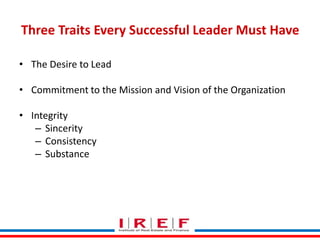
Three Traits Every Successful Leader Must Have
• The Desire to Lead
• Commitment to the Mission and Vision of the Organization
• Integrity
– Sincerity
– Consistency
– Substance
Trainings by Vidya Bhagwat
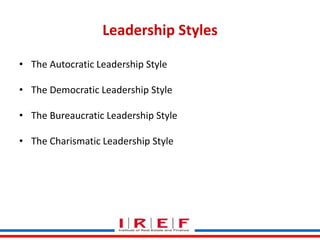
Leadership Styles
• The Autocratic Leadership Style
• The Democratic Leadership Style
• The Bureaucratic Leadership Style
• The Charismatic Leadership Style

Trainings by Vidya Bhagwat
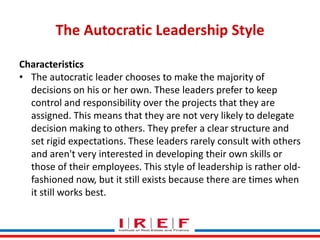
The Autocratic Leadership Style
Characteristics
• The autocratic leader chooses to make the majority of
decisions on his or her own. These leaders prefer to keep
control and responsibility over the projects that they are
assigned. This means that they are not very likely to delegate
decision making to others. They prefer a clear structure and
set rigid expectations. These leaders rarely consult with others
and aren't very interested in developing their own skills or
those of their employees. This style of leadership is rather oldfashioned now, but it still exists because there are times when
Trainings by Vidya Bhagwat
it still works best.
The Autocratic Leadership Style
When to Use It:
Good times to use this style are:
• Short-term, complex, technical, or urgent projects
• Low-skilled positions with monotonous tasks that can lead to
low motivation
• Where there is high turnover in the employees so keeping
organizational knowledge in a leader is important
Trainings by Vidya Bhagwat
The Democratic Leadership Style
Characteristics
• The democratic leadership style is just what you would think it's all about making decisions as a group. The team shares the
responsibility for making the decisions, making changes, and
making deadlines. The leader delegates a great deal of the
work, letting others have a say in what portion of the work
they take on. The leader seeks continual feedback and looks
for opportunities for development for both himself and his
team. This is a popular style because when it is done well, it
creates a harmonious, productive, Bhagwat work force.
Trainings by Vidya evolving
The Democratic Leadership Style
When to Use It
• The democratic style is useful when it's important that every
member of the team contributes their own creativity and
knowledge to the process. When you are ready to prioritize
training and team development and take the time needed to
give everyone a chance to contribute, this style can produce
great results. It is a good way to create a new team of people
who have not worked together before and need to get in gear
quickly.
Trainings by Vidya Bhagwat
The Bureaucratic Leadership Style
Characteristics
• In a bureaucratic leadership arrangement, the focus for the leader is
on making certain that employees follow the rules with consistency.
This style became very popular when the industrial era began
because factory work requires specific rules and procedures in
order to ensure consistent quality and to protect the health and
safety of the workers. In this leadership situation, the leader gains
authority more from his position than for other reasons. Employees
are rewarded for being able to follow the rules and producing
Trainings by Vidya Bhagwat
consistently rather than for innovation or brainstorming. The
environment tends to be more formal, with clear distinctions
between the leaders and their employees.
The Bureaucratic Leadership Style
When to Use It
• If the desire is to produce the image of regulation and
control, the bureaucratic leadership style is a good choice. It is
also a natural choice for organizations where there need to be
rigid controls over health and safety measures.

Trainings by Vidya Bhagwat
The Charismatic Leadership Style
Characteristics
• With this style, the main characteristic is the leader's ability to
inspire others. They do so through commitment to a vision which
they are charged with communicating to their team. It is possible
that the leader will actually have to create the vision as
well, requiring the ability to generate excitement in others about
new, possibly risky ideas. It takes a great deal of energy to be a
charismatic leader because it requires taking advantage of every
opportunity to 'sell' the team on the vision and mission of the
organization. Some members of the team will be easy to
Trainings by Vidya Bhagwat
inspire, while others will be 'sold' more slowly or, unfortunately, not
at all. This style depends on the leader's ability to build trust with
team members by demonstration personal integrity.
The Charismatic Leadership Style
When to Use It
• When commitment to a vision is the most important aspect of
a team's functioning, the charismatic leadership style can
work well. Particularly if there is the need to work
quickly, work hard, and get a new company, division, or
product off the ground. It can also be helpful to rejuvenate an
organization where team members have gotten stale or
disheartened. When companies seek to recreate their image
in the face of the public, they Vidyaoften put forth a
Trainings by will Bhagwat
charismatic leader as the representative of the 'new' element.
Assignments
1. Observe any 5 great leaders in history and comment on their
leadership styles.
2. Prepare a checklist to see what traits of a great leader you
possess.
3. Other than the three traits of a great leader that are
mentioned, what other traits are important according to
you?
Trainings by Vidya Bhagwat

BHS-01

  • 1.
  • 2.
    Agenda – Introduction – Threetraits every successful leader must have – Leadership styles Trainings by Vidya Bhagwat
  • 3.
    Leadership Skills • Leadershipskills are the tools, behaviours, and capabilities that a person needs in order to be successful at motivating and directing others. • Yet true leadership skills involve something more; the ability to help people grow in their own abilities. It can be said that the most successful leaders are those that drive others to achieve their own success. Trainings by Vidya Bhagwat
  • 4.
    A Born Leader Whatskills did all born leader have that made them effective leaders? Here are a few, but there are certainly others: • • • • • • • • Is Committed to a Vision or Mission Understands His or Her Role Demonstrates Integrity Sets an Example Understands How to Motivate the Behaviour of Others Communicates Effectively Trainings by Vidya Bhagwat Is Willing to Take Risks Is Adept at Problem-Solving
  • 5.
    Three Traits EverySuccessful Leader Must Have • The Desire to Lead • Commitment to the Mission and Vision of the Organization • Integrity – Sincerity – Consistency – Substance Trainings by Vidya Bhagwat
  • 6.
    Leadership Styles • TheAutocratic Leadership Style • The Democratic Leadership Style • The Bureaucratic Leadership Style • The Charismatic Leadership Style Trainings by Vidya Bhagwat
  • 7.
    The Autocratic LeadershipStyle Characteristics • The autocratic leader chooses to make the majority of decisions on his or her own. These leaders prefer to keep control and responsibility over the projects that they are assigned. This means that they are not very likely to delegate decision making to others. They prefer a clear structure and set rigid expectations. These leaders rarely consult with others and aren't very interested in developing their own skills or those of their employees. This style of leadership is rather oldfashioned now, but it still exists because there are times when Trainings by Vidya Bhagwat it still works best.
  • 8.
    The Autocratic LeadershipStyle When to Use It: Good times to use this style are: • Short-term, complex, technical, or urgent projects • Low-skilled positions with monotonous tasks that can lead to low motivation • Where there is high turnover in the employees so keeping organizational knowledge in a leader is important Trainings by Vidya Bhagwat
  • 9.
    The Democratic LeadershipStyle Characteristics • The democratic leadership style is just what you would think it's all about making decisions as a group. The team shares the responsibility for making the decisions, making changes, and making deadlines. The leader delegates a great deal of the work, letting others have a say in what portion of the work they take on. The leader seeks continual feedback and looks for opportunities for development for both himself and his team. This is a popular style because when it is done well, it creates a harmonious, productive, Bhagwat work force. Trainings by Vidya evolving
  • 10.
    The Democratic LeadershipStyle When to Use It • The democratic style is useful when it's important that every member of the team contributes their own creativity and knowledge to the process. When you are ready to prioritize training and team development and take the time needed to give everyone a chance to contribute, this style can produce great results. It is a good way to create a new team of people who have not worked together before and need to get in gear quickly. Trainings by Vidya Bhagwat
  • 11.
    The Bureaucratic LeadershipStyle Characteristics • In a bureaucratic leadership arrangement, the focus for the leader is on making certain that employees follow the rules with consistency. This style became very popular when the industrial era began because factory work requires specific rules and procedures in order to ensure consistent quality and to protect the health and safety of the workers. In this leadership situation, the leader gains authority more from his position than for other reasons. Employees are rewarded for being able to follow the rules and producing Trainings by Vidya Bhagwat consistently rather than for innovation or brainstorming. The environment tends to be more formal, with clear distinctions between the leaders and their employees.
  • 12.
    The Bureaucratic LeadershipStyle When to Use It • If the desire is to produce the image of regulation and control, the bureaucratic leadership style is a good choice. It is also a natural choice for organizations where there need to be rigid controls over health and safety measures. Trainings by Vidya Bhagwat
  • 13.
    The Charismatic LeadershipStyle Characteristics • With this style, the main characteristic is the leader's ability to inspire others. They do so through commitment to a vision which they are charged with communicating to their team. It is possible that the leader will actually have to create the vision as well, requiring the ability to generate excitement in others about new, possibly risky ideas. It takes a great deal of energy to be a charismatic leader because it requires taking advantage of every opportunity to 'sell' the team on the vision and mission of the organization. Some members of the team will be easy to Trainings by Vidya Bhagwat inspire, while others will be 'sold' more slowly or, unfortunately, not at all. This style depends on the leader's ability to build trust with team members by demonstration personal integrity.
  • 14.
    The Charismatic LeadershipStyle When to Use It • When commitment to a vision is the most important aspect of a team's functioning, the charismatic leadership style can work well. Particularly if there is the need to work quickly, work hard, and get a new company, division, or product off the ground. It can also be helpful to rejuvenate an organization where team members have gotten stale or disheartened. When companies seek to recreate their image in the face of the public, they Vidyaoften put forth a Trainings by will Bhagwat charismatic leader as the representative of the 'new' element.
  • 15.
    Assignments 1. Observe any5 great leaders in history and comment on their leadership styles. 2. Prepare a checklist to see what traits of a great leader you possess. 3. Other than the three traits of a great leader that are mentioned, what other traits are important according to you? Trainings by Vidya Bhagwat
  • 16.