Object Modeling with OMG UML Tutorial Series


        Introduction to UML:
        Structural and Use Case Modeling


                                                    Cris Kobryn
                             Co-Chair UML Revision Task Force
                                             cris.kobryn@telelogic.com


© 1999-2001 OMG and Contributors: Crossmeta, EDS, IBM, Enea Data, Hewlett-Packard, IntelliCorp, Kabira Technologies, Klasse Objecten,
Rational Software, Telelogic, Unisys
Overview
!   Tutorial series
!   Quick tour
!   Structural modeling
!   Use case modeling


                Introduction to UML   2
Tutorial Series
!   Lecture 1: Introduction to UML:
    Structural and Use Case Modeling
!   Lecture 2: Behavioral Modeling with
    UML
!   Lecture 3: Advanced Modeling with UML
    [Note: This version of the tutorial series is based on OMG UML
    Specification v. 1.4, OMG doc# ad/01-02-13, adopted in May 2001.]


                             Introduction to UML                        3
Tutorial Goals
!   What you will learn:
    !   what the UML is and what is it not
    !   UML’s basic constructs, rules and diagram
        techniques
    !   how the UML can model large, complex systems
    !   how the UML can specify systems in an
        implementation-independent manner
!   What you will not learn:
    !   object methods or processes
    !   metamodeling techniques


                        Introduction to UML            4
Quick Tour
 !   Why do we model?
 !   What is the UML?
 !   Foundation elements
 !   Unifying concepts
 !   Language architecture
 !   Relation to other OMG
     technologies


                Introduction to UML   5
Why do we model?
!   Provide structure for problem solving
!   Experiment to explore multiple solutions
!   Furnish abstractions to manage complexity
!   Reduce time-to-market for business
    problem solutions
!   Decrease development costs
!   Manage the risk of mistakes


                     Introduction to UML    6
The Challenge


                    Tijuana “shantytown”:
      http://www.macalester.edu/~jschatz/residential.html


                        Introduction to UML                 7
The Vision


                              Fallingwater:
    http://www.adelaide.net.au/~jpolias/FLW/Images/FallingWater.jpeg


                           Introduction to UML                         8
Why do we model graphically?
!   Graphics reveal data.
    !   Edward Tufte
        The Visual Display of Quantitative Information,
        1983


!   1 bitmap = 1 megaword.
    !   Anonymous visual modeler


                         Introduction to UML              9
Quick Tour
!   The UML is a graphical language for
    !   specifying
    !   visualizing
    !   constructing
    !   documenting
    the artifacts of software systems
!   Added to the list of OMG adopted technologies in
    November 1997 as UML 1.1
!   Most recent minor revision is UML 1.4, adopted in
    May 2001.
!   Next major revision will be UML 2.0, planned to be
    completed in 2002


                        Introduction to UML              10
UML Goals
!   Define an easy-to-learn but semantically rich
    visual modeling language
!   Unify the Booch, OMT, and Objectory modeling
    languages
!   Include ideas from other modeling languages
!   Incorporate industry best practices
!   Address contemporary software development
    issues
    !   scale, distribution, concurrency, executability, etc.
!   Provide flexibility for applying different
    processes
!   Enable model interchange and define
    repository interfaces
                            Introduction to UML                 11
OMG UML Evolution
 2002
 (planned)
                                            <<document>>
                                               UML 2.0


                                                                        <<document>>
                                 <<document>>
                                                                           UML 2.0
                                    UML 2.0
                                                                           Diagram
                                 Superstructure
             <<document>>                                                Interchange
                                                     <<document>>
                 UML 2.0
                                                      UML 2.0 OCL
              Infrastructure


                           <<document>>
 Q2 2001                      UML 1.4
                                                             Editorial revision
                                                             without significant
                                                             technical changes.

                                      <<document>>
 1999                                    UML 1.3


                                                  <<document>>
 1998                                                UML 1.2


                                                               <<document>>
 1997                                                             UML 1.1
                                                                                       Updated from
 (adopted by OMG)                                                                      [Kobryn 01a].

                                          Introduction to UML                                          12
OMG UML Contributors
Aonix                              Microsoft
Colorado State University          ObjecTime
Computer Associates                Oracle
Concept Five                       Ptech
Data Access                        OAO Technology Solutions
EDS                                Rational Software
Enea Data                          Reich
Hewlett-Packard                    SAP
IBM                                Softeam
I-Logix                            Sterling Software
InLine Software                    Sun
Intellicorp                        Taskon
Kabira Technologies                Telelogic
Klasse Objecten                    Unisys
Lockheed Martin                    …


                            Introduction to UML               13
OMG UML 1.4 Specification
!   UML Summary
!   UML Semantics
!   UML Notation Guide
!   UML Example Profiles
    ! Software Development Processes

    ! Business Modeling

!   Model Interchange
    !   Model Interchange Using XMI
    !   Model Interchange Using CORBA IDL
!   Object Constraint Language


                      Introduction to UML   14
Tutorial Focus: the Language
!   language = syntax + semantics
    !   syntax = rules by which language elements
        (e.g., words) are assembled into
        expressions (e.g., phrases, clauses)
    !   semantics = rules by which syntactic
        expressions are assigned meanings
!   UML Notation Guide – defines UML’s
    graphic syntax
!   UML Semantics – defines UML’s
    semantics

                      Introduction to UML       15
Foundation Concepts
! Building blocks
! Well-formedness rules


               Introduction to UML   16
Building Blocks
!   The basic building blocks of UML are:
     !   model elements (classes, interfaces, components,
         use cases, etc.)
     !   relationships (associations, generalization,
         dependencies, etc.)
     !   diagrams (class diagrams, use case diagrams,
         interaction diagrams, etc.)
!   Simple building blocks are used to create large,
    complex structures
     !   cf. elements, bonds and molecules in chemistry
     !   cf. components, connectors and circuit boards in
         hardware


                           Introduction to UML              17
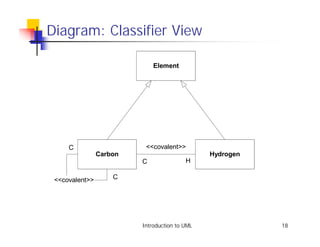
Diagram: Classifier View

                             Element


     C                    <<covalent>>
                Carbon                         Hydrogen
                         C               H

 <<covalent>>       C


                         Introduction to UML              18
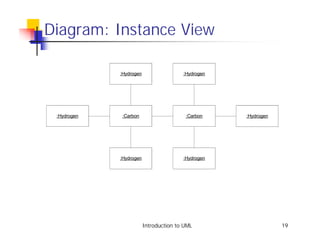
Diagram: Instance View

             :Hydrogen                  :Hydrogen


 :Hydrogen    :Carbon                    :Carbon    :Hydrogen


             :Hydrogen                  :Hydrogen


                         Introduction to UML                    19
Well-Formedness Rules
!   Well-formed: indicates that a model or model
    fragment adheres to all semantic and
    syntactic rules that apply to it.
!   UML specifies rules for:
       !   naming
       !   scoping
       !   visibility
       !   integrity
       !   execution (limited)
!   However, during iterative, incremental
    development it is expected that models will
    be incomplete and inconsistent.

                         Introduction to UML      20
Well-Formedness Rules (cont’d)
!   Example of semantic rule: Class [1]
       !   English: If a Class is concrete, all the
           Operations of the Class should have a realizing
           Method in the full descriptor.
       !   OCL: not self.isAbstract implies
           self.allOperations->
           forAll (op | self.allMethods->
           exists (m | m.specification-> includes(op)))


                           Introduction to UML               21
Well-Formedness Rules (cont’d)
!   Example of syntactic rules: Class
       !   Basic Notation: A class is drawn as a solid-
           outline rectangle with three compartments
           separated by horizontal lines.
       !   Presentation Option: Either or both of the
           attribute and operation compartments may be
           suppressed.
!   Example of syntactic guideline: Class
       !   Style Guideline: Begin class names with an
           uppercase letter.


                          Introduction to UML             22
Unifying Concepts
!   classifier-instance dichotomy
    !   e.g., an object is an instance of a class OR
        a class is the classifier of an object
!   specification-realization dichotomy
    !   e.g., an interface is a specification of a
        class OR
        a class is a realization of an interface
!   analysis-time vs. design-time vs. run-
    time
    !   modeling phases (“process creep”)
    !   usage guidelines suggested, not enforced

                        Introduction to UML            23
Language Architecture
! Metamodel architecture
! Package structure


            Introduction to UML   24
Metamodel Architecture
                                                   <<metamodel>>
                                                 MOF Meta-Metamodel
                             «metaclass»                   «metaclass»                     «metaclass»
                              Attribute                      Class                          Operation


                                  «instanceOf»                                       «instanceOf»
                                                                                                         <<use>>
                                                           «instanceOf»


                                                     <<metamodel>>
                                                     UML Metamodel


                             «metaclass»                   «metaclass»                     «metaclass»
                              Attribute                      Class                          Operation


                                                           «instanceOf»
                                                                                                         <<use>>


                                                      Analysis Model                                               The operation
                                                                                                                   issue of the
   The attribute fare of
                                                                                                                   PassengerTicket
   the PassengerTicket
                                                        PassengerTicket                                            class is an
   class is an instance of
                                                                                                                   instance of the
   the metaclass
                                                   -issuedBy : Airline                                             metaclass
   Attribute.
                                                   -issuingAgent : TravelAgent                                     Operation.
                                                   -fare : Currency
                                                   -tax : Currency
                                                   +total()
                                                   +issue()
                                                   +surrender()
                                                   +refund()

                                                                                                                    From [Kobryn 01b].
                                                           «instanceOf»


                                                 45723990550: PassengerTicket                                      Represents the
                                                                                                                   User Object layer
                                                                                                                   of the 4-layer
                                            -issuedBy : Airline = AcmeAirlines                                     metamodel
                                            -issuingAgent : TravelAgent = TerrificTravel                           architecture
                                            -fare : Currency = 1050.00                                             pattern.
                                            -tax : Currency = 57.56


                                                 Introduction to UML                                                                     25
UML Metamodel Layer
                        Behavioral Elements


                                              Activity Graphs
                                                                                           package


       Collaborations        Use Cases        State Machines                      Model Management


                          Common Behavior


                                                                                          dependency


                                              Foundation


                                    Core                        Extension Mechanisms


                                                  Data Types
                                                                                                       From [Kobryn 01b].


                                            Introduction to UML                                                        26
Relationships to Other Modeling Technologies


    Metadata layer                    Meta Object                      XMI
                                       Facility                       Facility


                                                                   <<document>>
                                                                   UML XMI DTD
                                        Unified
    Specification
                                       Modeling
    layer
                                       Language
                                                                    <<document>>
                                                                   UML CORBA IDL


    Customization    UML Profile                    UML Profile
    layer            for CORBA                      for Telecom


                         Platform                     Domain
                         technology                   technology
                         profiles                     profiles
                                                                         From [Kobryn 01b].


                                      Introduction to UML                                     27
Structural Modeling
!   What is structural modeling?
!   Core concepts
!   Diagram tour
!   When to model structure
!   Modeling tips
!   Example: Interface-based design


                  Introduction to UML   28
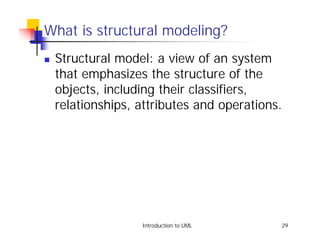
What is structural modeling?
!   Structural model: a view of an system
    that emphasizes the structure of the
    objects, including their classifiers,
    relationships, attributes and operations.


                   Introduction to UML      29
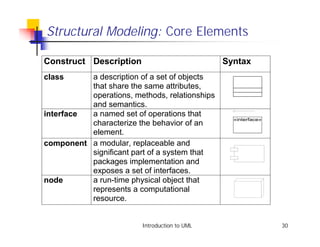
Structural Modeling: Core Elements

Construct Description                          Syntax
class     a description of a set of objects
          that share the same attributes,
          operations, methods, relationships
          and semantics.
interface a named set of operations that
                                                 «interface»
          characterize the behavior of an
          element.
component a modular, replaceable and
          significant part of a system that
          packages implementation and
          exposes a set of interfaces.
node      a run-time physical object that
          represents a computational
          resource.


                         Introduction to UML                   30
Structural Modeling: Core Elements (cont’d)

Construct        Description                                 Syntax
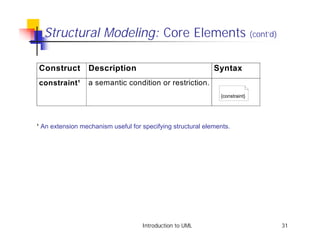
constraint¹      a semantic condition or restriction.
                                                               {constraint}


¹ An extension mechanism useful for specifying structural elements.


                                    Introduction to UML                       31
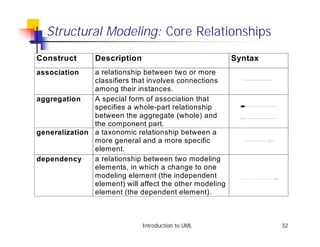
Structural Modeling: Core Relationships
Construct       Description                              Syntax
association    a relationship between two or more
               classifiers that involves connections
               among their instances.
aggregation    A special form of association that
               specifies a whole-part relationship
               between the aggregate (whole) and
               the component part.
generalization a taxonomic relationship between a
               more general and a more specific
               element.
dependency     a relationship between two modeling
               elements, in which a change to one
               modeling element (the independent
               element) will affect the other modeling
               element (the dependent element).


                              Introduction to UML                 32
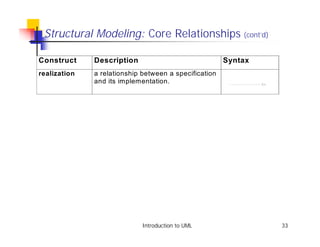
Structural Modeling: Core Relationships (cont’d)

Construct     Description                              Syntax
realization   a relationship between a specification
              and its implementation.


                             Introduction to UML                33
Structural Diagram Tour
!   Show the static structure of the model
     !   the entities that exist (e.g., classes, interfaces,
         components, nodes)
     !   internal structure
     !   relationship to other entities
!   Do not show
     !   temporal information
!   Kinds
     !   static structural diagrams
          !   class diagram
          !   object diagram
     !   implementation diagrams
          !   component diagram
          !   deployment diagram


                               Introduction to UML             34
Static Structural Diagrams
! Shows a graph of classifier
  elements connected by static
  relationships.
! kinds

    ! class diagram: classifier view
    ! object diagram: instance view


                Introduction to UML    35
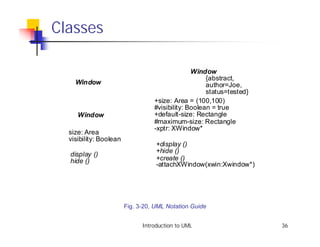
Classes

                                                Window
                                                     {abstract,
    Window                                           author=Joe,
                                                     status=tested}
                                  +size: Area = (100,100)
                                  #visibility: Boolean = true
     Window                       +default-size: Rectangle
                                  #maximum-size: Rectangle
                                  -xptr: XWindow*
  size: Area
  visibility: Boolean
                                   +display ()
                                   +hide ()
  display ()
  hide ()                          +create ()
                                   -attachXWindow(xwin:Xwindow*)


                        Fig. 3-20, UML Notation Guide


                              Introduction to UML                     36
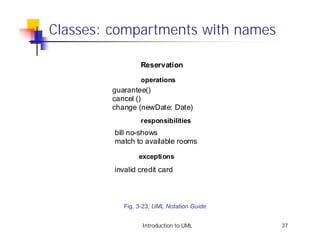
Classes: compartments with names

                 Reservation
                 operations
        guarantee()
        cancel ()
        change (newDate: Date)
                 responsibilities
         bill no-shows
         match to available rooms

                 exceptions
         invalid credit card


            Fig. 3-23, UML Notation Guide


                  Introduction to UML       37
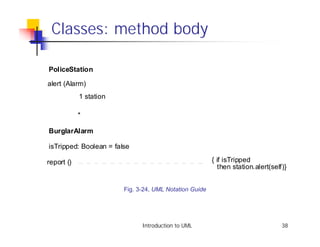
Classes: method body

PoliceStation

alert (Alarm)
            1 station

            *

BurglarAlarm

isTripped: Boolean = false

report ()                                               { if isTripped
                                                          then station.alert(self)}


                        Fig. 3-24, UML Notation Guide


                              Introduction to UML                                38
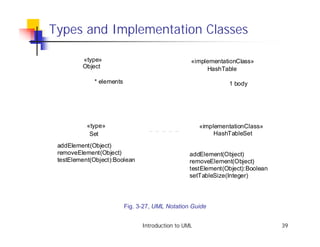
Types and Implementation Classes

         «type»                                   «implementationClass»
         Object                                        HashTable

             * elements                                        1 body


           «type»                                     «implementationClass»
            Set                                            HashTableSet
 addElement(Object)
 removeElement(Object)                            addElement(Object)
 testElement(Object):Boolean                      removeElement(Object)
                                                  testElement(Object):Boolean
                                                  setTableSize(Integer)


                          Fig. 3-27, UML Notation Guide


                                Introduction to UML                             39
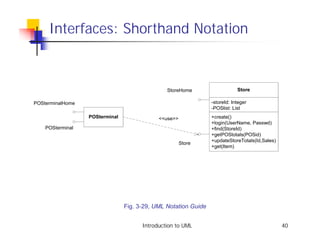
Interfaces: Shorthand Notation


                                               StoreHome                    Store

POSterminalHome                                                 -storeId: Integer
                                                                -POSlist: List
                  POSterminal               <<use>>             +create()
                                                                +login(UserName, Passwd)
    POSterminal                                                 +find(StoreId)
                                                                +getPOStotals(POSid)
                                                                +updateStoreTotals(Id,Sales)
                                                      Store
                                                                +get(Item)


                                Fig. 3-29, UML Notation Guide


                                      Introduction to UML                                      40
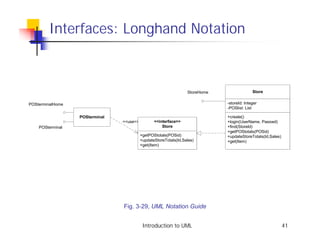
Interfaces: Longhand Notation


                                                                  StoreHome                 Store


POSterminalHome                                                               -storeId: Integer
                                                                              -POSlist: List

                  POSterminal                                                 +create()
                                <<use>>          <<interface>>                +login(UserName, Passwd)
    POSterminal                                      Store                    +find(StoreId)
                                                                              +getPOStotals(POSid)
                                          +getPOStotals(POSid)                +updateStoreTotals(Id,Sales)
                                          +updateStoreTotals(Id,Sales)        +get(Item)
                                          +get(Item)


                                Fig. 3-29, UML Notation Guide


                                           Introduction to UML                                               41
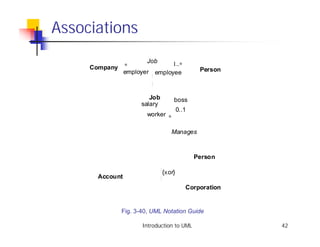
Associations
                    Job     1..∗
     Company ∗
             employer employee                 Person


                        Job        boss
                     salary
                                       0..1
                       worker ∗

                                  Manages


                                              Person

                              {X or}
       Account
                                          Corporation


              Fig. 3-40, UML Notation Guide

                     Introduction to UML                42
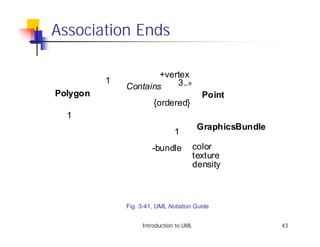
Association Ends

                      +vertex
          1               3..∗
              Contains
Polygon                                    Point
                       {ordered}
  1
                                          GraphicsBundle
                               1
                       -bundle           color
                                         texture
                                         density


              Fig. 3-41, UML Notation Guide


                   Introduction to UML                     43
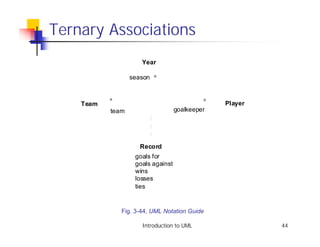
Ternary Associations
                      Year

                  season ∗


           ∗                                ∗
    Team                                        Player
           team                    goalkeeper


                     Record
                   goals for
                   goals against
                   wins
                   losses
                   ties


               Fig. 3-44, UML Notation Guide

                      Introduction to UML                44
Composition

                      Window

                   scrollbar [2]: Slider
                   title: Header
                   body: Panel


                          Window
                                          1
                      1        1

   scrollbar      2         title     1         body    1

        Slider                      Header             Panel


                 Fig. 3-45, UML Notation Guide


                          Introduction to UML                  45
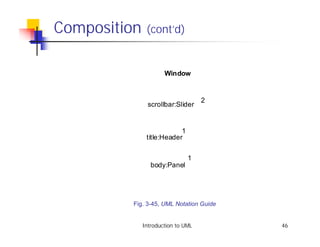
Composition    (cont’d)


                      Window


                                    2
                scrollbar:Slider


                           1
               title:Header


                               1
                 body:Panel


          Fig. 3-45, UML Notation Guide


              Introduction to UML         46
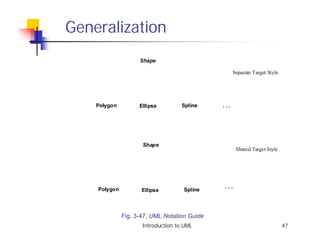
Generalization
                    Shape

                                                     Separate Target Style


    Polygon         Ellipse         Spline    . ..


                     Shape
                                                      Shared Target Style


                                               ...
    Polygon          Ellipse        Spline


              Fig. 3-47, UML Notation Guide
                     Introduction to UML                                     47
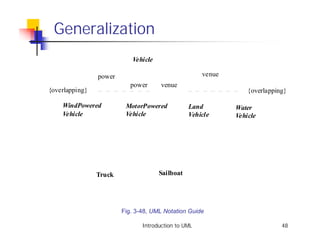
Generalization
                           Vehicle

                power                                venue
                           power      venue
{overlapping}                                                    {overlapping}

    WindPowered          MotorPowered           Land         Water
    Vehicle              Vehicle                Vehicle      Vehicle


                Truck                Sailboat


                        Fig. 3-48, UML Notation Guide

                               Introduction to UML                          48
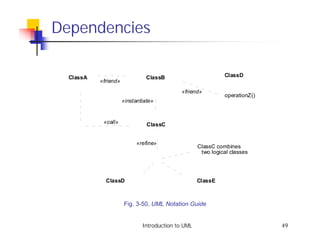
Dependencies

  ClassA                        ClassB                        ClassD
           «friend»
                                             «friend»
                                                              operationZ()
                      «instantiate»


            «call»              ClassC


                            «refine»
                                                    ClassC combines
                                                     two logical classes


             ClassD                                 ClassE


                      Fig. 3-50, UML Notation Guide


                              Introduction to UML                            49
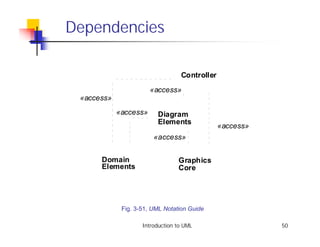
Dependencies

                                  Controller
                       «access»
 «access»
            «access»     Diagram
                         Elements
                                               «access»
                        «access»


      Domain                     Graphics
      Elements                   Core


             Fig. 3-51, UML Notation Guide

                    Introduction to UML                   50
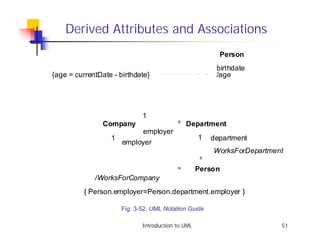
Derived Attributes and Associations
                                                          Person
                                                         birthdate
{age = currentDate - birthdate}                          /age


                             1
                Company                   ∗ Department
                         employer
                  1                                1    department
                    employer
                                                        WorksForDepartment
                                                    ∗
                                          ∗        Person
             /WorksForCompany
          { Person.employer=Person.department.employer }

                      Fig. 3-52, UML Notation Guide

                             Introduction to UML                         51
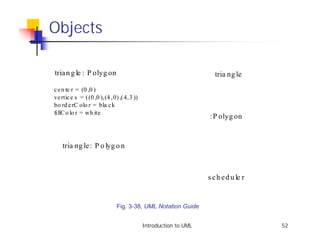
Objects

tria n g le : P olyg on                                             tria ng le

c e n te r = (0 ,0 )
ve rtic e s = ( (0 ,0 ),(4 ,0) ,( 4,3 ))
bo rd e rC olo r = bla c k
fillC o lo r = wh ite
                                                                 :P olyg on


    tria ng le : P o lyg o n


                                                                 s c h e d u le r


                             Fig. 3-38, UML Notation Guide


                                           Introduction to UML                      52
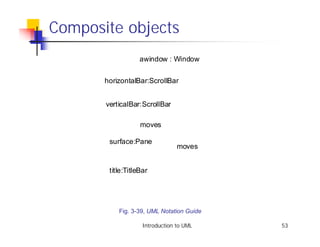
Composite objects
                   awindow : Window

       horizontalBar:ScrollBar


       verticalBar:ScrollBar

                   moves

        surface:Pane
                                 moves


        title:TitleBar


           Fig. 3-39, UML Notation Guide

                    Introduction to UML    53
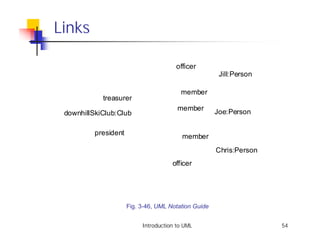
Links

                                       officer
                                                       Jill:Person

                                         member
            treasurer
                                        member
 downhillSkiClub:Club                                 Joe:Person

          president
                                          member
                                                      Chris:Person
                                      officer


                      Fig. 3-46, UML Notation Guide


                           Introduction to UML                       54
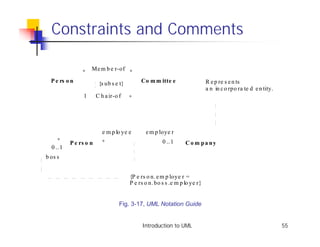
Constraints and Comments

                ∗    Me m b e r-of ∗

  P e rs o n             {s ub s e t}        Co m m itte e                   R e p re s e n ts
                                                                             a n in c o rpo ra te d e n tity.
                 1      C h a ir-o f    ∗


                           e m p lo ye e       e m p loye r
     ∗                     ∗
           P e rs o n                                  0 .. 1     Co m pa ny
  0 .. 1
b os s


                                        {P e rs o n. e m p loye r =
                                        P e rs o n. bo s s .e m p lo ye r}


                                   Fig. 3-17, UML Notation Guide


                                             Introduction to UML                                                55
Class Diagram Example
                                      CreditCard
                                                               PMCreditCard
                                      {abstract}


                                      OrderBean
    <<interface>>                     {abstract}
     EntityBean
                                +getOrderStatus
                                +setOrderStatus
                                                                 PMOrder
                                +getLineItems
                                +setLineItems
                    order       +getCreditApproved
                                +setCreditApproved
                            *   ...

                                       1       order


    buyer       1                      *       item

     Customer                          LineItem
                                                               PMLineItem
                                      {abstract}
                                                                   *
                                           *   item


                                           1   commodity


                                       Product


                                                           Adapted from Fig. 23 [EJB 2.0].


                            Introduction to UML                                              56
Implementation Diagrams
! Show aspects of model
  implementation, including source
  code structure and run-time
  implementation structure
! Kinds

    ! component diagram
    ! deployment diagram


               Introduction to UML   57
Component Diagram
!   Shows the organizations and
    dependencies among software
    components
!   Components may be
    !   specified by classifiers (e.g.,
        implementation classes)
    !   implemented by artifacts (e.g., binary,
        executable, or script files)


                     Introduction to UML          58
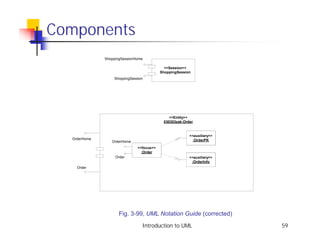
Components
              ShoppingSessionHome

                                            <<Session>>
                                          ShoppingSession
                  ShoppingSession


                                              <<Entity>>
                                           030303zak:Order


                                                           OrderPK
                                                        <<auxiliary>>
  OrderHome                                               :OrderPK
                 OrderHome
                              <<focus>>
                                :Order                     OrderInfo
                   Order                                <<auxiliary>>
                                                         :OrderInfo
    Order


                     Fig. 3-99, UML Notation Guide (corrected)
                                Introduction to UML                     59
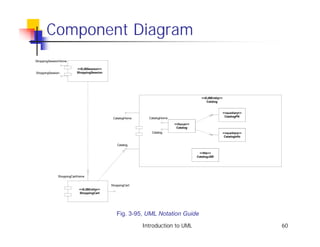
Component Diagram
ShoppingSessionHome

                         <<EJBSession>>
ShoppingSession          ShoppingSession


                                                                                        <<EJBEntity>>
                                                                                           Catalog

                                                                                                         CatalogPK
                                                                                                        <<auxiliary>>
                                                                                                         CatalogPK
                                            CatalogHome     CatalogHome

                                                                          <<focus>>
                                                                           Catalog
                                                                                                        CatalogInfo
                                                             Catalog                                    <<auxiliary>>
                                                                                                         CatalogInfo

                                               Catalog

                                                                                       <<file>>
                                                                                      CatalogJAR


              ShoppingCartHome

                                           ShoppingCart
                          <<EJBEntity>>
                          ShoppingCart


                                              Fig. 3-95, UML Notation Guide
                                                          Introduction to UML                                           60
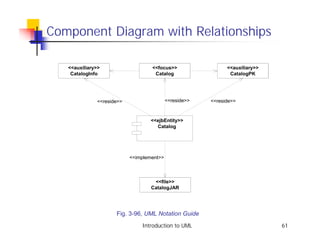
Component Diagram with Relationships

   <<auxiliary>>                   <<focus>>                  <<auxiliary>>
    CatalogInfo                     Catalog                    CatalogPK


              <<reside>>                   <<reside>>   <<reside>>


                                   <<ejbEntity>>
                                     Catalog


                           <<implement>>


                                    <<file>>
                                   CatalogJAR


                     Fig. 3-96, UML Notation Guide
                               Introduction to UML                            61
Deployment Diagram
!   Shows the configuration of run-time
    processing elements and the software
    components, processes and objects
    that live on them
!   Deployment diagrams may be used to
    show which components may run on
    which nodes


                 Introduction to UML   62
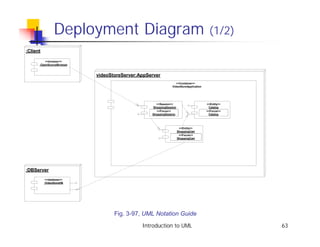
Deployment Diagram                                                    (1/2)
:Client

          <<browser>>
      :OpenSourceBrowser


                           videoStoreServer:AppServer
                                                                <<Container>>
                                                             VideoStoreApplication


                                                   <<Session>>                       <<Entity>>
                                                 ShoppingSession                      Catalog
                                                    <<Focus>>                        <<Focus>>
                                                 ShoppingSession                      Catalog


                                                                    <<Entity>>
                                                                   ShoppingCart
                                                                    <<Focus>>
                                                                   ShoppingCart


:DBServer
           <<database>>
          :VideoStoreDB


                                  Fig. 3-97, UML Notation Guide
                                             Introduction to UML                                  63
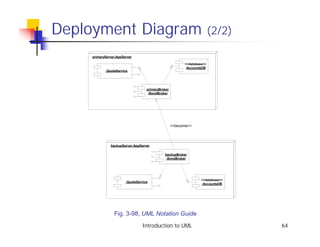
Deployment Diagram                                                      (2/2)

    primaryServer:AppServer

                                                         <<database>>
                                                         :AccountsDB
           :QuoteService


                                   primaryBroker
                                    :BondBroker


                                                   <<become>>


              backupServer:AppServer

                                             backupBroker
                                             :BondBroker


                                                                  <<database>>
                       :QuoteService
                                                                  :AccountsDB


                Fig. 3-98, UML Notation Guide
                                Introduction to UML                              64
When to model structure
!   Adopt an opportunistic top-down+bottom-up approach
    to modeling structure
    !   Specify the top-level structure using “architecturally significant”
        classifiers and model management constructs (packages,
        models, subsystems; see Tutorial 3)
    !   Specify lower-level structure as you discover detail re classifiers
        and relationships
!   If you understand your domain well you can frequently
    start with structural modeling; otherwise
    !   If you start with use case modeling (as with a use-case driven
        method) make sure that your structural model is consistent
        with your use cases
    !   If you start with role modeling (as with a collaboration-driven
        method) make sure that your structural model is consistent
        with your collaborations


                                  Introduction to UML                         65
Structural Modeling Tips
!   Define a “skeleton” (or “backbone”) that can be
    extended and refined as you learn more about your
    domain.
!   Focus on using basic constructs well; add advanced
    constructs and/or notation only as required.
!   Defer implementation concerns until late in the
    modeling process.
!   Structural diagrams should
     !   emphasize a particular aspect of the structural model
     !   contain classifiers at the same level of abstraction
!   Large numbers of classifiers should be organized into
    packages (see Lecture 3)


                               Introduction to UML               66
Example: Point-of-Sale
!   The following example shows how UML can
    model the interfaces for a Point of Sale
    application originally specified in CORBA IDL.
    From [Kobryn 01b].


                   Introduction to UML          67
Point-of-Sale Example
module POS
{
   typedef long   POSId;
   typedef string Barcode;

  interface InputMedia
  {
        typedef string OperatorCmd;
        void            BarcodeInput(in Barcode Item);
        void            KeypadInput(in OperatorCmd Cmd);
  };
  interface OutputMedia
  {...};
  interface POSTerminal
  {...};
   };
  ...
 Ch. 26, CORBA Fundamentals and Programming (2nd ed.), [Siegel 00]

                          Introduction to UML                        68
POS Class Diagram
                                                     Point_Of_Sale
                                                                                                  «CORBAInterface»
     «CORBAInterface»                                                                               IInputMedia
       IPOSterminal                                                                              -POSref : POSterminal
                                        InputMedia
-storeRef : Store                                                                                +initialization()
-storeAccessRef : StoreAccess                                                                    +barcodeInput()
-outputMediaRef : OutputMedia                                                                    +keypadInput()
-taxRef : Tax
                                                          «CORBAInterface»
-POSid : Integer
                                                            IOutputMedia
-itemBarcode : Integer
                                    OutputMedia
-itemQuantity : Integer                                                                           «CORBAInterface»
-itemInfo : ItemInfo                                                                                  IStore
                                                         +outputText()
-itemPrice : Currency
-itemTaxPrice : Currency                                                                         -totals : Totals
-itemExtension : Currency                                                                        -POSlist : List
-saleSubtotal : Currency                                                                         +initialization()
-taxableSubtotal : Currency                                                                      +login()
-saleTotal : Currency                                                                            +getPOStotals()
                                                             POSterminal
-saleTax : Currency                                                                              +updateStoreTotals()
-POSlist : List                                                                                  +getTotals()
+initialization()                                                                                +getStoreId()
+login()
+printPOSsalesSummary()
+printStoreSalesSummary()
+setItemQuantity()
+sendBarcode()                  class                                        longhand notation
+endSale()                                                                   for interface                Store


                                                                                                  «CORBAInterface»
                                 «CORBAInterface»                                                   IStoreAccess
                                      ITax
                                                                                                  -depotRef :
           Tax                   -rate : float                                                    -taxRef : Tax
                                 +initialization()                                                -storeMarkup : float
                                 +calculateTax()             StoreAccess                          -storeId : Integer
                                 +findTaxablePrice()                                              +initialization()
                                                                                                  +findPrice()

                                                          «CORBAInterface»
                                                              IDepot
                                                                                                         Depot

                                                          +intialization()
                                                          +findItemInfo()
                                                                                                                         From [Kobryn 2001b]

                                                        Introduction to UML                                                          69
POS Deployment Diagram
                                                   shorthand
   node                                            ("lollipop")                            component.
                                                   notation for
                                                   interface.


   station3:POSStation                                                   :StoreServer

                                                                                 ITax
            :InputMedia                                                                        :Tax
                            IInputMedia


                                                                                 IStore
                             :POSterminal                                                     :Store
           IPOSterminal


            :OutputMedia                                                                  :StoreAccess
                            IOutputMedia                                   IStoreAccess


           <<ethernet>>                                                                     <<ethernet>>


                                                    <<network>>
                                                 :LocalAreaNetwork


             <<ethernet>>                                       <<ethernet>>              <<ethernet>>


   :POSstation                             :DBServer                                         :POSstation


                                                       :Depot
                                                                        IDepot

                                                                                                         From [Kobryn 2001b]


                                           Introduction to UML                                                             70
Model Fragment from POS Example


                            «CORBAInterface»
                                 ITax

       Tax                  -rate : float
                            +initialization()
                            +calculateTax()
                            +findTaxablePrice()


                                                  From [Kobryn 2001b]


             Introduction to UML                                    71
XML Generated by XMI Facility

<XMI xmi.version = '1.1' xmlns:UML='//org.omg/UML/1.3' ...>
 <XMI.header>
  <XMI.metamodel xmi.name = 'UML' xmi.version = '1.3'/>
 </XMI.header>
<XMI.content>
<!--   POS_Example_R2    [Model]   -->
<UML:Model xmi.id = 'G.0'
  name = 'POS_Example_R2' visibility = 'public' isSpecification =
'false'
  isRoot = 'false' isLeaf = 'false' isAbstract = 'false' >
  <UML:Namespace.ownedElement>
    <!--   POS_Example_R2::Tax     [Class]   -->
    <UML:Class xmi.id = 'S.1'
       name = 'Tax' visibility = 'public' isSpecification = 'false'
       isRoot = 'true' isLeaf = 'true' isAbstract = 'false'
       isActive = 'false'                                 From [Kobryn 2001b]
      namespace = 'G.0' clientDependency = 'G.1' />
    ...                    Introduction to UML                              72
Use Case Modeling
 !   What is use case modeling?
 !   Core concepts
 !   Diagram tour
 !   When to model use cases
 !   Modeling tips
 !   Example: Online HR System


                   Introduction to UML   73
What is use case modeling?
!   use case model: a view of a
    system that emphasizes the
    behavior as it appears to outside
    users. A use case model partitions
    system functionality into
    transactions (‘use cases’) that are
    meaningful to users (‘actors’).


                 Introduction to UML      74
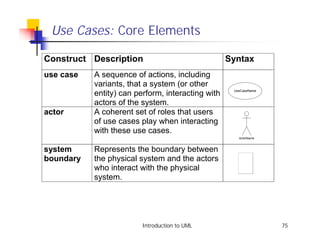
Use Cases: Core Elements

Construct Description                              Syntax
use case   A sequence of actions, including
           variants, that a system (or other
                                                    UseCaseName
           entity) can perform, interacting with
           actors of the system.
actor      A coherent set of roles that users
           of use cases play when interacting
           with these use cases.
                                                      ActorName


system     Represents the boundary between
boundary   the physical system and the actors
           who interact with the physical
           system.


                         Introduction to UML                      75
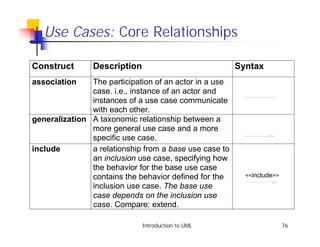
Use Cases: Core Relationships

Construct       Description                             Syntax
association    The participation of an actor in a use
               case. i.e., instance of an actor and
               instances of a use case communicate
               with each other.
generalization A taxonomic relationship between a
               more general use case and a more
               specific use case.
include        a relationship from a base use case to
               an inclusion use case, specifying how
               the behavior for the base use case
               contains the behavior defined for the      <<include>>
               inclusion use case. The base use
               case depends on the inclusion use
               case. Compare: extend.

                              Introduction to UML                       76
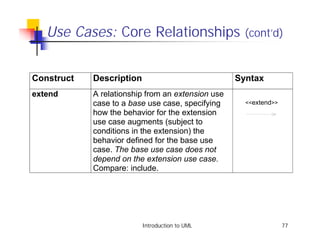
Use Cases: Core Relationships                     (cont’d)


Construct   Description                            Syntax
extend      A relationship from an extension use
            case to a base use case, specifying      <<extend>>
            how the behavior for the extension
            use case augments (subject to
            conditions in the extension) the
            behavior defined for the base use
            case. The base use case does not
            depend on the extension use case.
            Compare: include.


                          Introduction to UML                     77
Use Case Diagram Tour

!   Shows use cases, actors and their
    relationships
!   Use case internals can be specified by
    text and/or interaction diagrams (see
    Lecture 2)
!   Kinds
    !   use case diagram
    !   use case description


                       Introduction to UML   78
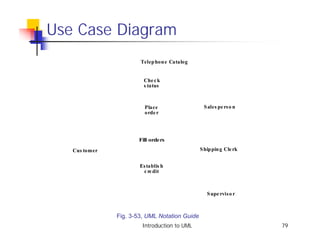
Use Case Diagram
                       Telep hon e Catalog


                        Che c k
                        s tatus


                         Place                  S ales pe rs o n
                         orde r


                      Fill orders

   Cus tomer                                   S hip pin g Cle rk


                       Es tablis h
                        c re dit


                                                  S upe rvis o r


               Fig. 3-53, UML Notation Guide
                        Introduction to UML                         79
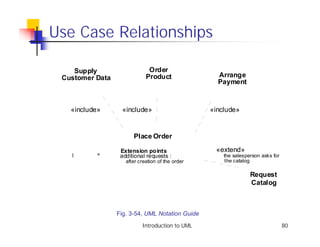
Use Case Relationships

    Supply                    Order
 Customer Data               Product                Arrange
                                                    Payment


   «include»       «include»                      «include»


                       Place Order

                  Extension points                 «extend»
   1       *      additional requests :               the salesperson asks for
                    after creation of the order       the catalog

                                                                 Request
                                                                 Catalog


                 Fig. 3-54, UML Notation Guide
                           Introduction to UML                                   80
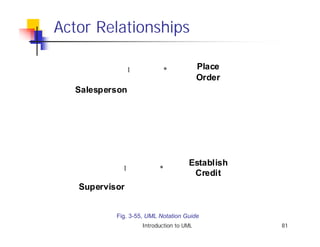
Actor Relationships

                1           *             Place
                                          Order
  Salesperson


                                     Establish
             1            *
                                      Credit
   Supervisor


           Fig. 3-55, UML Notation Guide
                    Introduction to UML           81
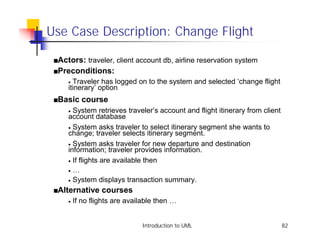
Use Case Description: Change Flight

 sActors:    traveler, client account db, airline reservation system
 sPreconditions:
    • Traveler has logged on to the system and selected ‘change flight
    itinerary’ option
 sBasic   course
    • System retrieves traveler’s account and flight itinerary from client
    account database
    • System asks traveler to select itinerary segment she wants to
    change; traveler selects itinerary segment.
    • System asks traveler for new departure and destination
    information; traveler provides information.
    • If flights are available then

    • …
    • System displays transaction summary.

 sAlternative    courses
    •   If no flights are available then …


                              Introduction to UML                            82
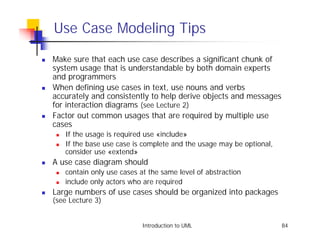
When to model use cases
!   Model user requirements with use cases.
!   Model test scenarios with use cases.
!   If you are using a use-case driven
    method
    !   start with use cases and derive your
        structural and behavioral models from it.
!   If you are not using a use-case driven
    method
    !   make sure that your use cases are consistent
        with your structural and behavioral models.


                         Introduction to UML           83
Use Case Modeling Tips
!   Make sure that each use case describes a significant chunk of
    system usage that is understandable by both domain experts
    and programmers
!   When defining use cases in text, use nouns and verbs
    accurately and consistently to help derive objects and messages
    for interaction diagrams (see Lecture 2)
!   Factor out common usages that are required by multiple use
    cases
     !   If the usage is required use «include»
     !   If the base use case is complete and the usage may be optional,
         consider use «extend»
!   A use case diagram should
     !   contain only use cases at the same level of abstraction
     !   include only actors who are required
!   Large numbers of use cases should be organized into packages
    (see Lecture 3)


                                 Introduction to UML                       84
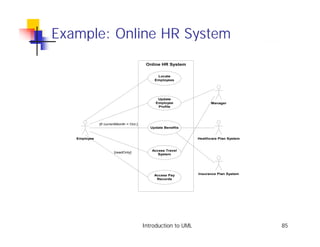
Example: Online HR System
                                          Online HR System

                                               Locate
                                              Employees


                                               Update
                                              Employee                Manager
                                               Profile


              {if currentMonth = Oct.}
                                            Update Benefits


   Employee                                                    Healthcare Plan System


                                            Access Travel
                       {readOnly}
                                               System


                                              Access Pay       Insurance Plan System
                                               Records


                                         Introduction to UML                            85
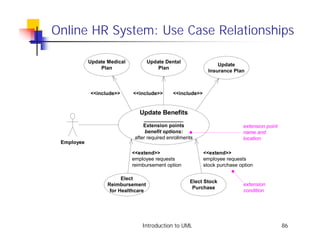
Online HR System: Use Case Relationships

            Update Medical           Update Dental
                                                                   Update
                Plan                     Plan
                                                               Insurance Plan


            <<include>>      <<include>>       <<include>>


                                Update Benefits
                                  ______________
                                  Extension points                           extension point
                                   benefit options:                          name and
                              after required enrollments                     location
 Employee

                             <<extend>>                      <<extend>>
                             employee requests               employee requests
                             reimbursement option            stock purchase option

                         Elect
                                                      Elect Stock
                   Reimbursement                                             extension
                                                       Purchase
                    for Healthcare                                           condition


                                 Introduction to UML                                           86
Online HR System: Update Benefits Use Case

sActors    : employee, employee account db, healthcare plan system,
insurance plan system
sPreconditions:
    •Employee has logged on to the system and selected ‘update benefits’
    option
sBasic    course
    •   System retrieves employee account from employee account db
    •System asks employee to select medical plan type; include Update
    Medical Plan.
    • System asks employee to select dental plan type; include Update
    Dental Plan.
    • …

sAlternative    courses
    • If health plan is not available in the employee’s area the employee is
    informed and asked to select another plan...


                               Introduction to UML                         87
Wrap Up
!   Ideas to take away
!   Preview of next tutorial
!   References
!   Further info


                 Introduction to UML   88
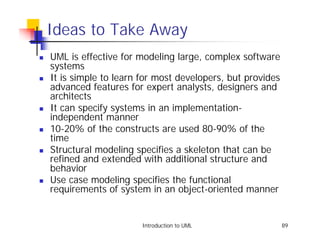
Ideas to Take Away
!   UML is effective for modeling large, complex software
    systems
!   It is simple to learn for most developers, but provides
    advanced features for expert analysts, designers and
    architects
!   It can specify systems in an implementation-
    independent manner
!   10-20% of the constructs are used 80-90% of the
    time
!   Structural modeling specifies a skeleton that can be
    refined and extended with additional structure and
    behavior
!   Use case modeling specifies the functional
    requirements of system in an object-oriented manner


                          Introduction to UML                 89
Preview - Next Tutorial
 !   Behavioral Modeling with UML
     !   Behavioral modeling overview
     !   Interactions
     !   Collaborations
     !   Statecharts
     !   Activity graphs


                    Introduction to UML   90
References
!   [UML 1.4] OMG UML Specification v. 1.4, UML Revision Task Force,
    OMG doc# ad/01-02-13.
!   [Kobryn 01a] C. Kobryn, “UML 2.0 Roadmap: Fast Track or Detours?,”
    Software Development, April 2001.
!   [Kobryn 01b] C. Kobryn, “Modeling Distributed Applications with UML,”
    Part IV: Chapter 1 in [Siegel 01] Quick CORBA 3, Wiley, 2001.
!   [Kobryn 00] “Modeling CORBA Applications with UML,” chapter 21 in
    [Siegel 00] CORBA 3 Fundamentals and Programming (2nd ed.), Wiley,
    2000.
!   [Kobryn 99] UML 2001: A Standardization Odyssey, Communications of
    the ACM, Oct. 1999.
!   [EJB 2.0] Enterprise JavaBeans Specification v. 2.0, Sun Microsystems,
    March 31, 2000.


                                Introduction to UML                          91
Further Info
!   Web:
    !   UML 1.4 RTF: www.celigent.com/omg/umlrtf
    !   OMG UML Tutorials:
        www.celigent.com/omg/umlrtf/tutorials.htm
    !   UML 2.0 Working Group:
        www.celigent.com/omg/adptf/wgs/uml2wg.htm
    !   OMG UML Resources: www.omg.org/uml/
!   Email
    !   uml-rtf@omg.org
    !   Cris.Kobryn@telelogic.com
!   Conferences & workshops
    !   UML World 2001, New York, June 11-14, 2001
    !   UML 2001, Toronto, Canada, Oct. 1-5, 2001
    !   OMG UML Workshop 2001, San Francisco, Dec. 3-6, 2001
    !   UML Forum/Tokyo 2002, Tokyo, Japan, April 2002.

                           Introduction to UML                 92

01 1 kobryn-structural_and_use_case_modeling_tutorial

  • 1.
    Object Modeling withOMG UML Tutorial Series Introduction to UML: Structural and Use Case Modeling Cris Kobryn Co-Chair UML Revision Task Force cris.kobryn@telelogic.com © 1999-2001 OMG and Contributors: Crossmeta, EDS, IBM, Enea Data, Hewlett-Packard, IntelliCorp, Kabira Technologies, Klasse Objecten, Rational Software, Telelogic, Unisys
  • 2.
    Overview ! Tutorial series ! Quick tour ! Structural modeling ! Use case modeling Introduction to UML 2
  • 3.
    Tutorial Series ! Lecture 1: Introduction to UML: Structural and Use Case Modeling ! Lecture 2: Behavioral Modeling with UML ! Lecture 3: Advanced Modeling with UML [Note: This version of the tutorial series is based on OMG UML Specification v. 1.4, OMG doc# ad/01-02-13, adopted in May 2001.] Introduction to UML 3
  • 4.
    Tutorial Goals ! What you will learn: ! what the UML is and what is it not ! UML’s basic constructs, rules and diagram techniques ! how the UML can model large, complex systems ! how the UML can specify systems in an implementation-independent manner ! What you will not learn: ! object methods or processes ! metamodeling techniques Introduction to UML 4
  • 5.
    Quick Tour ! Why do we model? ! What is the UML? ! Foundation elements ! Unifying concepts ! Language architecture ! Relation to other OMG technologies Introduction to UML 5
  • 6.
    Why do wemodel? ! Provide structure for problem solving ! Experiment to explore multiple solutions ! Furnish abstractions to manage complexity ! Reduce time-to-market for business problem solutions ! Decrease development costs ! Manage the risk of mistakes Introduction to UML 6
  • 7.
    The Challenge Tijuana “shantytown”: http://www.macalester.edu/~jschatz/residential.html Introduction to UML 7
  • 8.
    The Vision Fallingwater: http://www.adelaide.net.au/~jpolias/FLW/Images/FallingWater.jpeg Introduction to UML 8
  • 9.
    Why do wemodel graphically? ! Graphics reveal data. ! Edward Tufte The Visual Display of Quantitative Information, 1983 ! 1 bitmap = 1 megaword. ! Anonymous visual modeler Introduction to UML 9
  • 10.
    Quick Tour ! The UML is a graphical language for ! specifying ! visualizing ! constructing ! documenting the artifacts of software systems ! Added to the list of OMG adopted technologies in November 1997 as UML 1.1 ! Most recent minor revision is UML 1.4, adopted in May 2001. ! Next major revision will be UML 2.0, planned to be completed in 2002 Introduction to UML 10
  • 11.
    UML Goals ! Define an easy-to-learn but semantically rich visual modeling language ! Unify the Booch, OMT, and Objectory modeling languages ! Include ideas from other modeling languages ! Incorporate industry best practices ! Address contemporary software development issues ! scale, distribution, concurrency, executability, etc. ! Provide flexibility for applying different processes ! Enable model interchange and define repository interfaces Introduction to UML 11
  • 12.
    OMG UML Evolution 2002 (planned) <<document>> UML 2.0 <<document>> <<document>> UML 2.0 UML 2.0 Diagram Superstructure <<document>> Interchange <<document>> UML 2.0 UML 2.0 OCL Infrastructure <<document>> Q2 2001 UML 1.4 Editorial revision without significant technical changes. <<document>> 1999 UML 1.3 <<document>> 1998 UML 1.2 <<document>> 1997 UML 1.1 Updated from (adopted by OMG) [Kobryn 01a]. Introduction to UML 12
  • 13.
    OMG UML Contributors Aonix Microsoft Colorado State University ObjecTime Computer Associates Oracle Concept Five Ptech Data Access OAO Technology Solutions EDS Rational Software Enea Data Reich Hewlett-Packard SAP IBM Softeam I-Logix Sterling Software InLine Software Sun Intellicorp Taskon Kabira Technologies Telelogic Klasse Objecten Unisys Lockheed Martin … Introduction to UML 13
  • 14.
    OMG UML 1.4Specification ! UML Summary ! UML Semantics ! UML Notation Guide ! UML Example Profiles ! Software Development Processes ! Business Modeling ! Model Interchange ! Model Interchange Using XMI ! Model Interchange Using CORBA IDL ! Object Constraint Language Introduction to UML 14
  • 15.
    Tutorial Focus: theLanguage ! language = syntax + semantics ! syntax = rules by which language elements (e.g., words) are assembled into expressions (e.g., phrases, clauses) ! semantics = rules by which syntactic expressions are assigned meanings ! UML Notation Guide – defines UML’s graphic syntax ! UML Semantics – defines UML’s semantics Introduction to UML 15
  • 16.
    Foundation Concepts ! Buildingblocks ! Well-formedness rules Introduction to UML 16
  • 17.
    Building Blocks ! The basic building blocks of UML are: ! model elements (classes, interfaces, components, use cases, etc.) ! relationships (associations, generalization, dependencies, etc.) ! diagrams (class diagrams, use case diagrams, interaction diagrams, etc.) ! Simple building blocks are used to create large, complex structures ! cf. elements, bonds and molecules in chemistry ! cf. components, connectors and circuit boards in hardware Introduction to UML 17
  • 18.
    Diagram: Classifier View Element C <<covalent>> Carbon Hydrogen C H <<covalent>> C Introduction to UML 18
  • 19.
    Diagram: Instance View :Hydrogen :Hydrogen :Hydrogen :Carbon :Carbon :Hydrogen :Hydrogen :Hydrogen Introduction to UML 19
  • 20.
    Well-Formedness Rules ! Well-formed: indicates that a model or model fragment adheres to all semantic and syntactic rules that apply to it. ! UML specifies rules for: ! naming ! scoping ! visibility ! integrity ! execution (limited) ! However, during iterative, incremental development it is expected that models will be incomplete and inconsistent. Introduction to UML 20
  • 21.
    Well-Formedness Rules (cont’d) ! Example of semantic rule: Class [1] ! English: If a Class is concrete, all the Operations of the Class should have a realizing Method in the full descriptor. ! OCL: not self.isAbstract implies self.allOperations-> forAll (op | self.allMethods-> exists (m | m.specification-> includes(op))) Introduction to UML 21
  • 22.
    Well-Formedness Rules (cont’d) ! Example of syntactic rules: Class ! Basic Notation: A class is drawn as a solid- outline rectangle with three compartments separated by horizontal lines. ! Presentation Option: Either or both of the attribute and operation compartments may be suppressed. ! Example of syntactic guideline: Class ! Style Guideline: Begin class names with an uppercase letter. Introduction to UML 22
  • 23.
    Unifying Concepts ! classifier-instance dichotomy ! e.g., an object is an instance of a class OR a class is the classifier of an object ! specification-realization dichotomy ! e.g., an interface is a specification of a class OR a class is a realization of an interface ! analysis-time vs. design-time vs. run- time ! modeling phases (“process creep”) ! usage guidelines suggested, not enforced Introduction to UML 23
  • 24.
    Language Architecture ! Metamodelarchitecture ! Package structure Introduction to UML 24
  • 25.
    Metamodel Architecture <<metamodel>> MOF Meta-Metamodel «metaclass» «metaclass» «metaclass» Attribute Class Operation «instanceOf» «instanceOf» <<use>> «instanceOf» <<metamodel>> UML Metamodel «metaclass» «metaclass» «metaclass» Attribute Class Operation «instanceOf» <<use>> Analysis Model The operation issue of the The attribute fare of PassengerTicket the PassengerTicket PassengerTicket class is an class is an instance of instance of the the metaclass -issuedBy : Airline metaclass Attribute. -issuingAgent : TravelAgent Operation. -fare : Currency -tax : Currency +total() +issue() +surrender() +refund() From [Kobryn 01b]. «instanceOf» 45723990550: PassengerTicket Represents the User Object layer of the 4-layer -issuedBy : Airline = AcmeAirlines metamodel -issuingAgent : TravelAgent = TerrificTravel architecture -fare : Currency = 1050.00 pattern. -tax : Currency = 57.56 Introduction to UML 25
  • 26.
    UML Metamodel Layer Behavioral Elements Activity Graphs package Collaborations Use Cases State Machines Model Management Common Behavior dependency Foundation Core Extension Mechanisms Data Types From [Kobryn 01b]. Introduction to UML 26
  • 27.
    Relationships to OtherModeling Technologies Metadata layer Meta Object XMI Facility Facility <<document>> UML XMI DTD Unified Specification Modeling layer Language <<document>> UML CORBA IDL Customization UML Profile UML Profile layer for CORBA for Telecom Platform Domain technology technology profiles profiles From [Kobryn 01b]. Introduction to UML 27
  • 28.
    Structural Modeling ! What is structural modeling? ! Core concepts ! Diagram tour ! When to model structure ! Modeling tips ! Example: Interface-based design Introduction to UML 28
  • 29.
    What is structuralmodeling? ! Structural model: a view of an system that emphasizes the structure of the objects, including their classifiers, relationships, attributes and operations. Introduction to UML 29
  • 30.
    Structural Modeling: CoreElements Construct Description Syntax class a description of a set of objects that share the same attributes, operations, methods, relationships and semantics. interface a named set of operations that «interface» characterize the behavior of an element. component a modular, replaceable and significant part of a system that packages implementation and exposes a set of interfaces. node a run-time physical object that represents a computational resource. Introduction to UML 30
  • 31.
    Structural Modeling: CoreElements (cont’d) Construct Description Syntax constraint¹ a semantic condition or restriction. {constraint} ¹ An extension mechanism useful for specifying structural elements. Introduction to UML 31
  • 32.
    Structural Modeling: CoreRelationships Construct Description Syntax association a relationship between two or more classifiers that involves connections among their instances. aggregation A special form of association that specifies a whole-part relationship between the aggregate (whole) and the component part. generalization a taxonomic relationship between a more general and a more specific element. dependency a relationship between two modeling elements, in which a change to one modeling element (the independent element) will affect the other modeling element (the dependent element). Introduction to UML 32
  • 33.
    Structural Modeling: CoreRelationships (cont’d) Construct Description Syntax realization a relationship between a specification and its implementation. Introduction to UML 33
  • 34.
    Structural Diagram Tour ! Show the static structure of the model ! the entities that exist (e.g., classes, interfaces, components, nodes) ! internal structure ! relationship to other entities ! Do not show ! temporal information ! Kinds ! static structural diagrams ! class diagram ! object diagram ! implementation diagrams ! component diagram ! deployment diagram Introduction to UML 34
  • 35.
    Static Structural Diagrams !Shows a graph of classifier elements connected by static relationships. ! kinds ! class diagram: classifier view ! object diagram: instance view Introduction to UML 35
  • 36.
    Classes Window {abstract, Window author=Joe, status=tested} +size: Area = (100,100) #visibility: Boolean = true Window +default-size: Rectangle #maximum-size: Rectangle -xptr: XWindow* size: Area visibility: Boolean +display () +hide () display () hide () +create () -attachXWindow(xwin:Xwindow*) Fig. 3-20, UML Notation Guide Introduction to UML 36
  • 37.
    Classes: compartments withnames Reservation operations guarantee() cancel () change (newDate: Date) responsibilities bill no-shows match to available rooms exceptions invalid credit card Fig. 3-23, UML Notation Guide Introduction to UML 37
  • 38.
    Classes: method body PoliceStation alert(Alarm) 1 station * BurglarAlarm isTripped: Boolean = false report () { if isTripped then station.alert(self)} Fig. 3-24, UML Notation Guide Introduction to UML 38
  • 39.
    Types and ImplementationClasses «type» «implementationClass» Object HashTable * elements 1 body «type» «implementationClass» Set HashTableSet addElement(Object) removeElement(Object) addElement(Object) testElement(Object):Boolean removeElement(Object) testElement(Object):Boolean setTableSize(Integer) Fig. 3-27, UML Notation Guide Introduction to UML 39
  • 40.
    Interfaces: Shorthand Notation StoreHome Store POSterminalHome -storeId: Integer -POSlist: List POSterminal <<use>> +create() +login(UserName, Passwd) POSterminal +find(StoreId) +getPOStotals(POSid) +updateStoreTotals(Id,Sales) Store +get(Item) Fig. 3-29, UML Notation Guide Introduction to UML 40
  • 41.
    Interfaces: Longhand Notation StoreHome Store POSterminalHome -storeId: Integer -POSlist: List POSterminal +create() <<use>> <<interface>> +login(UserName, Passwd) POSterminal Store +find(StoreId) +getPOStotals(POSid) +getPOStotals(POSid) +updateStoreTotals(Id,Sales) +updateStoreTotals(Id,Sales) +get(Item) +get(Item) Fig. 3-29, UML Notation Guide Introduction to UML 41
  • 42.
    Associations Job 1..∗ Company ∗ employer employee Person Job boss salary 0..1 worker ∗ Manages Person {X or} Account Corporation Fig. 3-40, UML Notation Guide Introduction to UML 42
  • 43.
    Association Ends +vertex 1 3..∗ Contains Polygon Point {ordered} 1 GraphicsBundle 1 -bundle color texture density Fig. 3-41, UML Notation Guide Introduction to UML 43
  • 44.
    Ternary Associations Year season ∗ ∗ ∗ Team Player team goalkeeper Record goals for goals against wins losses ties Fig. 3-44, UML Notation Guide Introduction to UML 44
  • 45.
    Composition Window scrollbar [2]: Slider title: Header body: Panel Window 1 1 1 scrollbar 2 title 1 body 1 Slider Header Panel Fig. 3-45, UML Notation Guide Introduction to UML 45
  • 46.
    Composition (cont’d) Window 2 scrollbar:Slider 1 title:Header 1 body:Panel Fig. 3-45, UML Notation Guide Introduction to UML 46
  • 47.
    Generalization Shape Separate Target Style Polygon Ellipse Spline . .. Shape Shared Target Style ... Polygon Ellipse Spline Fig. 3-47, UML Notation Guide Introduction to UML 47
  • 48.
    Generalization Vehicle power venue power venue {overlapping} {overlapping} WindPowered MotorPowered Land Water Vehicle Vehicle Vehicle Vehicle Truck Sailboat Fig. 3-48, UML Notation Guide Introduction to UML 48
  • 49.
    Dependencies ClassA ClassB ClassD «friend» «friend» operationZ() «instantiate» «call» ClassC «refine» ClassC combines two logical classes ClassD ClassE Fig. 3-50, UML Notation Guide Introduction to UML 49
  • 50.
    Dependencies Controller «access» «access» «access» Diagram Elements «access» «access» Domain Graphics Elements Core Fig. 3-51, UML Notation Guide Introduction to UML 50
  • 51.
    Derived Attributes andAssociations Person birthdate {age = currentDate - birthdate} /age 1 Company ∗ Department employer 1 1 department employer WorksForDepartment ∗ ∗ Person /WorksForCompany { Person.employer=Person.department.employer } Fig. 3-52, UML Notation Guide Introduction to UML 51
  • 52.
    Objects tria n gle : P olyg on tria ng le c e n te r = (0 ,0 ) ve rtic e s = ( (0 ,0 ),(4 ,0) ,( 4,3 )) bo rd e rC olo r = bla c k fillC o lo r = wh ite :P olyg on tria ng le : P o lyg o n s c h e d u le r Fig. 3-38, UML Notation Guide Introduction to UML 52
  • 53.
    Composite objects awindow : Window horizontalBar:ScrollBar verticalBar:ScrollBar moves surface:Pane moves title:TitleBar Fig. 3-39, UML Notation Guide Introduction to UML 53
  • 54.
    Links officer Jill:Person member treasurer member downhillSkiClub:Club Joe:Person president member Chris:Person officer Fig. 3-46, UML Notation Guide Introduction to UML 54
  • 55.
    Constraints and Comments ∗ Me m b e r-of ∗ P e rs o n {s ub s e t} Co m m itte e R e p re s e n ts a n in c o rpo ra te d e n tity. 1 C h a ir-o f ∗ e m p lo ye e e m p loye r ∗ ∗ P e rs o n 0 .. 1 Co m pa ny 0 .. 1 b os s {P e rs o n. e m p loye r = P e rs o n. bo s s .e m p lo ye r} Fig. 3-17, UML Notation Guide Introduction to UML 55
  • 56.
    Class Diagram Example CreditCard PMCreditCard {abstract} OrderBean <<interface>> {abstract} EntityBean +getOrderStatus +setOrderStatus PMOrder +getLineItems +setLineItems order +getCreditApproved +setCreditApproved * ... 1 order buyer 1 * item Customer LineItem PMLineItem {abstract} * * item 1 commodity Product Adapted from Fig. 23 [EJB 2.0]. Introduction to UML 56
  • 57.
    Implementation Diagrams ! Showaspects of model implementation, including source code structure and run-time implementation structure ! Kinds ! component diagram ! deployment diagram Introduction to UML 57
  • 58.
    Component Diagram ! Shows the organizations and dependencies among software components ! Components may be ! specified by classifiers (e.g., implementation classes) ! implemented by artifacts (e.g., binary, executable, or script files) Introduction to UML 58
  • 59.
    Components ShoppingSessionHome <<Session>> ShoppingSession ShoppingSession <<Entity>> 030303zak:Order OrderPK <<auxiliary>> OrderHome :OrderPK OrderHome <<focus>> :Order OrderInfo Order <<auxiliary>> :OrderInfo Order Fig. 3-99, UML Notation Guide (corrected) Introduction to UML 59
  • 60.
    Component Diagram ShoppingSessionHome <<EJBSession>> ShoppingSession ShoppingSession <<EJBEntity>> Catalog CatalogPK <<auxiliary>> CatalogPK CatalogHome CatalogHome <<focus>> Catalog CatalogInfo Catalog <<auxiliary>> CatalogInfo Catalog <<file>> CatalogJAR ShoppingCartHome ShoppingCart <<EJBEntity>> ShoppingCart Fig. 3-95, UML Notation Guide Introduction to UML 60
  • 61.
    Component Diagram withRelationships <<auxiliary>> <<focus>> <<auxiliary>> CatalogInfo Catalog CatalogPK <<reside>> <<reside>> <<reside>> <<ejbEntity>> Catalog <<implement>> <<file>> CatalogJAR Fig. 3-96, UML Notation Guide Introduction to UML 61
  • 62.
    Deployment Diagram ! Shows the configuration of run-time processing elements and the software components, processes and objects that live on them ! Deployment diagrams may be used to show which components may run on which nodes Introduction to UML 62
  • 63.
    Deployment Diagram (1/2) :Client <<browser>> :OpenSourceBrowser videoStoreServer:AppServer <<Container>> VideoStoreApplication <<Session>> <<Entity>> ShoppingSession Catalog <<Focus>> <<Focus>> ShoppingSession Catalog <<Entity>> ShoppingCart <<Focus>> ShoppingCart :DBServer <<database>> :VideoStoreDB Fig. 3-97, UML Notation Guide Introduction to UML 63
  • 64.
    Deployment Diagram (2/2) primaryServer:AppServer <<database>> :AccountsDB :QuoteService primaryBroker :BondBroker <<become>> backupServer:AppServer backupBroker :BondBroker <<database>> :QuoteService :AccountsDB Fig. 3-98, UML Notation Guide Introduction to UML 64
  • 65.
    When to modelstructure ! Adopt an opportunistic top-down+bottom-up approach to modeling structure ! Specify the top-level structure using “architecturally significant” classifiers and model management constructs (packages, models, subsystems; see Tutorial 3) ! Specify lower-level structure as you discover detail re classifiers and relationships ! If you understand your domain well you can frequently start with structural modeling; otherwise ! If you start with use case modeling (as with a use-case driven method) make sure that your structural model is consistent with your use cases ! If you start with role modeling (as with a collaboration-driven method) make sure that your structural model is consistent with your collaborations Introduction to UML 65
  • 66.
    Structural Modeling Tips ! Define a “skeleton” (or “backbone”) that can be extended and refined as you learn more about your domain. ! Focus on using basic constructs well; add advanced constructs and/or notation only as required. ! Defer implementation concerns until late in the modeling process. ! Structural diagrams should ! emphasize a particular aspect of the structural model ! contain classifiers at the same level of abstraction ! Large numbers of classifiers should be organized into packages (see Lecture 3) Introduction to UML 66
  • 67.
    Example: Point-of-Sale ! The following example shows how UML can model the interfaces for a Point of Sale application originally specified in CORBA IDL. From [Kobryn 01b]. Introduction to UML 67
  • 68.
    Point-of-Sale Example module POS { typedef long POSId; typedef string Barcode; interface InputMedia { typedef string OperatorCmd; void BarcodeInput(in Barcode Item); void KeypadInput(in OperatorCmd Cmd); }; interface OutputMedia {...}; interface POSTerminal {...}; }; ... Ch. 26, CORBA Fundamentals and Programming (2nd ed.), [Siegel 00] Introduction to UML 68
  • 69.
    POS Class Diagram Point_Of_Sale «CORBAInterface» «CORBAInterface» IInputMedia IPOSterminal -POSref : POSterminal InputMedia -storeRef : Store +initialization() -storeAccessRef : StoreAccess +barcodeInput() -outputMediaRef : OutputMedia +keypadInput() -taxRef : Tax «CORBAInterface» -POSid : Integer IOutputMedia -itemBarcode : Integer OutputMedia -itemQuantity : Integer «CORBAInterface» -itemInfo : ItemInfo IStore +outputText() -itemPrice : Currency -itemTaxPrice : Currency -totals : Totals -itemExtension : Currency -POSlist : List -saleSubtotal : Currency +initialization() -taxableSubtotal : Currency +login() -saleTotal : Currency +getPOStotals() POSterminal -saleTax : Currency +updateStoreTotals() -POSlist : List +getTotals() +initialization() +getStoreId() +login() +printPOSsalesSummary() +printStoreSalesSummary() +setItemQuantity() +sendBarcode() class longhand notation +endSale() for interface Store «CORBAInterface» «CORBAInterface» IStoreAccess ITax -depotRef : Tax -rate : float -taxRef : Tax +initialization() -storeMarkup : float +calculateTax() StoreAccess -storeId : Integer +findTaxablePrice() +initialization() +findPrice() «CORBAInterface» IDepot Depot +intialization() +findItemInfo() From [Kobryn 2001b] Introduction to UML 69
  • 70.
    POS Deployment Diagram shorthand node ("lollipop") component. notation for interface. station3:POSStation :StoreServer ITax :InputMedia :Tax IInputMedia IStore :POSterminal :Store IPOSterminal :OutputMedia :StoreAccess IOutputMedia IStoreAccess <<ethernet>> <<ethernet>> <<network>> :LocalAreaNetwork <<ethernet>> <<ethernet>> <<ethernet>> :POSstation :DBServer :POSstation :Depot IDepot From [Kobryn 2001b] Introduction to UML 70
  • 71.
    Model Fragment fromPOS Example «CORBAInterface» ITax Tax -rate : float +initialization() +calculateTax() +findTaxablePrice() From [Kobryn 2001b] Introduction to UML 71
  • 72.
    XML Generated byXMI Facility <XMI xmi.version = '1.1' xmlns:UML='//org.omg/UML/1.3' ...> <XMI.header> <XMI.metamodel xmi.name = 'UML' xmi.version = '1.3'/> </XMI.header> <XMI.content> <!-- POS_Example_R2 [Model] --> <UML:Model xmi.id = 'G.0' name = 'POS_Example_R2' visibility = 'public' isSpecification = 'false' isRoot = 'false' isLeaf = 'false' isAbstract = 'false' > <UML:Namespace.ownedElement> <!-- POS_Example_R2::Tax [Class] --> <UML:Class xmi.id = 'S.1' name = 'Tax' visibility = 'public' isSpecification = 'false' isRoot = 'true' isLeaf = 'true' isAbstract = 'false' isActive = 'false' From [Kobryn 2001b] namespace = 'G.0' clientDependency = 'G.1' /> ... Introduction to UML 72
  • 73.
    Use Case Modeling ! What is use case modeling? ! Core concepts ! Diagram tour ! When to model use cases ! Modeling tips ! Example: Online HR System Introduction to UML 73
  • 74.
    What is usecase modeling? ! use case model: a view of a system that emphasizes the behavior as it appears to outside users. A use case model partitions system functionality into transactions (‘use cases’) that are meaningful to users (‘actors’). Introduction to UML 74
  • 75.
    Use Cases: CoreElements Construct Description Syntax use case A sequence of actions, including variants, that a system (or other UseCaseName entity) can perform, interacting with actors of the system. actor A coherent set of roles that users of use cases play when interacting with these use cases. ActorName system Represents the boundary between boundary the physical system and the actors who interact with the physical system. Introduction to UML 75
  • 76.
    Use Cases: CoreRelationships Construct Description Syntax association The participation of an actor in a use case. i.e., instance of an actor and instances of a use case communicate with each other. generalization A taxonomic relationship between a more general use case and a more specific use case. include a relationship from a base use case to an inclusion use case, specifying how the behavior for the base use case contains the behavior defined for the <<include>> inclusion use case. The base use case depends on the inclusion use case. Compare: extend. Introduction to UML 76
  • 77.
    Use Cases: CoreRelationships (cont’d) Construct Description Syntax extend A relationship from an extension use case to a base use case, specifying <<extend>> how the behavior for the extension use case augments (subject to conditions in the extension) the behavior defined for the base use case. The base use case does not depend on the extension use case. Compare: include. Introduction to UML 77
  • 78.
    Use Case DiagramTour ! Shows use cases, actors and their relationships ! Use case internals can be specified by text and/or interaction diagrams (see Lecture 2) ! Kinds ! use case diagram ! use case description Introduction to UML 78
  • 79.
    Use Case Diagram Telep hon e Catalog Che c k s tatus Place S ales pe rs o n orde r Fill orders Cus tomer S hip pin g Cle rk Es tablis h c re dit S upe rvis o r Fig. 3-53, UML Notation Guide Introduction to UML 79
  • 80.
    Use Case Relationships Supply Order Customer Data Product Arrange Payment «include» «include» «include» Place Order Extension points «extend» 1 * additional requests : the salesperson asks for after creation of the order the catalog Request Catalog Fig. 3-54, UML Notation Guide Introduction to UML 80
  • 81.
    Actor Relationships 1 * Place Order Salesperson Establish 1 * Credit Supervisor Fig. 3-55, UML Notation Guide Introduction to UML 81
  • 82.
    Use Case Description:Change Flight sActors: traveler, client account db, airline reservation system sPreconditions: • Traveler has logged on to the system and selected ‘change flight itinerary’ option sBasic course • System retrieves traveler’s account and flight itinerary from client account database • System asks traveler to select itinerary segment she wants to change; traveler selects itinerary segment. • System asks traveler for new departure and destination information; traveler provides information. • If flights are available then • … • System displays transaction summary. sAlternative courses • If no flights are available then … Introduction to UML 82
  • 83.
    When to modeluse cases ! Model user requirements with use cases. ! Model test scenarios with use cases. ! If you are using a use-case driven method ! start with use cases and derive your structural and behavioral models from it. ! If you are not using a use-case driven method ! make sure that your use cases are consistent with your structural and behavioral models. Introduction to UML 83
  • 84.
    Use Case ModelingTips ! Make sure that each use case describes a significant chunk of system usage that is understandable by both domain experts and programmers ! When defining use cases in text, use nouns and verbs accurately and consistently to help derive objects and messages for interaction diagrams (see Lecture 2) ! Factor out common usages that are required by multiple use cases ! If the usage is required use «include» ! If the base use case is complete and the usage may be optional, consider use «extend» ! A use case diagram should ! contain only use cases at the same level of abstraction ! include only actors who are required ! Large numbers of use cases should be organized into packages (see Lecture 3) Introduction to UML 84
  • 85.
    Example: Online HRSystem Online HR System Locate Employees Update Employee Manager Profile {if currentMonth = Oct.} Update Benefits Employee Healthcare Plan System Access Travel {readOnly} System Access Pay Insurance Plan System Records Introduction to UML 85
  • 86.
    Online HR System:Use Case Relationships Update Medical Update Dental Update Plan Plan Insurance Plan <<include>> <<include>> <<include>> Update Benefits ______________ Extension points extension point benefit options: name and after required enrollments location Employee <<extend>> <<extend>> employee requests employee requests reimbursement option stock purchase option Elect Elect Stock Reimbursement extension Purchase for Healthcare condition Introduction to UML 86
  • 87.
    Online HR System:Update Benefits Use Case sActors : employee, employee account db, healthcare plan system, insurance plan system sPreconditions: •Employee has logged on to the system and selected ‘update benefits’ option sBasic course • System retrieves employee account from employee account db •System asks employee to select medical plan type; include Update Medical Plan. • System asks employee to select dental plan type; include Update Dental Plan. • … sAlternative courses • If health plan is not available in the employee’s area the employee is informed and asked to select another plan... Introduction to UML 87
  • 88.
    Wrap Up ! Ideas to take away ! Preview of next tutorial ! References ! Further info Introduction to UML 88
  • 89.
    Ideas to TakeAway ! UML is effective for modeling large, complex software systems ! It is simple to learn for most developers, but provides advanced features for expert analysts, designers and architects ! It can specify systems in an implementation- independent manner ! 10-20% of the constructs are used 80-90% of the time ! Structural modeling specifies a skeleton that can be refined and extended with additional structure and behavior ! Use case modeling specifies the functional requirements of system in an object-oriented manner Introduction to UML 89
  • 90.
    Preview - NextTutorial ! Behavioral Modeling with UML ! Behavioral modeling overview ! Interactions ! Collaborations ! Statecharts ! Activity graphs Introduction to UML 90
  • 91.
    References ! [UML 1.4] OMG UML Specification v. 1.4, UML Revision Task Force, OMG doc# ad/01-02-13. ! [Kobryn 01a] C. Kobryn, “UML 2.0 Roadmap: Fast Track or Detours?,” Software Development, April 2001. ! [Kobryn 01b] C. Kobryn, “Modeling Distributed Applications with UML,” Part IV: Chapter 1 in [Siegel 01] Quick CORBA 3, Wiley, 2001. ! [Kobryn 00] “Modeling CORBA Applications with UML,” chapter 21 in [Siegel 00] CORBA 3 Fundamentals and Programming (2nd ed.), Wiley, 2000. ! [Kobryn 99] UML 2001: A Standardization Odyssey, Communications of the ACM, Oct. 1999. ! [EJB 2.0] Enterprise JavaBeans Specification v. 2.0, Sun Microsystems, March 31, 2000. Introduction to UML 91
  • 92.
    Further Info ! Web: ! UML 1.4 RTF: www.celigent.com/omg/umlrtf ! OMG UML Tutorials: www.celigent.com/omg/umlrtf/tutorials.htm ! UML 2.0 Working Group: www.celigent.com/omg/adptf/wgs/uml2wg.htm ! OMG UML Resources: www.omg.org/uml/ ! Email ! uml-rtf@omg.org ! Cris.Kobryn@telelogic.com ! Conferences & workshops ! UML World 2001, New York, June 11-14, 2001 ! UML 2001, Toronto, Canada, Oct. 1-5, 2001 ! OMG UML Workshop 2001, San Francisco, Dec. 3-6, 2001 ! UML Forum/Tokyo 2002, Tokyo, Japan, April 2002. Introduction to UML 92