Introduction to Robotics
What are Robots
Robotic Components
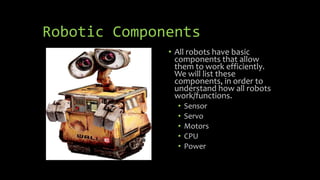
• All robots have basic
components that allow
them to work efficiently.
We will list these
components, in order to
understand how all robots
work/functions.
• Sensor
• Servo
• Motors
• CPU
• Power
Robotic Components
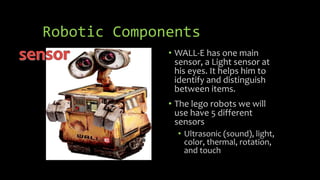
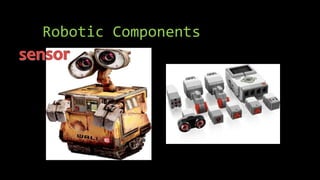
• WALL-E has one main
sensor, a Light sensor at
his eyes. It helps him to
identify and distinguish
between items.
• The lego robots we will
use have 5 different
sensors
• Ultrasonic (sound), light,
color, thermal, rotation,
and touch
Robotic Components
Robotic Components
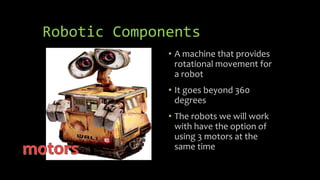
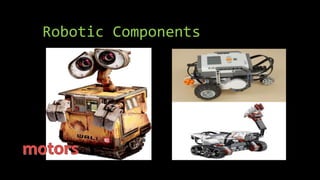
• A machine that provides
rotational movement for
a robot
• It goes beyond 360
degrees
• The robots we will work
with have the option of
using 3 motors at the
same time
Robotic Components
Robotic Components
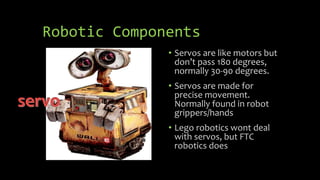
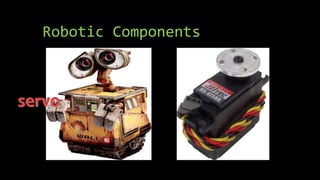
• Servos are like motors but
don’t pass 180 degrees,
normally 30-90 degrees.
• Servos are made for
precise movement.
Normally found in robot
grippers/hands
• Lego robotics wont deal
with servos, but FTC
robotics does
Robotic Components
Robotic Components
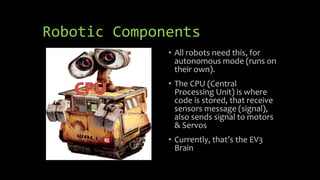
• All robots need this, for
autonomous mode (runs on
their own).
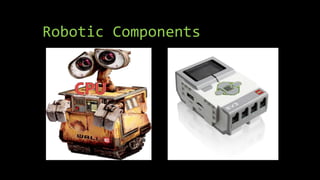
• The CPU (Central
Processing Unit) is where
code is stored, that receive
sensors message (signal),
also sends signal to motors
& Servos
• Currently, that’s the EV3
Brain
Robotic Components
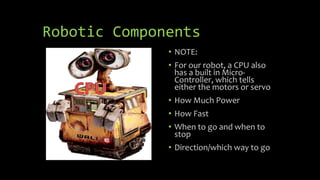
• NOTE:
• For our robot, a CPU also
has a built in Micro-
Controller, which tells
either the motors or servo
• How Much Power
• How Fast
• When to go and when to
stop
• Direction/which way to go
Robotic Components
Robotic Components
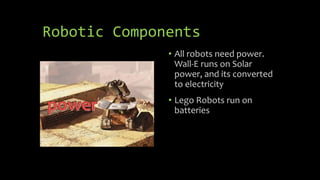
• All robots need power.
Wall-E runs on Solar
power, and its converted
to electricity
• Lego Robots run on
batteries
Design Challenge
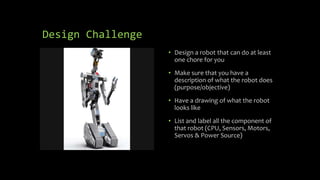
• Design a robot that can do at least
one chore for you
• Make sure that you have a
description of what the robot does
(purpose/objective)
• Have a drawing of what the robot
looks like
• List and label all the component of
that robot (CPU, Sensors, Motors,
Servos & Power Source)

003 mechanism pt 1 robotic components

  • 1.
  • 2.
    Robotic Components • Allrobots have basic components that allow them to work efficiently. We will list these components, in order to understand how all robots work/functions. • Sensor • Servo • Motors • CPU • Power
  • 3.
    Robotic Components • WALL-Ehas one main sensor, a Light sensor at his eyes. It helps him to identify and distinguish between items. • The lego robots we will use have 5 different sensors • Ultrasonic (sound), light, color, thermal, rotation, and touch
  • 4.
  • 5.
    Robotic Components • Amachine that provides rotational movement for a robot • It goes beyond 360 degrees • The robots we will work with have the option of using 3 motors at the same time
  • 6.
  • 7.
    Robotic Components • Servosare like motors but don’t pass 180 degrees, normally 30-90 degrees. • Servos are made for precise movement. Normally found in robot grippers/hands • Lego robotics wont deal with servos, but FTC robotics does
  • 8.
  • 9.
    Robotic Components • Allrobots need this, for autonomous mode (runs on their own). • The CPU (Central Processing Unit) is where code is stored, that receive sensors message (signal), also sends signal to motors & Servos • Currently, that’s the EV3 Brain
  • 10.
    Robotic Components • NOTE: •For our robot, a CPU also has a built in Micro- Controller, which tells either the motors or servo • How Much Power • How Fast • When to go and when to stop • Direction/which way to go
  • 11.
  • 12.
    Robotic Components • Allrobots need power. Wall-E runs on Solar power, and its converted to electricity • Lego Robots run on batteries
  • 13.
    Design Challenge • Designa robot that can do at least one chore for you • Make sure that you have a description of what the robot does (purpose/objective) • Have a drawing of what the robot looks like • List and label all the component of that robot (CPU, Sensors, Motors, Servos & Power Source)