Robot Architecture
Contents
Architecture
Parts of Robots
Robot Control loop
Robot Components
Life Cycle
3
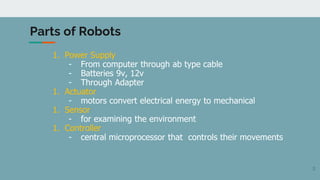
Parts of Robots
1. Power Supply
- From computer through ab type cable
- Batteries 9v, 12v
- Through Adapter
1. Actuator
- motors convert electrical energy to mechanical
1. Sensor
- for examining the environment
1. Controller
- central microprocessor that controls their movements
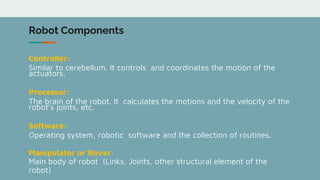
Robot Components
Controller:
Similar to cerebellum. It controls and coordinates the motion of the
actuators.
Processor:
The brain of the robot. It calculates the motions and the velocity of the
robot’s joints, etc.
Software:
Operating system, robotic software and the collection of routines.
Manipulator or Rover:
Main body of robot (Links, Joints, other structural element of the
robot)
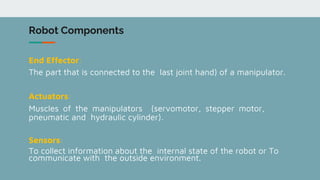
Robot Components
End Effector:
The part that is connected to the last joint hand) of a manipulator.
Actuators:
Muscles of the manipulators (servomotor, stepper motor,
pneumatic and hydraulic cylinder).
Sensors:
To collect information about the internal state of the robot or To
communicate with the outside environment.
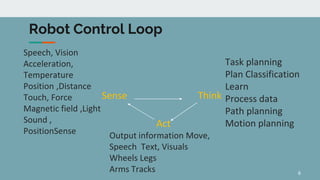
Speech, Vision
Acceleration,
Temperature
Position ,Distance
Touch, Force
Magnetic field ,Light
Sound ,
PositionSense
Task planning
Plan Classification
Learn
Process data
Path planning
Motion planning
Think
6
Sense
Act
Output information Move,
Speech Text, Visuals
Wheels Legs
Arms Tracks
Robot Control Loop
7
Artificial Intelligence
Artificial intelligence is the intelligence exhibited by
machines or software, and the branch of computer science
that develops machines and software with intelligence. Major
AI researchers and textbooks define the field as "the study
and design of intelligent agents",[where an intelligent agent is
a system that perceives its environment and takes actions
that maximize its chances of success.
John McCarthy, who coined the term in 1955,defines it as
"the science and engineering of making intelligent machines.
7
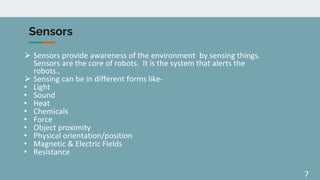
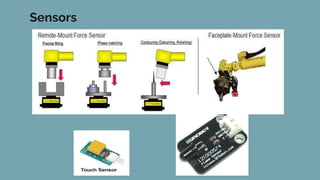
Sensors
⮚ Sensors provide awareness of the environment by sensing things.
Sensors are the core of robots. It is the system that alerts the
robots..
⮚ Sensing can be in different forms like-
• Light
• Sound
• Heat
• Chemicals
• Force
• Object proximity
• Physical orientation/position
• Magnetic & Electric Fields
• Resistance
Sensors
7
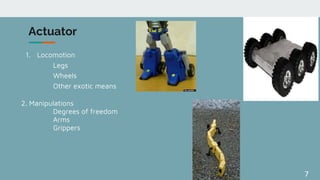
Actuator
1. Locomotion
Legs
Wheels
Other exotic means
2. Manipulations
Degrees of freedom
Arms
Grippers
7
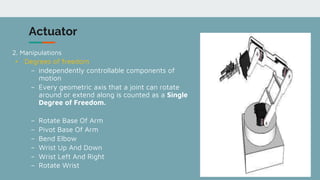
Actuator
2. Manipulations
• Degrees of freedom
– independently controllable components of
motion
– Every geometric axis that a joint can rotate
around or extend along is counted as a Single
Degree of Freedom.
– Rotate Base Of Arm
– Pivot Base Of Arm
– Bend Elbow
– Wrist Up And Down
– Wrist Left And Right
– Rotate Wrist
7
Actuator
2. Manipulations
• Arms
– more often used in fixed robots due to power & weight
– more difficult to control!
• due to extra degrees of freedom
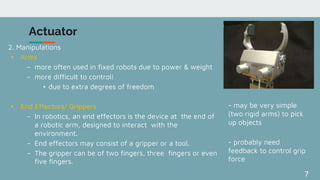
• End Effectors/ Grippers
– In robotics, an end effectors is the device at the end of
a robotic arm, designed to interact with the
environment.
– End effectors may consist of a gripper or a tool.
– The gripper can be of two fingers, three fingers or even
five fingers.
- may be very simple
(two rigid arms) to pick
up objects
- probably need
feedback to control grip
force
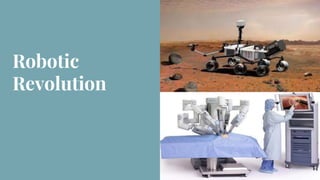
Robot Applications
1 EXPLORATION
Space Missions
Robots in the Antarctic
Exploring Volcanoes
Underwater
Exploration
2
MEDICAL
SCIENCE
Surgical Assistant
Handling
Assembly
Painting
Surveillance
Security (bomb disposal ,
etc)
Home help (grass
cutting, nursing)
3 FACTORIES
Robotic
Revolution
Robot Lifecycle
RPA development life cycle is a
blueprint that consists of the
processes of the organization
to be automated, the criteria to
follow, the deployment of a bot,
and constant monitoring once
the bot is in place.
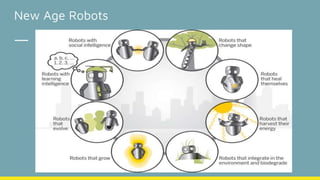
New Age Robots
17
Advantages
● Going to far away planets.
● Going far down into the unknown waters and mines where
humans would be crushed
● Giving us information that humans can't get
● Working at places 24/7 without any salary and food. Plus
they don't get bored
● They can perform tasks faster than humans and much more
consistently and accurately
● Most of them are automatic so they can go around by
themselves without any human interference.
18
Disadvantages
● People can lose jobs in factories
● It needs a supply of power
● It needs maintenance to keep it running .
● It costs money to make or buy a robot
Future Prospects
• Scientists say that it is possible that a robot brain will exist
by 2019 .
• Vernor Vinge has suggested that a moment may come when
computers and robots are smarter than humans.
• In 2009, some robots acquired various forms of semi-
autonomy, including being able to find power sources on
their own.
• The Association for the Advancement of Artificial
Intelligence has researched on this problem.

Robot Architecture.pptx

  • 1.
  • 2.
    Contents Architecture Parts of Robots RobotControl loop Robot Components Life Cycle
  • 3.
    3 Parts of Robots 1.Power Supply - From computer through ab type cable - Batteries 9v, 12v - Through Adapter 1. Actuator - motors convert electrical energy to mechanical 1. Sensor - for examining the environment 1. Controller - central microprocessor that controls their movements
  • 4.
    Robot Components Controller: Similar tocerebellum. It controls and coordinates the motion of the actuators. Processor: The brain of the robot. It calculates the motions and the velocity of the robot’s joints, etc. Software: Operating system, robotic software and the collection of routines. Manipulator or Rover: Main body of robot (Links, Joints, other structural element of the robot)
  • 5.
    Robot Components End Effector: Thepart that is connected to the last joint hand) of a manipulator. Actuators: Muscles of the manipulators (servomotor, stepper motor, pneumatic and hydraulic cylinder). Sensors: To collect information about the internal state of the robot or To communicate with the outside environment.
  • 6.
    Speech, Vision Acceleration, Temperature Position ,Distance Touch,Force Magnetic field ,Light Sound , PositionSense Task planning Plan Classification Learn Process data Path planning Motion planning Think 6 Sense Act Output information Move, Speech Text, Visuals Wheels Legs Arms Tracks Robot Control Loop
  • 7.
    7 Artificial Intelligence Artificial intelligenceis the intelligence exhibited by machines or software, and the branch of computer science that develops machines and software with intelligence. Major AI researchers and textbooks define the field as "the study and design of intelligent agents",[where an intelligent agent is a system that perceives its environment and takes actions that maximize its chances of success. John McCarthy, who coined the term in 1955,defines it as "the science and engineering of making intelligent machines.
  • 8.
    7 Sensors ⮚ Sensors provideawareness of the environment by sensing things. Sensors are the core of robots. It is the system that alerts the robots.. ⮚ Sensing can be in different forms like- • Light • Sound • Heat • Chemicals • Force • Object proximity • Physical orientation/position • Magnetic & Electric Fields • Resistance
  • 9.
  • 10.
    7 Actuator 1. Locomotion Legs Wheels Other exoticmeans 2. Manipulations Degrees of freedom Arms Grippers
  • 11.
    7 Actuator 2. Manipulations • Degreesof freedom – independently controllable components of motion – Every geometric axis that a joint can rotate around or extend along is counted as a Single Degree of Freedom. – Rotate Base Of Arm – Pivot Base Of Arm – Bend Elbow – Wrist Up And Down – Wrist Left And Right – Rotate Wrist
  • 12.
    7 Actuator 2. Manipulations • Arms –more often used in fixed robots due to power & weight – more difficult to control! • due to extra degrees of freedom • End Effectors/ Grippers – In robotics, an end effectors is the device at the end of a robotic arm, designed to interact with the environment. – End effectors may consist of a gripper or a tool. – The gripper can be of two fingers, three fingers or even five fingers. - may be very simple (two rigid arms) to pick up objects - probably need feedback to control grip force
  • 13.
    Robot Applications 1 EXPLORATION SpaceMissions Robots in the Antarctic Exploring Volcanoes Underwater Exploration 2 MEDICAL SCIENCE Surgical Assistant Handling Assembly Painting Surveillance Security (bomb disposal , etc) Home help (grass cutting, nursing) 3 FACTORIES
  • 14.
  • 15.
    Robot Lifecycle RPA developmentlife cycle is a blueprint that consists of the processes of the organization to be automated, the criteria to follow, the deployment of a bot, and constant monitoring once the bot is in place.
  • 16.
  • 17.
    17 Advantages ● Going tofar away planets. ● Going far down into the unknown waters and mines where humans would be crushed ● Giving us information that humans can't get ● Working at places 24/7 without any salary and food. Plus they don't get bored ● They can perform tasks faster than humans and much more consistently and accurately ● Most of them are automatic so they can go around by themselves without any human interference.
  • 18.
    18 Disadvantages ● People canlose jobs in factories ● It needs a supply of power ● It needs maintenance to keep it running . ● It costs money to make or buy a robot
  • 19.
    Future Prospects • Scientistssay that it is possible that a robot brain will exist by 2019 . • Vernor Vinge has suggested that a moment may come when computers and robots are smarter than humans. • In 2009, some robots acquired various forms of semi- autonomy, including being able to find power sources on their own. • The Association for the Advancement of Artificial Intelligence has researched on this problem.