Greedy Algorithm (0-1 Knapsack Problem)
Presented by :
Muskaan
Swati Rani
Presented to :
Ms. Pooja Jha
Introduction
 Greedy is an algorithmic paradigm that builds
up a solution piece by piece, always choosing
the next piece that offers the most obvious
and immediate benefit.
 So the problems where choosing locally
optimal also leads to global solution are best
fit for Greedy.
A Greedy algorithm works if a problem
exhibits the following two properties :
1. Greedy Choice Property
2. Optimal Substructure
Areas of Application
Greedy approach is used to solve many
problems , such as
 Finding the shortest path between two
vertices using Dijkstra’s algorithm
 Finding the minimal spanning tree in a
graph using Prim’s / Kruskal’s algorithm etc.
 Finding the maximum profit for the items to be
filled in a fixed weighted bag from Knapsack
algorithm
In general , Greedy algorithms have five
components :
1. A candidate set
2. A selection function
3. A feasibility function
4. An objective function
5. A solution function
Pros
 Finding solution is quite easy with Greedy
algorithm for a problem
 Analyzing the run time for Greedy algorithms
will generally be much easier than for other
techniques(like Divide and conquer)
Cons
 It is not suitable for problems where a solution
is required for every sub problem like sorting
 In such problems, the Greedy strategy can be
wrong ; in worst case even lead to a non-
optimal solution
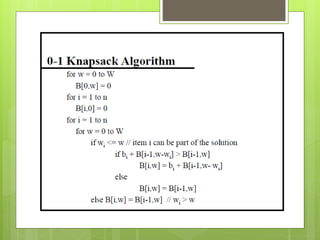
0-1 Knapsack Problem
 The problem is called a “0-1” problem,
because each item must be entirely accepted
or rejected
 Example : finding the least wasteful way to
cut raw materials, selection of investments
and portfolios.
0 1 knapsack problem(greedy algorithm)

0 1 knapsack problem(greedy algorithm)

  • 1.
    Greedy Algorithm (0-1Knapsack Problem) Presented by : Muskaan Swati Rani Presented to : Ms. Pooja Jha
  • 2.
    Introduction  Greedy isan algorithmic paradigm that builds up a solution piece by piece, always choosing the next piece that offers the most obvious and immediate benefit.  So the problems where choosing locally optimal also leads to global solution are best fit for Greedy.
  • 3.
    A Greedy algorithmworks if a problem exhibits the following two properties : 1. Greedy Choice Property 2. Optimal Substructure
  • 4.
    Areas of Application Greedyapproach is used to solve many problems , such as  Finding the shortest path between two vertices using Dijkstra’s algorithm  Finding the minimal spanning tree in a graph using Prim’s / Kruskal’s algorithm etc.  Finding the maximum profit for the items to be filled in a fixed weighted bag from Knapsack algorithm
  • 5.
    In general ,Greedy algorithms have five components : 1. A candidate set 2. A selection function 3. A feasibility function 4. An objective function 5. A solution function
  • 6.
    Pros  Finding solutionis quite easy with Greedy algorithm for a problem  Analyzing the run time for Greedy algorithms will generally be much easier than for other techniques(like Divide and conquer) Cons  It is not suitable for problems where a solution is required for every sub problem like sorting  In such problems, the Greedy strategy can be wrong ; in worst case even lead to a non- optimal solution
  • 7.
    0-1 Knapsack Problem The problem is called a “0-1” problem, because each item must be entirely accepted or rejected  Example : finding the least wasteful way to cut raw materials, selection of investments and portfolios.