Advisor :
Dr. Rajab Challoo
Team Members:
Shyam sunder Boddu-K00368501
Naresh Nadhendla-K00369367
Sirish Gangabathula-K00370898
Vamshi Drakshapally-K00381296
contents
• Introduction
• Wifi
• Lifi
• History
• Lifi working
• Comparison
• Flow chart
• Conclusion
• Future scope
Data communication
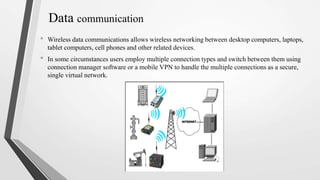
• Wireless data communications allows wireless networking between desktop computers, laptops,
tablet computers, cell phones and other related devices.
• In some circumstances users employ multiple connection types and switch between them using
connection manager software or a mobile VPN to handle the multiple connections as a secure,
single virtual network.
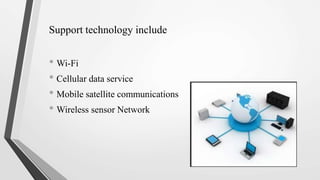
Support technology include
• Wi-Fi
• Cellular data service
• Mobile satellite communications
• Wireless sensor Network
WI-FI
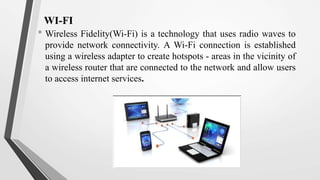
• Wireless Fidelity(Wi-Fi) is a technology that uses radio waves to
provide network connectivity. A Wi-Fi connection is established
using a wireless adapter to create hotspots - areas in the vicinity of
a wireless router that are connected to the network and allow users
to access internet services.
Over come the Wi-Fi Disadvantages
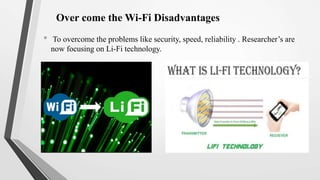
• To overcome the problems like security, speed, reliability . Researcher’s are
now focusing on Li-Fi technology.
LI-FI
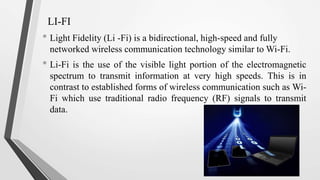
• Light Fidelity (Li -Fi) is a bidirectional, high-speed and fully
networked wireless communication technology similar to Wi-Fi.
• Li-Fi is the use of the visible light portion of the electromagnetic
spectrum to transmit information at very high speeds. This is in
contrast to established forms of wireless communication such as Wi-
Fi which use traditional radio frequency (RF) signals to transmit
data.
HISTORY
• Professor Harald Haas, coined the term "Li-Fi" at his 2011 TED
Global Talk where he introduced the idea of “Wireless data from every
light”. He is Chairman of Mobile Communications at the University of
Edinburgh and co-founder of pure Li-Fi.
• In April 2014, the Russian company Stins Coman
announced the development of a Li-Fi wireless local
network called Beam Caster. Their current module
transfers data at 1.25 gigabytes per second but they
foresee boosting speeds up to 5 GB/second in the
near future.
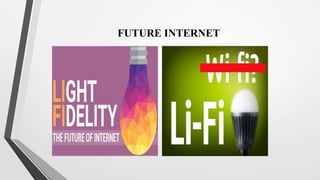
FUTURE INTERNET
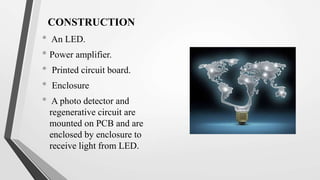
CONSTRUCTION
• An LED.
• Power amplifier.
• Printed circuit board.
• Enclosure
• A photo detector and
regenerative circuit are
mounted on PCB and are
enclosed by enclosure to
receive light from LED.
HOW IT WORKS ???
• Heart of Li-Fi technology is high brightness LEDs.
The led bulb will hold a micro chip that will do the
job of processing the data.
• Operational procedure is very simple, if the led is on,
you transmit a digital 1, if its off you transmit a 0.
The LED’s can be switched on and off very quickly,
which gives nice opportunities for transmitting data.
Hence all that us required is some LED’s and a
controller that code data into those LED’s.
POWER EFFICIENCY
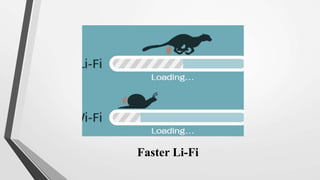
Faster Li-Fi
LIFI AT HOSPITALS
• You Might Just Live Longer For a long time, medical technology has
lagged behind the rest of the wireless world.
• Operating rooms do not allow Wi-Fi over radiation concerns, and there is
also that whole lack of dedicated spectrum.
• While Wi-Fi is in place in many hospitals , interference from cell phones
and computers can block signals from monitoring equipment.
• LI-FI solves both problems: lights are not only allowed in operating
rooms, but tend to be the most glaring (pun intended) fixtures in the room.
And, as Haas mentions in his TED Talk, Li-Fi has 10,000 times the
spectrum of Wi-Fi, so maybe we can delegate red light to priority medical
data. Code Red.
LIFI AT POWERPLANTS
• Like those surrounding power plants. But power plants need fast,
inter- connected data systems to monitor things like demand, grid
integrity and (in nuclear plants) core temperature.
• The savings from proper monitoring at a single power plant can add
up to hundreds of thousands of dollars.
• Li- Fi could offer safe, abundant connectivity for all areas of these
sensitive locations. Not only would this save money related to
currently implemented solutions, but the draw on a power plant’s
own reserves could be lessened if they haven’t yet converted.
Undersea Awesomeness
• Underwater ROVs, those favorite toys of treasure seekers and James
Cameron, operate from large cables that supply their power and allow
them to receive signals from their pilots above.
• ROVs work great, except when the tether isn’t long enough to
explore an area, or when it gets stuck on something.
• If their wires were cut and replaced with light — say from a
submerged, high-powered lamp — then they would be much freer to
explore.
• They could also use their headlamps to communicate with each other,
processing data autonomously and referring findings periodically back
to the surface, all the while obtaining their next batch of orders.
USES IN VARIOUS PLACES
• It can be used in the places where it is difficult to lay
the optical fiber like hospitals.
• In operation theatre Li- Fi can be used for modern
medical instruments.
• In traffic signals Li- Fi can be used which will
communicate with the LED lights of the cars and
accident numbers can be decreased.
• Thousand and millions of street lamps can be
transferred to Li-Fi lamps to transfer data.
• In aircraft Li- Fi can be used for data transmission.
• .
?
WHY Li Fi?
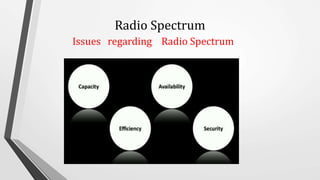
Radio Spectrum
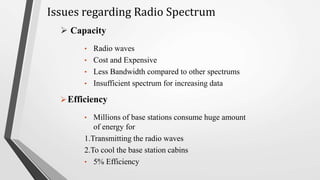
Issues regarding Radio Spectrum
 Capacity
• Radio waves
• Cost and Expensive
• Less Bandwidth compared to other spectrums
• Insufficient spectrum for increasing data
• Millions of base stations consume huge amount
of energy for
1.Transmitting the radio waves
2.To cool the base station cabins
• 5% Efficiency
Efficiency
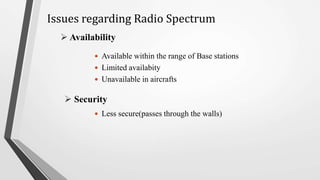
Issues regarding Radio Spectrum
 Availability
 Available within the range of Base stations
 Limited availabity
 Unavailable in aircrafts
 Less secure(passes through the walls)
 Security
Issues regarding Radio Spectrum
Comparison between Li-Fi and Wi-Fi:
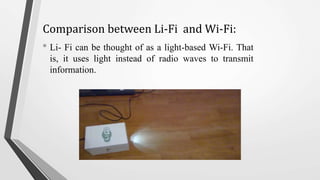
• Li- Fi can be thought of as a light-based Wi-Fi. That
is, it uses light instead of radio waves to transmit
information.
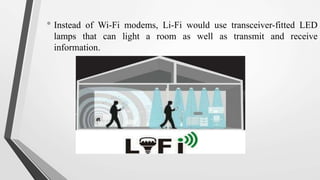
• Instead of Wi-Fi modems, Li-Fi would use transceiver-fitted LED
lamps that can light a room as well as transmit and receive
information.
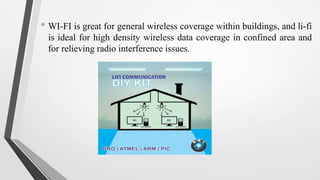
• WI-FI is great for general wireless coverage within buildings, and li-fi
is ideal for high density wireless data coverage in confined area and
for relieving radio interference issues.
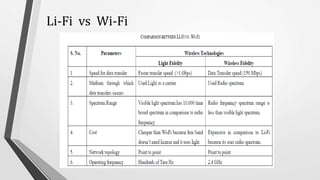
Li-Fi vs Wi-Fi
Serial Communication
• In serial communication, the data is sent one bit at a
time, in which the data is sent a byte or more at a time.
• It provides the data in byte-sized chunks, When
microprocessor communicates with the outside world.
• The baud rate in the ARM is programmable. This is
done with the help of timer 1.
ARM microcontroller
• The ARMv4 ISA which adds support for the 16-bit Thumb
instruction set.
• A 128-bit wide memory interface enable 32-bit code execution at
the maximum clock rate.
• The 16-bit Thumb alternative mode reduces code by more than
30% with minimal performance penalty.
Power supply:
• Connector:
2-pin screw terminal is basically a connector which is used to
interface power supply section with other circuits through wires.
• Bridge Rectifier:
W10 full wave bridge rectifier is used to convert incoming
AC signal into varying DC signal. i.e it consist of ripple at the
output.
• Filter capacitor:
Filter capacitor of 220 f at output of bridge rectifier is used to
provide less ripple at the output which is suitable for most electronic
circuits.
• Regulator:
Regulator IC is used to provide constant DC or smooth output with no
ripple
LIFI DATA TRANSMISSION
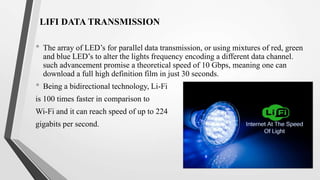
• The array of LED’s for parallel data transmission, or using mixtures of red, green
and blue LED’s to alter the lights frequency encoding a different data channel.
such advancement promise a theoretical speed of 10 Gbps, meaning one can
download a full high definition film in just 30 seconds.
• Being a bidirectional technology, Li-Fi
is 100 times faster in comparison to
Wi-Fi and it can reach speed of up to 224
gigabits per second.
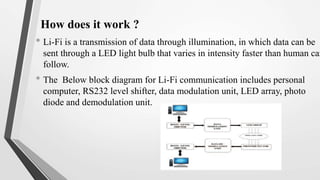
How does it work ?
• Li-Fi is a transmission of data through illumination, in which data can be
sent through a LED light bulb that varies in intensity faster than human can
follow.
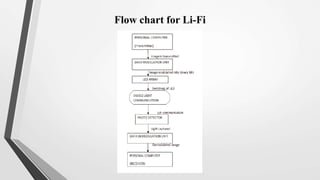
• The Below block diagram for Li-Fi communication includes personal
computer, RS232 level shifter, data modulation unit, LED array, photo
diode and demodulation unit.
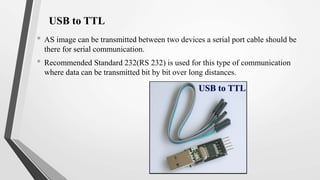
USB to TTL
• AS image can be transmitted between two devices a serial port cable should be
there for serial communication.
• Recommended Standard 232(RS 232) is used for this type of communication
where data can be transmitted bit by bit over long distances.
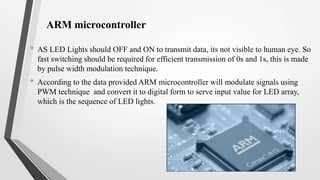
ARM microcontroller
• AS LED Lights should OFF and ON to transmit data, its not visible to human eye. So
fast switching should be required for efficient transmission of 0s and 1s, this is made
by pulse width modulation technique.
• According to the data provided ARM microcontroller will modulate signals using
PWM technique and convert it to digital form to serve input value for LED array,
which is the sequence of LED lights.
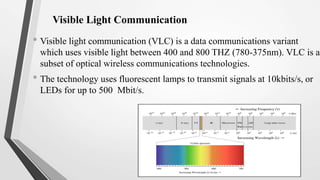
Visible Light Communication
• Visible light communication (VLC) is a data communications variant
which uses visible light between 400 and 800 THZ (780-375nm). VLC is a
subset of optical wireless communications technologies.
• The technology uses fluorescent lamps to transmit signals at 10kbits/s, or
LEDs for up to 500 Mbit/s.
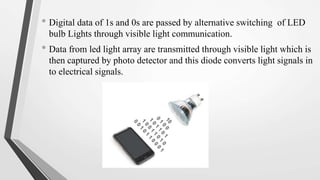
• Digital data of 1s and 0s are passed by alternative switching of LED
bulb Lights through visible light communication.
• Data from led light array are transmitted through visible light which is
then captured by photo detector and this diode converts light signals in
to electrical signals.
Modulation Techniques in Li-Fi
• Li-Fi uses visible light for sending data, it is necessary to modulate
the data into a signal which can be transmitted. These signal consist
of light pulses, some of the common modulation techniques used in
Li-Fi are
• OFDM
• OOK
• PWM
• PPM
• SIM-OFDM
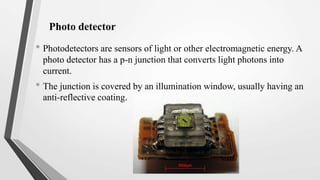
Photo detector
• Photodetectors are sensors of light or other electromagnetic energy. A
photo detector has a p-n junction that converts light photons into
current.
• The junction is covered by an illumination window, usually having an
anti-reflective coating.
Flow chart for Li-Fi
Li-Fi Transmitter
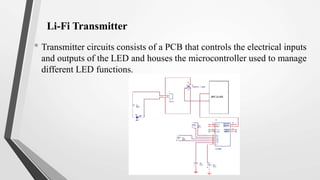
• Transmitter circuits consists of a PCB that controls the electrical inputs
and outputs of the LED and houses the microcontroller used to manage
different LED functions.
Li-Fi Receiver
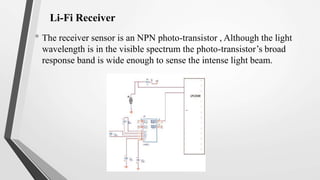
• The receiver sensor is an NPN photo-transistor , Although the light
wavelength is in the visible spectrum the photo-transistor’s broad
response band is wide enough to sense the intense light beam.
Result:
• The goal of transmitter part is to transmit image and the goal of receiving
part is to receive the image that is transmitted from the transmitted
successfully.
Advantages:
• Efficiency
• Availability
• Security
• Data rate greater than 10 Gbps
• Can be used anywhere, even in RF restricted areas
• Mostly LED light bulbs are used
• As light waves cannot penetrate through walls, the data cannot be intercepted;
Thus provides secured communication.
• quick and reliable.
Disadvantages:
• Internet cannot be used without a light source.
• the signal's range is limited by physical barriers.
• Other sources of light may interfere with the signal.
• A whole new infrastructure for Li-Fi would need to be constructed.
• Though it draws low power, in order to avail lifi internet services, lights need
to be kept ON throughout day and night. As internet is need of the hour, this
will waste energy more than any other internet system.
• One can not watch games and videos on internet in the dark during night
before sleeping on the bed.
Continues:
Applications:
• Dense urban environments
• Cellular communication
• EMI sensitive environments
• Augmented reality
• Safety environments
• Intelligent transportation systems
• Connectivity
• Sensitive data
Limitations:
Li-Fi technology is not without drawbacks. As there is Inability of light to penetrate solid
surfaces, so transmitter and receiver need to be aligned in order to establish a peer to peer
connection.
Service Providers while providing VLC services has to consider major issues like
reliability and availability of system. Companies also need to consider how to maintain
coverage area of network.
Limitations:
• The communication can be restricted due to the Interferences coming from
different sources for example sun light, normal bulbs and any non-
transparent materials in the path of transmission. VLC system has high
Initial Installation cost but when it is implemented at large scale area it can
accommodate us by its less operating cost like electricity bills ,less
operational staff and limited maintenance charges as compare to RF
system.
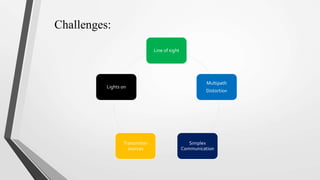
Challenges:
Line of sight
Multipath
Distortion
Simplex
Communication
Transmitter
sources
Lights on
Future Scope:
India - With the growing population (1.252 billion) and number of internet users (402
million) in India, we are definitely running out of space. By 2019, it is estimated that the
world will be exchanging roughly 35 quintillion bytes of information each month.
Since, radio frequencies are already in use and heavily regulated, that data is going to
struggle to find a spot in line. Given the situation, Li-Fi will be crucial for India. Li-Fi is
till in its nascent stage but the scope for it is limitless.
Conclusion:
• It assures data speed of 100gbps which is entirely greater than radio waves.
• The goal of this paper is LiFi provides secured ,low cost ,easy data transmission
and provides reliable communication.
• It can also be used in industrial ,medical, military applications.
• In spite of the research problems it is our belief that the VLC system will become
one of the most promising technologies for the future generation in optical
wireless communication.
• LiFi is still in its beginning stages, but improvements are being made rapidly, and
soon this technology will be able to be used in our daily lives.
References:
[1] “A Visible Light Communication System for Indoor Application” Amrutha.S, Ansu Mathew,
Rajasree.R, Swarthy Sugathan; Aravind.S, International Journal of Engineering and Innovative
Technology (IJEIT) Volume 3, Issue 12, June 2014.
[2] Abhishek Kurup, Vipin Tiwari, Selvanathiya (2014), ‘Implementation And Demonstration Of Li-Fi
Technology’, International Journal of Research in Engineering and Technology eISSN: 2319-1163 |
pISSN: 2321-7308.
[3] Akshata m sonnad (2013), ‘Led Recent Advancements In Li-Fi Technology’, International Journal
of Electrical, Electronics and Data Communication, ISSN: 2320-2084 Volume-1, Issue-10, Dec-2013.
[4] Anurag Sarkar (2015), ‘Li-Fi Technology: Data Transmission through Visible Light’, International
Journal of Advance Research in Computer Science and Management Studies Volume 3, Issue 6, June
2015
Lifi data transmission

Lifi data transmission

  • 1.
    Advisor : Dr. RajabChalloo Team Members: Shyam sunder Boddu-K00368501 Naresh Nadhendla-K00369367 Sirish Gangabathula-K00370898 Vamshi Drakshapally-K00381296
  • 2.
    contents • Introduction • Wifi •Lifi • History • Lifi working • Comparison • Flow chart • Conclusion • Future scope
  • 3.
    Data communication • Wirelessdata communications allows wireless networking between desktop computers, laptops, tablet computers, cell phones and other related devices. • In some circumstances users employ multiple connection types and switch between them using connection manager software or a mobile VPN to handle the multiple connections as a secure, single virtual network.
  • 4.
    Support technology include •Wi-Fi • Cellular data service • Mobile satellite communications • Wireless sensor Network
  • 5.
    WI-FI • Wireless Fidelity(Wi-Fi)is a technology that uses radio waves to provide network connectivity. A Wi-Fi connection is established using a wireless adapter to create hotspots - areas in the vicinity of a wireless router that are connected to the network and allow users to access internet services.
  • 6.
    Over come theWi-Fi Disadvantages • To overcome the problems like security, speed, reliability . Researcher’s are now focusing on Li-Fi technology.
  • 7.
    LI-FI • Light Fidelity(Li -Fi) is a bidirectional, high-speed and fully networked wireless communication technology similar to Wi-Fi. • Li-Fi is the use of the visible light portion of the electromagnetic spectrum to transmit information at very high speeds. This is in contrast to established forms of wireless communication such as Wi- Fi which use traditional radio frequency (RF) signals to transmit data.
  • 8.
    HISTORY • Professor HaraldHaas, coined the term "Li-Fi" at his 2011 TED Global Talk where he introduced the idea of “Wireless data from every light”. He is Chairman of Mobile Communications at the University of Edinburgh and co-founder of pure Li-Fi. • In April 2014, the Russian company Stins Coman announced the development of a Li-Fi wireless local network called Beam Caster. Their current module transfers data at 1.25 gigabytes per second but they foresee boosting speeds up to 5 GB/second in the near future.
  • 9.
  • 10.
    CONSTRUCTION • An LED. •Power amplifier. • Printed circuit board. • Enclosure • A photo detector and regenerative circuit are mounted on PCB and are enclosed by enclosure to receive light from LED.
  • 11.
    HOW IT WORKS??? • Heart of Li-Fi technology is high brightness LEDs. The led bulb will hold a micro chip that will do the job of processing the data. • Operational procedure is very simple, if the led is on, you transmit a digital 1, if its off you transmit a 0. The LED’s can be switched on and off very quickly, which gives nice opportunities for transmitting data. Hence all that us required is some LED’s and a controller that code data into those LED’s.
  • 12.
  • 13.
  • 14.
    LIFI AT HOSPITALS •You Might Just Live Longer For a long time, medical technology has lagged behind the rest of the wireless world. • Operating rooms do not allow Wi-Fi over radiation concerns, and there is also that whole lack of dedicated spectrum. • While Wi-Fi is in place in many hospitals , interference from cell phones and computers can block signals from monitoring equipment. • LI-FI solves both problems: lights are not only allowed in operating rooms, but tend to be the most glaring (pun intended) fixtures in the room. And, as Haas mentions in his TED Talk, Li-Fi has 10,000 times the spectrum of Wi-Fi, so maybe we can delegate red light to priority medical data. Code Red.
  • 15.
    LIFI AT POWERPLANTS •Like those surrounding power plants. But power plants need fast, inter- connected data systems to monitor things like demand, grid integrity and (in nuclear plants) core temperature. • The savings from proper monitoring at a single power plant can add up to hundreds of thousands of dollars. • Li- Fi could offer safe, abundant connectivity for all areas of these sensitive locations. Not only would this save money related to currently implemented solutions, but the draw on a power plant’s own reserves could be lessened if they haven’t yet converted.
  • 16.
    Undersea Awesomeness • UnderwaterROVs, those favorite toys of treasure seekers and James Cameron, operate from large cables that supply their power and allow them to receive signals from their pilots above. • ROVs work great, except when the tether isn’t long enough to explore an area, or when it gets stuck on something. • If their wires were cut and replaced with light — say from a submerged, high-powered lamp — then they would be much freer to explore. • They could also use their headlamps to communicate with each other, processing data autonomously and referring findings periodically back to the surface, all the while obtaining their next batch of orders.
  • 17.
    USES IN VARIOUSPLACES • It can be used in the places where it is difficult to lay the optical fiber like hospitals. • In operation theatre Li- Fi can be used for modern medical instruments. • In traffic signals Li- Fi can be used which will communicate with the LED lights of the cars and accident numbers can be decreased. • Thousand and millions of street lamps can be transferred to Li-Fi lamps to transfer data. • In aircraft Li- Fi can be used for data transmission. • .
  • 18.
  • 19.
  • 20.
     Capacity • Radiowaves • Cost and Expensive • Less Bandwidth compared to other spectrums • Insufficient spectrum for increasing data • Millions of base stations consume huge amount of energy for 1.Transmitting the radio waves 2.To cool the base station cabins • 5% Efficiency Efficiency Issues regarding Radio Spectrum
  • 21.
     Availability  Availablewithin the range of Base stations  Limited availabity  Unavailable in aircrafts  Less secure(passes through the walls)  Security Issues regarding Radio Spectrum
  • 22.
    Comparison between Li-Fiand Wi-Fi: • Li- Fi can be thought of as a light-based Wi-Fi. That is, it uses light instead of radio waves to transmit information.
  • 23.
    • Instead ofWi-Fi modems, Li-Fi would use transceiver-fitted LED lamps that can light a room as well as transmit and receive information.
  • 24.
    • WI-FI isgreat for general wireless coverage within buildings, and li-fi is ideal for high density wireless data coverage in confined area and for relieving radio interference issues.
  • 25.
  • 26.
    Serial Communication • Inserial communication, the data is sent one bit at a time, in which the data is sent a byte or more at a time. • It provides the data in byte-sized chunks, When microprocessor communicates with the outside world. • The baud rate in the ARM is programmable. This is done with the help of timer 1.
  • 27.
    ARM microcontroller • TheARMv4 ISA which adds support for the 16-bit Thumb instruction set. • A 128-bit wide memory interface enable 32-bit code execution at the maximum clock rate. • The 16-bit Thumb alternative mode reduces code by more than 30% with minimal performance penalty.
  • 28.
  • 29.
    • Connector: 2-pin screwterminal is basically a connector which is used to interface power supply section with other circuits through wires. • Bridge Rectifier: W10 full wave bridge rectifier is used to convert incoming AC signal into varying DC signal. i.e it consist of ripple at the output.
  • 30.
    • Filter capacitor: Filtercapacitor of 220 f at output of bridge rectifier is used to provide less ripple at the output which is suitable for most electronic circuits. • Regulator: Regulator IC is used to provide constant DC or smooth output with no ripple
  • 31.
    LIFI DATA TRANSMISSION •The array of LED’s for parallel data transmission, or using mixtures of red, green and blue LED’s to alter the lights frequency encoding a different data channel. such advancement promise a theoretical speed of 10 Gbps, meaning one can download a full high definition film in just 30 seconds. • Being a bidirectional technology, Li-Fi is 100 times faster in comparison to Wi-Fi and it can reach speed of up to 224 gigabits per second.
  • 32.
    How does itwork ? • Li-Fi is a transmission of data through illumination, in which data can be sent through a LED light bulb that varies in intensity faster than human can follow. • The Below block diagram for Li-Fi communication includes personal computer, RS232 level shifter, data modulation unit, LED array, photo diode and demodulation unit.
  • 33.
    USB to TTL •AS image can be transmitted between two devices a serial port cable should be there for serial communication. • Recommended Standard 232(RS 232) is used for this type of communication where data can be transmitted bit by bit over long distances.
  • 34.
    ARM microcontroller • ASLED Lights should OFF and ON to transmit data, its not visible to human eye. So fast switching should be required for efficient transmission of 0s and 1s, this is made by pulse width modulation technique. • According to the data provided ARM microcontroller will modulate signals using PWM technique and convert it to digital form to serve input value for LED array, which is the sequence of LED lights.
  • 35.
    Visible Light Communication •Visible light communication (VLC) is a data communications variant which uses visible light between 400 and 800 THZ (780-375nm). VLC is a subset of optical wireless communications technologies. • The technology uses fluorescent lamps to transmit signals at 10kbits/s, or LEDs for up to 500 Mbit/s.
  • 36.
    • Digital dataof 1s and 0s are passed by alternative switching of LED bulb Lights through visible light communication. • Data from led light array are transmitted through visible light which is then captured by photo detector and this diode converts light signals in to electrical signals.
  • 37.
    Modulation Techniques inLi-Fi • Li-Fi uses visible light for sending data, it is necessary to modulate the data into a signal which can be transmitted. These signal consist of light pulses, some of the common modulation techniques used in Li-Fi are • OFDM • OOK • PWM • PPM • SIM-OFDM
  • 38.
    Photo detector • Photodetectorsare sensors of light or other electromagnetic energy. A photo detector has a p-n junction that converts light photons into current. • The junction is covered by an illumination window, usually having an anti-reflective coating.
  • 39.
  • 40.
    Li-Fi Transmitter • Transmittercircuits consists of a PCB that controls the electrical inputs and outputs of the LED and houses the microcontroller used to manage different LED functions.
  • 41.
    Li-Fi Receiver • Thereceiver sensor is an NPN photo-transistor , Although the light wavelength is in the visible spectrum the photo-transistor’s broad response band is wide enough to sense the intense light beam.
  • 42.
    Result: • The goalof transmitter part is to transmit image and the goal of receiving part is to receive the image that is transmitted from the transmitted successfully.
  • 43.
    Advantages: • Efficiency • Availability •Security • Data rate greater than 10 Gbps • Can be used anywhere, even in RF restricted areas • Mostly LED light bulbs are used • As light waves cannot penetrate through walls, the data cannot be intercepted; Thus provides secured communication. • quick and reliable.
  • 44.
    Disadvantages: • Internet cannotbe used without a light source. • the signal's range is limited by physical barriers. • Other sources of light may interfere with the signal. • A whole new infrastructure for Li-Fi would need to be constructed.
  • 45.
    • Though itdraws low power, in order to avail lifi internet services, lights need to be kept ON throughout day and night. As internet is need of the hour, this will waste energy more than any other internet system. • One can not watch games and videos on internet in the dark during night before sleeping on the bed. Continues:
  • 46.
    Applications: • Dense urbanenvironments • Cellular communication • EMI sensitive environments • Augmented reality • Safety environments • Intelligent transportation systems • Connectivity • Sensitive data
  • 47.
    Limitations: Li-Fi technology isnot without drawbacks. As there is Inability of light to penetrate solid surfaces, so transmitter and receiver need to be aligned in order to establish a peer to peer connection. Service Providers while providing VLC services has to consider major issues like reliability and availability of system. Companies also need to consider how to maintain coverage area of network.
  • 48.
    Limitations: • The communicationcan be restricted due to the Interferences coming from different sources for example sun light, normal bulbs and any non- transparent materials in the path of transmission. VLC system has high Initial Installation cost but when it is implemented at large scale area it can accommodate us by its less operating cost like electricity bills ,less operational staff and limited maintenance charges as compare to RF system.
  • 49.
  • 50.
    Future Scope: India -With the growing population (1.252 billion) and number of internet users (402 million) in India, we are definitely running out of space. By 2019, it is estimated that the world will be exchanging roughly 35 quintillion bytes of information each month. Since, radio frequencies are already in use and heavily regulated, that data is going to struggle to find a spot in line. Given the situation, Li-Fi will be crucial for India. Li-Fi is till in its nascent stage but the scope for it is limitless.
  • 51.
    Conclusion: • It assuresdata speed of 100gbps which is entirely greater than radio waves. • The goal of this paper is LiFi provides secured ,low cost ,easy data transmission and provides reliable communication. • It can also be used in industrial ,medical, military applications. • In spite of the research problems it is our belief that the VLC system will become one of the most promising technologies for the future generation in optical wireless communication. • LiFi is still in its beginning stages, but improvements are being made rapidly, and soon this technology will be able to be used in our daily lives.
  • 52.
    References: [1] “A VisibleLight Communication System for Indoor Application” Amrutha.S, Ansu Mathew, Rajasree.R, Swarthy Sugathan; Aravind.S, International Journal of Engineering and Innovative Technology (IJEIT) Volume 3, Issue 12, June 2014. [2] Abhishek Kurup, Vipin Tiwari, Selvanathiya (2014), ‘Implementation And Demonstration Of Li-Fi Technology’, International Journal of Research in Engineering and Technology eISSN: 2319-1163 | pISSN: 2321-7308. [3] Akshata m sonnad (2013), ‘Led Recent Advancements In Li-Fi Technology’, International Journal of Electrical, Electronics and Data Communication, ISSN: 2320-2084 Volume-1, Issue-10, Dec-2013. [4] Anurag Sarkar (2015), ‘Li-Fi Technology: Data Transmission through Visible Light’, International Journal of Advance Research in Computer Science and Management Studies Volume 3, Issue 6, June 2015