PRESENTATION
ON
OUTLINES
• Introduction
• What is injection safety?
• Medication Preparation.
• SINGLE-DOSE/SINGLE-USE VIALS
• Summary
INTRODUCTION
Injected medicines are commonly
used in healthcare settings for the
prevention, diagnosis, and treatment of
various illnesses.
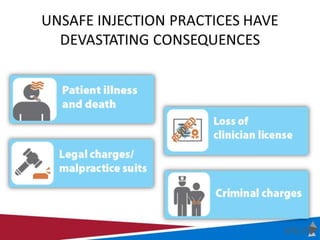
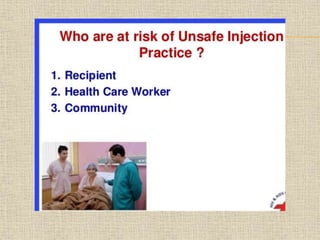
Unsafe injection practices put
patients and healthcare providers at risk
of infectious and non-infectious adverse
events.
DEFINITION
A set of specific practices and
procedures performed under
carefully controlled conditions with
the goal of minimizing
contamination
WHAT IS INJECTION
SAFETY?
• Injection safety, or safe injection
practices, is a set of measures taken to
perform injections in an optimally safe
manner for patients, healthcare personnel,
and others.
• „Prevent transmission of infections
from:
–Patient to patient.
–Patient to provider.
–Provider to patient.
• „Prevent harms such as needlestick
injuries
SINGLE DOSE VIAL
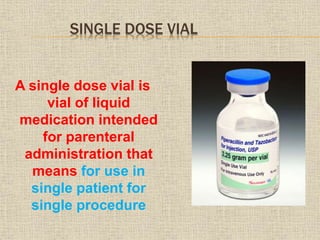
A single dose vial is
vial of liquid
medication intended
for parenteral
administration that
means for use in
single patient for
single procedure
SINGLE-DOSE/SINGLE-USE VIALS
?What is a single-dose or single-use vial
A single-dose or single-use vial is a vial of liquid medication
intended for parenteral administration (injection or
infusion) that is meant for use in a single patient for a
single case/procedure/injection
Single-dose or single-use vials are labeled as such by the
manufacturer and typically lack an antimicrobial preservative
Can single-dose or single-use vials be
used for more than one patient ?
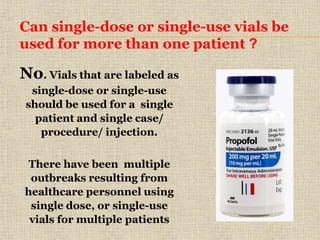
No. Vials that are labeled as
single-dose or single-use
should be used for a single
patient and single case/
procedure/ injection.
There have been multiple
outbreaks resulting from
healthcare personnel using
single dose, or single-use
vials for multiple patients
When should single-dose or
Single-use vials be discarded ?
 Medication vials should always be discardedwhenever
sterility is compromised or questionable.
 In addition, the following recommendations are made for
handling of single-dose or single-use vials:
 If a single-dose or single-use vial has been opened or accessed (e.g., needle-
punctured) the vial should be discarded according to the time the manufacturer
specifies for the opened vial or at the
 end of the case/procedure for which it is being used, whichever comes first. It
should not be stored for future use.
 If a single-dose or single-use vial has not been opened or accessed (e.g., needle-
punctured), it should be discarded according to the manufacturer’s expiration date.
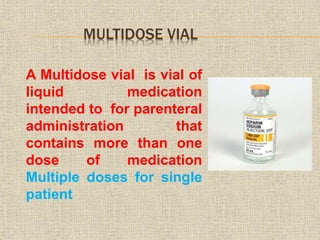
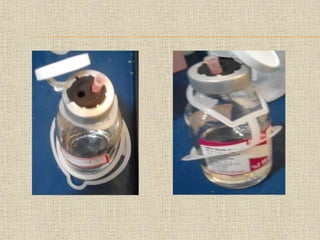
MULTIDOSE VIAL
A Multidose vial is vial of
liquid medication
intended to for parenteral
administration that
contains more than one
dose of medication
Multiple doses for single
patient
ARE WE USING THE MULTI DOSE VIALS ONLY
ON A SINGLE PATIENT
?
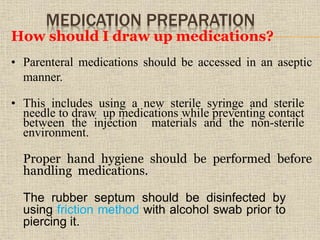
MEDICATION PREPARATION
How should I draw up medications?
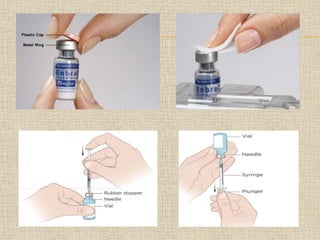
• Parenteral medications should be accessed in an aseptic
manner.
• This includes using a new sterile syringe and sterile
needle to draw up medications while preventing contact
between the injection materials and the non-sterile
environment.
Proper hand hygiene should be performed before
handling medications.
The rubber septum should be disinfected by
using friction method with alcohol swab prior to
piercing it.
WHERE SHOULD I DRAW UP MEDICATIONS?
1. Medications should be drawn up in a
designated clean medication area that is
not adjacent to areas where potentially
contaminated items are placed.
1. In general, any item that could have come
in contact with blood or body fluids should
not be in the medication preparation area.
 Is it acceptable to leave a needle or other
device inserted in the septum of a medication
vial for multiple medication draws?
 No. A needle or other device should never be left
inserted into a medication vial septum for multiple
uses.
This provides a direct route for microorganisms to
enter the vial and contaminate the fluid.
 IS IT ACCEPTABLE TO USE A SYRINGE (THAT HAS NOT
BEEN USED ON A PATIENT) TO DRAW UP AND MIX
CONTENTS FROM MULTIPLE MEDICATION VIALS?
• The safest practice is to always enter a medication vial with a sterile
needle and sterile syringe.
• There has been at least one outbreak attributed to healthcare personnel
using a common needle and syringe to access multiple multi-dose vials
for the purpose of combining their contents into a single syringe.
• If one vial becomes contaminated, this practice can spread
contamination to the others, prolonging presence of the pathogen and
increasing the potential for disease transmission. Syringe reuse in this
fashion may also have been a factor in additional outbreaks.
•
•
•
Injection safety guidelines from CDC
Never administer medications from the same syringe to more than one
patient, even if the needle is changed.
After a syringe or needle has been used to enter or connect to a patient’s
IV it is contaminated and should not be used on another patient or to
enter a medication vial.
Never enter a vial with a used syringe or needle.
• Never use medications packaged as single dose vials for more than one
patient.
• Assign medications packaged as multi-dose vials to a single patient
whenever possible.
• Do not use bags or bottles of intravenous solution as a common source of
supply for more than one patient
• Follow proper infection control practices during the preparation and
administration of injected medications.
• Wear a surgical mask when placing a catheter or injecting material into
the spinal canal or subdural space.
THIS HARM IS PREVENTABLE
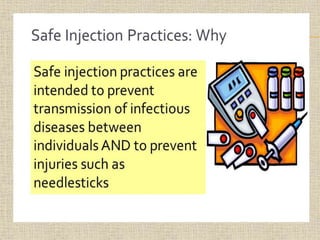
• Safe injection practices are now a part of Standard Precautions
and are aimed at maintaining basic levels of patient safety and
provider protections.
• A safe injection does not harm the recipient, does not expose the
provider to any avoidable risks and does not result in waste that is
dangerous for the community.
Three Things Every Provider Needs to
Know About Injection Safety
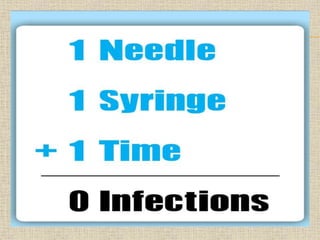
1.Needles and syringes are single use
devices. They should not be used for
more than one patient or reused to draw
up additional medication.
2. Do not administer medications from a
single-dose vial or IV bag to multiple
patients.
3. Limit the use of multi-dose vials and
dedicate them to a single patient
whenever possible.
Safe injection practice, INJECTION SAFETY

Safe injection practice, INJECTION SAFETY

  • 1.
  • 2.
    OUTLINES • Introduction • Whatis injection safety? • Medication Preparation. • SINGLE-DOSE/SINGLE-USE VIALS • Summary
  • 3.
    INTRODUCTION Injected medicines arecommonly used in healthcare settings for the prevention, diagnosis, and treatment of various illnesses. Unsafe injection practices put patients and healthcare providers at risk of infectious and non-infectious adverse events.
  • 4.
    DEFINITION A set ofspecific practices and procedures performed under carefully controlled conditions with the goal of minimizing contamination
  • 5.
    WHAT IS INJECTION SAFETY? •Injection safety, or safe injection practices, is a set of measures taken to perform injections in an optimally safe manner for patients, healthcare personnel, and others. • „Prevent transmission of infections from: –Patient to patient. –Patient to provider. –Provider to patient. • „Prevent harms such as needlestick injuries
  • 10.
    SINGLE DOSE VIAL Asingle dose vial is vial of liquid medication intended for parenteral administration that means for use in single patient for single procedure
  • 11.
    SINGLE-DOSE/SINGLE-USE VIALS ?What isa single-dose or single-use vial A single-dose or single-use vial is a vial of liquid medication intended for parenteral administration (injection or infusion) that is meant for use in a single patient for a single case/procedure/injection Single-dose or single-use vials are labeled as such by the manufacturer and typically lack an antimicrobial preservative
  • 12.
    Can single-dose orsingle-use vials be used for more than one patient ? No. Vials that are labeled as single-dose or single-use should be used for a single patient and single case/ procedure/ injection. There have been multiple outbreaks resulting from healthcare personnel using single dose, or single-use vials for multiple patients
  • 13.
    When should single-doseor Single-use vials be discarded ?  Medication vials should always be discardedwhenever sterility is compromised or questionable.  In addition, the following recommendations are made for handling of single-dose or single-use vials:  If a single-dose or single-use vial has been opened or accessed (e.g., needle- punctured) the vial should be discarded according to the time the manufacturer specifies for the opened vial or at the  end of the case/procedure for which it is being used, whichever comes first. It should not be stored for future use.  If a single-dose or single-use vial has not been opened or accessed (e.g., needle- punctured), it should be discarded according to the manufacturer’s expiration date.
  • 14.
    MULTIDOSE VIAL A Multidosevial is vial of liquid medication intended to for parenteral administration that contains more than one dose of medication Multiple doses for single patient
  • 18.
    ARE WE USINGTHE MULTI DOSE VIALS ONLY ON A SINGLE PATIENT ?
  • 19.
    MEDICATION PREPARATION How shouldI draw up medications? • Parenteral medications should be accessed in an aseptic manner. • This includes using a new sterile syringe and sterile needle to draw up medications while preventing contact between the injection materials and the non-sterile environment. Proper hand hygiene should be performed before handling medications. The rubber septum should be disinfected by using friction method with alcohol swab prior to piercing it.
  • 21.
    WHERE SHOULD IDRAW UP MEDICATIONS? 1. Medications should be drawn up in a designated clean medication area that is not adjacent to areas where potentially contaminated items are placed. 1. In general, any item that could have come in contact with blood or body fluids should not be in the medication preparation area.
  • 23.
     Is itacceptable to leave a needle or other device inserted in the septum of a medication vial for multiple medication draws?  No. A needle or other device should never be left inserted into a medication vial septum for multiple uses. This provides a direct route for microorganisms to enter the vial and contaminate the fluid.
  • 25.
     IS ITACCEPTABLE TO USE A SYRINGE (THAT HAS NOT BEEN USED ON A PATIENT) TO DRAW UP AND MIX CONTENTS FROM MULTIPLE MEDICATION VIALS? • The safest practice is to always enter a medication vial with a sterile needle and sterile syringe. • There has been at least one outbreak attributed to healthcare personnel using a common needle and syringe to access multiple multi-dose vials for the purpose of combining their contents into a single syringe. • If one vial becomes contaminated, this practice can spread contamination to the others, prolonging presence of the pathogen and increasing the potential for disease transmission. Syringe reuse in this fashion may also have been a factor in additional outbreaks.
  • 28.
    • • • Injection safety guidelinesfrom CDC Never administer medications from the same syringe to more than one patient, even if the needle is changed. After a syringe or needle has been used to enter or connect to a patient’s IV it is contaminated and should not be used on another patient or to enter a medication vial. Never enter a vial with a used syringe or needle. • Never use medications packaged as single dose vials for more than one patient. • Assign medications packaged as multi-dose vials to a single patient whenever possible. • Do not use bags or bottles of intravenous solution as a common source of supply for more than one patient • Follow proper infection control practices during the preparation and administration of injected medications. • Wear a surgical mask when placing a catheter or injecting material into the spinal canal or subdural space.
  • 29.
    THIS HARM ISPREVENTABLE • Safe injection practices are now a part of Standard Precautions and are aimed at maintaining basic levels of patient safety and provider protections. • A safe injection does not harm the recipient, does not expose the provider to any avoidable risks and does not result in waste that is dangerous for the community.
  • 30.
    Three Things EveryProvider Needs to Know About Injection Safety 1.Needles and syringes are single use devices. They should not be used for more than one patient or reused to draw up additional medication. 2. Do not administer medications from a single-dose vial or IV bag to multiple patients. 3. Limit the use of multi-dose vials and dedicate them to a single patient whenever possible.