Correcting Popularity Bias 
by Enhancing Recommendation Neutrality 
Toshihiro Kamishima*, Shotaro Akaho*, Hideki Asoh*, and Jun Sakuma** 
*National Institute of Advanced Industrial Science and Technology (AIST), Japan 
**University of Tsukuba, Japan 
The 8th ACM Conference on Recommender Systems, Poster 
@ Silicon Valley (Foster City), U.S.A., Oct. 8, 2014 
START 1
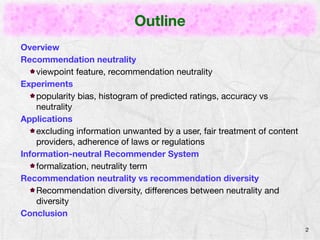
Outline 
Overview 
Recommendation neutrality 
viewpoint feature, recommendation neutrality 
Experiments 
popularity bias, histogram of predicted ratings, accuracy vs 
neutrality 
Applications 
excluding information unwanted by a user, fair treatment of content 
providers, adherence of laws or regulations 
Information-neutral Recommender System 
formalization, neutrality term 
Recommendation neutrality vs recommendation diversity 
Recommendation diversity, differences between neutrality and 
diversity 
Conclusion 
2
Overview 
3 
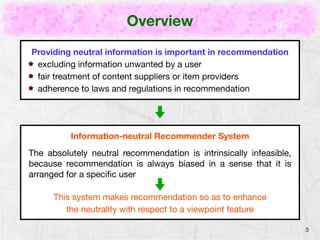
Providing neutral information is important in recommendation 
excluding information unwanted by a user 
fair treatment of content suppliers or item providers 
adherence to laws and regulations in recommendation 
Information-neutral Recommender System 
The absolutely neutral recommendation is intrinsically infeasible, 
because recommendation is always biased in a sense that it is 
arranged for a specific user 
↓ 
This system makes recommendation so as to enhance 
neutrality with respect to a viewpoint feature
Viewpoint Feature 
4 
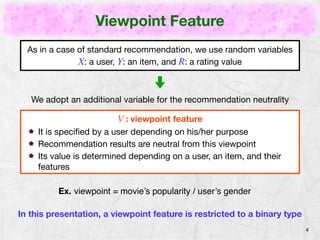
As in a case of standard recommendation, we use random variables 
X: a user, Y: an item, and R: a rating 
We adopt an additional variable for recommendation neutrality 
V : viewpoint feature 
It is specified by a user depending on his/her purpose 
Recommendation results are neutral with respect to this viewpoint 
Its value is determined depending on a user and an item 
Ex. viewpoint = movie’s popularity / user’s gender 
In this presentation, a viewpoint feature is restricted to a binary type
Recommendation Neutrality 
5 
Recommendation Neutrality 
[Kamishima 12, Kamishima 13] 
Recommendation results are neutral if no information about a 
viewpoint feature influences the results 
The status of the viewpoint feature is explicitly excluded from the 
inference of the recommendation results 
the statistical independence 
between a result, R, and a viewpoint feature, V 
Pr[R|V ] = Pr[R] 
⌘ 
R ?? V 
Ratings are predicted 
under this constraint of recommendation neutrality
Experimental Results 
6
Popularity Bias 
7 
[Celma 08] 
Popularity Bias 
the tendency for popular items to be recommended more frequently 
Flixster data 
The degree popularity of an item is measured 
by the number of users who rated the item 
[Jamali+ 10] 
short-head (top 1%) 
share in ratings: 47.2% 
mean rating: 3.71 
long-tail (bottom 99%) 
share in ratings: 52.8% 
mean rating: 3.53 
Short-head items are frequently and highly rated 
By specifying this popularity as a viewpoint feature, 
enhancing recommendation neutrality corrects this unwanted bias
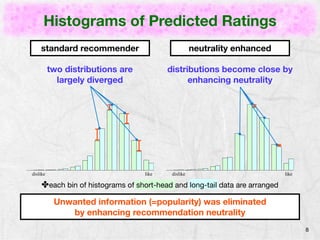
Histograms of Predicted Ratings 
8 
standard recommender neutrality enhanced 
two distributions are 
largely diverged 
distributions become close by 
enhancing neutrality 
dislike like dislike like 
✤each bin of histograms of short-head and long-tail data are arranged 
Unwanted information about popularity was successfully 
excluded by enhancing recommendation neutrality
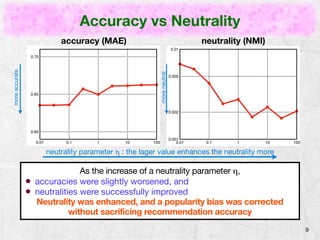
Accuracy vs Neutrality 
9 
0.01 
0.005 
0.002 
neutrality parameter η : the lager value enhances the neutrality more 
As the increase of a neutrality parameter η, 
0.70 
0.65 
accuracy was slightly worsened, but 
neutrality was successfully improved 
Neutrality was enhanced, and thus a popularity bias was corrected, 
without sacrificing recommendation accuracy 
more accurate 
accuracy (MAE) neutrality (NMI) 
0.60 
0.01 0.1 1 10 100 
0.001 
0.01 0.1 1 10 100 
more neutral
Applications of 
Recommendation Neutrality 
10
Application 
Excluding Unwanted Information 
11 
[TED Talk by Eli Pariser, http://www.filterbubble.com/] 
Information unwanted by a user is excluded from recommendation 
Filter Bubble: To fit for Pariser’s preference, conservative people are 
eliminated from his friend recommendation list in FaceBook 
viewpoint = a political conviction of a friend candidate 
Information about a candidate is conservative or progressive 
does not influence whether he/she is included in a friend list or not
Application 
Fair Treatment of Content Providers 
12 
System managers should fairly treat their content providers 
Ranking in a list retrieved by search engines 
The US FTC has been investigating Google to determine whether the 
search engine ranks its own services higher than those of competitors 
Content providers are managers’ customers 
For marketplace sites, their tenants are customers, and these tenants 
must be treated fairly when recommending the tenants’ products 
viewpoint = a content provider of a candidate item 
Information about who provides a candidate item is ignored, 
and providers are treated fairly 
[Bloomberg]
Application 
Adherence to Laws and Regulations 
13 
Recommendation services must be managed 
while adhering to laws and regulations 
[Sweeney 13] 
suspicious placement keyword-matching advertisement 
Advertisements indicating arrest records were more frequently 
displayed for names that are more popular among individuals of 
African descent than those of European descent 
Socially discriminative treatments must be avoided 
viewpoint = users’ socially sensitive demographic information 
Legally or socially sensitive information 
can be excluded from the inference process of recommendation
Information-neutral 
Recommender System 
14
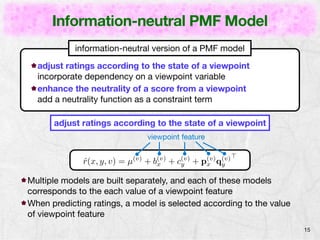
Information-neutral PMF Model 
15 
information-neutral version of a PMF model 
adjust ratings according to the state of a viewpoint 
incorporate dependency on a viewpoint variable 
enhance the neutrality of a score from a viewpoint 
add a neutrality function as a constraint term 
adjust ratings according to the state of a viewpoint 
viewpoint feature 
ˆr(x, y, v) = μ(v) + b(v) 
x + c(v) 
y + p(v) 
x q(v) 
y 
> 
Multiple models are built separately, and each of these models 
corresponds to the each value of a viewpoint feature 
When predicting ratings, a model is selected according to the value 
of viewpoint feature
Neutrality Term and Objective Function 
16 
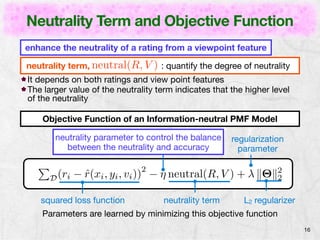
enhance the neutrality of a rating from a viewpoint feature 
neutrality term, neutral(R, V ) : quantify the degree of neutrality 
It depends on both ratings and view point features 
The larger value of the neutrality term indicates that the higher level 
of the neutrality 
Objective Function of an Information-neutral PMF Model 
regularization 
parameter 
neutrality parameter to control the balance 
between the neutrality and accuracy 
P 
D(ri − ˆr(xi, yi, vi))2 − ⌘ neutral(R, V ) + " k⇥k22 
squared loss function neutrality term L2 regularizer 
Parameters are learned by minimizing this objective function
Neutrality Term 
17 
Calders&Verwer’s Score (CV Score) 
make two distributions of R given V = 0 and 1 similar 
−k Pr[R|V = 0] − Pr[R|V = 1]k 
mean match method 
(MeanD(0)[ˆr] MeanD(1)[ˆr])2 
Matching means of predicted ratings 
for each data set where V=1 and V=0 
it matches only the first moment, but it empirically works well 
analytically differentiable and efficient in optimization
Recommendation Neutrality 
vs 
Recommendation Diversity 
18
Recommendation Diversity 
19 
[Ziegler+ 05, Zhang+ 08, Latha+ 09, Adomavicius+ 12] 
Recommendation Diversity 
Similar items are not recommended in a single list, to a single user, 
to all users, or in a temporally successive lists 
recommendation list 
similar items excluded 
Diversity 
Items that are similar in a 
specified metric are excluded 
from recommendation results 
The mutual relations 
among results 
Neutrality 
Information about a viewpoint 
feature is excluded from 
recommendation results 
The relations between 
results and viewpoints
Neutrality vs Diversity 
20 
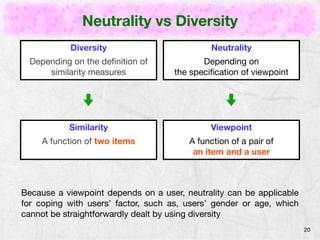
Diversity 
Depending on the definition of 
similarity measures 
Neutrality 
Depending on 
the specification of viewpoint 
Similarity 
A function of two items 
Viewpoint 
A function of a pair of 
an item and a user 
Because a viewpoint depends on a user, neutrality can be applicable 
for coping with users’ factor, such as, users’ gender or age, which 
cannot be straightforwardly dealt by using diversity
Neutrality vs Diversity 
21 
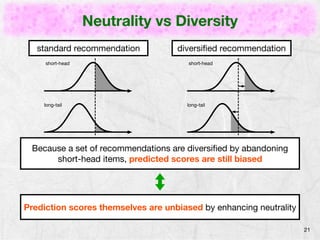
standard recommendation diversified recommendation 
short-head 
long-tail 
short-head 
long-tail 
Because a set of recommendations are diversified by abandoning 
short-head items, predicted scores are still biased 
Prediction scores themselves are unbiased by enhancing neutrality
Conclusion 
22 
Our Contributions 
We formulate the recommendation neutrality from a specified 
viewpoint feature 
We developed a recommendation technique that can enhance the 
recommendation neutrality 
We applied this technique to correct popularity bias, and the 
effectiveness of this is empirically shown 
Future Work 
Developing a neutrality term that can more precisely approximate 
distributions without losing its computational efficiency 
Program codes: http://www.kamishima.net/inrs/ 
Acknowledgements 
We would like to thank for providing a data set for Dr. Mohsen Jamali 
This work is supported by MEXT/JSPS KAKENHI Grant Number 16700157, 21500154, 24500194, and 25540094

Correcting Popularity Bias by Enhancing Recommendation Neutrality

  • 1.
    Correcting Popularity Bias by Enhancing Recommendation Neutrality Toshihiro Kamishima*, Shotaro Akaho*, Hideki Asoh*, and Jun Sakuma** *National Institute of Advanced Industrial Science and Technology (AIST), Japan **University of Tsukuba, Japan The 8th ACM Conference on Recommender Systems, Poster @ Silicon Valley (Foster City), U.S.A., Oct. 8, 2014 START 1
  • 2.
    Outline Overview Recommendationneutrality viewpoint feature, recommendation neutrality Experiments popularity bias, histogram of predicted ratings, accuracy vs neutrality Applications excluding information unwanted by a user, fair treatment of content providers, adherence of laws or regulations Information-neutral Recommender System formalization, neutrality term Recommendation neutrality vs recommendation diversity Recommendation diversity, differences between neutrality and diversity Conclusion 2
  • 3.
    Overview 3 Providingneutral information is important in recommendation excluding information unwanted by a user fair treatment of content suppliers or item providers adherence to laws and regulations in recommendation Information-neutral Recommender System The absolutely neutral recommendation is intrinsically infeasible, because recommendation is always biased in a sense that it is arranged for a specific user ↓ This system makes recommendation so as to enhance neutrality with respect to a viewpoint feature
  • 4.
    Viewpoint Feature 4 As in a case of standard recommendation, we use random variables X: a user, Y: an item, and R: a rating We adopt an additional variable for recommendation neutrality V : viewpoint feature It is specified by a user depending on his/her purpose Recommendation results are neutral with respect to this viewpoint Its value is determined depending on a user and an item Ex. viewpoint = movie’s popularity / user’s gender In this presentation, a viewpoint feature is restricted to a binary type
  • 5.
    Recommendation Neutrality 5 Recommendation Neutrality [Kamishima 12, Kamishima 13] Recommendation results are neutral if no information about a viewpoint feature influences the results The status of the viewpoint feature is explicitly excluded from the inference of the recommendation results the statistical independence between a result, R, and a viewpoint feature, V Pr[R|V ] = Pr[R] ⌘ R ?? V Ratings are predicted under this constraint of recommendation neutrality
  • 6.
  • 7.
    Popularity Bias 7 [Celma 08] Popularity Bias the tendency for popular items to be recommended more frequently Flixster data The degree popularity of an item is measured by the number of users who rated the item [Jamali+ 10] short-head (top 1%) share in ratings: 47.2% mean rating: 3.71 long-tail (bottom 99%) share in ratings: 52.8% mean rating: 3.53 Short-head items are frequently and highly rated By specifying this popularity as a viewpoint feature, enhancing recommendation neutrality corrects this unwanted bias
  • 8.
    Histograms of PredictedRatings 8 standard recommender neutrality enhanced two distributions are largely diverged distributions become close by enhancing neutrality dislike like dislike like ✤each bin of histograms of short-head and long-tail data are arranged Unwanted information about popularity was successfully excluded by enhancing recommendation neutrality
  • 9.
    Accuracy vs Neutrality 9 0.01 0.005 0.002 neutrality parameter η : the lager value enhances the neutrality more As the increase of a neutrality parameter η, 0.70 0.65 accuracy was slightly worsened, but neutrality was successfully improved Neutrality was enhanced, and thus a popularity bias was corrected, without sacrificing recommendation accuracy more accurate accuracy (MAE) neutrality (NMI) 0.60 0.01 0.1 1 10 100 0.001 0.01 0.1 1 10 100 more neutral
  • 10.
  • 11.
    Application Excluding UnwantedInformation 11 [TED Talk by Eli Pariser, http://www.filterbubble.com/] Information unwanted by a user is excluded from recommendation Filter Bubble: To fit for Pariser’s preference, conservative people are eliminated from his friend recommendation list in FaceBook viewpoint = a political conviction of a friend candidate Information about a candidate is conservative or progressive does not influence whether he/she is included in a friend list or not
  • 12.
    Application Fair Treatmentof Content Providers 12 System managers should fairly treat their content providers Ranking in a list retrieved by search engines The US FTC has been investigating Google to determine whether the search engine ranks its own services higher than those of competitors Content providers are managers’ customers For marketplace sites, their tenants are customers, and these tenants must be treated fairly when recommending the tenants’ products viewpoint = a content provider of a candidate item Information about who provides a candidate item is ignored, and providers are treated fairly [Bloomberg]
  • 13.
    Application Adherence toLaws and Regulations 13 Recommendation services must be managed while adhering to laws and regulations [Sweeney 13] suspicious placement keyword-matching advertisement Advertisements indicating arrest records were more frequently displayed for names that are more popular among individuals of African descent than those of European descent Socially discriminative treatments must be avoided viewpoint = users’ socially sensitive demographic information Legally or socially sensitive information can be excluded from the inference process of recommendation
  • 14.
  • 15.
    Information-neutral PMF Model 15 information-neutral version of a PMF model adjust ratings according to the state of a viewpoint incorporate dependency on a viewpoint variable enhance the neutrality of a score from a viewpoint add a neutrality function as a constraint term adjust ratings according to the state of a viewpoint viewpoint feature ˆr(x, y, v) = μ(v) + b(v) x + c(v) y + p(v) x q(v) y > Multiple models are built separately, and each of these models corresponds to the each value of a viewpoint feature When predicting ratings, a model is selected according to the value of viewpoint feature
  • 16.
    Neutrality Term andObjective Function 16 enhance the neutrality of a rating from a viewpoint feature neutrality term, neutral(R, V ) : quantify the degree of neutrality It depends on both ratings and view point features The larger value of the neutrality term indicates that the higher level of the neutrality Objective Function of an Information-neutral PMF Model regularization parameter neutrality parameter to control the balance between the neutrality and accuracy P D(ri − ˆr(xi, yi, vi))2 − ⌘ neutral(R, V ) + " k⇥k22 squared loss function neutrality term L2 regularizer Parameters are learned by minimizing this objective function
  • 17.
    Neutrality Term 17 Calders&Verwer’s Score (CV Score) make two distributions of R given V = 0 and 1 similar −k Pr[R|V = 0] − Pr[R|V = 1]k mean match method (MeanD(0)[ˆr] MeanD(1)[ˆr])2 Matching means of predicted ratings for each data set where V=1 and V=0 it matches only the first moment, but it empirically works well analytically differentiable and efficient in optimization
  • 18.
    Recommendation Neutrality vs Recommendation Diversity 18
  • 19.
    Recommendation Diversity 19 [Ziegler+ 05, Zhang+ 08, Latha+ 09, Adomavicius+ 12] Recommendation Diversity Similar items are not recommended in a single list, to a single user, to all users, or in a temporally successive lists recommendation list similar items excluded Diversity Items that are similar in a specified metric are excluded from recommendation results The mutual relations among results Neutrality Information about a viewpoint feature is excluded from recommendation results The relations between results and viewpoints
  • 20.
    Neutrality vs Diversity 20 Diversity Depending on the definition of similarity measures Neutrality Depending on the specification of viewpoint Similarity A function of two items Viewpoint A function of a pair of an item and a user Because a viewpoint depends on a user, neutrality can be applicable for coping with users’ factor, such as, users’ gender or age, which cannot be straightforwardly dealt by using diversity
  • 21.
    Neutrality vs Diversity 21 standard recommendation diversified recommendation short-head long-tail short-head long-tail Because a set of recommendations are diversified by abandoning short-head items, predicted scores are still biased Prediction scores themselves are unbiased by enhancing neutrality
  • 22.
    Conclusion 22 OurContributions We formulate the recommendation neutrality from a specified viewpoint feature We developed a recommendation technique that can enhance the recommendation neutrality We applied this technique to correct popularity bias, and the effectiveness of this is empirically shown Future Work Developing a neutrality term that can more precisely approximate distributions without losing its computational efficiency Program codes: http://www.kamishima.net/inrs/ Acknowledgements We would like to thank for providing a data set for Dr. Mohsen Jamali This work is supported by MEXT/JSPS KAKENHI Grant Number 16700157, 21500154, 24500194, and 25540094