Health technology is defined by the
World Health Organization as the "application of organized
knowledge and skills in the form of devices, medicines,
vaccines, procedures, and systems developed to solve
a health problem and improve quality of lives“
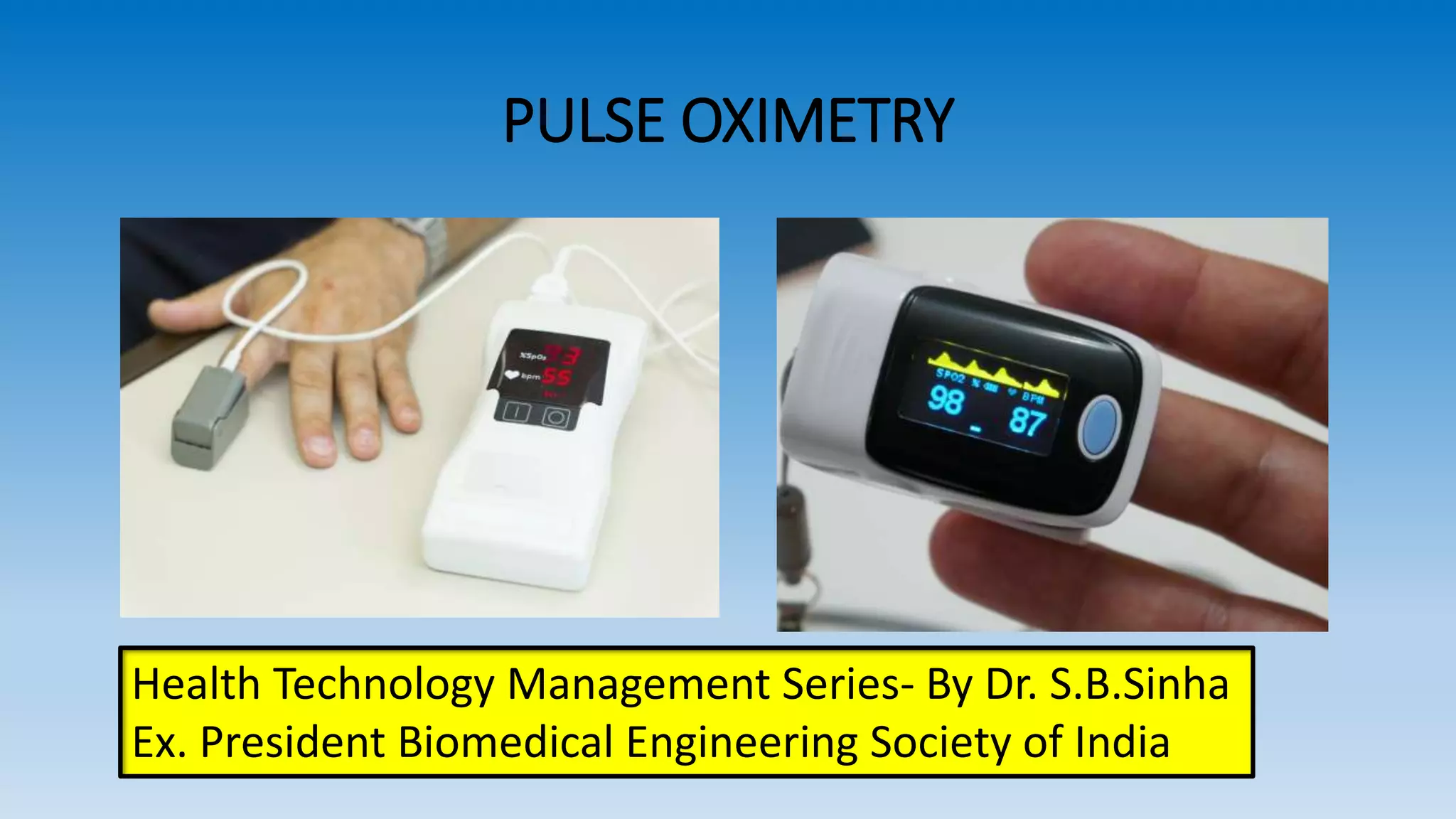
PULSE OXIMETRY
Health Technology Management Series- By Dr. S.B.Sinha
Ex. President Biomedical Engineering Society of India
HEMOGLOBIN/HAEMOGLOBIN
A Protein that carries
oxygen from lungs to
tissues throughout the
body
PULSE OXIMETER
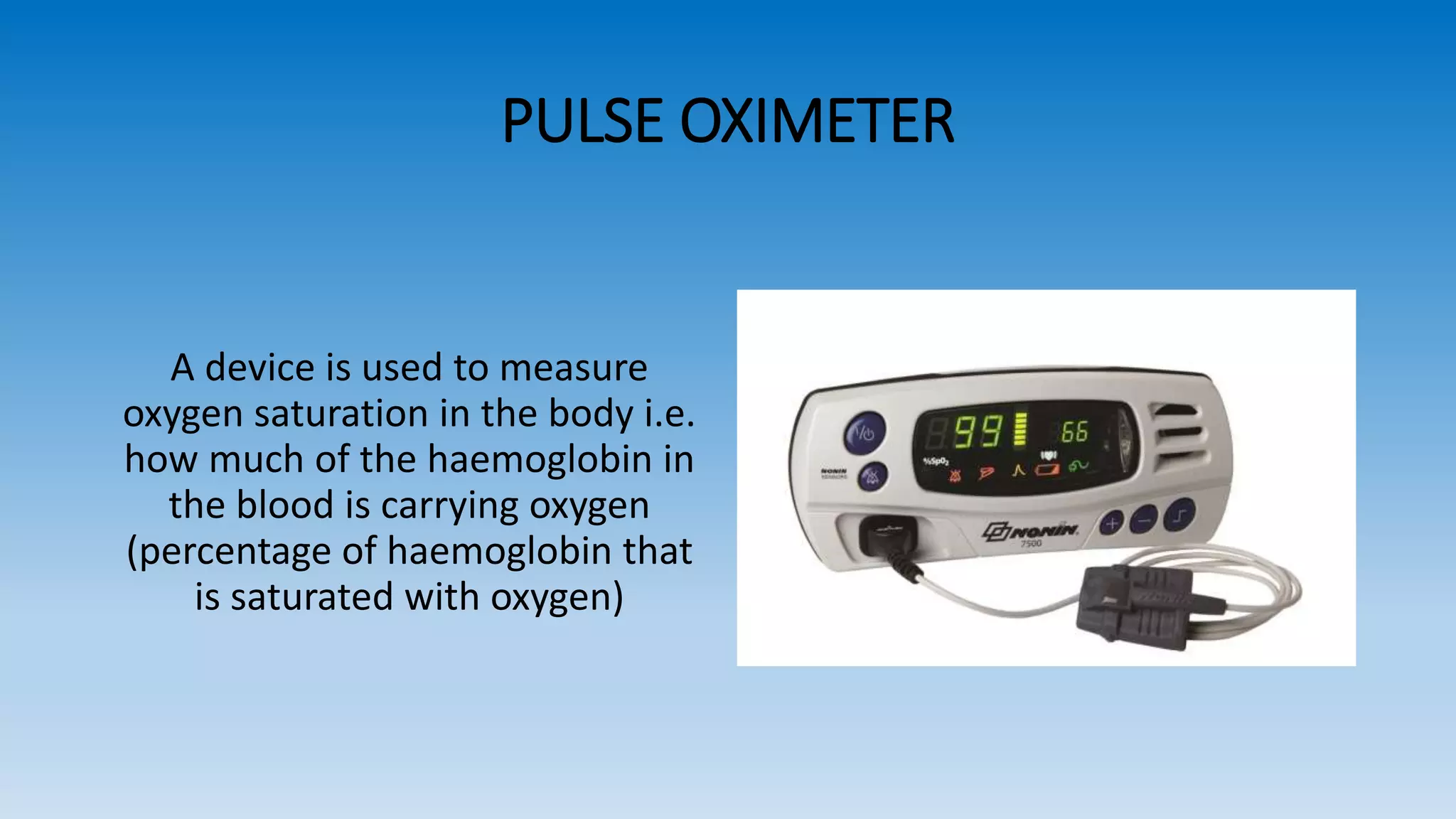
A device is used to measure
oxygen saturation in the body i.e.
how much of the haemoglobin in
the blood is carrying oxygen
(percentage of haemoglobin that
is saturated with oxygen)
PULSE OXIMETRY
• Pulse oximetry, sometimes
called the fifth vital sign, is a non
invasive method of measuring
oxygen saturation (SpO2) by
using a light signal transmitted
through the tissues.
• It is one of the most essential
monitoring for routine use in
anaesthesia and intensive care.
PULSE OXIMETRY
• It also measure the heart rate.
• Give an idea about tissue
perfusion by pulse wave form.
• If Spo2, specially below 90% may
be caused by problems including
lung diseases such as COPD,
breathing difficulties, circulatory
problem such as excessive
bleeding or blood circulation
problem.
PULSE OXIMETRY
• Pulse oximetry, sometimes called the fifth vital sign, is a non invasive
method of measuring oxygen saturation (SpO2) by using a light signal
transmitted through the tissues.
• It is one of the most essential monitoring for routine use in
anaesthesia and intensive care.
• It also measure the heart rate.
• Give an idea about tissue perfusion by pulse wave form.
• If Spo2, specially below 90% may be caused by problems including
lung diseases such as COPD, breathing difficulties, circulatory problem
such as excessive bleeding or blood circulation problem.
Normal Reading
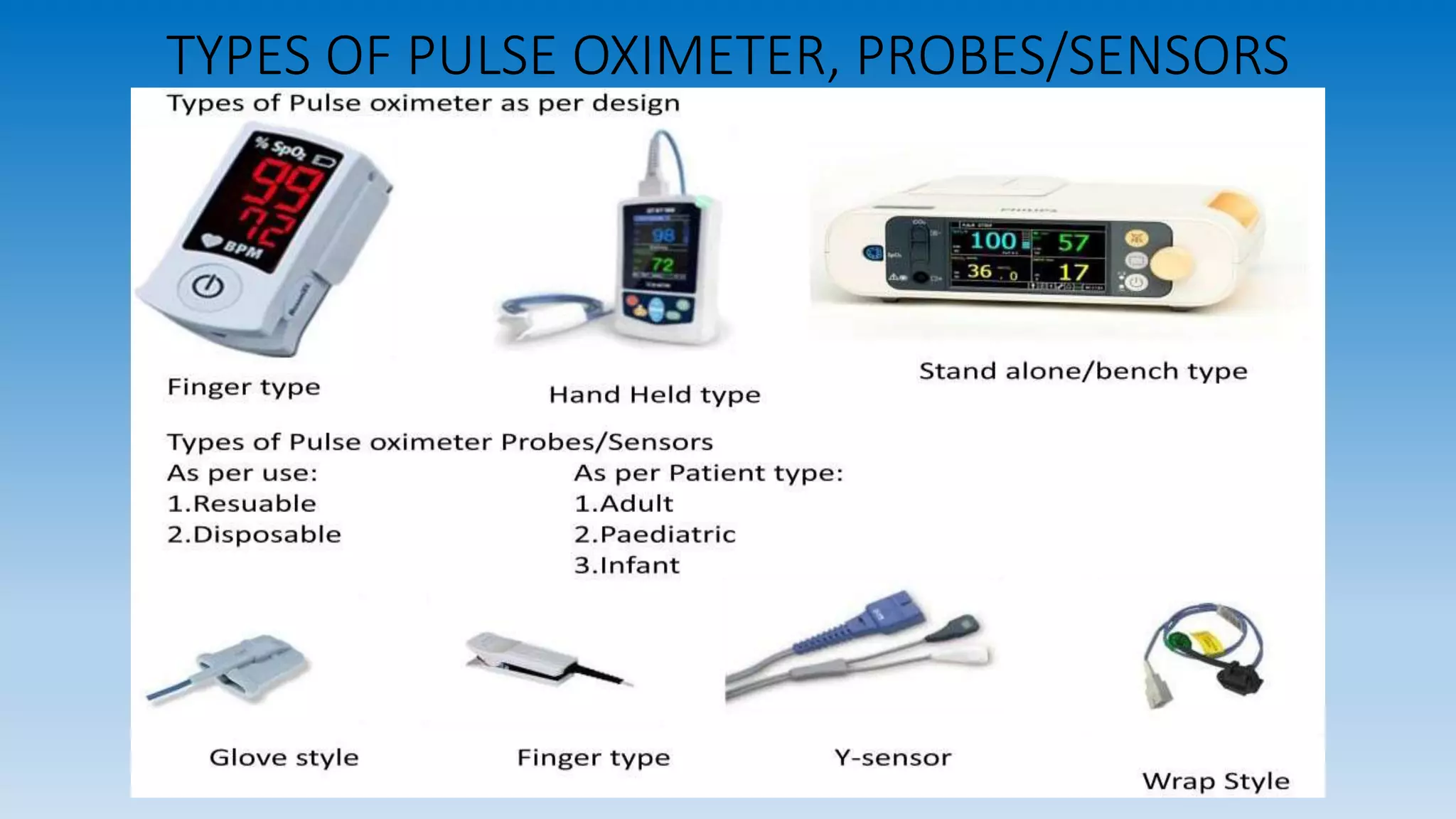
TYPES OF PULSE OXIMETER, PROBES/SENSORS
Working of the Pulse Oximeter
• Probe of pulse oximeter consists of two
diodes which emit equal intensities of red
and infrared light sequentially into pulsatile
tissue bed with two different wavelengths i.e
940 nm (infrared) and 660 nm (red)
respectively. Variable amount of these lights
are absorbed by oxygenated and reduced
haemoglobin. The Reduced haemoglobin
absorbs more red than infrared light and
oxygenated haemoglobin absorbs more
infrared than red.
• A photo-detector placed on the opposite
side senses the ratio of red and infrared light
based on which the proportion of
oxygenated and reduced haemoglobin is
estimated and displayed.
Do’s and Don’ts
• DO NOT use the Oximeter in environment with inflammable gas such as
some ignitable aesthetic agents.
• Don’t uses the Oximeter while the tested measured by MRI and CT.
• If the Oximeter gets wet, please stop using it immediately.
• Keep the Oximeter away from dust, vibration, corrosive substances,
explosive materials, high temperature and moisture.
• DO NOT operate keys on front panel with sharp materials.
• When it is carried from cold environment to warm or humid
environment, please do not use it immediately
• wipe its surface with disinfectant solution or IPA70% using a soft and lint
free cloths
Do’s and Don’ts
• Do not spray any liquid directly onto the device.
• High temperature or high pressure steam disinfection of the Oximeter is
not permitted. Refer to User Manual for instructions of cleaning and
disinfection.
• Use required probe type as per patient category i.e. adult, paediatric or
infant
• The unit shall be fully charged when its kept in Idle state.
• The battery compartment should be checked time to time for any
leakage.
• Timely replacement of the battery and sensor in case of expiry of the
life.
USER MAINTENANCE OF PULSE OXIMETER
DAILY
Cleaning  Remove any dust with damp cloth and dry off.
Visual  Check the main unit and all accessories periodically to
make sure that there is no visible damage that may
affect patient’s safety and monitoring performance
about cables and sensor.
 Check power cable and connector for any damage or
loose contract.
Function  After switching on the leave the monitor for its self-test.
USER MAINTENANCE OF PULSE OXIMETER
WEEKLY
Cleaning  Clean the front panel, basinet by using damp cloth
socked in mailed detergent/soap water. Do not use
sprit or other chemical.
 Disinfection as per manufacture’s recommendation.
Visual  Check all screws and wheels of basinet.
 Check power cable, sensor and connector for any
damage or loose contract.
Function  After switching on the leave the monitor for its self-
test. See the light of the sensor probe.
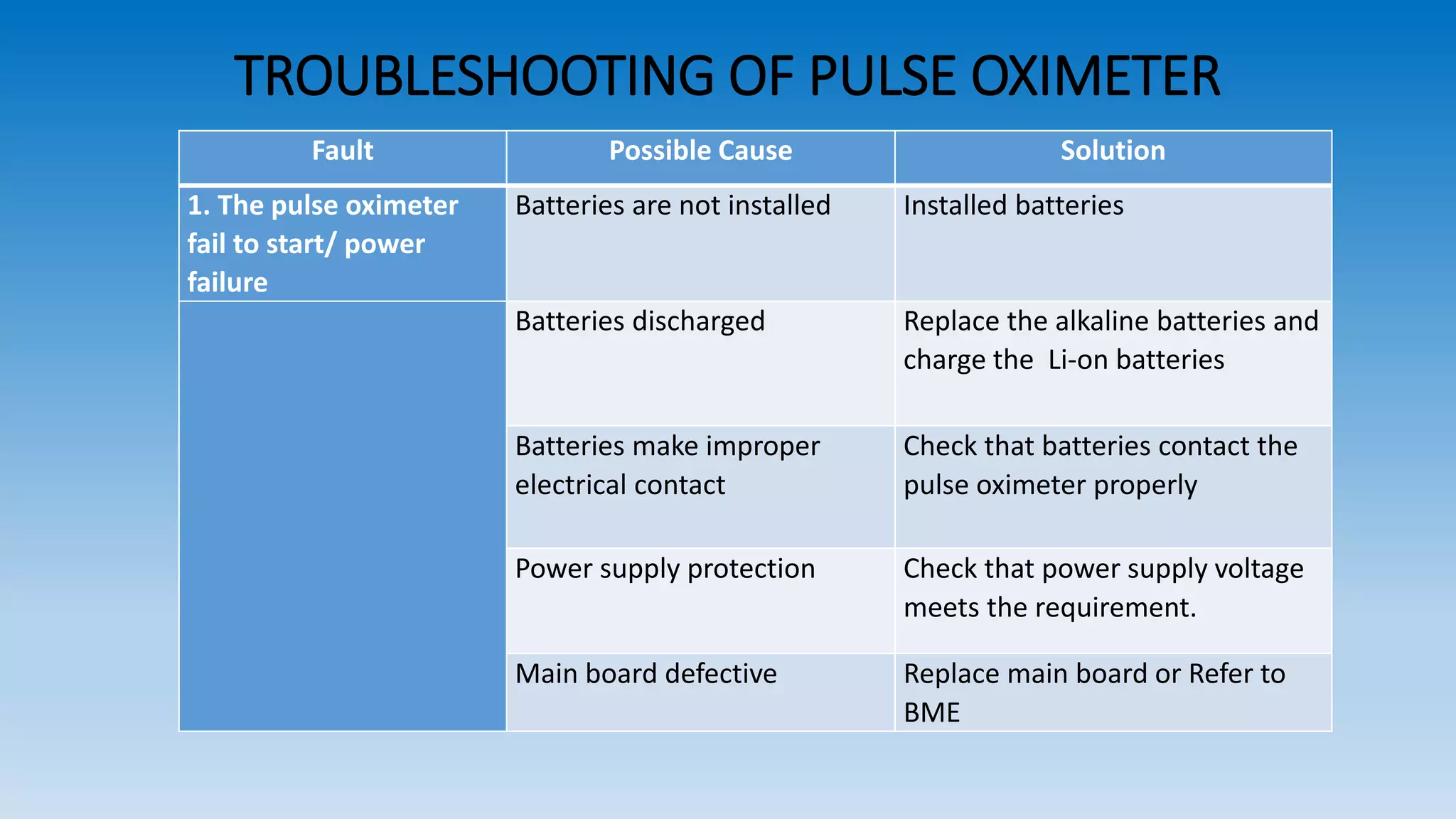
TROUBLESHOOTING OF PULSE OXIMETER
Fault Possible Cause Solution
1. The pulse oximeter
fail to start/ power
failure
Batteries are not installed Installed batteries
Batteries discharged Replace the alkaline batteries and
charge the Li-on batteries
Batteries make improper
electrical contact
Check that batteries contact the
pulse oximeter properly
Power supply protection Check that power supply voltage
meets the requirement.
Main board defective Replace main board or Refer to
BME
TROUBLESHOOTING OF PULSE OXIMETER
Fault Possible Cause Solution
2. LCD displays incorrectly Cables defective Check that LCD cable and
connector are undamaged
and properly connected.
LCD defective Replace LCD or Refer to
BME
Main board defective Replace main board or Refer
to BME
3. No alarm sound Speaker failure Replace speaker or refer to
BME
4. Sensor does not light Light sensor failure Replace sensor or refer to
BME
THANK YOU

Pulse oximeters- Application and Maintenance

  • 1.
    Health technology isdefined by the World Health Organization as the "application of organized knowledge and skills in the form of devices, medicines, vaccines, procedures, and systems developed to solve a health problem and improve quality of lives“
  • 2.
    PULSE OXIMETRY Health TechnologyManagement Series- By Dr. S.B.Sinha Ex. President Biomedical Engineering Society of India
  • 3.
    HEMOGLOBIN/HAEMOGLOBIN A Protein thatcarries oxygen from lungs to tissues throughout the body
  • 4.
    PULSE OXIMETER A deviceis used to measure oxygen saturation in the body i.e. how much of the haemoglobin in the blood is carrying oxygen (percentage of haemoglobin that is saturated with oxygen)
  • 5.
    PULSE OXIMETRY • Pulseoximetry, sometimes called the fifth vital sign, is a non invasive method of measuring oxygen saturation (SpO2) by using a light signal transmitted through the tissues. • It is one of the most essential monitoring for routine use in anaesthesia and intensive care.
  • 6.
    PULSE OXIMETRY • Italso measure the heart rate. • Give an idea about tissue perfusion by pulse wave form. • If Spo2, specially below 90% may be caused by problems including lung diseases such as COPD, breathing difficulties, circulatory problem such as excessive bleeding or blood circulation problem.
  • 7.
    PULSE OXIMETRY • Pulseoximetry, sometimes called the fifth vital sign, is a non invasive method of measuring oxygen saturation (SpO2) by using a light signal transmitted through the tissues. • It is one of the most essential monitoring for routine use in anaesthesia and intensive care. • It also measure the heart rate. • Give an idea about tissue perfusion by pulse wave form. • If Spo2, specially below 90% may be caused by problems including lung diseases such as COPD, breathing difficulties, circulatory problem such as excessive bleeding or blood circulation problem.
  • 8.
  • 9.
    TYPES OF PULSEOXIMETER, PROBES/SENSORS
  • 10.
    Working of thePulse Oximeter • Probe of pulse oximeter consists of two diodes which emit equal intensities of red and infrared light sequentially into pulsatile tissue bed with two different wavelengths i.e 940 nm (infrared) and 660 nm (red) respectively. Variable amount of these lights are absorbed by oxygenated and reduced haemoglobin. The Reduced haemoglobin absorbs more red than infrared light and oxygenated haemoglobin absorbs more infrared than red. • A photo-detector placed on the opposite side senses the ratio of red and infrared light based on which the proportion of oxygenated and reduced haemoglobin is estimated and displayed.
  • 11.
    Do’s and Don’ts •DO NOT use the Oximeter in environment with inflammable gas such as some ignitable aesthetic agents. • Don’t uses the Oximeter while the tested measured by MRI and CT. • If the Oximeter gets wet, please stop using it immediately. • Keep the Oximeter away from dust, vibration, corrosive substances, explosive materials, high temperature and moisture. • DO NOT operate keys on front panel with sharp materials. • When it is carried from cold environment to warm or humid environment, please do not use it immediately • wipe its surface with disinfectant solution or IPA70% using a soft and lint free cloths
  • 12.
    Do’s and Don’ts •Do not spray any liquid directly onto the device. • High temperature or high pressure steam disinfection of the Oximeter is not permitted. Refer to User Manual for instructions of cleaning and disinfection. • Use required probe type as per patient category i.e. adult, paediatric or infant • The unit shall be fully charged when its kept in Idle state. • The battery compartment should be checked time to time for any leakage. • Timely replacement of the battery and sensor in case of expiry of the life.
  • 13.
    USER MAINTENANCE OFPULSE OXIMETER DAILY Cleaning  Remove any dust with damp cloth and dry off. Visual  Check the main unit and all accessories periodically to make sure that there is no visible damage that may affect patient’s safety and monitoring performance about cables and sensor.  Check power cable and connector for any damage or loose contract. Function  After switching on the leave the monitor for its self-test.
  • 14.
    USER MAINTENANCE OFPULSE OXIMETER WEEKLY Cleaning  Clean the front panel, basinet by using damp cloth socked in mailed detergent/soap water. Do not use sprit or other chemical.  Disinfection as per manufacture’s recommendation. Visual  Check all screws and wheels of basinet.  Check power cable, sensor and connector for any damage or loose contract. Function  After switching on the leave the monitor for its self- test. See the light of the sensor probe.
  • 15.
    TROUBLESHOOTING OF PULSEOXIMETER Fault Possible Cause Solution 1. The pulse oximeter fail to start/ power failure Batteries are not installed Installed batteries Batteries discharged Replace the alkaline batteries and charge the Li-on batteries Batteries make improper electrical contact Check that batteries contact the pulse oximeter properly Power supply protection Check that power supply voltage meets the requirement. Main board defective Replace main board or Refer to BME
  • 16.
    TROUBLESHOOTING OF PULSEOXIMETER Fault Possible Cause Solution 2. LCD displays incorrectly Cables defective Check that LCD cable and connector are undamaged and properly connected. LCD defective Replace LCD or Refer to BME Main board defective Replace main board or Refer to BME 3. No alarm sound Speaker failure Replace speaker or refer to BME 4. Sensor does not light Light sensor failure Replace sensor or refer to BME
  • 17.