Finger Tip Injuries
Introduction
• Fingertip injury is any soft tissue, nail or bony
injury distal to insertion of the long flexor and
extensor tendon of a finger or thumb.
• Acute fingertip and thumb injuries are
common and require prompt and meticulous
composite soft tissue repair in incomplete
amputations.
Epidemiology
• Can affect all ages but common in working
class adults and children.
• In adults
– Laceration (Most common)
– Crush & Avulsion injuries
• In children
– Most injuries arise at home and due to
jamming/crushing by doors
Clinical Presentation
• History
– Mechanism:
• Avulsion
• Laceration
• Crush
– Hand dominance
– Occupation & Hobbies
– Time since injury
– Tetanus immunization status
Clinical Presentation
• Physical Examination
– Inspection
• Crush vs Sharp injury
• Presence or absence of exposed bone
• Red line sign
• Ribbon sign
• Nail or Nail bed involvement
• Viability of tip
• Presence of foreign body
– Range of motion
• Flexor and Extensor tendon involvement
Clinical Presentation
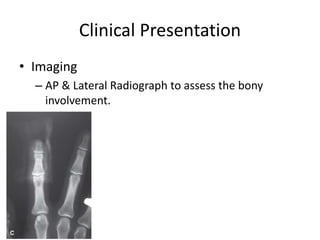
• Imaging
– AP & Lateral Radiograph to assess the bony
involvement.
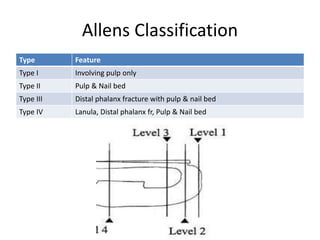
Allens Classification
Type Feature
Type I Involving pulp only
Type II Pulp & Nail bed
Type III Distal phalanx fracture with pulp & nail bed
Type IV Lanula, Distal phalanx fr, Pulp & Nail bed
Classification
Zone Characterstics
Zone I Distal to distal phalanx
Nail bed & matrix preserved
Zone II Distal to lunula of nail bed
Distal phalanx exposed
Zone III Nail matrix involved
Loss of entire nail bed
Reference : Treatment of fingertip and nail bed injury
Rosenthal EA
Orthop Clin North Am 1983 Oct; 14(4):675-97
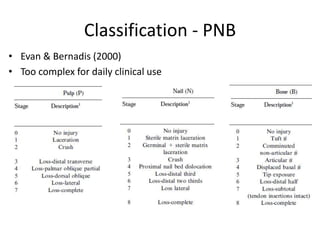
Classification - PNB
• Evan & Bernadis (2000)
• Too complex for daily clinical use
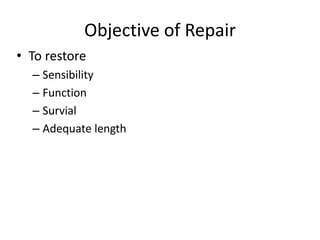
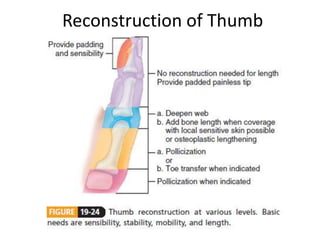
Objective of Repair
• To restore
– Sensibility
– Function
– Survial
– Adequate length
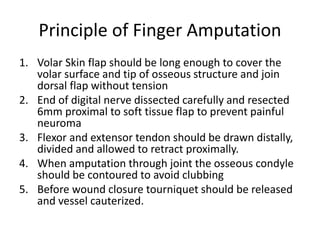
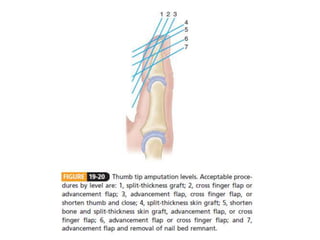
Principle of Finger Amputation
1. Volar Skin flap should be long enough to cover the
volar surface and tip of osseous structure and join
dorsal flap without tension
2. End of digital nerve dissected carefully and resected
6mm proximal to soft tissue flap to prevent painful
neuroma
3. Flexor and extensor tendon should be drawn distally,
divided and allowed to retract proximally.
4. When amputation through joint the osseous condyle
should be contoured to avoid clubbing
5. Before wound closure tourniquet should be released
and vessel cauterized.
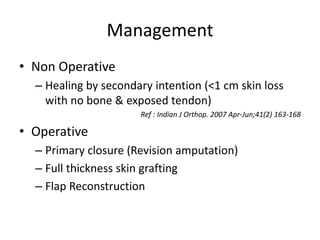
Management
• Non Operative
– Healing by secondary intention (<1 cm skin loss
with no bone & exposed tendon)
Ref : Indian J Orthop. 2007 Apr-Jun;41(2) 163-168
• Operative
– Primary closure (Revision amputation)
– Full thickness skin grafting
– Flap Reconstruction
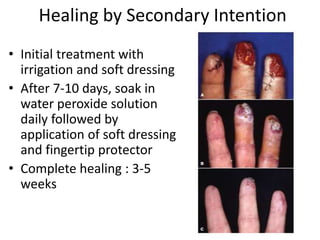
Healing by Secondary Intention
• Initial treatment with
irrigation and soft dressing
• After 7-10 days, soak in
water peroxide solution
daily followed by
application of soft dressing
and fingertip protector
• Complete healing : 3-5
weeks
Revision Amputation
• Remove remaining nail matrix to prevent
irritant nail remnant
• If flexor or extensor tendon insertion cannot
be preserved, disarticulate DIP joint
• Cut digital nerve & remaining tendon as
proximal as possible
• Palmar skin brought over bone and sutured to
dorsal skin
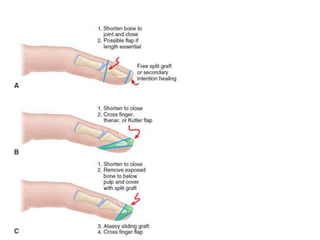
Flap Reconstruction Techniques
Site Technique
1. Finger Tip Straight/Dorsal Oblique Laceration
•V-Y advancement flap
•Digital island artery
Volar Oblique Laceration
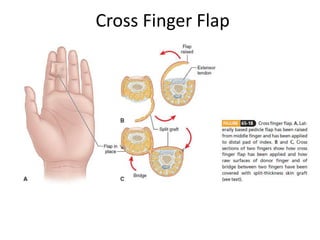
•Cross finger flap (age>30 yrs)
•Thenar flap (age<30 yrs)
2. Volar Proximal Finger Cross finger (Age>30 yrs)
Axial flag flap from long finger
3. Dorsal Proximal Finger & MCP Reverse Cross Finger
Axial flap from long finger
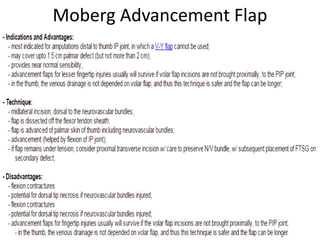
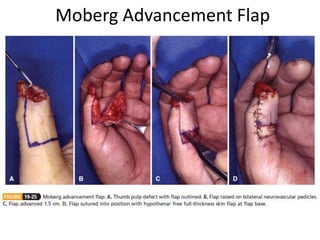
4. Volar Thumb Moberg Advancement Volar Flap (<2cm)
FDMA (if >2cm)
Neurovascular Island Flap (upto 4 cm)
5. Dorsal Thumb FDMA
6. First Web Space Z plasty with 60 degree flaps
Posterior Interosseous Fasciocutaneuos flap
7. Dorsal Hand Groin Flap
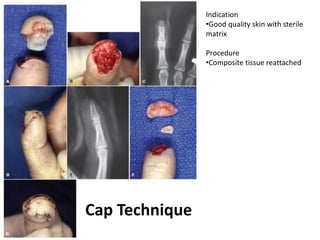
Cap Technique
Indication
•Good quality skin with sterile
matrix
Procedure
•Composite tissue reattached
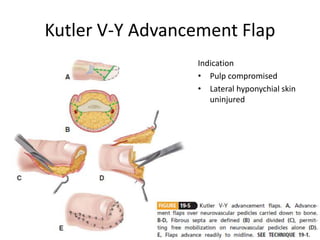
Kutler V-Y Advancement Flap
Indication
• Pulp compromised
• Lateral hyponychial skin
uninjured
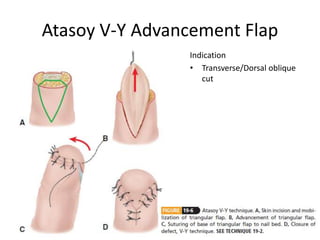
Atasoy V-Y Advancement Flap
Indication
• Transverse/Dorsal oblique
cut
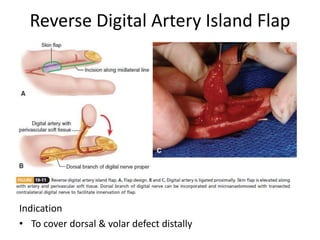
Reverse Digital Artery Island Flap
Indication
• To cover dorsal & volar defect distally
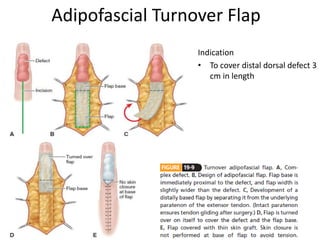
Adipofascial Turnover Flap
Indication
• To cover distal dorsal defect 3
cm in length
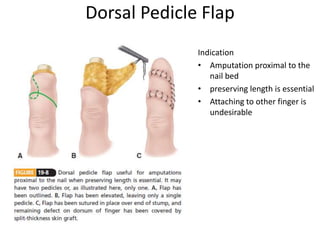
Dorsal Pedicle Flap
Indication
• Amputation proximal to the
nail bed
• preserving length is essential
• Attaching to other finger is
undesirable
Cross Finger Flap
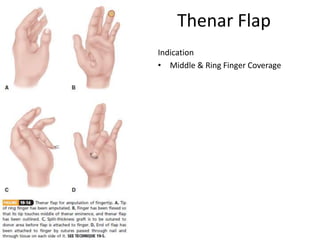
Thenar Flap
Indication
• Middle & Ring Finger Coverage
Reconstruction of Thumb
Moberg Advancement Flap

Finger tip injuries

  • 1.
  • 2.
    Introduction • Fingertip injuryis any soft tissue, nail or bony injury distal to insertion of the long flexor and extensor tendon of a finger or thumb. • Acute fingertip and thumb injuries are common and require prompt and meticulous composite soft tissue repair in incomplete amputations.
  • 3.
    Epidemiology • Can affectall ages but common in working class adults and children. • In adults – Laceration (Most common) – Crush & Avulsion injuries • In children – Most injuries arise at home and due to jamming/crushing by doors
  • 4.
    Clinical Presentation • History –Mechanism: • Avulsion • Laceration • Crush – Hand dominance – Occupation & Hobbies – Time since injury – Tetanus immunization status
  • 5.
    Clinical Presentation • PhysicalExamination – Inspection • Crush vs Sharp injury • Presence or absence of exposed bone • Red line sign • Ribbon sign • Nail or Nail bed involvement • Viability of tip • Presence of foreign body – Range of motion • Flexor and Extensor tendon involvement
  • 6.
    Clinical Presentation • Imaging –AP & Lateral Radiograph to assess the bony involvement.
  • 7.
    Allens Classification Type Feature TypeI Involving pulp only Type II Pulp & Nail bed Type III Distal phalanx fracture with pulp & nail bed Type IV Lanula, Distal phalanx fr, Pulp & Nail bed
  • 8.
    Classification Zone Characterstics Zone IDistal to distal phalanx Nail bed & matrix preserved Zone II Distal to lunula of nail bed Distal phalanx exposed Zone III Nail matrix involved Loss of entire nail bed Reference : Treatment of fingertip and nail bed injury Rosenthal EA Orthop Clin North Am 1983 Oct; 14(4):675-97
  • 9.
    Classification - PNB •Evan & Bernadis (2000) • Too complex for daily clinical use
  • 10.
    Objective of Repair •To restore – Sensibility – Function – Survial – Adequate length
  • 11.
    Principle of FingerAmputation 1. Volar Skin flap should be long enough to cover the volar surface and tip of osseous structure and join dorsal flap without tension 2. End of digital nerve dissected carefully and resected 6mm proximal to soft tissue flap to prevent painful neuroma 3. Flexor and extensor tendon should be drawn distally, divided and allowed to retract proximally. 4. When amputation through joint the osseous condyle should be contoured to avoid clubbing 5. Before wound closure tourniquet should be released and vessel cauterized.
  • 12.
    Management • Non Operative –Healing by secondary intention (<1 cm skin loss with no bone & exposed tendon) Ref : Indian J Orthop. 2007 Apr-Jun;41(2) 163-168 • Operative – Primary closure (Revision amputation) – Full thickness skin grafting – Flap Reconstruction
  • 13.
    Healing by SecondaryIntention • Initial treatment with irrigation and soft dressing • After 7-10 days, soak in water peroxide solution daily followed by application of soft dressing and fingertip protector • Complete healing : 3-5 weeks
  • 14.
    Revision Amputation • Removeremaining nail matrix to prevent irritant nail remnant • If flexor or extensor tendon insertion cannot be preserved, disarticulate DIP joint • Cut digital nerve & remaining tendon as proximal as possible • Palmar skin brought over bone and sutured to dorsal skin
  • 15.
    Flap Reconstruction Techniques SiteTechnique 1. Finger Tip Straight/Dorsal Oblique Laceration •V-Y advancement flap •Digital island artery Volar Oblique Laceration •Cross finger flap (age>30 yrs) •Thenar flap (age<30 yrs) 2. Volar Proximal Finger Cross finger (Age>30 yrs) Axial flag flap from long finger 3. Dorsal Proximal Finger & MCP Reverse Cross Finger Axial flap from long finger 4. Volar Thumb Moberg Advancement Volar Flap (<2cm) FDMA (if >2cm) Neurovascular Island Flap (upto 4 cm) 5. Dorsal Thumb FDMA 6. First Web Space Z plasty with 60 degree flaps Posterior Interosseous Fasciocutaneuos flap 7. Dorsal Hand Groin Flap
  • 17.
    Cap Technique Indication •Good qualityskin with sterile matrix Procedure •Composite tissue reattached
  • 18.
    Kutler V-Y AdvancementFlap Indication • Pulp compromised • Lateral hyponychial skin uninjured
  • 19.
    Atasoy V-Y AdvancementFlap Indication • Transverse/Dorsal oblique cut
  • 20.
    Reverse Digital ArteryIsland Flap Indication • To cover dorsal & volar defect distally
  • 21.
    Adipofascial Turnover Flap Indication •To cover distal dorsal defect 3 cm in length
  • 22.
    Dorsal Pedicle Flap Indication •Amputation proximal to the nail bed • preserving length is essential • Attaching to other finger is undesirable
  • 23.
  • 24.
    Thenar Flap Indication • Middle& Ring Finger Coverage
  • 26.
  • 27.
  • 28.