SAFETY AND SECURITY IN INDUSTRIAL RADIOGRAPHY PUSAT LATIHAN  AGENSI NUKLEAR MALAYSIA
Contents 1.0  Introduction 2.0  Basic principle and utilization of radiographic technique. 3.0  Equipment 4.0  Control of external radiation exposure 5.0  Working procedure 6.0  Physical safety of radioactive material
A non-destructive  technique (NDT) to examine irregularity of internal structure of objects or specimen. The highly penetrating radiation such as x and gamma radiation is used to visualized internal structure of solid and hard material such as steel or other types of metal. Radiography is an example of nuclear technology application involving high dose rate radiation source. It is important to note; exposure time of minutes to the ionizing radiation can cause serious physical injury to practitioners. 1.0  Introduction
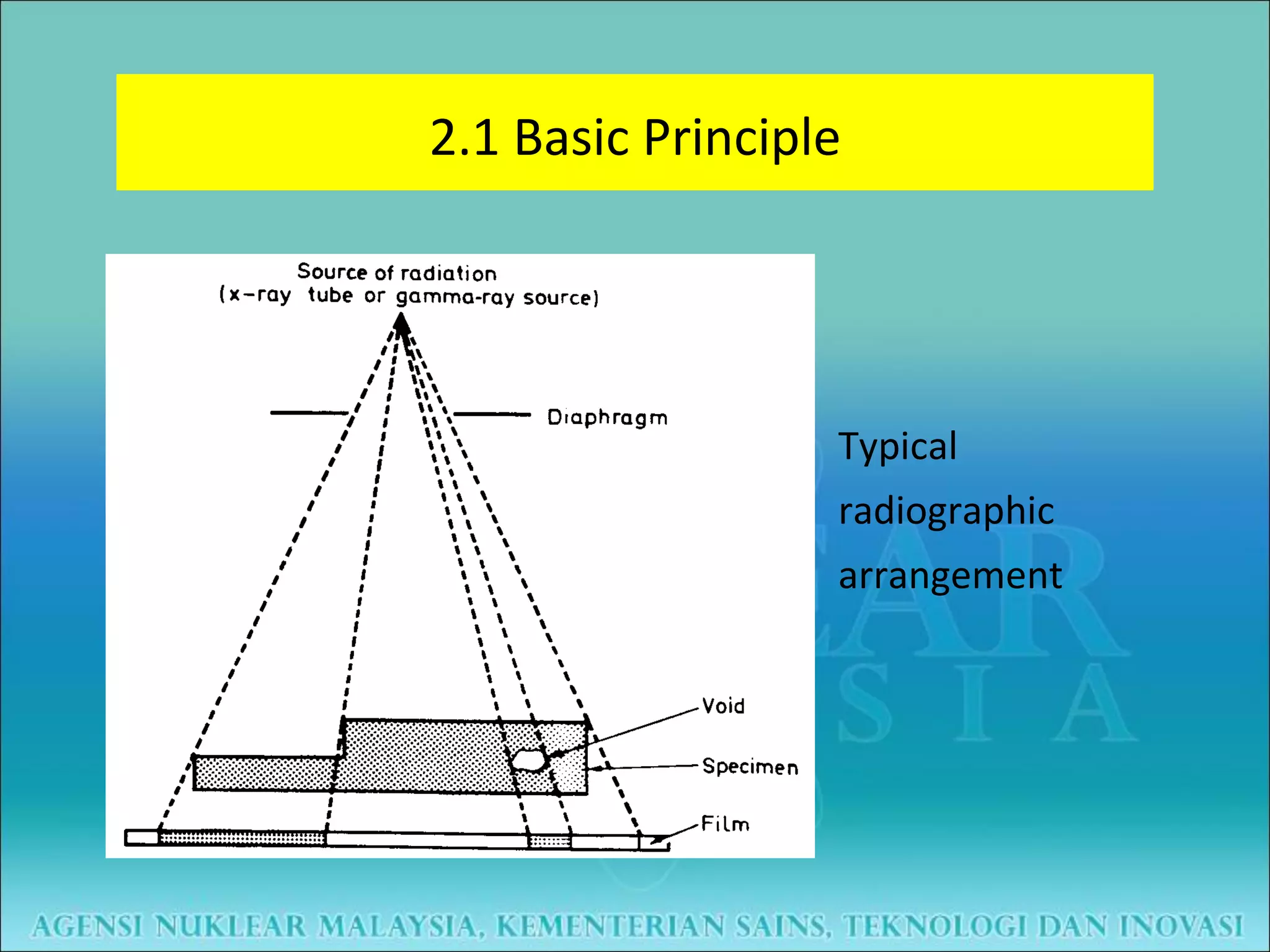
2.1 Basic Principle The radiation from a radiation source penetrates the specimen and exposed the film located behind the specimen, which is sensitive to X and gamma radiation. 2.0 Basic Principle and Application
Typical radiographic arrangement 2.1 Basic Principle
2.2  Application Quality control of industrial products such as pressure vessels and boilers.  In Malaysia, the applications have been going on since more than two decades. The application of the technique became more pronounced since the enforcement of the regulations under the Factory and machinery Acts 1967 (Act 139) that require pressure vessels and boilers to be examined of its overall and welding integrity by radiographic technique prior to their utilization. Consequently, all welders of pressure vessels and boilers have to pass radiographic examination before they were licensed to operate. The competency examined include both aspect; quality of performance as well as safety and health. 2.0  Principle and Application
3.1  Radiation devices 3.2  Gamma radiation equipment 3.3  Pipe-line crawler equipment 3.4  Safety equipment 3.0 Equipments in Industrial Radiography
There are two types of radiation sources used in industrial radiography: 3.1.1  X-ray radiographic equipment 3.1.2  Gamma emitting sources 3.1 Radiation Devices
3.1.1  X-ray Radiographic Equipment Types There are 4 types of X-ray equipment used for the various industrial radiographic works: Conventional (directional and panoramic) X-ray units . Consist of two types namely directional and panoramic x-ray tubes. The directional X-ray tubes are fitted with collimators whilst the panoramic without collimators. Crawler X-ray system . The X-ray tube is attached to a remote control crawler to internally radiograph piping.  Micro-focus X-ray system . The system utilize a very fine focus size with the tube current in the range of several hundred microamperes. Flash X-ray equipment . A rapid successive radiograph to examine kinetic or dynamic change in a system.
Components X-ray radiographic equipment consist of: X-ray tube High voltage supply Voltage transformer Control panel 3.1.1  X-ray Radiographic Equipment
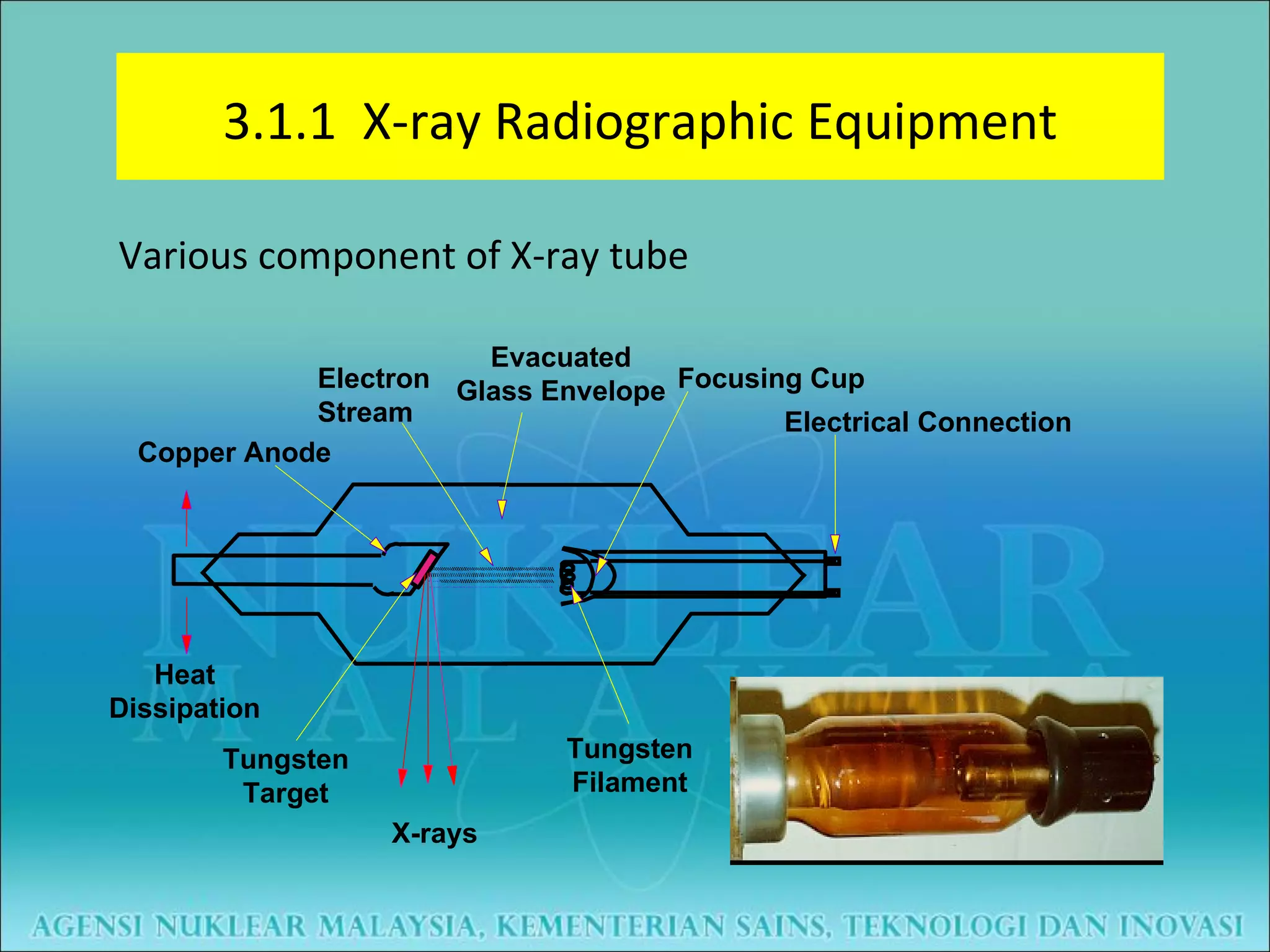
The most important components of X-ray system is the  X-ray tubes  itself which consist of: Sealed glass envelope . Made of material having high melting point and has sufficient strength to withstand the impulse force of high vacuum interior.  Cathode . Cathode incorporates a focusing cup and filament, which provide thermal electrons for the acceleration. Filament is made of easily ionized metal such as Tungsten.  Anode .  Metallic electrode of high electrical and thermal conductivity. Tungsten, Gold and Platinum are typical metal for the anode. Lead shield . To reduce risk of radiation to operator and member of the public. 3.1.1  X-ray Radiographic Equipment
Various component of X-ray tube 3.1.1  X-ray Radiographic Equipment Copper Anode Electron Stream Evacuated Glass Envelope Focusing Cup Electrical Connection Tungsten Filament X-rays Heat Dissipation Tungsten Target
X-ray Apparatus Circuit Autotransformer Voltmeter Milliammeter Filament Transformer Choke coil A.C main + - X-rays
Control panel The X -ray tube control panel   that govern a radiographic exposure may consist of: Timer . The timer is calibrated in minutes.  Current knob . The knob that controls the intensity of the X-ray through controlling amount of current input (in unit ampere). Voltage knob . The knob that control wavelength or quality (penetrating power) of the ionizing radiation. 3.1.1  X-ray Radiographic Equipment
3.1.2  Gamma Emitting Sources Commonly used Gamma emitting radioactive sealed sources in industrial radiography: Radionuclides    Energies (MeV) Half-life Optimum Steel Thickness of Test Material (mm) 60 Co High  (1.17 and 1.3) 5.3 yrs 50-150 137 Cs High (0.662) 30 yrs 50-100 192 Ir Medium  (0.2-1.4) 74 days 10-70 75 Se Medium  (0.12-0.97)  120 days 4-28
Characteristic of the source assembly : The source assembly should be designed and developed based on the standard requirement as specified in ISO 2919 and ISO 3999 or other equivalent standards. The source assembly should be contained in a shielded container known as  exposure container or device . 3.1.2  Gamma Emitting Sources
There are three types of exposure container: 3.1.2  Gamma Emitting Sources Class Maximum Dose Equivalent Rate (  Sv/h) On External Surface At 50 mm Distance At 1 m Distance P – Portable Type  Weight    50 kg 2000 500 20 M – Movable  Type 2000 1000 50  F – Fixed Installed Exposure Container Type 2000 1000 100
The gamma radiation equipment consist of two main parts: Gamma-rays Projector .  Types of gamma-ray projector is given in next slide Remote Control Unit or Cable-operated Projector Source Assembly .  The later unit is normally comprises of a connector, locking ball and source capsule linked by a teleflex cable (pig-tail) enabling operation being made with much higher source activity. 3.2  Gamma Radiation Equipment
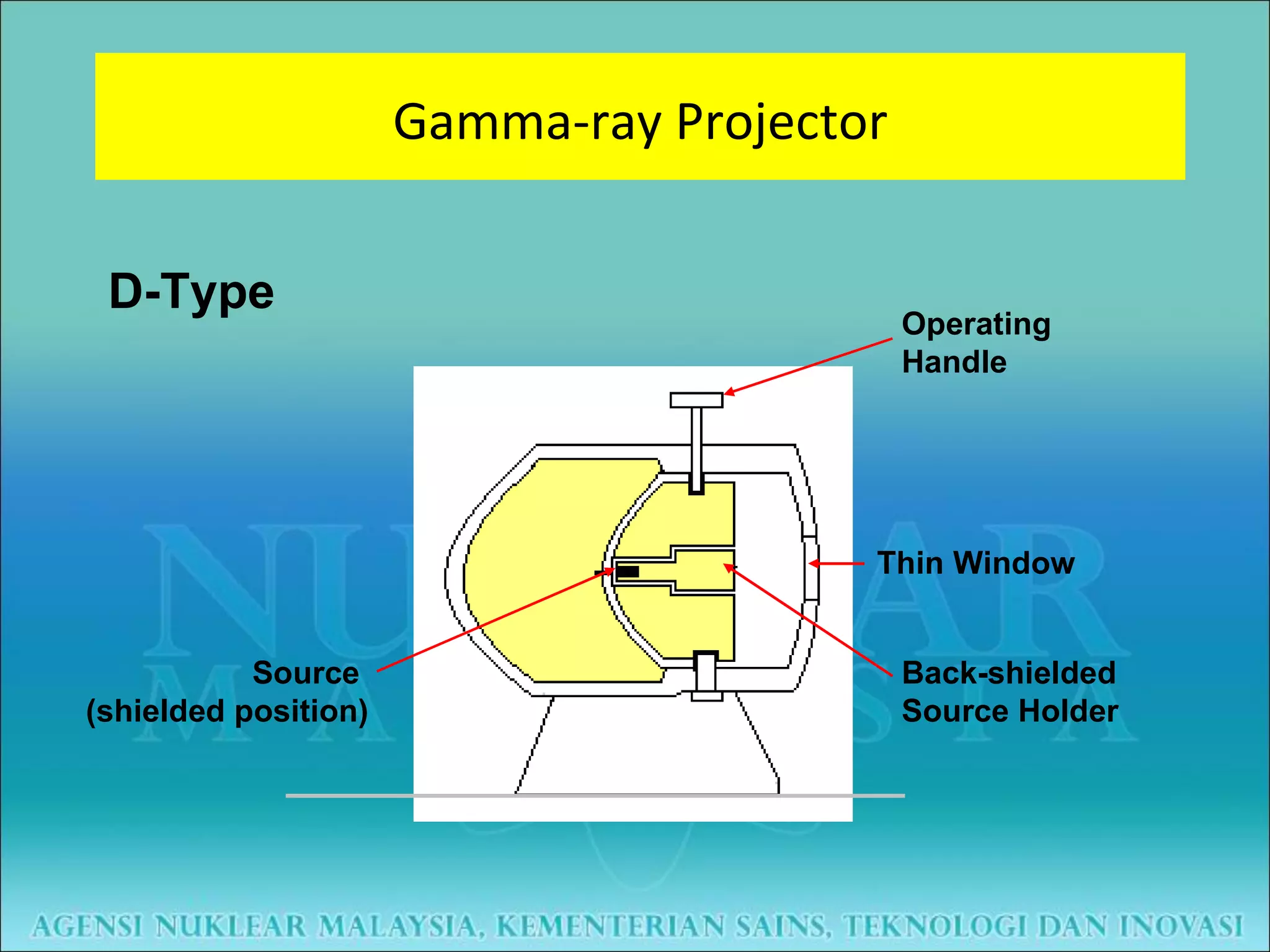
There are many types of gamma-ray projectors available. The most common are: Removable plug types . Available with the strength of radioactive sources up to 74 GBq of  60 Co (or 3.7 TBq of  192 Ir) D-types . Available with the source strength of up to 277.5 GBq of  192 Ir or 37 GBq of  137 Cs. 3.2  Gamma Radiation Equipment
Removable  Plug type Gamma-ray Projector Shutter Shielding Source Handle Source holder with back shielding
D-Type Operating Handle Back-shielded Source Holder Source  (shielded position) Gamma-ray Projector Thin Window
Remote Control Unit Stored Open on Source stored Source partly out, no longer shielded Source all the way out
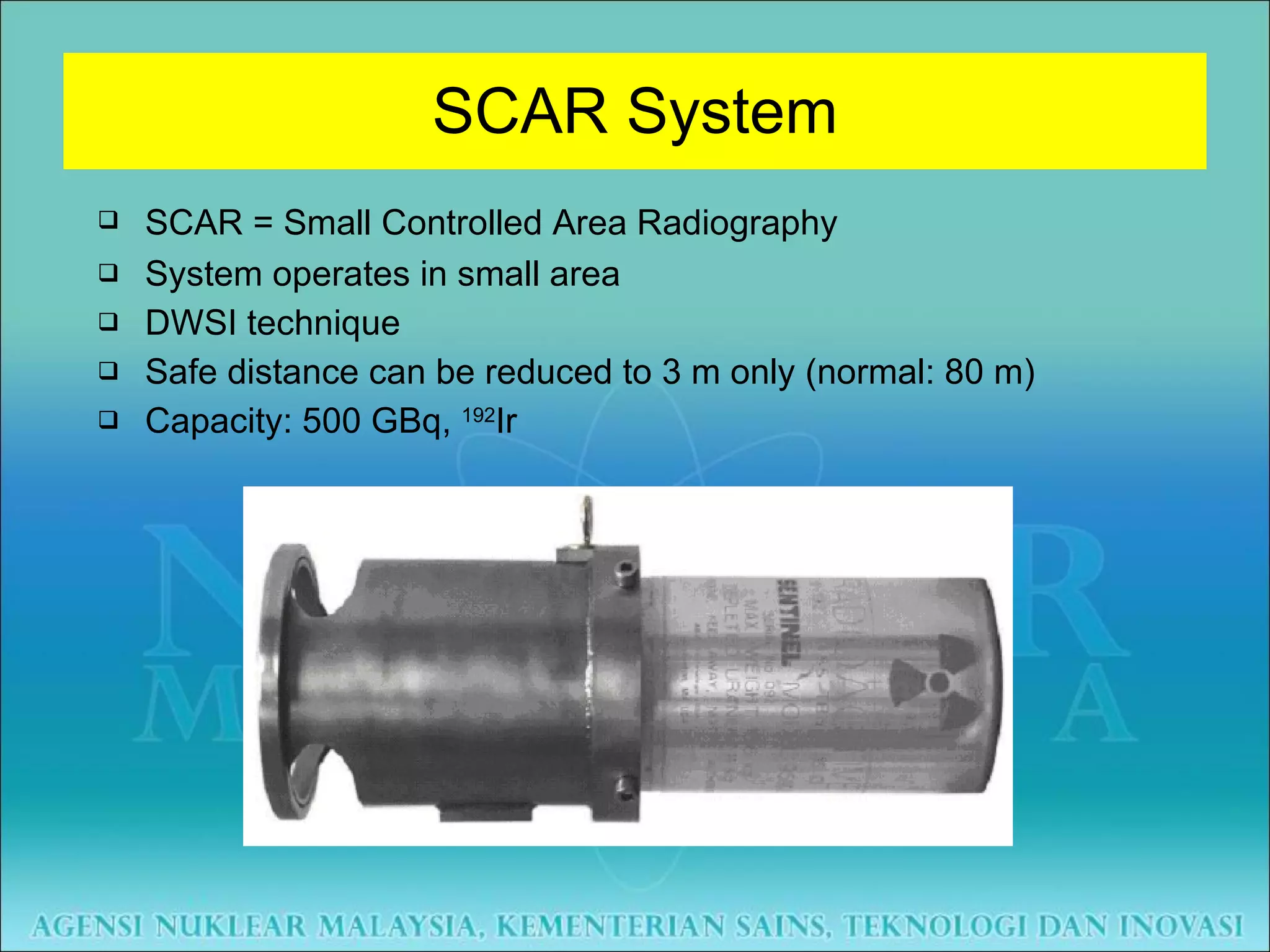
SCAR System SCAR = Small Controlled Area Radiography System operates in small area  DWSI technique Safe distance can be reduced to 3 m only (normal: 80 m) Capacity: 500 GBq,  192 Ir
3.3 Pipe-line Crawler Equipment Purpose . Pipe crawler is a mobile carrier designed to facilitate radiography works in area that is not accessible by human such as internal part of piping. Power supply . The crawler is powered either by battery or internal combustion engine or trailing cable from a generator. Control . The crawler is activated and controlled by radiographer from outside of the pipe where its location is identified using a control source, which normally a low activity  137 Cs sealed source. Application . It can be fitted with either X-ray equipment or gamma-ray sources to radiograph internal part of piping.
Typical sketch of crawlers
3.4  Safety Equipment Radiography is type of high risk work, thus safety is the main concern: The design of equipment including projector, source assembly and sealed source should meet requirements of the ISO 3999 and ISO 2919 or equivalent standard. All metallic components such as casings, interconnecting cables, power supply unit (transformer or generator), control panel and tube assembly should be bonded together and earthed.
Shielding . The safety system for shielded enclosures should be designed and installed with the following features: X-ray exposure could not be initiated unless the door is closed or is terminated automatically if the door is opened. Cut-off switches or other means of terminating X-ray exposure should be provided to discontinue X-ray exposure in any emergency. 3.4  Safety Equipment
Radiation monitoring equipment to be made available include: Personnel monitoring device . Including film badge or TLD, and a pen dosimeter that gives immediate reading such as pen dosimeter. Survey meter . The survey meter should possess a valid calibration certificate. 3.4  Safety Equipment
Source Changer Purpose . Source changer is a device used to transport new and spent sources from the manufacturer to the operating organization and vice-versa. Location of changing a source . Should be done in controlled area. Who should perform the source change . Well trained and authorized worker and should be done in accordance to procedures as described in the instruction manual. 3.4  Safety Equipment
4.1  Time, distance and shielding. 4.2  Design of exposure room. 4.0  Control of External Radiation Exposure
4.1  Time, Distance and Shielding. Basic principles in reducing external exposure to ionizing radiation. 4.1.1  Time 4.1.2  Distance 4.1.3  Shielding
4.1.1  Time Dose received by a worker is directly proportional to the amount of time spent in the area. Dose = Dose rate x time To optimize the dose, one has to spent the minimum time in the area and should  no longer than necessary.
Example:   A radiographer is found to receive an exposure of 1 mSv after he stands for 2 minutes at a certain distance from the source.  What is the total radiation exposure received if he stands for a period of 5 minutes at the same distance?
Thus, if he spends for 5 minutes, the total exposure will be:   
Radiation dose rate is inversely proportional to the square of the distance from the source. Known as  Inverse Square Law Mathematically, it can be expressed as  I 1 d 1 2  = I 2 d 2 2 The formula can be used to estimate dose equivalent rate from a gamma source at any distance if specific gamma-ray constant (  ) value is given. The constant (  ) represents the radiation equivalent dose rate from 1 GBq source at a unit distance   (1 meter). 4.1.2  Distance
DISTANCE Inverse Square Law  I 1   =  d 2 2 I 2   d 1 2 I = Radiation Intensity d = distance The dose rate at 2m from a gamma source is 40mR/hr. At what distance will it give a dose rate at 2.5mR/hr? I 1   =  d 2 2  , 40  =  d 2 2  d 2 2  = 64  I 2   d 1 2  2.5  4 d 2  = 8m
The specific gamma-ray constant (  ) of common radionuclides used in industrial radiography. 4.1.2  Distance Radionuclides Gamma-ray constant (  ) (mSv/hr/Gbq at 1 meter) 60 Co 0.351 192 Ir 0.130 137 Cs 0.081 169 Yb 0.0007
Shielding may reduce intensity of ionizing radiation exposed to workers and surrounding people.  The effectiveness of shielding is determined by the following : Atomic number/density .  The atomic number of the shielding material proportional to density. The higher the atomic number the higher efficiency of shielding properties of the material.  Energy of radiation .  Higher energy radiation is less likely to interact with electrons of the shielding material. Consequently thicker shielding is required to attenuate higher energy of electromagnetic ionizing radiation. Thickness .  The effectiveness of a specific shielding material will depend on the thickness of the material. The thicker the material the more radiation attenuated. 4.1.3  Shielding
The relationship between the thickness of a particular shielding material and the intensity of the traversed ionizing radiation. The narrow beam radiation . I x  = I 0  e -  x Where I 0  is the intensity of  radiation without shielding and I x  is the  intensity of traversed; x the thickness of shielding in unit cm and    is the  attenuation coefficient  (unit cm -1 ). The broad beam radiation .   I x  = BI 0  e -  x Where B is the build up factor which is dependent on types of material  and radiation. 4.1.3  Shielding
Concept of 1.  Half-value layer (HVL) -  the attenuation equation may be written as: I 0 /I n  = 2 n Where n is the number of HVL, I 0  is the original radiation intensity and I n  is the intensity or dose rate after shielding 2.  Ten-value layer (TVL) -  the attenuation equation may be written as: I 0 /I n  = 10 n Where n is the number of TVL 4.1.3  Shielding
What is the concrete thickness required to reduce a radiation dose rate of 80 Sv/hr from a Co-60 source to 2.5Sv/hr? (Given -    for concrete is 0.105 cm -1 ). From formula,      Therefore; the thickness of concrete required is  80  Sv/hr reduce to 40  Sv/hr need 1HVL 40  Sv/hr reduce to 20  Sv/hr need 2HVL 20  Sv/hr reduce to 10  Sv/hr need 3HVL 10  Sv/hr reduce to 5  Sv/hr need 4HVL 5  Sv/hr reduce to 2.5  Sv/hr need 5HVL
Estimate TVL and HVL for various types shielding material. 4.1.3  Shielding Types of material 192 Ir 60 Co TVL (cm) HVL (cm) TVL (cm) HVL (cm) Concrete 15.74 4.82 22.86 6.85 Steel 2.90 0.87 7.36 2.20 Lead 1.62 0.48 4.11 1.24 Tungsten 1.09 0.33 2.62 0.79 Uranium 0.93 0.28 2.29 0.69
Half-value layer (HVL) and attenuation coefficient From definition I x =(1/2)I 0 Therefore the effect of radiation attenuation to thickness shielding material can be rewrite:   2 = e  .HVL , where HVL = x   ln 2  =   .HVL       = (0.693)/HVL Therefore    in unit cm -1  can be calculated if the HVL is given, the HVL should be in unit cm. 4.1.3  Shielding
Ten-value layer(TVL) and attenuation coefficient From definition I x =(1/10)I 0 Therefore the effect of radiation attenuation to thickness shielding material can be rewrite:   10 = e  .HVL , where TVL = x ln 10  =   .TVL       = (2.303)/TVL Therefore    in unit cm -1  can be calculated if the TVL is given, the TVL should be in unit cm. 4.1.3  Shielding
4.2  Design of Exposure Room. Exposure room . A specially designed enclosed space with adequate shielding to protect persons in the vicinity from radiation risk. Purpose . The special design room to allow the radiography activity be carry out by competent professionals. The use of the enclosure allows other activity in the adjacent area to continue without interruption.  Detail design . Drawings or sketches  of the installation and its surrounding including dimensions of each enclosed area, and shielding thickness, density and type of material on all sides including above and below the exposure area should be mentioned.
Plan views of door entries to exposure rooms, showing incorrect (a) and correct (b), (c) methods of fitting.  4.2  Design of Exposure Room. Leakage of primary radiation due to incorrectly fitted sliding door;  hinged door;  sliding door (c)  (a) (b)
Methods of shielding when pipes ducts, conduits or cables must pass through walls of exposure room   4.2  Design of Exposure Room.
Scatter of radiation through a roof 4.2  Design of Exposure Room.
4.2  Design of Exposure Room. Labyrinth Design of Exposure Room. This is effectively reduced the lead door thickness.  Radiation is reduced to approximately 0.1% on each scatter
Other requirement of the design .  Shielding calculation should taken into consideration the total dose rate from both primary and scattered radiation including usage and occupancy factor .  Documentation and layout plan of the exposure room shall be submitted to the relevant authority for approval, and should include results of calculation, radiation level estimation and measurement and maximum expected radiation levels inside the shielded enclosure and in all adjacent areas. 4.2  Design of Exposure Room.
Alteration of design .  Once approved, the alteration of the design that may affect the efficacy of the exposure room in term of radiation safety are not allowed. 4.2  Design of Exposure Room.
Works in Exposure Rooms
5.1 Preparation prior to commencement of work 5.2 Procedure in exposure room 5.3 Procedure in open sites 5.4 Establishment of radiographic boundary 5.5 Storage of radioactive source and radiation apparatus 5.6 Radioactive source changing 5.7 Transportation of radioactive materials. 5.0  Working Procedure
Personnel monitoring device .  All personnel should be equipped and be ensured to wear the monitoring device such as film badge or TLD at all time during the radiographic work.  Any accidental exposure or damage to the film badge shall be reported immediately to the safety officer in-charge.  In addition pen dosimeter that could provide immediate reading of the integrated dose should also be made available . 5.1 Preparation Prior to Commencement of Work
Radiation survey meter .  There are many types of survey meters available in the market.  The response of the survey meter should be appropriate to the type of radiation to be measured.  Ensure that the survey meter possess a valid calibration certificate.  Ensure that the battery level is sufficient for optimum operation . Warning signal .  The warning signals are used to warn surrounding public about the present of ionizing radiation. The signals could be in the form of light and preferably with audible warning. 5.1 Preparation Prior to Commencement of Work
Radiation signs .  Radiation signage (Tri-foil) of adequate size (250 mm x 250 mm) must be made available.  It is strongly recommended that the name, address and telephone number of the person responsible for the site to be included on each warning sign. 5.1 Preparation Prior to Commencement of Work DANGER RADIOACTIVE MATERIAL BEWARE X-RAY
WARNING NOTICES CAUTIOUS RADIATION MONITORING DEVICES IS NEEDED BEYOND THIS LIMIT Name of RPO: Address: Tel. No: RADIOACTIVE MATERIAL DANGER NO ENTRY Name of RPO: Address: Tel. No:
5.2  Procedure in Exposure Room Accessibility .  Only authorized workers who have received appropriate training are allowed to get access to exposure room. Controlled area . The exposure room is classified as controlled area.  Therefore, it is a legal requirement for the authorized worker to undergo medical examination and be provided with personnel dosimeter. Personnel dosimeter has to be worn continuously while working in controlled area.  Area monitoring should also be performed on regular basis within and outside the exposure room.  Results of personnel and area monitoring should be recorded and ready for inspection by the relevant authority.
Working procedure .  Written operating procedure should be readily available as appropriate.  It is  important to note  that, any change to projectors or their use that are not considered in the design of the exposure room may result in excessive radiation exposure to personal outside the exposure room. 5.2  Procedure in Exposure Room
5.3  Procedure in Open Sites Working procedure in open sites may cover following activities: Movement of radiation sources outside premise. Activity at site on arrival. Preparation of working area.  Establishment of radiographic barriers. Generic procedure during operation. Storage of radiographic equipments on sites.
Movement of radiation sources outside premise. Regulations to follow . Transportation of radioactive sources should be done following procedures as clearly defined by  Radiation Protection (Transport Regulation) 1989. Prior to movement . Consignor should inform and win approval from RPO to move radioactive sources to site. 5.3  Procedure in Open Sites
Activity at site on-arrival . On-arrival at site, radiographer must obtain permit-to-work from authorized person of work site and inform him of  following:  Type and strength of radiographic sources. Model and serial number of radiographic equipment. Name of radiographer. Type of safety equipment to be used. Period of works. Sketch of site plan indicating location of works and intended safety boundary. 5.3  Procedure in Open Sites
Preparation of working area . After location of radiographic work has been identified, following requirement shall be fulfilled:  Boundary  for controlled area shall be clearly defined with barriers of rope or other means. Warning lights shall be displayed to indicate that radiographic exposure is pursued. Warning and radiation signage shall be prominently displayed. The area shall be kept under surveillance at all times during the radiographic exposure. 5.3  Procedure in Open Sites
Generic procedure during operation . Ensure site boundary at all time be appropriately positioned, by carrying out measurement of radiation level at frequent interval and readjust boundary position if necessary. Radiographer must take every effort to minimize risk of over exposure. This can be achieved by observing  three important parameters: Time spent should be the shortest possible Distance should be as far as possible from radiation source Shielding; should use collimator or any shielding material 5.3  Procedure in Open Sites
Generic procedure during operation. On the completion of the work, the radiographer must ensure that all radiation equipment and radiation warnings or signs removed from the site before leaving. In situation  where work cannot be completed at the end of the day, the radiation sources or equipment must be safely and securely stored. 5.3  Procedure in Open Sites
5.4  Establishment of Radiographic Boundary Boundary should be established by following steps : Calculate safe working distance using inverse square law. Established the preliminary boundary and place radiation warning sigs at the appropriate position. Energize the x-ray machine or exposed the radioactive source. Check the dose rate at the boundary using a survey meter and adjust the boundary if necessary. At this point, the safe boundary is now established.
Typical radiographic boundary. Radiation Sign Gamma Projector Specimen Survey Meter Define boundary-dose rate 0.75 mR/hr or 7.5  Sv/hr 'D0 NOT PASS THIS BARRIER, RADIOGRAPHY WORK  IN PROGRESS'   5.4  Establishment of Radiographic Boundary
Fully Open Sites (Field sites) 5.4  Establishment of Radiographic Boundary
5.5  Storage of Radioactive Source  and Radiation Apparatus The radiographic work may involve the application of either radioactive source or x-ray equipment. The storage of the devices at site should be done accordingly. Storage for radioactive sources Storage for x-ray equipment
Storage for radioactive sources. Prior to source movement to the site, a storage pit (bomb-pit) should be constructed. The authorize person appointed by the NDT company is responsible to ensure safety and security of the pit. Sufficient radiation warning notices shall be displayed at the fence so as to be clearly visible from all direction.  Information signifying the ownership of the material should also be displayed include name and telephone number of responsible person together with name, address and telephone number of the company. 5.5  Storage of Radioactive Source  and Radiation Apparatus
Storage for radioactive sources. Storage of gamma source can be classified into two types: Long term storage . The sources may be stored in its own containers that are used to transport and to temporary storage between exposures. The dose outside the store should not exceed  0.02 mSv/h at 1 meter from the source  or  0.2 mSv/h  at any accessible position 5 cm from outer surface of the protective container or any other shielding used around it. Temporary storage.  Permanently marked for the intended use (nuclides, maximum permitted activity) and with a warning if they do not fulfill the requirement for long term storage. 5.5  Storage of Radioactive Source  and Radiation Apparatus
Typical Storage Pit Exposure device  Storage pit Fence The radioisotope storage pit (bomb-pit) 1.0 meter < 0.25mR/hr or 2.5microSv/hr < 0.75mR/hr or 7.5microSv/hr
The bomb-pit or radioisotope storage pit shall be approved by LPTA/AELB before it can be used. 5.5  Storage of Radioactive Source  and Radiation Apparatus
Storage for x-ray equipment A storage facility for X-ray is less complicated than that  for radioactive source. It should be: A small lockable storeroom is sufficient. Protection is only required against theft or vandalism. 5.5  Storage of Radioactive Source  and Radiation Apparatus
5.6  Radioactive Source Changing Radioactive source changing is a process where a decayed spent source is transferred from an exposure container or projector and a new source is installed. The procedure to be followed for the source changing is the same as that for operating a projector except that instead of using a source stop at the end of the guide tube, the guide tube is attached to an empty chamber on the source changer.
Source Changer and Transport Container
Source Changing Processes Punca baru Punca lama dimasukkan Punca baru Punca baru dipindah ke dalam projektor  Punca lama
Source changing procedure. The spent source is then transferred from the projector, through the guide tube to the source changer. The drive cable is then disconnected from the decay source holder assembly and the guide tube removed. The drive cable is then again attached to new source holder assembly and the guide tube is attached to the chamber of the source changer containing new source. The new radioactive source is then retracted from the source changer through tube into the projector. It is important to note that the radiation survey should always be monitored during the source changing procedure.  5.6  Radioactive Source Changing
5.7  Transportation of Radioactive Materials Industrial radiography works are always performed at site in the field, and transportation of radioactive material and radiation apparatus is a norm in the practice. It is important to specifically but briefly recap the transportation process in the lecture to ensure safe movement of the hazardous material to field. The transport of radiation apparatus such as x-ray system may be undertaken through normal process.  But the transport of radioactive material has to be strictly be done following the regulatory acceptable procedure.
Transportation of radioactive material. Within premise . Not covered under Radiation Protection (Transport) Regulation 1989 but covered under the transport procedure within a premise as described in Radiation Protection Program of the organization. Field site outside premise . Should be done following the procedures as described in in according to requirement Radiation Protection (Transport) Regulation 1989. 5.7  Transportation of Radioactive Materials
Transportation within a premise. The source should not be freely moved from one place to another unless absolutely necessary. To minimize the need for the movement, sources should be stored in a place near the area where radiographic work is going to be performed. Source should be transported in its container (projector) or in other appropriate container as instructed by the responsible officer. The container should be adequately shielded. Appropriate label and warning signage should be placed on the container. Information such as type, nature, activity and radiation level of the source being transported should be written on the container. 5.7  Transportation of Radioactive Materials
Transport to site outside premises. The shipment/transportation of the source should be made in accordance with the requirements of the  Radiation Protection (Transport) Regulations 1989 . Ensure that the source is packed in an appropriate  package as required by the regulations.  Ensure that the vehicle to be used for transporting the source is in good working condition. 5.7  Transportation of Radioactive Materials
Transport to site outside premises. Ensure that the radiation level in the driver’s compartment shall not exceed 0.02 mSv/h. The driver or non-radiation worker should be given a personal dosimeter such as film badge or TLD and/or pen dosimeter. Since the vehicle may also be used as a storage facility en-route, radiation levels external to the vehicle should also satisfy the requirements for an unrestricted area. Ensure that all emergency equipment such as radiation signage, rope, fire extinguisher, radiation survey instrument are available in the vehicle. 5.7  Transportation of Radioactive Materials
Transport to site outside premises. In case of an accident, make an immediate radiation survey to see where, if at all, the radiation levels are higher than normal.  If any abnormal radiation level exist, treat the situation as an emergency. Establish and secure the restricted area and notify the responsible officer.  The RPO should notify the accident to AELB within 24 hours.  The RPO also should establish an investigation team and carried out investigation about the accident.  Detail report should be sent to AELB within 30 days after the event. 5.7  Transportation of Radioactive Materials
Transport to site outside premises. If the vehicle carrying packages categorized as Yellow-II and Yellow-III, the vehicle must be labeled with a radioactive placard at the left, right and the rear sides. No other person (beside the driver and/or assistant) is allowed travelling in the same vehicle transporting/carrying radioactive source. Any loss of gamma sources during transport shall be reported immediately to the RPO 5.7  Transportation of Radioactive Materials
Summary Industrial radiography is a profession with high-risk radiological hazard. Majority of radiological accident in Malaysia are related to this profession causing over exposure of radiation workers to the ionizing radiation.
TERIMA KASIH

Non-Destructive Testing (NDT) - Industrial Radiography Normal Working Procedures

  • 1.
    SAFETY AND SECURITYIN INDUSTRIAL RADIOGRAPHY PUSAT LATIHAN AGENSI NUKLEAR MALAYSIA
  • 2.
    Contents 1.0 Introduction 2.0 Basic principle and utilization of radiographic technique. 3.0 Equipment 4.0 Control of external radiation exposure 5.0 Working procedure 6.0 Physical safety of radioactive material
  • 3.
    A non-destructive technique (NDT) to examine irregularity of internal structure of objects or specimen. The highly penetrating radiation such as x and gamma radiation is used to visualized internal structure of solid and hard material such as steel or other types of metal. Radiography is an example of nuclear technology application involving high dose rate radiation source. It is important to note; exposure time of minutes to the ionizing radiation can cause serious physical injury to practitioners. 1.0 Introduction
  • 4.
    2.1 Basic PrincipleThe radiation from a radiation source penetrates the specimen and exposed the film located behind the specimen, which is sensitive to X and gamma radiation. 2.0 Basic Principle and Application
  • 5.
  • 6.
    2.2 ApplicationQuality control of industrial products such as pressure vessels and boilers. In Malaysia, the applications have been going on since more than two decades. The application of the technique became more pronounced since the enforcement of the regulations under the Factory and machinery Acts 1967 (Act 139) that require pressure vessels and boilers to be examined of its overall and welding integrity by radiographic technique prior to their utilization. Consequently, all welders of pressure vessels and boilers have to pass radiographic examination before they were licensed to operate. The competency examined include both aspect; quality of performance as well as safety and health. 2.0 Principle and Application
  • 7.
    3.1 Radiationdevices 3.2 Gamma radiation equipment 3.3 Pipe-line crawler equipment 3.4 Safety equipment 3.0 Equipments in Industrial Radiography
  • 8.
    There are twotypes of radiation sources used in industrial radiography: 3.1.1 X-ray radiographic equipment 3.1.2 Gamma emitting sources 3.1 Radiation Devices
  • 9.
    3.1.1 X-rayRadiographic Equipment Types There are 4 types of X-ray equipment used for the various industrial radiographic works: Conventional (directional and panoramic) X-ray units . Consist of two types namely directional and panoramic x-ray tubes. The directional X-ray tubes are fitted with collimators whilst the panoramic without collimators. Crawler X-ray system . The X-ray tube is attached to a remote control crawler to internally radiograph piping. Micro-focus X-ray system . The system utilize a very fine focus size with the tube current in the range of several hundred microamperes. Flash X-ray equipment . A rapid successive radiograph to examine kinetic or dynamic change in a system.
  • 10.
    Components X-ray radiographicequipment consist of: X-ray tube High voltage supply Voltage transformer Control panel 3.1.1 X-ray Radiographic Equipment
  • 11.
    The most importantcomponents of X-ray system is the X-ray tubes itself which consist of: Sealed glass envelope . Made of material having high melting point and has sufficient strength to withstand the impulse force of high vacuum interior. Cathode . Cathode incorporates a focusing cup and filament, which provide thermal electrons for the acceleration. Filament is made of easily ionized metal such as Tungsten. Anode . Metallic electrode of high electrical and thermal conductivity. Tungsten, Gold and Platinum are typical metal for the anode. Lead shield . To reduce risk of radiation to operator and member of the public. 3.1.1 X-ray Radiographic Equipment
  • 12.
    Various component ofX-ray tube 3.1.1 X-ray Radiographic Equipment Copper Anode Electron Stream Evacuated Glass Envelope Focusing Cup Electrical Connection Tungsten Filament X-rays Heat Dissipation Tungsten Target
  • 13.
    X-ray Apparatus CircuitAutotransformer Voltmeter Milliammeter Filament Transformer Choke coil A.C main + - X-rays
  • 14.
    Control panel TheX -ray tube control panel that govern a radiographic exposure may consist of: Timer . The timer is calibrated in minutes. Current knob . The knob that controls the intensity of the X-ray through controlling amount of current input (in unit ampere). Voltage knob . The knob that control wavelength or quality (penetrating power) of the ionizing radiation. 3.1.1 X-ray Radiographic Equipment
  • 15.
    3.1.2 GammaEmitting Sources Commonly used Gamma emitting radioactive sealed sources in industrial radiography: Radionuclides  Energies (MeV) Half-life Optimum Steel Thickness of Test Material (mm) 60 Co High (1.17 and 1.3) 5.3 yrs 50-150 137 Cs High (0.662) 30 yrs 50-100 192 Ir Medium (0.2-1.4) 74 days 10-70 75 Se Medium (0.12-0.97) 120 days 4-28
  • 16.
    Characteristic of thesource assembly : The source assembly should be designed and developed based on the standard requirement as specified in ISO 2919 and ISO 3999 or other equivalent standards. The source assembly should be contained in a shielded container known as exposure container or device . 3.1.2 Gamma Emitting Sources
  • 17.
    There are threetypes of exposure container: 3.1.2 Gamma Emitting Sources Class Maximum Dose Equivalent Rate (  Sv/h) On External Surface At 50 mm Distance At 1 m Distance P – Portable Type Weight  50 kg 2000 500 20 M – Movable Type 2000 1000 50 F – Fixed Installed Exposure Container Type 2000 1000 100
  • 18.
    The gamma radiationequipment consist of two main parts: Gamma-rays Projector . Types of gamma-ray projector is given in next slide Remote Control Unit or Cable-operated Projector Source Assembly . The later unit is normally comprises of a connector, locking ball and source capsule linked by a teleflex cable (pig-tail) enabling operation being made with much higher source activity. 3.2 Gamma Radiation Equipment
  • 19.
    There are manytypes of gamma-ray projectors available. The most common are: Removable plug types . Available with the strength of radioactive sources up to 74 GBq of 60 Co (or 3.7 TBq of 192 Ir) D-types . Available with the source strength of up to 277.5 GBq of 192 Ir or 37 GBq of 137 Cs. 3.2 Gamma Radiation Equipment
  • 20.
    Removable Plugtype Gamma-ray Projector Shutter Shielding Source Handle Source holder with back shielding
  • 21.
    D-Type Operating HandleBack-shielded Source Holder Source (shielded position) Gamma-ray Projector Thin Window
  • 22.
    Remote Control UnitStored Open on Source stored Source partly out, no longer shielded Source all the way out
  • 23.
    SCAR System SCAR= Small Controlled Area Radiography System operates in small area DWSI technique Safe distance can be reduced to 3 m only (normal: 80 m) Capacity: 500 GBq, 192 Ir
  • 24.
    3.3 Pipe-line CrawlerEquipment Purpose . Pipe crawler is a mobile carrier designed to facilitate radiography works in area that is not accessible by human such as internal part of piping. Power supply . The crawler is powered either by battery or internal combustion engine or trailing cable from a generator. Control . The crawler is activated and controlled by radiographer from outside of the pipe where its location is identified using a control source, which normally a low activity 137 Cs sealed source. Application . It can be fitted with either X-ray equipment or gamma-ray sources to radiograph internal part of piping.
  • 25.
  • 26.
    3.4 SafetyEquipment Radiography is type of high risk work, thus safety is the main concern: The design of equipment including projector, source assembly and sealed source should meet requirements of the ISO 3999 and ISO 2919 or equivalent standard. All metallic components such as casings, interconnecting cables, power supply unit (transformer or generator), control panel and tube assembly should be bonded together and earthed.
  • 27.
    Shielding . Thesafety system for shielded enclosures should be designed and installed with the following features: X-ray exposure could not be initiated unless the door is closed or is terminated automatically if the door is opened. Cut-off switches or other means of terminating X-ray exposure should be provided to discontinue X-ray exposure in any emergency. 3.4 Safety Equipment
  • 28.
    Radiation monitoring equipmentto be made available include: Personnel monitoring device . Including film badge or TLD, and a pen dosimeter that gives immediate reading such as pen dosimeter. Survey meter . The survey meter should possess a valid calibration certificate. 3.4 Safety Equipment
  • 29.
    Source Changer Purpose. Source changer is a device used to transport new and spent sources from the manufacturer to the operating organization and vice-versa. Location of changing a source . Should be done in controlled area. Who should perform the source change . Well trained and authorized worker and should be done in accordance to procedures as described in the instruction manual. 3.4 Safety Equipment
  • 30.
    4.1 Time,distance and shielding. 4.2 Design of exposure room. 4.0 Control of External Radiation Exposure
  • 31.
    4.1 Time,Distance and Shielding. Basic principles in reducing external exposure to ionizing radiation. 4.1.1 Time 4.1.2 Distance 4.1.3 Shielding
  • 32.
    4.1.1 TimeDose received by a worker is directly proportional to the amount of time spent in the area. Dose = Dose rate x time To optimize the dose, one has to spent the minimum time in the area and should no longer than necessary.
  • 33.
    Example:   Aradiographer is found to receive an exposure of 1 mSv after he stands for 2 minutes at a certain distance from the source. What is the total radiation exposure received if he stands for a period of 5 minutes at the same distance?
  • 34.
    Thus, if hespends for 5 minutes, the total exposure will be:  
  • 35.
    Radiation dose rateis inversely proportional to the square of the distance from the source. Known as Inverse Square Law Mathematically, it can be expressed as I 1 d 1 2 = I 2 d 2 2 The formula can be used to estimate dose equivalent rate from a gamma source at any distance if specific gamma-ray constant (  ) value is given. The constant (  ) represents the radiation equivalent dose rate from 1 GBq source at a unit distance (1 meter). 4.1.2 Distance
  • 36.
    DISTANCE Inverse SquareLaw I 1 = d 2 2 I 2 d 1 2 I = Radiation Intensity d = distance The dose rate at 2m from a gamma source is 40mR/hr. At what distance will it give a dose rate at 2.5mR/hr? I 1 = d 2 2 , 40 = d 2 2 d 2 2 = 64 I 2 d 1 2 2.5 4 d 2 = 8m
  • 37.
    The specific gamma-rayconstant (  ) of common radionuclides used in industrial radiography. 4.1.2 Distance Radionuclides Gamma-ray constant (  ) (mSv/hr/Gbq at 1 meter) 60 Co 0.351 192 Ir 0.130 137 Cs 0.081 169 Yb 0.0007
  • 38.
    Shielding may reduceintensity of ionizing radiation exposed to workers and surrounding people. The effectiveness of shielding is determined by the following : Atomic number/density . The atomic number of the shielding material proportional to density. The higher the atomic number the higher efficiency of shielding properties of the material. Energy of radiation . Higher energy radiation is less likely to interact with electrons of the shielding material. Consequently thicker shielding is required to attenuate higher energy of electromagnetic ionizing radiation. Thickness . The effectiveness of a specific shielding material will depend on the thickness of the material. The thicker the material the more radiation attenuated. 4.1.3 Shielding
  • 39.
    The relationship betweenthe thickness of a particular shielding material and the intensity of the traversed ionizing radiation. The narrow beam radiation . I x = I 0 e -  x Where I 0 is the intensity of radiation without shielding and I x is the intensity of traversed; x the thickness of shielding in unit cm and  is the attenuation coefficient (unit cm -1 ). The broad beam radiation . I x = BI 0 e -  x Where B is the build up factor which is dependent on types of material and radiation. 4.1.3 Shielding
  • 40.
    Concept of 1. Half-value layer (HVL) - the attenuation equation may be written as: I 0 /I n = 2 n Where n is the number of HVL, I 0 is the original radiation intensity and I n is the intensity or dose rate after shielding 2. Ten-value layer (TVL) - the attenuation equation may be written as: I 0 /I n = 10 n Where n is the number of TVL 4.1.3 Shielding
  • 41.
    What is theconcrete thickness required to reduce a radiation dose rate of 80 Sv/hr from a Co-60 source to 2.5Sv/hr? (Given -  for concrete is 0.105 cm -1 ). From formula,      Therefore; the thickness of concrete required is 80  Sv/hr reduce to 40  Sv/hr need 1HVL 40  Sv/hr reduce to 20  Sv/hr need 2HVL 20  Sv/hr reduce to 10  Sv/hr need 3HVL 10  Sv/hr reduce to 5  Sv/hr need 4HVL 5  Sv/hr reduce to 2.5  Sv/hr need 5HVL
  • 42.
    Estimate TVL andHVL for various types shielding material. 4.1.3 Shielding Types of material 192 Ir 60 Co TVL (cm) HVL (cm) TVL (cm) HVL (cm) Concrete 15.74 4.82 22.86 6.85 Steel 2.90 0.87 7.36 2.20 Lead 1.62 0.48 4.11 1.24 Tungsten 1.09 0.33 2.62 0.79 Uranium 0.93 0.28 2.29 0.69
  • 43.
    Half-value layer (HVL)and attenuation coefficient From definition I x =(1/2)I 0 Therefore the effect of radiation attenuation to thickness shielding material can be rewrite: 2 = e  .HVL , where HVL = x ln 2 =  .HVL  = (0.693)/HVL Therefore  in unit cm -1 can be calculated if the HVL is given, the HVL should be in unit cm. 4.1.3 Shielding
  • 44.
    Ten-value layer(TVL) andattenuation coefficient From definition I x =(1/10)I 0 Therefore the effect of radiation attenuation to thickness shielding material can be rewrite: 10 = e  .HVL , where TVL = x ln 10 =  .TVL  = (2.303)/TVL Therefore  in unit cm -1 can be calculated if the TVL is given, the TVL should be in unit cm. 4.1.3 Shielding
  • 45.
    4.2 Designof Exposure Room. Exposure room . A specially designed enclosed space with adequate shielding to protect persons in the vicinity from radiation risk. Purpose . The special design room to allow the radiography activity be carry out by competent professionals. The use of the enclosure allows other activity in the adjacent area to continue without interruption. Detail design . Drawings or sketches of the installation and its surrounding including dimensions of each enclosed area, and shielding thickness, density and type of material on all sides including above and below the exposure area should be mentioned.
  • 46.
    Plan views ofdoor entries to exposure rooms, showing incorrect (a) and correct (b), (c) methods of fitting. 4.2 Design of Exposure Room. Leakage of primary radiation due to incorrectly fitted sliding door; hinged door; sliding door (c) (a) (b)
  • 47.
    Methods of shieldingwhen pipes ducts, conduits or cables must pass through walls of exposure room 4.2 Design of Exposure Room.
  • 48.
    Scatter of radiationthrough a roof 4.2 Design of Exposure Room.
  • 49.
    4.2 Designof Exposure Room. Labyrinth Design of Exposure Room. This is effectively reduced the lead door thickness. Radiation is reduced to approximately 0.1% on each scatter
  • 50.
    Other requirement ofthe design . Shielding calculation should taken into consideration the total dose rate from both primary and scattered radiation including usage and occupancy factor . Documentation and layout plan of the exposure room shall be submitted to the relevant authority for approval, and should include results of calculation, radiation level estimation and measurement and maximum expected radiation levels inside the shielded enclosure and in all adjacent areas. 4.2 Design of Exposure Room.
  • 51.
    Alteration of design. Once approved, the alteration of the design that may affect the efficacy of the exposure room in term of radiation safety are not allowed. 4.2 Design of Exposure Room.
  • 52.
  • 53.
    5.1 Preparation priorto commencement of work 5.2 Procedure in exposure room 5.3 Procedure in open sites 5.4 Establishment of radiographic boundary 5.5 Storage of radioactive source and radiation apparatus 5.6 Radioactive source changing 5.7 Transportation of radioactive materials. 5.0 Working Procedure
  • 54.
    Personnel monitoring device. All personnel should be equipped and be ensured to wear the monitoring device such as film badge or TLD at all time during the radiographic work. Any accidental exposure or damage to the film badge shall be reported immediately to the safety officer in-charge. In addition pen dosimeter that could provide immediate reading of the integrated dose should also be made available . 5.1 Preparation Prior to Commencement of Work
  • 55.
    Radiation survey meter. There are many types of survey meters available in the market. The response of the survey meter should be appropriate to the type of radiation to be measured. Ensure that the survey meter possess a valid calibration certificate. Ensure that the battery level is sufficient for optimum operation . Warning signal . The warning signals are used to warn surrounding public about the present of ionizing radiation. The signals could be in the form of light and preferably with audible warning. 5.1 Preparation Prior to Commencement of Work
  • 56.
    Radiation signs . Radiation signage (Tri-foil) of adequate size (250 mm x 250 mm) must be made available. It is strongly recommended that the name, address and telephone number of the person responsible for the site to be included on each warning sign. 5.1 Preparation Prior to Commencement of Work DANGER RADIOACTIVE MATERIAL BEWARE X-RAY
  • 57.
    WARNING NOTICES CAUTIOUSRADIATION MONITORING DEVICES IS NEEDED BEYOND THIS LIMIT Name of RPO: Address: Tel. No: RADIOACTIVE MATERIAL DANGER NO ENTRY Name of RPO: Address: Tel. No:
  • 58.
    5.2 Procedurein Exposure Room Accessibility . Only authorized workers who have received appropriate training are allowed to get access to exposure room. Controlled area . The exposure room is classified as controlled area. Therefore, it is a legal requirement for the authorized worker to undergo medical examination and be provided with personnel dosimeter. Personnel dosimeter has to be worn continuously while working in controlled area. Area monitoring should also be performed on regular basis within and outside the exposure room. Results of personnel and area monitoring should be recorded and ready for inspection by the relevant authority.
  • 59.
    Working procedure . Written operating procedure should be readily available as appropriate. It is important to note that, any change to projectors or their use that are not considered in the design of the exposure room may result in excessive radiation exposure to personal outside the exposure room. 5.2 Procedure in Exposure Room
  • 60.
    5.3 Procedurein Open Sites Working procedure in open sites may cover following activities: Movement of radiation sources outside premise. Activity at site on arrival. Preparation of working area. Establishment of radiographic barriers. Generic procedure during operation. Storage of radiographic equipments on sites.
  • 61.
    Movement of radiationsources outside premise. Regulations to follow . Transportation of radioactive sources should be done following procedures as clearly defined by Radiation Protection (Transport Regulation) 1989. Prior to movement . Consignor should inform and win approval from RPO to move radioactive sources to site. 5.3 Procedure in Open Sites
  • 62.
    Activity at siteon-arrival . On-arrival at site, radiographer must obtain permit-to-work from authorized person of work site and inform him of following: Type and strength of radiographic sources. Model and serial number of radiographic equipment. Name of radiographer. Type of safety equipment to be used. Period of works. Sketch of site plan indicating location of works and intended safety boundary. 5.3 Procedure in Open Sites
  • 63.
    Preparation of workingarea . After location of radiographic work has been identified, following requirement shall be fulfilled: Boundary for controlled area shall be clearly defined with barriers of rope or other means. Warning lights shall be displayed to indicate that radiographic exposure is pursued. Warning and radiation signage shall be prominently displayed. The area shall be kept under surveillance at all times during the radiographic exposure. 5.3 Procedure in Open Sites
  • 64.
    Generic procedure duringoperation . Ensure site boundary at all time be appropriately positioned, by carrying out measurement of radiation level at frequent interval and readjust boundary position if necessary. Radiographer must take every effort to minimize risk of over exposure. This can be achieved by observing three important parameters: Time spent should be the shortest possible Distance should be as far as possible from radiation source Shielding; should use collimator or any shielding material 5.3 Procedure in Open Sites
  • 65.
    Generic procedure duringoperation. On the completion of the work, the radiographer must ensure that all radiation equipment and radiation warnings or signs removed from the site before leaving. In situation where work cannot be completed at the end of the day, the radiation sources or equipment must be safely and securely stored. 5.3 Procedure in Open Sites
  • 66.
    5.4 Establishmentof Radiographic Boundary Boundary should be established by following steps : Calculate safe working distance using inverse square law. Established the preliminary boundary and place radiation warning sigs at the appropriate position. Energize the x-ray machine or exposed the radioactive source. Check the dose rate at the boundary using a survey meter and adjust the boundary if necessary. At this point, the safe boundary is now established.
  • 67.
    Typical radiographic boundary.Radiation Sign Gamma Projector Specimen Survey Meter Define boundary-dose rate 0.75 mR/hr or 7.5  Sv/hr 'D0 NOT PASS THIS BARRIER, RADIOGRAPHY WORK IN PROGRESS' 5.4 Establishment of Radiographic Boundary
  • 68.
    Fully Open Sites(Field sites) 5.4 Establishment of Radiographic Boundary
  • 69.
    5.5 Storageof Radioactive Source and Radiation Apparatus The radiographic work may involve the application of either radioactive source or x-ray equipment. The storage of the devices at site should be done accordingly. Storage for radioactive sources Storage for x-ray equipment
  • 70.
    Storage for radioactivesources. Prior to source movement to the site, a storage pit (bomb-pit) should be constructed. The authorize person appointed by the NDT company is responsible to ensure safety and security of the pit. Sufficient radiation warning notices shall be displayed at the fence so as to be clearly visible from all direction. Information signifying the ownership of the material should also be displayed include name and telephone number of responsible person together with name, address and telephone number of the company. 5.5 Storage of Radioactive Source and Radiation Apparatus
  • 71.
    Storage for radioactivesources. Storage of gamma source can be classified into two types: Long term storage . The sources may be stored in its own containers that are used to transport and to temporary storage between exposures. The dose outside the store should not exceed 0.02 mSv/h at 1 meter from the source or 0.2 mSv/h at any accessible position 5 cm from outer surface of the protective container or any other shielding used around it. Temporary storage. Permanently marked for the intended use (nuclides, maximum permitted activity) and with a warning if they do not fulfill the requirement for long term storage. 5.5 Storage of Radioactive Source and Radiation Apparatus
  • 72.
    Typical Storage PitExposure device Storage pit Fence The radioisotope storage pit (bomb-pit) 1.0 meter < 0.25mR/hr or 2.5microSv/hr < 0.75mR/hr or 7.5microSv/hr
  • 73.
    The bomb-pit orradioisotope storage pit shall be approved by LPTA/AELB before it can be used. 5.5 Storage of Radioactive Source and Radiation Apparatus
  • 74.
    Storage for x-rayequipment A storage facility for X-ray is less complicated than that for radioactive source. It should be: A small lockable storeroom is sufficient. Protection is only required against theft or vandalism. 5.5 Storage of Radioactive Source and Radiation Apparatus
  • 75.
    5.6 RadioactiveSource Changing Radioactive source changing is a process where a decayed spent source is transferred from an exposure container or projector and a new source is installed. The procedure to be followed for the source changing is the same as that for operating a projector except that instead of using a source stop at the end of the guide tube, the guide tube is attached to an empty chamber on the source changer.
  • 76.
    Source Changer andTransport Container
  • 77.
    Source Changing ProcessesPunca baru Punca lama dimasukkan Punca baru Punca baru dipindah ke dalam projektor Punca lama
  • 78.
    Source changing procedure.The spent source is then transferred from the projector, through the guide tube to the source changer. The drive cable is then disconnected from the decay source holder assembly and the guide tube removed. The drive cable is then again attached to new source holder assembly and the guide tube is attached to the chamber of the source changer containing new source. The new radioactive source is then retracted from the source changer through tube into the projector. It is important to note that the radiation survey should always be monitored during the source changing procedure. 5.6 Radioactive Source Changing
  • 79.
    5.7 Transportationof Radioactive Materials Industrial radiography works are always performed at site in the field, and transportation of radioactive material and radiation apparatus is a norm in the practice. It is important to specifically but briefly recap the transportation process in the lecture to ensure safe movement of the hazardous material to field. The transport of radiation apparatus such as x-ray system may be undertaken through normal process. But the transport of radioactive material has to be strictly be done following the regulatory acceptable procedure.
  • 80.
    Transportation of radioactivematerial. Within premise . Not covered under Radiation Protection (Transport) Regulation 1989 but covered under the transport procedure within a premise as described in Radiation Protection Program of the organization. Field site outside premise . Should be done following the procedures as described in in according to requirement Radiation Protection (Transport) Regulation 1989. 5.7 Transportation of Radioactive Materials
  • 81.
    Transportation within apremise. The source should not be freely moved from one place to another unless absolutely necessary. To minimize the need for the movement, sources should be stored in a place near the area where radiographic work is going to be performed. Source should be transported in its container (projector) or in other appropriate container as instructed by the responsible officer. The container should be adequately shielded. Appropriate label and warning signage should be placed on the container. Information such as type, nature, activity and radiation level of the source being transported should be written on the container. 5.7 Transportation of Radioactive Materials
  • 82.
    Transport to siteoutside premises. The shipment/transportation of the source should be made in accordance with the requirements of the Radiation Protection (Transport) Regulations 1989 . Ensure that the source is packed in an appropriate package as required by the regulations. Ensure that the vehicle to be used for transporting the source is in good working condition. 5.7 Transportation of Radioactive Materials
  • 83.
    Transport to siteoutside premises. Ensure that the radiation level in the driver’s compartment shall not exceed 0.02 mSv/h. The driver or non-radiation worker should be given a personal dosimeter such as film badge or TLD and/or pen dosimeter. Since the vehicle may also be used as a storage facility en-route, radiation levels external to the vehicle should also satisfy the requirements for an unrestricted area. Ensure that all emergency equipment such as radiation signage, rope, fire extinguisher, radiation survey instrument are available in the vehicle. 5.7 Transportation of Radioactive Materials
  • 84.
    Transport to siteoutside premises. In case of an accident, make an immediate radiation survey to see where, if at all, the radiation levels are higher than normal. If any abnormal radiation level exist, treat the situation as an emergency. Establish and secure the restricted area and notify the responsible officer. The RPO should notify the accident to AELB within 24 hours. The RPO also should establish an investigation team and carried out investigation about the accident. Detail report should be sent to AELB within 30 days after the event. 5.7 Transportation of Radioactive Materials
  • 85.
    Transport to siteoutside premises. If the vehicle carrying packages categorized as Yellow-II and Yellow-III, the vehicle must be labeled with a radioactive placard at the left, right and the rear sides. No other person (beside the driver and/or assistant) is allowed travelling in the same vehicle transporting/carrying radioactive source. Any loss of gamma sources during transport shall be reported immediately to the RPO 5.7 Transportation of Radioactive Materials
  • 86.
    Summary Industrial radiographyis a profession with high-risk radiological hazard. Majority of radiological accident in Malaysia are related to this profession causing over exposure of radiation workers to the ionizing radiation.
  • 87.

Editor's Notes

  • #4 Explain the ability of ionizing radiation especially X and gamma radiation to penetrate the object; density is a factor determining how deep the penetration of the radiation into the object; apart from the energy of the radiation; the higher the energy of ionizing radiation the deeper the penetration. Other properties of ionizing radiation: Refracted when passing through media of different density. Some of the radiation be reflected when meeting smooth surface of an object and some penetrated into the object. The energey expressed in eV, keV and MeV Should also explain other properties of ionizing radiation
  • #5 Discussion Where do you think you should put the film to have optimum image of the internal structure of the specimen???
  • #10 Directional x-ray tubes are fitted with suitable collimators called cones and diaphragms to reduce the useful beam to a minimum size necessary for the work and to minimise the scattered radiation from the irradiated object.
  • #12 When the filament in the cathode is heated, free electrons escape from the surface of the material. The potential difference (kV) applied between the cathode and anode will cause acceleration of the electron toward the anode. Sudden stop of the high speed electrons cause transformation of almost 97% of kinetic energy to heat and only small portion of the energy turn into emission of x-ray from the anode. The energy of the x-ray range from 0 to the maximum, which is determined by the kinetic energy of the electrons or kV and also on how rapidly the electrons are decelarated.
  • #19 High intensity sources such as several curies of 192 Ir and 60 Co are best handled with specific equipment that permit the radiographer to remain several meters from the projector when the source is exposed.
  • #29 Ensure that the survey meter is used for tasks: To initially check that the safety barriers are positioned where the dose rate is not greater than 7.5 uSv/h. To monitor on a routine basis the dose rate at the safety barriers, particularly when the radiographic techniques varies. To make sure that a source is fully shielded after use or that a source is fully retracted. To help task of locating a lost source (if any).
  • #36 Where I 1 is the intensity of radiation in unit activity either Ci or Bq, or in unit dose received such as Sv and fraction of the unit(uSv, mSv etc.) at distance d 1 in unit distance such as cm or m Whilst I 2 is the radiation intensity in the respective unit at distance d 2 in unit distance such as cm or m.
  • #39 Atomic number . Shielding property proportional to atomic number of shielding material. Example lead with atomic number 82 is more effective shielding material than Ni with atomic number 28.
  • #40 Notes Narrow beam radiation when the radioactive material is a point source The e -  x is also known as transmission factor symbolized as  , where the above equation may simply rewritten as I x =I 0 
  • #41 If I x =I 0 /2, therefore 2 = e  x , where x=x/2 or HVL, thus HVL or x =ln2/  = 0.693/  . I 0 /I n = 2 n Say for (1) half thickness I 0 /I 1 =2 1 , two (2) half thickness I 0 /I 2 =2 2 , and if n half thickness I 0 /I n =2 n Say for a thickness that reduce the intensity to 10 of the original radiation intensity. I0/I10 = 10 = e  x where x = TVL, therefore ln10=  x, or TVL=2.303/  . How to derive I 0 /I n = 10 n . I 0 /I 1 = 10 1 , I 0 /I 2 = 10 2 , ……. I 0 /I n =10 n
  • #43 The U having the lowest TVL signifying of its effectiveness in attenuating the ionizing radiation due to highest atomic number (92) compare to lead with atomic number 82. It is noted that density also determined the TVL or /and HVL for example lead with specific density of 11.28 having HVL/TVL higher than tungsten with specific density 19.35.
  • #59 The working area classified as clean, supervised and controlled area when meeting the following. Source – sealed source. Clean area in the radiation exposure less than 1/10 x annual total dose equivalent (5 mSv/yr) Supervised area if the radiation exposure more than 1/10 of annual dose equaivalent but less than 3/10 of annual dose equaivalent ( more that 5 mSv peryear but less that 15 mSv/year) Controlled area – if the annual dose equaivalent more than 3/5 of annual dose equivalent perannum( more than 15 mSv/yr.)
  • #82 Movement at site location from a place to another within reasonable site area is considered as movement within site.