Prepared by

              (4th batch)
What is case history?
   It is a classic form of documentation ranges from clinical sketches to
    highly detailed and extended accounts that help in arriving at a
    diagnosis and formulation of treatment plan of a person before
    treatment
   Steps in case history taking
   Step 1;assemble all the available facts gathered from chief
    complaint, medical history, dental history ,diagnostic tests and
    investigations
   Step 2:analyse and interpret the assembled clues to reach the
    provisional diagnosis
   Step3 :make a differential diagnosis of all possible complications
   Step4 ;select a closest possible choice-final diagnosis
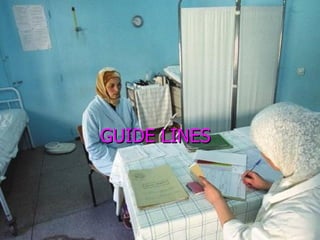
GUIDE LINES
Guidelines for taking case history;
   Questions should be open ended (encourage a detailed
    explanation). No ‘yes’ or ‘no’ questions
   Avoid leading questions
   Infants under 5yrs parent is interviewed
   The questions should be clear and should touch various
    aspects of the disease
   Symptoms are described by patient should record in his
    own words
   Doctor should be an empathetic listener
     NB: Behavior Shaping of pedo patient should be started
    from case history taking or even before
Consent
   Esp. in pediatric patients a written consent
    is a must to get adequate information
    about the case and to escape from medico
    legal complications
STEPS IN CASE HISTORY TAKING
Case history taking;
1)VITAL STATISTICS;
   a) date;-time of admission
           reference during follow up visits
    b) out patient number;-maintaining a record, billing , medico
 legal considerations
   c) name:-to communicate with the patient
              -to establish a rapport with the patient
    d) age:- chronological age (date of birth) should be noted to
 know whether growth and development is normal or not
     -occurrence of certain diseases correlated with age
      eg; primary herpetic gingivostomatitis(6months to 6years)
          nursing caries-pre schoolers
     -behavior management techniques also varry according to age
e) sex;-girls mature earlier than boys-require treatment
   earlier
      -some diseases shows sex predilection
       eg: anorexia-females
          hemophilia -males
f) race/ethnic origin:-certain religious cultures depends the
   etiology of certain diseases.
g) school/class:-to communicate with teacher
     -to know the IQ level
h) address;-communication
     -to chart out appointments for patients from distant
   places
    -to know endemic status of disease in the locality
i] socio economic status-to know about the nourishment,
   hygiene, $ payment capacity of the patient
2)Chief complaint:
 Always record in patient’s own words
 Mention only the chief problem of the present day in the order of
  severity
 Follow the chronological order

3)History of the present illness;-it should
    indicate the severity and urgency of the problem
    detailed history of the chief complaint-eg; dental pain
  -quality,-dull, sharp ;throbbing ,constant
 -quantity, severity, and frequency
  -location-localized ,diffuse ,referred, radiating.
 -duration of complaint
-onset; spontaneous, on stimulation, intermittent
 -Aggravated by: cold, heat, palpation, percussion
- Relieved by ;cold, heat, any medication ,sleep
MEDICAL HISTORY
4)Medical history
 Check list of medical history-by Scully and Cawson
          -Anemia
          -Bleeding disorders
          -Cardio respiratory disorders
          -Drug treatment and allergies
          -Endocrine disorders
          -Fits and faints
          -Gastrointestinal disorders
          -Hospital admissions and surgeries
          -Infections
          -Jaundice
          -Kidney disease
antibiotic prophylaxis needed in case of bacterial endocarditis
5)Past dental history

   History of dental treatment undergone by the patient ,along with patients experience
    before, during and after the dental treatment
   History of complications experienced by the patient
                 6)Family history
   To know about parental attitude towards the child and towards the dental treatment
   Presence of genetic / inherited abnormalities
                   7)Personal history
  Prenatal history: maternal history of nourishment, usage of drugs etc
  eg; tetracycline staining of teeth
     phenytoin sodium –cleft lips in child
 Natal history: birth injuries –forceps delivery
                 premature baby, low birth weight baby
                  neonatal jaundice-due to rapid destruction of immature
                     RBCs in liver
                Rh incompatibility –rh+ father and Rh –ive mother
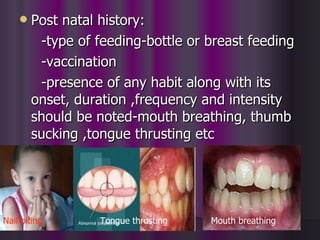
   Post natal history:
         -type of feeding-bottle or breast feeding
         -vaccination
         -presence of any habit along with its
        onset, duration ,frequency and intensity
        should be noted-mouth breathing, thumb
        sucking ,tongue thrusting etc


Nail biting       Tongue thrusting   Mouth breathing
-behavioral status-co-operative or not
   -diet chart
   -physical and emotional development of the child.
  -oral hygiene status of the child-type, method and frequency of
   brushing
GENERAL EXAMINATION
8)General examination: analyze while child entering the clinic
    built, height ,gait, and posture should be noted
    nourishment of the child
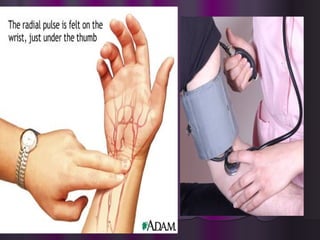
    vital signs like temperature, blood pressure, pulse, respiratory rate
   should be noted
 body type-ectomorphic (lean),mesomorphic (normal), endomorphic
   (obese)
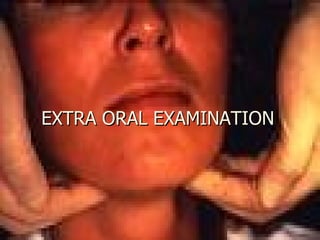
EXTRA ORAL EXAMINATION
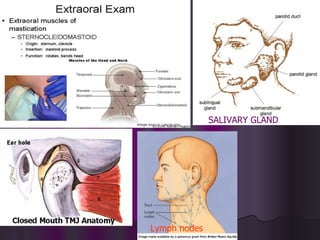
9)Extra oral examination
   Shape of head- mesocephalic (oval), brachycephalic (short and
    broad), dolicocephalic (long ,thin ,tapering)
   facial form –straight, convex (class II), Concave (class III)
   facial symmetry –bilaterally symmetrical/asymmetrical
   Lip competency-competent/incompetent
   Soft tissue-color ,contour, consistency, temperature ,size ,extend
    and shape
   TMJ-clicking ,deviation ,pain , crepitation should be noted while jaw
    movements
   Lymphnodes : size, shape, consistency, number, tender on
    palpation, mobility should be noted
   Salivary glands- Submandibular gland-bimanual palpation
SALIVARY GLAND


Lymph nodes
INTRA ORAL EXAMINATION
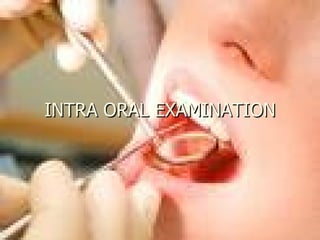
10)Intra oral examination
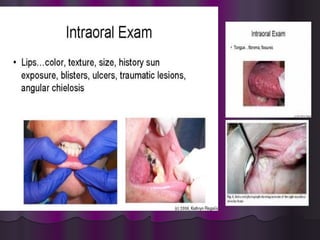
   A) soft tissue examination
-lips-sinus ,fistula ,ulcers, bite marks
-mucosa-(buccal, alveolar, labial); ulcerations, color, consistency
    ,koplik’s spots in measles ,white lesions, trauma etc
-hard and soft palate:-developmental anomalies,lesions, systemic
    disorders, growths etc
-gingiva- color, contour, consistancy ,size, shape, resiliency, exudation
    etc
-Toungue- growth, developmental anomalies, ulcers and lesions,
    speech pattern ,trauma
-floor of the mouth-ulcers and lesions, growth etc
-tonsils and adenoids:-inflammatory enlargements
-salivary orifice-flow of saliva,inflammation,exudation
b) Hard tissue examination
   Oral hygiene status
   Restorations-fractures or failures, over extensions.
   Dental caries
   Missing teeth
   Discolorations,
   regressive alterations-attrition ,abrasions, erosions
   Periodontal status-bleeding from gums ,mobility (grade I-Slight, II-
    Moderate mobility within a range of 1 mm, III-Extensive movement
    more than 1mm both mesiodistal and vertical) recession ,furcation
    involvement etc
   Class of malocclusion
   Crowding, rotations, space loss
   Pulpal diseases
   Eruption status and development of jaws and teeth
   Retained deciduous teeth etc
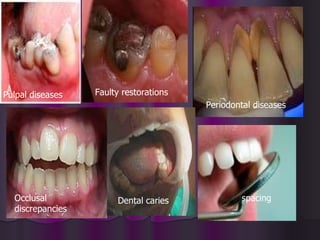
Pulpal diseases   Faulty restorations
                                        Periodontal diseases


  Occlusal             Dental caries            spacing
  discrepancies
11)Provisional diagnosis
   A general diagnosis based on the clinical impression without any
    lab. Investigations
                   12)Differential diagnosis
The process of listing out of 2 or more diseases having similar signs
  and symptoms of which only one could be attributed to the patient’s
  suffering
                   13)Investigations
radiographs, biopsy, $ other tests


14)Final diagnosis
       A confirmed diagnosis based on all available data.
TREATMENT PLAN
Treatment plan
 A) systemic phase; stabilize the medical condition if any, antibiotic
  prophylaxis, sedation, consent
 B) preventive phase: caries risk assessment, personal oral hygiene,
  flouride application, pit and fissure sealant, diet counseling
 C) preparatory phase: behavior management, oral prophylaxis,
  caries control, orthodontic consultation, oral surgical procedure
  (extractions) ,endodontic therapy
 D) corrective phase: restorative dentistry-permanent fillings,
  stainless steel crowns
     prosthetic rehabilitation-tooth replacements ,jacket crowns
     early orthodontic intervention;-minor tooth movements,serial
  extraction, space management
   E) Maintanance phase;3-6 month recalls
 -review check up of oral health indices
-repeat caries activity tests
 -reinforcement of home care measures
 -motivation and re-counseling of the parent
 -follow up of treatment procedures


         “Chances only favors trained mind “
                           Louis Pasture
Bibliography
   Text books of pedodontics- Shoba tandon
                                -Damlae
                                -Pinkham
     Text book of pediatric operative dentistry-Kennedy
    text book of oral medicine-Burkette
   Carranza’s periodontology
   Text book of endodontics-Grossman
                               -Nisha garg
Thank you….!

dental history taking

  • 1.
    Prepared by (4th batch)
  • 2.
    What is casehistory?  It is a classic form of documentation ranges from clinical sketches to highly detailed and extended accounts that help in arriving at a diagnosis and formulation of treatment plan of a person before treatment  Steps in case history taking  Step 1;assemble all the available facts gathered from chief complaint, medical history, dental history ,diagnostic tests and investigations  Step 2:analyse and interpret the assembled clues to reach the provisional diagnosis  Step3 :make a differential diagnosis of all possible complications  Step4 ;select a closest possible choice-final diagnosis
  • 3.
  • 4.
    Guidelines for takingcase history;  Questions should be open ended (encourage a detailed explanation). No ‘yes’ or ‘no’ questions  Avoid leading questions  Infants under 5yrs parent is interviewed  The questions should be clear and should touch various aspects of the disease  Symptoms are described by patient should record in his own words  Doctor should be an empathetic listener NB: Behavior Shaping of pedo patient should be started from case history taking or even before
  • 5.
    Consent  Esp. in pediatric patients a written consent is a must to get adequate information about the case and to escape from medico legal complications
  • 6.
    STEPS IN CASEHISTORY TAKING
  • 7.
    Case history taking; 1)VITALSTATISTICS; a) date;-time of admission reference during follow up visits b) out patient number;-maintaining a record, billing , medico legal considerations c) name:-to communicate with the patient -to establish a rapport with the patient d) age:- chronological age (date of birth) should be noted to know whether growth and development is normal or not -occurrence of certain diseases correlated with age eg; primary herpetic gingivostomatitis(6months to 6years) nursing caries-pre schoolers -behavior management techniques also varry according to age
  • 8.
    e) sex;-girls matureearlier than boys-require treatment earlier -some diseases shows sex predilection eg: anorexia-females hemophilia -males f) race/ethnic origin:-certain religious cultures depends the etiology of certain diseases. g) school/class:-to communicate with teacher -to know the IQ level h) address;-communication -to chart out appointments for patients from distant places -to know endemic status of disease in the locality i] socio economic status-to know about the nourishment, hygiene, $ payment capacity of the patient
  • 9.
    2)Chief complaint:  Alwaysrecord in patient’s own words  Mention only the chief problem of the present day in the order of severity  Follow the chronological order 3)History of the present illness;-it should indicate the severity and urgency of the problem  detailed history of the chief complaint-eg; dental pain -quality,-dull, sharp ;throbbing ,constant -quantity, severity, and frequency -location-localized ,diffuse ,referred, radiating. -duration of complaint -onset; spontaneous, on stimulation, intermittent -Aggravated by: cold, heat, palpation, percussion - Relieved by ;cold, heat, any medication ,sleep
  • 10.
  • 11.
    4)Medical history  Checklist of medical history-by Scully and Cawson -Anemia -Bleeding disorders -Cardio respiratory disorders -Drug treatment and allergies -Endocrine disorders -Fits and faints -Gastrointestinal disorders -Hospital admissions and surgeries -Infections -Jaundice -Kidney disease antibiotic prophylaxis needed in case of bacterial endocarditis
  • 12.
    5)Past dental history  History of dental treatment undergone by the patient ,along with patients experience before, during and after the dental treatment  History of complications experienced by the patient 6)Family history  To know about parental attitude towards the child and towards the dental treatment  Presence of genetic / inherited abnormalities 7)Personal history  Prenatal history: maternal history of nourishment, usage of drugs etc eg; tetracycline staining of teeth phenytoin sodium –cleft lips in child  Natal history: birth injuries –forceps delivery premature baby, low birth weight baby neonatal jaundice-due to rapid destruction of immature RBCs in liver Rh incompatibility –rh+ father and Rh –ive mother
  • 13.
    Post natal history: -type of feeding-bottle or breast feeding -vaccination -presence of any habit along with its onset, duration ,frequency and intensity should be noted-mouth breathing, thumb sucking ,tongue thrusting etc Nail biting Tongue thrusting Mouth breathing
  • 14.
    -behavioral status-co-operative ornot -diet chart -physical and emotional development of the child. -oral hygiene status of the child-type, method and frequency of brushing
  • 15.
    GENERAL EXAMINATION 8)General examination:analyze while child entering the clinic built, height ,gait, and posture should be noted nourishment of the child vital signs like temperature, blood pressure, pulse, respiratory rate should be noted body type-ectomorphic (lean),mesomorphic (normal), endomorphic (obese)
  • 17.
  • 18.
    9)Extra oral examination  Shape of head- mesocephalic (oval), brachycephalic (short and broad), dolicocephalic (long ,thin ,tapering)  facial form –straight, convex (class II), Concave (class III)  facial symmetry –bilaterally symmetrical/asymmetrical  Lip competency-competent/incompetent  Soft tissue-color ,contour, consistency, temperature ,size ,extend and shape  TMJ-clicking ,deviation ,pain , crepitation should be noted while jaw movements  Lymphnodes : size, shape, consistency, number, tender on palpation, mobility should be noted  Salivary glands- Submandibular gland-bimanual palpation
  • 19.
  • 20.
  • 21.
    10)Intra oral examination  A) soft tissue examination -lips-sinus ,fistula ,ulcers, bite marks -mucosa-(buccal, alveolar, labial); ulcerations, color, consistency ,koplik’s spots in measles ,white lesions, trauma etc -hard and soft palate:-developmental anomalies,lesions, systemic disorders, growths etc -gingiva- color, contour, consistancy ,size, shape, resiliency, exudation etc -Toungue- growth, developmental anomalies, ulcers and lesions, speech pattern ,trauma -floor of the mouth-ulcers and lesions, growth etc -tonsils and adenoids:-inflammatory enlargements -salivary orifice-flow of saliva,inflammation,exudation
  • 23.
    b) Hard tissueexamination  Oral hygiene status  Restorations-fractures or failures, over extensions.  Dental caries  Missing teeth  Discolorations,  regressive alterations-attrition ,abrasions, erosions  Periodontal status-bleeding from gums ,mobility (grade I-Slight, II- Moderate mobility within a range of 1 mm, III-Extensive movement more than 1mm both mesiodistal and vertical) recession ,furcation involvement etc  Class of malocclusion  Crowding, rotations, space loss  Pulpal diseases  Eruption status and development of jaws and teeth  Retained deciduous teeth etc
  • 24.
    Pulpal diseases Faulty restorations Periodontal diseases Occlusal Dental caries spacing discrepancies
  • 25.
    11)Provisional diagnosis  A general diagnosis based on the clinical impression without any lab. Investigations 12)Differential diagnosis The process of listing out of 2 or more diseases having similar signs and symptoms of which only one could be attributed to the patient’s suffering 13)Investigations radiographs, biopsy, $ other tests 14)Final diagnosis A confirmed diagnosis based on all available data.
  • 26.
  • 27.
    Treatment plan  A)systemic phase; stabilize the medical condition if any, antibiotic prophylaxis, sedation, consent  B) preventive phase: caries risk assessment, personal oral hygiene, flouride application, pit and fissure sealant, diet counseling  C) preparatory phase: behavior management, oral prophylaxis, caries control, orthodontic consultation, oral surgical procedure (extractions) ,endodontic therapy  D) corrective phase: restorative dentistry-permanent fillings, stainless steel crowns prosthetic rehabilitation-tooth replacements ,jacket crowns early orthodontic intervention;-minor tooth movements,serial extraction, space management
  • 28.
    E) Maintanance phase;3-6 month recalls -review check up of oral health indices -repeat caries activity tests -reinforcement of home care measures -motivation and re-counseling of the parent -follow up of treatment procedures “Chances only favors trained mind “ Louis Pasture
  • 29.
    Bibliography  Text books of pedodontics- Shoba tandon -Damlae -Pinkham  Text book of pediatric operative dentistry-Kennedy  text book of oral medicine-Burkette  Carranza’s periodontology  Text book of endodontics-Grossman -Nisha garg
  • 30.