BLOOD CELL COUNT 
RAJESH MOHESS,CLT
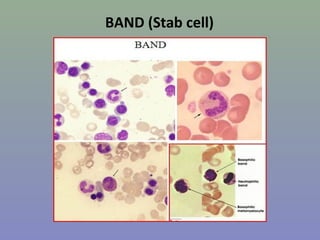
BAND (Stab cell) 
• Band are round or oval in shape and smaller than metamyelocyte. 
• They can be found in low percentage in the peripheral blood smear 0% - 
5% 
• Bone Marrow: 17% - 33% 
• Size: 9 to 15 μm 
• Chromatin: The nucleus has a deeply indented U-shape, C, S, kidney-bean 
shape or rod shape of equal thickness 
• The chromatin is coarse and clumped and is stained dark red or red blue. 
No nucleoli 
• They are often described as ‘stab’ (rod-like) forms. 
• Cytoplasm: Brown-pink (light acidophilic) and contains secondary 
granules characteristic for some species of granulocytes 
• Differentiating characteristics: No filament 
It may resemble a metamyelocyte but indentation is more severe and 
chromatin is more clumped
BAND (Stab cell)
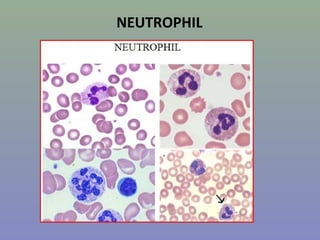
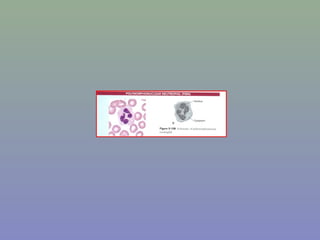
MATURE NEUTROPHIL 
(Segmented Neutrophil/PMN) 
• Segmented neutrophilic granulocyte is a mature cell, round or 
oval shape 
• Size: 9 to 15 μm 
• Chromatin: The nucleus is lobulated, with two to five lobes 
connected by a thin chromatin thread-like filament 
• The chromatin stains purple and is coarse and arranged in clumps. 
• The nucleus of 1-16 % of neutrophils may have a drumstick-shaped 
appendage attached to one lobe by a chromatin strand. 
• Neucleoli are absent 
• Cytoplasm is pale blue to pink granules 
• N:C 3:1 in favor of the cytoplasm. 
• Distinguishing characteristics: if no constriction is observed in 
nucleus, then the cell is a band 
• Bone Marrow: 3% - 11% 
• Peripheral smear: 50 – 70 % (adults)
NEUTROPHIL
NEUTROPENIA 
Neutropenia - low neutrophil count in the blood 
Neutrophils serve as the major defense of the body 
against aaccuuttee bbaacctteerriiaall and certain fungal infections. 
 Neutrophils usually constitute about 50 to 70% of all 
white blood cells in the bloodstream. 
When the neutrophil count falls below 1,000 cells per 
microliter of blood, the risk of infection increases 
Without the key defense provided by neutrophils, 
people have problems controlling infections and are at 
risk of dying from an infection
CAUSES OF NEUTROPENIA 
Neutropenia significantly increases the risk of life-threatening 
infection 
Neutropenia is often caused by cancer chemotherapy or radiation 
therapy 
Neutropenia can develop if neutrophils are used up or destroyed in 
the bloodstream faster than the bone marrow can make new ones. 
With some bacterial infections, some allergic disorders, and some 
drug treatments, neutrophils are destroyed faster than they are 
produced. 
People with an autoimmune disease can make antibodies that 
destroy neutrophils and result in neutropenia. 
People with an enlarged spleen may have a low neutrophil count 
because the enlarged spleen traps and destroys neutrophils. 
Many drugs, including phenytoin, chloramphenicol, sulfa drugs, 
and many drugs used in cancer treatment (chemotherapy)
NEUTROPHILIA 
Neutrophilia (Neutrophilic Leukocytosis) is a higher than 
normal Neutrophils in the blood 
Infections by bacteria, viruses, fungi, and parasites may all 
increase the number of neutrophils in the blood. 
The number may rise in people who have an injury, such as 
a hip fracture or burn. 
Inflammatory disorders, including autoimmune disorders 
such as rheumatoid arthritis, can cause an increase in the 
number and activity of neutrophils. 
Some drugs, such as corticosteroids, also lead to an 
increased number of neutrophils in the blood. 
Myelocytic leukemias can lead to an increased number of 
immature or mature neutrophils in the blood
EOSINOPHIL 
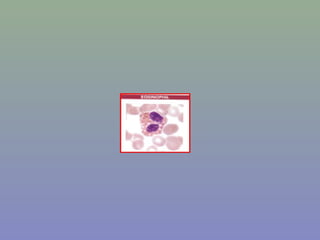
• Eosinophils are round or oval cells that are, on average, 
slightly larger than the mature neutrophils. 
• Size: 10 to 16 μm 
• N:C: Barely 1:1 
• Chromatin: Eccentric nucleus, usually bilobed 
• Nucleoli is absent 
• Cytoplasm is large and orange-pink with distinctive red-orange 
specific granules which are highly metabolic and 
contain histamine and other substances 
• Distinguishing characteristics: Granules are uniformly round, 
large, and individualized; if stain is less than adequate, 
observe granules carefully for their crystalloid nature 
• Bone Marrow: 0% - 3% 
• Peripheral smear: 0% - 4% (adults)
EOSINOPHIL
EOSINOPHIL DISORDERS 
• Eosinophilic granulocytes are mostly located in tissues, and 
not in the peripheral blood. 
• Before moving to tissues they remain in the peripheral blood 
for about 10 hours. 
• Eosinophilia accompanies immune, allergic reactions and 
parasitic reactions. 
• Eosinophilic granulocytes have antihistaminic function – 
preventing edema and smooth muscles spasm. 
• They have power of phagocytosis, but not as great as the 
neutrophils 
• Eosinopenia can occur with Cushing's syndrome, stress 
reactions, and treatment with corticosteroids
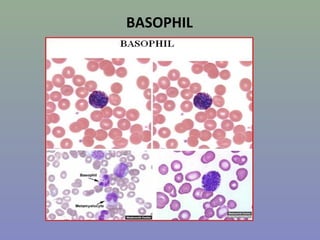
BASOPHIL 
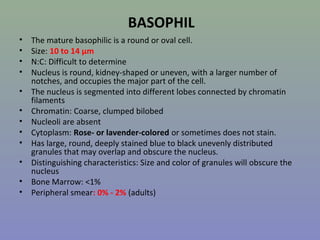
• The mature basophilic is a round or oval cell. 
• Size: 10 to 14 μm 
• N:C: Difficult to determine 
• Nucleus is round, kidney-shaped or uneven, with a larger number of 
notches, and occupies the major part of the cell. 
• The nucleus is segmented into different lobes connected by chromatin 
filaments 
• Chromatin: Coarse, clumped bilobed 
• Nucleoli are absent 
• Cytoplasm: Rose- or lavender-colored or sometimes does not stain. 
• Has large, round, deeply stained blue to black unevenly distributed 
granules that may overlap and obscure the nucleus. 
• Distinguishing characteristics: Size and color of granules will obscure the 
nucleus 
• Bone Marrow: <1% 
• Peripheral smear: 0% - 2% (adults)
BASOPHIL
BASOPHILS DISORDERS 
• Basophilic granulocytes take part in the reactions of having the role of 
degrading lipids. 
• Basophilic granules contain histamine and heparin. 
• Under the influence of histamine release factors, basophilic granulocytes 
release histamine responsible for numerous allergic reactions. 
• Basophilic granulocytes release all stored heparin during hyperlipemia 
after food intake, which enables the degradation of triglycerides into 
fatty acids and glycerol (heparin activates lipoproteinic lipase) 
• Basopenia can occur as a response to thyrotoxicosis, acute 
hypersensitivity reactions, and infections 
• Basophilia can occur in people with hypothyroidism 
• In the myeloproliferative disorders (e.g., polycythemia vera and 
myelofibrosis), a marked increase in the number of basophils can occur
Monocyte 
• Monocyte is round or oval shape 
• Due to ameboid movements on the edge of the cell, 1, 2 or 
more pseudopods can be seen 
• The size is 12-20 μm 
• N:C 2:1 – 1:1 
• The cytoplasm is relatively abundant dull grey-blue 
It may have a ground-glass appearance with a number of 
evenly distributed fine azurophilic granules. Vacuoles 
common 
• The nucleus is usually round or kidney-shaped or horse-shoe 
shaped but may be markedly indented or even lobulated, 
with two or more lobes 
• Nucleoli are not usually visible 
• Bone Marrow: 2% 
• Peripheral Smear: 2% - 9% (adults)
Monocyte
MONOCYTE DISORDERS 
Monocytes help other white blood cells remove 
dead or damaged tissues, destroy cancer cells, 
and regulate immunity against foreign 
substances. 
After a few hours in the bloodstream, they 
migrate to tissues (such as spleen, liver, lung, and 
bone marrow tissue), where they mature into 
macrophages as the main scavenger cells of the 
immune system
MONOCYTE DISORDERS 
• Monocytosis occurs in response to chronic 
infections, in autoimmune disorders, in blood 
disorders, cancers and in sarcoidosis (an 
infection of the lung) 
• Monocytopenia can occur in response to the 
release of toxins into the blood by certain 
types of bacteria as, well as in people 
receiving chemotherapy or corticosteroids
LYMPHOCYTE 
• Two types of lymphocytes can be distinguished: 
- Small lymphocyte 
- Large lymphocyte
SMALL LYMPHOCYTE 
• Small lymphocytes are the major part of lymphocytes in the blood. 
• The cell has a large roundish and regular nucleus. 
• Size: about 9 - 12 μm 
• N:C: 4:1 
• Chromatin: Nucleus is eccentrically located, round or oval, often with 
an indentation in one place; chromatin is heavily clumped, forming 
compact lumpy accumulations without sharp demarcations 
• Nucleoli not present 
• Cytoplasm: Scanty cytoplasm is often barely visible and quite often 
seen only at the nuclear periphery 
No granules. Distinctly basophilic 
• Bone Marrow: 5% - 15% 
• Peripheral smear: 20% - 44% (adults)
SMALL LYMPHOCYTE
LARGE LYMPHOCYTE 
• Large lymphocytes are the minor part of lymphocytes in the 
bloodstream. 
• The cell has a large roundish and regular nucleus 
• Size: 9 to 18 μm 
• N:C: 3:1 
• Chromatin: Nucleus is slightly eccentric located, round or 
oval, sometimes slightly indented 
• Chromatin has a looser pattern and more transparent. 
• Nucleoli is not present 
• Cytoplasm: Larger amount of cytoplasm, sky-blue color 
• There may be up to 10 azurophilic granules 
• Distinguishing characteristic: Cytoplasm is more abundant 
with tendency for azurophilic granules
LARGE LYMPHOCYTE
LYMPHOCYTES DISORDERS 
• T- and B-lymphocytes have different roles in generating 
acquired immunity: 
- T-lymphocytes in cellular 
- B-lymphocytes in humoral immunity 
• Both types produce antibodies 
• Together with natural killer-cells (NK-cells) and the 
complement system they compose a powerful defensive 
system in the organism 
• Lymphocytopenia is an abnormally low lymphocyte count in 
the body 
• A reduction in the number of lymphocytes may not cause a 
significant decrease in the total number of white blood cells
LYMPHOCYTOPENIA 
• Viral infections – including HIV infection 
• Lymphocytes can decrease briefly during 
starvation, times of severe stress, and during 
use of corticosteroids, chemotherapy for 
cancer, and radiation therapy 
• Cancer – leukemias, lymphomas 
• Rheumatoid Arthritis 
• Systemic Lupus Erthematosus (SLE)
LYMPHOCYTOSIS 
Lymphocytosis is an abnormally high lymphocyte count in 
the blood 
The number of lymphocytes can increase in response to 
infections, especially by viruses 
Some bacterial infections, such as tuberculosis, may also 
increase the number. 
Certain types of cancer, such as lymphomas and acute or 
chronic lymphocytic leukemia, may produce an increase in 
the number of lymphocytes, in part by releasing immature 
lymphocytes (lymphoblasts) or the lymphoma cells into the 
bloodstream. 
Graves' disease and Crohn's disease may also result in an 
increase in the number of lymphocytes in the bloodstream
PLASMA CELL 
• Size: 8 to 20 μm 
• N:C: 2-1:1 
• Nucleoli: None 
• Nucleus: Round or oval, eccentric 
• Chromatin: coarse 
• Cytoplasm: Deeply basophilic, often with perinuclear zone (hof) 
• Vacuoles: None to several 
• Bone Marrow: 0% - 1% 
• Peripheral blood: 0% 
• Function of plasma cells is the synthesis and excretion of 
immunoglobulins (antibodies) 
• Plasma cells may be found in peripheral blood of patients with 
measles, chickenpox, scarlet fever, multiple myeloma and plasmacytic 
leukemia
PLASMA CELL
PLASMA CELL
REFERENCE RANGE 
Cell 0- 4 years (%) Adult (%) 
• NNeeuuttrroopphhiillss 2200--4444 5500--7700 
• BBaannddss 00--55 22--66 
• LLyymmpphhooccyytteess 4488--7788 2200--4444 
• MMoonnooccyytteess 22--1111 22--99 
• EEoossiinnoopphhiillss 11--44 00--44 
• BBaassoopphhiillss 00--22 00--22
WHITE BLOOD CELLS
RELATIVE VS ABSOLUTE COUNT 
• RReellaattiivvee aanndd aabbssoolluuttee counts are terms referring to the white cell 
differential. 
• The relative count refers to the percentage of a particular cell 
counted from the 100 WBC differential 
• The absolute count refers to the count derived from the total 
white count multiplied by the percentage of any particular white 
cell. 
• The absolute count is clinically significant in many disease states 
providing important information to the clinician. 
• It provides a more accurate measure of the actual numbers of 
cells present in the peripheral blood 
• For example, Neutropenia in a patient, will place the patient at a 
higher risk for infections. Patients undergoing chemotherapy will 
need to get an absolute neutrophil count to monitor their 
immune status
RELATIVE VS ABSOLUTE COUNT 
Example: 
• If the WBC is 5.0 x 10³/μL 
• And the differential reads: 
- Segmented neutrophils: 40% (Range: 50% to 70%) 
- Bands: 3% (Range: 2% to 6%) 
- Lymphocytes: 55% (Range: 20% to 44%) 
- Monocytes: 2% (Range: 2% to 9%) 
• Then the absolute count of lymphocytes would be : 
5000 X 0.55 = 2750 
OR: (5 x 55) X 10 = 2750 OR: (5000 x 55) / 100 = 2750 
• Absolute Neutrophil count = (% of Neutrophils + Bands) X 
total WBC
RELATIVE VS ABSOLUTE COUNT 
Normal values 
• Neutrophils: 1800 – 6800 /μL 
• Band Neutrophils: 0 – 700 /μL 
• Lymphocytes: 1000 – 3400 /μL 
• Monocytes: 200 – 800 /μL 
• Eosionphils: 0 – 400 /μL 
• Basophils: 0 – 100 /μL
BLOOD CELL COUNTING 
THE END

Blood cell counting

  • 1.
    BLOOD CELL COUNT RAJESH MOHESS,CLT
  • 2.
    BAND (Stab cell) • Band are round or oval in shape and smaller than metamyelocyte. • They can be found in low percentage in the peripheral blood smear 0% - 5% • Bone Marrow: 17% - 33% • Size: 9 to 15 μm • Chromatin: The nucleus has a deeply indented U-shape, C, S, kidney-bean shape or rod shape of equal thickness • The chromatin is coarse and clumped and is stained dark red or red blue. No nucleoli • They are often described as ‘stab’ (rod-like) forms. • Cytoplasm: Brown-pink (light acidophilic) and contains secondary granules characteristic for some species of granulocytes • Differentiating characteristics: No filament It may resemble a metamyelocyte but indentation is more severe and chromatin is more clumped
  • 3.
  • 4.
    MATURE NEUTROPHIL (SegmentedNeutrophil/PMN) • Segmented neutrophilic granulocyte is a mature cell, round or oval shape • Size: 9 to 15 μm • Chromatin: The nucleus is lobulated, with two to five lobes connected by a thin chromatin thread-like filament • The chromatin stains purple and is coarse and arranged in clumps. • The nucleus of 1-16 % of neutrophils may have a drumstick-shaped appendage attached to one lobe by a chromatin strand. • Neucleoli are absent • Cytoplasm is pale blue to pink granules • N:C 3:1 in favor of the cytoplasm. • Distinguishing characteristics: if no constriction is observed in nucleus, then the cell is a band • Bone Marrow: 3% - 11% • Peripheral smear: 50 – 70 % (adults)
  • 5.
  • 6.
    NEUTROPENIA Neutropenia -low neutrophil count in the blood Neutrophils serve as the major defense of the body against aaccuuttee bbaacctteerriiaall and certain fungal infections.  Neutrophils usually constitute about 50 to 70% of all white blood cells in the bloodstream. When the neutrophil count falls below 1,000 cells per microliter of blood, the risk of infection increases Without the key defense provided by neutrophils, people have problems controlling infections and are at risk of dying from an infection
  • 7.
    CAUSES OF NEUTROPENIA Neutropenia significantly increases the risk of life-threatening infection Neutropenia is often caused by cancer chemotherapy or radiation therapy Neutropenia can develop if neutrophils are used up or destroyed in the bloodstream faster than the bone marrow can make new ones. With some bacterial infections, some allergic disorders, and some drug treatments, neutrophils are destroyed faster than they are produced. People with an autoimmune disease can make antibodies that destroy neutrophils and result in neutropenia. People with an enlarged spleen may have a low neutrophil count because the enlarged spleen traps and destroys neutrophils. Many drugs, including phenytoin, chloramphenicol, sulfa drugs, and many drugs used in cancer treatment (chemotherapy)
  • 8.
    NEUTROPHILIA Neutrophilia (NeutrophilicLeukocytosis) is a higher than normal Neutrophils in the blood Infections by bacteria, viruses, fungi, and parasites may all increase the number of neutrophils in the blood. The number may rise in people who have an injury, such as a hip fracture or burn. Inflammatory disorders, including autoimmune disorders such as rheumatoid arthritis, can cause an increase in the number and activity of neutrophils. Some drugs, such as corticosteroids, also lead to an increased number of neutrophils in the blood. Myelocytic leukemias can lead to an increased number of immature or mature neutrophils in the blood
  • 10.
    EOSINOPHIL • Eosinophilsare round or oval cells that are, on average, slightly larger than the mature neutrophils. • Size: 10 to 16 μm • N:C: Barely 1:1 • Chromatin: Eccentric nucleus, usually bilobed • Nucleoli is absent • Cytoplasm is large and orange-pink with distinctive red-orange specific granules which are highly metabolic and contain histamine and other substances • Distinguishing characteristics: Granules are uniformly round, large, and individualized; if stain is less than adequate, observe granules carefully for their crystalloid nature • Bone Marrow: 0% - 3% • Peripheral smear: 0% - 4% (adults)
  • 11.
  • 12.
    EOSINOPHIL DISORDERS •Eosinophilic granulocytes are mostly located in tissues, and not in the peripheral blood. • Before moving to tissues they remain in the peripheral blood for about 10 hours. • Eosinophilia accompanies immune, allergic reactions and parasitic reactions. • Eosinophilic granulocytes have antihistaminic function – preventing edema and smooth muscles spasm. • They have power of phagocytosis, but not as great as the neutrophils • Eosinopenia can occur with Cushing's syndrome, stress reactions, and treatment with corticosteroids
  • 14.
    BASOPHIL • Themature basophilic is a round or oval cell. • Size: 10 to 14 μm • N:C: Difficult to determine • Nucleus is round, kidney-shaped or uneven, with a larger number of notches, and occupies the major part of the cell. • The nucleus is segmented into different lobes connected by chromatin filaments • Chromatin: Coarse, clumped bilobed • Nucleoli are absent • Cytoplasm: Rose- or lavender-colored or sometimes does not stain. • Has large, round, deeply stained blue to black unevenly distributed granules that may overlap and obscure the nucleus. • Distinguishing characteristics: Size and color of granules will obscure the nucleus • Bone Marrow: <1% • Peripheral smear: 0% - 2% (adults)
  • 15.
  • 16.
    BASOPHILS DISORDERS •Basophilic granulocytes take part in the reactions of having the role of degrading lipids. • Basophilic granules contain histamine and heparin. • Under the influence of histamine release factors, basophilic granulocytes release histamine responsible for numerous allergic reactions. • Basophilic granulocytes release all stored heparin during hyperlipemia after food intake, which enables the degradation of triglycerides into fatty acids and glycerol (heparin activates lipoproteinic lipase) • Basopenia can occur as a response to thyrotoxicosis, acute hypersensitivity reactions, and infections • Basophilia can occur in people with hypothyroidism • In the myeloproliferative disorders (e.g., polycythemia vera and myelofibrosis), a marked increase in the number of basophils can occur
  • 18.
    Monocyte • Monocyteis round or oval shape • Due to ameboid movements on the edge of the cell, 1, 2 or more pseudopods can be seen • The size is 12-20 μm • N:C 2:1 – 1:1 • The cytoplasm is relatively abundant dull grey-blue It may have a ground-glass appearance with a number of evenly distributed fine azurophilic granules. Vacuoles common • The nucleus is usually round or kidney-shaped or horse-shoe shaped but may be markedly indented or even lobulated, with two or more lobes • Nucleoli are not usually visible • Bone Marrow: 2% • Peripheral Smear: 2% - 9% (adults)
  • 19.
  • 20.
    MONOCYTE DISORDERS Monocyteshelp other white blood cells remove dead or damaged tissues, destroy cancer cells, and regulate immunity against foreign substances. After a few hours in the bloodstream, they migrate to tissues (such as spleen, liver, lung, and bone marrow tissue), where they mature into macrophages as the main scavenger cells of the immune system
  • 21.
    MONOCYTE DISORDERS •Monocytosis occurs in response to chronic infections, in autoimmune disorders, in blood disorders, cancers and in sarcoidosis (an infection of the lung) • Monocytopenia can occur in response to the release of toxins into the blood by certain types of bacteria as, well as in people receiving chemotherapy or corticosteroids
  • 23.
    LYMPHOCYTE • Twotypes of lymphocytes can be distinguished: - Small lymphocyte - Large lymphocyte
  • 24.
    SMALL LYMPHOCYTE •Small lymphocytes are the major part of lymphocytes in the blood. • The cell has a large roundish and regular nucleus. • Size: about 9 - 12 μm • N:C: 4:1 • Chromatin: Nucleus is eccentrically located, round or oval, often with an indentation in one place; chromatin is heavily clumped, forming compact lumpy accumulations without sharp demarcations • Nucleoli not present • Cytoplasm: Scanty cytoplasm is often barely visible and quite often seen only at the nuclear periphery No granules. Distinctly basophilic • Bone Marrow: 5% - 15% • Peripheral smear: 20% - 44% (adults)
  • 25.
  • 26.
    LARGE LYMPHOCYTE •Large lymphocytes are the minor part of lymphocytes in the bloodstream. • The cell has a large roundish and regular nucleus • Size: 9 to 18 μm • N:C: 3:1 • Chromatin: Nucleus is slightly eccentric located, round or oval, sometimes slightly indented • Chromatin has a looser pattern and more transparent. • Nucleoli is not present • Cytoplasm: Larger amount of cytoplasm, sky-blue color • There may be up to 10 azurophilic granules • Distinguishing characteristic: Cytoplasm is more abundant with tendency for azurophilic granules
  • 27.
  • 28.
    LYMPHOCYTES DISORDERS •T- and B-lymphocytes have different roles in generating acquired immunity: - T-lymphocytes in cellular - B-lymphocytes in humoral immunity • Both types produce antibodies • Together with natural killer-cells (NK-cells) and the complement system they compose a powerful defensive system in the organism • Lymphocytopenia is an abnormally low lymphocyte count in the body • A reduction in the number of lymphocytes may not cause a significant decrease in the total number of white blood cells
  • 29.
    LYMPHOCYTOPENIA • Viralinfections – including HIV infection • Lymphocytes can decrease briefly during starvation, times of severe stress, and during use of corticosteroids, chemotherapy for cancer, and radiation therapy • Cancer – leukemias, lymphomas • Rheumatoid Arthritis • Systemic Lupus Erthematosus (SLE)
  • 30.
    LYMPHOCYTOSIS Lymphocytosis isan abnormally high lymphocyte count in the blood The number of lymphocytes can increase in response to infections, especially by viruses Some bacterial infections, such as tuberculosis, may also increase the number. Certain types of cancer, such as lymphomas and acute or chronic lymphocytic leukemia, may produce an increase in the number of lymphocytes, in part by releasing immature lymphocytes (lymphoblasts) or the lymphoma cells into the bloodstream. Graves' disease and Crohn's disease may also result in an increase in the number of lymphocytes in the bloodstream
  • 32.
    PLASMA CELL •Size: 8 to 20 μm • N:C: 2-1:1 • Nucleoli: None • Nucleus: Round or oval, eccentric • Chromatin: coarse • Cytoplasm: Deeply basophilic, often with perinuclear zone (hof) • Vacuoles: None to several • Bone Marrow: 0% - 1% • Peripheral blood: 0% • Function of plasma cells is the synthesis and excretion of immunoglobulins (antibodies) • Plasma cells may be found in peripheral blood of patients with measles, chickenpox, scarlet fever, multiple myeloma and plasmacytic leukemia
  • 33.
  • 34.
  • 35.
    REFERENCE RANGE Cell0- 4 years (%) Adult (%) • NNeeuuttrroopphhiillss 2200--4444 5500--7700 • BBaannddss 00--55 22--66 • LLyymmpphhooccyytteess 4488--7788 2200--4444 • MMoonnooccyytteess 22--1111 22--99 • EEoossiinnoopphhiillss 11--44 00--44 • BBaassoopphhiillss 00--22 00--22
  • 36.
  • 37.
    RELATIVE VS ABSOLUTECOUNT • RReellaattiivvee aanndd aabbssoolluuttee counts are terms referring to the white cell differential. • The relative count refers to the percentage of a particular cell counted from the 100 WBC differential • The absolute count refers to the count derived from the total white count multiplied by the percentage of any particular white cell. • The absolute count is clinically significant in many disease states providing important information to the clinician. • It provides a more accurate measure of the actual numbers of cells present in the peripheral blood • For example, Neutropenia in a patient, will place the patient at a higher risk for infections. Patients undergoing chemotherapy will need to get an absolute neutrophil count to monitor their immune status
  • 38.
    RELATIVE VS ABSOLUTECOUNT Example: • If the WBC is 5.0 x 10³/μL • And the differential reads: - Segmented neutrophils: 40% (Range: 50% to 70%) - Bands: 3% (Range: 2% to 6%) - Lymphocytes: 55% (Range: 20% to 44%) - Monocytes: 2% (Range: 2% to 9%) • Then the absolute count of lymphocytes would be : 5000 X 0.55 = 2750 OR: (5 x 55) X 10 = 2750 OR: (5000 x 55) / 100 = 2750 • Absolute Neutrophil count = (% of Neutrophils + Bands) X total WBC
  • 39.
    RELATIVE VS ABSOLUTECOUNT Normal values • Neutrophils: 1800 – 6800 /μL • Band Neutrophils: 0 – 700 /μL • Lymphocytes: 1000 – 3400 /μL • Monocytes: 200 – 800 /μL • Eosionphils: 0 – 400 /μL • Basophils: 0 – 100 /μL
  • 40.