Business Process Re-engineering Name  :  UBAID UR RAHMAN Roll No  :  FA11-MS-0065 Subject  : BPR (Business Process Re-Engineering Teacher/By  : Zulfiqar Ahmed  Farhan
Three C’s that Define Today’s Business Climate Customers Competition Change By: Zulfiqar Ahmed Farhan
Customers Take Charge Customers tell suppliers  what they want when they want it how they want it what they will pay. Customers, both consumers and corporations, demand products and services designed for their unique and particular needs. By: Zulfiqar Ahmed Farhan
Competition to the MAX Fewer trade barriers; it’s a world market If a company cannot stand shoulder to shoulder with the world’s best in a competitive category, it soon has no place to stand at all By: Zulfiqar Ahmed Farhan
Change Becomes Constant Change has become both pervasive and persistent The pace of change has accelerated due to globalization of the economy and technological advancements  What’s driving this? E-commerce By: Zulfiqar Ahmed Farhan
Managing Change The ability to manage change is critical to the success of systems development.  The new or modified systems created during systems development will inevitably cause change. Managing change requires the ability to recognize existing or potential problems. By: Zulfiqar Ahmed Farhan
All this leads to the  need for change Business Process Reengineering  is the fundamental rethinking and radical redesign of business processes to achieve dramatic improvements in critical, contemporary measures of performance, such as cost, quality, service, and speed. By: Zulfiqar Ahmed Farhan
B USINESS  P ROCESSES By: Zulfiqar Ahmed Farhan Business Process Redesign Six principles for redesigning business processes: Organize business processes around outcomes, not tasks Assign those who use the output to perform the process Integrate information processing into the work that produces the information
B USINESS  P ROCESSES By: Zulfiqar Ahmed Farhan Business Process Redesign Six principles for redesigning business processes: Create a virtual enterprise by treating geographically distributed resources as though they were centralized Link parallel activities instead of integrating their results Have the people who do the work make all the decisions, and let controls built into the system monitor the process
Four Key Words for Reengineering Fundamental Radical Dramatic Process By: Zulfiqar Ahmed Farhan
Fundamental Why do we do what we do? Why do we do it the way we do? By: Zulfiqar Ahmed Farhan
Radical Getting to the root of things: not making superficial changes or fiddling with what is already in place Disregarding all existing structures and procedures and inventing completely new ways of accomplishing work By: Zulfiqar Ahmed Farhan
Dramatic Dramatic improvement demands blowing up the old and replacing it with something new By: Zulfiqar Ahmed Farhan
Process Collection of activities that takes one or more kinds of input and creates an output that is of value to the customer By: Zulfiqar Ahmed Farhan
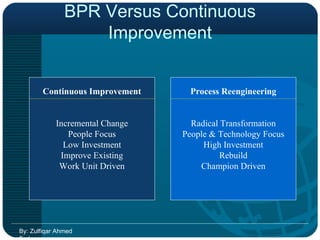
BPR Versus Continuous Improvement By: Zulfiqar Ahmed Farhan Process Reengineering Radical Transformation People & Technology Focus High Investment Rebuild Champion Driven Continuous Improvement Incremental Change People Focus Low Investment Improve Existing Work Unit Driven
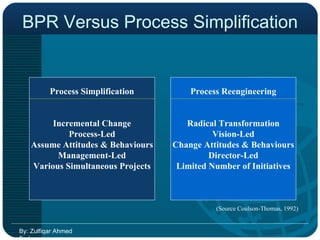
BPR Versus Process Simplification By: Zulfiqar Ahmed Farhan Process Reengineering Radical Transformation Vision-Led Change Attitudes & Behaviours Director-Led Limited Number of Initiatives Process Simplification Incremental Change Process-Led Assume Attitudes & Behaviours Management-Led Various Simultaneous Projects (Source Coulson-Thomas, 1992)
Common Benefits of BPR •  Enterprise integration  –  Departments are consolidated  –  Several jobs are combined into one job  By: Zulfiqar Ahmed Farhan
Common Benefits of BPR Worker empowerment  –  There is both horizontal and vertical reorganization  –  Handoffs are eliminated  –  There are fewer rules and less coordination is required  By: Zulfiqar Ahmed Farhan
Common Benefits of BPR •  The steps are performed in a more natural order  –  Many tasks can be done simultaneously  –  In reengineered process, work is sequenced in terms of what needs to follow what Processes have multiple versions  –  Not just one process but many are employed depending on the size of the job  –  Which version works best in a given situation (for simpler process short version) •   Work is performed where it makes the most sense  –  Wal-Mart moves the replenishment function to its suppliers  By: Zulfiqar Ahmed Farhan
Common Benefits of BPR •  Reconciliation is minimized    –  Inconsistent data  Checks and controls are reduced •  A case manager provides a single point of contact  •   Hybrid centralized/decentralized operations are prevalent  –  IT enables decisions to operate autonomously  By: Zulfiqar Ahmed Farhan
Information Technology & BPR By: Zulfiqar Ahmed Farhan
Benefits From IT Assists the Implementation of Business Processes Enables Product & Service Innovations Improve Operational Efficiency Coordinate Vendors & Customers in the Process Chain  Improve monitoring Centralization Uniformity By: Zulfiqar Ahmed Farhan
Computer Aided BPR (CABPR) Focus Business Processes Process Redesign Process Implementation By: Zulfiqar Ahmed Farhan
BPR Challenges By: Zulfiqar Ahmed Farhan
Common Problems Process Simplification is Common - True BPR is Not Desire to Change Not Strong Enough Start Point the Existing Process Not a Blank Slate Commitment to Existing Processes Too Strong By: Zulfiqar Ahmed Farhan
Common Problems with BPR Process under review too big or too small Reliance on existing process too strong The Costs of the Change Seem Too Large BPR Isolated Activity not Aligned to the Business Objectives Allocation of Resources Poor Timing and Planning Keeping the Team and Organization on Target By: Zulfiqar Ahmed Farhan
By: Zulfiqar Ahmed Farhan Phases of BPR
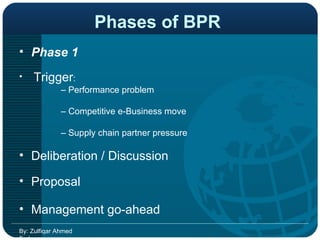
Phases of BPR   Phase 1   Trigger :  –  Performance problem  –  Competitive e-Business move  –  Supply chain partner pressure  Deliberation / Discussion   Proposal  Management go-ahead  By: Zulfiqar Ahmed Farhan
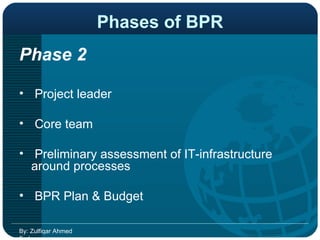
Phases of BPR Phase 2  Project leader  Core team  Preliminary assessment of IT-infrastructure around processes  BPR Plan & Budget  By: Zulfiqar Ahmed Farhan
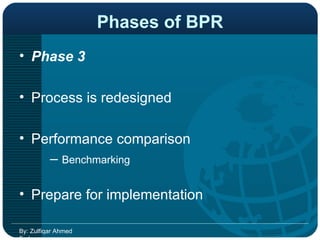
Phases of BPR Phase 3   Process is redesigned  Performance comparison  –  Benchmarking  Prepare for implementation  By: Zulfiqar Ahmed Farhan
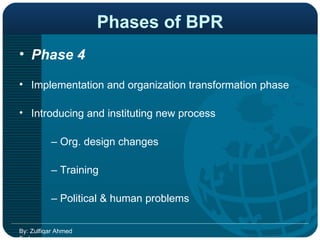
Phases of BPR Phase 4   Implementation and organization transformation phase  Introducing and instituting new process  –  Org. design changes  –  Training  –  Political & human problems  By: Zulfiqar Ahmed Farhan
Phases of BPR Phase 5   Continuous monitoring  Modified as needed.  By: Zulfiqar Ahmed Farhan
BPR is Not? Automation Downsizing Outsourcing Business Improvement Restructuring TQM By: Zulfiqar Ahmed Farhan
Summary Reengineering is a fundamental rethinking and redesign of business processes to achieve dramatic improvements BPR has emerged from key management traditions such as scientific management and systems thinking Rules and symbols play an integral part of all BPR initiatives By: Zulfiqar Ahmed Farhan
Summary Don’t assume anything - remember BPR is fundamental rethinking of business processes By: Zulfiqar Ahmed Farhan
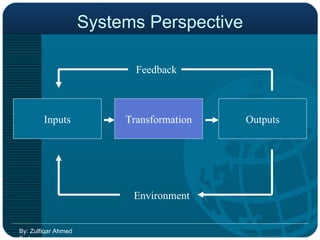
Systems Perspective By: Zulfiqar Ahmed Farhan Transformation Inputs Outputs Feedback Environment
BPR Symbols By: Zulfiqar Ahmed Farhan
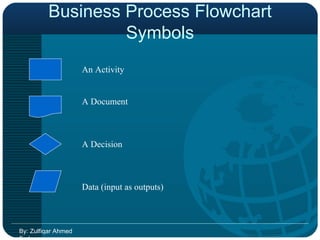
Business Process Flowchart Symbols By: Zulfiqar Ahmed Farhan An Activity A Document A Decision Data (input as outputs)
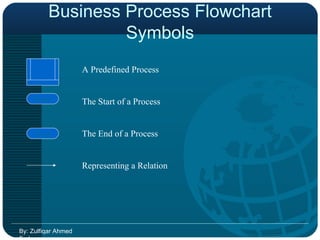
Business Process Flowchart Symbols By: Zulfiqar Ahmed Farhan A Predefined Process The Start of a Process The End of a Process Representing a Relation Start End
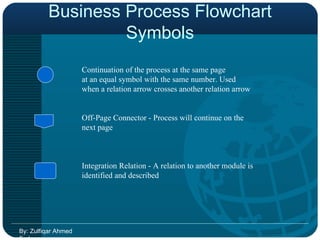
Business Process Flowchart Symbols By: Zulfiqar Ahmed Farhan Continuation of the process at the same page  at an equal symbol with the same number. Used when a relation arrow crosses another relation arrow Off-Page Connector - Process will continue on the  next page Integration Relation - A relation to another module is  identified and described
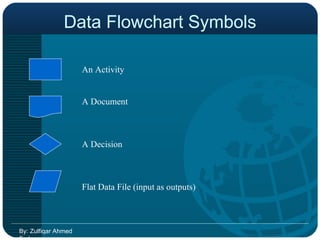
Data Flowchart Symbols By: Zulfiqar Ahmed Farhan An Activity A Document A Decision Flat Data File (input as outputs)
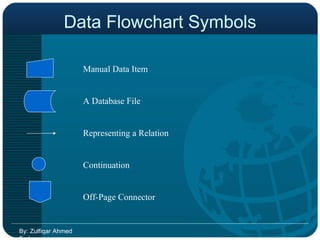
Data Flowchart Symbols By: Zulfiqar Ahmed Farhan Manual Data Item A Database File Representing a Relation Continuation Off-Page Connector
BPR & ERP   Just automating the existing business practices will not help ERP to achieve the anticipated results  Business Process Re-engineering [BPR] brings out the deficiencies of the existing setup  Business Process Re-engineering [BPR] brings out the deficiencies of the existing setup  BPR may be time consuming but the scope can be restricted & controlled by the Management  By: Zulfiqar Ahmed Farhan
Impact on ERP   If poor BPR is conducted, or if vendor system adopted without consideration of organizational requirements  –  Will discard processes in which organization has developed competitive advantage  –  Even when BPR beneficial, there will be a transition period where employee performance degrades while learning new system   By: Zulfiqar Ahmed Farhan

BPR OR Business Process Re-Engineer

  • 1.
    Business Process Re-engineeringName : UBAID UR RAHMAN Roll No : FA11-MS-0065 Subject : BPR (Business Process Re-Engineering Teacher/By : Zulfiqar Ahmed Farhan
  • 2.
    Three C’s thatDefine Today’s Business Climate Customers Competition Change By: Zulfiqar Ahmed Farhan
  • 3.
    Customers Take ChargeCustomers tell suppliers what they want when they want it how they want it what they will pay. Customers, both consumers and corporations, demand products and services designed for their unique and particular needs. By: Zulfiqar Ahmed Farhan
  • 4.
    Competition to theMAX Fewer trade barriers; it’s a world market If a company cannot stand shoulder to shoulder with the world’s best in a competitive category, it soon has no place to stand at all By: Zulfiqar Ahmed Farhan
  • 5.
    Change Becomes ConstantChange has become both pervasive and persistent The pace of change has accelerated due to globalization of the economy and technological advancements What’s driving this? E-commerce By: Zulfiqar Ahmed Farhan
  • 6.
    Managing Change Theability to manage change is critical to the success of systems development. The new or modified systems created during systems development will inevitably cause change. Managing change requires the ability to recognize existing or potential problems. By: Zulfiqar Ahmed Farhan
  • 7.
    All this leadsto the need for change Business Process Reengineering is the fundamental rethinking and radical redesign of business processes to achieve dramatic improvements in critical, contemporary measures of performance, such as cost, quality, service, and speed. By: Zulfiqar Ahmed Farhan
  • 8.
    B USINESS P ROCESSES By: Zulfiqar Ahmed Farhan Business Process Redesign Six principles for redesigning business processes: Organize business processes around outcomes, not tasks Assign those who use the output to perform the process Integrate information processing into the work that produces the information
  • 9.
    B USINESS P ROCESSES By: Zulfiqar Ahmed Farhan Business Process Redesign Six principles for redesigning business processes: Create a virtual enterprise by treating geographically distributed resources as though they were centralized Link parallel activities instead of integrating their results Have the people who do the work make all the decisions, and let controls built into the system monitor the process
  • 10.
    Four Key Wordsfor Reengineering Fundamental Radical Dramatic Process By: Zulfiqar Ahmed Farhan
  • 11.
    Fundamental Why dowe do what we do? Why do we do it the way we do? By: Zulfiqar Ahmed Farhan
  • 12.
    Radical Getting tothe root of things: not making superficial changes or fiddling with what is already in place Disregarding all existing structures and procedures and inventing completely new ways of accomplishing work By: Zulfiqar Ahmed Farhan
  • 13.
    Dramatic Dramatic improvementdemands blowing up the old and replacing it with something new By: Zulfiqar Ahmed Farhan
  • 14.
    Process Collection ofactivities that takes one or more kinds of input and creates an output that is of value to the customer By: Zulfiqar Ahmed Farhan
  • 15.
    BPR Versus ContinuousImprovement By: Zulfiqar Ahmed Farhan Process Reengineering Radical Transformation People & Technology Focus High Investment Rebuild Champion Driven Continuous Improvement Incremental Change People Focus Low Investment Improve Existing Work Unit Driven
  • 16.
    BPR Versus ProcessSimplification By: Zulfiqar Ahmed Farhan Process Reengineering Radical Transformation Vision-Led Change Attitudes & Behaviours Director-Led Limited Number of Initiatives Process Simplification Incremental Change Process-Led Assume Attitudes & Behaviours Management-Led Various Simultaneous Projects (Source Coulson-Thomas, 1992)
  • 17.
    Common Benefits ofBPR • Enterprise integration – Departments are consolidated – Several jobs are combined into one job By: Zulfiqar Ahmed Farhan
  • 18.
    Common Benefits ofBPR Worker empowerment – There is both horizontal and vertical reorganization – Handoffs are eliminated – There are fewer rules and less coordination is required By: Zulfiqar Ahmed Farhan
  • 19.
    Common Benefits ofBPR • The steps are performed in a more natural order – Many tasks can be done simultaneously – In reengineered process, work is sequenced in terms of what needs to follow what Processes have multiple versions – Not just one process but many are employed depending on the size of the job – Which version works best in a given situation (for simpler process short version) • Work is performed where it makes the most sense – Wal-Mart moves the replenishment function to its suppliers By: Zulfiqar Ahmed Farhan
  • 20.
    Common Benefits ofBPR • Reconciliation is minimized – Inconsistent data Checks and controls are reduced • A case manager provides a single point of contact • Hybrid centralized/decentralized operations are prevalent – IT enables decisions to operate autonomously By: Zulfiqar Ahmed Farhan
  • 21.
    Information Technology &BPR By: Zulfiqar Ahmed Farhan
  • 22.
    Benefits From ITAssists the Implementation of Business Processes Enables Product & Service Innovations Improve Operational Efficiency Coordinate Vendors & Customers in the Process Chain Improve monitoring Centralization Uniformity By: Zulfiqar Ahmed Farhan
  • 23.
    Computer Aided BPR(CABPR) Focus Business Processes Process Redesign Process Implementation By: Zulfiqar Ahmed Farhan
  • 24.
    BPR Challenges By:Zulfiqar Ahmed Farhan
  • 25.
    Common Problems ProcessSimplification is Common - True BPR is Not Desire to Change Not Strong Enough Start Point the Existing Process Not a Blank Slate Commitment to Existing Processes Too Strong By: Zulfiqar Ahmed Farhan
  • 26.
    Common Problems withBPR Process under review too big or too small Reliance on existing process too strong The Costs of the Change Seem Too Large BPR Isolated Activity not Aligned to the Business Objectives Allocation of Resources Poor Timing and Planning Keeping the Team and Organization on Target By: Zulfiqar Ahmed Farhan
  • 27.
    By: Zulfiqar AhmedFarhan Phases of BPR
  • 28.
    Phases of BPR Phase 1 Trigger : – Performance problem – Competitive e-Business move – Supply chain partner pressure Deliberation / Discussion Proposal Management go-ahead By: Zulfiqar Ahmed Farhan
  • 29.
    Phases of BPRPhase 2 Project leader Core team Preliminary assessment of IT-infrastructure around processes BPR Plan & Budget By: Zulfiqar Ahmed Farhan
  • 30.
    Phases of BPRPhase 3 Process is redesigned Performance comparison – Benchmarking Prepare for implementation By: Zulfiqar Ahmed Farhan
  • 31.
    Phases of BPRPhase 4 Implementation and organization transformation phase Introducing and instituting new process – Org. design changes – Training – Political & human problems By: Zulfiqar Ahmed Farhan
  • 32.
    Phases of BPRPhase 5 Continuous monitoring Modified as needed. By: Zulfiqar Ahmed Farhan
  • 33.
    BPR is Not?Automation Downsizing Outsourcing Business Improvement Restructuring TQM By: Zulfiqar Ahmed Farhan
  • 34.
    Summary Reengineering isa fundamental rethinking and redesign of business processes to achieve dramatic improvements BPR has emerged from key management traditions such as scientific management and systems thinking Rules and symbols play an integral part of all BPR initiatives By: Zulfiqar Ahmed Farhan
  • 35.
    Summary Don’t assumeanything - remember BPR is fundamental rethinking of business processes By: Zulfiqar Ahmed Farhan
  • 36.
    Systems Perspective By:Zulfiqar Ahmed Farhan Transformation Inputs Outputs Feedback Environment
  • 37.
    BPR Symbols By:Zulfiqar Ahmed Farhan
  • 38.
    Business Process FlowchartSymbols By: Zulfiqar Ahmed Farhan An Activity A Document A Decision Data (input as outputs)
  • 39.
    Business Process FlowchartSymbols By: Zulfiqar Ahmed Farhan A Predefined Process The Start of a Process The End of a Process Representing a Relation Start End
  • 40.
    Business Process FlowchartSymbols By: Zulfiqar Ahmed Farhan Continuation of the process at the same page at an equal symbol with the same number. Used when a relation arrow crosses another relation arrow Off-Page Connector - Process will continue on the next page Integration Relation - A relation to another module is identified and described
  • 41.
    Data Flowchart SymbolsBy: Zulfiqar Ahmed Farhan An Activity A Document A Decision Flat Data File (input as outputs)
  • 42.
    Data Flowchart SymbolsBy: Zulfiqar Ahmed Farhan Manual Data Item A Database File Representing a Relation Continuation Off-Page Connector
  • 43.
    BPR & ERP Just automating the existing business practices will not help ERP to achieve the anticipated results Business Process Re-engineering [BPR] brings out the deficiencies of the existing setup Business Process Re-engineering [BPR] brings out the deficiencies of the existing setup BPR may be time consuming but the scope can be restricted & controlled by the Management By: Zulfiqar Ahmed Farhan
  • 44.
    Impact on ERP If poor BPR is conducted, or if vendor system adopted without consideration of organizational requirements – Will discard processes in which organization has developed competitive advantage – Even when BPR beneficial, there will be a transition period where employee performance degrades while learning new system By: Zulfiqar Ahmed Farhan

Editor's Notes

  • #3 7 Companies created to thrive on mass production, stability, and growth can’t be fixed to succeed in a world where customers, competition, and change demand flexibility and quick response.
  • #4 8 Consumer expectations soared in the United States when competitors - many of them Japanese - burst upon the market with lower prices combined with higher quality goods. This was mass production plus - plus quality, price, selection, and service. Once customers experience superior service, they do not happily return to accepting less. For companies that grew up with a mass market mentality, the hardest new reality to accept about customers is that each one counts.
  • #5 9 Start-up companies that carry no organizational baggage and are not constrained by their histories can enter a market with the next product or service generation before existing companies can even recoup their development costs on the last one. Examples: Sun Microsystems and Walmart Walmart and Procter & Gambles’ Diaper Inventory Agreement
  • #6 10 Change is normality. Not long ago, for example, life insurance companies offered only two products: term and whole life. Today, they supply a constantly changing smorgasbord of products, and the competitive pressure on insurance companies to create new products is constantly increasing. Not only have product and service life cycles diminished, but so has the time available to develop new products and introduce them. Today, companies must move fast, or they won’t be moving at all.
  • #11 14
  • #12 15 Reengineering begins with no assumptions and no givens. It ignores what is and concentrates on what should be.
  • #13 16 Throwing away the old. Business reinvention.
  • #14 17
  • #15 18