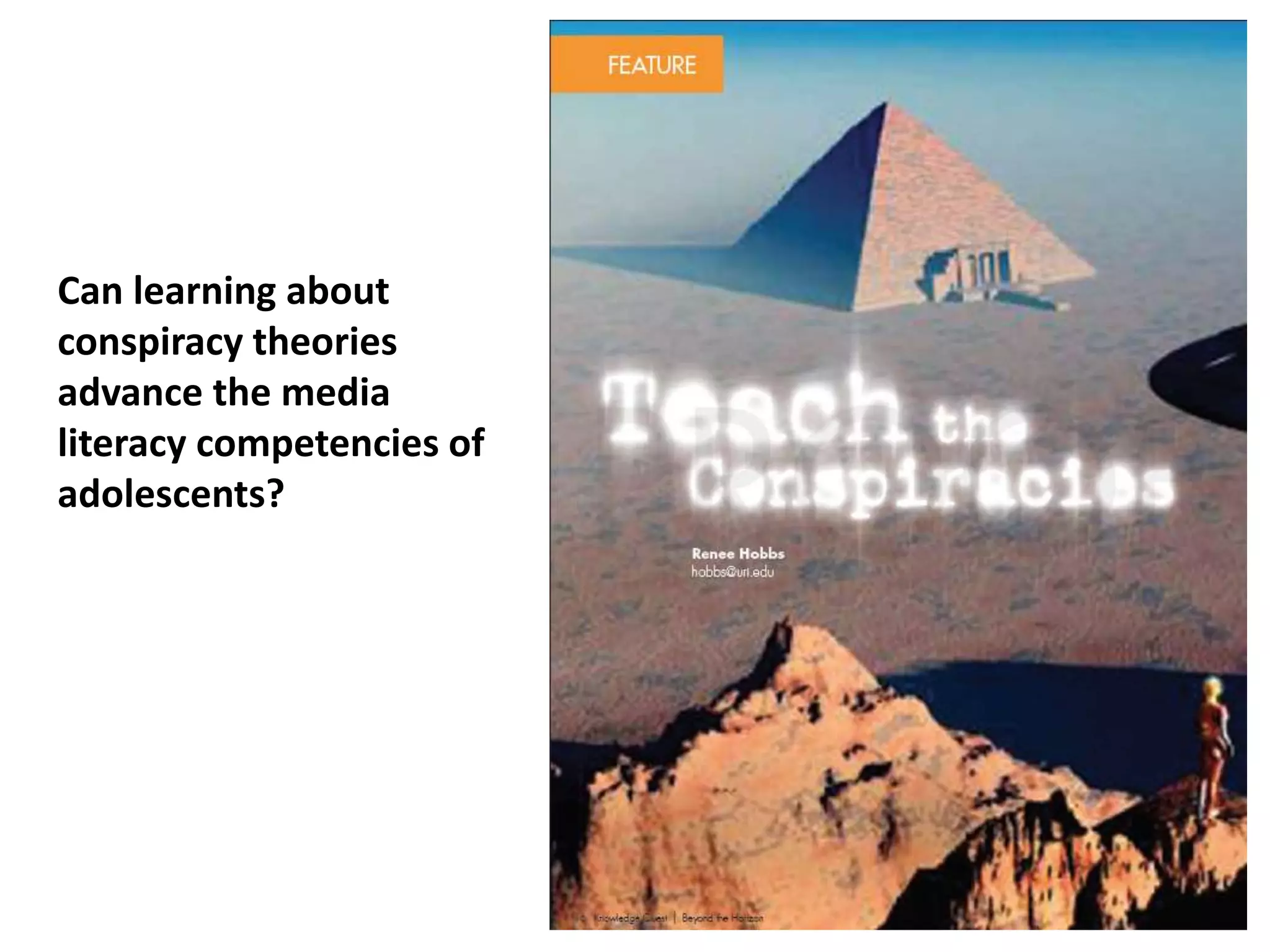






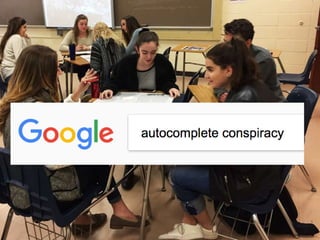

Can learning about
conspiracy theories
advance the media
literacy competencies of
adolescents?
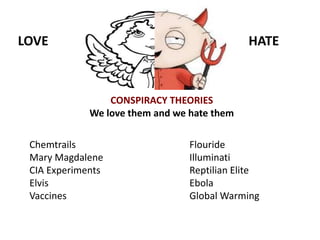
LOVE HATE
CONSPIRACY THEORIES
We love them and we hate them
Chemtrails Flouride
Mary Magdalene Illuminati
CIA Experiments Reptilian Elite
Elvis Ebola
Vaccines Global Warming
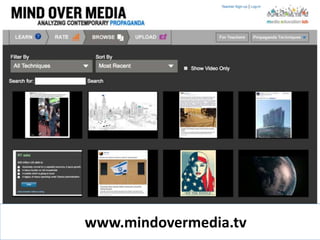
www.mindovermedia.tv
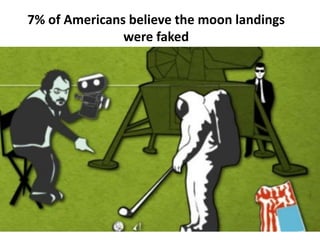
7% of Americans believe the moon landings
were faked
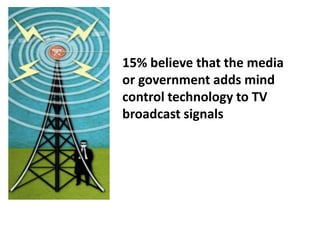
15% believe that the media
or government adds mind
control technology to TV
broadcast signals
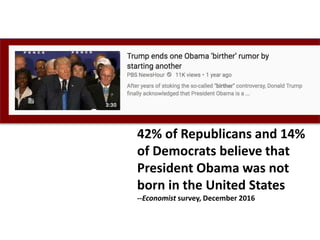
42% of Republicans and 14%
of Democrats believe that
President Obama was not
born in the United States
--Economist survey, December 2016
Conspiracy theory: a type of belief in which the
ultimate cause of an event is believed to be due
to a plot by multiple actors working together
with a clear goal in mind, often unlawfully and
in secret
TERMS FOR UNDERSTANDING CONSPIRACY THEORIES
disillusionment
anxiety
hoax
paranoia
ambiguity
open-mindedness
closure
cynicism
Government
commission concludes:
Peace is not in the
interest of a stable
society.
Even if lasting peace
"could be achieved, it
would almost certainly
not be in the best
interests of society to
achieve it.”
Becomes a best selling
book, translated into 15
languages
1972: Leonard Lewin
admits he is the author
& explains its purpose
as dark political satire
1990:
Liberty Lobby publishes
the report as a public
domain document
Right-wing websites re-
distribute it online
Conspiracy Theories are Resilient
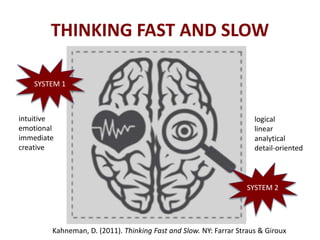
THINKING FAST AND SLOW
Kahneman, D. (2011). Thinking Fast and Slow. NY: Farrar Straus & Giroux
SYSTEM 1
SYSTEM 2
intuitive
emotional
immediate
creative
logical
linear
analytical
detail-oriented
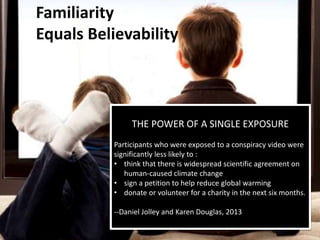
Familiarity
Equals Believability
THE POWER OF A SINGLE EXPOSURE
Participants who were exposed to a conspiracy video were
significantly less likely to :
• think that there is widespread scientific agreement on
human-caused climate change
• sign a petition to help reduce global warming
• donate or volunteer for a charity in the next six months.
--Daniel Jolley and Karen Douglas, 2013
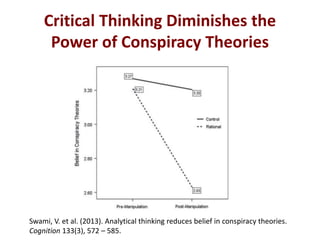
Critical Thinking Diminishes the
Power of Conspiracy Theories
Swami, V. et al. (2013). Analytical thinking reduces belief in conspiracy theories.
Cognition 133(3), 572 – 585.
Media literacy educators can
explore conspiracy theories to strengthen
critical thinking skills
Screening conspiracy theory videos in the
classroom risks validating them
 There may not be enough time in class to
examine evidence in depth
 There’s too much junk information online
on these topics
 It’s too easy to trivialize conspiracy
theories, reinforcing “us” and “them”
thinking
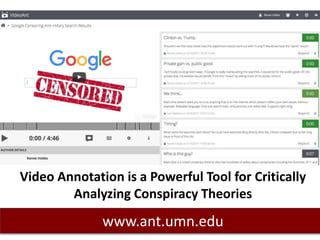
Video Annotation is a Powerful Tool for Critically
Analyzing Conspiracy Theories
www.ant.umn.edu
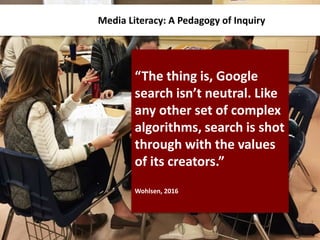
Media Literacy: A Pedagogy of Inquiry
“The thing is, Google
search isn’t neutral. Like
any other set of complex
algorithms, search is shot
through with the values
of its creators.”
Wohlsen, 2016
Should you discuss
conspiracy theories
in the classroom?
Why or why not?
TIME TO REFLECT
re
Conspiracy theories are alarm systems
that help people deal with threat. They
resonate most among groups suffering
from loss, weakness, or disunity.
--Uscinski & Parent, 2014
Responding Critically & Sympathetically
Conspiracy theories are resilient: they cannot be easily
disproved
They resonate in an age of anxiety by offering simple
explanations for complex and ambiguous realities
Although even brief exposures to conspiracy theories
increases their believability, analytical thinking can lower
belief in conspiracy theories
Video annotation tools “slow down” people’s response to
video and promotes analytic & reflective thinking
Teachers must wrestle with important paradoxes when
deciding whether, when & how to teach about conspiracy
theories
Renee Hobbs
Professor of Communication Studies
Director, Media Education Lab
University of Rhode Island USA
Twitter: @reneehobbs
SEPT/OCT 2017
Knowledge Quest
A publication of the American Association for
School Librarians (AASL)
www.mediaeducationlab.com

Teach the Conspiracies

  • 1.
    Can learning about conspiracytheories advance the media literacy competencies of adolescents?
  • 3.
    LOVE HATE CONSPIRACY THEORIES Welove them and we hate them Chemtrails Flouride Mary Magdalene Illuminati CIA Experiments Reptilian Elite Elvis Ebola Vaccines Global Warming
  • 4.
  • 5.
    7% of Americansbelieve the moon landings were faked
  • 6.
    15% believe thatthe media or government adds mind control technology to TV broadcast signals
  • 8.
    42% of Republicansand 14% of Democrats believe that President Obama was not born in the United States --Economist survey, December 2016
  • 9.
    Conspiracy theory: atype of belief in which the ultimate cause of an event is believed to be due to a plot by multiple actors working together with a clear goal in mind, often unlawfully and in secret
  • 10.
    TERMS FOR UNDERSTANDINGCONSPIRACY THEORIES disillusionment anxiety hoax paranoia ambiguity open-mindedness closure cynicism
  • 12.
    Government commission concludes: Peace isnot in the interest of a stable society. Even if lasting peace "could be achieved, it would almost certainly not be in the best interests of society to achieve it.”
  • 13.
    Becomes a bestselling book, translated into 15 languages 1972: Leonard Lewin admits he is the author & explains its purpose as dark political satire
  • 14.
    1990: Liberty Lobby publishes thereport as a public domain document Right-wing websites re- distribute it online
  • 15.
  • 17.
    THINKING FAST ANDSLOW Kahneman, D. (2011). Thinking Fast and Slow. NY: Farrar Straus & Giroux SYSTEM 1 SYSTEM 2 intuitive emotional immediate creative logical linear analytical detail-oriented
  • 18.
    Familiarity Equals Believability THE POWEROF A SINGLE EXPOSURE Participants who were exposed to a conspiracy video were significantly less likely to : • think that there is widespread scientific agreement on human-caused climate change • sign a petition to help reduce global warming • donate or volunteer for a charity in the next six months. --Daniel Jolley and Karen Douglas, 2013
  • 19.
    Critical Thinking Diminishesthe Power of Conspiracy Theories Swami, V. et al. (2013). Analytical thinking reduces belief in conspiracy theories. Cognition 133(3), 572 – 585.
  • 20.
    Media literacy educatorscan explore conspiracy theories to strengthen critical thinking skills
  • 21.
    Screening conspiracy theoryvideos in the classroom risks validating them  There may not be enough time in class to examine evidence in depth  There’s too much junk information online on these topics  It’s too easy to trivialize conspiracy theories, reinforcing “us” and “them” thinking
  • 24.
    Video Annotation isa Powerful Tool for Critically Analyzing Conspiracy Theories www.ant.umn.edu
  • 25.
    Media Literacy: APedagogy of Inquiry “The thing is, Google search isn’t neutral. Like any other set of complex algorithms, search is shot through with the values of its creators.” Wohlsen, 2016
  • 26.
    Should you discuss conspiracytheories in the classroom? Why or why not? TIME TO REFLECT
  • 27.
    re Conspiracy theories arealarm systems that help people deal with threat. They resonate most among groups suffering from loss, weakness, or disunity. --Uscinski & Parent, 2014 Responding Critically & Sympathetically
  • 28.
    Conspiracy theories areresilient: they cannot be easily disproved They resonate in an age of anxiety by offering simple explanations for complex and ambiguous realities Although even brief exposures to conspiracy theories increases their believability, analytical thinking can lower belief in conspiracy theories Video annotation tools “slow down” people’s response to video and promotes analytic & reflective thinking Teachers must wrestle with important paradoxes when deciding whether, when & how to teach about conspiracy theories
  • 29.
    Renee Hobbs Professor ofCommunication Studies Director, Media Education Lab University of Rhode Island USA Twitter: @reneehobbs SEPT/OCT 2017 Knowledge Quest A publication of the American Association for School Librarians (AASL) www.mediaeducationlab.com

Editor's Notes

  • #4  National poll shows 37% think global warming is a hoax; 21% believe govt is covering up alien evidence; 28% believe a secret elite is conspiring to rule the world.
  • #19 British Journal of Psychology