Coping with transpiration theory and practice
of irrigation at catchment scale using modern
information and modelling
Doctoral School in Civil, Environmental & Mechanical Engineering |
XXXII°Cycle
October 10, 2017
Candidate:
Michele Bottazzi
Supervisors:
Prof. Riccardo Rigon
Prof. Maurizio Righetti
ISTITUTIONAL & RESEARCH ACTIVITIES
Istitutional & Research activities Research topic Case Studies
EDUCATION & TRAINING
Summer schools, Workshops & Courses
→ Statistical methods and data analysis;
→ Intelligent optimization for data science;
→ Machine learning;
→ Acquedotti e fognature (teaching assistant);
→ Winter school: Advanced numerical methods for free surface;
→ Summer school: Principles of catchment-scale hydrological
modelling;
→ Summer school: Hydrometeorological extremes: processes, models
and human impacts;
→ Seminary: Gestione e riabilitazione delle infrastrutture idrauliche
(GERI);
→ Workshop: Isotope-based studies of water partitioning and
plant-soil interactions in forested and agricultural environments;
→ Workshop: Introduction to R for data analytics.
3
Istitutional & Research activities Research topic Case Studies
OPTIMAL SENSOR DISPLACMENT & LEAKAGES DETECTION
→ Method for the optimal sensor
displacement in a distribution
network
→ Sensors installed on Egna
network
→ Leakages detection based on
Differential evolutive - Particle
swarm optimization (DEPSO).
Case study:
• Apulian network (synthetic)
• Egna
• Levico
• Laives
4
Istitutional & Research activities Research topic Case Studies
KRIGING COMPONENT IN OMS3
Implementation of the Kriging component in the NewAge model based
on OMS3 framework.
−→ J-Grass-NewAge is a semi-distributed, componente based,
hydrological model.
−→ OMS3 is a Java-based framework for the environmental modelling,
able to support Fortran, C/C++, Python and R languages.
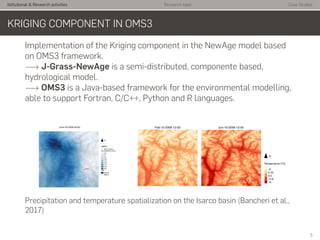
Precipitation and temperature spatialization on the Isarco basin (Bancheri et al.,
2017)
5
Istitutional & Research activities Research topic Case Studies
PUBBLICATIONS
Paper:
→ Bancheri M., Serafin F., Bottazzi M., Abera W., Formetta G., Rigon R.,
The design and implementatation of Kriging models in the Object
Modelling System v.3. [In submittion to Environmental Modelling
& Software]
→ Bort Giorgio C.M., Bottazzi M., Righetti M., Optimal selection and
monitoring of nodes aimed at supporting leakages identification in
WDS networks. [In submittion to Procedia Engineering]
Conference paper:
→ Bottazzi M., Raniero W., Bort Giorgio C.M., Righetti M., Bertola P.,
Metodo di selezione ottimale dei nodi di monitoraggio. Seminary:
Gestione e Riabilitazione delle Infrastrutture Idrauliche (GERI)
→ Rigon R., Bancheri M., Serafin F., Abera W., Bottazzi M., Strategies
for estimating the water budget at different scales using the
JGrass-NewAGE system. AGU session H024: Balancing the Water
Budget: A Physical Basis for Quantifying Water Fluxes Using Data
and Models
6
RESEARCH TOPIC
Istitutional & Research activities Research topic Case Studies
RESEARCH TOPIC
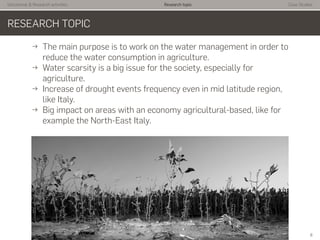
→ The main purpose is to work on the water management in order to
reduce the water consumption in agriculture.
→ Water scarsity is a big issue for the society, especially for
agriculture.
→ Increase of drought events frequency even in mid latitude region,
like Italy.
→ Big impact on areas with an economy agricultural-based, like for
example the North-East Italy.
8
Istitutional & Research activities Research topic Case Studies
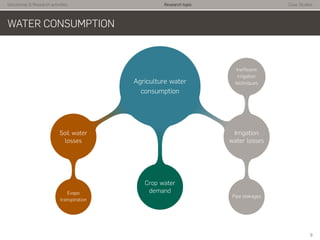
WATER CONSUMPTION
Agriculture water
consumption
Irrigation
water losses
Pipe leakages
Inefficient
irrigation
techniques
Crop water
demand
Soil water
losses
Evapo
transpiration
9
Istitutional & Research activities Research topic Case Studies
Why is the evapotranspiration the
keystone?
→ We already have tools for the leakage detection;
→ Not always possible to apply drop by drop irrigation;
→ We have also equations for evaluating evapotranspiration, but …
10
Istitutional & Research activities Research topic Case Studies
EVAPOTRANSPIRATION
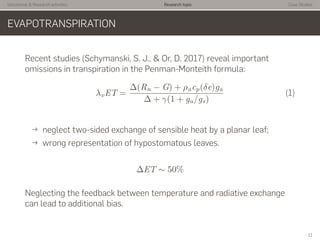
Recent studies (Schymanski, S. J., & Or, D. 2017) reveal important
omissions in transpiration in the Penman-Monteith formula:
λvET =
∆(Rn − G) + ρacp(δe)ga
∆ + γ(1 + ga/gs)
(1)
→ neglect two-sided exchange of sensible heat by a planar leaf;
→ wrong representation of hypostomatous leaves.
∆ET ∼ 50%
Neglecting the feedback between temperature and radiative exchange
can lead to additional bias.
11
Istitutional & Research activities Research topic Case Studies
FUTURE MAIN TASK
Main task of second year:
→ Implementation of the transpiration corrected in accord to
Schymanski, S. J., & Or, D. (2017) inside the GEOframe system (e.g.
Bancheri, 2017);
→ Extending it from leaf to forest:
→ Use the Leaf Area Index(LAI);
→ Different irradiation on different leaf;
→ Insert a phenology model, involving carbon cycle;
→ Evaluation of the turbolence fluxes contribute to evapotranspiration;
→ Application to the case study.
12
CASE STUDIES
Istitutional & Research activities Research topic Case Studies
CASE STUDIES
This tool will be applicated to different case studies:
→ Apple crops in Val di Non, Val di Sole and Val Venosta, in collabora-
tion with the Bozen University (Prof. Maurizio Righetti) and Eurac (Dr.
Giacomo Bertoldi);
→ First studied separatly then matched with NET3.
→ one between the Blue Nile in collaboration with CIAT (International
Center for Tropical Agriculture), Dr. Wuletawu Abera or the Cauca
basin, in collaboration with the Cauca University (Leonairo Pencue-
Fierro)
14
Istitutional & Research activities Research topic Case Studies
THANKS FOR
YOUR ATTENTION
15
Istitutional & Research activities Research topic Case Studies
ESSENTIAL BIBLIOGRAPHY
• Schymanski, Stanislaus J., and Dani Or. ”Leaf-scale experiments re-
veal an important omission in the Penman-Monteith equation.” (2017)
• Bancheri M. ”A flexible approach to the estimation of water budgets
and its connection to the travel time theory.” (2017)
• Formetta G., Antonello A., Franceschi S., David O. and Rigon R. ”The
informatics of the hydrological modelling system JGrass-NewAge.”
(2012)
• Formetta G., Antonello A., Franceschi S., David O., and Rigon R. ”Hy-
drological modelling with components: A GIS-based open-source frame-
work.” (2014)
• Willmer C., & Fricker M. ”Stomata.” (1996)
16
Istitutional & Research activities Research topic Case Studies
APPENDIX
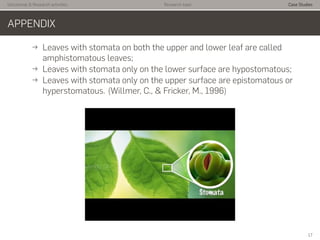
→ Leaves with stomata on both the upper and lower leaf are called
amphistomatous leaves;
→ Leaves with stomata only on the lower surface are hypostomatous;
→ Leaves with stomata only on the upper surface are epistomatous or
hyperstomatous. (Willmer, C., & Fricker, M., 1996)
17
Istitutional & Research activities Research topic Case Studies
APPENDIX
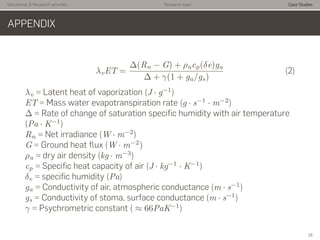
λvET =
∆(Rn − G) + ρacp(δe)ga
∆ + γ(1 + ga/gs)
(2)
λv = Latent heat of vaporization (J · g−1
)
ET = Mass water evapotranspiration rate (g · s−1
· m−2
)
∆ = Rate of change of saturation specific humidity with air temperature
(Pa · K−1
)
Rn = Net irradiance (W · m−2
)
G = Ground heat flux (W · m−2
)
ρa = dry air density (kg · m−3
)
cp = Specific heat capacity of air (J · kg−1
· K−1
)
δe = specific humidity (Pa)
ga = Conductivity of air, atmospheric conductance (m · s−1
)
gs = Conductivity of stoma, surface conductance (m · s−1
)
γ = Psychrometric constant ( ≈ 66PaK−1
)
18

EvaporAzione

  • 1.
    Coping with transpirationtheory and practice of irrigation at catchment scale using modern information and modelling Doctoral School in Civil, Environmental & Mechanical Engineering | XXXII°Cycle October 10, 2017 Candidate: Michele Bottazzi Supervisors: Prof. Riccardo Rigon Prof. Maurizio Righetti
  • 2.
  • 3.
    Istitutional & Researchactivities Research topic Case Studies EDUCATION & TRAINING Summer schools, Workshops & Courses → Statistical methods and data analysis; → Intelligent optimization for data science; → Machine learning; → Acquedotti e fognature (teaching assistant); → Winter school: Advanced numerical methods for free surface; → Summer school: Principles of catchment-scale hydrological modelling; → Summer school: Hydrometeorological extremes: processes, models and human impacts; → Seminary: Gestione e riabilitazione delle infrastrutture idrauliche (GERI); → Workshop: Isotope-based studies of water partitioning and plant-soil interactions in forested and agricultural environments; → Workshop: Introduction to R for data analytics. 3
  • 4.
    Istitutional & Researchactivities Research topic Case Studies OPTIMAL SENSOR DISPLACMENT & LEAKAGES DETECTION → Method for the optimal sensor displacement in a distribution network → Sensors installed on Egna network → Leakages detection based on Differential evolutive - Particle swarm optimization (DEPSO). Case study: • Apulian network (synthetic) • Egna • Levico • Laives 4
  • 5.
    Istitutional & Researchactivities Research topic Case Studies KRIGING COMPONENT IN OMS3 Implementation of the Kriging component in the NewAge model based on OMS3 framework. −→ J-Grass-NewAge is a semi-distributed, componente based, hydrological model. −→ OMS3 is a Java-based framework for the environmental modelling, able to support Fortran, C/C++, Python and R languages. Precipitation and temperature spatialization on the Isarco basin (Bancheri et al., 2017) 5
  • 6.
    Istitutional & Researchactivities Research topic Case Studies PUBBLICATIONS Paper: → Bancheri M., Serafin F., Bottazzi M., Abera W., Formetta G., Rigon R., The design and implementatation of Kriging models in the Object Modelling System v.3. [In submittion to Environmental Modelling & Software] → Bort Giorgio C.M., Bottazzi M., Righetti M., Optimal selection and monitoring of nodes aimed at supporting leakages identification in WDS networks. [In submittion to Procedia Engineering] Conference paper: → Bottazzi M., Raniero W., Bort Giorgio C.M., Righetti M., Bertola P., Metodo di selezione ottimale dei nodi di monitoraggio. Seminary: Gestione e Riabilitazione delle Infrastrutture Idrauliche (GERI) → Rigon R., Bancheri M., Serafin F., Abera W., Bottazzi M., Strategies for estimating the water budget at different scales using the JGrass-NewAGE system. AGU session H024: Balancing the Water Budget: A Physical Basis for Quantifying Water Fluxes Using Data and Models 6
  • 7.
  • 8.
    Istitutional & Researchactivities Research topic Case Studies RESEARCH TOPIC → The main purpose is to work on the water management in order to reduce the water consumption in agriculture. → Water scarsity is a big issue for the society, especially for agriculture. → Increase of drought events frequency even in mid latitude region, like Italy. → Big impact on areas with an economy agricultural-based, like for example the North-East Italy. 8
  • 9.
    Istitutional & Researchactivities Research topic Case Studies WATER CONSUMPTION Agriculture water consumption Irrigation water losses Pipe leakages Inefficient irrigation techniques Crop water demand Soil water losses Evapo transpiration 9
  • 10.
    Istitutional & Researchactivities Research topic Case Studies Why is the evapotranspiration the keystone? → We already have tools for the leakage detection; → Not always possible to apply drop by drop irrigation; → We have also equations for evaluating evapotranspiration, but … 10
  • 11.
    Istitutional & Researchactivities Research topic Case Studies EVAPOTRANSPIRATION Recent studies (Schymanski, S. J., & Or, D. 2017) reveal important omissions in transpiration in the Penman-Monteith formula: λvET = ∆(Rn − G) + ρacp(δe)ga ∆ + γ(1 + ga/gs) (1) → neglect two-sided exchange of sensible heat by a planar leaf; → wrong representation of hypostomatous leaves. ∆ET ∼ 50% Neglecting the feedback between temperature and radiative exchange can lead to additional bias. 11
  • 12.
    Istitutional & Researchactivities Research topic Case Studies FUTURE MAIN TASK Main task of second year: → Implementation of the transpiration corrected in accord to Schymanski, S. J., & Or, D. (2017) inside the GEOframe system (e.g. Bancheri, 2017); → Extending it from leaf to forest: → Use the Leaf Area Index(LAI); → Different irradiation on different leaf; → Insert a phenology model, involving carbon cycle; → Evaluation of the turbolence fluxes contribute to evapotranspiration; → Application to the case study. 12
  • 13.
  • 14.
    Istitutional & Researchactivities Research topic Case Studies CASE STUDIES This tool will be applicated to different case studies: → Apple crops in Val di Non, Val di Sole and Val Venosta, in collabora- tion with the Bozen University (Prof. Maurizio Righetti) and Eurac (Dr. Giacomo Bertoldi); → First studied separatly then matched with NET3. → one between the Blue Nile in collaboration with CIAT (International Center for Tropical Agriculture), Dr. Wuletawu Abera or the Cauca basin, in collaboration with the Cauca University (Leonairo Pencue- Fierro) 14
  • 15.
    Istitutional & Researchactivities Research topic Case Studies THANKS FOR YOUR ATTENTION 15
  • 16.
    Istitutional & Researchactivities Research topic Case Studies ESSENTIAL BIBLIOGRAPHY • Schymanski, Stanislaus J., and Dani Or. ”Leaf-scale experiments re- veal an important omission in the Penman-Monteith equation.” (2017) • Bancheri M. ”A flexible approach to the estimation of water budgets and its connection to the travel time theory.” (2017) • Formetta G., Antonello A., Franceschi S., David O. and Rigon R. ”The informatics of the hydrological modelling system JGrass-NewAge.” (2012) • Formetta G., Antonello A., Franceschi S., David O., and Rigon R. ”Hy- drological modelling with components: A GIS-based open-source frame- work.” (2014) • Willmer C., & Fricker M. ”Stomata.” (1996) 16
  • 17.
    Istitutional & Researchactivities Research topic Case Studies APPENDIX → Leaves with stomata on both the upper and lower leaf are called amphistomatous leaves; → Leaves with stomata only on the lower surface are hypostomatous; → Leaves with stomata only on the upper surface are epistomatous or hyperstomatous. (Willmer, C., & Fricker, M., 1996) 17
  • 18.
    Istitutional & Researchactivities Research topic Case Studies APPENDIX λvET = ∆(Rn − G) + ρacp(δe)ga ∆ + γ(1 + ga/gs) (2) λv = Latent heat of vaporization (J · g−1 ) ET = Mass water evapotranspiration rate (g · s−1 · m−2 ) ∆ = Rate of change of saturation specific humidity with air temperature (Pa · K−1 ) Rn = Net irradiance (W · m−2 ) G = Ground heat flux (W · m−2 ) ρa = dry air density (kg · m−3 ) cp = Specific heat capacity of air (J · kg−1 · K−1 ) δe = specific humidity (Pa) ga = Conductivity of air, atmospheric conductance (m · s−1 ) gs = Conductivity of stoma, surface conductance (m · s−1 ) γ = Psychrometric constant ( ≈ 66PaK−1 ) 18