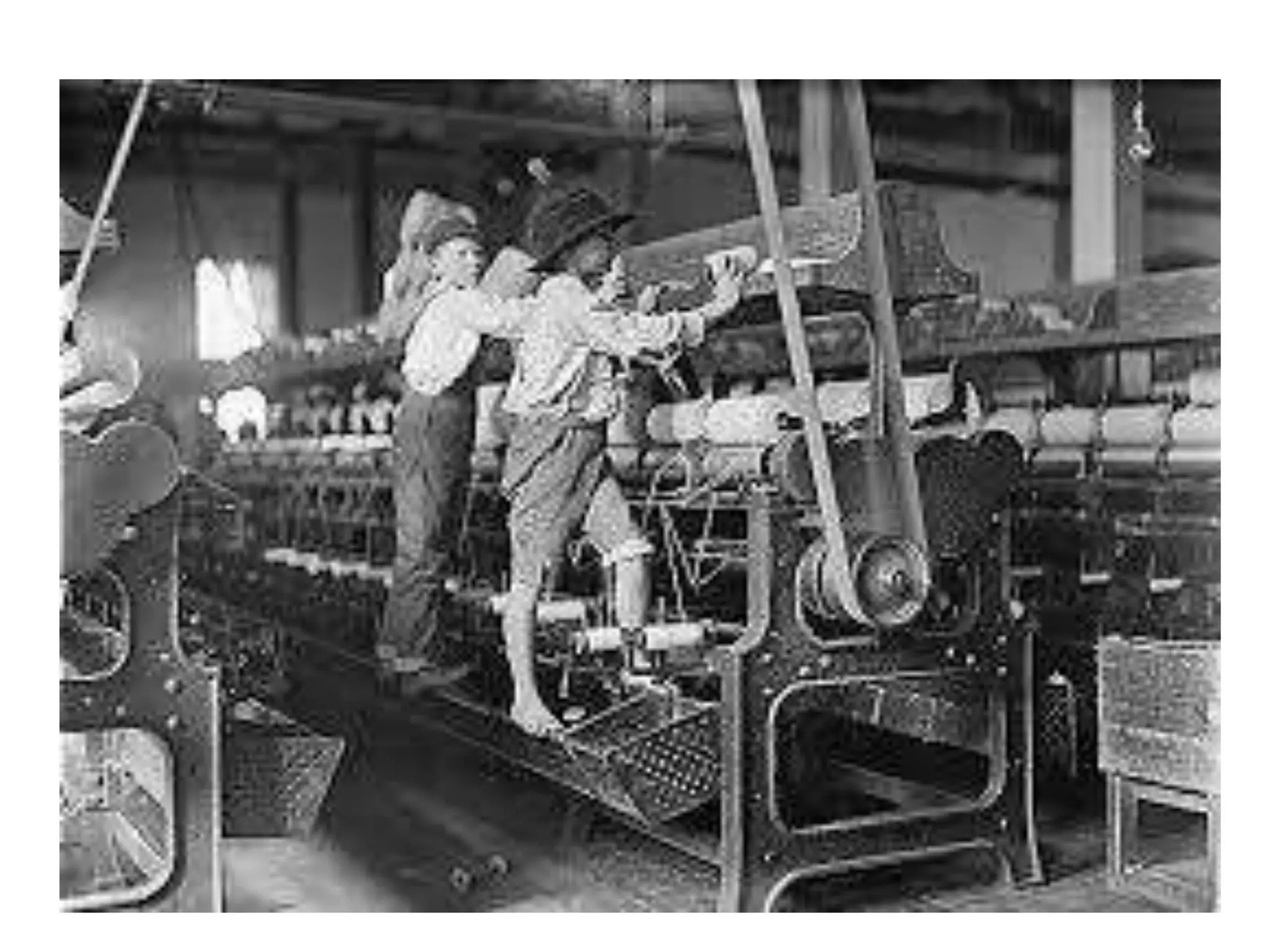
Industrial Revolution
(inventions)
by Vera Glez 4º B
INTRODUCTION
 The Industrial Revolution is a process that began in the second
half of the XVIII century in Britain, which extended a few
decades later to Europe and America, and concluded between
1820 and 1840. This period saw the greatest set of economic,
technological and social transformations in history, it took the
step from a rural economy based on agriculture and
commerce to an urban, industrialized and mechanized
economy.
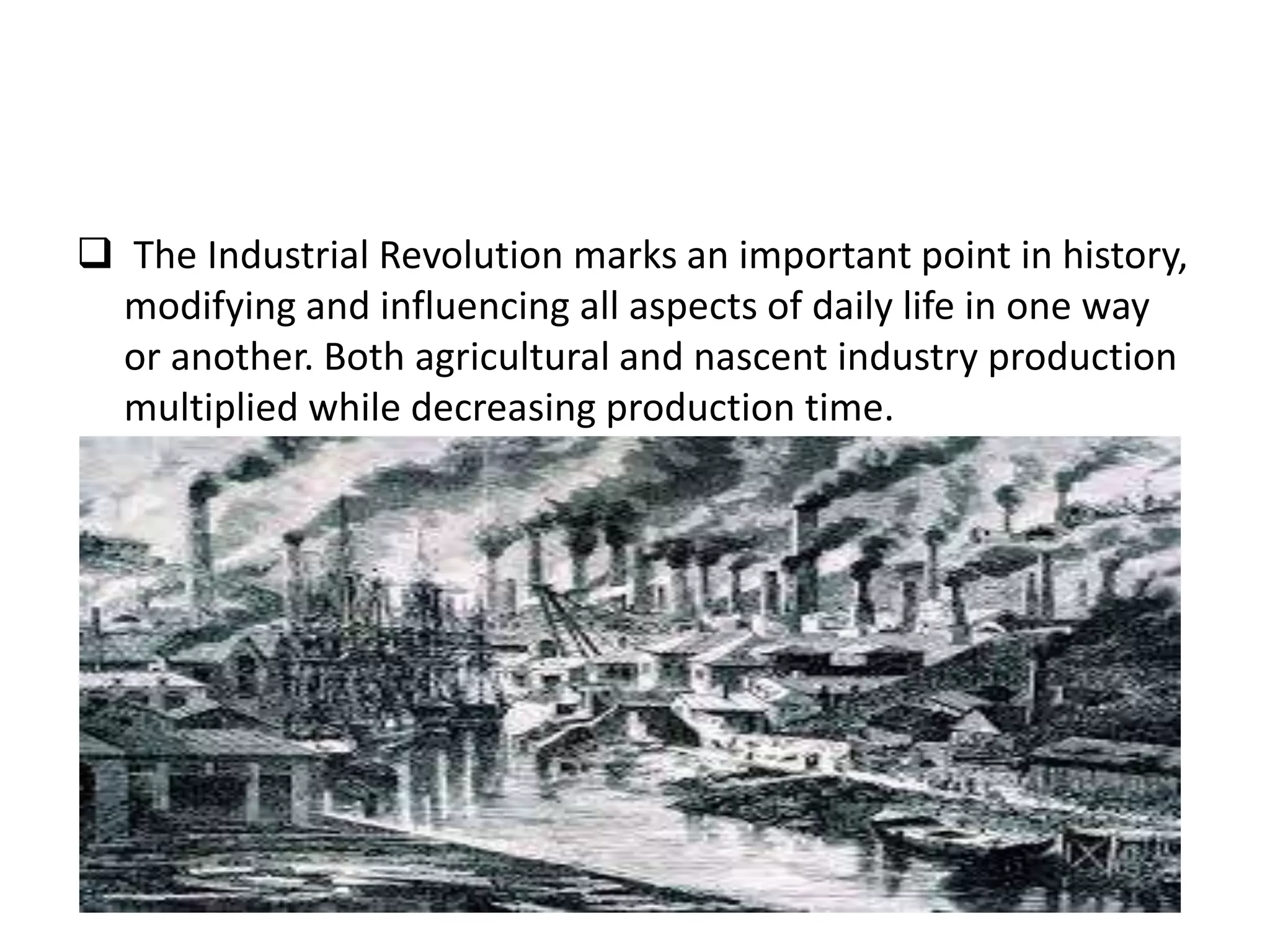
 The Industrial Revolution marks an important point in history,
modifying and influencing all aspects of daily life in one way
or another. Both agricultural and nascent industry production
multiplied while decreasing production time.
The Railway
 The first was patented by James Watt in 1769, but the engines
were too heavy and generated little pressure to be used in
locomotives.
 In 1804, Richard Trevithick presented the first locomotive
capable of dragging a train, the test had a relative success,
since the locomotive broke the rails.
 In 1811, John Blenkinsop designed the first functional
locomotive that had managed to pass all the tests, this was
named Salamanca.
 In 1825, George Stephenson built the locomotive for the line
to the northeast of England, which was the first that dragged
public transport trains. Their success led Stephenson to create
the first steam locomotive company that was used on the
lines of Europe and the United States.
The Sewing Machine
 In the early 1800’s sewing was done by hand; the families
patched the clothes with needle and thread, but the sewing
machine would not exist without the art of sewing by hand,
which existed more than 10,000 years ago, when the first
needles were created with animal bones.
 Although the first patent for a sewing machine, was
ordered by the Englishman Thomas Saint in 1790, it was
designed to sew leather and cloth, used a single thread and
formed a chain stitch.
 (Although a fact that few know is that Years before, the
German engineer Charles Fredrick is granted the first
patent for a sewing needle adapted for a machine.)
The steam boat
 A steamboat, also called, with less frequently, pyroscaphe, is a
ship propelled by steam engines, currently in disuse, or by
steam turbines.
 It consists primarily of a steam boiler, a steam engine and a
refrigerated condenser, transmission is achieved with a
crankshaft in steam engines or with a gearbox in the case of
using turbines. It was a revolution in world maritime
navigation as they began to not depend so much on winds
and currents (as with sailing).
 The first true transatlantic ships were steamers and thanks to
them the use of the word "steam" was extended to refer to a
ship
THE END

3

  • 1.
  • 2.
    INTRODUCTION  The IndustrialRevolution is a process that began in the second half of the XVIII century in Britain, which extended a few decades later to Europe and America, and concluded between 1820 and 1840. This period saw the greatest set of economic, technological and social transformations in history, it took the step from a rural economy based on agriculture and commerce to an urban, industrialized and mechanized economy.
  • 3.
     The IndustrialRevolution marks an important point in history, modifying and influencing all aspects of daily life in one way or another. Both agricultural and nascent industry production multiplied while decreasing production time.
  • 4.
    The Railway  Thefirst was patented by James Watt in 1769, but the engines were too heavy and generated little pressure to be used in locomotives.  In 1804, Richard Trevithick presented the first locomotive capable of dragging a train, the test had a relative success, since the locomotive broke the rails.  In 1811, John Blenkinsop designed the first functional locomotive that had managed to pass all the tests, this was named Salamanca.
  • 5.
     In 1825,George Stephenson built the locomotive for the line to the northeast of England, which was the first that dragged public transport trains. Their success led Stephenson to create the first steam locomotive company that was used on the lines of Europe and the United States.
  • 6.
    The Sewing Machine In the early 1800’s sewing was done by hand; the families patched the clothes with needle and thread, but the sewing machine would not exist without the art of sewing by hand, which existed more than 10,000 years ago, when the first needles were created with animal bones.  Although the first patent for a sewing machine, was ordered by the Englishman Thomas Saint in 1790, it was designed to sew leather and cloth, used a single thread and formed a chain stitch.  (Although a fact that few know is that Years before, the German engineer Charles Fredrick is granted the first patent for a sewing needle adapted for a machine.)
  • 9.
    The steam boat A steamboat, also called, with less frequently, pyroscaphe, is a ship propelled by steam engines, currently in disuse, or by steam turbines.  It consists primarily of a steam boiler, a steam engine and a refrigerated condenser, transmission is achieved with a crankshaft in steam engines or with a gearbox in the case of using turbines. It was a revolution in world maritime navigation as they began to not depend so much on winds and currents (as with sailing).
  • 10.
     The firsttrue transatlantic ships were steamers and thanks to them the use of the word "steam" was extended to refer to a ship
  • 11.