


























Getting product strategy right
@destraynor from @intercom
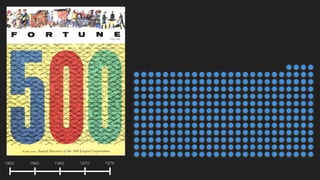
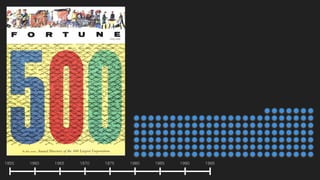
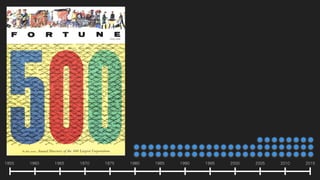
Even the world’s biggest companies don’t last for long…
1955
1955 1960 1965 1970 1975
1955 1960 1965 1970 1975 19901980 19951985
1955 1960 1965 1970 1975 19901980 1995 2000 2005 201520101985
The same can be said for the world’s hottest startups…
How do you last more than one hype cycle?
How can your product strategy prevent this?
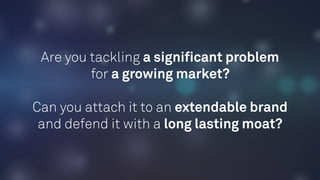
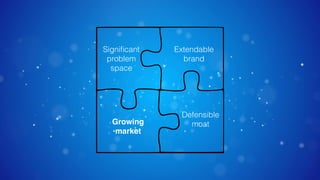
Are you tackling a significant problem
for a growing market? 


Can you attach it to an extendable brand
and defend it with a long lasting moat?
Significant
problem
space
Extendable
brand
Growing
market
Defensible

moat
Finding a significant problem space
Text here
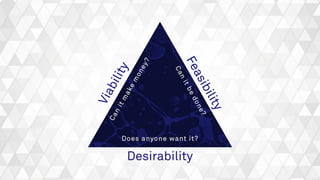
Viability
Feasibility
Desirability
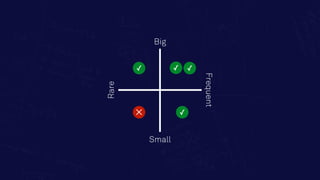
Big
Rare
Small
Frequent
✓
✓
✓
✕
✓
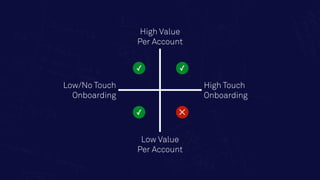
High Value
Per Account
Low/No Touch
Onboarding
Low Value
Per Account
High Touch
Onboarding
✓
✕
✓
✓
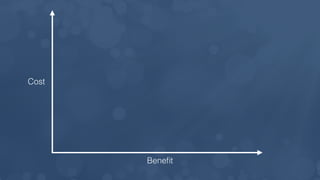
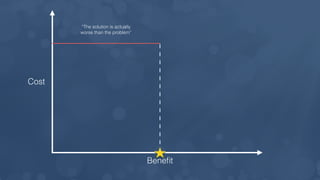
Cost
Benefit
Cost
Benefit
YAY! All my
photos are in
one place
Cost
Benefit
Cost
Benefit
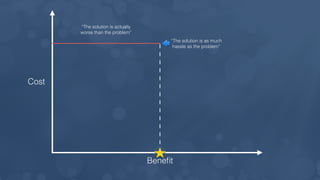
“The solution is actually
worse than the problem”
“The solution is as much
hassle as the problem”
Cost
Benefit
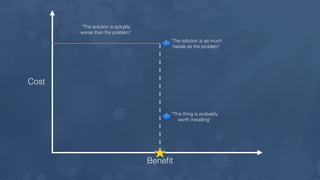
“The solution is actually
worse than the problem”
“The solution is as much
hassle as the problem”
“This thing is probably
worth installing”
Cost
Benefit
“The solution is actually
worse than the problem”
Cost
Benefit
Benefit
Cost
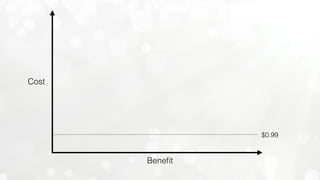
$0.99
Benefit
Cost
$0.99
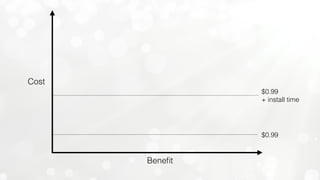
$0.99
+ install time
Benefit
$0.99
$0.99
+ install time
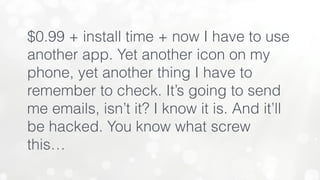
$0.99 + install time + now I have to
use another app. Yet another icon on
my phone, yet another thing I have to
remember to check. It’s going to
send me emails, isn’t it? I know it is.
And it’ll be hacked. You know what
screw this…
Cost
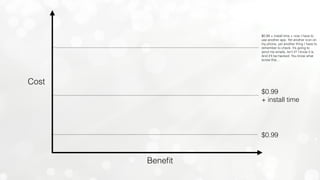
$0.99 + install time + now I have to use
another app. Yet another icon on my
phone, yet another thing I have to
remember to check. It’s going to send
me emails, isn’t it? I know it is. And it’ll
be hacked. You know what screw
this…
Do you frequently experience and understand the problem?
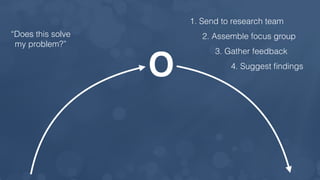
When new technology emerges,
can you:
observe,
orient,
decide and,
act
O
O
D
A
O
“Does this solve 

my problem?”
1. Send to research team
2. Assemble focus group
3. Gather feedback
4. Suggest findings
Can you express the problem
in a timeless and technology-agnostic way?
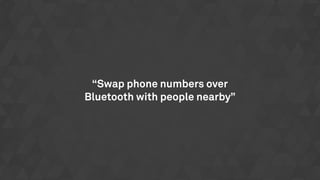
“Swap phone numbers over
Bluetooth with people nearby”
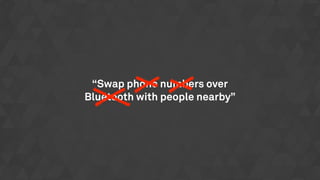
“Swap phone numbers over
Bluetooth with people nearby”
“Send emails automatically when
users trigger events in your web app”
“Send emails automatically when
users trigger events in your web app”
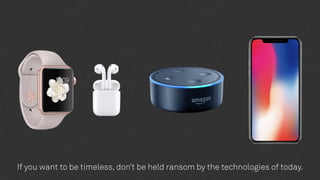
If you want to be timeless, don’t be held ransom by the technologies of today.
Significant
problem
space
Extendable
brand
Growing
market
Defensible

moat
In 5 years time….

Will more people have this problem?

Will people have this problem more or less often?
Will the problem hurt more or less?
Internet businesses - there will be more
Customer loyalty - it will matter more
Too many tools - there will be more tools
Messaging - it will replace email
Is Intercom’s market growing or shrinking?
“Appointment scheduling for dentists”
“Automatically log your mileage with your employer”
“Analytics for enterprise sales teams”
“Virus protection for the desktop”
“Mobile first marketplace for second hand cars”
There’s a gap in the market,
but is there a market in the gap?
Why a “growing” market?
Growing markets means lots of new entrants
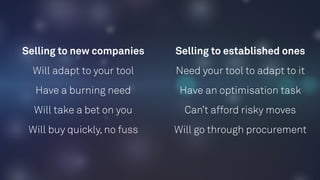
Selling to new companies Selling to established ones
Will adapt to your tool Need your tool to adapt to it
Have a burning need Have an optimisation task
Will take a bet on you Can’t afford risky moves
Will buy quickly, no fuss Will go through procurement
Significant
problem
space
Extendable
brand
Growing
market
Defensible

moat
Brand is the most overlooked element
in new software companies.
Your brand represents the promises
you make to your customers.


When you start out
your product = your brand = your company = you
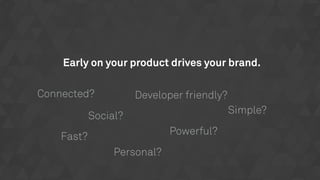
Early on your product drives your brand.
Fast?
Social?
Powerful?
Simple?
Connected? Developer friendly?
Personal?
Later on your brand drives your products.
Apple Maps vs Google Maps
Facebook Messenger vs Google Hangouts
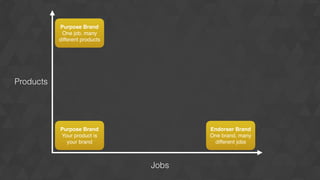
Can your brand extend to match your ambition?
TeamChat
Developer Payments
UserChat
The Dublin Web Summit
Slack
Stripe
Intercom
Web Summit
Products
Jobs
Purpose Brand
One job, many
different products
Purpose Brand
Your product is
your brand
Endorser Brand
One brand, many
different jobs
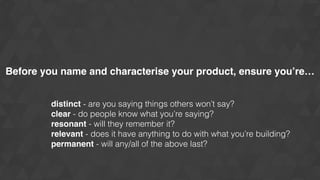
Before you name and characterise your product, ensure you’re…
distinct - are you saying things others won’t say?
clear - do people know what you’re saying?
resonant - will they remember it?
relevant - does it have anything to do with what you’re building?
permanent - will any/all of the above last?
Significant
problem
space
Extendable
brand
Growing
market
Defensible

moat
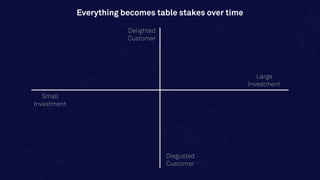
Almost every feature you work on either 

a) fails
b) gets copied
Delighted
Customer
Small
Investment
Disgusted
Customer
Large
Investment
Everything becomes table stakes over time
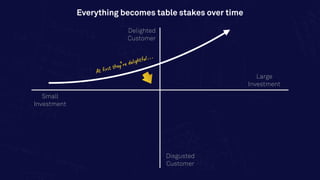
Delighted
Customer
Small
Investment
Disgusted
Customer
Large
Investment
Everything becomes table stakes over time
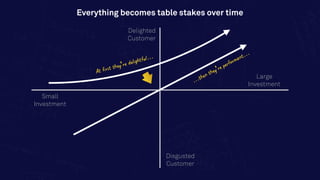
At first they’re delightful…
Delighted
Customer
Small
Investment
Disgusted
Customer
Large
Investment
Everything becomes table stakes over time
At first they’re delightful…
…then they’re performant…
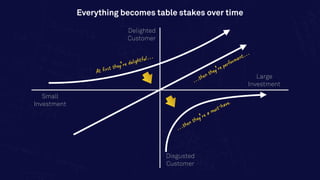
Delighted
Customer
Small
Investment
Disgusted
Customer
Large
Investment
Everything becomes table stakes over time
At first they’re delightful…
…then they’re performant…
…then they’re a must-have.
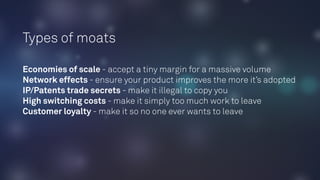
Types of moats
Economies of scale - accept a tiny margin for a massive volume
Network effects - ensure your product improves the more it’s adopted
IP/Patents trade secrets - make it illegal to copy you
High switching costs - make it simply too much work to leave
Customer loyalty - make it so no one ever wants to leave
Build a platform that others rely on
Build a connected community that can’t be copied
Build a brand that stands alone
Getting product strategy right…
Problem
Start from the inside out. Pick a big problem that occurs frequently.
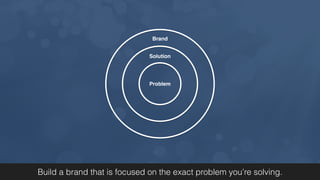
Problem
Solution
Design a solution that doesn’t care about technology.
Problem
Solution
Brand
Build a brand that is focused on the exact problem you’re solving.
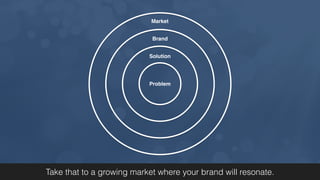
Problem
Solution
Brand
Market
Take that to a growing market where your brand will resonate.
Thanks
@destraynor from @intercom


slides:blog.intercom.com

Getting product strategy right