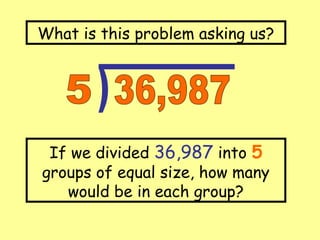
What is this problem asking us?
If we divided 36,987 into 5
groups of equal size, how many
would be in each group?
Real Life Example
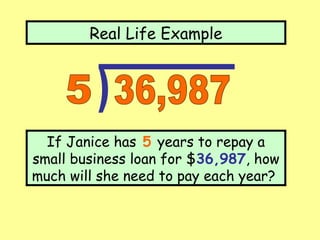
If Janice has 5 years to repay a
small business loan for $36,987, how
much will she need to pay each year?
How do we solve it?
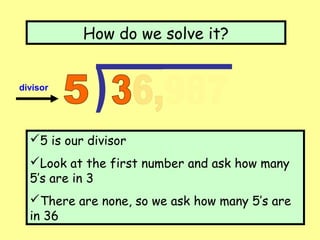
5 is our divisor
Look at the first number and ask how many
5’s are in 3
There are none, so we ask how many 5’s are
in 36
divisor
How many 5’s are in 36?
Recall your multiplication facts to
find the one that will give an answer
near 36.
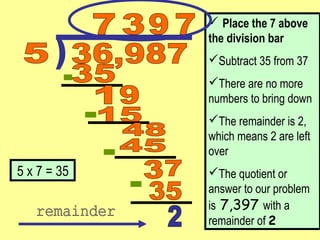
5 x 7 = 35
 5 x 7 = 35
 Place the 7 above
the division bar
Subtract 35 from 36
Bring down the next
digit in the dividend
 Now ask how
many 5’s are in 19
 5 x 3 = 15
 Place the 3 above
the division bar
Subtract 15 from 19
Bring down the next
digit in the dividend
 Now we ask how
many 5’s are in 48
 5 x 9 = 45
 Place the 9 above
the division bar
Subtract 45 from 48
Bring down the next
digit in the dividend
 Now we ask how
many 5’s are in 37
5 x 7 = 35
 Place the 7 above
the division bar
Subtract 35 from 37
There are no more
numbers to bring down
The remainder is 2,
which means 2 are left
over
The quotient or
answer to our problem
is 7,397 with a
remainder of 2
Our Real Life Example
If Janice has 5 years to repay a small
business loan for $36,987, how much
will she need to pay each year?
What is this problem asking us?
If we divided 8,437 into 6
groups of equal size, how many
would be in each group?
Real Life Example
Can you think of a word problem that
can be expressed as the division
problem written above?
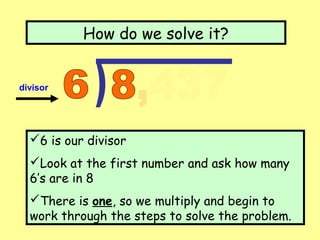
How do we solve it?
6 is our divisor
Look at the first number and ask how many
6’s are in 8
There is one, so we multiply and begin to
work through the steps to solve the problem.
divisor
 6 x 1 = 6
 Place the 1 above
the division bar
Subtract 6 from 8
Bring down the next
digit in the dividend
 Now ask how
many 6’s are in 24
 6 x 4 = 24
 Place the 4 above
the division bar
Subtract 24 from 24
Bring down the next
digit in the dividend
 Now ask how
many 6’s are in 3
 6 x 0 = 0
 Place the 0 above
the division bar
Subtract 0 from 3
Bring down the next
digit in the dividend
 Now ask how
many 6’s are in 37
 6 x 6 = 36
 Place the 6 above the division bar
Subtract 36 from 37
There are no more numbers to bring
down
The remainder is 1, which means
there is one left over
The quotient or answer to our
problem is 1,406 with a remainder of 2
-42
3
-21
2,5387
 25 ÷ 7 or how many groups
of 7 are in 25
Think of a your seven facts
7x3=21
Place the 3 above the bar
Subtract 21 from 25
Bring down the next digit in
the dividend ~ THREE
43 ÷ 7 or how many 7’s are
in 43
3
7 x 6 = 42
4
6
4
-14
81
3
-42
-21
2,5387
7 x 6 = 42 ~ Place the 6 above
the division bar
Subtract 42 from 43
Bring down the next number in
the dividend ~ EIGHT
How many 7’s are in 18
7 x 2 = 14
Place the 2 above the bar
Subtract 14 from 18
Our quotient is 362 with a
remainder of 4
3
4
6 2
-56
9
-32
3,7928
 37 ÷ 8 or how many groups
of 8 are in 37
Think of a your eight facts
8 x 4 = 32
Place the 4 above the bar
Subtract 32 from 37
Bring down the next digit in
the dividend ~ NINE
59÷ 8 or how many 8’s are
in 59
4
8 x 7 = 56
5
7
0
-32
23
9
-56
-32
3,7928
8 x 7 = 56 ~ Place the 7 above
the division bar
Subtract 56 from 59
Bring down the next number in
the dividend ~ TWO
How many 8’s are in 32
8 X 4 = 32
Place the 4 above the bar
Subtract 32 from 32
Our quotient is 474
4
5
7 4
-24
6
-15
1,7633
 17 ÷ 3 or how many groups
of 3 are in 17
Think of a your three facts
3 x 5 = 15
Place the 5 above the bar
Subtract 15 from 17
Bring down the next digit in
the dividend ~ SIX
26 ÷ 3 or how many 3’s are
in 26
5
8 X 3 = 24
2
8
2
-21
32
6
-24
-15
1,7633
3 x 8 = 24 ~ Place the 8 above
the division bar
Subtract 24 from 26
Bring down the next number in
the dividend ~ THREE
How many 3’s are in 23
3 x 7 = 21
Place the 7 above the bar
Subtract 21 from 23
Our quotient is 587 with a
remainder of 2
5
2
8 7
-63
7
-18
2,4739
 24 ÷ 9 or how many groups
of 9 are in 24
Think of a your nine facts
9 x 2 = 18
Place the 2 above the bar
Subtract 18 from 24
Bring down the next digit in
the dividend ~ SEVEN
67 ÷ 9 or how many 9’s are
in 67
2
9 x 7 = 63
6
7
7
-36
34
7
-63
-18
2,4739
9 X 7 = 63 ~ Place the 7 above
the division bar
Subtract 63 from 67
Bring down the next number in
the dividend ~ THREE
How many 9’s are in 43
9 x 4 = 36
Place the 4 above the bar
Subtract 36 from 43
Our quotient is 274 with a
remainder of 7
2
6
7 4
- 8
9
-14
1,4992
 14 ÷ 2 or how many groups
of 2 are in 14
Think of your doubles
2 x 7 = 14
Place the 7 above the bar
Subtract 14 from 14
Bring down the next digit in
the dividend ~ NINE
9 ÷ 2 or how many 2’s are in
9
7
2 x 4 = 8
0
4
1
-18
91
9
- 8
-14
1,4992
2 x 4 = 8 ~ Place the 4 above
the division bar
Subtract 8 from 9
Bring down the next number in
the dividend ~ NINE
How many 2s are in 19
2 x 9 = 18
Place the 9 above the bar
Subtract 18 from 19
Our quotient is 749 with a
remainder of 1
7
0
4 9
- 6
80
-6
6,8433
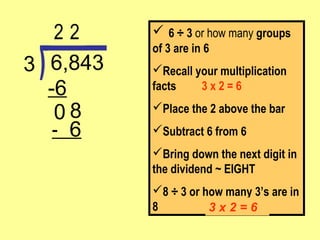
 6 ÷ 3 or how many groups
of 3 are in 6
Recall your multiplication
facts 3 x 2 = 6
Place the 2 above the bar
Subtract 6 from 6
Bring down the next digit in
the dividend ~ EIGHT
8 ÷ 3 or how many 3’s are in
8
2
3 x 2 = 6
2
2
- 3
30
- 6
80
-6
6,8433
 3 x 2 = 6 or how many groups of
3 are in 6
Place the 2 above the bar
Subtract 6 from 8
Bring down the next digit in the
dividend ~ FOUR
How many 3’s are in 24
Place the 8 above the bar
 Subtract 24 from 24
Bring down the THREE
 3 x 1 = 3 ~ Now subtract
Our quotient is 2,281
2 12 8
4
-24
Try These On Your Own
• We will check them using webmath.com
8
4
7
6 8,146
9
3,927
3,506 4,468
8,338

Long division intro

  • 2.
    What is thisproblem asking us? If we divided 36,987 into 5 groups of equal size, how many would be in each group?
  • 3.
    Real Life Example IfJanice has 5 years to repay a small business loan for $36,987, how much will she need to pay each year?
  • 4.
    How do wesolve it? 5 is our divisor Look at the first number and ask how many 5’s are in 3 There are none, so we ask how many 5’s are in 36 divisor
  • 5.
    How many 5’sare in 36? Recall your multiplication facts to find the one that will give an answer near 36. 5 x 7 = 35
  • 6.
     5 x7 = 35  Place the 7 above the division bar Subtract 35 from 36 Bring down the next digit in the dividend  Now ask how many 5’s are in 19
  • 7.
     5 x3 = 15  Place the 3 above the division bar Subtract 15 from 19 Bring down the next digit in the dividend  Now we ask how many 5’s are in 48
  • 8.
     5 x9 = 45  Place the 9 above the division bar Subtract 45 from 48 Bring down the next digit in the dividend  Now we ask how many 5’s are in 37
  • 9.
    5 x 7= 35  Place the 7 above the division bar Subtract 35 from 37 There are no more numbers to bring down The remainder is 2, which means 2 are left over The quotient or answer to our problem is 7,397 with a remainder of 2
  • 10.
    Our Real LifeExample If Janice has 5 years to repay a small business loan for $36,987, how much will she need to pay each year?
  • 11.
    What is thisproblem asking us? If we divided 8,437 into 6 groups of equal size, how many would be in each group?
  • 12.
    Real Life Example Canyou think of a word problem that can be expressed as the division problem written above?
  • 13.
    How do wesolve it? 6 is our divisor Look at the first number and ask how many 6’s are in 8 There is one, so we multiply and begin to work through the steps to solve the problem. divisor
  • 14.
     6 x1 = 6  Place the 1 above the division bar Subtract 6 from 8 Bring down the next digit in the dividend  Now ask how many 6’s are in 24
  • 15.
     6 x4 = 24  Place the 4 above the division bar Subtract 24 from 24 Bring down the next digit in the dividend  Now ask how many 6’s are in 3
  • 16.
     6 x0 = 0  Place the 0 above the division bar Subtract 0 from 3 Bring down the next digit in the dividend  Now ask how many 6’s are in 37
  • 17.
     6 x6 = 36  Place the 6 above the division bar Subtract 36 from 37 There are no more numbers to bring down The remainder is 1, which means there is one left over The quotient or answer to our problem is 1,406 with a remainder of 2
  • 18.
    -42 3 -21 2,5387  25 ÷7 or how many groups of 7 are in 25 Think of a your seven facts 7x3=21 Place the 3 above the bar Subtract 21 from 25 Bring down the next digit in the dividend ~ THREE 43 ÷ 7 or how many 7’s are in 43 3 7 x 6 = 42 4 6
  • 19.
    4 -14 81 3 -42 -21 2,5387 7 x 6= 42 ~ Place the 6 above the division bar Subtract 42 from 43 Bring down the next number in the dividend ~ EIGHT How many 7’s are in 18 7 x 2 = 14 Place the 2 above the bar Subtract 14 from 18 Our quotient is 362 with a remainder of 4 3 4 6 2
  • 20.
    -56 9 -32 3,7928  37 ÷8 or how many groups of 8 are in 37 Think of a your eight facts 8 x 4 = 32 Place the 4 above the bar Subtract 32 from 37 Bring down the next digit in the dividend ~ NINE 59÷ 8 or how many 8’s are in 59 4 8 x 7 = 56 5 7
  • 21.
    0 -32 23 9 -56 -32 3,7928 8 x 7= 56 ~ Place the 7 above the division bar Subtract 56 from 59 Bring down the next number in the dividend ~ TWO How many 8’s are in 32 8 X 4 = 32 Place the 4 above the bar Subtract 32 from 32 Our quotient is 474 4 5 7 4
  • 22.
    -24 6 -15 1,7633  17 ÷3 or how many groups of 3 are in 17 Think of a your three facts 3 x 5 = 15 Place the 5 above the bar Subtract 15 from 17 Bring down the next digit in the dividend ~ SIX 26 ÷ 3 or how many 3’s are in 26 5 8 X 3 = 24 2 8
  • 23.
    2 -21 32 6 -24 -15 1,7633 3 x 8= 24 ~ Place the 8 above the division bar Subtract 24 from 26 Bring down the next number in the dividend ~ THREE How many 3’s are in 23 3 x 7 = 21 Place the 7 above the bar Subtract 21 from 23 Our quotient is 587 with a remainder of 2 5 2 8 7
  • 24.
    -63 7 -18 2,4739  24 ÷9 or how many groups of 9 are in 24 Think of a your nine facts 9 x 2 = 18 Place the 2 above the bar Subtract 18 from 24 Bring down the next digit in the dividend ~ SEVEN 67 ÷ 9 or how many 9’s are in 67 2 9 x 7 = 63 6 7
  • 25.
    7 -36 34 7 -63 -18 2,4739 9 X 7= 63 ~ Place the 7 above the division bar Subtract 63 from 67 Bring down the next number in the dividend ~ THREE How many 9’s are in 43 9 x 4 = 36 Place the 4 above the bar Subtract 36 from 43 Our quotient is 274 with a remainder of 7 2 6 7 4
  • 26.
    - 8 9 -14 1,4992  14÷ 2 or how many groups of 2 are in 14 Think of your doubles 2 x 7 = 14 Place the 7 above the bar Subtract 14 from 14 Bring down the next digit in the dividend ~ NINE 9 ÷ 2 or how many 2’s are in 9 7 2 x 4 = 8 0 4
  • 27.
    1 -18 91 9 - 8 -14 1,4992 2 x4 = 8 ~ Place the 4 above the division bar Subtract 8 from 9 Bring down the next number in the dividend ~ NINE How many 2s are in 19 2 x 9 = 18 Place the 9 above the bar Subtract 18 from 19 Our quotient is 749 with a remainder of 1 7 0 4 9
  • 28.
    - 6 80 -6 6,8433  6÷ 3 or how many groups of 3 are in 6 Recall your multiplication facts 3 x 2 = 6 Place the 2 above the bar Subtract 6 from 6 Bring down the next digit in the dividend ~ EIGHT 8 ÷ 3 or how many 3’s are in 8 2 3 x 2 = 6 2
  • 29.
    2 - 3 30 - 6 80 -6 6,8433 3 x 2 = 6 or how many groups of 3 are in 6 Place the 2 above the bar Subtract 6 from 8 Bring down the next digit in the dividend ~ FOUR How many 3’s are in 24 Place the 8 above the bar  Subtract 24 from 24 Bring down the THREE  3 x 1 = 3 ~ Now subtract Our quotient is 2,281 2 12 8 4 -24
  • 30.
    Try These OnYour Own • We will check them using webmath.com 8 4 7 6 8,146 9 3,927 3,506 4,468 8,338