Page 41
Answer Key
1. 19
2. 18
3. 13
4. 27
5. 16 R9
6. 12 R4
7. 11 R4
*8. 68
Guess-and-Check
Algorithm for Division
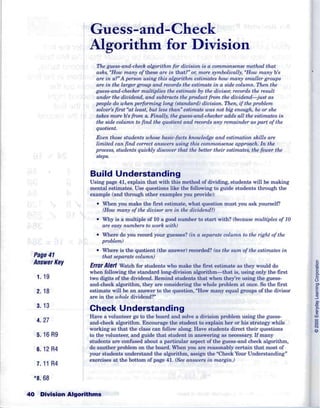
The guess-and-check algorithm for division is a commonsense method that

asks, "How many of these are in that?"or, more symbolically, "How many b's

are in a ?"A person using this algorithm estimates how many smaller groups

are in the larger group and records the estimate in a side column. Then the

guess-and-checher multiplies the estimate by the divisor, records the result

under the dividend, and subtracts the product from the dividend-just as

people do when performing long (standard) division. Then, if the problem

solver's first "at least, but less than" estimate was not big enough, he or she

takes more b's from a. Finally, the guess-and-checker adds all the estimates in

the side column to find the quotient and records any remainder as part ofthe

quotient.

Even those students whose basic-facts knowledge and estimation skills are

limited can find correct answers using this commonsense approach. In the

process, students quickly discover tha t the better their estimates, the fewer the

steps.

Build Understanding
Using page 41, explain that with this method of dividing, students will be making
mental estimates. Use questions like the following to guide students through the
example (and through other examples you provide):
•	 When you make the first estimate, what question must you ask yourself?
(How many of the di visor are in the dividendi)
•	 Why is a multiple of 10 a good number to start with? (because multiples of 10

are easy numbers to work with)

•	 Where do you record your guesses? (in a separate column to the right of the

problem)

•	 Where is the quotient (the answer) recorded? (as the sum ofthe estimates in

that separate column)

c:
o
Error Alert Watch for students who make the first estimate as they would do ~owhen following the standard long-division algorithm-that is, using only the first	 0­
two digits of the dividend. Remind students that when they're using the guess­	 oU
0>and-check algorithm, they are considering the whole problem at once. So the first c:
'eestimate will be an answer to the question, "How many equal groups of the divisor IiiQ)
are in the whole dividend?"	 ...J
fa
-g,
Check Understanding ~wHave a volunteer go to the board and solve a division problem using the guess­
o
oand-check algorithm. Encourage the student to explain her or his strategy while
~
working so that the class can follow along. Have students direct their question ©
to the volunteer, and guide that student in answering as necessary. If many
students are confused about a particular aspect of the guess-and check algorithm,
do another problem on the board. When you are reasonably certain that most of
your students understand the algorithm, assign the "Check Your Understanding"
exercises at the bottom of page 41. (See answers in margin.)
40 Division Algorithms
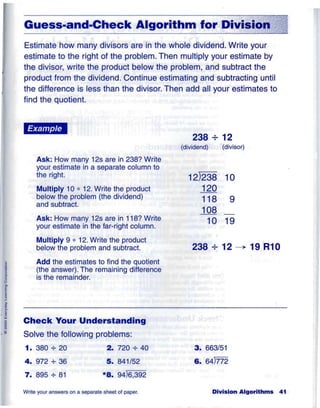
Estimate how many divisors are in the whole dividend. Write your
estimate to the right of the problem.Then multiply your estimate by
the divisor, write the product below the problem, and subtract the
product from the dividend. Continue estimating and subtracting until
the difference is less than the divisor. Then add all your estimates to
find the quotient.
Example
238 + 12
(dividend) (divisor)
Ask: How many 12s are in 238? Write

your estimate in a separate column to

the right.
 12)238 10
Multiply 10 * 12. Write the product 120
below the problem (the dividend) 118 9
and subtract.
108
Ask: How many 12s are in 118? Write 10 19
your estimate in the far-right column.
Multiply 9 * 12. Write the product
below the problem and subtract. 238 + 12 19 R10
§ Add the estimates to find the quotient
I (the answer).The remaining difference
o is the remainder.o
en
c
1:
~
~
,.,
os
~Gl
• >
8o(I
• 0
Check Your Understanding
Solve the following problems:
1. 380 + 20 2. 720 + 40 3 . 663/51
4. 972 + 36 5. 841 /52 6. 64)772
7. 895 + 81 *8. 94)6,392
Write your answers on a separate sheet of paper. Division Algorithms 41
Page 43
Answer Key
1. 49
2. 63
3. 36
4. 82
5. 87
6. 83
7. 23 R7
*8. 99 R3
Long (Standard) Algorithm

for Division (with Models)

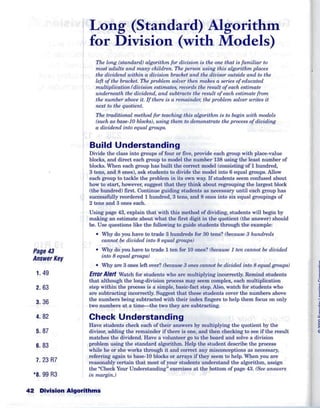
The long (standard) algorithm for di vision is the one that is familiar to

most adults and many children. The person using this algorithm places

the di vidend within a division bracket and the divisor outside and to the

left of the bracket. The problem solver then makes a series ofeducated

multiplication / division estimates, records the result ofeach estimate

underneath the dividend, and subtracts the result ofeach estimate from

the number above it. If there is a remainder, the problem solver writes it

next to the quotient.

The traditional method for teaching this algorithm is to begin with models

(such as base-lO blocks), using them to demonstrate the process of dividing

a dividend into equal groups.

Build Understanding
Divide the class into groups offour or five, provide each group with place-value
blocks, and direct each group to model the number 138 using the least number of
blocks. When each group has built the correct model (consisting of 1 hundred,
3 tens, and 8 ones), ask students to divide the model into 6 equal groups. Allow
each group to tackle the probl em in its own way. If students seem confused about
how to start, however, suggest that they think about regrouping the largest block
(the hundred) first. Continue guiding students as necessa ry until each group has
successfully reordered 1 hundred, 3 tens, and 8 ones into six equal groupings of
2 tens and 3 ones each.
Usi ng page 43, explain that with this method of dividing, students will begin by
making an estimate about what the first digit in the quotient (the answer) should
be. Use questions like the following to guide students through the example:
•	 Why do you have to trade 3 hundreds for 30 tens? (because 3 hundreds

cannot be divided into 8 equal groups)

•	 Why do you have to trade 1 ten for 10 ones? (because 1 ten cannot be divided
into 8 equal groups)
c
•	 Why are 3 ones left over? (because 3 ones cannot be divided into 8 equal groups) J
!
Error Alert Watch for students who are multiplying incorrectly. Remind students (
(
c
that although the long-division process may seem compl ex, each multiplication C.
",
e
step within the process is a simple, basic-fact step. Also, watch for students who c
are subtracting incorrectly. Suggest that these students cover the numbers above
•the numbers being subtracted with their index fingers to help them focus on only
~
two numbers at a time-the two they are subtracting.
Check Understanding
Have students check each of their answers by multiplying the quotient by the
divisor, adding the remainder if there is one, and then checking to see if the result
matches the divid end. Have a volunteer go to the board and solve a division
problem using the standard algorithm. Help the student describe the process
while he or she works through it and correct any misconceptions as necessary,
referring again to base-l0 blocks or arrays if they seem to help. When you are
reasonably certain that most of your students understand the algorithm, assign
the "Check Your Understanding" exercises at the bottom of page 43. (See answers
in margin.)
42 Division Algorithms
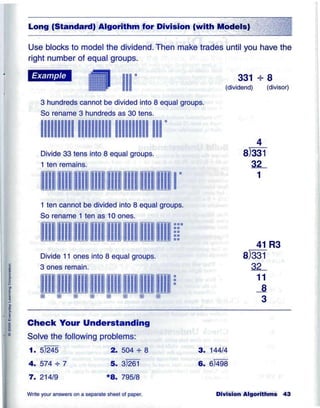
Use blocks to model the dividend. Then make trades until you have the
right number of equal groups.
Example
• III'
3 hundreds cannot be divided into 8 equal groups.
So rename 3 hundreds as 30 tens.
1111111111 1111111111 1111111111 III "

Divide 33 tens into 8 equal groups.
1 ten remains.
DDDDDDDDDDDDDDDDI"
1 ten cannot be divided into 8 equal groups.
So rename 1 ten as 10 ones.
DDDDDDDDDDDDDDDD~r
Divide 11 ones into 8 equal groups.
.2
c
3 ones remain .
~
(;
o
Cll
R
DDDDDDDDDDDDDDDD:'c
C
iij @ @ @ @ @ @ @ @Q)
oJ
~
331 + 8
(dividend) (divisor)
4
8)331
32
1

41 R3
8)331
32
11
--8

3
~
, ~
o
w
Check Your Understandingo
al
, I}
Solve the following problems:
1. 5)245 2. 504 -:- 8 3. 144/4
4. 574 -:- 7 5 . 3)261 6. 6)498
7. 214/9 *8 . 795/8
Write your answers on a separate sheet of paper. Division Algorithms 43
Page 47
Answer Key
1. 11
2. 36
3. 14
4. 31
5. 11 R7
6. 58
7. 24 R8
*8. 244 R10
A Short Algorithm
for Division
Thi s short algorithm for division utilizes the traditional long-division

bracket, but the person using this shorthand algorithm does not need to

record all the estimating, multiplying, and subtracting steps. Instead, the

problem solver using this method records only the results of the subtractions

underneath the dividend.

This short algorithm builds mental-math skills, and many students find it to

be an efficient alternative to the much more complex recording requirements

of the traditional long-division algorithm.

Build Understanding
Practice mental math with your class. If necessary, begin with the basic facts;
however, the goal should be to move on quickly to problems that involve doubling
(such as 13 x 2); multiples of 11 (such as 11 x 4); multiples based on money (such
as 25 x 6-students can think of 4 quarters, plus an extra 50 cents); and extended
facts (such as 40 x 5). Encourage students to develop their own "tricks" that they
can use to sharpen their skills. Allow students to use their fingers if needed but
not paper and pencil.
Using page 47, explain that with this method of dividing, students will be using­
and sharpening- their mental-math skills. Use questions like the following to
guide students through the example (and through other examples you provide):
•	 What is the first number that you will mentally divide in to? (the first two

digits ofthe dividend)

•	 What is the second number that you will divide into? (the first two-digit

number written under the dividend)

•	 How can you record any number that is left over? (Write it next to the

quotient.)

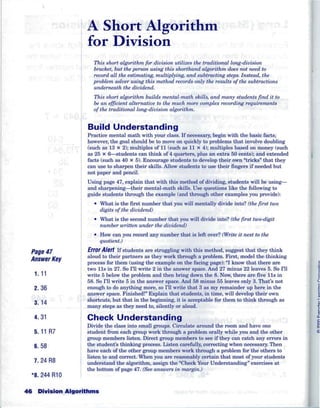
Error Alert If students are struggling with this method, suggest that they think
aloud to their partners as they work through a problem. First, model the thinking
process for them (using the example on th e facin g page): "1 know that there are c
i
two 11s in 27. So I'll write 2 in the answer space. And 27 minus 22 leaves 5. So I'll ~
c
cwri te 5 below the probl em and then bring down the 8. Now, there are five 11s in C
58. So I'll write 5 in the answer space. And 58 minus 55 leaves only 3. That's not <.
c
cenough to do anything more, so I'll write that 3 as my remainder up here in the
"E
a
~answer space. Finished!" Explain that students, in time, will develop their own
shortcuts, but that in the beginning, it is accepta ble for them to think through as
many steps as they need to, silently or aloud.
Check Understanding
Divide the class in to small groups. Circulate around the room and have one
student from each group work through a problem orally while you and the other
group members listen . Direct group members to see if they can catch any errors in
the student's thinking process. Listen carefully, correcting when necessary. Then
have each of the other group members work through a problem for the others to
listen to and correct. When you are reasonably certain that most of your students
understand the algorithm, assign the "Check Your Understanding" exercises at
the bottom of page 47. (See answers in margin.)
46 Division Algorithms
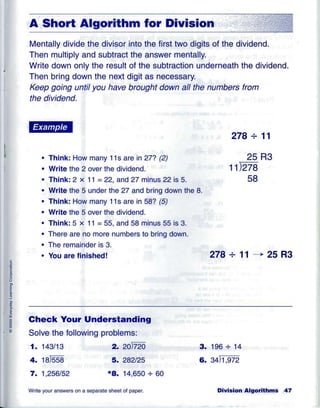
Mentally divide the divisor into the first two digits of the dividend.

Then multiply and subtract the answer mentally.

Write down only the result of the subtraction underneath the dividend.

Then bring down the next digit as necessary.

Keep going until you have brouont down all the numbers from
the dividend.
Example
278 + 11
• Think: How many 11 s are in 27? (2) 25 R3
• Write the 2 over the dividend. 11)278
• Think: 2 x 11 = 22, and 27 minus 22 is 5. 58
• Write the 5 under the 27 and bring down the 8.
• Think: How many 11 s are in 58? (5)
• Write the 5 over the dividend.
• Think: 5 x 11 =55, and 58 minus 55 is 3.
• There are no more numbers to bring down.
• The remainder is 3.
• You are finished! 278 + 11 ~ 25 R3
c
.Q
~
o
S
a.
Ol
c:
·c
1uQ)
..J
>.
ell
"0
eQ)
>
o
w
Check Your Understandingo
o
N
@
Solve the following problems:
1. 143/13 2. 20)720
4. 18)558 5. 282/25
7. 1,256/52 *8. 14,650 + 60
Write your answers on a separate sheet of paper.
3. 196 + 14
6. 34)1 ,972
Division Algorithms 47

Division algorithms (2)

  • 1.
    Page 41 Answer Key 1.19 2. 18 3. 13 4. 27 5. 16 R9 6. 12 R4 7. 11 R4 *8. 68 Guess-and-Check Algorithm for Division The guess-and-check algorithm for division is a commonsense method that asks, "How many of these are in that?"or, more symbolically, "How many b's are in a ?"A person using this algorithm estimates how many smaller groups are in the larger group and records the estimate in a side column. Then the guess-and-checher multiplies the estimate by the divisor, records the result under the dividend, and subtracts the product from the dividend-just as people do when performing long (standard) division. Then, if the problem solver's first "at least, but less than" estimate was not big enough, he or she takes more b's from a. Finally, the guess-and-checker adds all the estimates in the side column to find the quotient and records any remainder as part ofthe quotient. Even those students whose basic-facts knowledge and estimation skills are limited can find correct answers using this commonsense approach. In the process, students quickly discover tha t the better their estimates, the fewer the steps. Build Understanding Using page 41, explain that with this method of dividing, students will be making mental estimates. Use questions like the following to guide students through the example (and through other examples you provide): • When you make the first estimate, what question must you ask yourself? (How many of the di visor are in the dividendi) • Why is a multiple of 10 a good number to start with? (because multiples of 10 are easy numbers to work with) • Where do you record your guesses? (in a separate column to the right of the problem) • Where is the quotient (the answer) recorded? (as the sum ofthe estimates in that separate column) c: o Error Alert Watch for students who make the first estimate as they would do ~owhen following the standard long-division algorithm-that is, using only the first 0­ two digits of the dividend. Remind students that when they're using the guess­ oU 0>and-check algorithm, they are considering the whole problem at once. So the first c: 'eestimate will be an answer to the question, "How many equal groups of the divisor IiiQ) are in the whole dividend?" ...J fa -g, Check Understanding ~wHave a volunteer go to the board and solve a division problem using the guess­ o oand-check algorithm. Encourage the student to explain her or his strategy while ~ working so that the class can follow along. Have students direct their question © to the volunteer, and guide that student in answering as necessary. If many students are confused about a particular aspect of the guess-and check algorithm, do another problem on the board. When you are reasonably certain that most of your students understand the algorithm, assign the "Check Your Understanding" exercises at the bottom of page 41. (See answers in margin.) 40 Division Algorithms
  • 2.
    Estimate how manydivisors are in the whole dividend. Write your estimate to the right of the problem.Then multiply your estimate by the divisor, write the product below the problem, and subtract the product from the dividend. Continue estimating and subtracting until the difference is less than the divisor. Then add all your estimates to find the quotient. Example 238 + 12 (dividend) (divisor) Ask: How many 12s are in 238? Write your estimate in a separate column to the right. 12)238 10 Multiply 10 * 12. Write the product 120 below the problem (the dividend) 118 9 and subtract. 108 Ask: How many 12s are in 118? Write 10 19 your estimate in the far-right column. Multiply 9 * 12. Write the product below the problem and subtract. 238 + 12 19 R10 § Add the estimates to find the quotient I (the answer).The remaining difference o is the remainder.o en c 1: ~ ~ ,., os ~Gl • > 8o(I • 0 Check Your Understanding Solve the following problems: 1. 380 + 20 2. 720 + 40 3 . 663/51 4. 972 + 36 5. 841 /52 6. 64)772 7. 895 + 81 *8. 94)6,392 Write your answers on a separate sheet of paper. Division Algorithms 41
  • 3.
    Page 43 Answer Key 1.49 2. 63 3. 36 4. 82 5. 87 6. 83 7. 23 R7 *8. 99 R3 Long (Standard) Algorithm for Division (with Models) The long (standard) algorithm for di vision is the one that is familiar to most adults and many children. The person using this algorithm places the di vidend within a division bracket and the divisor outside and to the left of the bracket. The problem solver then makes a series ofeducated multiplication / division estimates, records the result ofeach estimate underneath the dividend, and subtracts the result ofeach estimate from the number above it. If there is a remainder, the problem solver writes it next to the quotient. The traditional method for teaching this algorithm is to begin with models (such as base-lO blocks), using them to demonstrate the process of dividing a dividend into equal groups. Build Understanding Divide the class into groups offour or five, provide each group with place-value blocks, and direct each group to model the number 138 using the least number of blocks. When each group has built the correct model (consisting of 1 hundred, 3 tens, and 8 ones), ask students to divide the model into 6 equal groups. Allow each group to tackle the probl em in its own way. If students seem confused about how to start, however, suggest that they think about regrouping the largest block (the hundred) first. Continue guiding students as necessa ry until each group has successfully reordered 1 hundred, 3 tens, and 8 ones into six equal groupings of 2 tens and 3 ones each. Usi ng page 43, explain that with this method of dividing, students will begin by making an estimate about what the first digit in the quotient (the answer) should be. Use questions like the following to guide students through the example: • Why do you have to trade 3 hundreds for 30 tens? (because 3 hundreds cannot be divided into 8 equal groups) • Why do you have to trade 1 ten for 10 ones? (because 1 ten cannot be divided into 8 equal groups) c • Why are 3 ones left over? (because 3 ones cannot be divided into 8 equal groups) J ! Error Alert Watch for students who are multiplying incorrectly. Remind students ( ( c that although the long-division process may seem compl ex, each multiplication C. ", e step within the process is a simple, basic-fact step. Also, watch for students who c are subtracting incorrectly. Suggest that these students cover the numbers above •the numbers being subtracted with their index fingers to help them focus on only ~ two numbers at a time-the two they are subtracting. Check Understanding Have students check each of their answers by multiplying the quotient by the divisor, adding the remainder if there is one, and then checking to see if the result matches the divid end. Have a volunteer go to the board and solve a division problem using the standard algorithm. Help the student describe the process while he or she works through it and correct any misconceptions as necessary, referring again to base-l0 blocks or arrays if they seem to help. When you are reasonably certain that most of your students understand the algorithm, assign the "Check Your Understanding" exercises at the bottom of page 43. (See answers in margin.) 42 Division Algorithms
  • 4.
    Use blocks tomodel the dividend. Then make trades until you have the right number of equal groups. Example • III' 3 hundreds cannot be divided into 8 equal groups. So rename 3 hundreds as 30 tens. 1111111111 1111111111 1111111111 III " Divide 33 tens into 8 equal groups. 1 ten remains. DDDDDDDDDDDDDDDDI" 1 ten cannot be divided into 8 equal groups. So rename 1 ten as 10 ones. DDDDDDDDDDDDDDDD~r Divide 11 ones into 8 equal groups. .2 c 3 ones remain . ~ (; o Cll R DDDDDDDDDDDDDDDD:'c C iij @ @ @ @ @ @ @ @Q) oJ ~ 331 + 8 (dividend) (divisor) 4 8)331 32 1 41 R3 8)331 32 11 --8 3 ~ , ~ o w Check Your Understandingo al , I} Solve the following problems: 1. 5)245 2. 504 -:- 8 3. 144/4 4. 574 -:- 7 5 . 3)261 6. 6)498 7. 214/9 *8 . 795/8 Write your answers on a separate sheet of paper. Division Algorithms 43
  • 5.
    Page 47 Answer Key 1.11 2. 36 3. 14 4. 31 5. 11 R7 6. 58 7. 24 R8 *8. 244 R10 A Short Algorithm for Division Thi s short algorithm for division utilizes the traditional long-division bracket, but the person using this shorthand algorithm does not need to record all the estimating, multiplying, and subtracting steps. Instead, the problem solver using this method records only the results of the subtractions underneath the dividend. This short algorithm builds mental-math skills, and many students find it to be an efficient alternative to the much more complex recording requirements of the traditional long-division algorithm. Build Understanding Practice mental math with your class. If necessary, begin with the basic facts; however, the goal should be to move on quickly to problems that involve doubling (such as 13 x 2); multiples of 11 (such as 11 x 4); multiples based on money (such as 25 x 6-students can think of 4 quarters, plus an extra 50 cents); and extended facts (such as 40 x 5). Encourage students to develop their own "tricks" that they can use to sharpen their skills. Allow students to use their fingers if needed but not paper and pencil. Using page 47, explain that with this method of dividing, students will be using­ and sharpening- their mental-math skills. Use questions like the following to guide students through the example (and through other examples you provide): • What is the first number that you will mentally divide in to? (the first two digits ofthe dividend) • What is the second number that you will divide into? (the first two-digit number written under the dividend) • How can you record any number that is left over? (Write it next to the quotient.) Error Alert If students are struggling with this method, suggest that they think aloud to their partners as they work through a problem. First, model the thinking process for them (using the example on th e facin g page): "1 know that there are c i two 11s in 27. So I'll write 2 in the answer space. And 27 minus 22 leaves 5. So I'll ~ c cwri te 5 below the probl em and then bring down the 8. Now, there are five 11s in C 58. So I'll write 5 in the answer space. And 58 minus 55 leaves only 3. That's not <. c cenough to do anything more, so I'll write that 3 as my remainder up here in the "E a ~answer space. Finished!" Explain that students, in time, will develop their own shortcuts, but that in the beginning, it is accepta ble for them to think through as many steps as they need to, silently or aloud. Check Understanding Divide the class in to small groups. Circulate around the room and have one student from each group work through a problem orally while you and the other group members listen . Direct group members to see if they can catch any errors in the student's thinking process. Listen carefully, correcting when necessary. Then have each of the other group members work through a problem for the others to listen to and correct. When you are reasonably certain that most of your students understand the algorithm, assign the "Check Your Understanding" exercises at the bottom of page 47. (See answers in margin.) 46 Division Algorithms
  • 6.
    Mentally divide thedivisor into the first two digits of the dividend. Then multiply and subtract the answer mentally. Write down only the result of the subtraction underneath the dividend. Then bring down the next digit as necessary. Keep going until you have brouont down all the numbers from the dividend. Example 278 + 11 • Think: How many 11 s are in 27? (2) 25 R3 • Write the 2 over the dividend. 11)278 • Think: 2 x 11 = 22, and 27 minus 22 is 5. 58 • Write the 5 under the 27 and bring down the 8. • Think: How many 11 s are in 58? (5) • Write the 5 over the dividend. • Think: 5 x 11 =55, and 58 minus 55 is 3. • There are no more numbers to bring down. • The remainder is 3. • You are finished! 278 + 11 ~ 25 R3 c .Q ~ o S a. Ol c: ·c 1uQ) ..J >. ell "0 eQ) > o w Check Your Understandingo o N @ Solve the following problems: 1. 143/13 2. 20)720 4. 18)558 5. 282/25 7. 1,256/52 *8. 14,650 + 60 Write your answers on a separate sheet of paper. 3. 196 + 14 6. 34)1 ,972 Division Algorithms 47