GROUP 3 MATH
PRESENTATION
Number 1
Jahid as a Math Tutor
Sir Jahid Dalidig is a math tutor in a tutorial center..
He is preparing a test for his tutees for upcoming test, he want to
creat a worksheet for them to practice their skill in dividing
polynomials. So he will prepare a 10-item worksheet which includes
five items for long division and five items for synthetic division. He
will going to submit this worksheet to his coordinator, Mr. Lance
Cobrado with the corresponding answer key that shows the detailed
solution. Mr. Lance Cobrado will evaluate his work based on the
correctness and appropriateness of the given items and excercises,
and the accuracy of solutions and answers.
Yes sir, I am! And I will
submit it to your desk
sir.
Mr. Dalidig, are you
preparing the test for your
tutees?
Long Division
Ah! this should be done.
All I need is to check the
solutions
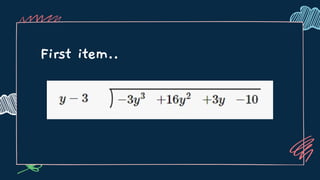
First item..
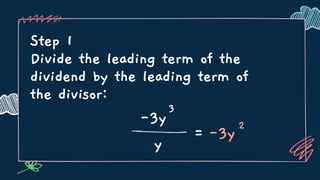
Step 1
Divide the leading term of the
dividend by the leading term of
the divisor:
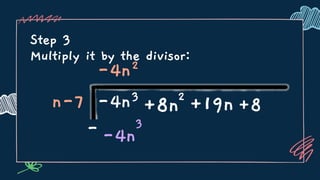
-3y
3
y
=
2
-3y
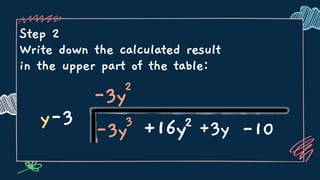
Step 2
Write down the calculated result
in the upper part of the table:
y-3
-3y2
-3y3
+16y2 +3y -10
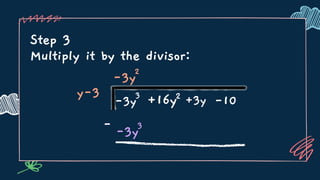
Step 3
Multiply it by the divisor:
y-3
-3y2
-3y3
+16y2 +3y -10
-3y3
-
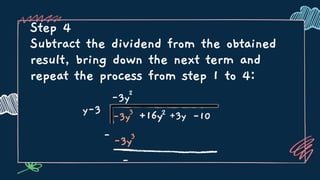
Step 4
Subtract the dividend from the obtained
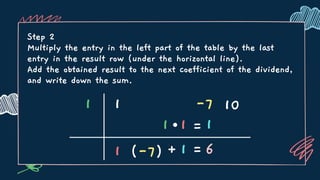
result, bring down the next term and
repeat the process from step 1 to 4:
y-3
-3y2
-3y3
+16y2 +3y -10
-3y3
-
-
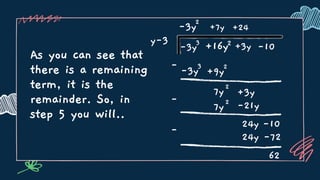
y-3
-3y2
-3y3
+16y2 +3y -10
-3y3
-
+9y2
7y2
+3y
-
7y2
-21y
24y -10
-
24y -72
62
As you can see that
there is a remaining
term, it is the
remainder. So, in
step 5 you will..
+7y +24
y-3
-3y2
-3y3
+16y2 +3y -10
-3y3
-
+9y2
7y2
+3y -10
-
7y2
-21y
24y -10
-
24y -72y
62
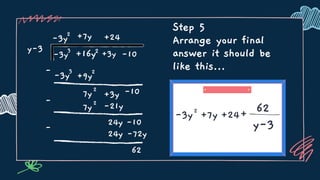
+7y +24
+24
+7y
-3y2
+ 62
y-3
Step 5
Arrange your final
answer it should be
like this...
2
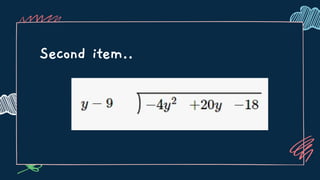
Second item..
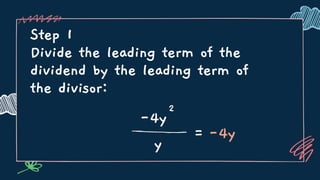
Step 1
Divide the leading term of the
dividend by the leading term of
the divisor:
-4y
2
y
= -4y
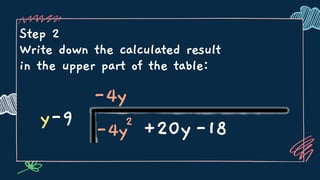
Step 2
Write down the calculated result
in the upper part of the table:
y-9
-4y
-4y2
+20y-18
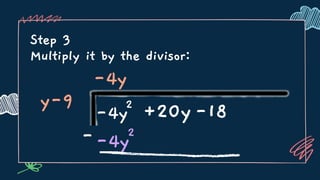
Step 3
Multiply it by the divisor:
y-9
-4y
-4y2
+20y-18
--4y2
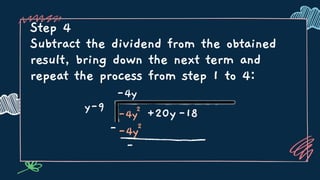
Step 4
Subtract the dividend from the obtained
result, bring down the next term and
repeat the process from step 1 to 4:
y-9
-4y
-4y2
+20y-18
--4y2
-
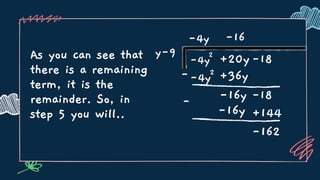
As you can see that
there is a remaining
term, it is the
remainder. So, in
step 5 you will..
y-9
-4y
-4y2
+20y-18
--4y2
-
+36y
-16y -18
-16
-16y +144
-162
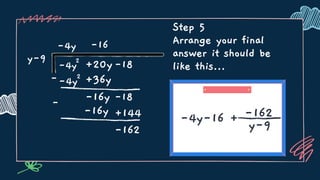
Step 5
Arrange your final
answer it should be
like this...
y-9
-4y
-4y2
+20y-18
--4y2
-
+36y
-16y -18
-16
-16y +144
-162
-4y-16 + -162
y-9
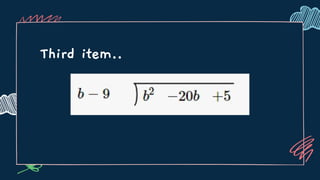
Third item..
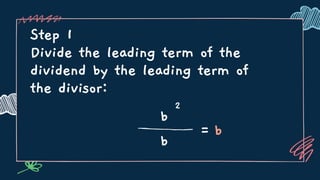
Step 1
Divide the leading term of the
dividend by the leading term of
the divisor:
b
2
b
= b
Step 2
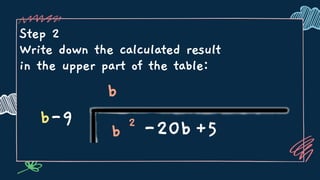
Write down the calculated result
in the upper part of the table:
b-9
b
b 2
-20b+5
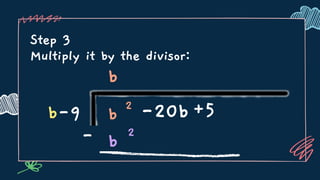
Step 3
Multiply it by the divisor:
- b 2
b
b-9 b 2
-20b+5
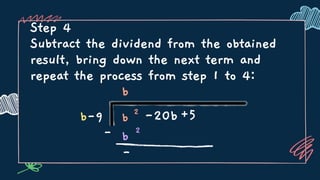
Step 4
Subtract the dividend from the obtained
result, bring down the next term and
repeat the process from step 1 to 4:
- b 2
b
b-9 b 2
-20b+5
-
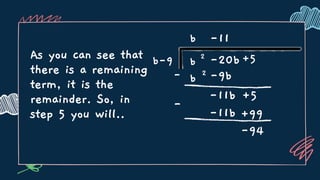
As you can see that
there is a remaining
term, it is the
remainder. So, in
step 5 you will..
- b 2
b
b-9 b 2
-20b+5
-9b
-11b +5
-11
-
-11b +99
-94
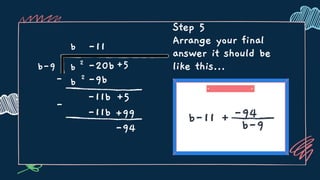
Step 5
Arrange your final
answer it should be
like this...
b-11 + -94
b-9
- b 2
b
b-9 b 2
-20b+5
-9b
-11b +5
-11
-
-11b +99
-94
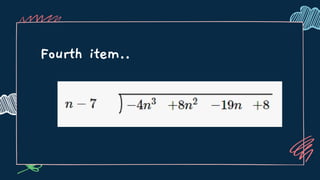
Fourth item..
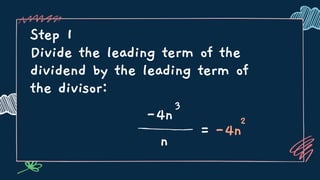
Step 1
Divide the leading term of the
dividend by the leading term of
the divisor:
-4n
3
n
= -4n
2
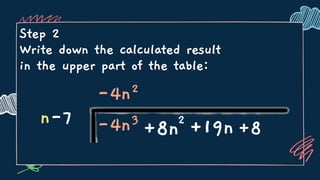
Step 2
Write down the calculated result
in the upper part of the table:
n-7 3
+8n +8
-4n
-4n2
2
+19n
Step 3
Multiply it by the divisor:
n-7 3
+8n +8
-4n
-4n2
2
+19n
--4n
3
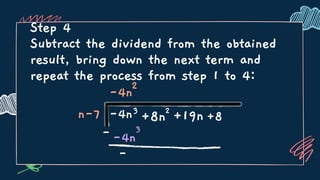
Step 4
Subtract the dividend from the obtained
result, bring down the next term and
repeat the process from step 1 to 4:
n-7 3
+8n
-4n
-4n
2
+19n
--4n
3
-
+8
2
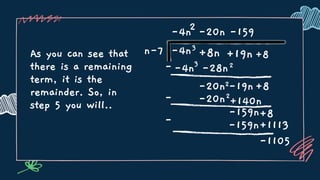
As you can see that
there is a remaining
term, it is the
remainder. So, in
step 5 you will..
n-7 3
+8n
-4n
-4n
--4n3
-20n2
-28n2
-19n+8
+19n+8
-20n2
- +140n
-159n+8
- -159n+1113
-1105
-20n -159
2
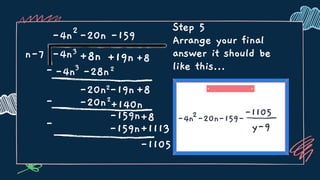
Step 5
Arrange your final
answer it should be
like this...
-4n -20n-159-
-1105
y-9
n-7 3
+8n
-4n
-4n
--4n3
-20n2
-28n2
-19n+8
+19n+8
-20n2
- +140n
-159n+8
- -159n+1113
-1105
-20n -159
2
2
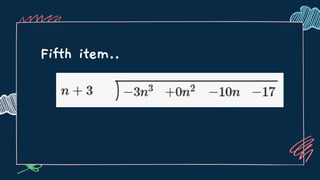
Fifth item..
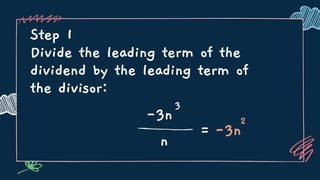
Step 1
Divide the leading term of the
dividend by the leading term of
the divisor:
-3n
3
n
= -3n
2
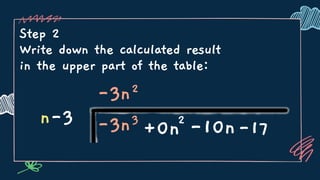
Step 2
Write down the calculated result
in the upper part of the table:
n-3 3
+0n -17
-3n
-3n2
2
-10n
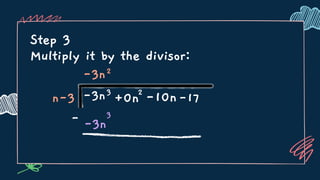
Step 3
Multiply it by the divisor:
n-3 3
+0n -17
-3n
-3n2
2
-10n
-3n
3
-
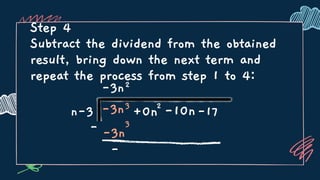
Step 4
Subtract the dividend from the obtained
result, bring down the next term and
repeat the process from step 1 to 4:
n-3 3
+0n -17
-3n
-3n2
2
-10n
-3n
3
-
-
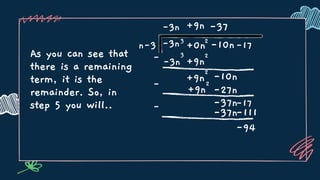
As you can see that
there is a remaining
term, it is the
remainder. So, in
step 5 you will..
n-3 3
+0n -17
-3n
-3n
2
-10n
-3n
3
-
-
+9n
+9n
2
+9n
2
-10n
-37
-27n
+9n
2
-37n-17
-37n
-
-111
-94
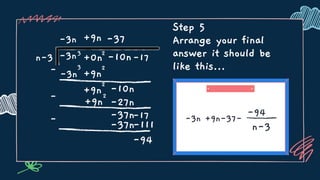
Step 5
Arrange your final
answer it should be
like this...
-3n +9n-37-
-94
n-3
n-3 3
+0n -17
-3n
-3n
2
-10n
-3n
3
-
-
+9n
+9n
2
+9n
2
-10n
-37
-27n
+9n
2
-37n-17
-37n
-
-111
-94
Now, we will proceed for
five items left whic is the
synthetic division..
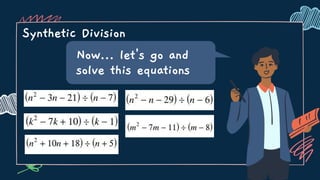
Now... let's go and
solve this equations
Synthetic Division
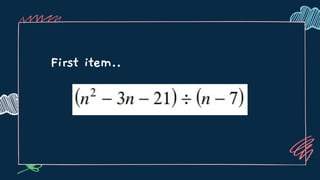
First item..
Take the constant term of the divisor
with the opposite sign and write it to
the left.
Write the coefficients of the dividend
to the right.
To do this:
1.
2.
Step 1
Write down the first coefficient
without changes:
7 1 -3 -21
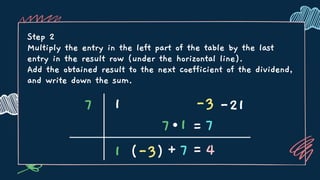
Step 2
Multiply the entry in the left part of the table by the last
entry in the result row (under the horizontal line).
Add the obtained result to the next coefficient of the dividend,
and write down the sum.
7 1 -3 -21
1 (-3)
7 1
+7 =
=7
4
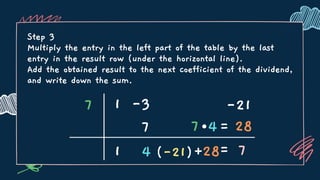
Step 3
Multiply the entry in the left part of the table by the last
entry in the result row (under the horizontal line).
Add the obtained result to the next coefficient of the dividend,
and write down the sum.
7 1 -3 -21
1 + =
=
7
4
4
7
(-21) 28 7
28
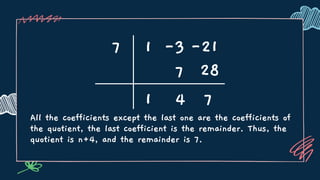
All the coefficients except the last one are the coefficients of
the quotient, the last coefficient is the remainder. Thus, the
quotient is n+4, and the remainder is 7.
7 1 -3 -21
1
7
4 7
28
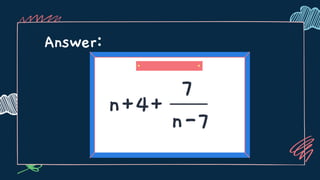
Answer:
n+4+
7
n-7
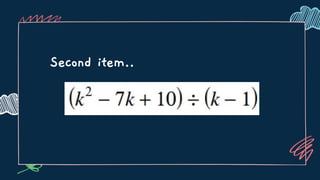
Second item..
Take the constant term of the divisor
with the opposite sign and write it to
the left.
Write the coefficients of the dividend
to the right.
To do this:
1.
2.
Step 1
Write down the first coefficient
without changes:
1 1 -7 10
Step 2
Multiply the entry in the left part of the table by the last
entry in the result row (under the horizontal line).
Add the obtained result to the next coefficient of the dividend,
and write down the sum.
1 1 -7 10
1 (-7)
1 1
+1 =
=1
6
Step 3
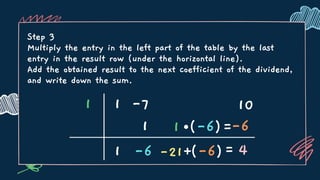
Multiply the entry in the left part of the table by the last
entry in the result row (under the horizontal line).
Add the obtained result to the next coefficient of the dividend,
and write down the sum.
1 1 -7 10
1 + =
=
1
-6
(-6)
1
-21 (-6) 4
-6
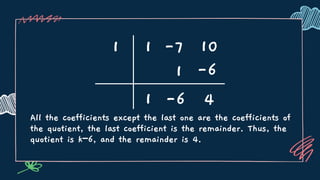
All the coefficients except the last one are the coefficients of
the quotient, the last coefficient is the remainder. Thus, the
quotient is k−6, and the remainder is 4.
1 1 -7 10
1
1
-6 4
-6
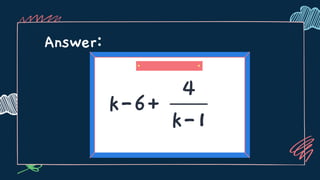
Answer:
k-6+
4
k-1
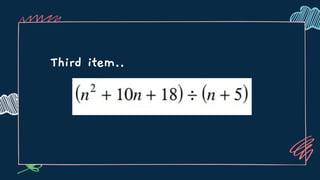
Third item..
Step 1
Write down the first coefficient
without changes:
-5 1 10 18
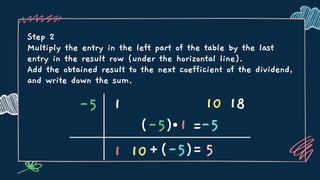
Step 2
Multiply the entry in the left part of the table by the last
entry in the result row (under the horizontal line).
Add the obtained result to the next coefficient of the dividend,
and write down the sum.
-5 1 10 18
1 10
(-5) 1
+(-5)=
=-5
5
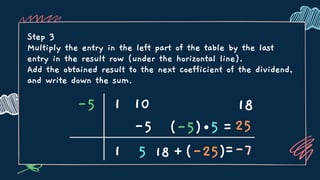
Step 3
Multiply the entry in the left part of the table by the last
entry in the result row (under the horizontal line).
Add the obtained result to the next coefficient of the dividend,
and write down the sum.
-5 1 10 18
1 + =
=
-5
5
5
(-5)
18 (-25) -7
25
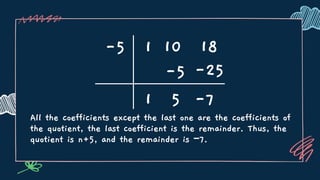
All the coefficients except the last one are the coefficients of
the quotient, the last coefficient is the remainder. Thus, the
quotient is n+5, and the remainder is −7.
-5 1 10 18
1
-5
5 -7
-25
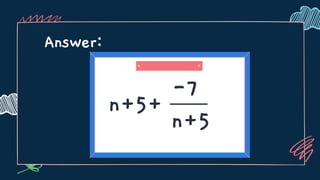
Answer:
n+5+
-7
n+5
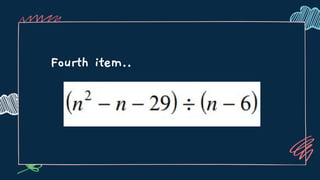
Fourth item..
Step 1
Write down the first coefficient
without changes:
6 1 -1 -29
Step 2
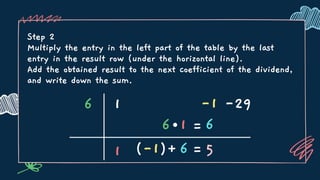
Multiply the entry in the left part of the table by the last
entry in the result row (under the horizontal line).
Add the obtained result to the next coefficient of the dividend,
and write down the sum.
6 1 -1 -29
1 (-1)
6 1
+6 =
=6
5
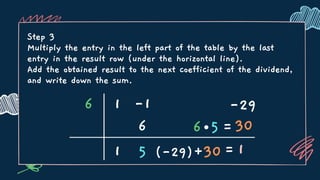
Step 3
Multiply the entry in the left part of the table by the last
entry in the result row (under the horizontal line).
Add the obtained result to the next coefficient of the dividend,
and write down the sum.
6 1 -1 -29
1 + =
=
6
5
5
6
(-29) 30 1
30
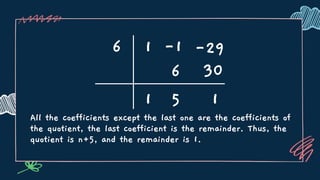
All the coefficients except the last one are the coefficients of
the quotient, the last coefficient is the remainder. Thus, the
quotient is n+5, and the remainder is 1.
6 1 -1
30
1
6
5 1
-29
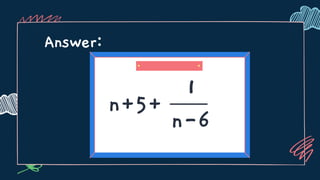
Answer:
n+5+
1
n-6
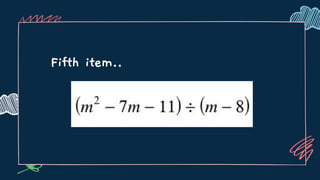
Fifth item..
Step 1
Write down the first coefficient
without changes:
8 1 -7 -11
Step 2
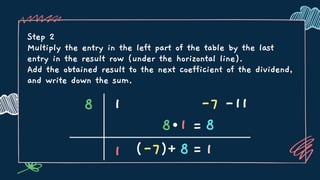
Multiply the entry in the left part of the table by the last
entry in the result row (under the horizontal line).
Add the obtained result to the next coefficient of the dividend,
and write down the sum.
8 1 -7 -11
1 (-7)
8 1
+8 =
=8
1
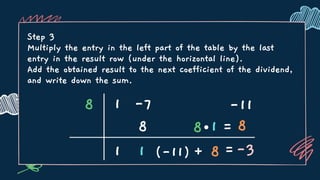
Step 3
Multiply the entry in the left part of the table by the last
entry in the result row (under the horizontal line).
Add the obtained result to the next coefficient of the dividend,
and write down the sum.
8 1 -7 -11
1 + =
=
8
1
1
8
(-11) 8 -3
8
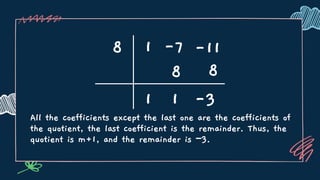
All the coefficients except the last one are the coefficients of
the quotient, the last coefficient is the remainder. Thus, the
quotient is m+1, and the remainder is −3.
8 1 -7
8
1
8
1 -3
-11
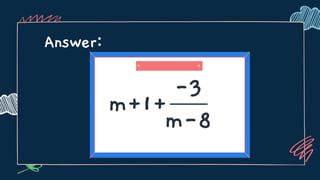
Answer:
m+1+
-3
m-8
Awesome,
good job Mr. Dalidig!
ALMOST ALL OF THE STUDENTS GOT HIGH
SCORES IN TEST, THANKS TO MR. DALIDIG
WORKSHEETS TO TEST THE SKILLS OF THE
STUDENTS!

Long division and synthetic division

  • 1.
  • 2.
    Jahid as aMath Tutor Sir Jahid Dalidig is a math tutor in a tutorial center.. He is preparing a test for his tutees for upcoming test, he want to creat a worksheet for them to practice their skill in dividing polynomials. So he will prepare a 10-item worksheet which includes five items for long division and five items for synthetic division. He will going to submit this worksheet to his coordinator, Mr. Lance Cobrado with the corresponding answer key that shows the detailed solution. Mr. Lance Cobrado will evaluate his work based on the correctness and appropriateness of the given items and excercises, and the accuracy of solutions and answers.
  • 3.
    Yes sir, Iam! And I will submit it to your desk sir. Mr. Dalidig, are you preparing the test for your tutees?
  • 4.
    Long Division Ah! thisshould be done. All I need is to check the solutions
  • 5.
  • 6.
    Step 1 Divide theleading term of the dividend by the leading term of the divisor: -3y 3 y = 2 -3y
  • 7.
    Step 2 Write downthe calculated result in the upper part of the table: y-3 -3y2 -3y3 +16y2 +3y -10
  • 8.
    Step 3 Multiply itby the divisor: y-3 -3y2 -3y3 +16y2 +3y -10 -3y3 -
  • 9.
    Step 4 Subtract thedividend from the obtained result, bring down the next term and repeat the process from step 1 to 4: y-3 -3y2 -3y3 +16y2 +3y -10 -3y3 - -
  • 10.
    y-3 -3y2 -3y3 +16y2 +3y -10 -3y3 - +9y2 7y2 +3y - 7y2 -21y 24y-10 - 24y -72 62 As you can see that there is a remaining term, it is the remainder. So, in step 5 you will.. +7y +24
  • 11.
    y-3 -3y2 -3y3 +16y2 +3y -10 -3y3 - +9y2 7y2 +3y-10 - 7y2 -21y 24y -10 - 24y -72y 62 +7y +24 +24 +7y -3y2 + 62 y-3 Step 5 Arrange your final answer it should be like this... 2
  • 12.
  • 13.
    Step 1 Divide theleading term of the dividend by the leading term of the divisor: -4y 2 y = -4y
  • 14.
    Step 2 Write downthe calculated result in the upper part of the table: y-9 -4y -4y2 +20y-18
  • 15.
    Step 3 Multiply itby the divisor: y-9 -4y -4y2 +20y-18 --4y2
  • 16.
    Step 4 Subtract thedividend from the obtained result, bring down the next term and repeat the process from step 1 to 4: y-9 -4y -4y2 +20y-18 --4y2 -
  • 17.
    As you cansee that there is a remaining term, it is the remainder. So, in step 5 you will.. y-9 -4y -4y2 +20y-18 --4y2 - +36y -16y -18 -16 -16y +144 -162
  • 18.
    Step 5 Arrange yourfinal answer it should be like this... y-9 -4y -4y2 +20y-18 --4y2 - +36y -16y -18 -16 -16y +144 -162 -4y-16 + -162 y-9
  • 19.
  • 20.
    Step 1 Divide theleading term of the dividend by the leading term of the divisor: b 2 b = b
  • 21.
    Step 2 Write downthe calculated result in the upper part of the table: b-9 b b 2 -20b+5
  • 22.
    Step 3 Multiply itby the divisor: - b 2 b b-9 b 2 -20b+5
  • 23.
    Step 4 Subtract thedividend from the obtained result, bring down the next term and repeat the process from step 1 to 4: - b 2 b b-9 b 2 -20b+5 -
  • 24.
    As you cansee that there is a remaining term, it is the remainder. So, in step 5 you will.. - b 2 b b-9 b 2 -20b+5 -9b -11b +5 -11 - -11b +99 -94
  • 25.
    Step 5 Arrange yourfinal answer it should be like this... b-11 + -94 b-9 - b 2 b b-9 b 2 -20b+5 -9b -11b +5 -11 - -11b +99 -94
  • 26.
  • 27.
    Step 1 Divide theleading term of the dividend by the leading term of the divisor: -4n 3 n = -4n 2
  • 28.
    Step 2 Write downthe calculated result in the upper part of the table: n-7 3 +8n +8 -4n -4n2 2 +19n
  • 29.
    Step 3 Multiply itby the divisor: n-7 3 +8n +8 -4n -4n2 2 +19n --4n 3
  • 30.
    Step 4 Subtract thedividend from the obtained result, bring down the next term and repeat the process from step 1 to 4: n-7 3 +8n -4n -4n 2 +19n --4n 3 - +8 2
  • 31.
    As you cansee that there is a remaining term, it is the remainder. So, in step 5 you will.. n-7 3 +8n -4n -4n --4n3 -20n2 -28n2 -19n+8 +19n+8 -20n2 - +140n -159n+8 - -159n+1113 -1105 -20n -159 2
  • 32.
    Step 5 Arrange yourfinal answer it should be like this... -4n -20n-159- -1105 y-9 n-7 3 +8n -4n -4n --4n3 -20n2 -28n2 -19n+8 +19n+8 -20n2 - +140n -159n+8 - -159n+1113 -1105 -20n -159 2 2
  • 33.
  • 34.
    Step 1 Divide theleading term of the dividend by the leading term of the divisor: -3n 3 n = -3n 2
  • 35.
    Step 2 Write downthe calculated result in the upper part of the table: n-3 3 +0n -17 -3n -3n2 2 -10n
  • 36.
    Step 3 Multiply itby the divisor: n-3 3 +0n -17 -3n -3n2 2 -10n -3n 3 -
  • 37.
    Step 4 Subtract thedividend from the obtained result, bring down the next term and repeat the process from step 1 to 4: n-3 3 +0n -17 -3n -3n2 2 -10n -3n 3 - -
  • 38.
    As you cansee that there is a remaining term, it is the remainder. So, in step 5 you will.. n-3 3 +0n -17 -3n -3n 2 -10n -3n 3 - - +9n +9n 2 +9n 2 -10n -37 -27n +9n 2 -37n-17 -37n - -111 -94
  • 39.
    Step 5 Arrange yourfinal answer it should be like this... -3n +9n-37- -94 n-3 n-3 3 +0n -17 -3n -3n 2 -10n -3n 3 - - +9n +9n 2 +9n 2 -10n -37 -27n +9n 2 -37n-17 -37n - -111 -94
  • 40.
    Now, we willproceed for five items left whic is the synthetic division..
  • 41.
    Now... let's goand solve this equations Synthetic Division
  • 42.
  • 43.
    Take the constantterm of the divisor with the opposite sign and write it to the left. Write the coefficients of the dividend to the right. To do this: 1. 2.
  • 44.
    Step 1 Write downthe first coefficient without changes: 7 1 -3 -21
  • 45.
    Step 2 Multiply theentry in the left part of the table by the last entry in the result row (under the horizontal line). Add the obtained result to the next coefficient of the dividend, and write down the sum. 7 1 -3 -21 1 (-3) 7 1 +7 = =7 4
  • 46.
    Step 3 Multiply theentry in the left part of the table by the last entry in the result row (under the horizontal line). Add the obtained result to the next coefficient of the dividend, and write down the sum. 7 1 -3 -21 1 + = = 7 4 4 7 (-21) 28 7 28
  • 47.
    All the coefficientsexcept the last one are the coefficients of the quotient, the last coefficient is the remainder. Thus, the quotient is n+4, and the remainder is 7. 7 1 -3 -21 1 7 4 7 28
  • 48.
  • 49.
  • 50.
    Take the constantterm of the divisor with the opposite sign and write it to the left. Write the coefficients of the dividend to the right. To do this: 1. 2.
  • 51.
    Step 1 Write downthe first coefficient without changes: 1 1 -7 10
  • 52.
    Step 2 Multiply theentry in the left part of the table by the last entry in the result row (under the horizontal line). Add the obtained result to the next coefficient of the dividend, and write down the sum. 1 1 -7 10 1 (-7) 1 1 +1 = =1 6
  • 53.
    Step 3 Multiply theentry in the left part of the table by the last entry in the result row (under the horizontal line). Add the obtained result to the next coefficient of the dividend, and write down the sum. 1 1 -7 10 1 + = = 1 -6 (-6) 1 -21 (-6) 4 -6
  • 54.
    All the coefficientsexcept the last one are the coefficients of the quotient, the last coefficient is the remainder. Thus, the quotient is k−6, and the remainder is 4. 1 1 -7 10 1 1 -6 4 -6
  • 55.
  • 56.
  • 57.
    Step 1 Write downthe first coefficient without changes: -5 1 10 18
  • 58.
    Step 2 Multiply theentry in the left part of the table by the last entry in the result row (under the horizontal line). Add the obtained result to the next coefficient of the dividend, and write down the sum. -5 1 10 18 1 10 (-5) 1 +(-5)= =-5 5
  • 59.
    Step 3 Multiply theentry in the left part of the table by the last entry in the result row (under the horizontal line). Add the obtained result to the next coefficient of the dividend, and write down the sum. -5 1 10 18 1 + = = -5 5 5 (-5) 18 (-25) -7 25
  • 60.
    All the coefficientsexcept the last one are the coefficients of the quotient, the last coefficient is the remainder. Thus, the quotient is n+5, and the remainder is −7. -5 1 10 18 1 -5 5 -7 -25
  • 61.
  • 62.
  • 63.
    Step 1 Write downthe first coefficient without changes: 6 1 -1 -29
  • 64.
    Step 2 Multiply theentry in the left part of the table by the last entry in the result row (under the horizontal line). Add the obtained result to the next coefficient of the dividend, and write down the sum. 6 1 -1 -29 1 (-1) 6 1 +6 = =6 5
  • 65.
    Step 3 Multiply theentry in the left part of the table by the last entry in the result row (under the horizontal line). Add the obtained result to the next coefficient of the dividend, and write down the sum. 6 1 -1 -29 1 + = = 6 5 5 6 (-29) 30 1 30
  • 66.
    All the coefficientsexcept the last one are the coefficients of the quotient, the last coefficient is the remainder. Thus, the quotient is n+5, and the remainder is 1. 6 1 -1 30 1 6 5 1 -29
  • 67.
  • 68.
  • 69.
    Step 1 Write downthe first coefficient without changes: 8 1 -7 -11
  • 70.
    Step 2 Multiply theentry in the left part of the table by the last entry in the result row (under the horizontal line). Add the obtained result to the next coefficient of the dividend, and write down the sum. 8 1 -7 -11 1 (-7) 8 1 +8 = =8 1
  • 71.
    Step 3 Multiply theentry in the left part of the table by the last entry in the result row (under the horizontal line). Add the obtained result to the next coefficient of the dividend, and write down the sum. 8 1 -7 -11 1 + = = 8 1 1 8 (-11) 8 -3 8
  • 72.
    All the coefficientsexcept the last one are the coefficients of the quotient, the last coefficient is the remainder. Thus, the quotient is m+1, and the remainder is −3. 8 1 -7 8 1 8 1 -3 -11
  • 73.
  • 74.
    Awesome, good job Mr.Dalidig! ALMOST ALL OF THE STUDENTS GOT HIGH SCORES IN TEST, THANKS TO MR. DALIDIG WORKSHEETS TO TEST THE SKILLS OF THE STUDENTS!