• Ice Caps / Glaciers 1.5 cups
• Groundwater .5 cups
• Freshwater Lakes .25 table spoons
• Salt Lakes .15 table spoons
• Atmosphere 3 drops
• Rivers .5 drops
• Useable water available for humans
after pollution and contamination =.001
drop
Oceans (all water left in bucket)
Copyright © 2010 Ryan P. Murphy
• RED SLIDE: These are notes that are very
important and should be recorded in your
science journal.
Copyright © 2010 Ryan P. Murphy
-Nice neat notes that are legible and use indentations
when appropriate.
-Example of indent.
-Skip a line between topics
-Don’t skip pages
-Make visuals clear and well drawn.
• RED SLIDE: These are notes that are very
important and should be recorded in your
science journal.
• BLACK SLIDE: Pay attention, follow
directions, complete projects as described
and answer required questions neatly.
Copyright © 2010 Ryan P. Murphy
• http://sciencepowerpoint.com/
Copyright © 2010 Ryan P. Murphy
Area of Focus: Where’s our water?Area of Focus: Where’s our water?
Copyright © 2010 Ryan P. Murphy
• Earth is known as the blue planet as it
has a blue glow from space.
• Earth is known as the blue planet as it
has a blue glow from space.
– This blue is from all of the water on our
planet.
• Water on Earth Available Sheet
• Why should we study water?
–Bullet List.
–3-5 Sentence minimum paragraph
Copyright © 2010 Ryan P. Murphy
• Activity! Water Usage.
– Create a list of all the ways humans use
water.
Copyright © 2010 Ryan P. Murphy
• Please narrow down the class list to 6
Categories (Work in Table Groups)
Copyright © 2010 Ryan P. Murphy
The six ways humans use waterThe six ways humans use water
--
--
--
--
--
--
Copyright © 2010 Ryan P. Murphy
The six ways humans use waterThe six ways humans use water
--
--
--
--
--
--
Copyright © 2010 Ryan P. Murphy
Survival / HealthSurvival / Health
Copyright © 2010 Ryan P. Murphy
Household.Household.
Copyright © 2010 Ryan P. Murphy
Recreational.Recreational.
Copyright © 2010 Ryan P. Murphy
Industrial.Industrial.
Copyright © 2010 Ryan P. Murphy
Transportation.Transportation.
Copyright © 2010 Ryan P. Murphy
Agricultural.Agricultural.
Copyright © 2010 Ryan P. Murphy
• You can now complete this question.
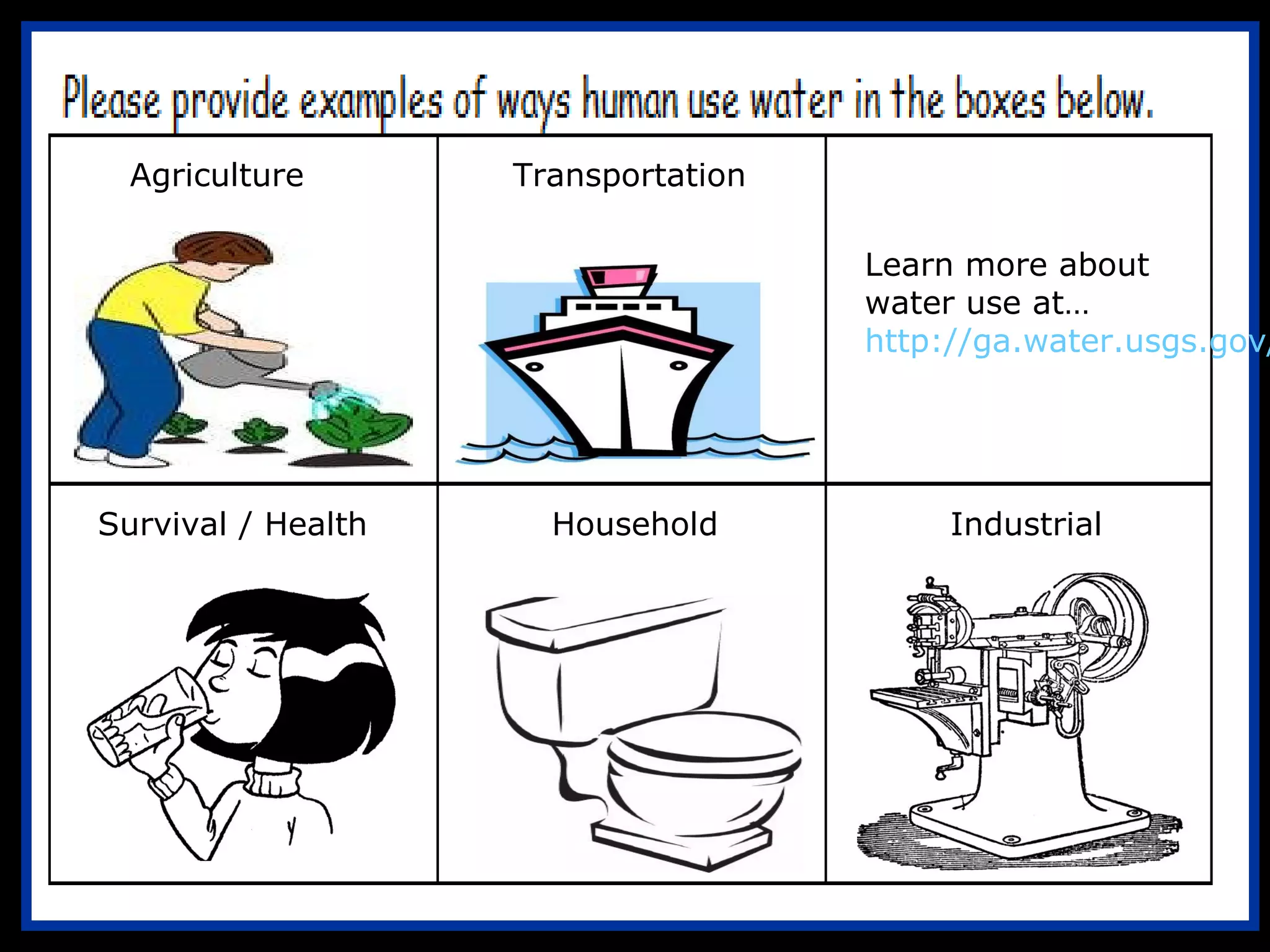
Agriculture
Agriculture
Agriculture Transportation
Agriculture Transportation Recreation
Survival / Health
Agriculture Transportation Recreation
Survival / Health
Agriculture Transportation Recreation
Survival / Health Household
Agriculture Transportation Recreation
Survival / Health Household
Agriculture Transportation Recreation
Survival / Health Household Industrial
Agriculture Transportation
Survival / Health Household Industrial
Learn more about
water use at…
http://ga.water.usgs.gov/
• What % of the earth is covered with water?
Copyright © 2010 Ryan P. Murphy
• What % of the earth is covered with
water?
Copyright © 2010 Ryan P. Murphy
• What % of the earth is covered with
water?
Copyright © 2010 Ryan P. Murphy
Ice Caps are
Water
• What % of the earth is covered with
water?
Copyright © 2010 Ryan P. Murphy
Ice Caps are
Water
Clouds
are Water
• What % of the earth is covered with
water?
Copyright © 2010 Ryan P. Murphy
Close to 71% of the earth is
covered with water
Ice Caps are
Water
Clouds
are Water
• What % of the earth is covered with
water?
Copyright © 2010 Ryan P. Murphy
Close to 71% of the earth is
covered with water
Ice Caps are
Water
Clouds
are Water
• What % of the earth is covered with
water?
Copyright © 2010 Ryan P. Murphy
Close to 71% of the earth is
covered with water
Ice Caps are
Water
Clouds
are Water
• What % of the earth is covered with
water?
Copyright © 2010 Ryan P. Murphy
Close to 71% of the earth is
covered with water
Ice Caps are
Water
Clouds
are Water
• What % of the earth is covered with
water?
Copyright © 2010 Ryan P. Murphy
Close to 71% of the earth is
covered with water
• What % of the earth is covered with
water?
Copyright © 2010 Ryan P. Murphy
Close to 71% of the earth is
covered with water
• What % of the earth is covered with
water?
Copyright © 2010 Ryan P. Murphy
Close to 71% of the earth is
covered with water
Demonstration
-Where’s the water?
- Teacher fills 5 gallon bucket which represents
all of the water on earth.
Copyright © 2010 Ryan P. Murphy
• The bucket represents
–Oceans
–Salt Lakes
–Rivers
–Ice Caps / Glaciers
–Atmosphere
–Groundwater
–Freshwater Lakes
–Potable Water (Useable water available for
humans after pollution and contamination)
Copyright © 2010 Ryan P. Murphy
• The bucket represents
–Oceans
–Salt Lakes
–Rivers
–Ice Caps / Glaciers
–Atmosphere
–Groundwater
–Freshwater Lakes
–Potable Water (Useable water available for
humans after pollution and contamination)
Copyright © 2010 Ryan P. Murphy
• Ice Caps / Glaciers 1.5 cups
• Groundwater .5 cups
• Freshwater Lakes .25 table spoons
• Salt Lakes .15 table spoons
• Atmosphere 3 drops
• Rivers .5 drops
• Useable water available for humans
after pollution and contamination =.001
drop
Oceans (all water left in bucket)
Copyright © 2010 Ryan P. Murphy
• Ice Caps / Glaciers 1.5 cups
• Groundwater .5 cups
• Freshwater Lakes .25 table spoons
• Salt Lakes .15 table spoons
• Atmosphere 3 drops
• Rivers .5 drops
• Useable water available for humans
after pollution and contamination =.001
drop
Oceans (all water left in bucket)
Copyright © 2010 Ryan P. Murphy
• Ice Caps / Glaciers 1.5 cups
• Groundwater .5 cups
• Freshwater Lakes .25 table spoons
• Salt Lakes .15 table spoons
• Atmosphere 3 drops
• Rivers .5 drops
• Useable water available for humans
after pollution and contamination =.001
drop
Oceans (all water left in bucket)
Copyright © 2010 Ryan P. Murphy
• Ice Caps / Glaciers 1.5 cups
• Groundwater .5 cups
• Freshwater Lakes .25 table spoons
• Salt Lakes .15 table spoons
• Atmosphere 3 drops
• Rivers .5 drops
• Useable water available for humans
after pollution and contamination =.001
drop
Oceans (all water left in bucket)
Copyright © 2010 Ryan P. Murphy
• Ice Caps / Glaciers 1.5 cups
• Groundwater .5 cups
• Freshwater Lakes .25 table spoons
• Salt Lakes .15 table spoons
• Atmosphere 3 drops
• Rivers .5 drops
• Useable water available for humans
after pollution and contamination =.001
drop
Oceans (all water left in bucket)
Copyright © 2010 Ryan P. Murphy
• Ice Caps / Glaciers 1.5 cups
• Groundwater .5 cups
• Freshwater Lakes .25 table spoons
• Salt Lakes .15 table spoons
• Atmosphere 3 drops
• Rivers .5 drops
• Useable water available for humans
after pollution and contamination =.001
drop
Oceans (all water left in bucket)
Copyright © 2010 Ryan P. Murphy
• Ice Caps / Glaciers 1.5 cups
• Groundwater .5 cups
• Freshwater Lakes .25 table spoons
• Salt Lakes .15 table spoons
• Atmosphere 3 drops
• Rivers .5 drops
• Useable water available for humans
after pollution and contamination =.001
drop
Oceans (all water left in bucket)
Copyright © 2010 Ryan P. Murphy
• Ice Caps / Glaciers 1.5 cups
• Groundwater .5 cups
• Freshwater Lakes .25 table spoons
• Salt Lakes .15 table spoons
• Atmosphere 3 drops
• Rivers .5 drops
• Useable water available for humans
after pollution and contamination =
Oceans (all water left in bucket)
Copyright © 2010 Ryan P. Murphy
• Ice Caps / Glaciers 1.5 cups
• Groundwater .5 cups
• Freshwater Lakes .25 table spoons
• Salt Lakes .15 table spoons
• Atmosphere 3 drops
• Rivers .5 drops
• Useable water available for humans
after pollution and contamination =.001 drop
Oceans (all water left in bucket)
Copyright © 2010 Ryan P. Murphy
• Ice Caps / Glaciers 1.5 cups
• Groundwater .5 cups
• Freshwater Lakes .25 table spoons
• Salt Lakes .15 table spoons
• Atmosphere 3 drops
• Rivers .5 drops
• Useable water available for humans
after pollution and contamination =.001 drop
Oceans (all water left in bucket)
Copyright © 2010 Ryan P. Murphy
• Ice Caps / Glaciers 1.5 cups
• Groundwater .5 cups
• Freshwater Lakes .25 table spoons
• Salt Lakes .15 table spoons
• Atmosphere 3 drops
• Rivers .5 drops
• Useable water available for humans
after pollution and contamination =.001 drop
Oceans (all water left in bucket)
Copyright © 2010 Ryan P. Murphy
Learn more about water on earth at….
http://ga.water.usgs.gov/edu/earthwherewater.html
• 97% of all water on Earth is found in the
ocean.
• Can humans drink saltwater, or put it on
crops?
Copyright © 2010 Ryan P. Murphy
• Answer! Humans cannot drink saltwater and
survive.
Copyright © 2010 Ryan P. Murphy
• Answer! Humans cannot drink saltwater and
survive.
– Saltwater dehydrates you faster than no water at
all. It also kills plants and contaminates the soil.
Copyright © 2010 Ryan P. Murphy
• Which of the plants in this study was given
the most saltwater?
Copyright © 2010 Ryan P. Murphy
• Which of the plants in this study was given
the most saltwater?
Copyright © 2010 Ryan P. Murphy
• Which of the plants in this study was given
the most saltwater?
Copyright © 2010 Ryan P. Murphy
Earth’s Water SupplyEarth’s Water Supply
--
--
--
--
--
--
Copyright © 2010 Ryan P. Murphy
Oceans 97.3% - Salt (Cannot drink orOceans 97.3% - Salt (Cannot drink or
use for Agriculture)use for Agriculture) 
Copyright © 2010 Ryan P. Murphy
• Oceans 97.3% - Salt (Cannot drink or
use for Agriculture) 
Copyright © 2010 Ryan P. Murphy
Agriculture: Production of food
and goods from farming.
• Oceans 97.3% - Salt (Cannot drink or
use for Agriculture) 
Copyright © 2010 Ryan P. Murphy
Agriculture: Production of food
and goods from farming.
• Oceans 97.3% - Salt (Cannot drink or
use for Agriculture) 
Copyright © 2010 Ryan P. Murphy
Agriculture: Production of food
and goods from farming.
Ice Caps 2.19% (Locked)Ice Caps 2.19% (Locked) 
Copyright © 2010 Ryan P. Murphy
• Lets pretend that everyone in this room now
owns 5 million dollars?
– How much of this money are you willing to invest in
the Iceberg project?
– http://www.youtube.com/watch?v=opChLhLMFmU
• Why can’t we just go north and grab some
icebergs and bring them south?
• Why can’t we just go north and grab some
icebergs and bring them south?
• Why can’t we just go north and grab some
icebergs and bring them south?
• Why can’t we just go north and grab some
icebergs and bring them south?
• Why can’t we just go north and grab some
icebergs and bring them south?
• Why can’t we just go north and grab some
icebergs and bring them south?
• Why can’t we just go north and grab some
icebergs and bring them south?
• Why can’t we just go north and grab some
icebergs and bring them south?
• Why can’t we just go north and grab some
icebergs and bring them south?
• Why can’t we just go north and grab some
icebergs and bring them south?
• Why can’t we just go north and grab some
icebergs and bring them south?
Groundwater 0.5% (Most is too Deep)Groundwater 0.5% (Most is too Deep) 
Copyright © 2010 Ryan P. Murphy
• Video Link (Optional) Groundwater, The
Hidden Source of Life
– http://www.youtube.com/watch?v=Iht9WBBXepA
Atmosphere 0.001% (Can’t Obtain)Atmosphere 0.001% (Can’t Obtain) 
Copyright © 2010 Ryan P. Murphy
Soil Moisture 0.005% (Can’t Obtain)Soil Moisture 0.005% (Can’t Obtain) 
Copyright © 2010 Ryan P. Murphy
Inland Lakes 0.018% (Available) :Inland Lakes 0.018% (Available) : 
Copyright © 2010 Ryan P. Murphy
Rivers 0.000096% (Available)Rivers 0.000096% (Available) 
Copyright © 2010 Ryan P. Murphy
• Please create a pie graph of the data just
recorded in your journal.
– Use a petri-dish to help create your circle.
– Use color, provide a key.
Copyright © 2010 Ryan P. Murphy
• Please create a pie graph of the data just
recorded in your journal.
– Use a petri-dish to help create your circle.
– Use color, provide a key.
Copyright © 2010 Ryan P. Murphy
Ocean
Ice Caps
Underground
Soil Moisture
Atmosphere
Rivers
Copyright © 2010 Ryan P. Murphy
• You can now complete this question.
• Has anyone in the class left the country?
– Where have you been?
Copyright © 2010 Ryan P. Murphy
• Has anyone in the class left the country?
– Where have you been?
Copyright © 2010 Ryan P. Murphy
Warning – A part of the world that you have never
been to will be shown. This is a part of the world that
you don’t see everyday on T.V. Please close your
eyes if you get emotional.
Copyright © 2010 Ryan P. Murphy
• Raise your hand if you have played on
something like this?
Copyright © 2010 Ryan P. Murphy
• Raise your hand if you have owned something
like this at some point.
• Raise your hand if you have ever used a
flush toilet?
• Raise your hand if you have ever used a
dishwasher?
• Or washer machine?
• Raise your hand if you own a gaming
system of some type?
• Raise your hand if you have ever eaten
something like this?
• Raise your hand if you have ever eaten
something like this?
• Raise your hand if you have shopped in a
mall?
• Raise your hand if you have ever taken a
hot shower or bath?
• Raise your hand if you have ever been on
a slip n’ slide.
• Raise your hand if you have ever been
tubing.
• Raise your hand if you ever been to a
water park?
• Raise your hand if you have ever been in a
water fight?
• How about a…
• How about a… food fight?
• Raise your hand if you have ever had a
brother or sister die of starvation?
• Raise your hand if you have ever had to fight
through a starving crowd for a meal ration.
• Raise your hand if you have ever been
ruled by a warlord.
• Or if you have ever been in a civil war?
• Have you ever carried a starving child.
• From 1990 -2000 more than 100 million
children died from illness and starvation.
• Every 3.6 seconds someone dies of hunger.
175 Men, women, and children will die during
this lesson.
• For the price of one missile, a school full of
hungry children could eat lunch every day for
5 years.
• Water is incredibly important?
• Without it, you cannot grow food.
• Drought also kills livestock.
• These are the areas of the world that
struggle everyday from drought and famine.
• These are the areas of the world that
struggle everyday from drought and famine.
• Whatever your issues are, you’ll probably be
alive tomorrow.
Copyright © 2010 Ryan P. Murphy
• Whatever your issues are, you’ll probably be
alive tomorrow.
– 2000 other kids won’t.
Copyright © 2010 Ryan P. Murphy
• Whatever your issues are, you’ll probably be
alive tomorrow.
– 2000 other kids won’t. You are one of the
luckiest kids on Earth because you are sitting in a
classroom right now with a water fountain that’s
just down the hall.
Copyright © 2010 Ryan P. Murphy
• Video Link! (Optional) UNICEF, Drought
and Famine (2007)
– http://www.youtube.com/watch?v=CAEa66reTyg&f
Learn more about the earths water crisis at…
http://water.org/water-crisis/water-facts/water/
• Parts of Somalia are controlled by
warlords with militias.
Copyright © 2010 Ryan P. Murphy
• Many places in the world are burdened by
civil war and fighting.
• Activity! Reading the article about the war
over the well in Somalia.
– Please answer 3 of the 7 questions in detail
after reading the article.
• A kitchen in rural Africa.
All of the
household
water
• A kitchen in rural Africa.
Gathered from a dirty watering
hole ½ hours walk
• A kitchen in rural Africa.
Bowl is also used to collect goats
urine for washing kitchen tools
• Indoor plumbing is very rare.
– Most people in this world must carry water to
their dwelling.
• Activity! (Optional) Class must carry several
5 gallon buckets filled with water outside
simulating a walk from the well to home.
– Do not carry on your head / bearing the weight
on your neck.
– Those young girls and boys have been doing it
since they could walk and have built-up
strength. (Your neck will break!)
• Question: How would your water use
change if you had to collect and carry every
drop?
• Video Link! Drought and Famine in Africa.
– Observe how people in the video rely on water.
– http://www.youtube.com/watch?v=gOpURGlAsgY
• You can now complete this question.
• Activity! Guess the picture beneath the
boxes. Please raise your hand when you
think you know it.
– You only get one guess.
Copyright © 2010 Ryan P. Murphy
• Activity! Guess the picture beneath the
boxes. Please raise your hand when you
think you know it.
– You only get one guess.
Copyright © 2010 Ryan P. Murphy
• “AYE” Advance Your Exploration ELA and
Literacy Opportunity Worksheet
– Visit some of the many provided links or..
– Articles can be found at (w/ membership to
NABT and NSTA)
• http
://www.nabt.org/websites/institution/index.php?p=1
• http://learningcenter.nsta.org/browse_journals.aspx?journ
Please visit at least one of the
“learn more” educational links
provided in this unit and
complete this worksheet
• “AYE” Advance Your Exploration ELA and
Literacy Opportunity Worksheet
– Visit some of the many provided links or..
– Articles can be found at (w/ membership to and
NSTA)
• http://www.sciencedaily.com/
• http://www.sciencemag.org/
• http://learningcenter.nsta.org/browse_journals.aspx?
journal=tst
• http://sciencepowerpoint.com/
Areas of Focus within the Water Molecule Unit:
Locations of Water on the Planet, Importance of Water, Groundwater,
Groundwater Pollution, The Water Molecule, Properties of Water,
Polarity, Cohesion, Adhesion, Capillary Action, High Specific Heat,
Water has a Neutral pH, Lower Density of Ice. Water is the Universal
Solvent, Mixtures
Full unit can be found at…
http://sciencepowerpoint.com/Water_Molecule_Unit.html
http://www.teacherspayteachers.com/Product/Physical-Science-Curriculum-59http://www.teacherspayteachers.com/Product/Life-http://www.teacherspayte
• Please visit the links below to learn more
about each of the units in this curriculum
– These units take me about four years to complete
with my students in grades 5-10.
Earth Science Units Extended Tour Link and Curriculum Guide
Geology Topics Unit http://sciencepowerpoint.com/Geology_Unit.html
Astronomy Topics Unit http://sciencepowerpoint.com/Astronomy_Unit.html
Weather and Climate Unit http://sciencepowerpoint.com/Weather_Climate_Unit.html
Soil Science, Weathering, More http://sciencepowerpoint.com/Soil_and_Glaciers_Unit.html
Water Unit http://sciencepowerpoint.com/Water_Molecule_Unit.html
Rivers Unit http://sciencepowerpoint.com/River_and_Water_Quality_Unit.html
= Easier = More Difficult = Most Difficult
5th
– 7th
grade 6th
– 8th
grade 8th
– 10th
grade
Physical Science Units Extended Tour Link and Curriculum Guide
Science Skills Unit http://sciencepowerpoint.com/Science_Introduction_Lab_Safety_Metric_Methods.
html
Motion and Machines Unit http://sciencepowerpoint.com/Newtons_Laws_Motion_Machines_Unit.html
Matter, Energy, Envs. Unit http://sciencepowerpoint.com/Energy_Topics_Unit.html
Atoms and Periodic Table Unit http://sciencepowerpoint.com/Atoms_Periodic_Table_of_Elements_Unit.html
Life Science Units Extended Tour Link and Curriculum Guide
Human Body / Health Topics
http://sciencepowerpoint.com/Human_Body_Systems_and_Health_Topics_Unit.html
DNA and Genetics Unit http://sciencepowerpoint.com/DNA_Genetics_Unit.html
Cell Biology Unit http://sciencepowerpoint.com/Cellular_Biology_Unit.html
Infectious Diseases Unit http://sciencepowerpoint.com/Infectious_Diseases_Unit.html
Taxonomy and Classification Unit http://sciencepowerpoint.com/Taxonomy_Classification_Unit.html
Evolution / Natural Selection Unit http://sciencepowerpoint.com/Evolution_Natural_Selection_Unit.html
Botany Topics Unit http://sciencepowerpoint.com/Plant_Botany_Unit.html
Ecology Feeding Levels Unit http://sciencepowerpoint.com/Ecology_Feeding_Levels_Unit.htm
Ecology Interactions Unit http://sciencepowerpoint.com/Ecology_Interactions_Unit.html
Ecology Abiotic Factors Unit http://sciencepowerpoint.com/Ecology_Abiotic_Factors_Unit.html
• The entire four year curriculum can be found
at... http://sciencepowerpoint.com/ Please feel
free to contact me with any questions you may
have. Thank you for your interest in this
curriculum.
Sincerely,
Ryan Murphy M.Ed
• http://sciencepowerpoint.com/

Water on Earth, H2O Lesson PowerPoint

  • 1.
    • Ice Caps/ Glaciers 1.5 cups • Groundwater .5 cups • Freshwater Lakes .25 table spoons • Salt Lakes .15 table spoons • Atmosphere 3 drops • Rivers .5 drops • Useable water available for humans after pollution and contamination =.001 drop Oceans (all water left in bucket) Copyright © 2010 Ryan P. Murphy
  • 3.
    • RED SLIDE:These are notes that are very important and should be recorded in your science journal. Copyright © 2010 Ryan P. Murphy
  • 4.
    -Nice neat notesthat are legible and use indentations when appropriate. -Example of indent. -Skip a line between topics -Don’t skip pages -Make visuals clear and well drawn.
  • 5.
    • RED SLIDE:These are notes that are very important and should be recorded in your science journal. • BLACK SLIDE: Pay attention, follow directions, complete projects as described and answer required questions neatly. Copyright © 2010 Ryan P. Murphy
  • 6.
  • 8.
    Copyright © 2010Ryan P. Murphy
  • 9.
    Area of Focus:Where’s our water?Area of Focus: Where’s our water? Copyright © 2010 Ryan P. Murphy
  • 15.
    • Earth isknown as the blue planet as it has a blue glow from space.
  • 16.
    • Earth isknown as the blue planet as it has a blue glow from space. – This blue is from all of the water on our planet.
  • 17.
    • Water onEarth Available Sheet
  • 18.
    • Water onEarth Available Sheet
  • 19.
    • Why shouldwe study water? –Bullet List. –3-5 Sentence minimum paragraph Copyright © 2010 Ryan P. Murphy
  • 20.
    • Activity! WaterUsage. – Create a list of all the ways humans use water. Copyright © 2010 Ryan P. Murphy
  • 22.
    • Please narrowdown the class list to 6 Categories (Work in Table Groups) Copyright © 2010 Ryan P. Murphy
  • 23.
    The six wayshumans use waterThe six ways humans use water -- -- -- -- -- -- Copyright © 2010 Ryan P. Murphy
  • 24.
    The six wayshumans use waterThe six ways humans use water -- -- -- -- -- -- Copyright © 2010 Ryan P. Murphy
  • 25.
    Copyright © 2010Ryan P. Murphy
  • 26.
    Survival / HealthSurvival/ Health Copyright © 2010 Ryan P. Murphy
  • 27.
    Copyright © 2010Ryan P. Murphy
  • 28.
  • 29.
    Copyright © 2010Ryan P. Murphy
  • 30.
  • 31.
    Copyright © 2010Ryan P. Murphy
  • 32.
  • 33.
    Copyright © 2010Ryan P. Murphy
  • 34.
  • 35.
    Copyright © 2010Ryan P. Murphy
  • 36.
  • 37.
    • You cannow complete this question.
  • 38.
    • You cannow complete this question.
  • 42.
  • 43.
  • 44.
  • 45.
  • 46.
  • 47.
  • 48.
  • 49.
  • 50.
  • 51.
  • 52.
  • 53.
    Agriculture Transportation Survival /Health Household Industrial Learn more about water use at… http://ga.water.usgs.gov/
  • 54.
    • What %of the earth is covered with water? Copyright © 2010 Ryan P. Murphy
  • 55.
    Copyright © 2010Ryan P. Murphy
  • 56.
    • What %of the earth is covered with water? Copyright © 2010 Ryan P. Murphy
  • 57.
    • What %of the earth is covered with water? Copyright © 2010 Ryan P. Murphy Ice Caps are Water
  • 58.
    • What %of the earth is covered with water? Copyright © 2010 Ryan P. Murphy Ice Caps are Water Clouds are Water
  • 59.
    • What %of the earth is covered with water? Copyright © 2010 Ryan P. Murphy Close to 71% of the earth is covered with water Ice Caps are Water Clouds are Water
  • 60.
    • What %of the earth is covered with water? Copyright © 2010 Ryan P. Murphy Close to 71% of the earth is covered with water Ice Caps are Water Clouds are Water
  • 61.
    • What %of the earth is covered with water? Copyright © 2010 Ryan P. Murphy Close to 71% of the earth is covered with water Ice Caps are Water Clouds are Water
  • 62.
    • What %of the earth is covered with water? Copyright © 2010 Ryan P. Murphy Close to 71% of the earth is covered with water Ice Caps are Water Clouds are Water
  • 63.
    • What %of the earth is covered with water? Copyright © 2010 Ryan P. Murphy Close to 71% of the earth is covered with water
  • 64.
    • What %of the earth is covered with water? Copyright © 2010 Ryan P. Murphy Close to 71% of the earth is covered with water
  • 65.
    • What %of the earth is covered with water? Copyright © 2010 Ryan P. Murphy Close to 71% of the earth is covered with water
  • 66.
    Demonstration -Where’s the water? -Teacher fills 5 gallon bucket which represents all of the water on earth. Copyright © 2010 Ryan P. Murphy
  • 67.
    • The bucketrepresents –Oceans –Salt Lakes –Rivers –Ice Caps / Glaciers –Atmosphere –Groundwater –Freshwater Lakes –Potable Water (Useable water available for humans after pollution and contamination) Copyright © 2010 Ryan P. Murphy
  • 68.
    • The bucketrepresents –Oceans –Salt Lakes –Rivers –Ice Caps / Glaciers –Atmosphere –Groundwater –Freshwater Lakes –Potable Water (Useable water available for humans after pollution and contamination) Copyright © 2010 Ryan P. Murphy
  • 69.
    • Ice Caps/ Glaciers 1.5 cups • Groundwater .5 cups • Freshwater Lakes .25 table spoons • Salt Lakes .15 table spoons • Atmosphere 3 drops • Rivers .5 drops • Useable water available for humans after pollution and contamination =.001 drop Oceans (all water left in bucket) Copyright © 2010 Ryan P. Murphy
  • 70.
    • Ice Caps/ Glaciers 1.5 cups • Groundwater .5 cups • Freshwater Lakes .25 table spoons • Salt Lakes .15 table spoons • Atmosphere 3 drops • Rivers .5 drops • Useable water available for humans after pollution and contamination =.001 drop Oceans (all water left in bucket) Copyright © 2010 Ryan P. Murphy
  • 71.
    • Ice Caps/ Glaciers 1.5 cups • Groundwater .5 cups • Freshwater Lakes .25 table spoons • Salt Lakes .15 table spoons • Atmosphere 3 drops • Rivers .5 drops • Useable water available for humans after pollution and contamination =.001 drop Oceans (all water left in bucket) Copyright © 2010 Ryan P. Murphy
  • 72.
    • Ice Caps/ Glaciers 1.5 cups • Groundwater .5 cups • Freshwater Lakes .25 table spoons • Salt Lakes .15 table spoons • Atmosphere 3 drops • Rivers .5 drops • Useable water available for humans after pollution and contamination =.001 drop Oceans (all water left in bucket) Copyright © 2010 Ryan P. Murphy
  • 73.
    • Ice Caps/ Glaciers 1.5 cups • Groundwater .5 cups • Freshwater Lakes .25 table spoons • Salt Lakes .15 table spoons • Atmosphere 3 drops • Rivers .5 drops • Useable water available for humans after pollution and contamination =.001 drop Oceans (all water left in bucket) Copyright © 2010 Ryan P. Murphy
  • 74.
    • Ice Caps/ Glaciers 1.5 cups • Groundwater .5 cups • Freshwater Lakes .25 table spoons • Salt Lakes .15 table spoons • Atmosphere 3 drops • Rivers .5 drops • Useable water available for humans after pollution and contamination =.001 drop Oceans (all water left in bucket) Copyright © 2010 Ryan P. Murphy
  • 75.
    • Ice Caps/ Glaciers 1.5 cups • Groundwater .5 cups • Freshwater Lakes .25 table spoons • Salt Lakes .15 table spoons • Atmosphere 3 drops • Rivers .5 drops • Useable water available for humans after pollution and contamination =.001 drop Oceans (all water left in bucket) Copyright © 2010 Ryan P. Murphy
  • 76.
    • Ice Caps/ Glaciers 1.5 cups • Groundwater .5 cups • Freshwater Lakes .25 table spoons • Salt Lakes .15 table spoons • Atmosphere 3 drops • Rivers .5 drops • Useable water available for humans after pollution and contamination = Oceans (all water left in bucket) Copyright © 2010 Ryan P. Murphy
  • 77.
    • Ice Caps/ Glaciers 1.5 cups • Groundwater .5 cups • Freshwater Lakes .25 table spoons • Salt Lakes .15 table spoons • Atmosphere 3 drops • Rivers .5 drops • Useable water available for humans after pollution and contamination =.001 drop Oceans (all water left in bucket) Copyright © 2010 Ryan P. Murphy
  • 78.
    • Ice Caps/ Glaciers 1.5 cups • Groundwater .5 cups • Freshwater Lakes .25 table spoons • Salt Lakes .15 table spoons • Atmosphere 3 drops • Rivers .5 drops • Useable water available for humans after pollution and contamination =.001 drop Oceans (all water left in bucket) Copyright © 2010 Ryan P. Murphy
  • 79.
    • Ice Caps/ Glaciers 1.5 cups • Groundwater .5 cups • Freshwater Lakes .25 table spoons • Salt Lakes .15 table spoons • Atmosphere 3 drops • Rivers .5 drops • Useable water available for humans after pollution and contamination =.001 drop Oceans (all water left in bucket) Copyright © 2010 Ryan P. Murphy Learn more about water on earth at…. http://ga.water.usgs.gov/edu/earthwherewater.html
  • 80.
    • 97% ofall water on Earth is found in the ocean.
  • 81.
    • Can humansdrink saltwater, or put it on crops? Copyright © 2010 Ryan P. Murphy
  • 82.
    • Answer! Humanscannot drink saltwater and survive. Copyright © 2010 Ryan P. Murphy
  • 83.
    • Answer! Humanscannot drink saltwater and survive. – Saltwater dehydrates you faster than no water at all. It also kills plants and contaminates the soil. Copyright © 2010 Ryan P. Murphy
  • 84.
    • Which ofthe plants in this study was given the most saltwater? Copyright © 2010 Ryan P. Murphy
  • 85.
    • Which ofthe plants in this study was given the most saltwater? Copyright © 2010 Ryan P. Murphy
  • 86.
    • Which ofthe plants in this study was given the most saltwater? Copyright © 2010 Ryan P. Murphy
  • 87.
    Earth’s Water SupplyEarth’sWater Supply -- -- -- -- -- -- Copyright © 2010 Ryan P. Murphy
  • 88.
    Oceans 97.3% - Salt(Cannot drink orOceans 97.3% - Salt (Cannot drink or use for Agriculture)use for Agriculture)  Copyright © 2010 Ryan P. Murphy
  • 89.
    • Oceans 97.3%- Salt (Cannot drink or use for Agriculture)  Copyright © 2010 Ryan P. Murphy Agriculture: Production of food and goods from farming.
  • 90.
    • Oceans 97.3%- Salt (Cannot drink or use for Agriculture)  Copyright © 2010 Ryan P. Murphy Agriculture: Production of food and goods from farming.
  • 91.
    • Oceans 97.3%- Salt (Cannot drink or use for Agriculture)  Copyright © 2010 Ryan P. Murphy Agriculture: Production of food and goods from farming.
  • 92.
    Ice Caps 2.19%(Locked)Ice Caps 2.19% (Locked)  Copyright © 2010 Ryan P. Murphy
  • 93.
    • Lets pretendthat everyone in this room now owns 5 million dollars? – How much of this money are you willing to invest in the Iceberg project? – http://www.youtube.com/watch?v=opChLhLMFmU
  • 94.
    • Why can’twe just go north and grab some icebergs and bring them south?
  • 95.
    • Why can’twe just go north and grab some icebergs and bring them south?
  • 96.
    • Why can’twe just go north and grab some icebergs and bring them south?
  • 97.
    • Why can’twe just go north and grab some icebergs and bring them south?
  • 98.
    • Why can’twe just go north and grab some icebergs and bring them south?
  • 99.
    • Why can’twe just go north and grab some icebergs and bring them south?
  • 100.
    • Why can’twe just go north and grab some icebergs and bring them south?
  • 101.
    • Why can’twe just go north and grab some icebergs and bring them south?
  • 102.
    • Why can’twe just go north and grab some icebergs and bring them south?
  • 103.
    • Why can’twe just go north and grab some icebergs and bring them south?
  • 104.
    • Why can’twe just go north and grab some icebergs and bring them south?
  • 105.
    Groundwater 0.5% (Mostis too Deep)Groundwater 0.5% (Most is too Deep)  Copyright © 2010 Ryan P. Murphy
  • 106.
    • Video Link(Optional) Groundwater, The Hidden Source of Life – http://www.youtube.com/watch?v=Iht9WBBXepA
  • 107.
    Atmosphere 0.001% (Can’t Obtain)Atmosphere 0.001%(Can’t Obtain)  Copyright © 2010 Ryan P. Murphy
  • 108.
    Soil Moisture 0.005% (Can’tObtain)Soil Moisture 0.005% (Can’t Obtain)  Copyright © 2010 Ryan P. Murphy
  • 109.
    Inland Lakes 0.018% (Available):Inland Lakes 0.018% (Available) :  Copyright © 2010 Ryan P. Murphy
  • 110.
    Rivers 0.000096% (Available)Rivers0.000096% (Available)  Copyright © 2010 Ryan P. Murphy
  • 111.
    • Please createa pie graph of the data just recorded in your journal. – Use a petri-dish to help create your circle. – Use color, provide a key. Copyright © 2010 Ryan P. Murphy
  • 112.
    • Please createa pie graph of the data just recorded in your journal. – Use a petri-dish to help create your circle. – Use color, provide a key. Copyright © 2010 Ryan P. Murphy
  • 113.
  • 114.
    • You cannow complete this question.
  • 115.
    • You cannow complete this question.
  • 117.
    • Has anyonein the class left the country? – Where have you been? Copyright © 2010 Ryan P. Murphy
  • 118.
    • Has anyonein the class left the country? – Where have you been? Copyright © 2010 Ryan P. Murphy
  • 119.
    Warning – Apart of the world that you have never been to will be shown. This is a part of the world that you don’t see everyday on T.V. Please close your eyes if you get emotional. Copyright © 2010 Ryan P. Murphy
  • 120.
    • Raise yourhand if you have played on something like this? Copyright © 2010 Ryan P. Murphy
  • 121.
    • Raise yourhand if you have owned something like this at some point.
  • 122.
    • Raise yourhand if you have ever used a flush toilet?
  • 123.
    • Raise yourhand if you have ever used a dishwasher?
  • 124.
    • Or washermachine?
  • 125.
    • Raise yourhand if you own a gaming system of some type?
  • 126.
    • Raise yourhand if you have ever eaten something like this?
  • 127.
    • Raise yourhand if you have ever eaten something like this?
  • 128.
    • Raise yourhand if you have shopped in a mall?
  • 129.
    • Raise yourhand if you have ever taken a hot shower or bath?
  • 130.
    • Raise yourhand if you have ever been on a slip n’ slide.
  • 131.
    • Raise yourhand if you have ever been tubing.
  • 132.
    • Raise yourhand if you ever been to a water park?
  • 133.
    • Raise yourhand if you have ever been in a water fight?
  • 134.
  • 135.
    • How abouta… food fight?
  • 139.
    • Raise yourhand if you have ever had a brother or sister die of starvation?
  • 140.
    • Raise yourhand if you have ever had to fight through a starving crowd for a meal ration.
  • 142.
    • Raise yourhand if you have ever been ruled by a warlord.
  • 143.
    • Or ifyou have ever been in a civil war?
  • 145.
    • Have youever carried a starving child.
  • 149.
    • From 1990-2000 more than 100 million children died from illness and starvation.
  • 151.
    • Every 3.6seconds someone dies of hunger. 175 Men, women, and children will die during this lesson.
  • 152.
    • For theprice of one missile, a school full of hungry children could eat lunch every day for 5 years.
  • 153.
    • Water isincredibly important?
  • 154.
    • Without it,you cannot grow food.
  • 155.
    • Drought alsokills livestock.
  • 156.
    • These arethe areas of the world that struggle everyday from drought and famine.
  • 157.
    • These arethe areas of the world that struggle everyday from drought and famine.
  • 158.
    • Whatever yourissues are, you’ll probably be alive tomorrow. Copyright © 2010 Ryan P. Murphy
  • 159.
    • Whatever yourissues are, you’ll probably be alive tomorrow. – 2000 other kids won’t. Copyright © 2010 Ryan P. Murphy
  • 160.
    • Whatever yourissues are, you’ll probably be alive tomorrow. – 2000 other kids won’t. You are one of the luckiest kids on Earth because you are sitting in a classroom right now with a water fountain that’s just down the hall. Copyright © 2010 Ryan P. Murphy
  • 161.
    • Video Link!(Optional) UNICEF, Drought and Famine (2007) – http://www.youtube.com/watch?v=CAEa66reTyg&f
  • 165.
    Learn more aboutthe earths water crisis at… http://water.org/water-crisis/water-facts/water/
  • 171.
    • Parts ofSomalia are controlled by warlords with militias. Copyright © 2010 Ryan P. Murphy
  • 172.
    • Many placesin the world are burdened by civil war and fighting.
  • 174.
    • Activity! Readingthe article about the war over the well in Somalia. – Please answer 3 of the 7 questions in detail after reading the article.
  • 175.
    • A kitchenin rural Africa.
  • 176.
    • A kitchenin rural Africa. All of the household water
  • 177.
    • A kitchenin rural Africa. Gathered from a dirty watering hole ½ hours walk
  • 178.
    • A kitchenin rural Africa. Bowl is also used to collect goats urine for washing kitchen tools
  • 179.
    • Indoor plumbingis very rare. – Most people in this world must carry water to their dwelling.
  • 181.
    • Activity! (Optional)Class must carry several 5 gallon buckets filled with water outside simulating a walk from the well to home. – Do not carry on your head / bearing the weight on your neck. – Those young girls and boys have been doing it since they could walk and have built-up strength. (Your neck will break!)
  • 182.
    • Question: Howwould your water use change if you had to collect and carry every drop?
  • 185.
    • Video Link!Drought and Famine in Africa. – Observe how people in the video rely on water. – http://www.youtube.com/watch?v=gOpURGlAsgY
  • 186.
    • You cannow complete this question.
  • 187.
    • You cannow complete this question.
  • 189.
    • Activity! Guessthe picture beneath the boxes. Please raise your hand when you think you know it. – You only get one guess. Copyright © 2010 Ryan P. Murphy
  • 199.
    • Activity! Guessthe picture beneath the boxes. Please raise your hand when you think you know it. – You only get one guess. Copyright © 2010 Ryan P. Murphy
  • 210.
    • “AYE” AdvanceYour Exploration ELA and Literacy Opportunity Worksheet – Visit some of the many provided links or.. – Articles can be found at (w/ membership to NABT and NSTA) • http ://www.nabt.org/websites/institution/index.php?p=1 • http://learningcenter.nsta.org/browse_journals.aspx?journ Please visit at least one of the “learn more” educational links provided in this unit and complete this worksheet
  • 211.
    • “AYE” AdvanceYour Exploration ELA and Literacy Opportunity Worksheet – Visit some of the many provided links or.. – Articles can be found at (w/ membership to and NSTA) • http://www.sciencedaily.com/ • http://www.sciencemag.org/ • http://learningcenter.nsta.org/browse_journals.aspx? journal=tst
  • 212.
  • 214.
    Areas of Focuswithin the Water Molecule Unit: Locations of Water on the Planet, Importance of Water, Groundwater, Groundwater Pollution, The Water Molecule, Properties of Water, Polarity, Cohesion, Adhesion, Capillary Action, High Specific Heat, Water has a Neutral pH, Lower Density of Ice. Water is the Universal Solvent, Mixtures Full unit can be found at… http://sciencepowerpoint.com/Water_Molecule_Unit.html
  • 219.
  • 220.
    • Please visitthe links below to learn more about each of the units in this curriculum – These units take me about four years to complete with my students in grades 5-10. Earth Science Units Extended Tour Link and Curriculum Guide Geology Topics Unit http://sciencepowerpoint.com/Geology_Unit.html Astronomy Topics Unit http://sciencepowerpoint.com/Astronomy_Unit.html Weather and Climate Unit http://sciencepowerpoint.com/Weather_Climate_Unit.html Soil Science, Weathering, More http://sciencepowerpoint.com/Soil_and_Glaciers_Unit.html Water Unit http://sciencepowerpoint.com/Water_Molecule_Unit.html Rivers Unit http://sciencepowerpoint.com/River_and_Water_Quality_Unit.html = Easier = More Difficult = Most Difficult 5th – 7th grade 6th – 8th grade 8th – 10th grade
  • 221.
    Physical Science UnitsExtended Tour Link and Curriculum Guide Science Skills Unit http://sciencepowerpoint.com/Science_Introduction_Lab_Safety_Metric_Methods. html Motion and Machines Unit http://sciencepowerpoint.com/Newtons_Laws_Motion_Machines_Unit.html Matter, Energy, Envs. Unit http://sciencepowerpoint.com/Energy_Topics_Unit.html Atoms and Periodic Table Unit http://sciencepowerpoint.com/Atoms_Periodic_Table_of_Elements_Unit.html Life Science Units Extended Tour Link and Curriculum Guide Human Body / Health Topics http://sciencepowerpoint.com/Human_Body_Systems_and_Health_Topics_Unit.html DNA and Genetics Unit http://sciencepowerpoint.com/DNA_Genetics_Unit.html Cell Biology Unit http://sciencepowerpoint.com/Cellular_Biology_Unit.html Infectious Diseases Unit http://sciencepowerpoint.com/Infectious_Diseases_Unit.html Taxonomy and Classification Unit http://sciencepowerpoint.com/Taxonomy_Classification_Unit.html Evolution / Natural Selection Unit http://sciencepowerpoint.com/Evolution_Natural_Selection_Unit.html Botany Topics Unit http://sciencepowerpoint.com/Plant_Botany_Unit.html Ecology Feeding Levels Unit http://sciencepowerpoint.com/Ecology_Feeding_Levels_Unit.htm Ecology Interactions Unit http://sciencepowerpoint.com/Ecology_Interactions_Unit.html Ecology Abiotic Factors Unit http://sciencepowerpoint.com/Ecology_Abiotic_Factors_Unit.html
  • 222.
    • The entirefour year curriculum can be found at... http://sciencepowerpoint.com/ Please feel free to contact me with any questions you may have. Thank you for your interest in this curriculum. Sincerely, Ryan Murphy M.Ed
  • 223.