THE MODIFIED
     CORNELL
NOTE TAKING SYSTEM
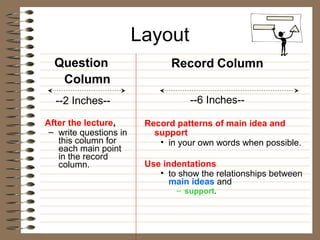
Layout
  Question                     Record Column
   Column
  --2 Inches--                     --6 Inches--

After the lecture,       Record patterns of main idea and
 – write questions in      support
   this column for          • in your own words when possible.
   each main point
   in the record
   column.               Use indentations
                            • to show the relationships between
                               main ideas and
                                – support.
Record Column
Write main ideas and supporting material in
the right column
 – Use signals from the lecture
     • Titles & keywords= topics  main ideas
     • “Transition” words/phrases introduce details
         – First, most, some, this is called, there are two types


 – Use abbreviations to get the full idea.
 – Leave spaces between ideas so you can
     • fill in more later.
     • see how ideas relate to one another
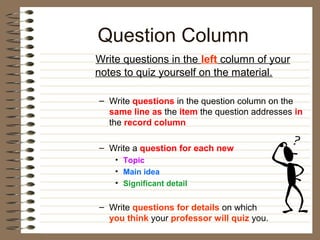
Question Column
Write questions in the left column of your
notes to quiz yourself on the material.

– Write questions in the question column on the
  same line as the item the question addresses in
  the record column

– Write a question for each new
    • Topic
    • Main idea
    • Significant detail


– Write questions for details on which
  you think your professor will quiz you.
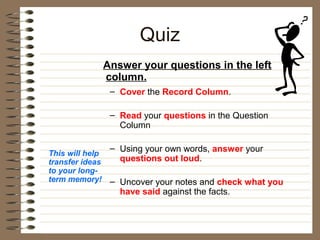
Quiz
                 Answer your questions in the left
                 column.
                  – Cover the Record Column.

                  – Read your questions in the Question
                    Column

                  – Using your own words, answer your
This will help
transfer ideas      questions out loud.
to your long-
term memory!      – Uncover your notes and check what you
                    have said against the facts.
Review
Review to improve your memory.
 – If you spend 10 minutes every week or so in
   a quick review of your notes,

    • you will retain most of what you have studied

    • you won’t have to cram during an “all-nighter”

    • you will relate the facts and ideas to
      present lectures or readings.
Example
Here is the text.

In the “Legend of Sleepy Hollow,” there are four main characters –
including one that may mat really exist. The first and most important
character is Ichabod Crane. He is an ambitious schoolteacher, who
hopes to marry the second character, Katrina Van Tassel. Katrina is
the handsome daughter of a wealthy farmer. The third character is
Brom Bones. He is Ichabod’s rival for Katrinia, and he is also well
known for his practical jokes. The fourth and final character is the
frightening, ghostly figure of the Headless Horseman, who terrifies
Ichabod into running away. But Irving strongly hints that this might
simply be another of the characters in disguise.
Here are the notes:

                       The Legend of Sleepy Hollow – 4 Main Characters

1st character?              1.   Ichabod Crane
      Job?                            •    Most important
      Interest?
                                      •    School teacher
                                      •    Wants to marry Katrina


2nd character?              2.   Katrina Van Tassel
      Description?                    •    Beautiful daughter of wealthy farmer


3rd character?              3.   Brom Bones
      Interested in?                  •    Also wants to marry Katrina
      Likes what?
                                      •    Well known for practical jokes

4th character               4.   Headless Horseman
      Real or not?
      Scares who?                     •    Scary ghost
      Might be who?                   •    Scares Ichabod away
                                      •    Might be another character [Brom?] in disguise
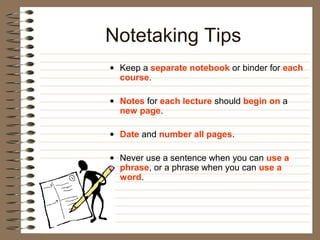
Notetaking Tips
• Keep a separate notebook or binder for each
  course.

• Notes for each lecture should begin on a
  new page.

• Date and number all pages.

• Never use a sentence when you can use a
  phrase, or a phrase when you can use a
  word.
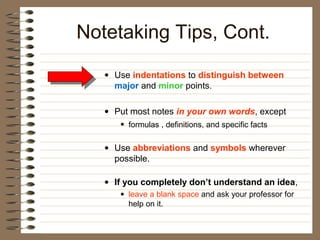
Notetaking Tips, Cont.
   • Use indentations to distinguish between
     major and minor points.

   • Put most notes in your own words, except
      • formulas , definitions, and specific facts

   • Use abbreviations and symbols wherever
     possible.

   • If you completely don’t understand an idea,
      • leave a blank space and ask your professor for
        help on it.
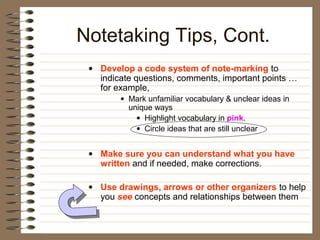
Notetaking Tips, Cont.
 • Develop a code system of note-marking to
   indicate questions, comments, important points …
   for example,
        • Mark unfamiliar vocabulary & unclear ideas in
          unique ways
            • Highlight vocabulary in pink.
            • Circle ideas that are still unclear


 • Make sure you can understand what you have
   written and if needed, make corrections.

 • Use drawings, arrows or other organizers to help
   you see concepts and relationships between them
The End!

Cornell notes

  • 1.
    THE MODIFIED CORNELL NOTE TAKING SYSTEM
  • 2.
    Layout Question Record Column Column --2 Inches-- --6 Inches-- After the lecture, Record patterns of main idea and – write questions in support this column for • in your own words when possible. each main point in the record column. Use indentations • to show the relationships between main ideas and – support.
  • 3.
    Record Column Write mainideas and supporting material in the right column – Use signals from the lecture • Titles & keywords= topics  main ideas • “Transition” words/phrases introduce details – First, most, some, this is called, there are two types – Use abbreviations to get the full idea. – Leave spaces between ideas so you can • fill in more later. • see how ideas relate to one another
  • 4.
    Question Column Write questionsin the left column of your notes to quiz yourself on the material. – Write questions in the question column on the same line as the item the question addresses in the record column – Write a question for each new • Topic • Main idea • Significant detail – Write questions for details on which you think your professor will quiz you.
  • 5.
    Quiz Answer your questions in the left column. – Cover the Record Column. – Read your questions in the Question Column – Using your own words, answer your This will help transfer ideas questions out loud. to your long- term memory! – Uncover your notes and check what you have said against the facts.
  • 6.
    Review Review to improveyour memory. – If you spend 10 minutes every week or so in a quick review of your notes, • you will retain most of what you have studied • you won’t have to cram during an “all-nighter” • you will relate the facts and ideas to present lectures or readings.
  • 7.
    Example Here is thetext. In the “Legend of Sleepy Hollow,” there are four main characters – including one that may mat really exist. The first and most important character is Ichabod Crane. He is an ambitious schoolteacher, who hopes to marry the second character, Katrina Van Tassel. Katrina is the handsome daughter of a wealthy farmer. The third character is Brom Bones. He is Ichabod’s rival for Katrinia, and he is also well known for his practical jokes. The fourth and final character is the frightening, ghostly figure of the Headless Horseman, who terrifies Ichabod into running away. But Irving strongly hints that this might simply be another of the characters in disguise.
  • 8.
    Here are thenotes: The Legend of Sleepy Hollow – 4 Main Characters 1st character? 1. Ichabod Crane Job? • Most important Interest? • School teacher • Wants to marry Katrina 2nd character? 2. Katrina Van Tassel Description? • Beautiful daughter of wealthy farmer 3rd character? 3. Brom Bones Interested in? • Also wants to marry Katrina Likes what? • Well known for practical jokes 4th character 4. Headless Horseman Real or not? Scares who? • Scary ghost Might be who? • Scares Ichabod away • Might be another character [Brom?] in disguise
  • 9.
    Notetaking Tips • Keepa separate notebook or binder for each course. • Notes for each lecture should begin on a new page. • Date and number all pages. • Never use a sentence when you can use a phrase, or a phrase when you can use a word.
  • 10.
    Notetaking Tips, Cont. • Use indentations to distinguish between major and minor points. • Put most notes in your own words, except • formulas , definitions, and specific facts • Use abbreviations and symbols wherever possible. • If you completely don’t understand an idea, • leave a blank space and ask your professor for help on it.
  • 11.
    Notetaking Tips, Cont. • Develop a code system of note-marking to indicate questions, comments, important points … for example, • Mark unfamiliar vocabulary & unclear ideas in unique ways • Highlight vocabulary in pink. • Circle ideas that are still unclear • Make sure you can understand what you have written and if needed, make corrections. • Use drawings, arrows or other organizers to help you see concepts and relationships between them
  • 12.