Language Network


Clauses and
 Sentence
 Structure
Clauses and Sentence Structure


 Kinds of Clauses
     Here’s the Idea
       Independent Clauses
       Subordinate Clauses

     Why It Matters
     Practice and Apply
Here’s the Idea


       Clause


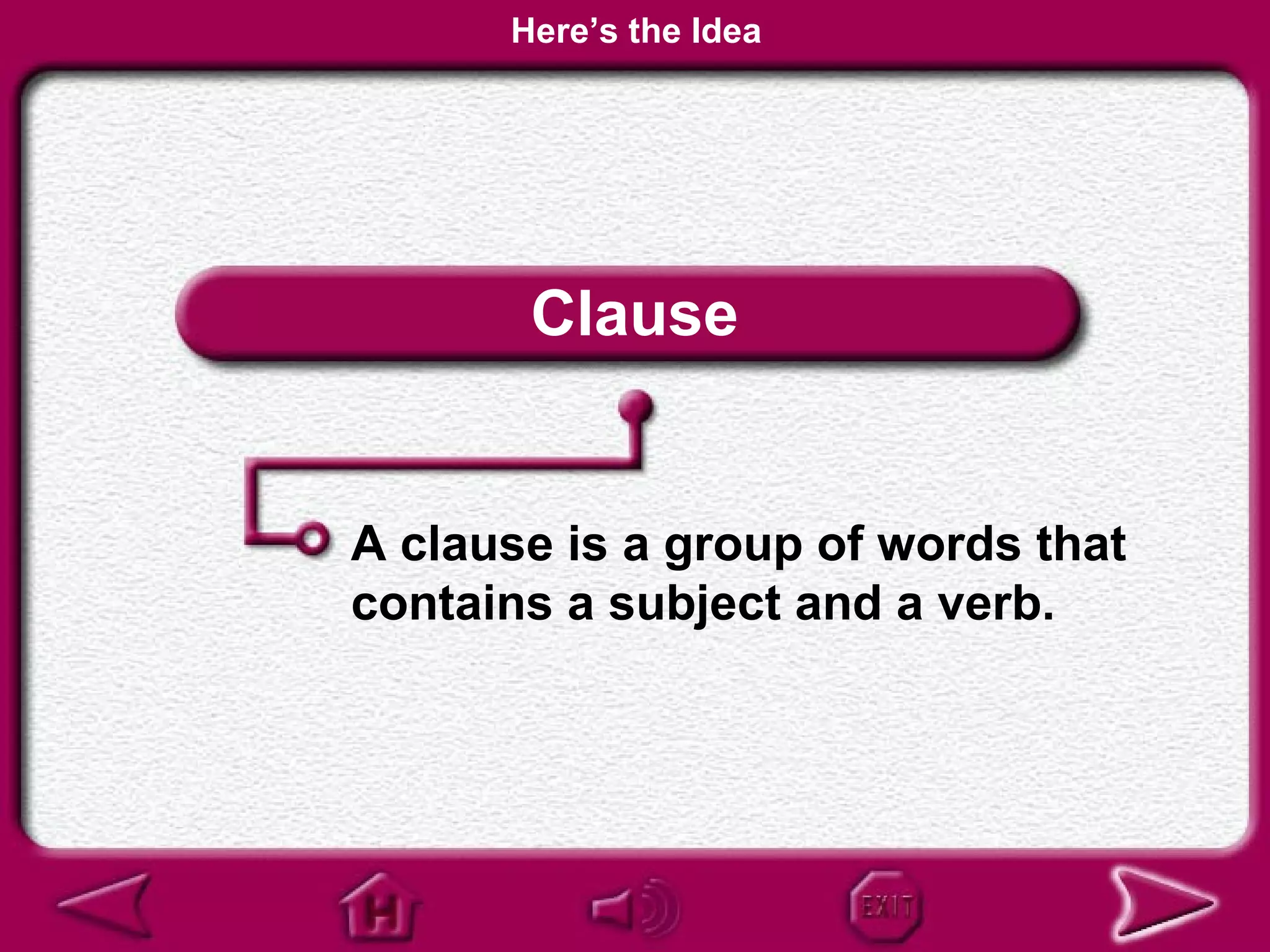
A clause is a group of words that
contains a subject and a verb.
Here’s the Idea


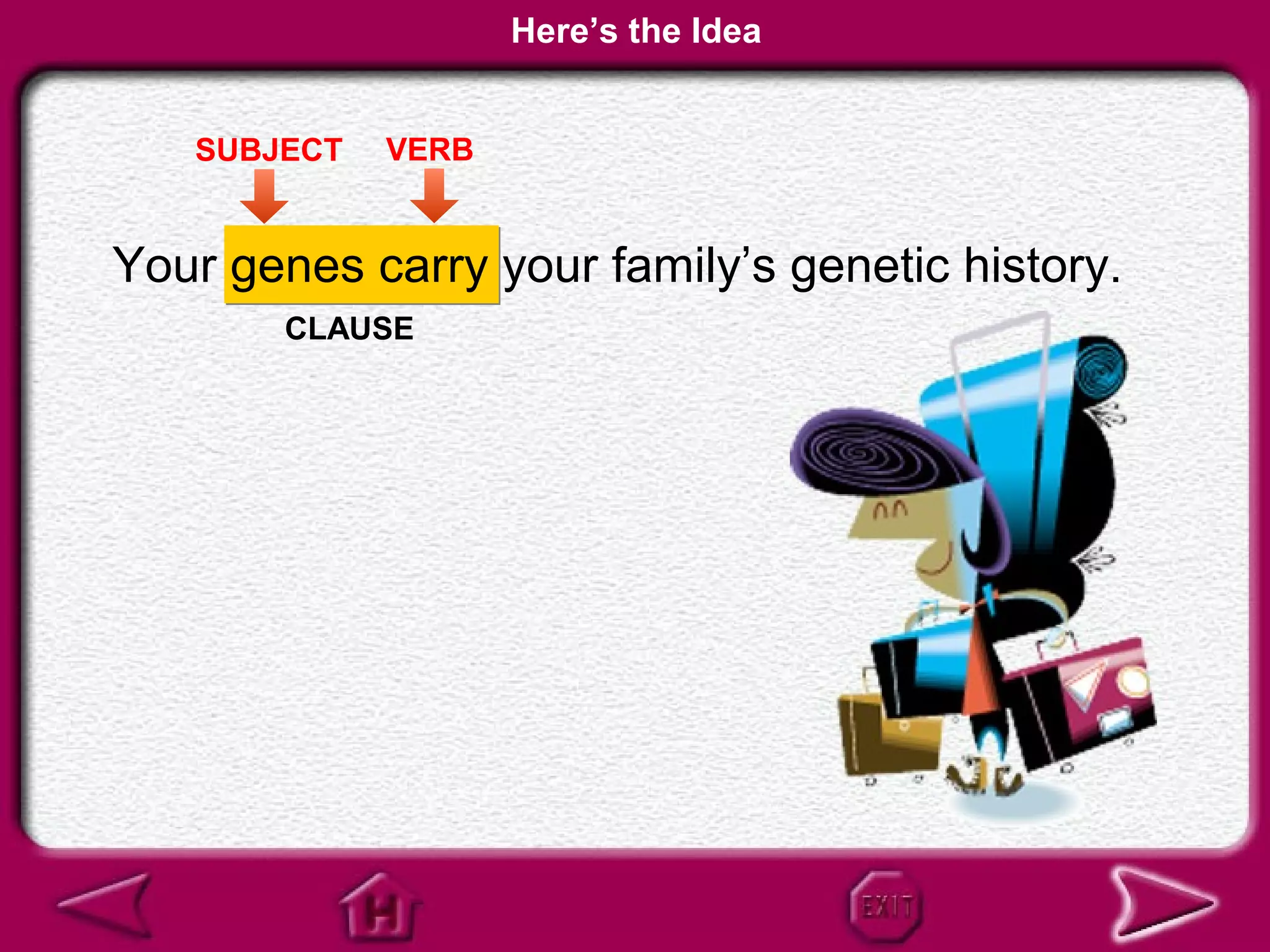
   SUBJECT   VERB


Your genes carry your family’s genetic history.
        CLAUSE
Here’s the Idea


Clauses add details.


Clauses show relationships
between ideas.
Here’s the Idea


Independent Clause


An independent (or main)
clause expresses a complete
thought and can stand alone
as a sentence.
Here’s the Idea


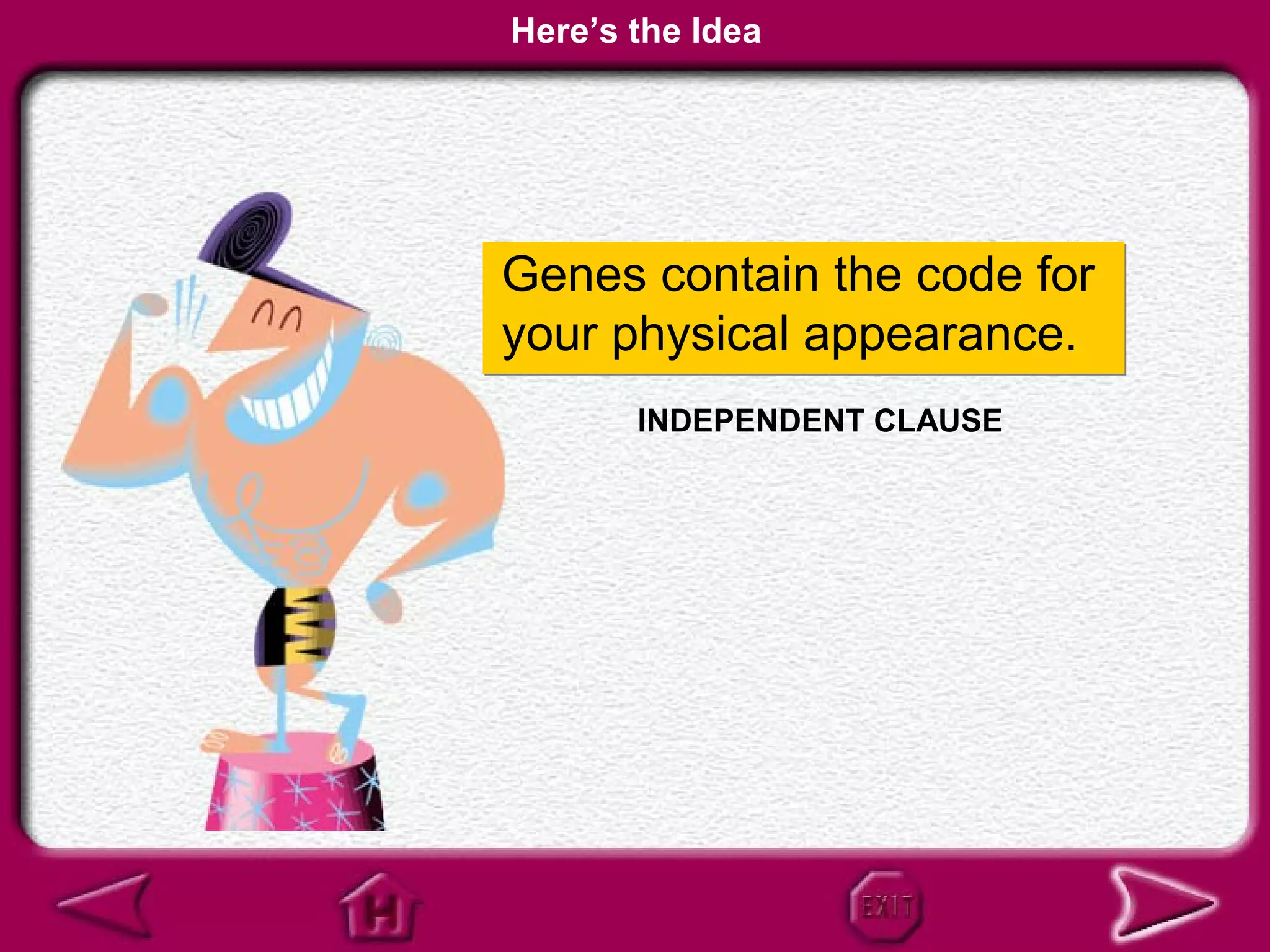
Genes contain the code for
your physical appearance.
       INDEPENDENT CLAUSE
Here’s the Idea


Subordinate Clause


A subordinate (or dependent)
clause contains a subject and
a verb but does not express a
complete thought and cannot
stand alone as a sentence.
Here’s the Idea


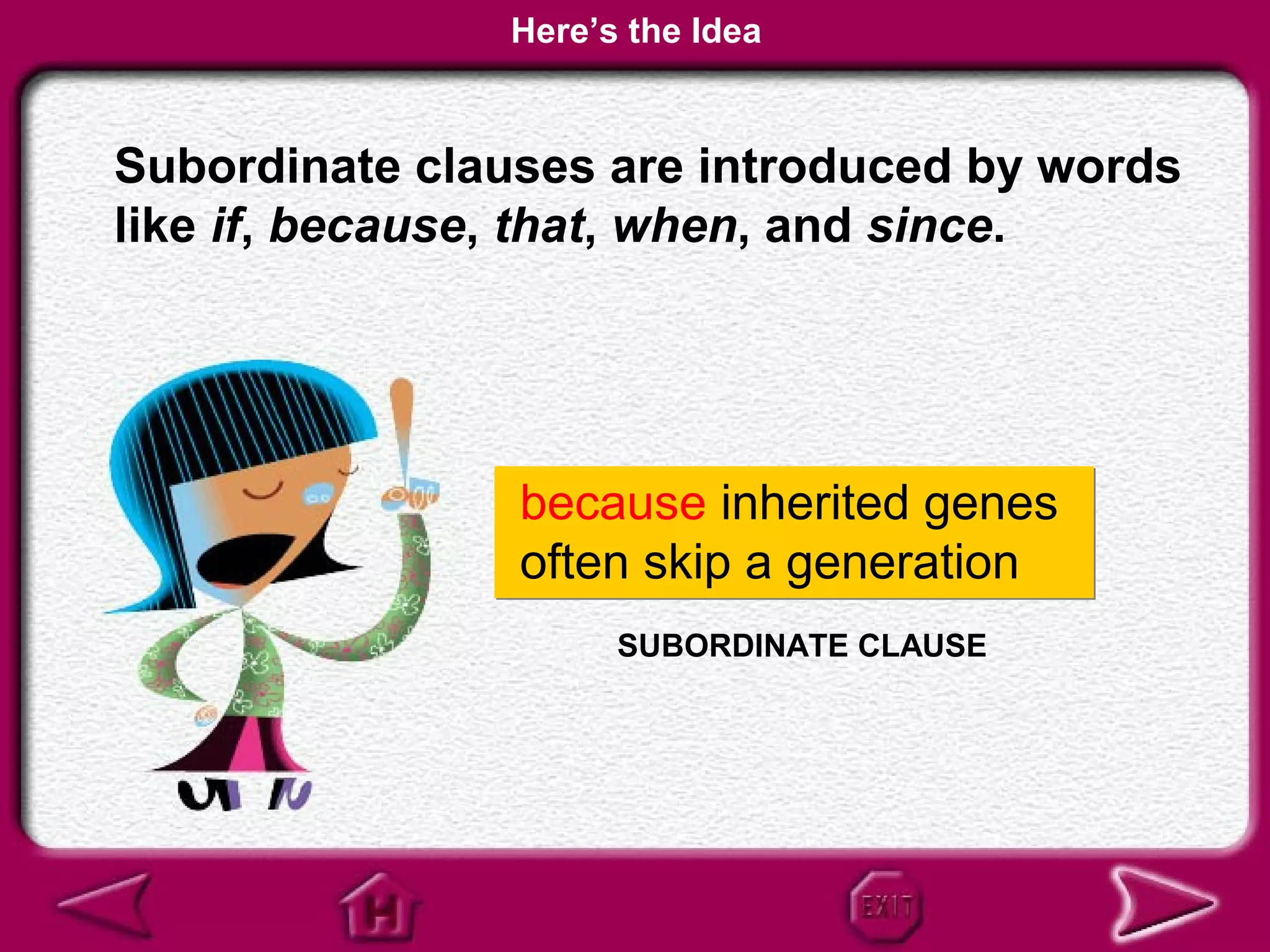
Subordinate clauses are introduced by words
like if, because, that, when, and since.


                because inherited genes
                often skip a generation
                     SUBORDINATE CLAUSE
Here’s the Idea


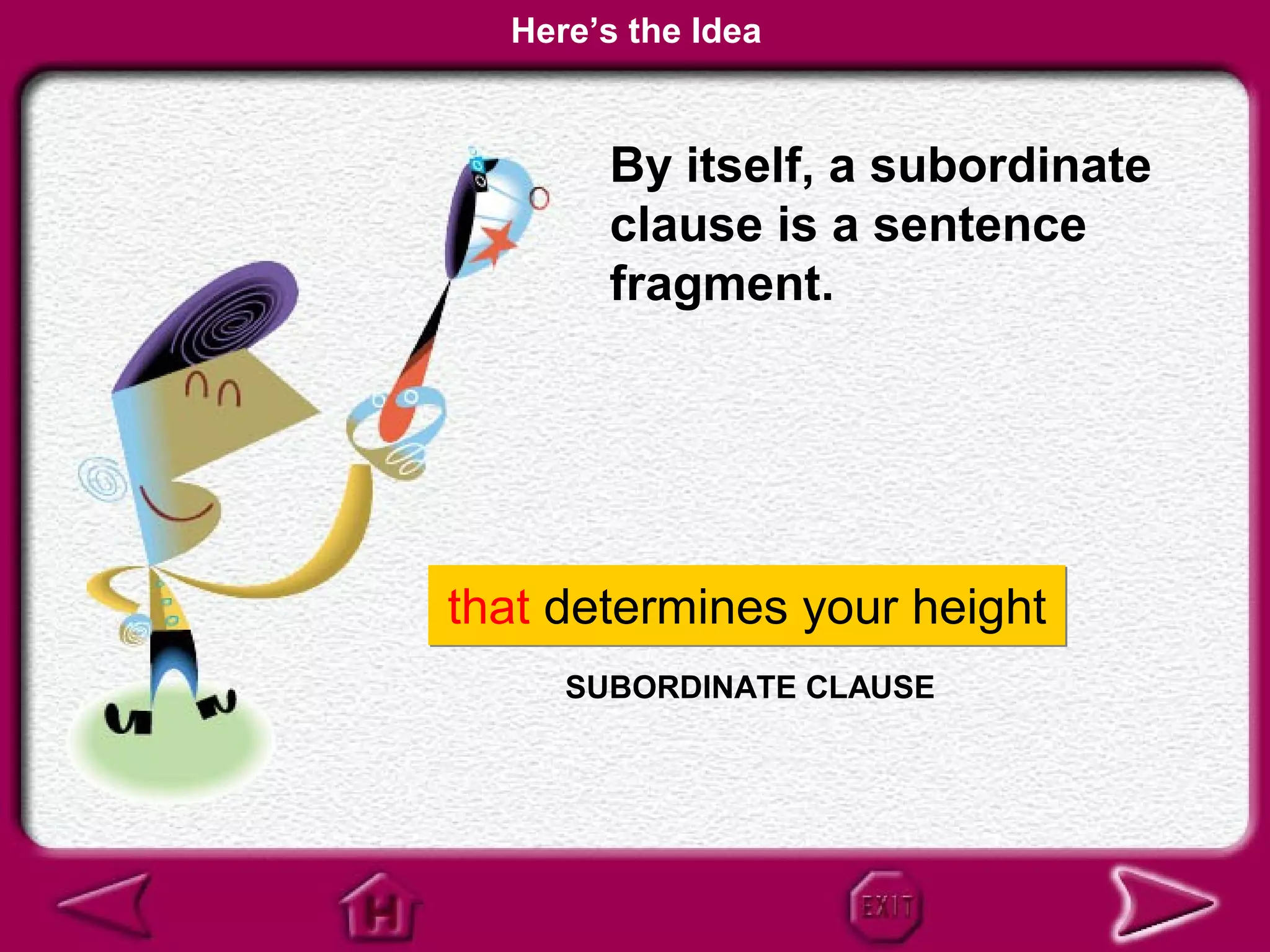
       By itself, a subordinate
       clause is a sentence
       fragment.


that determines your height
     SUBORDINATE CLAUSE
Here’s the Idea


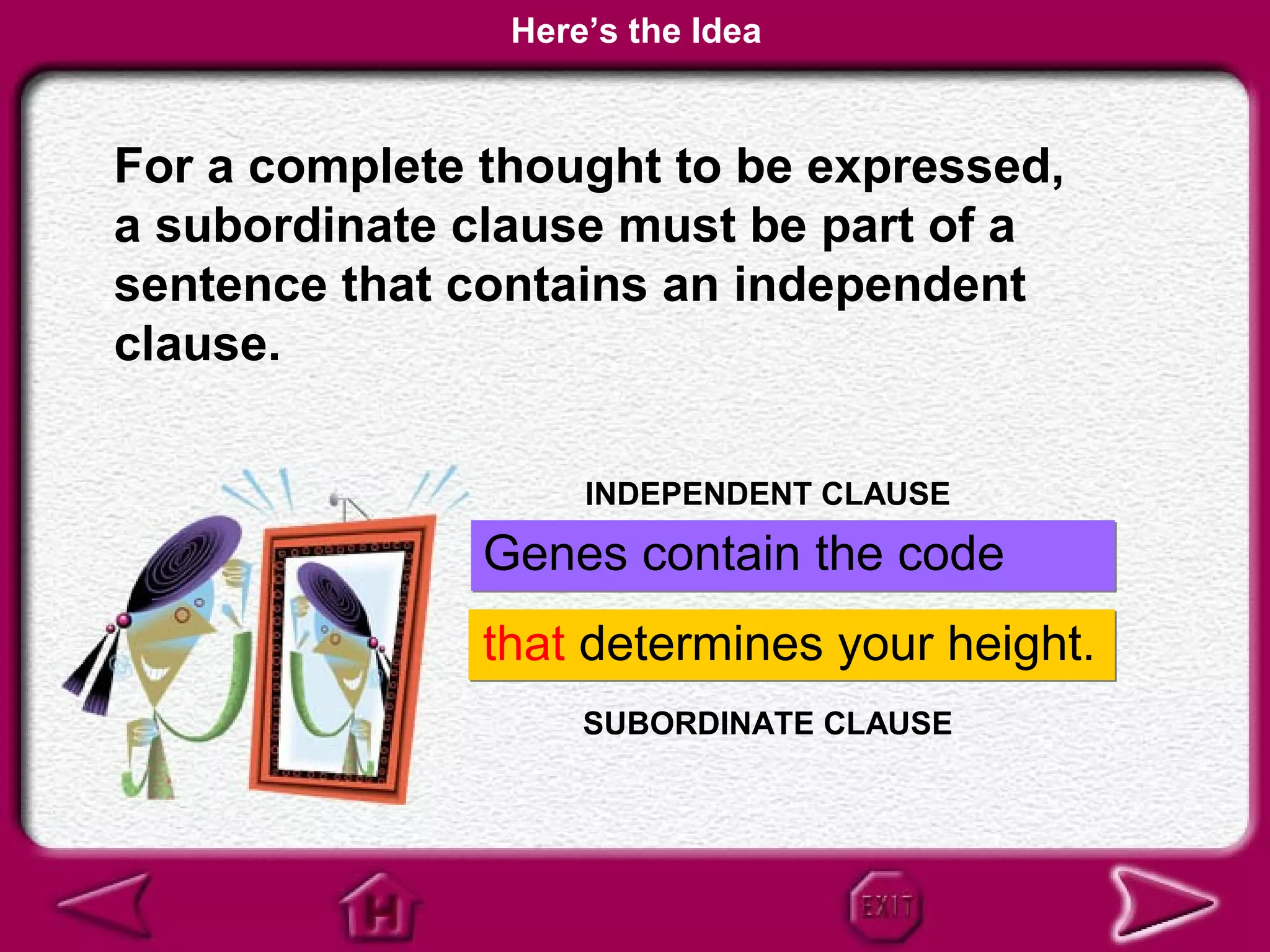
For a complete thought to be expressed,
a subordinate clause must be part of a
sentence that contains an independent
clause.

                    INDEPENDENT CLAUSE

               Genes contain the code
               that determines your height.
                    SUBORDINATE CLAUSE
Why It Matters


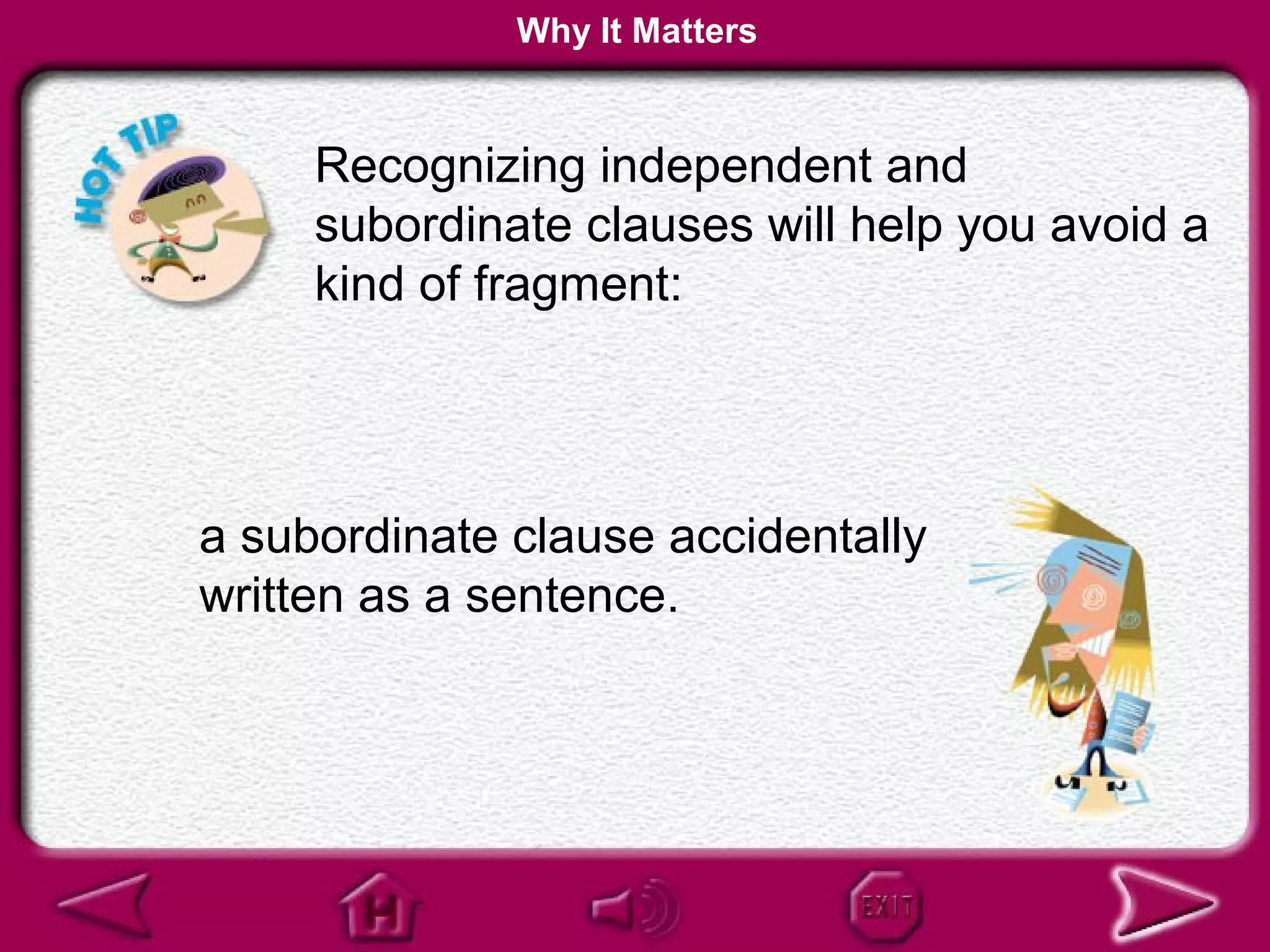
     Recognizing independent and
     subordinate clauses will help you avoid a
     kind of fragment:


a subordinate clause accidentally
written as a sentence.
Why It Matters


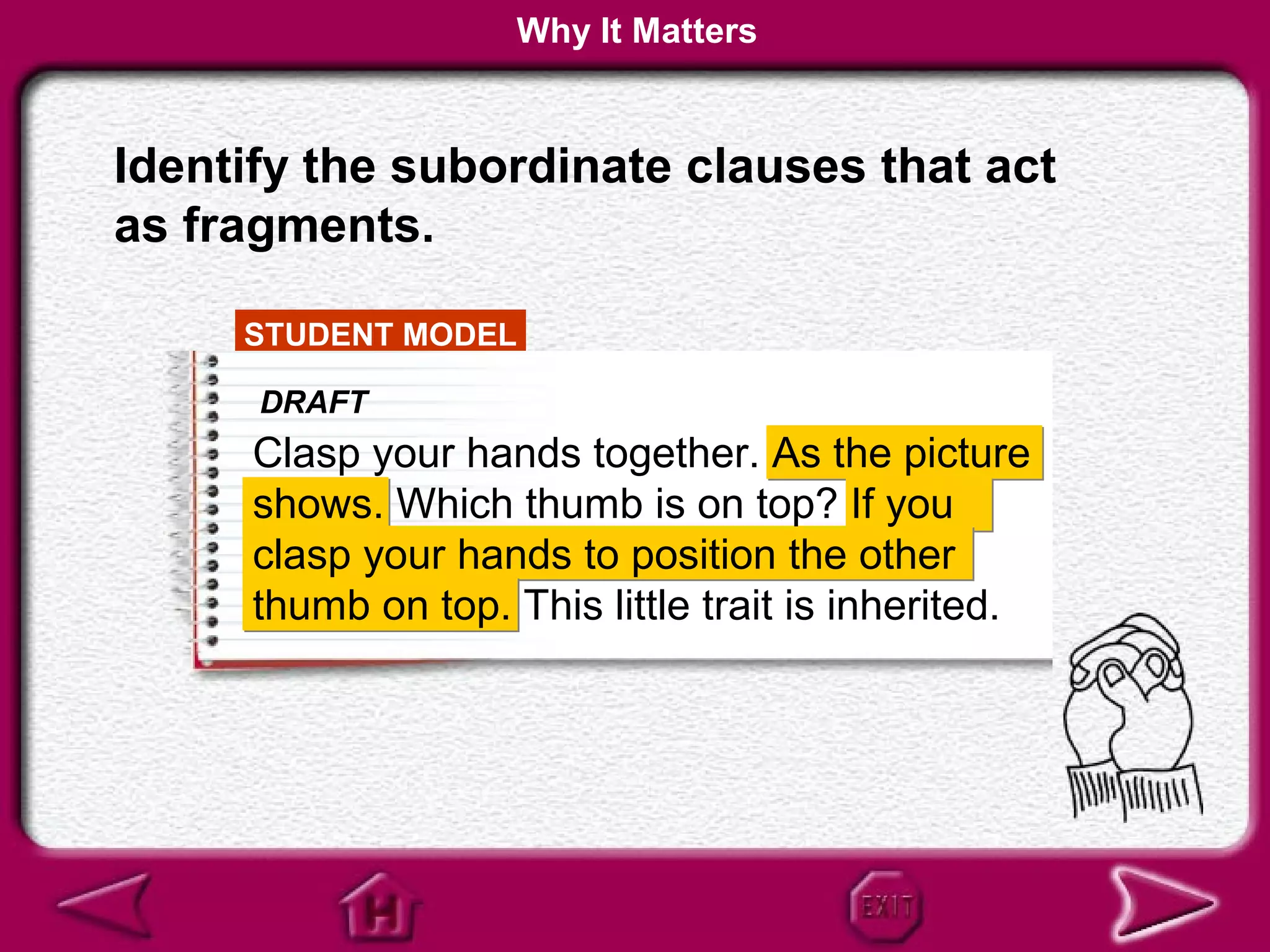
Identify the subordinate clauses that act
as fragments.

     STUDENT MODEL

      DRAFT
      Clasp your hands together. As the picture
      shows. Which thumb is on top? If you
      clasp your hands to position the other
      thumb on top. This little trait is inherited.
Why It Matters


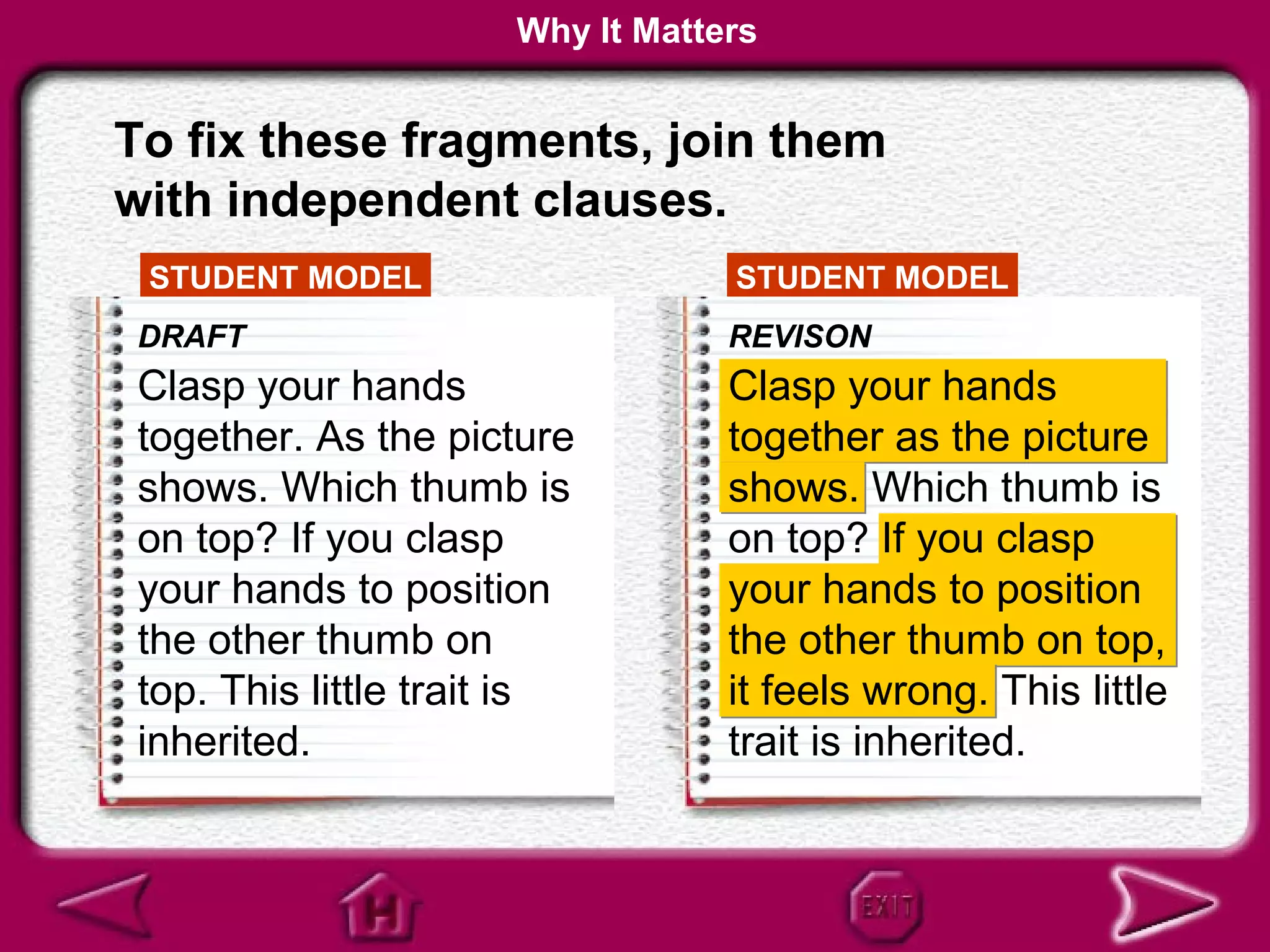
To fix these fragments, join them
with independent clauses.
 STUDENT MODEL                    STUDENT MODEL
 DRAFT                            REVISON
 Clasp your hands                 Clasp your hands
 together. As the picture         together as the picture
 shows. Which thumb is            shows. Which thumb is
 on top? If you clasp             on top? If you clasp
 your hands to position           your hands to position
 the other thumb on               the other thumb on top,
 top. This little trait is        it feels wrong. This little
 inherited.                       trait is inherited.
Practice and Apply


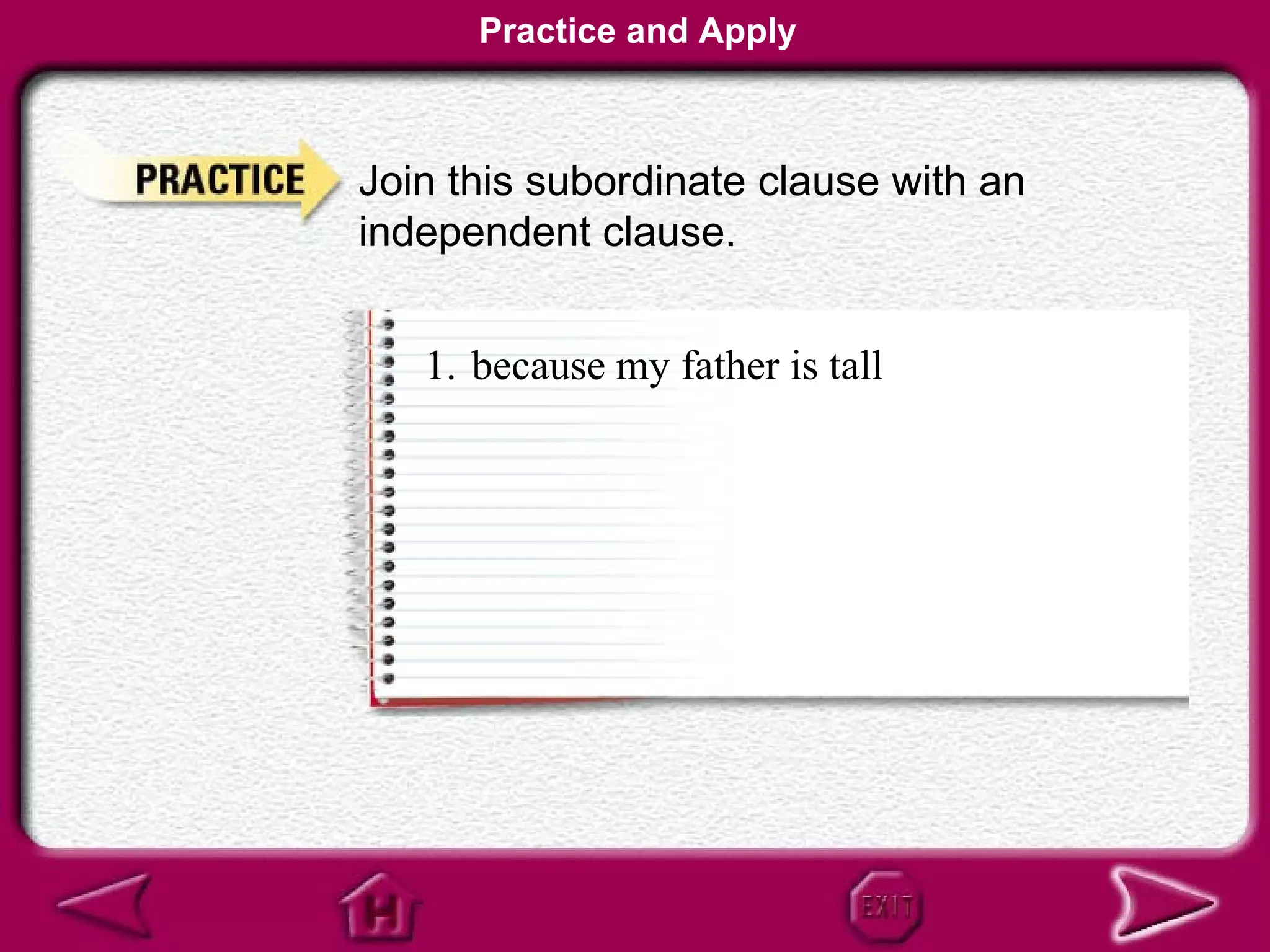
Join this subordinate clause with an
independent clause.


   1. because my father is tall
Practice and Apply


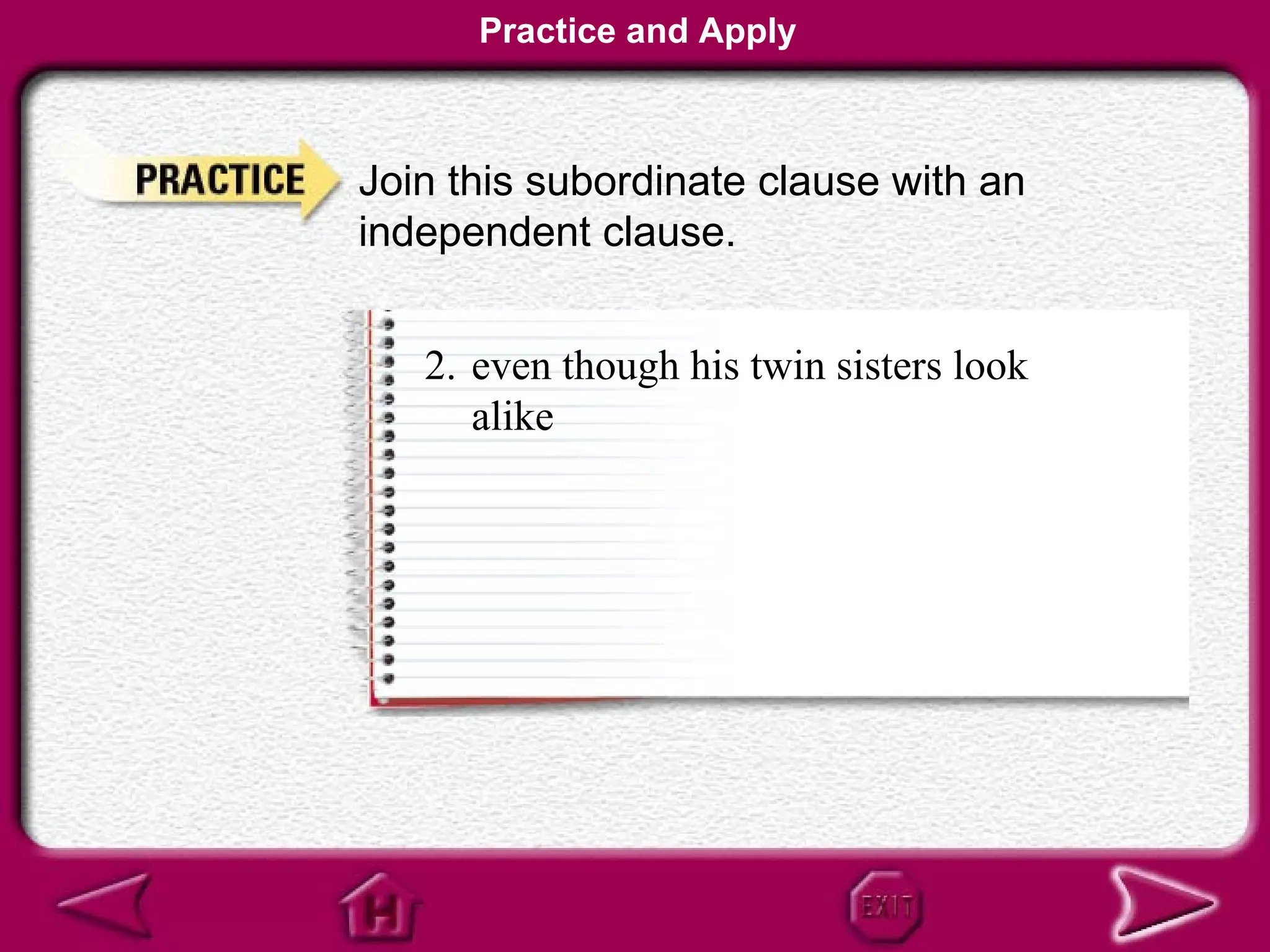
Join this subordinate clause with an
independent clause.


   2. even though his twin sisters look
      alike
Practice and Apply


Join this subordinate clause with an
independent clause.


   3. that shows her family tree
Practice and Apply


Join this subordinate clause with an
independent clause.


   4. when my ancestors arrived in this
      country
Clauses and Sentence Structure


Adjective Clauses
     Here’s the Idea
      Adjective Clauses
      Essential Adjective Clauses
      Nonessential Adjective Clauses

     Why It Matters
     Practice and Apply
Here’s the Idea


Subordinate clauses can
be adjective clauses.
Here’s the Idea


 Adjective Clause


An adjective clause is a
subordinate clause that is used
as an adjective to modify a
noun or a pronoun.
Here’s the Idea


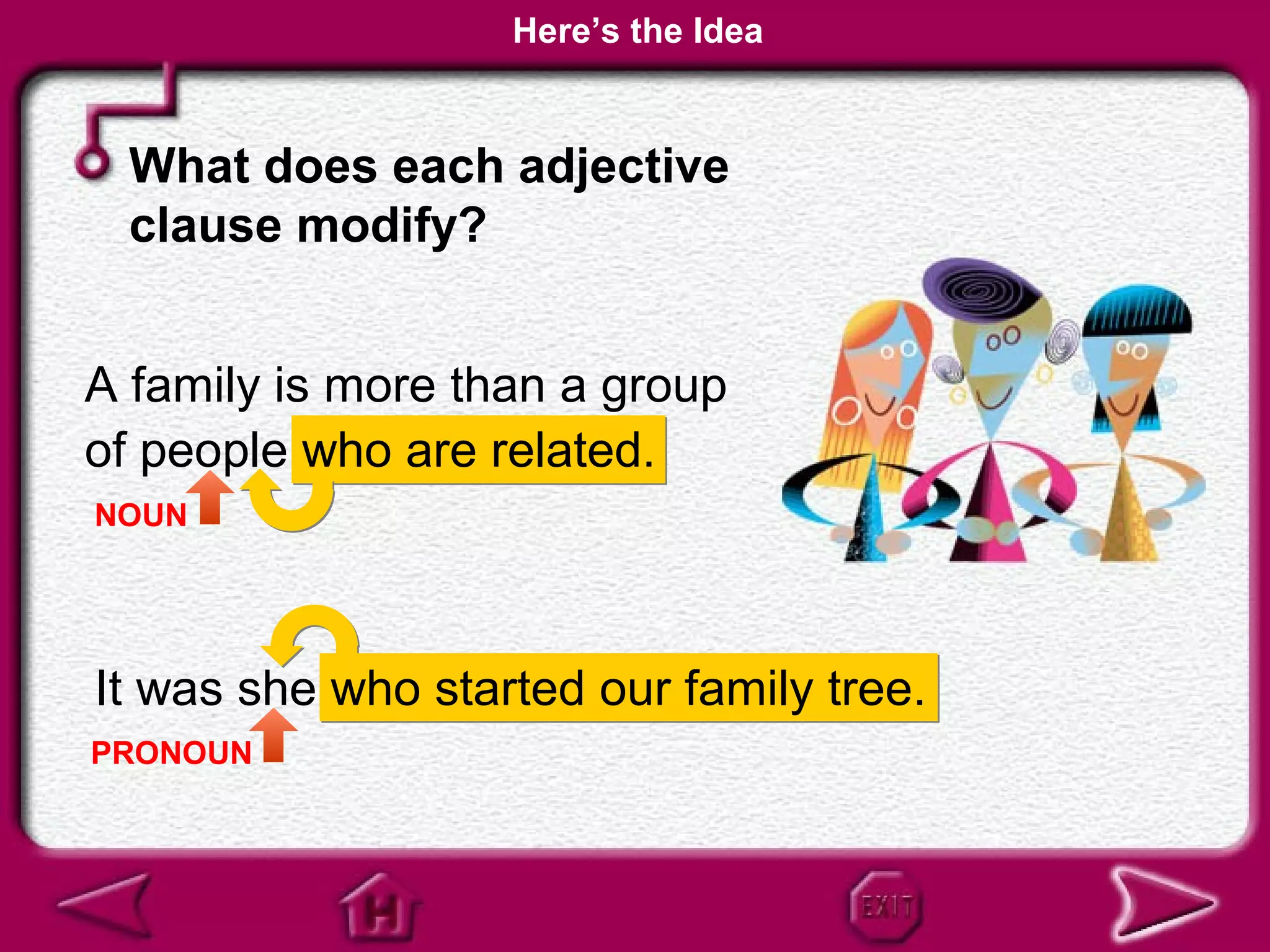
 What does each adjective
 clause modify?


A family is more than a group
of people who are related.
NOUN


It was she who started our family tree.
PRONOUN
Here’s the Idea


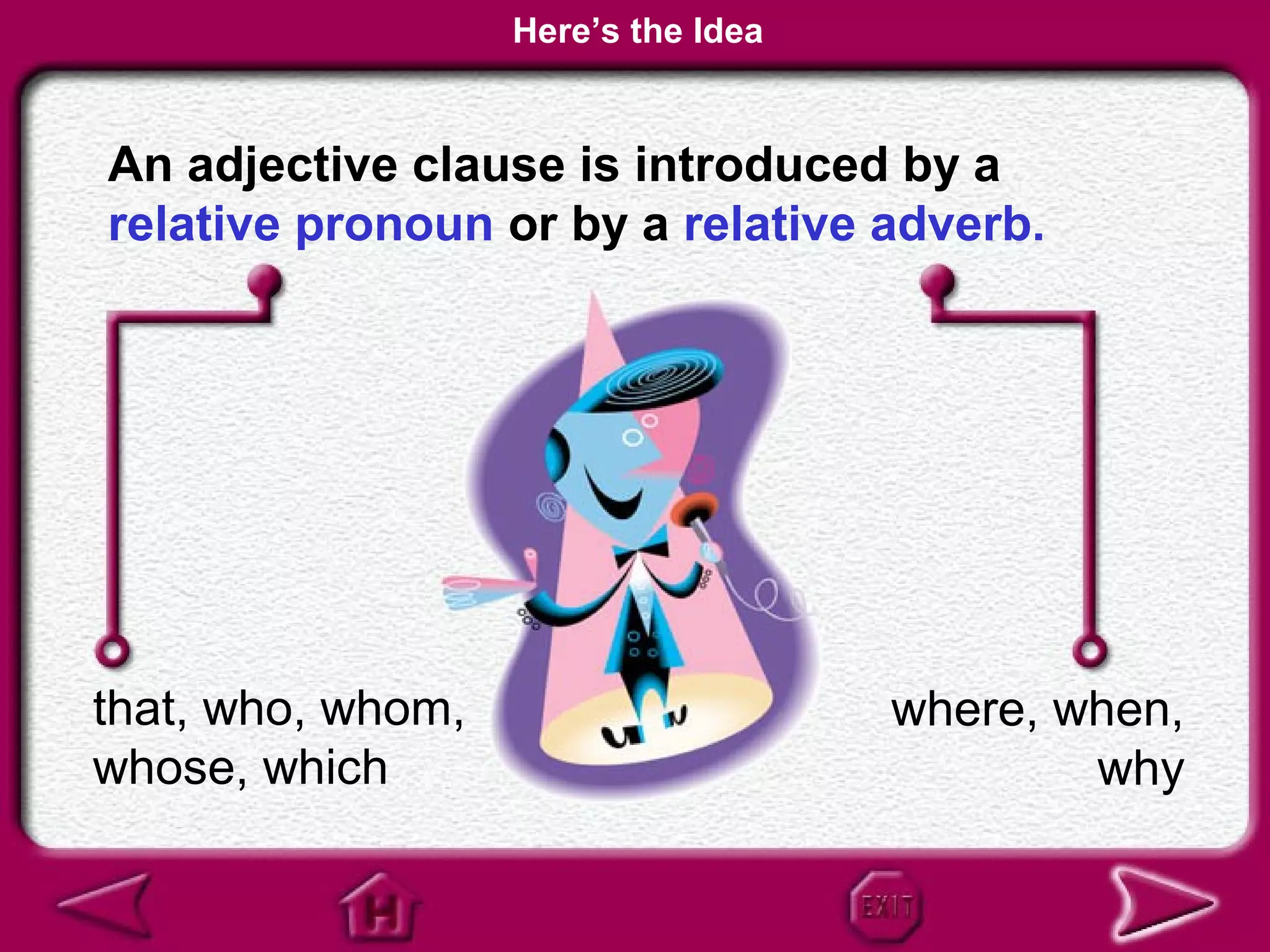
An adjective clause is introduced by a
relative pronoun or by a relative adverb.


that, who, whom,                     where, when,
whose, which                                 why
Here’s the Idea


Essential Adjective Clause


   An essential (or restrictive)
   adjective clause provides
   information that is necessary
   to identify the preceding noun
   or pronoun.
Here’s the Idea


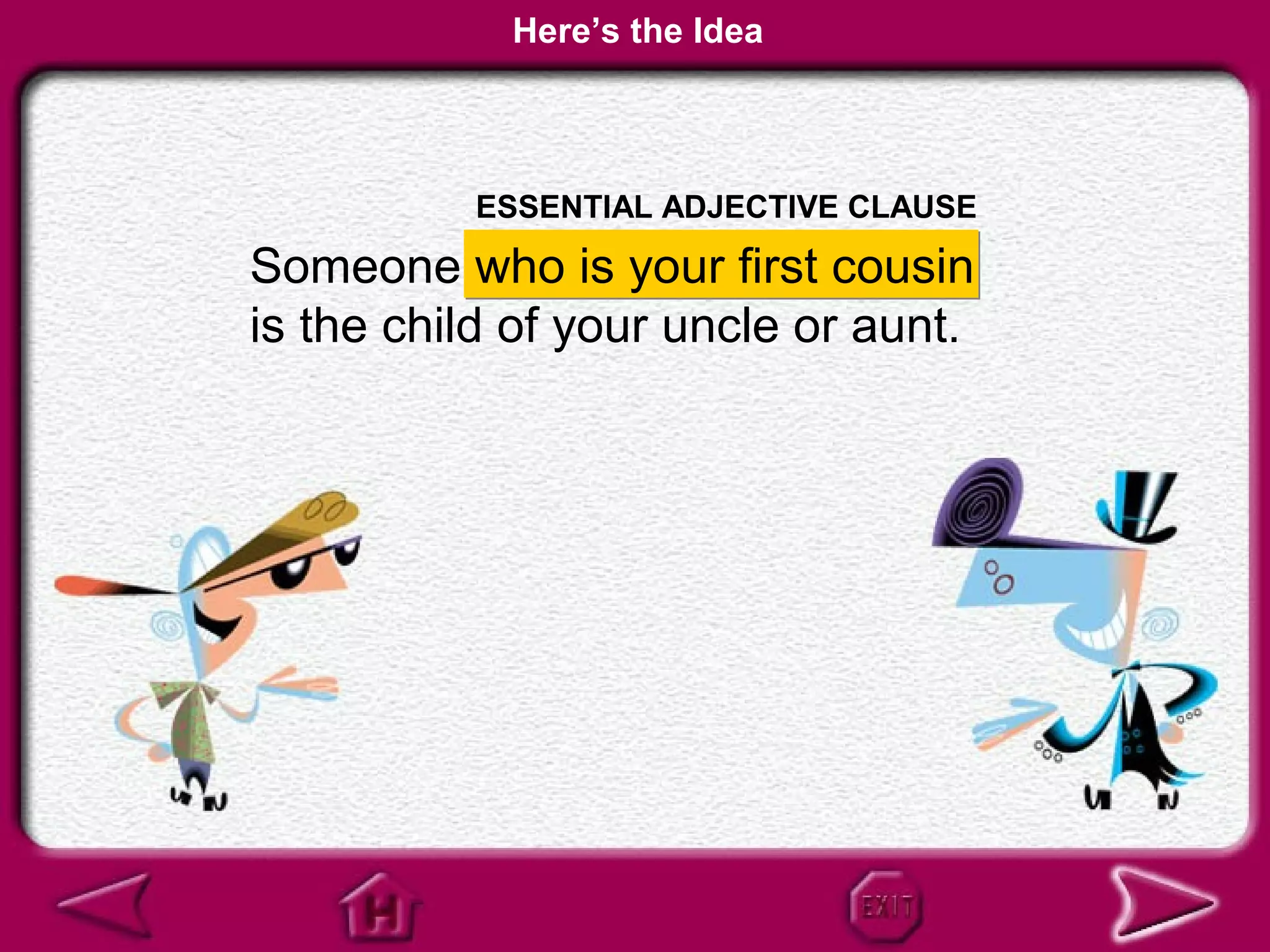
          ESSENTIAL ADJECTIVE CLAUSE

Someone who is your first cousin
is the child of your uncle or aunt.
Here’s the Idea


Nonessential Adjective Clause


    A nonessential (or nonrestrictive)
    adjective clause adds additional
    information about a noun or
    pronoun whose meaning is
    already clear.
Here’s the Idea


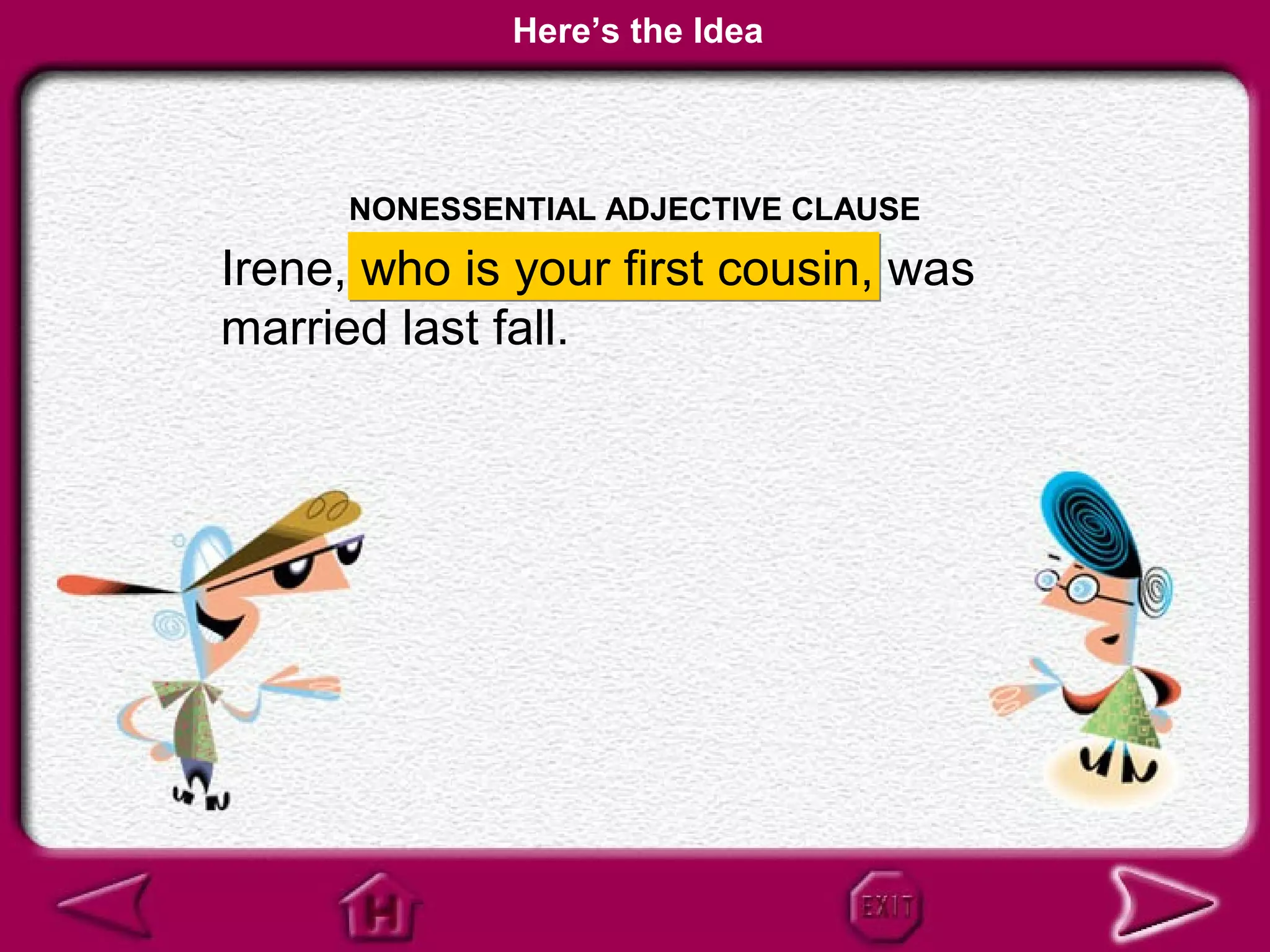
      NONESSENTIAL ADJECTIVE CLAUSE

Irene, who is your first cousin, was
married last fall.
Here’s the Idea


Use commas to set off a nonessential
clause. The commas separate
nonessential information from the
main idea of the sentence.
Why It Matters


Adjective clauses can
supply details necessary
to explain, support, and
connect your ideas.
Why It Matters


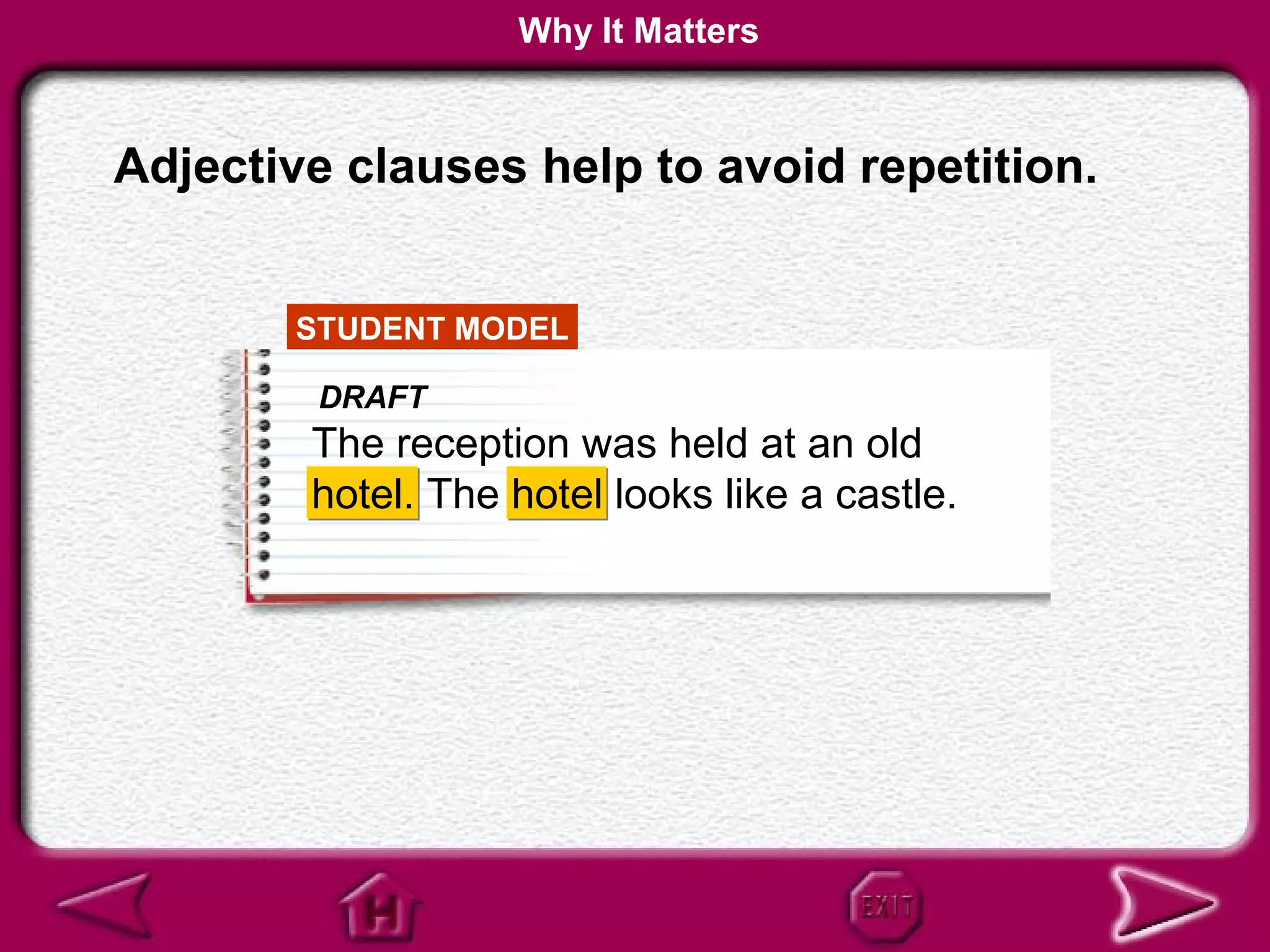
Adjective clauses help to avoid repetition.


       STUDENT MODEL

        DRAFT
        The reception was held at an old
        hotel. The hotel looks like a castle.
Why It Matters


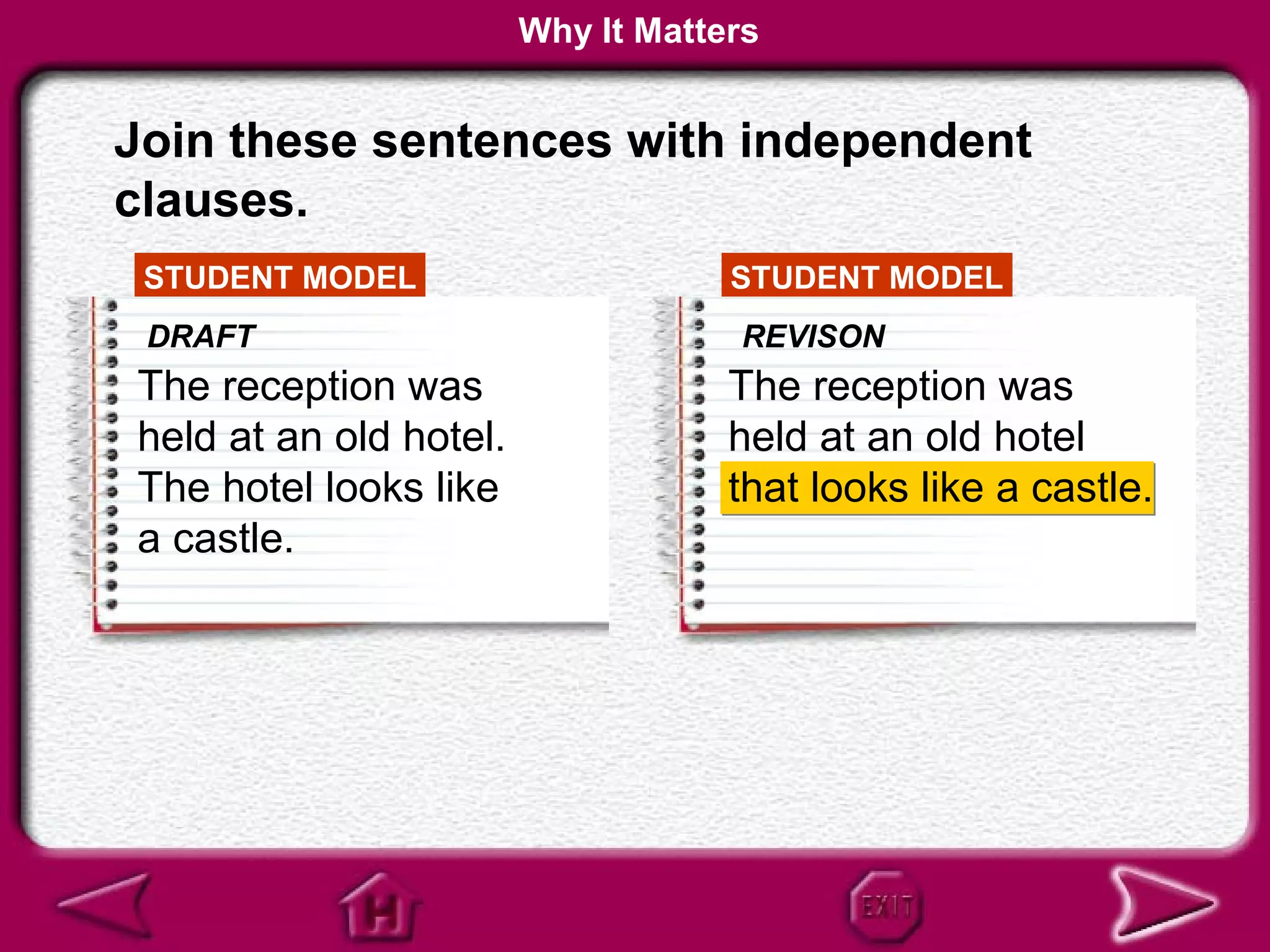
Join these sentences with independent
clauses.
 STUDENT MODEL                      STUDENT MODEL
 DRAFT                              REVISON
The reception was                   The reception was
held at an old hotel.               held at an old hotel
The hotel looks like                that looks like a castle.
a castle.
Practice and Apply


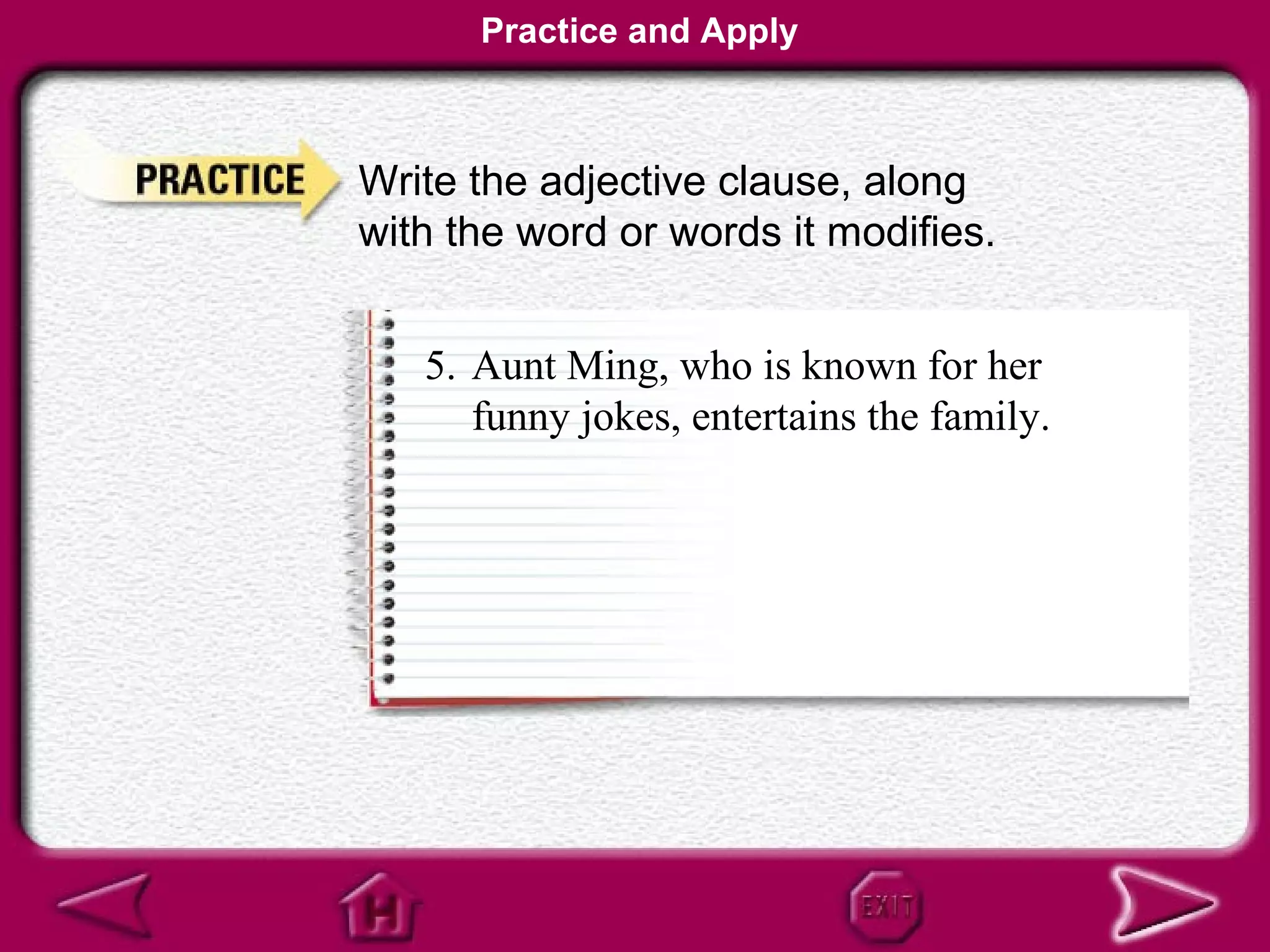
Write the adjective clause, along
with the word or words it modifies.


   5. Aunt Ming, who is known for her
      funny jokes, entertains the family.
Practice and Apply


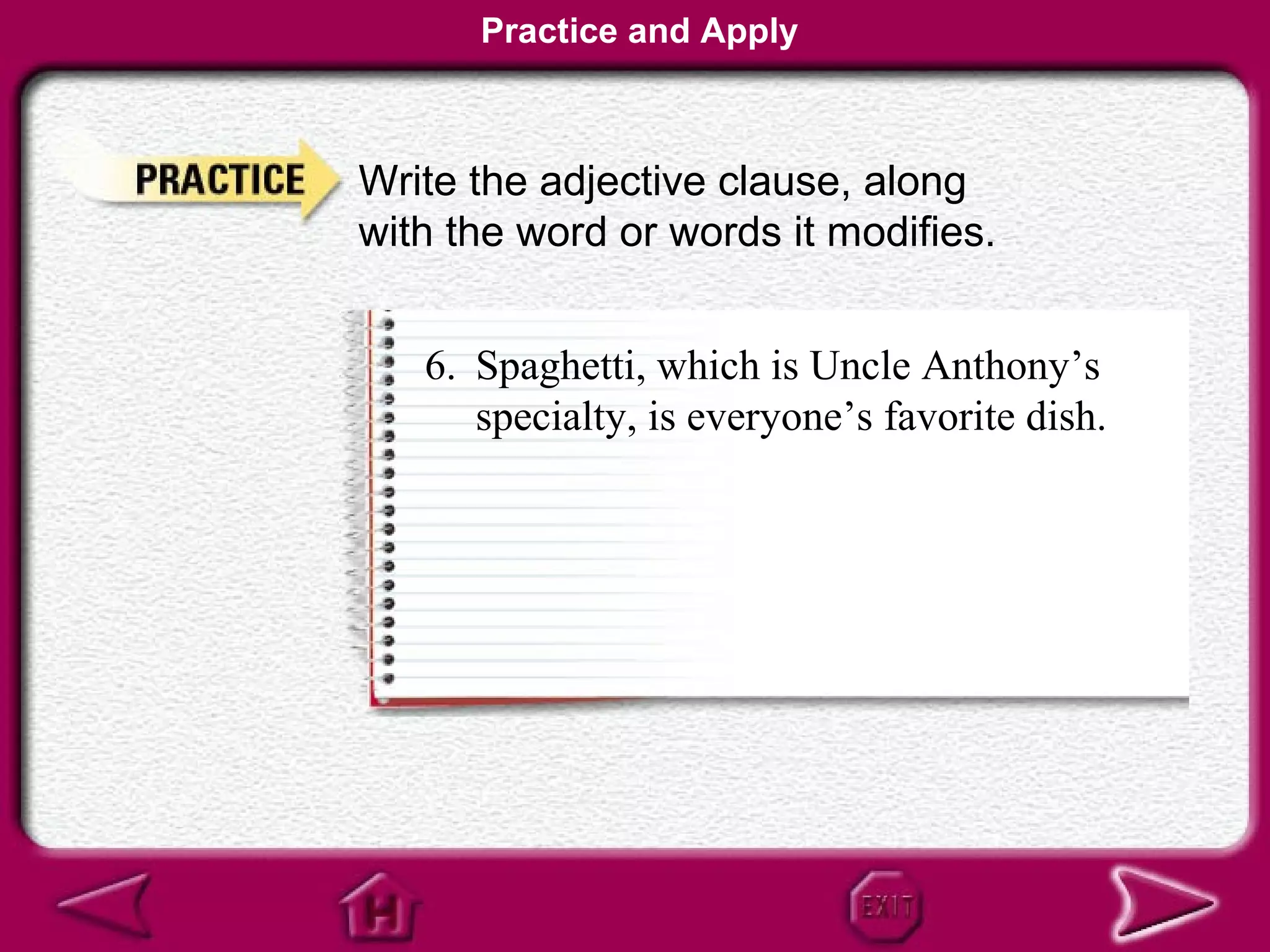
Write the adjective clause, along
with the word or words it modifies.


   6. Spaghetti, which is Uncle Anthony’s
      specialty, is everyone’s favorite dish.
Practice and Apply


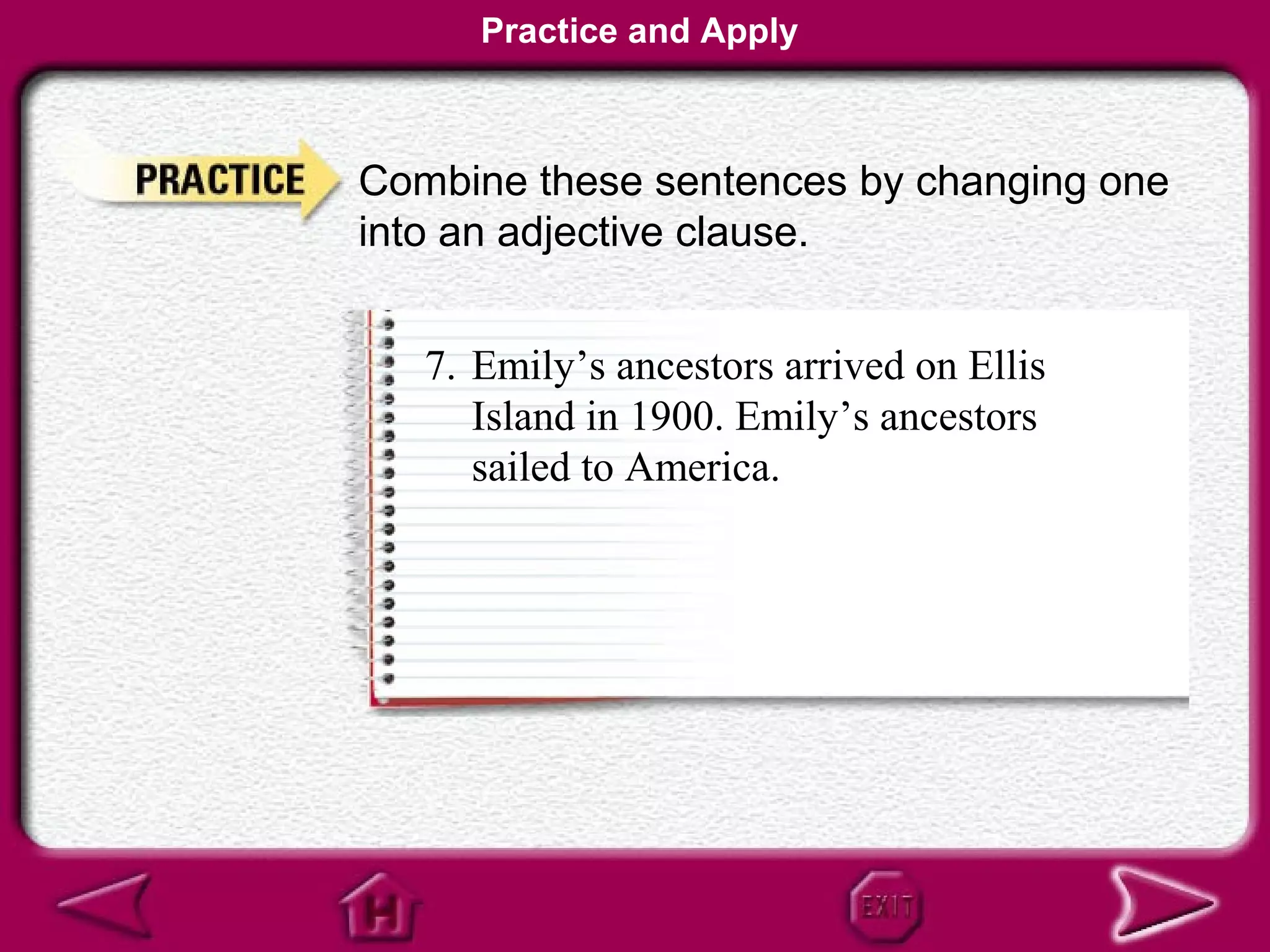
Combine these sentences by changing one
into an adjective clause.


   7. Emily’s ancestors arrived on Ellis
      Island in 1900. Emily’s ancestors
      sailed to America.
Practice and Apply


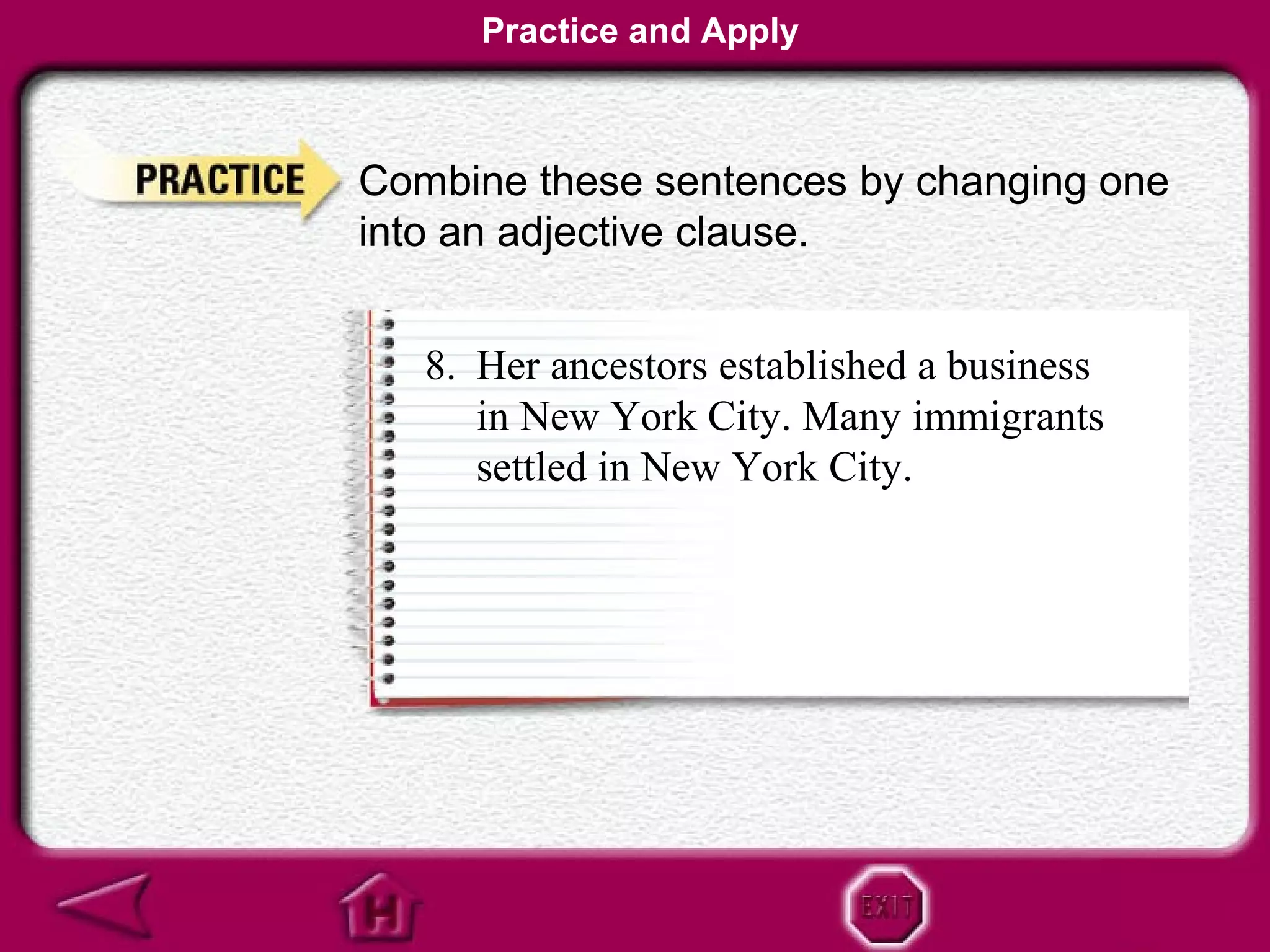
Combine these sentences by changing one
into an adjective clause.


   8. Her ancestors established a business
      in New York City. Many immigrants
      settled in New York City.

Caluses

  • 1.
  • 2.
    Clauses and SentenceStructure Kinds of Clauses Here’s the Idea Independent Clauses Subordinate Clauses Why It Matters Practice and Apply
  • 3.
    Here’s the Idea Clause A clause is a group of words that contains a subject and a verb.
  • 4.
    Here’s the Idea SUBJECT VERB Your genes carry your family’s genetic history. CLAUSE
  • 5.
    Here’s the Idea Clausesadd details. Clauses show relationships between ideas.
  • 6.
    Here’s the Idea IndependentClause An independent (or main) clause expresses a complete thought and can stand alone as a sentence.
  • 7.
    Here’s the Idea Genescontain the code for your physical appearance. INDEPENDENT CLAUSE
  • 8.
    Here’s the Idea SubordinateClause A subordinate (or dependent) clause contains a subject and a verb but does not express a complete thought and cannot stand alone as a sentence.
  • 9.
    Here’s the Idea Subordinateclauses are introduced by words like if, because, that, when, and since. because inherited genes often skip a generation SUBORDINATE CLAUSE
  • 10.
    Here’s the Idea By itself, a subordinate clause is a sentence fragment. that determines your height SUBORDINATE CLAUSE
  • 11.
    Here’s the Idea Fora complete thought to be expressed, a subordinate clause must be part of a sentence that contains an independent clause. INDEPENDENT CLAUSE Genes contain the code that determines your height. SUBORDINATE CLAUSE
  • 12.
    Why It Matters Recognizing independent and subordinate clauses will help you avoid a kind of fragment: a subordinate clause accidentally written as a sentence.
  • 13.
    Why It Matters Identifythe subordinate clauses that act as fragments. STUDENT MODEL DRAFT Clasp your hands together. As the picture shows. Which thumb is on top? If you clasp your hands to position the other thumb on top. This little trait is inherited.
  • 14.
    Why It Matters Tofix these fragments, join them with independent clauses. STUDENT MODEL STUDENT MODEL DRAFT REVISON Clasp your hands Clasp your hands together. As the picture together as the picture shows. Which thumb is shows. Which thumb is on top? If you clasp on top? If you clasp your hands to position your hands to position the other thumb on the other thumb on top, top. This little trait is it feels wrong. This little inherited. trait is inherited.
  • 15.
    Practice and Apply Jointhis subordinate clause with an independent clause. 1. because my father is tall
  • 16.
    Practice and Apply Jointhis subordinate clause with an independent clause. 2. even though his twin sisters look alike
  • 17.
    Practice and Apply Jointhis subordinate clause with an independent clause. 3. that shows her family tree
  • 18.
    Practice and Apply Jointhis subordinate clause with an independent clause. 4. when my ancestors arrived in this country
  • 19.
    Clauses and SentenceStructure Adjective Clauses Here’s the Idea Adjective Clauses Essential Adjective Clauses Nonessential Adjective Clauses Why It Matters Practice and Apply
  • 20.
    Here’s the Idea Subordinateclauses can be adjective clauses.
  • 21.
    Here’s the Idea Adjective Clause An adjective clause is a subordinate clause that is used as an adjective to modify a noun or a pronoun.
  • 22.
    Here’s the Idea What does each adjective clause modify? A family is more than a group of people who are related. NOUN It was she who started our family tree. PRONOUN
  • 23.
    Here’s the Idea Anadjective clause is introduced by a relative pronoun or by a relative adverb. that, who, whom, where, when, whose, which why
  • 24.
    Here’s the Idea EssentialAdjective Clause An essential (or restrictive) adjective clause provides information that is necessary to identify the preceding noun or pronoun.
  • 25.
    Here’s the Idea ESSENTIAL ADJECTIVE CLAUSE Someone who is your first cousin is the child of your uncle or aunt.
  • 26.
    Here’s the Idea NonessentialAdjective Clause A nonessential (or nonrestrictive) adjective clause adds additional information about a noun or pronoun whose meaning is already clear.
  • 27.
    Here’s the Idea NONESSENTIAL ADJECTIVE CLAUSE Irene, who is your first cousin, was married last fall.
  • 28.
    Here’s the Idea Usecommas to set off a nonessential clause. The commas separate nonessential information from the main idea of the sentence.
  • 29.
    Why It Matters Adjectiveclauses can supply details necessary to explain, support, and connect your ideas.
  • 30.
    Why It Matters Adjectiveclauses help to avoid repetition. STUDENT MODEL DRAFT The reception was held at an old hotel. The hotel looks like a castle.
  • 31.
    Why It Matters Jointhese sentences with independent clauses. STUDENT MODEL STUDENT MODEL DRAFT REVISON The reception was The reception was held at an old hotel. held at an old hotel The hotel looks like that looks like a castle. a castle.
  • 32.
    Practice and Apply Writethe adjective clause, along with the word or words it modifies. 5. Aunt Ming, who is known for her funny jokes, entertains the family.
  • 33.
    Practice and Apply Writethe adjective clause, along with the word or words it modifies. 6. Spaghetti, which is Uncle Anthony’s specialty, is everyone’s favorite dish.
  • 34.
    Practice and Apply Combinethese sentences by changing one into an adjective clause. 7. Emily’s ancestors arrived on Ellis Island in 1900. Emily’s ancestors sailed to America.
  • 35.
    Practice and Apply Combinethese sentences by changing one into an adjective clause. 8. Her ancestors established a business in New York City. Many immigrants settled in New York City.