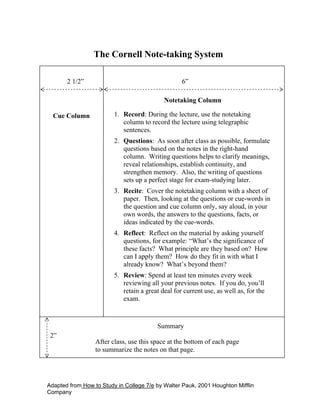
The Cornell Note-taking System

       2 1/2”                                      6”

                                            Notetaking Column

  Cue Column             1. Record: During the lecture, use the notetaking
                            column to record the lecture using telegraphic
                            sentences.
                         2. Questions: As soon after class as possible, formulate
                            questions based on the notes in the right-hand
                            column. Writing questions helps to clarify meanings,
                            reveal relationships, establish continuity, and
                            strengthen memory. Also, the writing of questions
                            sets up a perfect stage for exam-studying later.
                         3. Recite: Cover the notetaking column with a sheet of
                            paper. Then, looking at the questions or cue-words in
                            the question and cue column only, say aloud, in your
                            own words, the answers to the questions, facts, or
                            ideas indicated by the cue-words.
                         4. Reflect: Reflect on the material by asking yourself
                            questions, for example: “What’s the significance of
                            these facts? What principle are they based on? How
                            can I apply them? How do they fit in with what I
                            already know? What’s beyond them?
                         5. Review: Spend at least ten minutes every week
                            reviewing all your previous notes. If you do, you’ll
                            retain a great deal for current use, as well as, for the
                            exam.


                                         Summary
 2”
                  After class, use this space at the bottom of each page
                  to summarize the notes on that page.


Adapted from How to Study in College 7/e by Walter Pauk, 2001 Houghton Mifflin
Company

Cornell system

  • 1.
    The Cornell Note-takingSystem 2 1/2” 6” Notetaking Column Cue Column 1. Record: During the lecture, use the notetaking column to record the lecture using telegraphic sentences. 2. Questions: As soon after class as possible, formulate questions based on the notes in the right-hand column. Writing questions helps to clarify meanings, reveal relationships, establish continuity, and strengthen memory. Also, the writing of questions sets up a perfect stage for exam-studying later. 3. Recite: Cover the notetaking column with a sheet of paper. Then, looking at the questions or cue-words in the question and cue column only, say aloud, in your own words, the answers to the questions, facts, or ideas indicated by the cue-words. 4. Reflect: Reflect on the material by asking yourself questions, for example: “What’s the significance of these facts? What principle are they based on? How can I apply them? How do they fit in with what I already know? What’s beyond them? 5. Review: Spend at least ten minutes every week reviewing all your previous notes. If you do, you’ll retain a great deal for current use, as well as, for the exam. Summary 2” After class, use this space at the bottom of each page to summarize the notes on that page. Adapted from How to Study in College 7/e by Walter Pauk, 2001 Houghton Mifflin Company