Embracing Imperfection
in Learning Analytics
Kirsty Kitto, Simon Buckingham Shum & Andrew Gibson
UTS Connected Intelligence Centre
@KirstyKitto • kirsty.kitto@uts.edu.au
@sbuckshum • @AndrewResearch
https://utscic.edu.au
2 https://utscic.edu.au/research/phd
we are
recruiting
students!
3
Photo by Blake Newman from Pexels https://www.pexels.com/photo/matador-786645/
the overture
4
how do you evaluate LA?
5
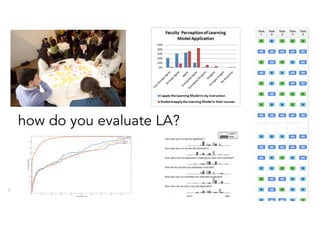
how do you evaluate LA?
6
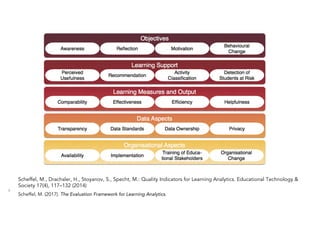
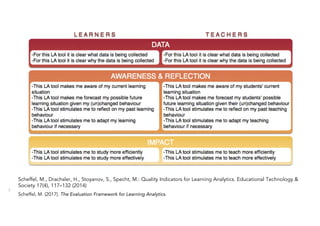
Scheffel, M., Drachsler, H., Stoyanov, S., Specht, M.: Quality Indicators for Learning Analytics. Educational Technology &
Society 17(4), 117–132 (2014)
Scheffel, M. (2017). The Evaluation Framework for Learning Analytics.
7
Scheffel, M., Drachsler, H., Stoyanov, S., Specht, M.: Quality Indicators for Learning Analytics. Educational Technology &
Society 17(4), 117–132 (2014)
Scheffel, M. (2017). The Evaluation Framework for Learning Analytics.
does LA help learning?
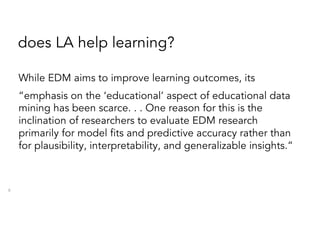
While EDM aims to improve learning outcomes, its
“emphasis on the ‘educational’ aspect of educational data
mining has been scarce. . . One reason for this is the
inclination of researchers to evaluate EDM research
primarily for model fits and predictive accuracy rather than
for plausibility, interpretability, and generalizable insights.”
8
does LA help learning?
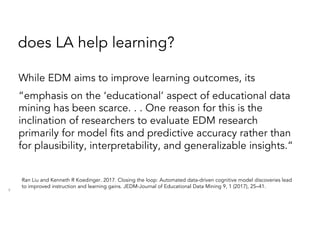
While EDM aims to improve learning outcomes, its
“emphasis on the ‘educational’ aspect of educational data
mining has been scarce. . . One reason for this is the
inclination of researchers to evaluate EDM research
primarily for model fits and predictive accuracy rather than
for plausibility, interpretability, and generalizable insights.”
9
Ran Liu and Kenneth R Koedinger. 2017. Closing the loop: Automated data-driven cognitive model discoveries lead
to improved instruction and learning gains. JEDM-Journal of Educational Data Mining 9, 1 (2017), 25–41.
AreW:https://www.flickr.com/photos/rwd/33305109244
10
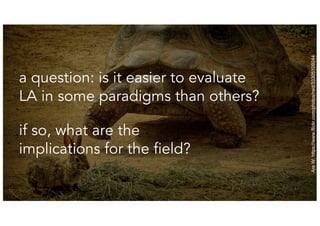
a question: is it easier to evaluate
LA in some paradigms than others?
if so, what are the
implications for the field?
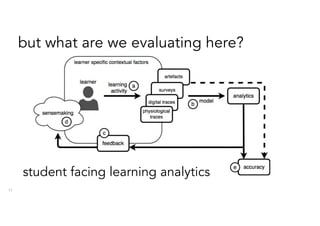
but what are we evaluating here?
11
student facing learning analytics
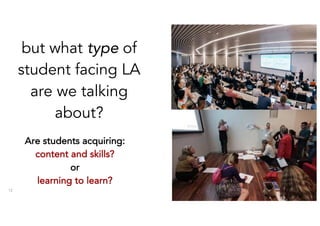
but what type of
student facing LA
are we talking
about?
Are students acquiring:
content and skills?
or
learning to learn?
12
13
14
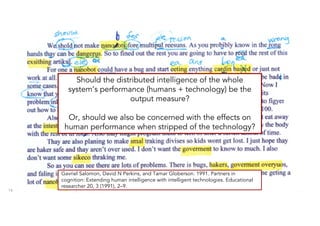
Should the distributed intelligence of the whole
system’s performance (humans + technology) be the
output measure?
Or, should we also be concerned with the effects on
human performance when stripped of the technology?
Gavriel Salomon, David N Perkins, and Tamar Globerson. 1991. Partners in
cognition: Extending human intelligence with intelligent technologies. Educational
researcher 20, 3 (1991), 2–9.
learning to learn
15
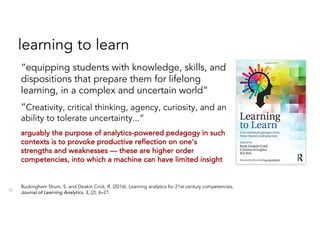
“equipping students with knowledge, skills, and
dispositions that prepare them for lifelong
learning, in a complex and uncertain world”
“Creativity, critical thinking, agency, curiosity, and an
ability to tolerate uncertainty...”
arguably the purpose of analytics-powered pedagogy in such
contexts is to provoke productive reflection on one’s
strengths and weaknesses — these are higher order
competencies, into which a machine can have limited insight
Buckingham Shum, S. and Deakin Crick, R. (2016). Learning analytics for 21st century competencies.
Journal of Learning Analytics, 3, (2), 6–21.
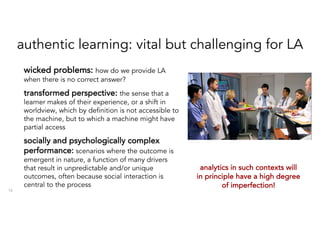
authentic learning: vital but challenging for LA
16
wicked problems: how do we provide LA
when there is no correct answer?
transformed perspective: the sense that a
learner makes of their experience, or a shift in
worldview, which by definition is not accessible to
the machine, but to which a machine might have
partial access
socially and psychologically complex
performance: scenarios where the outcome is
emergent in nature, a function of many drivers
that result in unpredictable and/or unique
outcomes, often because social interaction is
central to the process
analytics in such contexts will
in principle have a high degree
of imperfection!
17
Act 1:
perfection is not
possible
18
Turpin, Scholer (2006). User performance versus precision
measures for simple search tasks. In Proceedings of the 29th
annual international ACM SIGIR conference on Research and
development in information retrieval (pp. 11-18). ACM.
a cautionary tale
from information
retrieval
19
are we measuring what we value?
or merely valuing what we can
measure?
Gordon Wells and Guy Claxton. 2008. Learning for life in the 21st century: Sociocultural
perspectives on the future of education. John Wiley & Sons.
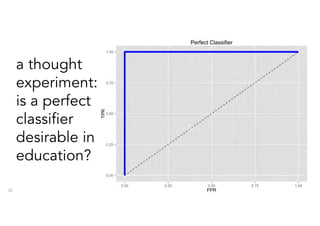
a thought
experiment:
is a perfect
classifier
desirable in
education?
20
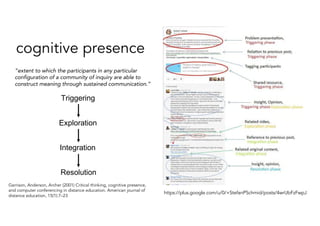
cognitive presence
https://plus.google.com/u/0/+StefanPSchmid/posts/4wrUbFzFwpJ
“extent to which the participants in any particular
configuration of a community of inquiry are able to
construct meaning through sustained communication.”
Triggering
Exploration
Integration
Resolution
Garrison, Anderson, Archer (2001) Critical thinking, cognitive presence,
and computer conferencing in distance education. American journal of
distance education, 15(1):7–23
Kovanović, Joksimović, Waters, Gašević, Kitto, Hatala, Siemens (2016).
Towards automated content analysis of discussion transcripts: a cognitive
presence case. In Proceedings of the Sixth International Conference on
Learning Analytics & Knowledge (LAK '16). ACM, New York, NY, USA, 15-24.
we can use machine
learning to classify
discussion forum text
using this construct
should we use it with students yet?
23
how accurate does it have to be?
data was unbalanced (solved using boosting)
▪ is it overfitted for one “type” of learning scenario?
▪ how accurate will it be if used in another context?
▪ how different does a situation have to be before we retrain?
how are we going to use it?
▪ who sees the classifications?
▪ what happens if the classifier is wrong?
24
25
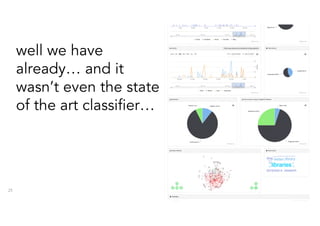
well we have
already… and it
wasn’t even the state
of the art classifier…
26
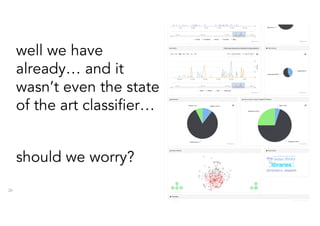
well we have
already… and it
wasn’t even the state
of the art classifier…
should we worry?
A very strong reflection from most recent trial?
27
In Week 2 I was very aspirational about the role I wanted to play; ‘I would like my profile
to be professional, respectful, organised, connected and visible. I aim to be an active
participant within “reflection and critical discourse that is the core dynamic of a
community of inquiry”. I achieved my aim of being an active participant as I made over
75 comments on my peers’ posts, averaging over 5 per week. However I feel I did not
participate fully in all 4 phases of the cognitive presence in the Practical [sic] Inquiry
Model; triggering event, exploration, integration and resolution – despite
having sentence openers taped next to my computer! Triggering events and some
exploration were met by sharing an interesting article relevant to a post I had read and
also asking some questions, but I felt a lot of my posts were agreeing with and
complimenting upon the erudite musings of my peers. I was definitely wary of
confronting differing ideas and promoting a critical discourse. This participation in all
cognitive phases needs improving so the sentence openers will remain up! [score=4]
Kirsty Kitto, Mandy Lupton, Kate Davis, and Zak Waters. 2017. Designing for student-facing learning analytics.
Australian Journal of Educational Technology, 33, 5 (2017), 152–168.
28
Act 2:
perfection is
not desirable
the Navajo rug
In a Navajo rug there is always an
imperfection woven into the corner. And
interestingly enough, it's where “the Spirit
moves in and out of the rug.” The pattern
is perfect and then there's one part of it
that clearly looks like a mistake …
Perfection is not the elimination of
imperfection. That's our Western either/or,
need-to-control thinking. Perfection,
rather, is the ability to incorporate
imperfection!
29
http://exhibitions.kelsey.lsa.umich.edu/less-than-perfect/navajo.php
Breathing Under Water: Spirituality and the 12 Steps,
by Richard Rohr
the Navajo rug
In a Navajo rug there is always an
imperfection woven into the corner. And
interestingly enough, it's where “the Spirit
moves in and out of the rug.” The pattern
is perfect and then there's one part of it
that clearly looks like a mistake …
Perfection is not the elimination of
imperfection. That's our Western either/or,
need-to-control thinking. Perfection,
rather, is the ability to incorporate
imperfection!
30
http://exhibitions.kelsey.lsa.umich.edu/less-than-perfect/navajo.php
Breathing Under Water: Spirituality and the 12 Steps,
by Richard Rohr
31
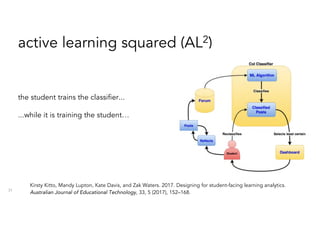
active learning squared (AL2)
the student trains the classifier...
...while it is training the student…
Kirsty Kitto, Mandy Lupton, Kate Davis, and Zak Waters. 2017. Designing for student-facing learning analytics.
Australian Journal of Educational Technology, 33, 5 (2017), 152–168.
32
33
34
35
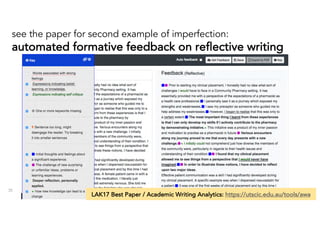
LAK17 Best Paper / Academic Writing Analytics: https://utscic.edu.au/tools/awa
see the paper for second example of imperfection:
automated formative feedback on reflective writing
36
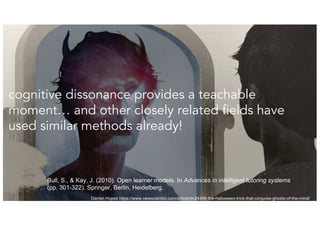
Darren Hopes https://www.newscientist.com/article/dn24466-the-halloween-trick-that-conjures-ghosts-of-the-mind/
cognitive dissonance provides a teachable
moment… and other closely related fields have
used similar methods already!
Bull, S., & Kay, J. (2010). Open learner models. In Advances in intelligent tutoring systems
(pp. 301-322). Springer, Berlin, Heidelberg.
embracing imperfection
37
so imperfection in our LA tools opens up new opportunities
▪ teachable moments
▪ intelligence augmentation
▪ mindful engagement with automated feedback
▪ learning to challenge computational decisions
▪ accelerates presence of more advanced LA in
education
but to get to this point we need to ensure that mature LA tools
are evaluated holistically!
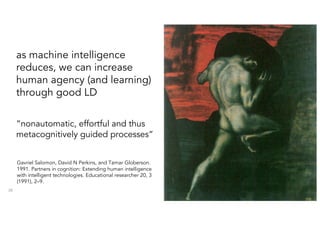
as machine intelligence
reduces, we can increase
human agency (and learning)
through good LD
38
Gavriel Salomon, David N Perkins, and Tamar Globerson.
1991. Partners in cognition: Extending human intelligence
with intelligent technologies. Educational researcher 20, 3
(1991), 2–9.
“nonautomatic, effortful and thus
metacognitively guided processes”
39
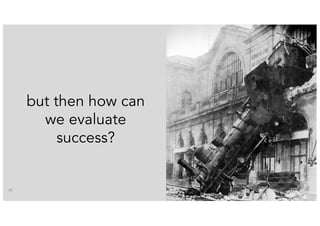
but then how can
we evaluate
success?
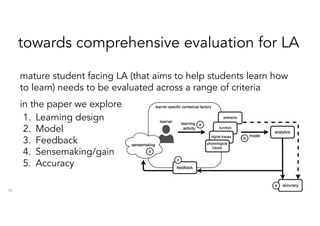
towards comprehensive evaluation for LA
mature student facing LA (that aims to help students learn how
to learn) needs to be evaluated across a range of criteria
in the paper we explore:
1. Learning design
2. Model
3. Feedback
4. Sensemaking/gain
5. Accuracy
40
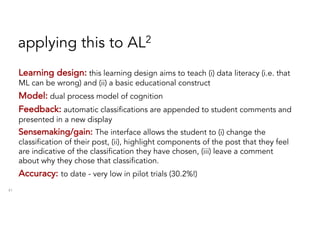
applying this to AL2
41
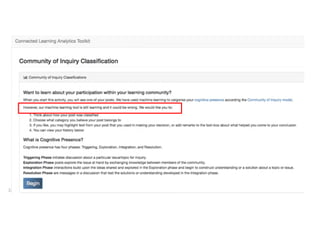
Learning design: this learning design aims to teach (i) data literacy (i.e. that
ML can be wrong) and (ii) a basic educational construct
Model: dual process model of cognition
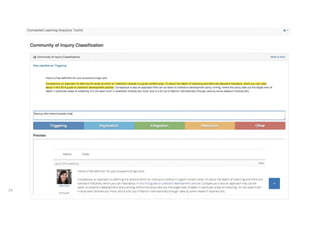
Feedback: automatic classifications are appended to student comments and
presented in a new display
Sensemaking/gain: The interface allows the student to (i) change the
classification of their post, (ii), highlight components of the post that they feel
are indicative of the classification they have chosen, (iii) leave a comment
about why they chose that classification.
Accuracy: to date - very low in pilot trials (30.2%!)
conclusions
42
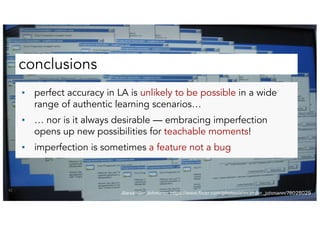
▪ perfect accuracy in LA is unlikely to be possible in a wide
range of authentic learning scenarios…
▪ … nor is it always desirable — embracing imperfection
opens up new possibilities for teachable moments!
▪ imperfection is sometimes a feature not a bug
Alexander Johmann: https://www.flickr.com/photos/alexander_johmann/78028029
Thanks!
Debate!
@kirstykitto
@sbuckshum
@andrewresearch
Open Access reprint:
http://bit.ly/NavajoRugLAK18
43

Embracing Imperfection in Learning Analytics

  • 1.
    Embracing Imperfection in LearningAnalytics Kirsty Kitto, Simon Buckingham Shum & Andrew Gibson UTS Connected Intelligence Centre @KirstyKitto • kirsty.kitto@uts.edu.au @sbuckshum • @AndrewResearch https://utscic.edu.au
  • 2.
  • 3.
    3 Photo by BlakeNewman from Pexels https://www.pexels.com/photo/matador-786645/ the overture
  • 4.
    4 how do youevaluate LA?
  • 5.
    5 how do youevaluate LA?
  • 6.
    6 Scheffel, M., Drachsler,H., Stoyanov, S., Specht, M.: Quality Indicators for Learning Analytics. Educational Technology & Society 17(4), 117–132 (2014) Scheffel, M. (2017). The Evaluation Framework for Learning Analytics.
  • 7.
    7 Scheffel, M., Drachsler,H., Stoyanov, S., Specht, M.: Quality Indicators for Learning Analytics. Educational Technology & Society 17(4), 117–132 (2014) Scheffel, M. (2017). The Evaluation Framework for Learning Analytics.
  • 8.
    does LA helplearning? While EDM aims to improve learning outcomes, its “emphasis on the ‘educational’ aspect of educational data mining has been scarce. . . One reason for this is the inclination of researchers to evaluate EDM research primarily for model fits and predictive accuracy rather than for plausibility, interpretability, and generalizable insights.” 8
  • 9.
    does LA helplearning? While EDM aims to improve learning outcomes, its “emphasis on the ‘educational’ aspect of educational data mining has been scarce. . . One reason for this is the inclination of researchers to evaluate EDM research primarily for model fits and predictive accuracy rather than for plausibility, interpretability, and generalizable insights.” 9 Ran Liu and Kenneth R Koedinger. 2017. Closing the loop: Automated data-driven cognitive model discoveries lead to improved instruction and learning gains. JEDM-Journal of Educational Data Mining 9, 1 (2017), 25–41.
  • 10.
    AreW:https://www.flickr.com/photos/rwd/33305109244 10 a question: isit easier to evaluate LA in some paradigms than others? if so, what are the implications for the field?
  • 11.
    but what arewe evaluating here? 11 student facing learning analytics
  • 12.
    but what typeof student facing LA are we talking about? Are students acquiring: content and skills? or learning to learn? 12
  • 13.
  • 14.
    14 Should the distributedintelligence of the whole system’s performance (humans + technology) be the output measure? Or, should we also be concerned with the effects on human performance when stripped of the technology? Gavriel Salomon, David N Perkins, and Tamar Globerson. 1991. Partners in cognition: Extending human intelligence with intelligent technologies. Educational researcher 20, 3 (1991), 2–9.
  • 15.
    learning to learn 15 “equippingstudents with knowledge, skills, and dispositions that prepare them for lifelong learning, in a complex and uncertain world” “Creativity, critical thinking, agency, curiosity, and an ability to tolerate uncertainty...” arguably the purpose of analytics-powered pedagogy in such contexts is to provoke productive reflection on one’s strengths and weaknesses — these are higher order competencies, into which a machine can have limited insight Buckingham Shum, S. and Deakin Crick, R. (2016). Learning analytics for 21st century competencies. Journal of Learning Analytics, 3, (2), 6–21.
  • 16.
    authentic learning: vitalbut challenging for LA 16 wicked problems: how do we provide LA when there is no correct answer? transformed perspective: the sense that a learner makes of their experience, or a shift in worldview, which by definition is not accessible to the machine, but to which a machine might have partial access socially and psychologically complex performance: scenarios where the outcome is emergent in nature, a function of many drivers that result in unpredictable and/or unique outcomes, often because social interaction is central to the process analytics in such contexts will in principle have a high degree of imperfection!
  • 17.
  • 18.
    18 Turpin, Scholer (2006).User performance versus precision measures for simple search tasks. In Proceedings of the 29th annual international ACM SIGIR conference on Research and development in information retrieval (pp. 11-18). ACM. a cautionary tale from information retrieval
  • 19.
    19 are we measuringwhat we value? or merely valuing what we can measure? Gordon Wells and Guy Claxton. 2008. Learning for life in the 21st century: Sociocultural perspectives on the future of education. John Wiley & Sons.
  • 20.
    a thought experiment: is aperfect classifier desirable in education? 20
  • 21.
    cognitive presence https://plus.google.com/u/0/+StefanPSchmid/posts/4wrUbFzFwpJ “extent towhich the participants in any particular configuration of a community of inquiry are able to construct meaning through sustained communication.” Triggering Exploration Integration Resolution Garrison, Anderson, Archer (2001) Critical thinking, cognitive presence, and computer conferencing in distance education. American journal of distance education, 15(1):7–23
  • 22.
    Kovanović, Joksimović, Waters,Gašević, Kitto, Hatala, Siemens (2016). Towards automated content analysis of discussion transcripts: a cognitive presence case. In Proceedings of the Sixth International Conference on Learning Analytics & Knowledge (LAK '16). ACM, New York, NY, USA, 15-24. we can use machine learning to classify discussion forum text using this construct
  • 23.
    should we useit with students yet? 23
  • 24.
    how accurate doesit have to be? data was unbalanced (solved using boosting) ▪ is it overfitted for one “type” of learning scenario? ▪ how accurate will it be if used in another context? ▪ how different does a situation have to be before we retrain? how are we going to use it? ▪ who sees the classifications? ▪ what happens if the classifier is wrong? 24
  • 25.
    25 well we have already…and it wasn’t even the state of the art classifier…
  • 26.
    26 well we have already…and it wasn’t even the state of the art classifier… should we worry?
  • 27.
    A very strongreflection from most recent trial? 27 In Week 2 I was very aspirational about the role I wanted to play; ‘I would like my profile to be professional, respectful, organised, connected and visible. I aim to be an active participant within “reflection and critical discourse that is the core dynamic of a community of inquiry”. I achieved my aim of being an active participant as I made over 75 comments on my peers’ posts, averaging over 5 per week. However I feel I did not participate fully in all 4 phases of the cognitive presence in the Practical [sic] Inquiry Model; triggering event, exploration, integration and resolution – despite having sentence openers taped next to my computer! Triggering events and some exploration were met by sharing an interesting article relevant to a post I had read and also asking some questions, but I felt a lot of my posts were agreeing with and complimenting upon the erudite musings of my peers. I was definitely wary of confronting differing ideas and promoting a critical discourse. This participation in all cognitive phases needs improving so the sentence openers will remain up! [score=4] Kirsty Kitto, Mandy Lupton, Kate Davis, and Zak Waters. 2017. Designing for student-facing learning analytics. Australian Journal of Educational Technology, 33, 5 (2017), 152–168.
  • 28.
  • 29.
    the Navajo rug Ina Navajo rug there is always an imperfection woven into the corner. And interestingly enough, it's where “the Spirit moves in and out of the rug.” The pattern is perfect and then there's one part of it that clearly looks like a mistake … Perfection is not the elimination of imperfection. That's our Western either/or, need-to-control thinking. Perfection, rather, is the ability to incorporate imperfection! 29 http://exhibitions.kelsey.lsa.umich.edu/less-than-perfect/navajo.php Breathing Under Water: Spirituality and the 12 Steps, by Richard Rohr
  • 30.
    the Navajo rug Ina Navajo rug there is always an imperfection woven into the corner. And interestingly enough, it's where “the Spirit moves in and out of the rug.” The pattern is perfect and then there's one part of it that clearly looks like a mistake … Perfection is not the elimination of imperfection. That's our Western either/or, need-to-control thinking. Perfection, rather, is the ability to incorporate imperfection! 30 http://exhibitions.kelsey.lsa.umich.edu/less-than-perfect/navajo.php Breathing Under Water: Spirituality and the 12 Steps, by Richard Rohr
  • 31.
    31 active learning squared(AL2) the student trains the classifier... ...while it is training the student… Kirsty Kitto, Mandy Lupton, Kate Davis, and Zak Waters. 2017. Designing for student-facing learning analytics. Australian Journal of Educational Technology, 33, 5 (2017), 152–168.
  • 32.
  • 33.
  • 34.
  • 35.
    35 LAK17 Best Paper/ Academic Writing Analytics: https://utscic.edu.au/tools/awa see the paper for second example of imperfection: automated formative feedback on reflective writing
  • 36.
    36 Darren Hopes https://www.newscientist.com/article/dn24466-the-halloween-trick-that-conjures-ghosts-of-the-mind/ cognitivedissonance provides a teachable moment… and other closely related fields have used similar methods already! Bull, S., & Kay, J. (2010). Open learner models. In Advances in intelligent tutoring systems (pp. 301-322). Springer, Berlin, Heidelberg.
  • 37.
    embracing imperfection 37 so imperfectionin our LA tools opens up new opportunities ▪ teachable moments ▪ intelligence augmentation ▪ mindful engagement with automated feedback ▪ learning to challenge computational decisions ▪ accelerates presence of more advanced LA in education but to get to this point we need to ensure that mature LA tools are evaluated holistically!
  • 38.
    as machine intelligence reduces,we can increase human agency (and learning) through good LD 38 Gavriel Salomon, David N Perkins, and Tamar Globerson. 1991. Partners in cognition: Extending human intelligence with intelligent technologies. Educational researcher 20, 3 (1991), 2–9. “nonautomatic, effortful and thus metacognitively guided processes”
  • 39.
    39 but then howcan we evaluate success?
  • 40.
    towards comprehensive evaluationfor LA mature student facing LA (that aims to help students learn how to learn) needs to be evaluated across a range of criteria in the paper we explore: 1. Learning design 2. Model 3. Feedback 4. Sensemaking/gain 5. Accuracy 40
  • 41.
    applying this toAL2 41 Learning design: this learning design aims to teach (i) data literacy (i.e. that ML can be wrong) and (ii) a basic educational construct Model: dual process model of cognition Feedback: automatic classifications are appended to student comments and presented in a new display Sensemaking/gain: The interface allows the student to (i) change the classification of their post, (ii), highlight components of the post that they feel are indicative of the classification they have chosen, (iii) leave a comment about why they chose that classification. Accuracy: to date - very low in pilot trials (30.2%!)
  • 42.
    conclusions 42 ▪ perfect accuracyin LA is unlikely to be possible in a wide range of authentic learning scenarios… ▪ … nor is it always desirable — embracing imperfection opens up new possibilities for teachable moments! ▪ imperfection is sometimes a feature not a bug Alexander Johmann: https://www.flickr.com/photos/alexander_johmann/78028029
  • 43.