At work in the phenomenal field: can
 there be a person centred library?
   Nick’s research, beginning 2013
Our values define us and guide our
       decision-making behaviour
• We are;                                 •   Critical in our thinking:
                                          •   aspirational, challenging, researching,
•   Student-centred:                      •   questioning, analytical, innovative,
•   maximising potential, nurturing       •   independent thinking.
    talent,
•   respecting individuality, holistic.   •   Professional:
                                          •   relevant, contemporary, ambitious,
•   Focused on specialist creative        •   achieving, international, employable,
•   communities:                          •   entrepreneurial, networked with
•   collaborative, interactive,               industry.
    multidisciplinary,
•   studio-focused,                       •   Progressive:
•   externally engaged.                   •   beautiful, unconventional, risk-
                                              taking,
                                          •   experimental, radical, responsive.
Our values define us and guide our
     decision-making behaviour
• Are we?                       • Are we?
• maximising                    • relevant, contemporary,
  potential, nurturing            ambitious, achieving,
  talent, respecting              international,
  individuality, holistic.      • employable,
• collaborative, interactive,     entrepreneurial,
  multidisciplinary, studio-      networked with industry.
  focused, externally           • beautiful,
  engaged.                        unconventional, risk-
• aspirational, challenging,      taking,
  researching, questioning,     • experimental, radical,
  analytical, innovative, ind     responsive.
  ependent thinking.
Networking...
• Emma Coonan & Andy Walsh – both met at
  “Librarians as researchers”.
Networking...
• Emma Coonan & Andy Walsh – both met at
  “Librarians as researchers”.
• Emma challenged me to begin Twitter account
  in order to communicate about blog.
Networking...
• Emma Coonan & Andy Walsh – both met at
  “Librarians as researchers”.
• Emma challenged me to begin Twitter account
  in order to communicate about blog.
• Andy’s interest in “play” as means of exploring
  the library.
Networking...
• Emma Coonan & Andy Walsh – both met at
  “Librarians as researchers”.
• Emma challenged me to begin Twitter account
  in order to communicate about blog.
• Andy’s interest in “play” as means of exploring
  the library.
• Becky pointed out how my research idea fitted
  with the “Only connect” book proposition.
Networking...
• Submitted a proposal:


 At work in the phenomenal field:
   can there be a person centred
              library?
Networking...
• At work in the phenomenal field: can there be
  a person centred library?
• They asked me what this meant!
• I gave a further break down of the structure &
  content.
• Chapter proposal accepted!
Networking worked!
•   Now I only need to write it...
•   First draft by June
•   Publication Autumn 2013
•   So............................
“Only connect ...” discovery
pathways, library explorations, and
    the information adventure.
    A collection of information
        discovery journeys.
Free e-book distributed under Creative
          Commons licence
• The editors’ gave the following suggestions to
  consider:
• The agency for the discovery pathway rests with the
  learner both naturally and ethically - and we must
  recognise this
• The learner creates the connections as a means of
  achieving a narrative of his/her reality
• co-constructed or constructivist learning as opposed to
  transmission model; profound impact on our
  approaches to teaching and our understanding of
  learning as a negotiation of the info context, not an
  unquestioned acceptance of librarian diktats
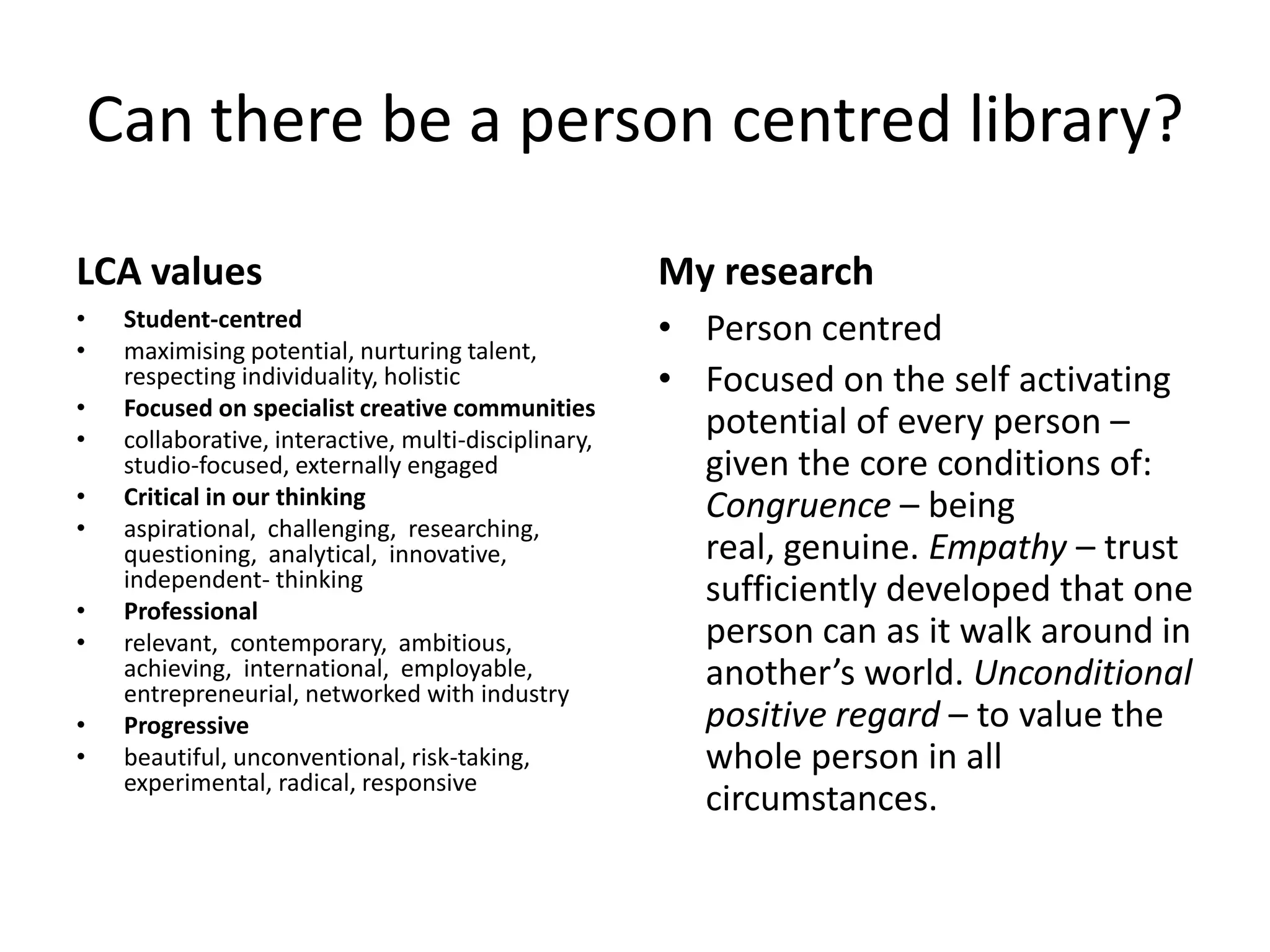
Can there be a person centred library?

LCA values                                             My research
•    Student-centred                                   • Person centred
•    maximising potential, nurturing talent,
     respecting individuality, holistic                • Focused on the self activating
•    Focused on specialist creative communities
•    collaborative, interactive, multi-disciplinary,
                                                         potential of every person –
     studio-focused, externally engaged                  given the core conditions of:
•    Critical in our thinking                            Congruence – being
•    aspirational, challenging, researching,
     questioning, analytical, innovative,                real, genuine. Empathy – trust
     independent- thinking                               sufficiently developed that one
•    Professional
•    relevant, contemporary, ambitious,                  person can as it walk around in
     achieving, international, employable,
     entrepreneurial, networked with industry
                                                         another’s world. Unconditional
•    Progressive                                         positive regard – to value the
•    beautiful, unconventional, risk-taking,             whole person in all
     experimental, radical, responsive
                                                         circumstances.
•   Realness in the facilitator of learning. Perhaps the most basic of
Carl R. Rogers (1902 -                          these essential attitudes is realness or genuineness. When the
                                                facilitator is a real person, being what she is, entering into a
1987)                                           relationship with the learner without presenting a front or a façade,
                                                she is much more likely to be effective. This means that the feelings
Carl Rogers has provided educators              that she is experiencing are available to her, available to her
                                                awareness, that she is able to live these feelings, be them, and able
with some fascinating and important             to communicate if appropriate. It means coming into a direct
questions with regard to their way of           personal encounter with the learner, meeting her on a person-to-
being with participants, and the                person basis. It means that she is being herself, not denying herself.
                                            •   Prizing, acceptance, trust. There is another attitude that stands out
processes they might employ. The                in those who are successful in facilitating learning… I think of it as
danger in his work for informal                 prizing the learner, prizing her feelings, her opinions, her person. It
educators lays in what has been a               is a caring for the learner, but a non-possessive caring. It is an
                                                acceptance of this other individual as a separate person, having
point of great attraction - his person-         worth in her own right. It is a basic trust - a belief that this other
centredness. Informal education is not          person is somehow fundamentally trustworthy… What we are
so much person-centred as dialogical.           describing is a prizing of the learner as an imperfect human being
                                                with many feelings, many potentialities. The facilitator’s prizing or
A focus on the other rather than on             acceptance of the learner is an operational expression of her
what lies between us could lead away            essential confidence and trust in the capacity of the human
from the relational into a rather selfish       organism.
individualism. Indeed, this criticism       •   Empathic understanding. A further element that establishes a
                                                climate for self-initiated experiential learning is emphatic
could also be made of the general               understanding. When the teacher has the ability to understand the
direction of his therapeutic                    student’s reactions from the inside, has a sensitive awareness of the
endeavours.                                     way the process of education and learning seems to the student,
                                                then again the likelihood of significant learning is increased….
                                                [Students feel deeply appreciative] when they are simply
                                                understood – not evaluated, not judged, simply understood from
http://www.infed.org/thinkers/et-               their own point of view, not the teacher’s. (Rogers 1967 304-311)
rogers.htm
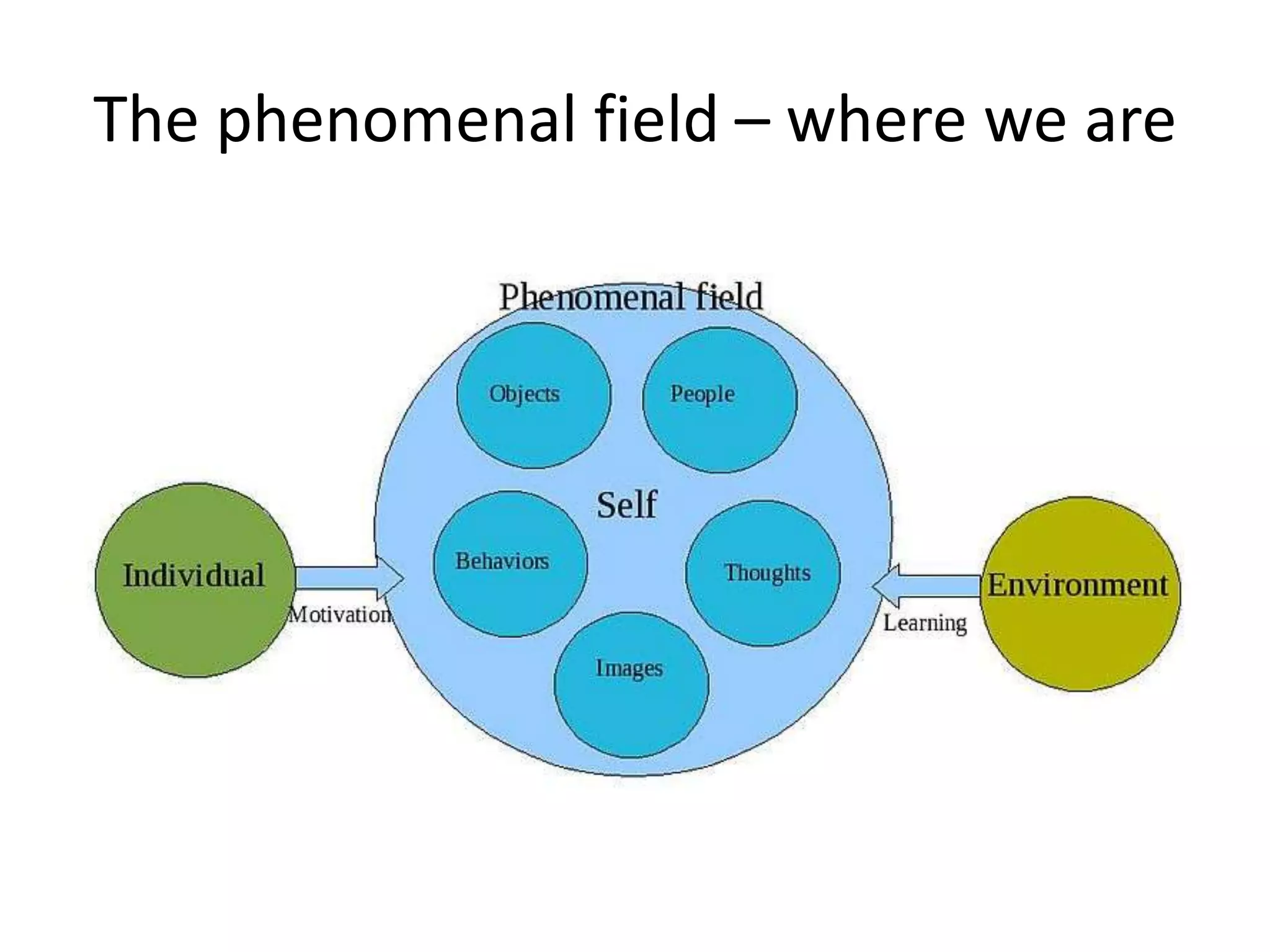
The phenomenal field – where we are
Is this your sense of “self”?
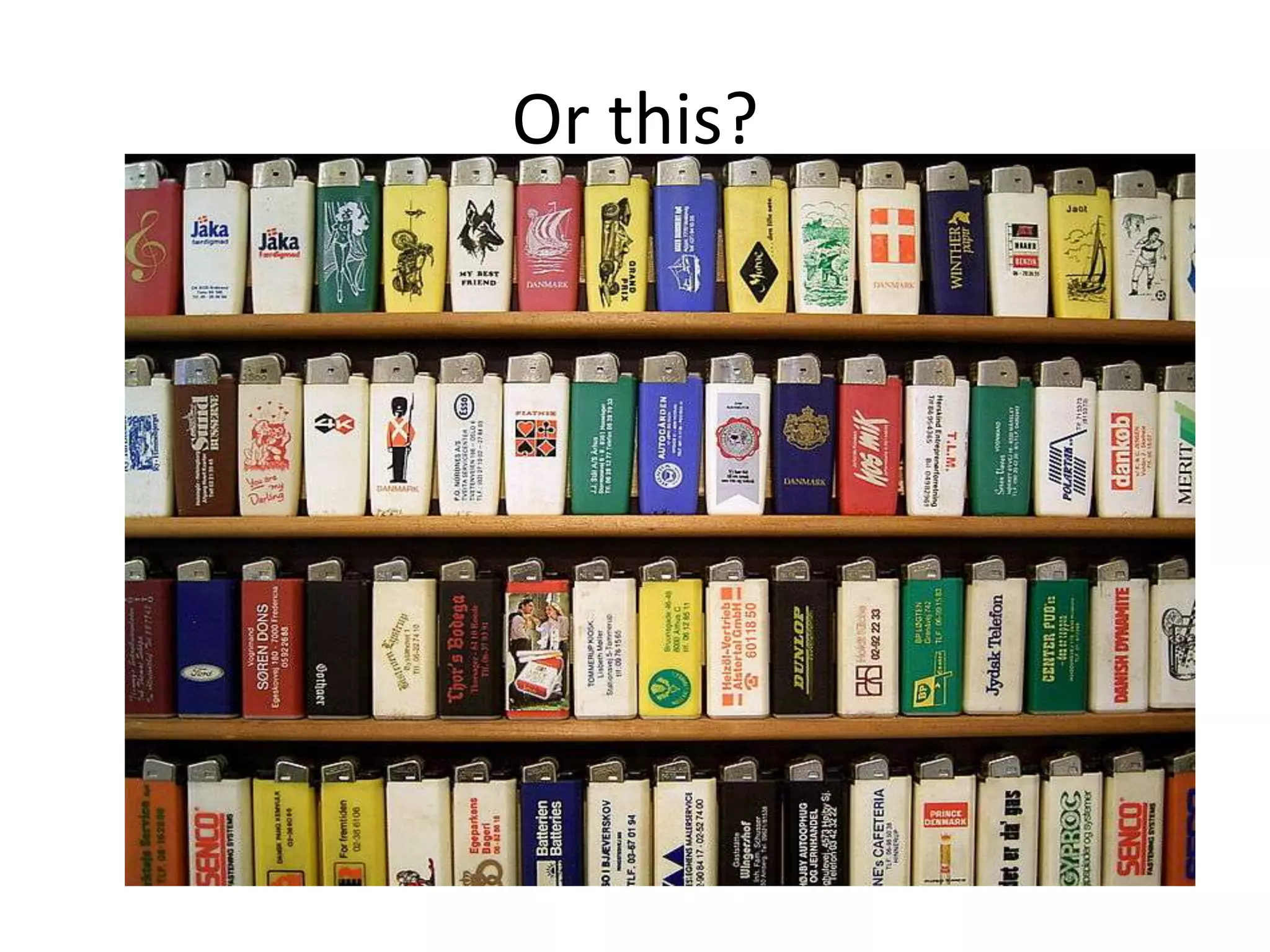
Or this?
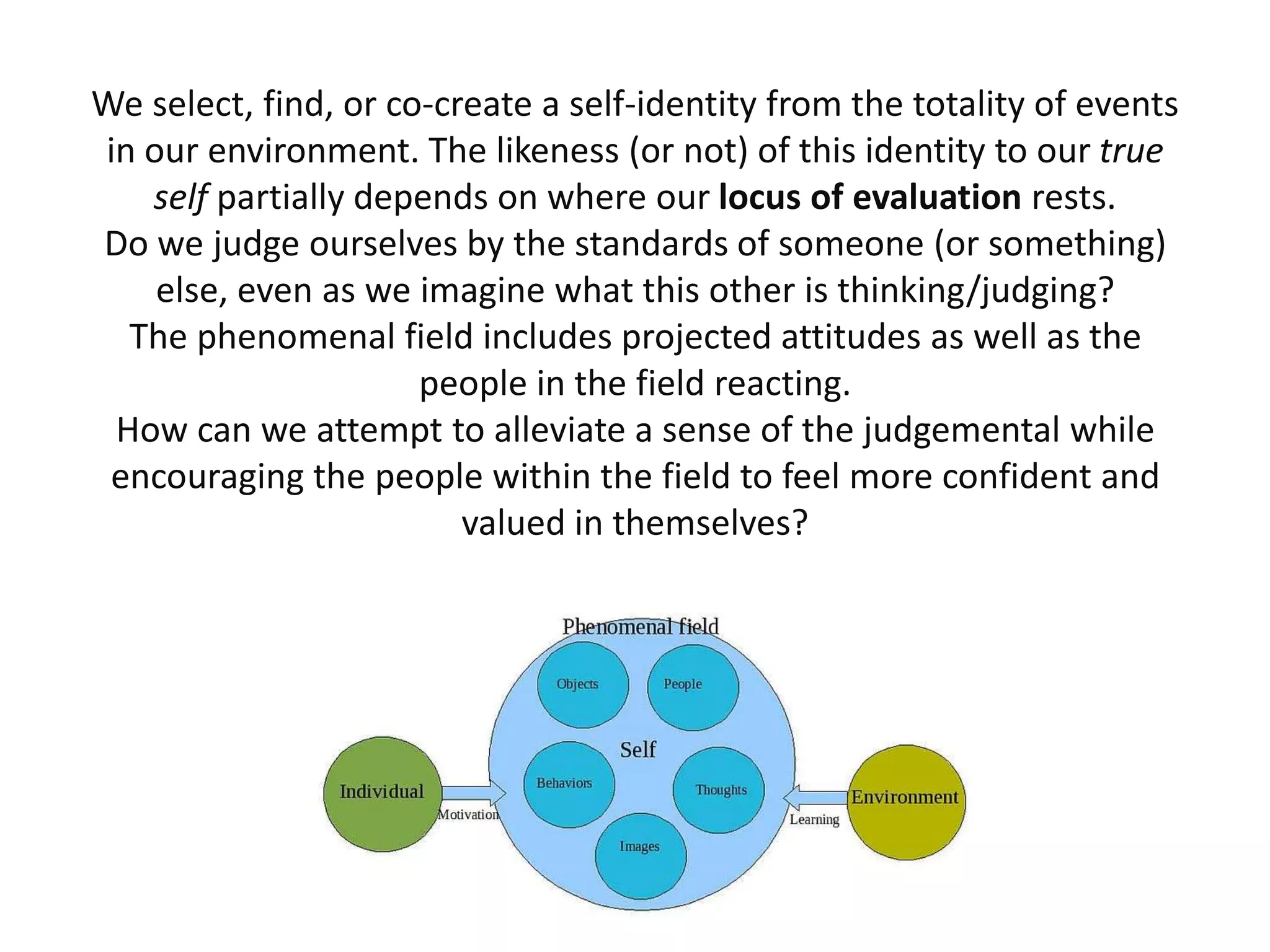
We select, find, or co-create a self-identity from the totality of events
in our environment. The likeness (or not) of this identity to our true
   self partially depends on where our locus of evaluation rests.
Do we judge ourselves by the standards of someone (or something)
    else, even as we imagine what this other is thinking/judging?
  The phenomenal field includes projected attitudes as well as the
                      people in the field reacting.
 How can we attempt to alleviate a sense of the judgemental while
 encouraging the people within the field to feel more confident and
                         valued in themselves?
Thoughts & processes
• This cannot be a purely theoretical text
• Dialogic
• Setting up conversations
• Library Interventions – exhibition series – this
  is the fruit of beginning a dialogue inspired by
  my blog; Adventure of Library
• http://nicknorton2.wordpress.com/
Library Interventions

     • Beginning conversations. A series
       of artist led interventions into
       the library context: book, books,
       collection, searchable archive,
       facilitated learning, thinking
       space, discovery, mapped and
       yet still uncharted territory.
     • 1st intervention: Garry Barker, Art
       and Fiction.
Suggestions
1.   The best time for first intervention & series launch would be
     September – allowing inductees to view. Also this will become
     part of LCA gallery marketing programme & provide time for
     further organisation
2.   Twitter: tweet “a bay a day” mirco-interventions
     (colour, title, sculpture, curriculum links), invite artists, course
     areas, any staff doing shelving to photograph a shelf and send as
     link + comment
3.   This continually curated space to be a “viral campaign” aka a viral
     feed... Use #tags to gain audience
4.   Cumulated posts could become a “zine” to be published at the
     launch
5.   Turn weeding into an auction/performance? Other “Library
     games”? Reading groups?
Dialogue
• Questions and answers, yes
• But
Dialogue
•          yes
• But
• Listening facilitates movement between
  question and answer
Dialogue


• Between territory and discovery
Dialogue


• Between persons
• The person centred approach began in a
  therapeutic context but proved useful in
  education & group dynamics. Carl Rogers was
  nominated for the Noble Peace Prize for his
  work in South African & N. Ireland peace
  processes...
• Can it have any value in a library context?
• Can it work in a library context?
• More conversations – the college has two
  qualified counsellors working in Student
  Services.
• It was pointed out that to value the person is
  not the same as being “merely” nice – it is a
  challenge.
Input
• To develop an ethos
• To be congruent across the whole service
• To set boundaries and establish an understanding
  of how we want to work
   – With one another
   – With the library user
   – With the collection
• To work out the limits of what is possible (or
  desirable)
• I need to look at other institutions also
• Ethical concerns – make institution and
  contributing voices anonymous, right of
  review, bring no harm
• As the author I speak only as an author rather
  than a representative of LCA library
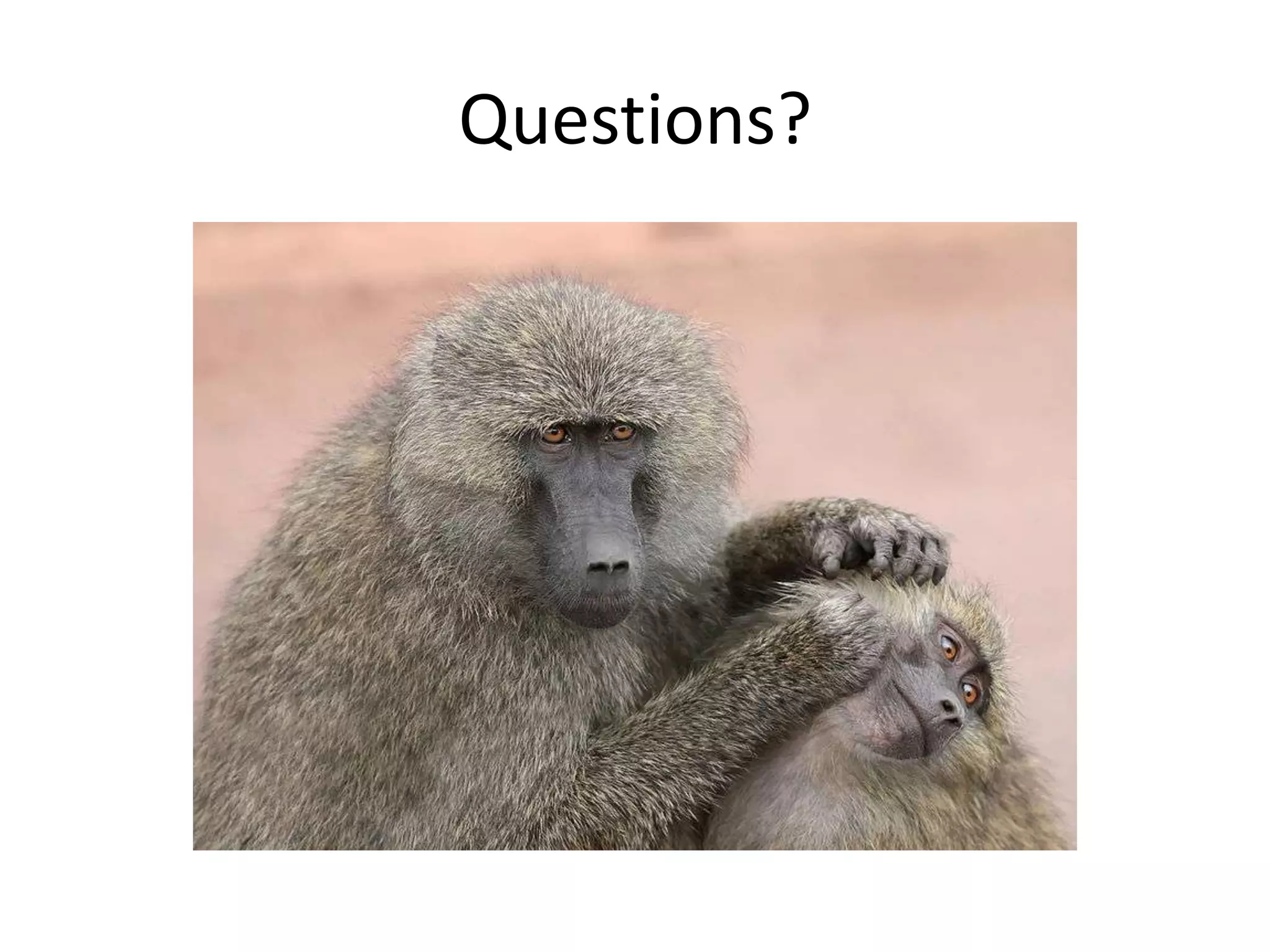
Questions?

At work in the phenomenal field, introduction to my research

  • 1.
    At work inthe phenomenal field: can there be a person centred library? Nick’s research, beginning 2013
  • 2.
    Our values defineus and guide our decision-making behaviour • We are; • Critical in our thinking: • aspirational, challenging, researching, • Student-centred: • questioning, analytical, innovative, • maximising potential, nurturing • independent thinking. talent, • respecting individuality, holistic. • Professional: • relevant, contemporary, ambitious, • Focused on specialist creative • achieving, international, employable, • communities: • entrepreneurial, networked with • collaborative, interactive, industry. multidisciplinary, • studio-focused, • Progressive: • externally engaged. • beautiful, unconventional, risk- taking, • experimental, radical, responsive.
  • 3.
    Our values defineus and guide our decision-making behaviour • Are we? • Are we? • maximising • relevant, contemporary, potential, nurturing ambitious, achieving, talent, respecting international, individuality, holistic. • employable, • collaborative, interactive, entrepreneurial, multidisciplinary, studio- networked with industry. focused, externally • beautiful, engaged. unconventional, risk- • aspirational, challenging, taking, researching, questioning, • experimental, radical, analytical, innovative, ind responsive. ependent thinking.
  • 4.
    Networking... • Emma Coonan& Andy Walsh – both met at “Librarians as researchers”.
  • 5.
    Networking... • Emma Coonan& Andy Walsh – both met at “Librarians as researchers”. • Emma challenged me to begin Twitter account in order to communicate about blog.
  • 6.
    Networking... • Emma Coonan& Andy Walsh – both met at “Librarians as researchers”. • Emma challenged me to begin Twitter account in order to communicate about blog. • Andy’s interest in “play” as means of exploring the library.
  • 7.
    Networking... • Emma Coonan& Andy Walsh – both met at “Librarians as researchers”. • Emma challenged me to begin Twitter account in order to communicate about blog. • Andy’s interest in “play” as means of exploring the library. • Becky pointed out how my research idea fitted with the “Only connect” book proposition.
  • 8.
    Networking... • Submitted aproposal: At work in the phenomenal field: can there be a person centred library?
  • 9.
    Networking... • At workin the phenomenal field: can there be a person centred library? • They asked me what this meant! • I gave a further break down of the structure & content. • Chapter proposal accepted!
  • 10.
    Networking worked! • Now I only need to write it... • First draft by June • Publication Autumn 2013 • So............................
  • 11.
    “Only connect ...”discovery pathways, library explorations, and the information adventure. A collection of information discovery journeys.
  • 12.
    Free e-book distributedunder Creative Commons licence • The editors’ gave the following suggestions to consider: • The agency for the discovery pathway rests with the learner both naturally and ethically - and we must recognise this • The learner creates the connections as a means of achieving a narrative of his/her reality • co-constructed or constructivist learning as opposed to transmission model; profound impact on our approaches to teaching and our understanding of learning as a negotiation of the info context, not an unquestioned acceptance of librarian diktats
  • 13.
    Can there bea person centred library? LCA values My research • Student-centred • Person centred • maximising potential, nurturing talent, respecting individuality, holistic • Focused on the self activating • Focused on specialist creative communities • collaborative, interactive, multi-disciplinary, potential of every person – studio-focused, externally engaged given the core conditions of: • Critical in our thinking Congruence – being • aspirational, challenging, researching, questioning, analytical, innovative, real, genuine. Empathy – trust independent- thinking sufficiently developed that one • Professional • relevant, contemporary, ambitious, person can as it walk around in achieving, international, employable, entrepreneurial, networked with industry another’s world. Unconditional • Progressive positive regard – to value the • beautiful, unconventional, risk-taking, whole person in all experimental, radical, responsive circumstances.
  • 14.
    Realness in the facilitator of learning. Perhaps the most basic of Carl R. Rogers (1902 - these essential attitudes is realness or genuineness. When the facilitator is a real person, being what she is, entering into a 1987) relationship with the learner without presenting a front or a façade, she is much more likely to be effective. This means that the feelings Carl Rogers has provided educators that she is experiencing are available to her, available to her awareness, that she is able to live these feelings, be them, and able with some fascinating and important to communicate if appropriate. It means coming into a direct questions with regard to their way of personal encounter with the learner, meeting her on a person-to- being with participants, and the person basis. It means that she is being herself, not denying herself. • Prizing, acceptance, trust. There is another attitude that stands out processes they might employ. The in those who are successful in facilitating learning… I think of it as danger in his work for informal prizing the learner, prizing her feelings, her opinions, her person. It educators lays in what has been a is a caring for the learner, but a non-possessive caring. It is an acceptance of this other individual as a separate person, having point of great attraction - his person- worth in her own right. It is a basic trust - a belief that this other centredness. Informal education is not person is somehow fundamentally trustworthy… What we are so much person-centred as dialogical. describing is a prizing of the learner as an imperfect human being with many feelings, many potentialities. The facilitator’s prizing or A focus on the other rather than on acceptance of the learner is an operational expression of her what lies between us could lead away essential confidence and trust in the capacity of the human from the relational into a rather selfish organism. individualism. Indeed, this criticism • Empathic understanding. A further element that establishes a climate for self-initiated experiential learning is emphatic could also be made of the general understanding. When the teacher has the ability to understand the direction of his therapeutic student’s reactions from the inside, has a sensitive awareness of the endeavours. way the process of education and learning seems to the student, then again the likelihood of significant learning is increased…. [Students feel deeply appreciative] when they are simply understood – not evaluated, not judged, simply understood from http://www.infed.org/thinkers/et- their own point of view, not the teacher’s. (Rogers 1967 304-311) rogers.htm
  • 15.
    The phenomenal field– where we are
  • 16.
    Is this yoursense of “self”?
  • 17.
  • 18.
    We select, find,or co-create a self-identity from the totality of events in our environment. The likeness (or not) of this identity to our true self partially depends on where our locus of evaluation rests. Do we judge ourselves by the standards of someone (or something) else, even as we imagine what this other is thinking/judging? The phenomenal field includes projected attitudes as well as the people in the field reacting. How can we attempt to alleviate a sense of the judgemental while encouraging the people within the field to feel more confident and valued in themselves?
  • 19.
    Thoughts & processes •This cannot be a purely theoretical text • Dialogic • Setting up conversations • Library Interventions – exhibition series – this is the fruit of beginning a dialogue inspired by my blog; Adventure of Library • http://nicknorton2.wordpress.com/
  • 20.
    Library Interventions • Beginning conversations. A series of artist led interventions into the library context: book, books, collection, searchable archive, facilitated learning, thinking space, discovery, mapped and yet still uncharted territory. • 1st intervention: Garry Barker, Art and Fiction.
  • 21.
    Suggestions 1. The best time for first intervention & series launch would be September – allowing inductees to view. Also this will become part of LCA gallery marketing programme & provide time for further organisation 2. Twitter: tweet “a bay a day” mirco-interventions (colour, title, sculpture, curriculum links), invite artists, course areas, any staff doing shelving to photograph a shelf and send as link + comment 3. This continually curated space to be a “viral campaign” aka a viral feed... Use #tags to gain audience 4. Cumulated posts could become a “zine” to be published at the launch 5. Turn weeding into an auction/performance? Other “Library games”? Reading groups?
  • 22.
    Dialogue • Questions andanswers, yes • But
  • 23.
    Dialogue • yes • But • Listening facilitates movement between question and answer
  • 24.
  • 25.
  • 26.
    • The personcentred approach began in a therapeutic context but proved useful in education & group dynamics. Carl Rogers was nominated for the Noble Peace Prize for his work in South African & N. Ireland peace processes... • Can it have any value in a library context?
  • 27.
    • Can itwork in a library context? • More conversations – the college has two qualified counsellors working in Student Services. • It was pointed out that to value the person is not the same as being “merely” nice – it is a challenge.
  • 28.
    Input • To developan ethos • To be congruent across the whole service • To set boundaries and establish an understanding of how we want to work – With one another – With the library user – With the collection • To work out the limits of what is possible (or desirable)
  • 29.
    • I needto look at other institutions also • Ethical concerns – make institution and contributing voices anonymous, right of review, bring no harm • As the author I speak only as an author rather than a representative of LCA library
  • 30.

Editor's Notes

  • #3 LCA values taken from the current Strategic Plan.
  • #13 From Innovative Libraries website. The editors’ opening position