Postmortem changes
1
Forensic Taphonomy
(“taphos”=grave ;
“nomos”=law)
2
Signs of death
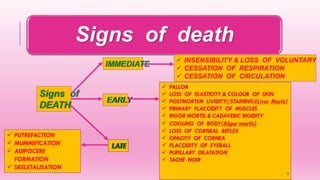
 INSENSIBILITY & LOSS OF VOLUNTARY P
 CESSATION OF RESPIRATION
 CESSATION OF CIRCULATION
3
4
5
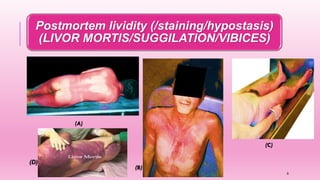
Postmortem lividity (/staining/hypostasis)
(LIVOR MORTIS/SUGGILATION/VIBICES)
(D)
6
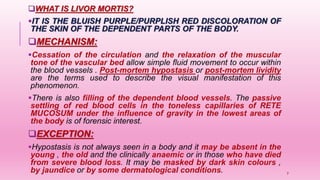
7
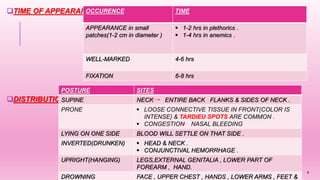
TIME OF APPEARANCE:
DISTRIBUTION:
OCCURENCE TIME
APPEARANCE in small
patches(1-2 cm in diameter )
 1-2 hrs in plethorics .
 1-4 hrs in anemics .
WELL-MARKED 4-6 hrs
FIXATION 6-8 hrs
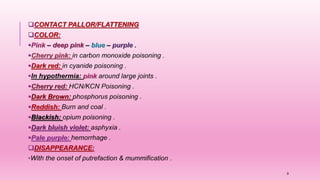
POSTURE SITES
SUPINE NECK ENTIRE BACK FLANKS & SIDES OF NECK .
PRONE  LOOSE CONNECTIVE TISSUE IN FRONT(COLOR IS
INTENSE) & TARDIEU SPOTS ARE COMMON .
 CONGESTION NASAL BLEEDING
LYING ON ONE SIDE BLOOD WILL SETTLE ON THAT SIDE .
INVERTED(DRUNKEN)  HEAD & NECK .
 CONJUNCTIVAL HEMORRHAGE .
UPRIGHT(HANGING) LEGS,EXTERNAL GENITALIA , LOWER PART OF
FOREARM , HAND.
DROWNING FACE , UPPER CHEST , HANDS , LOWER ARMS , FEET &
8
9
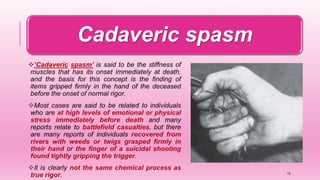
Cadaveric spasm
10
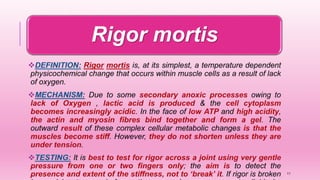
Rigor mortis
11
12
13
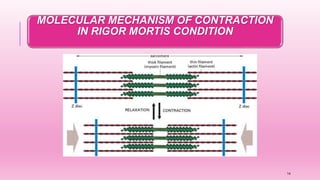
MOLECULAR MECHANISM OF CONTRACTION
IN RIGOR MORTIS CONDITION
14
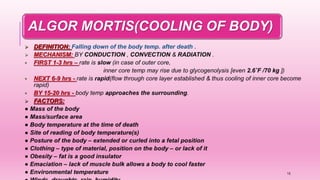
ALGOR MORTIS(COOLING OF BODY)
15
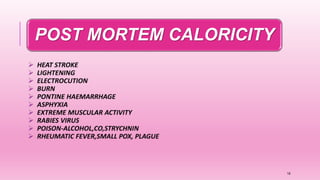
POST MORTEM CALORICITY
16
17
DECOMPOSITION
18
STAGES OF PUTREFACTION
19
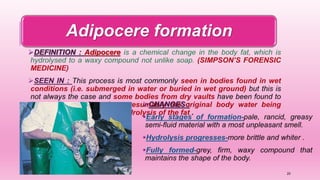
Adipocere formation
20
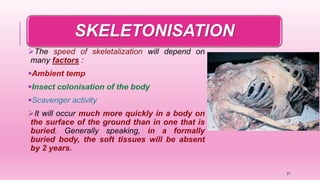
SKELETONISATION
21
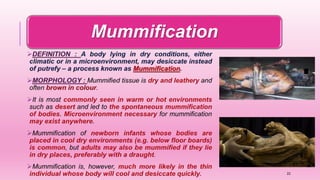
Mummification
22
BIBLIOGRAPHY
23
24
25

Postmortem changes

Editor's Notes

  • #7 A) Post-mortem hypostasis in a posterior distribution. Areas of pallor can be seen as a result of pressure of the body on a firm surface, whereas parts of the body not in direct contact with that surface are purple/ pink because of the ‘settling of blood under gravity’. This body has been lying on its back since death. B) Post-mortem hypostasis pattern on the front of a body found face down on a bed. The linear marks are formed by pressure from creases in a blanket. Pallor around the mouth and nose are caused by pressure against the bed and do not necessarily indicate marks of suffocation. C) Post-mortem hypostasis distribution following hanging. Note the skin discoloration is in the legs and hands because of the vertical body position after death and the green discoloration in the right iliac fossa region.
  • #11 FIG : Cadaveric rigidity – a rare post-mortem finding that may be seen in bodies recovered from water, where vegetation is found tightly ‘gripped’ in the hand.