Dr. Sarika Sawant presented on research ethics at a seminar. She discussed the definition of research ethics as regulating scientific activity to protect human participants and serve societal interests. She covered objectives like ensuring consent and oversight. Issues discussed included plagiarism, data handling, and research with humans and animals. National guidelines in India were also presented, as well as UNESCO's ethical guidelines focusing on informed consent, confidentiality, and integrity.
Research Ethics
Dr. Sarika Sawant
Refresher Course in Lib and Inf Science
Organised by VPM’s Joshi-Bedekar College
Date: 24th Aug to 13th Sept 2012
Theme: Facets of Information
Management in Libraries
Seminar Presentation 30/08/2012
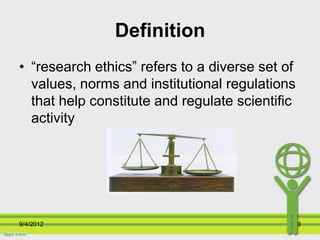
Definition
• “research ethics”refers to a diverse set of
values, norms and institutional regulations
that help constitute and regulate scientific
activity
9/4/2012 3
4.
Objectives of ResearchEthics
• to protect human participants
• to ensure that research is conducted in a
way that serves interests of individuals,
groups and/or society as a whole
• to examine specific research activities and
projects for their ethical soundness,
protection of confidentiality and the
process of informed consent.
9/4/2012 4
5.
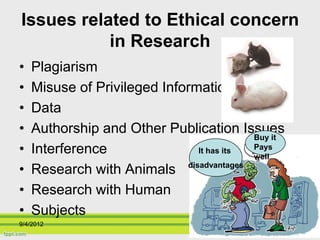
Issues related toEthical concern
in Research
• Plagiarism
• Misuse of Privileged Information
• Data
• Authorship and Other Publication Issues
Buy it
• Interference It has its Pays
well
• Research with Animals disadvantages
• Research with Human
• Subjects
9/4/2012 5
6.
National level ethical
guidelines
• Indian Council of Medical Research :
Ethical Guidelines for Biomedical
Research on Human participants
• National Committee for Ethics in Social
Science Research in Health :“Ethical
Guidelines for Social Science Research in
Health
• TIFR
9/4/2012 6
7.
UNESCO: Ethical Guidelines
•Principal investigators
• Integrity of the research enterprise is
maintained
• Potential benefit / harmful effects to the
participants and society
• Consider the effects of his/her work,
including the consequences or misuse
9/4/2012 7
8.
Contd.
• Competent fashion
•Awareness of, local customs, standards,
laws and regulations
• Informed consent
• Potential participants should be informed
about potentially harmful effects
• Full confidentiality
9/4/2012 8
9.
Contd.
• Participants shouldbe offered access to
research results
• Reported widely
• Acknowledged
• Preserved
9/4/2012 9
10.
References
• Center forbioethics, University of Minnesota. (2003). A guide
to research ethics. Available at
http://www.ahc.umn.edu/img/assets/26104/Research_Ethics.p
df
• National Committee for Research Ethics in Science and
Technology. (2007). Guidelines for Research Ethics in
Science and Technology. Available at
http://www.etikkom.no/Documents/English-
publications/Guidelines%20for%20research%20ethics%20in
%20science%20and%20technology%20(2008).pdf
• Walton, N. (n.d.). What is Research Ethics? Available at
http://www.researchethics.ca/what-is-research-ethics.htm
• www.bbk.ac.uk/.../research-
ethics/ethics/2_Research_Ethics_in.
9/4/2012 10
11.
Thank You
Keep following ethical guidelines
while doing research
9/4/2012 11