Presentation on
Ipsita Sahoo
Reg no- 200705180160
Presented by-
Introduction
Introduction
Fish Health Management GOALS
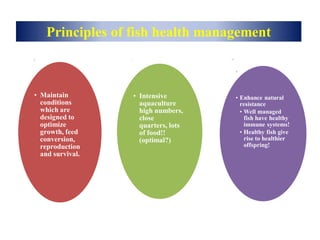
Principles of fish health management
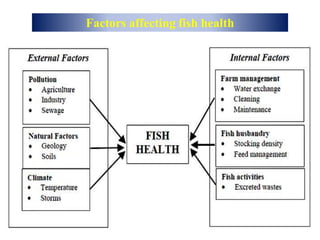
Factors affecting fish health
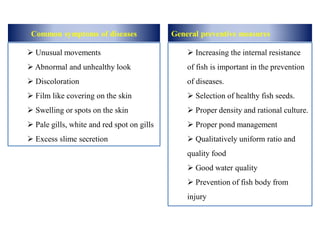
Common symptoms of diseases
General preventive measures
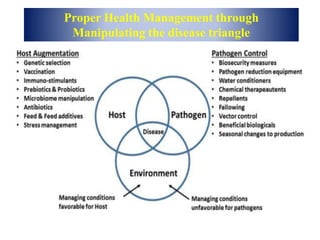
Proper Health Management through
Manipulating the disease triangle
Conclusion
References
 Fish health management is a term used in aquaculture to
describe management practices which are designed to
prevent fish disease. Once fish get sick it can be difficult to
salvage them.
Successful fish health management begins with prevention
of disease rather than treatment. Prevention of fish disease is
accomplished through good water quality
management, nutrition and sanitation. Without this
foundation it is impossible to prevent outbreaks of
opportunistic diseases.
 The first point to appreciate is that not all diseases are
infectious. For example, some are caused by toxins, others
by nutritional imbalances.
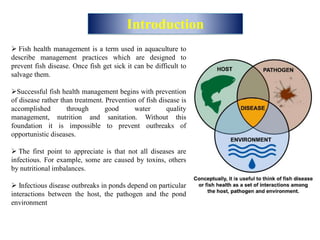
 Infectious disease outbreaks in ponds depend on particular
interactions between the host, the pathogen and the pond
environment
Introduction
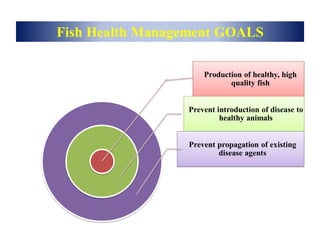
Fish Health Management GOALS
Production of healthy, high
quality fish
Prevent introduction of disease to
healthy animals
Prevent propagation of existing
disease agents
• Maintain
conditions
which are
designed to
optimize
growth, feed
conversion,
reproduction
and survival.
2
• Intensive
aquaculture
high numbers,
close
quarters, lots
of food!!
(optimal?)
3
• Enhance natural
resistance
• Well managed
fish have healthy
immune systems!
• Healthy fish give
rise to healthier
offspring!
Principles of fish health management
Factors affecting fish health
 Unusual movements
 Abnormal and unhealthy look
 Discoloration
 Film like covering on the skin
 Swelling or spots on the skin
 Pale gills, white and red spot on gills
 Excess slime secretion
 Increasing the internal resistance
of fish is important in the prevention
of diseases.
 Selection of healthy fish seeds.
 Proper density and rational culture.
 Proper pond management
 Qualitatively uniform ratio and
quality food
 Good water quality
 Prevention of fish body from
injury
Common symptoms of diseases General preventive measures
Proper Health Management through
Manipulating the disease triangle
 Fish disease outbreaks are often complex, involving both infectious and non-
infectious processes.
 Appropriate therapy often involves medication and changes in husbandry
practices. Assistance from UF/IFAS aquaculture extension specialists is available
to help you to manage disease outbreaks and develop management programs to
prevent them.
 A list of public laboratories available to assist with diagnoses of fish disease is
provided for your convenience at the end of this publication.
 There are many private veterinarians willing to see fish or aquaculture species
in their practice.
Conclusion
References
 Lio-Po, Gilda D., Celia R. Lavilla, and Erlinda R. Cruz-Lacierda. Health
management in aquaculture. Aquaculture Department, Southeast Asian
Fisheries Development Center, 2001.
 Bondad-Reantaso, M. G., Subasinghe, R. P., Arthur, J. R., Ogawa, K.,
Chinabut, S., Adlard, R., ... & Shariff, M. (2005). Disease and health
management in Asian aquaculture. Veterinary parasitology, 132(3-4), 249-
272.
Meyer, F. P. (1991). Aquaculture disease and health management. Journal
of animal science, 69(10), 4201-4208.
Fish Health Management

Fish Health Management

  • 1.
    Presentation on Ipsita Sahoo Regno- 200705180160 Presented by-
  • 2.
    Introduction Introduction Fish Health ManagementGOALS Principles of fish health management Factors affecting fish health Common symptoms of diseases General preventive measures Proper Health Management through Manipulating the disease triangle Conclusion References
  • 3.
     Fish healthmanagement is a term used in aquaculture to describe management practices which are designed to prevent fish disease. Once fish get sick it can be difficult to salvage them. Successful fish health management begins with prevention of disease rather than treatment. Prevention of fish disease is accomplished through good water quality management, nutrition and sanitation. Without this foundation it is impossible to prevent outbreaks of opportunistic diseases.  The first point to appreciate is that not all diseases are infectious. For example, some are caused by toxins, others by nutritional imbalances.  Infectious disease outbreaks in ponds depend on particular interactions between the host, the pathogen and the pond environment Introduction
  • 4.
    Fish Health ManagementGOALS Production of healthy, high quality fish Prevent introduction of disease to healthy animals Prevent propagation of existing disease agents
  • 5.
    • Maintain conditions which are designedto optimize growth, feed conversion, reproduction and survival. 2 • Intensive aquaculture high numbers, close quarters, lots of food!! (optimal?) 3 • Enhance natural resistance • Well managed fish have healthy immune systems! • Healthy fish give rise to healthier offspring! Principles of fish health management
  • 6.
  • 7.
     Unusual movements Abnormal and unhealthy look  Discoloration  Film like covering on the skin  Swelling or spots on the skin  Pale gills, white and red spot on gills  Excess slime secretion  Increasing the internal resistance of fish is important in the prevention of diseases.  Selection of healthy fish seeds.  Proper density and rational culture.  Proper pond management  Qualitatively uniform ratio and quality food  Good water quality  Prevention of fish body from injury Common symptoms of diseases General preventive measures
  • 8.
    Proper Health Managementthrough Manipulating the disease triangle
  • 9.
     Fish diseaseoutbreaks are often complex, involving both infectious and non- infectious processes.  Appropriate therapy often involves medication and changes in husbandry practices. Assistance from UF/IFAS aquaculture extension specialists is available to help you to manage disease outbreaks and develop management programs to prevent them.  A list of public laboratories available to assist with diagnoses of fish disease is provided for your convenience at the end of this publication.  There are many private veterinarians willing to see fish or aquaculture species in their practice. Conclusion
  • 10.
    References  Lio-Po, GildaD., Celia R. Lavilla, and Erlinda R. Cruz-Lacierda. Health management in aquaculture. Aquaculture Department, Southeast Asian Fisheries Development Center, 2001.  Bondad-Reantaso, M. G., Subasinghe, R. P., Arthur, J. R., Ogawa, K., Chinabut, S., Adlard, R., ... & Shariff, M. (2005). Disease and health management in Asian aquaculture. Veterinary parasitology, 132(3-4), 249- 272. Meyer, F. P. (1991). Aquaculture disease and health management. Journal of animal science, 69(10), 4201-4208.