

HelioScope Updates
May 2017
1
About
2
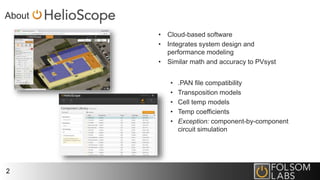
• Cloud-based software
• Integrates system design and
performance modeling
• Similar math and accuracy to PVsyst
• .PAN file compatibility
• Transposition models
• Cell temp models
• Temp coefficients
• Exception: component-by-component
circuit simulation
About
3
• Considered bankable by IEs, banks,
owners, and developers
• Residential, commercial, and utility-
scale
• 600k projects to date in 160 countries
• Taught at universities across the world
Updates to HelioScope
Performance Modeling
• Spectral adjustment for CdTe modules
• Next generation shading engine
Engineering Process
• Team management & design defaults
• Single line diagram
• Financial integration (Energy Toolbase)
• Standardized shade reports
Design Environment
• Interactive 3D environment
• Field segment heights
• East-west racking
• Automatic stringing based on ASHRAE
data
• Dual-MPPT inverters
• LiDAR
• Faster layout algorithm
4
Oct 2016
May 2017
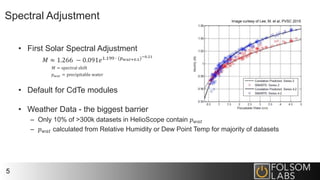
Spectral Adjustment
• First Solar Spectral Adjustment
𝑀 ≈ 1.266 − 0.091𝑒1.199 ∙ (𝑝 𝑤𝑎𝑡+0.5)−0.21
𝑀 = spectral shift
𝑝 𝑤𝑎𝑡 = precipitable water
• Default for CdTe modules
• Weather Data - the biggest barrier
– Only 10% of >300k datasets in HelioScope contain 𝑝 𝑤𝑎𝑡
– 𝑝 𝑤𝑎𝑡 calculated from Relative Humidity or Dew Point Temp for majority of datasets
5
Image curtesy of Lee, M. et al, PVSC 2015
Updates to HelioScope
Performance Modeling
• Spectral adjustment for CdTe modules
• Next generation shading engine
Engineering Process
• Team management & design defaults
• Single line diagram
• Financial integration (Energy Toolbase)
• Standardized shade reports
Design Environment
• Interactive 3D environment
• Field segment heights
• East-west racking
• Automatic stringing based on ASHRAE data
• Dual-MPPT inverters
• LiDAR
• Faster layout algorithm
6
Oct 2016
May 2017
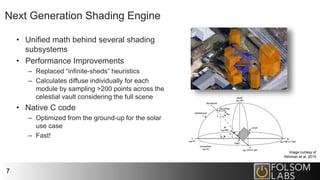
Next Generation Shading Engine
• Unified math behind several shading
subsystems
• Performance Improvements
– Replaced “infinite-sheds” heuristics
– Calculates diffuse individually for each
module by sampling >200 points across the
celestial vault considering the full scene
• Native C code
– Optimized from the ground-up for the solar
use case
– Fast!
7
Image curtesy of
Rehman et al, 2015
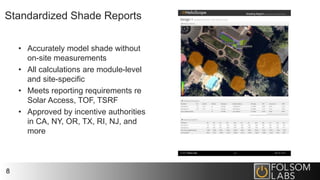
Standardized Shade Reports
• Accurately model shade without
on-site measurements
• All calculations are module-level
and site-specific
• Meets reporting requirements re
Solar Access, TOF, TSRF
• Approved by incentive authorities
in CA, NY, OR, TX, RI, NJ, and
more
8
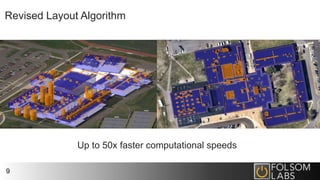
Revised Layout Algorithm
Up to 50x faster computational speeds
9
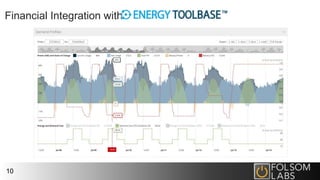
Financial Integration with
10
DEMO
http://help.helioscope.com/article/14-5-minute-overview
https://www.helioscope.com/webinars
11
Product Roadmap
• Financial and utility rate engine
• Customer-facing proposal tool
• Single-axis trackers
• and many more; see blog.helioscope.com for the latest
12
Thank you!
13
Questions and Comments?
Teresa W. Zhang, PhD
teresa.zhang@folsomlabs.com
14

13 helioscope pvpmc 2017v4

  • 1.
  • 2.
    About 2 • Cloud-based software •Integrates system design and performance modeling • Similar math and accuracy to PVsyst • .PAN file compatibility • Transposition models • Cell temp models • Temp coefficients • Exception: component-by-component circuit simulation
  • 3.
    About 3 • Considered bankableby IEs, banks, owners, and developers • Residential, commercial, and utility- scale • 600k projects to date in 160 countries • Taught at universities across the world
  • 4.
    Updates to HelioScope PerformanceModeling • Spectral adjustment for CdTe modules • Next generation shading engine Engineering Process • Team management & design defaults • Single line diagram • Financial integration (Energy Toolbase) • Standardized shade reports Design Environment • Interactive 3D environment • Field segment heights • East-west racking • Automatic stringing based on ASHRAE data • Dual-MPPT inverters • LiDAR • Faster layout algorithm 4 Oct 2016 May 2017
  • 5.
    Spectral Adjustment • FirstSolar Spectral Adjustment 𝑀 ≈ 1.266 − 0.091𝑒1.199 ∙ (𝑝 𝑤𝑎𝑡+0.5)−0.21 𝑀 = spectral shift 𝑝 𝑤𝑎𝑡 = precipitable water • Default for CdTe modules • Weather Data - the biggest barrier – Only 10% of >300k datasets in HelioScope contain 𝑝 𝑤𝑎𝑡 – 𝑝 𝑤𝑎𝑡 calculated from Relative Humidity or Dew Point Temp for majority of datasets 5 Image curtesy of Lee, M. et al, PVSC 2015
  • 6.
    Updates to HelioScope PerformanceModeling • Spectral adjustment for CdTe modules • Next generation shading engine Engineering Process • Team management & design defaults • Single line diagram • Financial integration (Energy Toolbase) • Standardized shade reports Design Environment • Interactive 3D environment • Field segment heights • East-west racking • Automatic stringing based on ASHRAE data • Dual-MPPT inverters • LiDAR • Faster layout algorithm 6 Oct 2016 May 2017
  • 7.
    Next Generation ShadingEngine • Unified math behind several shading subsystems • Performance Improvements – Replaced “infinite-sheds” heuristics – Calculates diffuse individually for each module by sampling >200 points across the celestial vault considering the full scene • Native C code – Optimized from the ground-up for the solar use case – Fast! 7 Image curtesy of Rehman et al, 2015
  • 8.
    Standardized Shade Reports •Accurately model shade without on-site measurements • All calculations are module-level and site-specific • Meets reporting requirements re Solar Access, TOF, TSRF • Approved by incentive authorities in CA, NY, OR, TX, RI, NJ, and more 8
  • 9.
    Revised Layout Algorithm Upto 50x faster computational speeds 9
  • 10.
  • 11.
  • 12.
    Product Roadmap • Financialand utility rate engine • Customer-facing proposal tool • Single-axis trackers • and many more; see blog.helioscope.com for the latest 12
  • 13.
  • 14.
    Questions and Comments? TeresaW. Zhang, PhD teresa.zhang@folsomlabs.com 14

Editor's Notes

  • #3 BUT higher precision .PAN file compatibility (40k module characterizations, 300k weather files spanning the globe) Transposition models (Hay & Perez) Cell temp models (Sandia & Diffusion) Temp coeffs (Fixed-tilt & flush-mount) Exception: component-by-component circuit simulation Calculates - voltage at every step, resistance of conductors - mismatch based on shading
  • #4 BTW, educational discount
  • #5 Last fall – largest release to date, HelioScope 2.0
  • #7 September – largest release to date
  • #10 Intelligently recalculates only necessary portions of the scene Recalculates shading for complex projects and projects with thousands of modules in fractions of a second. Design update times ---- Large (2MW blocks): 1-2s Typical commercial: 3s Very complex: >10s  < 0.25s
  • #11 Best-in-class financial analyses and custom proposals Financials include utility rate schedules (3-full time staff) tax credits and NEM 2.0 scenarios