How to present a journal club?
Contents 
Introduction 
Definition of journal 
 Need of the journal club 
Evolution of journal 
Definition of journal club 
Aim and goal of journal club
Contents contd…. 
Types of journal club 
How to start a journal club 
Impact of journal club 
Evaluation of journal club 
Conclusion 
References
Introduction 
Medical literature is continually 
expanding 
Concepts, ideas, beliefs are undergoing rapid 
transformation. 
Imperative on the part of academicians, 
practitioners, students and the researchers to keep 
up with the vast amount of information available.
Introduction contd… 
The journal club provides a forum to remain 
current with the literature and also offers an 
opportunity to learn methods of critically 
evaluating journal articles. 
Journal clubs are usually organized 
around a defined subject in basic or 
applied research.
Definition of journal 
It is a periodical , aimed at a particular discipline.
Different from a magazine
Why do we need to read 
journals? 
To impress 
To keep abreast 
of professional 
news 
To understand 
patho-biology 
Learn clinical 
features and 
cause 
Whether to use a 
new or existing 
diagnostic test 
Handling of a 
problem 
To distinguish 
useful from 
harmful 
Need of health 
care, quality 
and cost 
effectiveness 
To be titillated 
by letters to 
the editors
Different types of scientific 
writing 
Original article 
Case report 
Review article 
Editorial 
Letters to the editor
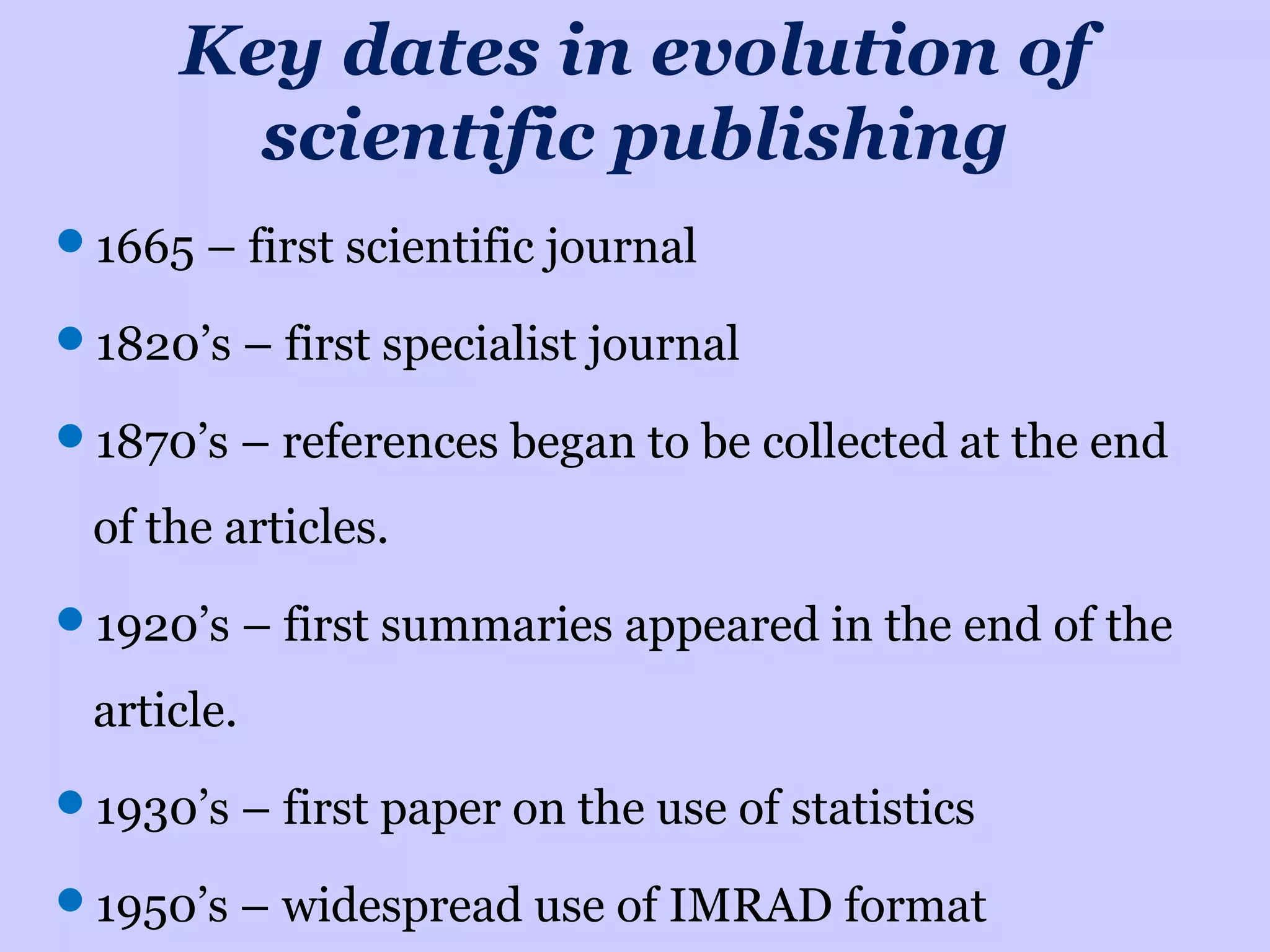
Key dates in evolution of 
scientific publishing 
1665 – first scientific journal 
1820’s – first specialist journal 
1870’s – references began to be collected at the end 
of the articles. 
1920’s – first summaries appeared in the end of the 
article. 
1930’s – first paper on the use of statistics 
1950’s – widespread use of IMRAD format
Key dates in evolution of scientific 
publishing contd… 
1960’s- summaries at the end became abstract 
1970’s – database introduced 
1980’s – first international conference on peer-review. 
1990’s – introduction of electronic journal.
Classification of scientific 
papers 
Data driven papers 
Tutorial papers 
Method mongering papers 
Consciousness raising papers. 
Theoretical papers. 
Review papers. 
Demonstration of concept papers.
Definition of journal club 
A journal club is a group of individual who meet 
regularly to critically read, understand and evaluate 
recent articles published in medical or dental 
literature.
Historical background of 
journal club 
Journal clubs have been used as a teaching or 
learning format in academic medicine for over a 
hundred years. 
The earliest reference to a journal club is found in 
a book of memoirs and letters by the late Sir James 
Paget, a British surgeon.
Historical background of journal 
club contd… 
He describes a group at St. Bartholomew’s 
hospital in London 1835-1854 AD. 
Sir William Osler is often recognized as the 
founder of journal clubs in North America in 
McGill University in 1875 AD.
Aim of Journal club 
Till 1980’s it was to provide its member with up-to 
date medical literature but quite recently it has 
become a forum for teaching and learning critical 
appraisal techniques and a method to promote 
evidence-based medical practice.
Common journal club goals 
1. Providing participation with an update of medical 
or dental literature. 
2. Teaching and learning the technique of critical 
appraisal of available literature. 
3. Promoting the importance of valid research 
findings into regular practice at individual 
or community level.
Benefits 
Learning presentation skill 
Feedback to the presenter. 
Better performance.
Responsibility
Timetable and location
Preparation 
Encourage the presenter to plan ahead. 
Confirmed presentation. 
Papers should be handed out to participant to read 
in advance.
Presentation 
Chalk and talk 
Overhead projector 
Power point
Delivery
Types of journal clubs 
1. Journal clubs aimed at updating knowledge related to a 
field of interest. 
2.Journal club aimed at updating clinical practice. 

3. Journal club which aim at teaching and learning critical 
appraisal techniques with evidence based medicine and 
dentistry. 
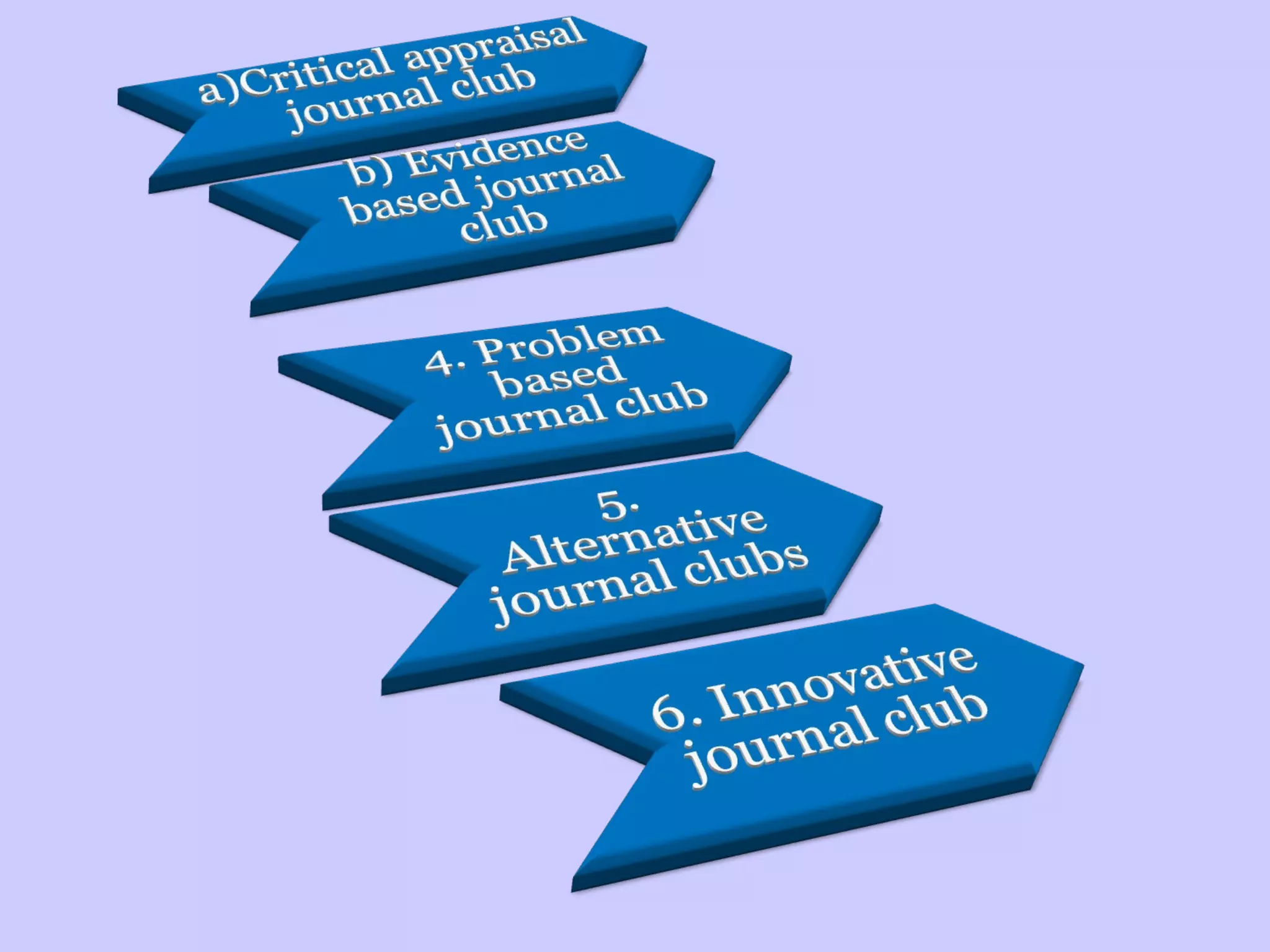
a) critical appraisal Journal club 
b) evidence based Journal club
4. Problem based journal club- centered on a problem. 
- format 
5. Alternative journal club- video, book, review and 
storytelling 
6. Innovative journal club-a) 
relating the learning task to immediate work 
experience 
b) use of problem solving 
c) use of multiple teaching format 
d) use of frequent constructive format.
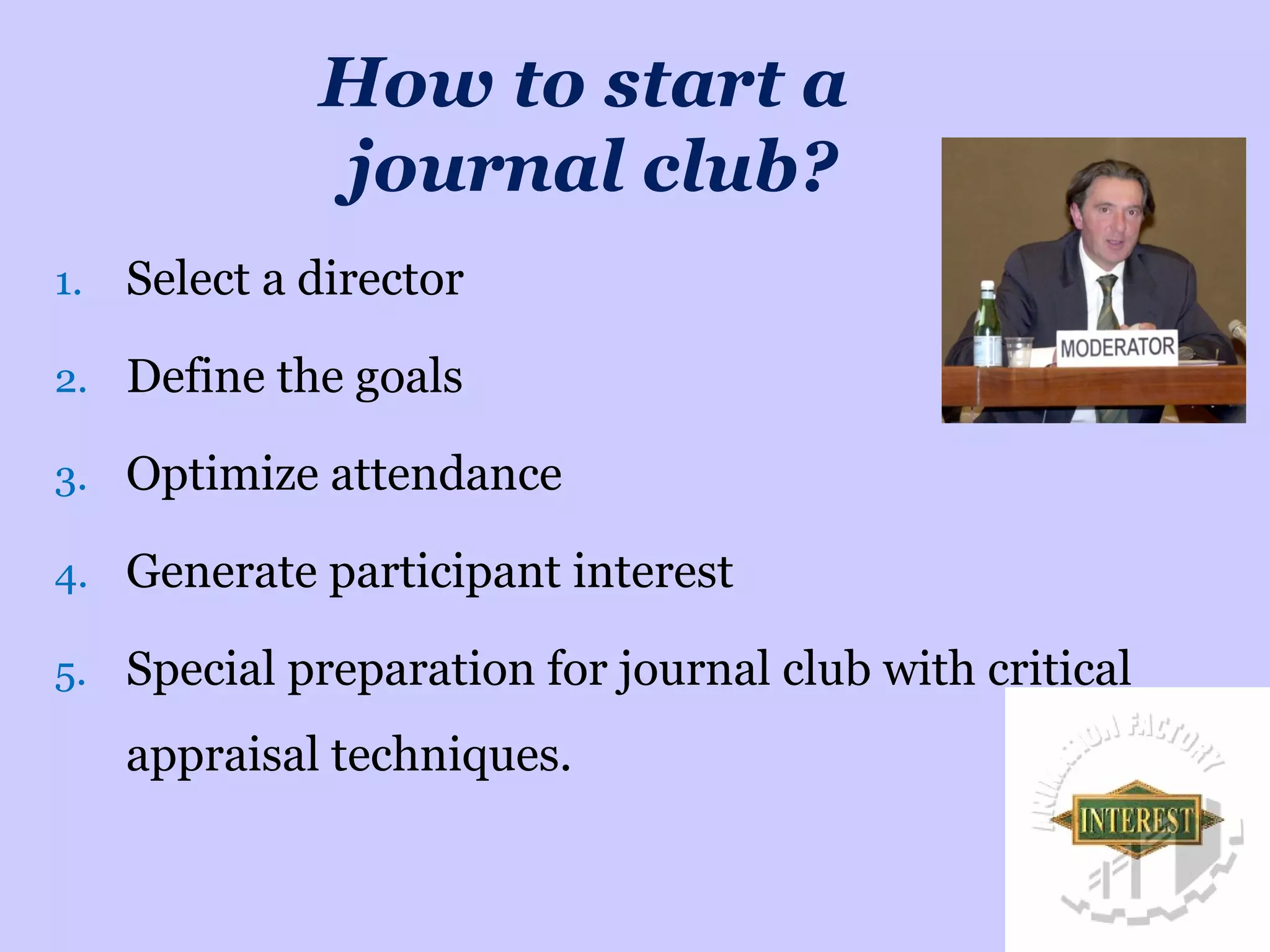
How to start a 
journal club? 
1. Select a director 
2. Define the goals 
3. Optimize attendance 
4. Generate participant interest 
5. Special preparation for journal club with critical 
appraisal techniques.
Guidelines 
Introduction 
Short review 
Presenting and evaluating the data from the research 
article 
Briefly outline the experimental design for the paper. 
By using the key figures from the paper, how the 
data support the conclusion 
Conclusion
Journal club should include 
Title 
Author and place of work 
Introduction 
Material 
Methods 
Results 
Discussion 
What questions to ask? 
General rules.
Journal club format 
Articles are selected by director and proposed by 
student earlier. 
Approval 2-3 weeks before. 
A specific participant is assigned the task of 
presenting the article. 
Student should confidently present the content, 
evaluation report with his/her own opinion and 
defend with proper reasoning.
Journal club session
Journal club session 
Round table 
conference 
Horse shoe 
shaped
Journal club session contd… 
1. Horse shoe or round table 
2. Presenter initiates and lead the discussion 
3. Moderator solicit the comments from participating 
to stimulate discussion when they are not 
forthcoming. 
4. Director should direct the session and break 
impasse when confronted by one 
5. An attempt should be made by the members to 
reach consensus especially in the wake of divergent 
opinions.
Do’s and don’ts 
Organizer 
Presenter 
•Timetable 
•Snacks 
•Supportive senior clinician 
•Things for last minute 
•Choose clinically relevant 
papers 
•Summary in own words 
•Don’t run over the 
allocated time
Select articles which have different study designs 
Creating a controversy 
Meticulous analysis of a single article 
Problem based learning
Why journal club 
Journal clubs are valued as a means 
of keeping abreast with the literature. 
Journal club offers a forum for teaching and learning 
critical appraisal techniques.
Impact of journal club 
Improves reading habits by enabling critical 
thinking, meta-questioning, meta-thinking etc. 
It expands the body of knowledge within a person. 
It facilitates acquisition of new skills. 
It induces scientific temperament by promoting 
questioning attitude.
Impact of journal club contd… 
Make the members to be more skeptical of the 
authors conclusion. 
It improves knowledge of clinical epidemiology and 
biostatistics.
Evaluation of journal club 
In order to keep the journal club stimulating to its 
audience it will probably have to undergo periodic 
refinement. 
The best way to decide whether any adjustment are 
necessary is to ask the participant whether they are 
satisfied with the conference.
Conclusion
References 
Nagesh L. a hand book on journal club and critical 
evaluation.1st edition Davangere: kavitha printers and 
book binding works. 
Daniel RS. Techniques in medical education.BMJ 
2002;325:137. 
Valentini RP. The journal club. Technique in medical 
education 96; 16:5-10.
How to present a journal club

How to present a journal club

  • 1.
    How to presenta journal club?
  • 2.
    Contents Introduction Definitionof journal  Need of the journal club Evolution of journal Definition of journal club Aim and goal of journal club
  • 3.
    Contents contd…. Typesof journal club How to start a journal club Impact of journal club Evaluation of journal club Conclusion References
  • 4.
    Introduction Medical literatureis continually expanding Concepts, ideas, beliefs are undergoing rapid transformation. Imperative on the part of academicians, practitioners, students and the researchers to keep up with the vast amount of information available.
  • 5.
    Introduction contd… Thejournal club provides a forum to remain current with the literature and also offers an opportunity to learn methods of critically evaluating journal articles. Journal clubs are usually organized around a defined subject in basic or applied research.
  • 6.
    Definition of journal It is a periodical , aimed at a particular discipline.
  • 7.
  • 8.
    Why do weneed to read journals? To impress To keep abreast of professional news To understand patho-biology Learn clinical features and cause Whether to use a new or existing diagnostic test Handling of a problem To distinguish useful from harmful Need of health care, quality and cost effectiveness To be titillated by letters to the editors
  • 9.
    Different types ofscientific writing Original article Case report Review article Editorial Letters to the editor
  • 10.
    Key dates inevolution of scientific publishing 1665 – first scientific journal 1820’s – first specialist journal 1870’s – references began to be collected at the end of the articles. 1920’s – first summaries appeared in the end of the article. 1930’s – first paper on the use of statistics 1950’s – widespread use of IMRAD format
  • 11.
    Key dates inevolution of scientific publishing contd… 1960’s- summaries at the end became abstract 1970’s – database introduced 1980’s – first international conference on peer-review. 1990’s – introduction of electronic journal.
  • 12.
    Classification of scientific papers Data driven papers Tutorial papers Method mongering papers Consciousness raising papers. Theoretical papers. Review papers. Demonstration of concept papers.
  • 13.
    Definition of journalclub A journal club is a group of individual who meet regularly to critically read, understand and evaluate recent articles published in medical or dental literature.
  • 14.
    Historical background of journal club Journal clubs have been used as a teaching or learning format in academic medicine for over a hundred years. The earliest reference to a journal club is found in a book of memoirs and letters by the late Sir James Paget, a British surgeon.
  • 15.
    Historical background ofjournal club contd… He describes a group at St. Bartholomew’s hospital in London 1835-1854 AD. Sir William Osler is often recognized as the founder of journal clubs in North America in McGill University in 1875 AD.
  • 16.
    Aim of Journalclub Till 1980’s it was to provide its member with up-to date medical literature but quite recently it has become a forum for teaching and learning critical appraisal techniques and a method to promote evidence-based medical practice.

  • 17.
    Common journal clubgoals 1. Providing participation with an update of medical or dental literature. 2. Teaching and learning the technique of critical appraisal of available literature. 3. Promoting the importance of valid research findings into regular practice at individual or community level.
  • 18.
    Benefits Learning presentationskill Feedback to the presenter. Better performance.
  • 19.
  • 20.
  • 21.
    Preparation Encourage thepresenter to plan ahead. Confirmed presentation. Papers should be handed out to participant to read in advance.
  • 22.
    Presentation Chalk andtalk Overhead projector Power point
  • 23.
  • 24.
    Types of journalclubs 1. Journal clubs aimed at updating knowledge related to a field of interest. 2.Journal club aimed at updating clinical practice. 3. Journal club which aim at teaching and learning critical appraisal techniques with evidence based medicine and dentistry. a) critical appraisal Journal club b) evidence based Journal club
  • 26.
    4. Problem basedjournal club- centered on a problem. - format 5. Alternative journal club- video, book, review and storytelling 6. Innovative journal club-a) relating the learning task to immediate work experience b) use of problem solving c) use of multiple teaching format d) use of frequent constructive format.
  • 27.
    How to starta journal club? 1. Select a director 2. Define the goals 3. Optimize attendance 4. Generate participant interest 5. Special preparation for journal club with critical appraisal techniques.
  • 28.
    Guidelines Introduction Shortreview Presenting and evaluating the data from the research article Briefly outline the experimental design for the paper. By using the key figures from the paper, how the data support the conclusion Conclusion
  • 29.
    Journal club shouldinclude Title Author and place of work Introduction Material Methods Results Discussion What questions to ask? General rules.
  • 30.
    Journal club format Articles are selected by director and proposed by student earlier. Approval 2-3 weeks before. A specific participant is assigned the task of presenting the article. Student should confidently present the content, evaluation report with his/her own opinion and defend with proper reasoning.
  • 31.
  • 32.
    Journal club session Round table conference Horse shoe shaped
  • 33.
    Journal club sessioncontd… 1. Horse shoe or round table 2. Presenter initiates and lead the discussion 3. Moderator solicit the comments from participating to stimulate discussion when they are not forthcoming. 4. Director should direct the session and break impasse when confronted by one 5. An attempt should be made by the members to reach consensus especially in the wake of divergent opinions.
  • 34.
    Do’s and don’ts Organizer Presenter •Timetable •Snacks •Supportive senior clinician •Things for last minute •Choose clinically relevant papers •Summary in own words •Don’t run over the allocated time
  • 35.
    Select articles whichhave different study designs Creating a controversy Meticulous analysis of a single article Problem based learning
  • 36.
    Why journal club Journal clubs are valued as a means of keeping abreast with the literature. Journal club offers a forum for teaching and learning critical appraisal techniques.
  • 37.
    Impact of journalclub Improves reading habits by enabling critical thinking, meta-questioning, meta-thinking etc. It expands the body of knowledge within a person. It facilitates acquisition of new skills. It induces scientific temperament by promoting questioning attitude.
  • 38.
    Impact of journalclub contd… Make the members to be more skeptical of the authors conclusion. It improves knowledge of clinical epidemiology and biostatistics.
  • 39.
    Evaluation of journalclub In order to keep the journal club stimulating to its audience it will probably have to undergo periodic refinement. The best way to decide whether any adjustment are necessary is to ask the participant whether they are satisfied with the conference.

  • 40.
  • 41.
    References Nagesh L.a hand book on journal club and critical evaluation.1st edition Davangere: kavitha printers and book binding works. Daniel RS. Techniques in medical education.BMJ 2002;325:137. Valentini RP. The journal club. Technique in medical education 96; 16:5-10.