microbemagic.ucc.ie
Taxonomy is the science dealing with the description,
identification, naming, and classification of organisms.
Classification is the ‘grouping’ of organisms based on
particular characters and is not arranged in hierarchical
order.
Taxonomy is the science dealing with the description,
identification, naming, and classification of organisms.
Taxonomy provides basic understanding about the
components of biodiversity which is necessary for effective
decision-making about conservation and sustainable use.
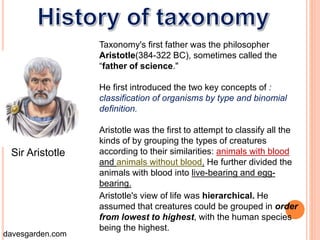
Taxonomy's first father was the philosopher
Aristotle(384-322 BC), sometimes called the
“father of science."
He first introduced the two key concepts of :
classification of organisms by type and binomial
definition.
Aristotle was the first to attempt to classify all the
kinds of by grouping the types of creatures
according to their similarities: animals with blood
and animals without blood. He further divided the
animals with blood into live-bearing and egg-
bearing.
Sir Aristotle
Aristotle's view of life was hierarchical. He
assumed that creatures could be grouped in order
from lowest to highest, with the human species
being the highest.
davesgarden.com
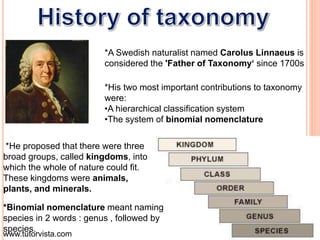
*A Swedish naturalist named Carolus Linnaeus is
considered the 'Father of Taxonomy‘ since 1700s
*His two most important contributions to taxonomy
were:
•A hierarchical classification system
•The system of binomial nomenclature
www.tutorvista.com
*He proposed that there were three
broad groups, called kingdoms, into
which the whole of nature could fit.
These kingdoms were animals,
plants, and minerals.
*Binomial nomenclature meant naming
species in 2 words : genus , followed by
species.
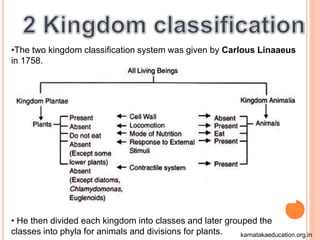
•The two kingdom classification system was given by Carlous Linaaeus
in 1758.
• He then divided each kingdom into classes and later grouped the
classes into phyla for animals and divisions for plants. karnatakaeducation.org.in
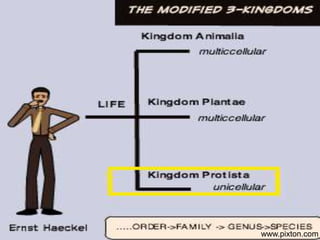
www.pixton.com
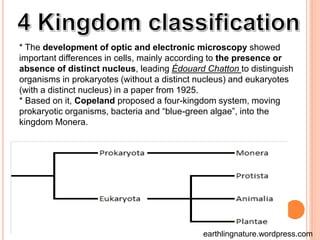
* The development of optic and electronic microscopy showed
important differences in cells, mainly according to the presence or
absence of distinct nucleus, leading Édouard Chatton to distinguish
organisms in prokaryotes (without a distinct nucleus) and eukaryotes
(with a distinct nucleus) in a paper from 1925.
* Based on it, Copeland proposed a four-kingdom system, moving
prokaryotic organisms, bacteria and “blue-green algae”, into the
kingdom Monera.
earthlingnature.wordpress.com
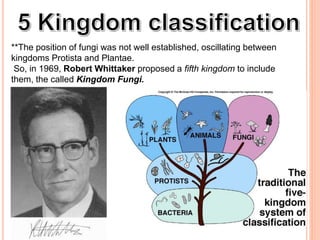
**The position of fungi was not well established, oscillating between
kingdoms Protista and Plantae.
So, in 1969, Robert Whittaker proposed a fifth kingdom to include
them, the called Kingdom Fungi.
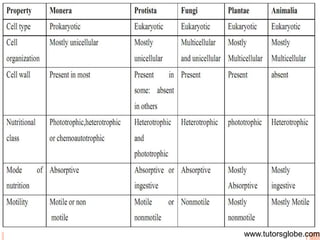
www.tutorsglobe.com
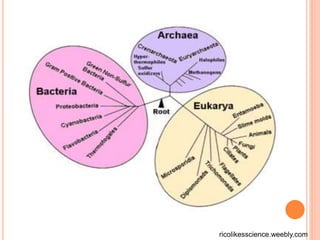
*The three-domain system is a biological classification introduced
by Carl Woese in 1977 that divides cellular life forms
into archaea, bacteria, and eukaryote domains.
*In particular, it emphasizes the separation of prokaryotes into two
groups, originally called Eubacteria (now Bacteria)
and Archaebacteria (now Archaea).
*Woese argued that, on the basis of differences in 16S rRNA genes,
these two groups and the eukaryotes each arose separately from an
ancestor with poorly developed genetic machinery, often called
a progenote.
ricolikesscience.weebly.com
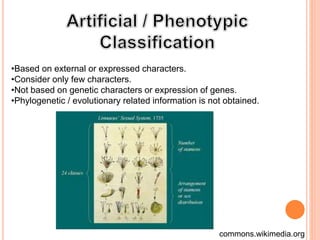
•Based on external or expressed characters.
•Consider only few characters.
•Not based on genetic characters or expression of genes.
•Phylogenetic / evolutionary related information is not obtained.
commons.wikimedia.org
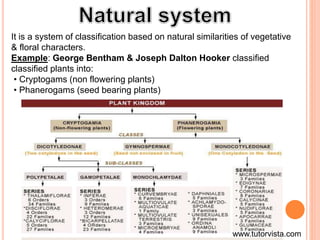
It is a system of classification based on natural similarities of vegetative
& floral characters.
Example: George Bentham & Joseph Dalton Hooker classified
classified plants into:
• Cryptogams (non flowering plants)
• Phanerogams (seed bearing plants)
www.tutorvista.com
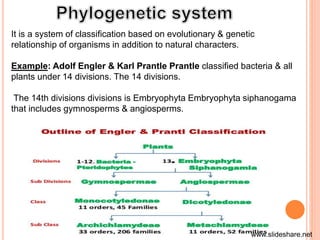
It is a system of classification based on evolutionary & genetic
relationship of organisms in addition to natural characters.
Example: Adolf Engler & Karl Prantle Prantle classified bacteria & all
plants under 14 divisions. The 14 divisions.
The 14th divisions divisions is Embryophyta Embryophyta siphanogama
that includes gymnosperms & angiosperms.
www.slideshare.net
Polyphasic Taxonomy is used to determine the genus and species of a
newly discovered procaryote.
This polyphasic taxonomy takes into account all available phenotypic
and genotypic data and integrates them in a consensus type of
classification, framed in a general phylogeny derived from 16S rRNA
sequence analysis.
There are no particular set of rules guiding this taxonomy.
It mainly focus on
(i) enormous amounts of data,
(ii) large numbers of strains, and
(iii) data fusion (data aggregation)
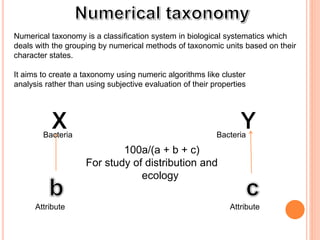
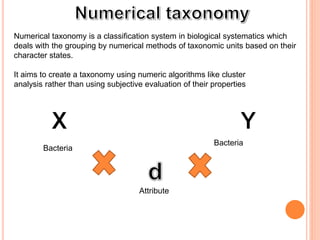
Numerical taxonomy is a classification system in biological systematics which
deals with the grouping by numerical methods of taxonomic units based on their
character states.
It aims to create a taxonomy using numeric algorithms like cluster
analysis rather than using subjective evaluation of their properties
The concept was first developed by Robert R. Sokal & Peter H. A.
Sneath in 1963
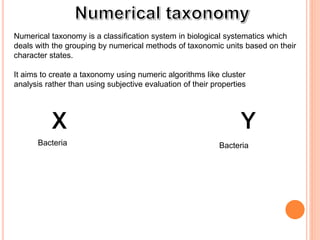
Numerical taxonomy is a classification system in biological systematics which
deals with the grouping by numerical methods of taxonomic units based on their
character states.
It aims to create a taxonomy using numeric algorithms like cluster
analysis rather than using subjective evaluation of their properties
Bacteria Bacteria
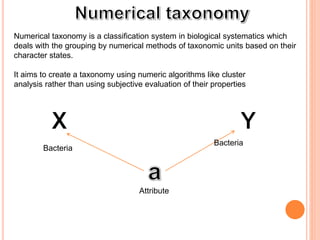
Numerical taxonomy is a classification system in biological systematics which
deals with the grouping by numerical methods of taxonomic units based on their
character states.
It aims to create a taxonomy using numeric algorithms like cluster
analysis rather than using subjective evaluation of their properties
Attribute
Bacteria
Bacteria
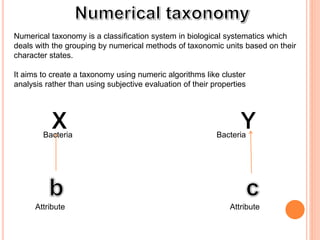
Numerical taxonomy is a classification system in biological systematics which
deals with the grouping by numerical methods of taxonomic units based on their
character states.
It aims to create a taxonomy using numeric algorithms like cluster
analysis rather than using subjective evaluation of their properties
Attribute Attribute
Bacteria Bacteria
Numerical taxonomy is a classification system in biological systematics which
deals with the grouping by numerical methods of taxonomic units based on their
character states.
It aims to create a taxonomy using numeric algorithms like cluster
analysis rather than using subjective evaluation of their properties
Attribute Attribute
Bacteria Bacteria
100a/(a + b + c)
For study of distribution and
ecology
Numerical taxonomy is a classification system in biological systematics which
deals with the grouping by numerical methods of taxonomic units based on their
character states.
It aims to create a taxonomy using numeric algorithms like cluster
analysis rather than using subjective evaluation of their properties
Attribute
Bacteria
Bacteria
Numerical taxonomy is a classification system in biological systematics which
deals with the grouping by numerical methods of taxonomic units based on their
character states.
It aims to create a taxonomy using numeric algorithms like cluster
analysis rather than using subjective evaluation of their properties
Attribute
Bacteria
Bacteria
100( a + d)]/( a + b + c + d)
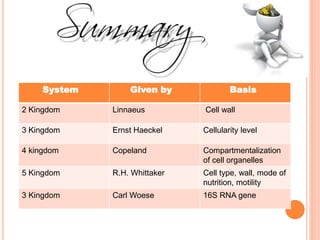
System Given by Basis
2 Kingdom Linnaeus Cell wall
3 Kingdom Ernst Haeckel Cellularity level
4 kingdom Copeland Compartmentalization
of cell organelles
5 Kingdom R.H. Whittaker Cell type, wall, mode of
nutrition, motility
3 Kingdom Carl Woese 16S RNA gene
System Example Basis
Artificial Linnaeus Visible/ expressed
characters
Natural Bentham and Hooker Natural similarities
Phylogenetic Engler & Prantle Evolutionary
relationships
Polyphasic Carl Woese Phylogenitics &
phenotypic
Numerical Sokal and Sneath Expression of
characters in terms of
numeric value
*Polyphasic taxonomy, a consensus approach to bacterial
systematics.
P Vandamme, B Pot, M Gillis, P de Vos, K Kersters, and J Swings
*Numerical Taxonomy of Bacteria - Some Published Data Re -
examined BY D. W. GOODALL
*Microbial evolution and diversity ; Part V
*insects.tamu.edu
oilersnation.com

Microbial taxonomy and classification system

  • 1.
  • 2.
    Taxonomy is thescience dealing with the description, identification, naming, and classification of organisms. Classification is the ‘grouping’ of organisms based on particular characters and is not arranged in hierarchical order.
  • 3.
    Taxonomy is thescience dealing with the description, identification, naming, and classification of organisms. Taxonomy provides basic understanding about the components of biodiversity which is necessary for effective decision-making about conservation and sustainable use.
  • 4.
    Taxonomy's first fatherwas the philosopher Aristotle(384-322 BC), sometimes called the “father of science." He first introduced the two key concepts of : classification of organisms by type and binomial definition. Aristotle was the first to attempt to classify all the kinds of by grouping the types of creatures according to their similarities: animals with blood and animals without blood. He further divided the animals with blood into live-bearing and egg- bearing. Sir Aristotle Aristotle's view of life was hierarchical. He assumed that creatures could be grouped in order from lowest to highest, with the human species being the highest. davesgarden.com
  • 5.
    *A Swedish naturalistnamed Carolus Linnaeus is considered the 'Father of Taxonomy‘ since 1700s *His two most important contributions to taxonomy were: •A hierarchical classification system •The system of binomial nomenclature www.tutorvista.com *He proposed that there were three broad groups, called kingdoms, into which the whole of nature could fit. These kingdoms were animals, plants, and minerals. *Binomial nomenclature meant naming species in 2 words : genus , followed by species.
  • 6.
    •The two kingdomclassification system was given by Carlous Linaaeus in 1758. • He then divided each kingdom into classes and later grouped the classes into phyla for animals and divisions for plants. karnatakaeducation.org.in
  • 7.
  • 8.
    * The developmentof optic and electronic microscopy showed important differences in cells, mainly according to the presence or absence of distinct nucleus, leading Édouard Chatton to distinguish organisms in prokaryotes (without a distinct nucleus) and eukaryotes (with a distinct nucleus) in a paper from 1925. * Based on it, Copeland proposed a four-kingdom system, moving prokaryotic organisms, bacteria and “blue-green algae”, into the kingdom Monera. earthlingnature.wordpress.com
  • 9.
    **The position offungi was not well established, oscillating between kingdoms Protista and Plantae. So, in 1969, Robert Whittaker proposed a fifth kingdom to include them, the called Kingdom Fungi.
  • 10.
  • 11.
    *The three-domain systemis a biological classification introduced by Carl Woese in 1977 that divides cellular life forms into archaea, bacteria, and eukaryote domains. *In particular, it emphasizes the separation of prokaryotes into two groups, originally called Eubacteria (now Bacteria) and Archaebacteria (now Archaea). *Woese argued that, on the basis of differences in 16S rRNA genes, these two groups and the eukaryotes each arose separately from an ancestor with poorly developed genetic machinery, often called a progenote.
  • 12.
  • 13.
    •Based on externalor expressed characters. •Consider only few characters. •Not based on genetic characters or expression of genes. •Phylogenetic / evolutionary related information is not obtained. commons.wikimedia.org
  • 14.
    It is asystem of classification based on natural similarities of vegetative & floral characters. Example: George Bentham & Joseph Dalton Hooker classified classified plants into: • Cryptogams (non flowering plants) • Phanerogams (seed bearing plants) www.tutorvista.com
  • 15.
    It is asystem of classification based on evolutionary & genetic relationship of organisms in addition to natural characters. Example: Adolf Engler & Karl Prantle Prantle classified bacteria & all plants under 14 divisions. The 14 divisions. The 14th divisions divisions is Embryophyta Embryophyta siphanogama that includes gymnosperms & angiosperms. www.slideshare.net
  • 16.
    Polyphasic Taxonomy isused to determine the genus and species of a newly discovered procaryote. This polyphasic taxonomy takes into account all available phenotypic and genotypic data and integrates them in a consensus type of classification, framed in a general phylogeny derived from 16S rRNA sequence analysis. There are no particular set of rules guiding this taxonomy. It mainly focus on (i) enormous amounts of data, (ii) large numbers of strains, and (iii) data fusion (data aggregation)
  • 17.
    Numerical taxonomy isa classification system in biological systematics which deals with the grouping by numerical methods of taxonomic units based on their character states. It aims to create a taxonomy using numeric algorithms like cluster analysis rather than using subjective evaluation of their properties The concept was first developed by Robert R. Sokal & Peter H. A. Sneath in 1963
  • 18.
    Numerical taxonomy isa classification system in biological systematics which deals with the grouping by numerical methods of taxonomic units based on their character states. It aims to create a taxonomy using numeric algorithms like cluster analysis rather than using subjective evaluation of their properties Bacteria Bacteria
  • 19.
    Numerical taxonomy isa classification system in biological systematics which deals with the grouping by numerical methods of taxonomic units based on their character states. It aims to create a taxonomy using numeric algorithms like cluster analysis rather than using subjective evaluation of their properties Attribute Bacteria Bacteria
  • 20.
    Numerical taxonomy isa classification system in biological systematics which deals with the grouping by numerical methods of taxonomic units based on their character states. It aims to create a taxonomy using numeric algorithms like cluster analysis rather than using subjective evaluation of their properties Attribute Attribute Bacteria Bacteria
  • 21.
    Numerical taxonomy isa classification system in biological systematics which deals with the grouping by numerical methods of taxonomic units based on their character states. It aims to create a taxonomy using numeric algorithms like cluster analysis rather than using subjective evaluation of their properties Attribute Attribute Bacteria Bacteria 100a/(a + b + c) For study of distribution and ecology
  • 22.
    Numerical taxonomy isa classification system in biological systematics which deals with the grouping by numerical methods of taxonomic units based on their character states. It aims to create a taxonomy using numeric algorithms like cluster analysis rather than using subjective evaluation of their properties Attribute Bacteria Bacteria
  • 23.
    Numerical taxonomy isa classification system in biological systematics which deals with the grouping by numerical methods of taxonomic units based on their character states. It aims to create a taxonomy using numeric algorithms like cluster analysis rather than using subjective evaluation of their properties Attribute Bacteria Bacteria 100( a + d)]/( a + b + c + d)
  • 24.
    System Given byBasis 2 Kingdom Linnaeus Cell wall 3 Kingdom Ernst Haeckel Cellularity level 4 kingdom Copeland Compartmentalization of cell organelles 5 Kingdom R.H. Whittaker Cell type, wall, mode of nutrition, motility 3 Kingdom Carl Woese 16S RNA gene
  • 25.
    System Example Basis ArtificialLinnaeus Visible/ expressed characters Natural Bentham and Hooker Natural similarities Phylogenetic Engler & Prantle Evolutionary relationships Polyphasic Carl Woese Phylogenitics & phenotypic Numerical Sokal and Sneath Expression of characters in terms of numeric value
  • 26.
    *Polyphasic taxonomy, aconsensus approach to bacterial systematics. P Vandamme, B Pot, M Gillis, P de Vos, K Kersters, and J Swings *Numerical Taxonomy of Bacteria - Some Published Data Re - examined BY D. W. GOODALL *Microbial evolution and diversity ; Part V *insects.tamu.edu
  • 27.