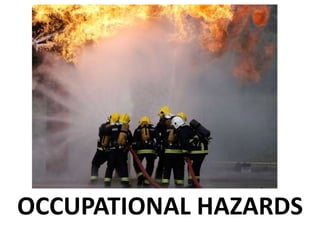
OCCUPATIONAL HAZARDS
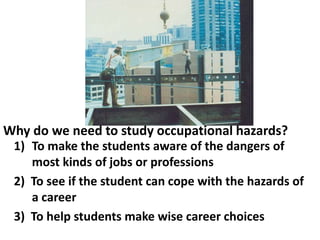
Why do we need to study occupational hazards?
1) To make the students aware of the dangers of
most kinds of jobs or professions
2) To see if the student can cope with the hazards of
a career
3) To help students make wise career choices
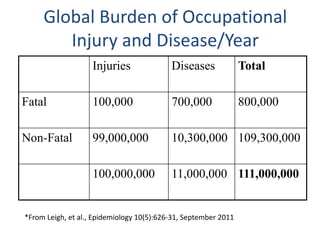
Global Burden of Occupational
Injury and Disease/Year
Injuries

Diseases

Total

Fatal

100,000

700,000

800,000

Non-Fatal

99,000,000

10,300,000 109,300,000

100,000,000

11,000,000 111,000,000

*From Leigh, et al., Epidemiology 10(5):626-31, September 2011
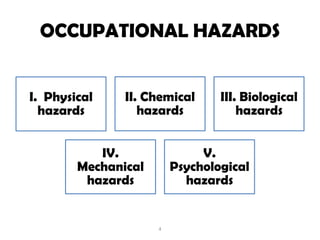
OCCUPATIONAL HAZARDS
I. Physical
hazards

II. Chemical
hazards

IV.
Mechanical
hazards

III. Biological
hazards

V.
Psychological
hazards

4
OCCUPATIONAL
DISEASES
5
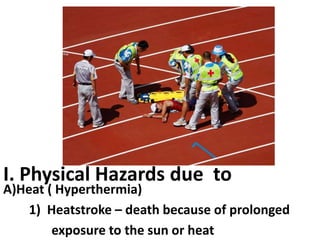
I. Physical Hazards due to

A)Heat ( Hyperthermia)
1) Heatstroke – death because of prolonged
exposure to the sun or heat
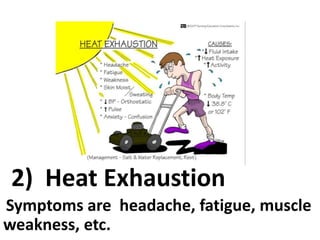
2) Heat Exhaustion
Symptoms are headache, fatigue, muscle
weakness, etc.
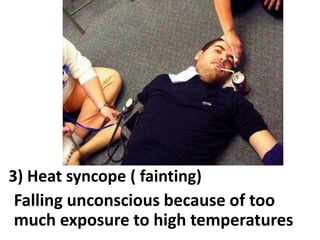
3) Heat syncope ( fainting)
Falling unconscious because of too
much exposure to high temperatures
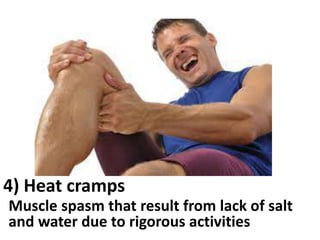
4) Heat cramps
Muscle spasm that result from lack of salt
and water due to rigorous activities
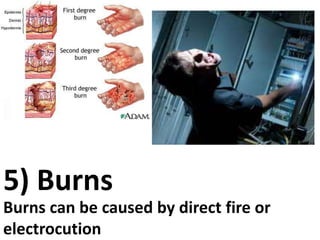
5) Burns
Burns can be caused by direct fire or
electrocution
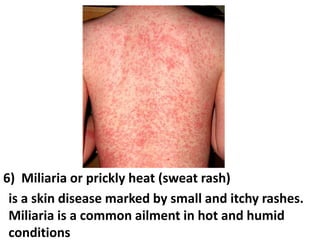
6) Miliaria or prickly heat (sweat rash)
is a skin disease marked by small and itchy rashes.
Miliaria is a common ailment in hot and humid
conditions
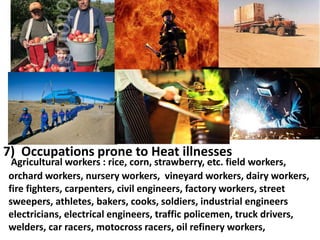
7) Occupations prone to Heat illnesses

Agricultural workers : rice, corn, strawberry, etc. field workers,
orchard workers, nursery workers, vineyard workers, dairy workers,
fire fighters, carpenters, civil engineers, factory workers, street
sweepers, athletes, bakers, cooks, soldiers, industrial engineers
electricians, electrical engineers, traffic policemen, truck drivers,
welders, car racers, motocross racers, oil refinery workers,
8) Preventive Measures
a) Wear proper clothing,
protective gadgets, use proper
equipment
(the employer must make sure
employees do this)
b) Have regular medical check-ups,
make sure the workers are fit
for the job (employer’s job)
c) Have careful and proper training.
Workers should never start
work until they know all the
procedures and hazards of the
job
d) There should be a regular
check-up of all equipment,
electrical wirings, parts of the
building, air conditioning,
water supply, make sure all the
workers follow the SOP’s or
Standard Operating Procedures

e) Constantly check the temperature in
the work place. There is an ideal
temperature for every factory or
bakery
f) Make sure you bring a lot of water and
other liquids
g) Proper time management
farm workers should work early in
the morning and take a break when
the sun is too hot, resume work in
the late afternoon
h) Poor health conditions make it easy to
be a victim or heat illnesses.
Workers have to be healthy and fit.
i)
The employer should give fire
drills, or earthquake drills. Make
sure all fire exits are functional and
fire extinguishers are available
B) Cold
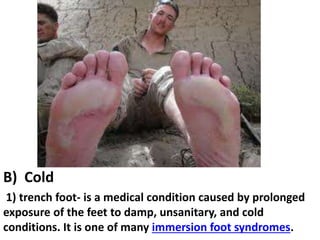
1) trench foot- is a medical condition caused by prolonged
exposure of the feet to damp, unsanitary, and cold
conditions. It is one of many immersion foot syndromes.
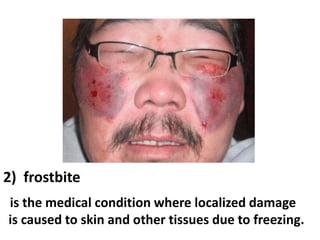
2) frostbite
is the medical condition where localized damage
is caused to skin and other tissues due to freezing.
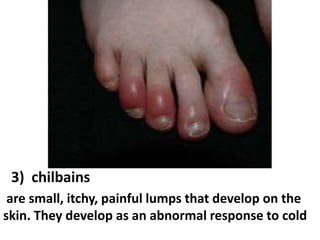
3) chilbains
are small, itchy, painful lumps that develop on the
skin. They develop as an abnormal response to cold
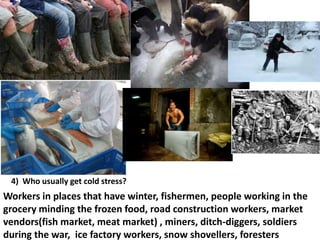
4) Who usually get cold stress?

Workers in places that have winter, fishermen, people working in the
grocery minding the frozen food, road construction workers, market
vendors(fish market, meat market) , miners, ditch-diggers, soldiers
during the war, ice factory workers, snow shovellers, foresters
5) Preventive Measures
a) Use proper clothing and
safety gear( mittens, ear
cuffs, scarf, bonnets,
hats, etc
-should not be too tight to
allow ventillation
b) Temperature in the
workplace must be
closely monitored
c) Have regular medical
check-ups
d) Employees should be
properly trained
e) Make sure shoes, socks
and boots are cleaned
regularly

f) Always have hot
beverage available
g) Eat enough protein and
fats in your diet
h) Boots should be
waterproof
i) Avoid touching cold
metals with bare skin
j) Bring a thermometer
k) Bring blankets and
sheets in case someone
gets too cold
l) Use gas or electrical
heaters
C) Light

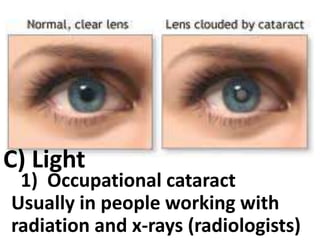
1) Occupational cataract
Usually in people working with
radiation and x-rays (radiologists)
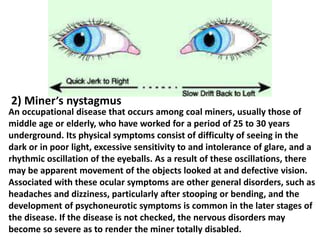
2) Miner’s nystagmus

An occupational disease that occurs among coal miners, usually those of
middle age or elderly, who have worked for a period of 25 to 30 years
underground. Its physical symptoms consist of difficulty of seeing in the
dark or in poor light, excessive sensitivity to and intolerance of glare, and a
rhythmic oscillation of the eyeballs. As a result of these oscillations, there
may be apparent movement of the objects looked at and defective vision.
Associated with these ocular symptoms are other general disorders, such as
headaches and dizziness, particularly after stooping or bending, and the
development of psychoneurotic symptoms is common in the later stages of
the disease. If the disease is not checked, the nervous disorders may
become so severe as to render the miner totally disabled.
D ) Pressure

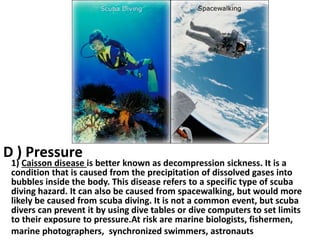
1) Caisson disease is better known as decompression sickness. It is a
condition that is caused from the precipitation of dissolved gases into
bubbles inside the body. This disease refers to a specific type of scuba
diving hazard. It can also be caused from spacewalking, but would more
likely be caused from scuba diving. It is not a common event, but scuba
divers can prevent it by using dive tables or dive computers to set limits
to their exposure to pressure.At risk are marine biologists, fishermen,
marine photographers, synchronized swimmers, astronauts
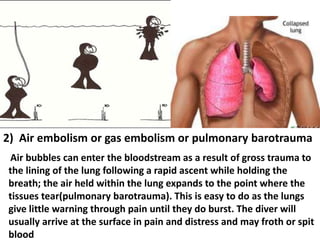
2) Air embolism or gas embolism or pulmonary barotrauma
Air bubbles can enter the bloodstream as a result of gross trauma to
the lining of the lung following a rapid ascent while holding the
breath; the air held within the lung expands to the point where the
tissues tear(pulmonary barotrauma). This is easy to do as the lungs
give little warning through pain until they do burst. The diver will
usually arrive at the surface in pain and distress and may froth or spit
blood
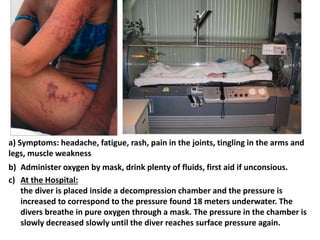
a) Symptoms: headache, fatigue, rash, pain in the joints, tingling in the arms and
legs, muscle weakness
b) Administer oxygen by mask, drink plenty of fluids, first aid if unconsious.
c) At the Hospital:
the diver is placed inside a decompression chamber and the pressure is
increased to correspond to the pressure found 18 meters underwater. The
divers breathe in pure oxygen through a mask. The pressure in the chamber is
slowly decreased slowly until the diver reaches surface pressure again.
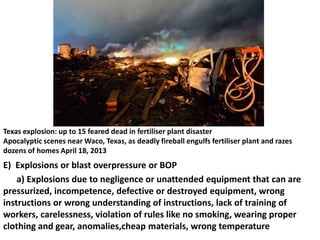
Texas explosion: up to 15 feared dead in fertiliser plant disaster
Apocalyptic scenes near Waco, Texas, as deadly fireball engulfs fertiliser plant and razes
dozens of homes April 18, 2013
E) Explosions or blast overpressure or BOP
a) Explosions due to negligence or unattended equipment that can are
pressurized, incompetence, defective or destroyed equipment, wrong
instructions or wrong understanding of instructions, lack of training of
workers, carelessness, violation of rules like no smoking, wearing proper
clothing and gear, anomalies,cheap materials, wrong temperature
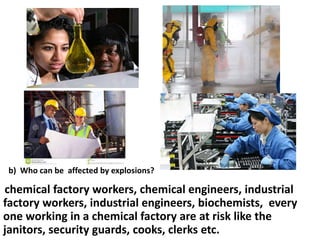
b) Who can be affected by explosions?

chemical factory workers, chemical engineers, industrial
factory workers, industrial engineers, biochemists, every
one working in a chemical factory are at risk like the
janitors, security guards, cooks, clerks etc.
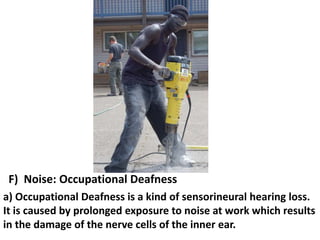
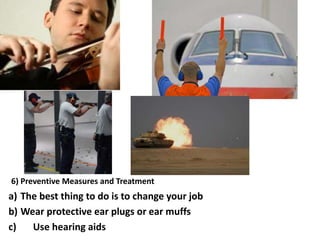
F) Noise: Occupational Deafness
a) Occupational Deafness is a kind of sensorineural hearing loss.
It is caused by prolonged exposure to noise at work which results
in the damage of the nerve cells of the inner ear.
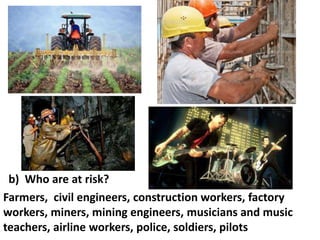
b) Who are at risk?
Farmers, civil engineers, construction workers, factory
workers, miners, mining engineers, musicians and music
teachers, airline workers, police, soldiers, pilots
6) Preventive Measures and Treatment

a) The best thing to do is to change your job
b) Wear protective ear plugs or ear muffs
c)
Use hearing aids
G) Radiation
a) Refers to ionizing radiation ( x-rays and Gamma rays)
b) Exposure to high doses cause damage to living tissue,
skin burns and death
c) Low exposure causes cancer and genetic damage
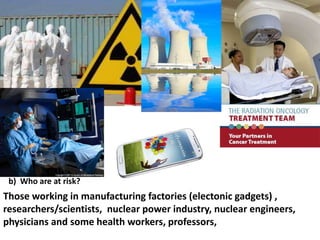
b) Who are at risk?

Those working in manufacturing factories (electonic gadgets) ,
researchers/scientists, nuclear power industry, nuclear engineers,
physicians and some health workers, professors,
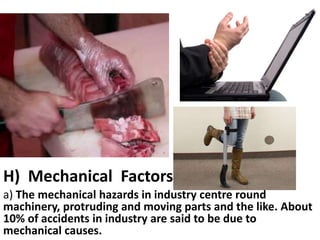
H) Mechanical Factors
a) The mechanical hazards in industry centre round
machinery, protruding and moving parts and the like. About
10% of accidents in industry are said to be due to
mechanical causes.
b) Who are at risk?
1) agricultural workers
2) business
establishments
workers
3) construction workers
4) transport workers

C) Common injuries due
to trips, slips or falls,
mishandling and
lifting of equipment
1) sprains and strains
2) back injuries
3) head injuries
4) neck injuries
5) appendage injuries
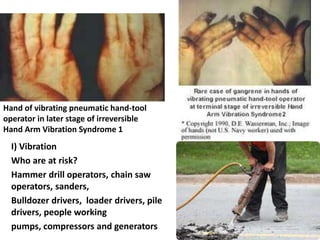
Hand of vibrating pneumatic hand-tool
operator in later stage of irreversible
Hand Arm Vibration Syndrome 1

I) Vibration
Who are at risk?
Hammer drill operators, chain saw
operators, sanders,
Bulldozer drivers, loader drivers, pile
drivers, people working
pumps, compressors and generators
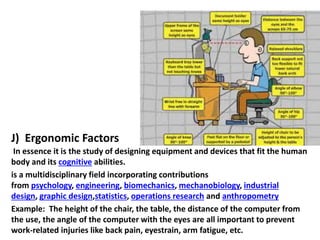
J) Ergonomic Factors
In essence it is the study of designing equipment and devices that fit the human
body and its cognitive abilities.
is a multidisciplinary field incorporating contributions
from psychology, engineering, biomechanics, mechanobiology, industrial
design, graphic design,statistics, operations research and anthropometry
Example: The height of the chair, the table, the distance of the computer from
the use, the angle of the computer with the eyes are all important to prevent
work-related injuries like back pain, eyestrain, arm fatigue, etc.
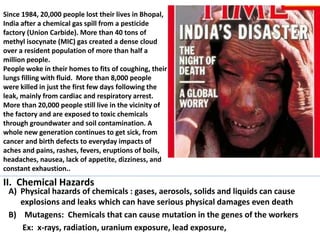
Since 1984, 20,000 people lost their lives in Bhopal,
India after a chemical gas spill from a pesticide
factory (Union Carbide). More than 40 tons of
methyl isocynate (MIC) gas created a dense cloud
over a resident population of more than half a
million people.
People woke in their homes to fits of coughing, their
lungs filling with fluid. More than 8,000 people
were killed in just the first few days following the
leak, mainly from cardiac and respiratory arrest.
More than 20,000 people still live in the vicinity of
the factory and are exposed to toxic chemicals
through groundwater and soil contamination. A
whole new generation continues to get sick, from
cancer and birth defects to everyday impacts of
aches and pains, rashes, fevers, eruptions of boils,
headaches, nausea, lack of appetite, dizziness, and
constant exhaustion..

II. Chemical Hazards

A) Physical hazards of chemicals : gases, aerosols, solids and liquids can cause
explosions and leaks which can have serious physical damages even death
B) Mutagens: Chemicals that can cause mutation in the genes of the workers
Ex: x-rays, radiation, uranium exposure, lead exposure,
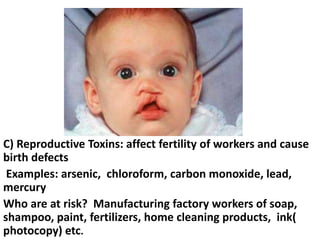
C) Reproductive Toxins: affect fertility of workers and cause
birth defects
Examples: arsenic, chloroform, carbon monoxide, lead,
mercury
Who are at risk? Manufacturing factory workers of soap,
shampoo, paint, fertilizers, home cleaning products, ink(
photocopy) etc.
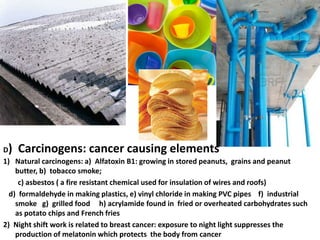
) Carcinogens: cancer causing elements

D
1) Natural carcinogens: a) Alfatoxin B1: growing in stored peanuts, grains and peanut
butter, b) tobacco smoke;
c) asbestos ( a fire resistant chemical used for insulation of wires and roofs)
d) formaldehyde in making plastics, e) vinyl chloride in making PVC pipes f) industrial
smoke g) grilled food h) acrylamide found in fried or overheated carbohydrates such
as potato chips and French fries
2) Night shift work is related to breast cancer: exposure to night light suppresses the
production of melatonin which protects the body from cancer
E)

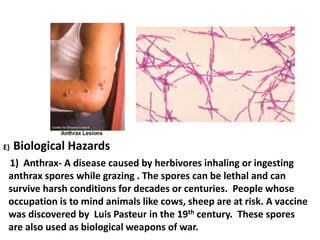
Biological Hazards

1) Anthrax- A disease caused by herbivores inhaling or ingesting
anthrax spores while grazing . The spores can be lethal and can
survive harsh conditions for decades or centuries. People whose
occupation is to mind animals like cows, sheep are at risk. A vaccine
was discovered by Luis Pasteur in the 19th century. These spores
are also used as biological weapons of war.
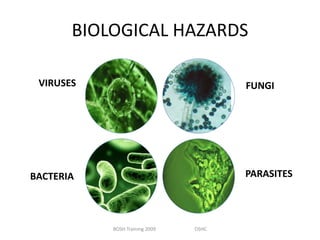
BIOLOGICAL HAZARDS
VIRUSES

FUNGI

PARASITES

BACTERIA

BOSH Training 2009

OSHC
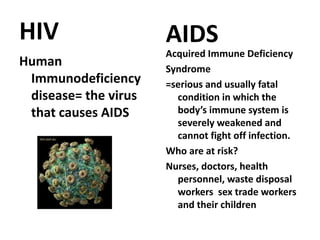
HIV
Human
Immunodeficiency
disease= the virus
that causes AIDS

AIDS
Acquired Immune Deficiency
Syndrome
=serious and usually fatal
condition in which the
body’s immune system is
severely weakened and
cannot fight off infection.
Who are at risk?
Nurses, doctors, health
personnel, waste disposal
workers sex trade workers
and their children
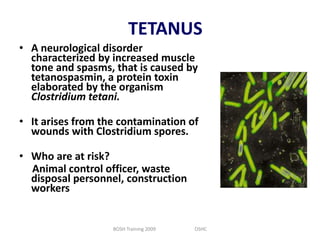
TETANUS
• A neurological disorder
characterized by increased muscle
tone and spasms, that is caused by
tetanospasmin, a protein toxin
elaborated by the organism
Clostridium tetani.

• It arises from the contamination of
wounds with Clostridium spores.
• Who are at risk?
Animal control officer, waste
disposal personnel, construction
workers

BOSH Training 2009

OSHC
TETANUS
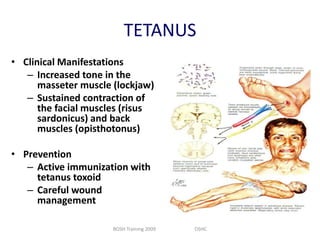
• Clinical Manifestations
– Increased tone in the
masseter muscle (lockjaw)
– Sustained contraction of
the facial muscles (risus
sardonicus) and back
muscles (opisthotonus)
• Prevention
– Active immunization with
tetanus toxoid
– Careful wound
management
BOSH Training 2009

OSHC
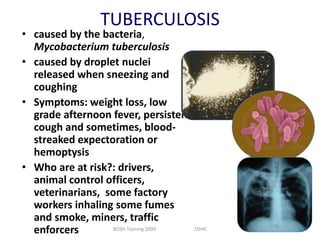
TUBERCULOSIS

• caused by the bacteria,
Mycobacterium tuberculosis
• caused by droplet nuclei
released when sneezing and
coughing
• Symptoms: weight loss, low
grade afternoon fever, persistent
cough and sometimes, bloodstreaked expectoration or
hemoptysis
• Who are at risk?: drivers,
animal control officers,
veterinarians, some factory
workers inhaling some fumes
and smoke, miners, traffic
BOSH Training 2009
OSHC
enforcers
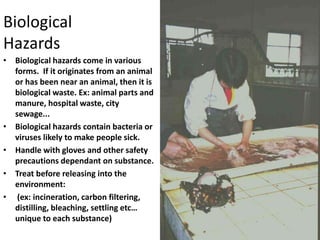
Biological
Hazards
• Biological hazards come in various
forms. If it originates from an animal
or has been near an animal, then it is
biological waste. Ex: animal parts and
manure, hospital waste, city
sewage...
• Biological hazards contain bacteria or
viruses likely to make people sick.
• Handle with gloves and other safety
precautions dependant on substance.
• Treat before releasing into the
environment:
• (ex: incineration, carbon filtering,
distilling, bleaching, settling etc…
unique to each substance)
Occupational hazards

Occupational hazards

  • 1.
  • 2.
    Why do weneed to study occupational hazards? 1) To make the students aware of the dangers of most kinds of jobs or professions 2) To see if the student can cope with the hazards of a career 3) To help students make wise career choices
  • 3.
    Global Burden ofOccupational Injury and Disease/Year Injuries Diseases Total Fatal 100,000 700,000 800,000 Non-Fatal 99,000,000 10,300,000 109,300,000 100,000,000 11,000,000 111,000,000 *From Leigh, et al., Epidemiology 10(5):626-31, September 2011
  • 4.
    OCCUPATIONAL HAZARDS I. Physical hazards II.Chemical hazards IV. Mechanical hazards III. Biological hazards V. Psychological hazards 4
  • 5.
  • 6.
    I. Physical Hazardsdue to A)Heat ( Hyperthermia) 1) Heatstroke – death because of prolonged exposure to the sun or heat
  • 7.
    2) Heat Exhaustion Symptomsare headache, fatigue, muscle weakness, etc.
  • 8.
    3) Heat syncope( fainting) Falling unconscious because of too much exposure to high temperatures
  • 9.
    4) Heat cramps Musclespasm that result from lack of salt and water due to rigorous activities
  • 10.
    5) Burns Burns canbe caused by direct fire or electrocution
  • 11.
    6) Miliaria orprickly heat (sweat rash) is a skin disease marked by small and itchy rashes. Miliaria is a common ailment in hot and humid conditions
  • 12.
    7) Occupations proneto Heat illnesses Agricultural workers : rice, corn, strawberry, etc. field workers, orchard workers, nursery workers, vineyard workers, dairy workers, fire fighters, carpenters, civil engineers, factory workers, street sweepers, athletes, bakers, cooks, soldiers, industrial engineers electricians, electrical engineers, traffic policemen, truck drivers, welders, car racers, motocross racers, oil refinery workers,
  • 13.
    8) Preventive Measures a)Wear proper clothing, protective gadgets, use proper equipment (the employer must make sure employees do this) b) Have regular medical check-ups, make sure the workers are fit for the job (employer’s job) c) Have careful and proper training. Workers should never start work until they know all the procedures and hazards of the job d) There should be a regular check-up of all equipment, electrical wirings, parts of the building, air conditioning, water supply, make sure all the workers follow the SOP’s or Standard Operating Procedures e) Constantly check the temperature in the work place. There is an ideal temperature for every factory or bakery f) Make sure you bring a lot of water and other liquids g) Proper time management farm workers should work early in the morning and take a break when the sun is too hot, resume work in the late afternoon h) Poor health conditions make it easy to be a victim or heat illnesses. Workers have to be healthy and fit. i) The employer should give fire drills, or earthquake drills. Make sure all fire exits are functional and fire extinguishers are available
  • 14.
    B) Cold 1) trenchfoot- is a medical condition caused by prolonged exposure of the feet to damp, unsanitary, and cold conditions. It is one of many immersion foot syndromes.
  • 15.
    2) frostbite is themedical condition where localized damage is caused to skin and other tissues due to freezing.
  • 16.
    3) chilbains are small,itchy, painful lumps that develop on the skin. They develop as an abnormal response to cold
  • 17.
    4) Who usuallyget cold stress? Workers in places that have winter, fishermen, people working in the grocery minding the frozen food, road construction workers, market vendors(fish market, meat market) , miners, ditch-diggers, soldiers during the war, ice factory workers, snow shovellers, foresters
  • 18.
    5) Preventive Measures a)Use proper clothing and safety gear( mittens, ear cuffs, scarf, bonnets, hats, etc -should not be too tight to allow ventillation b) Temperature in the workplace must be closely monitored c) Have regular medical check-ups d) Employees should be properly trained e) Make sure shoes, socks and boots are cleaned regularly f) Always have hot beverage available g) Eat enough protein and fats in your diet h) Boots should be waterproof i) Avoid touching cold metals with bare skin j) Bring a thermometer k) Bring blankets and sheets in case someone gets too cold l) Use gas or electrical heaters
  • 19.
    C) Light 1) Occupationalcataract Usually in people working with radiation and x-rays (radiologists)
  • 20.
    2) Miner’s nystagmus Anoccupational disease that occurs among coal miners, usually those of middle age or elderly, who have worked for a period of 25 to 30 years underground. Its physical symptoms consist of difficulty of seeing in the dark or in poor light, excessive sensitivity to and intolerance of glare, and a rhythmic oscillation of the eyeballs. As a result of these oscillations, there may be apparent movement of the objects looked at and defective vision. Associated with these ocular symptoms are other general disorders, such as headaches and dizziness, particularly after stooping or bending, and the development of psychoneurotic symptoms is common in the later stages of the disease. If the disease is not checked, the nervous disorders may become so severe as to render the miner totally disabled.
  • 21.
    D ) Pressure 1)Caisson disease is better known as decompression sickness. It is a condition that is caused from the precipitation of dissolved gases into bubbles inside the body. This disease refers to a specific type of scuba diving hazard. It can also be caused from spacewalking, but would more likely be caused from scuba diving. It is not a common event, but scuba divers can prevent it by using dive tables or dive computers to set limits to their exposure to pressure.At risk are marine biologists, fishermen, marine photographers, synchronized swimmers, astronauts
  • 22.
    2) Air embolismor gas embolism or pulmonary barotrauma Air bubbles can enter the bloodstream as a result of gross trauma to the lining of the lung following a rapid ascent while holding the breath; the air held within the lung expands to the point where the tissues tear(pulmonary barotrauma). This is easy to do as the lungs give little warning through pain until they do burst. The diver will usually arrive at the surface in pain and distress and may froth or spit blood
  • 23.
    a) Symptoms: headache,fatigue, rash, pain in the joints, tingling in the arms and legs, muscle weakness b) Administer oxygen by mask, drink plenty of fluids, first aid if unconsious. c) At the Hospital: the diver is placed inside a decompression chamber and the pressure is increased to correspond to the pressure found 18 meters underwater. The divers breathe in pure oxygen through a mask. The pressure in the chamber is slowly decreased slowly until the diver reaches surface pressure again.
  • 24.
    Texas explosion: upto 15 feared dead in fertiliser plant disaster Apocalyptic scenes near Waco, Texas, as deadly fireball engulfs fertiliser plant and razes dozens of homes April 18, 2013 E) Explosions or blast overpressure or BOP a) Explosions due to negligence or unattended equipment that can are pressurized, incompetence, defective or destroyed equipment, wrong instructions or wrong understanding of instructions, lack of training of workers, carelessness, violation of rules like no smoking, wearing proper clothing and gear, anomalies,cheap materials, wrong temperature
  • 25.
    b) Who canbe affected by explosions? chemical factory workers, chemical engineers, industrial factory workers, industrial engineers, biochemists, every one working in a chemical factory are at risk like the janitors, security guards, cooks, clerks etc.
  • 26.
    F) Noise: OccupationalDeafness a) Occupational Deafness is a kind of sensorineural hearing loss. It is caused by prolonged exposure to noise at work which results in the damage of the nerve cells of the inner ear.
  • 27.
    b) Who areat risk? Farmers, civil engineers, construction workers, factory workers, miners, mining engineers, musicians and music teachers, airline workers, police, soldiers, pilots
  • 28.
    6) Preventive Measuresand Treatment a) The best thing to do is to change your job b) Wear protective ear plugs or ear muffs c) Use hearing aids
  • 29.
    G) Radiation a) Refersto ionizing radiation ( x-rays and Gamma rays) b) Exposure to high doses cause damage to living tissue, skin burns and death c) Low exposure causes cancer and genetic damage
  • 30.
    b) Who areat risk? Those working in manufacturing factories (electonic gadgets) , researchers/scientists, nuclear power industry, nuclear engineers, physicians and some health workers, professors,
  • 31.
    H) Mechanical Factors a)The mechanical hazards in industry centre round machinery, protruding and moving parts and the like. About 10% of accidents in industry are said to be due to mechanical causes.
  • 32.
    b) Who areat risk? 1) agricultural workers 2) business establishments workers 3) construction workers 4) transport workers C) Common injuries due to trips, slips or falls, mishandling and lifting of equipment 1) sprains and strains 2) back injuries 3) head injuries 4) neck injuries 5) appendage injuries
  • 33.
    Hand of vibratingpneumatic hand-tool operator in later stage of irreversible Hand Arm Vibration Syndrome 1 I) Vibration Who are at risk? Hammer drill operators, chain saw operators, sanders, Bulldozer drivers, loader drivers, pile drivers, people working pumps, compressors and generators
  • 34.
    J) Ergonomic Factors Inessence it is the study of designing equipment and devices that fit the human body and its cognitive abilities. is a multidisciplinary field incorporating contributions from psychology, engineering, biomechanics, mechanobiology, industrial design, graphic design,statistics, operations research and anthropometry Example: The height of the chair, the table, the distance of the computer from the use, the angle of the computer with the eyes are all important to prevent work-related injuries like back pain, eyestrain, arm fatigue, etc.
  • 35.
    Since 1984, 20,000people lost their lives in Bhopal, India after a chemical gas spill from a pesticide factory (Union Carbide). More than 40 tons of methyl isocynate (MIC) gas created a dense cloud over a resident population of more than half a million people. People woke in their homes to fits of coughing, their lungs filling with fluid. More than 8,000 people were killed in just the first few days following the leak, mainly from cardiac and respiratory arrest. More than 20,000 people still live in the vicinity of the factory and are exposed to toxic chemicals through groundwater and soil contamination. A whole new generation continues to get sick, from cancer and birth defects to everyday impacts of aches and pains, rashes, fevers, eruptions of boils, headaches, nausea, lack of appetite, dizziness, and constant exhaustion.. II. Chemical Hazards A) Physical hazards of chemicals : gases, aerosols, solids and liquids can cause explosions and leaks which can have serious physical damages even death B) Mutagens: Chemicals that can cause mutation in the genes of the workers Ex: x-rays, radiation, uranium exposure, lead exposure,
  • 36.
    C) Reproductive Toxins:affect fertility of workers and cause birth defects Examples: arsenic, chloroform, carbon monoxide, lead, mercury Who are at risk? Manufacturing factory workers of soap, shampoo, paint, fertilizers, home cleaning products, ink( photocopy) etc.
  • 37.
    ) Carcinogens: cancercausing elements D 1) Natural carcinogens: a) Alfatoxin B1: growing in stored peanuts, grains and peanut butter, b) tobacco smoke; c) asbestos ( a fire resistant chemical used for insulation of wires and roofs) d) formaldehyde in making plastics, e) vinyl chloride in making PVC pipes f) industrial smoke g) grilled food h) acrylamide found in fried or overheated carbohydrates such as potato chips and French fries 2) Night shift work is related to breast cancer: exposure to night light suppresses the production of melatonin which protects the body from cancer
  • 38.
    E) Biological Hazards 1) Anthrax-A disease caused by herbivores inhaling or ingesting anthrax spores while grazing . The spores can be lethal and can survive harsh conditions for decades or centuries. People whose occupation is to mind animals like cows, sheep are at risk. A vaccine was discovered by Luis Pasteur in the 19th century. These spores are also used as biological weapons of war.
  • 39.
  • 40.
    HIV Human Immunodeficiency disease= the virus thatcauses AIDS AIDS Acquired Immune Deficiency Syndrome =serious and usually fatal condition in which the body’s immune system is severely weakened and cannot fight off infection. Who are at risk? Nurses, doctors, health personnel, waste disposal workers sex trade workers and their children
  • 41.
    TETANUS • A neurologicaldisorder characterized by increased muscle tone and spasms, that is caused by tetanospasmin, a protein toxin elaborated by the organism Clostridium tetani. • It arises from the contamination of wounds with Clostridium spores. • Who are at risk? Animal control officer, waste disposal personnel, construction workers BOSH Training 2009 OSHC
  • 42.
    TETANUS • Clinical Manifestations –Increased tone in the masseter muscle (lockjaw) – Sustained contraction of the facial muscles (risus sardonicus) and back muscles (opisthotonus) • Prevention – Active immunization with tetanus toxoid – Careful wound management BOSH Training 2009 OSHC
  • 43.
    TUBERCULOSIS • caused bythe bacteria, Mycobacterium tuberculosis • caused by droplet nuclei released when sneezing and coughing • Symptoms: weight loss, low grade afternoon fever, persistent cough and sometimes, bloodstreaked expectoration or hemoptysis • Who are at risk?: drivers, animal control officers, veterinarians, some factory workers inhaling some fumes and smoke, miners, traffic BOSH Training 2009 OSHC enforcers
  • 46.
    Biological Hazards • Biological hazardscome in various forms. If it originates from an animal or has been near an animal, then it is biological waste. Ex: animal parts and manure, hospital waste, city sewage... • Biological hazards contain bacteria or viruses likely to make people sick. • Handle with gloves and other safety precautions dependant on substance. • Treat before releasing into the environment: • (ex: incineration, carbon filtering, distilling, bleaching, settling etc… unique to each substance)