Occupational Diseases
Introduction
• There are 100 million occupational injuries causing 0.1
million deaths in the world according to WHO
• In India it is estimated that 17 million (17% of global
burden) occupational non-fatal injuries and 45,000 fatal
injuries occur each year
Objectives
At the end of this unit, you will be able to:
• Define occupational health, occupational diseases
• Identify factors affecting health of workers
• Enumerate occupational health hazards and occupational
diseases
• List preventive measures and compact occupational hazards
Concept of Occupational Health
• Occupational health:
› The study and prevention of environmental problems in worker population with
in the work place
• The health of the worker is influenced by three factors:
› Occupational environment
› Domestic, social security and
› Welfare measures
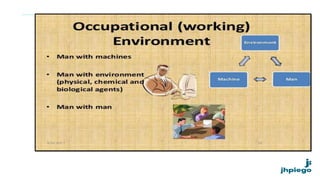
Occupational Environment
1. Man with machine:
› Poor installation of machines, the unguarded protruding moving parts, poor
maintenance etc. results in accidents.
› Working for long hours result in fatigue, discomfort and decreased efficiency.
2. Second one is man with environment:
› Interaction between man and environment
3. The third one is man with man:
› Interaction between worker, his co-worker and employer.
› This depends on many psychosocial factors like job satisfaction, payment,
welfare conditions, incentive etc. which has influence on their safety, security
and mental health.
6
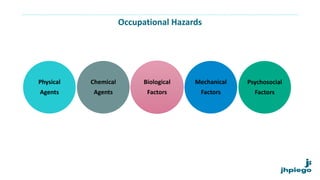
Occupational Hazards
Physical
Agents
Chemical
Agents
Biological
Factors
Mechanical
Factors
Psychosocial
Factors
OCCUPATIONAL DISEASES
• “Occupational diseases are those which arise out of or in the course of
employment.”
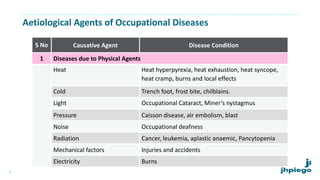
Aetiological Agents of Occupational Diseases
S No Causative Agent Disease Condition
1 Diseases due to Physical Agents
Heat Heat hyperpyrexia, heat exhaustion, heat syncope,
heat cramp, burns and local effects
Cold Trench foot, frost bite, chilblains.
Light Occupational Cataract, Miner’s nystagmus
Pressure Caisson disease, air embolism, blast
Noise Occupational deafness
Radiation Cancer, leukemia, aplastic anaemic, Pancytopenia
Mechanical factors Injuries and accidents
Electricity Burns
9
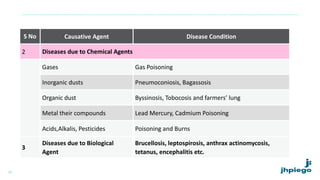
S No Causative Agent Disease Condition
2 Diseases due to Chemical Agents
Gases Gas Poisoning
Inorganic dusts Pneumoconiosis, Bagassosis
Organic dust Byssinosis, Tobocosis and farmers’ lung
Metal their compounds Lead Mercury, Cadmium Poisoning
Acids,Alkalis, Pesticides Poisoning and Burns
3
Diseases due to Biological
Agent
Brucellosis, leptospirosis, anthrax actinomycosis,
tetanus, encephalitis etc.
10
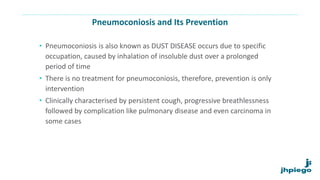
Pneumoconiosis and Its Prevention
• Pneumoconiosis is also known as DUST DISEASE occurs due to specific
occupation, caused by inhalation of insoluble dust over a prolonged
period of time
• There is no treatment for pneumoconiosis, therefore, prevention is only
intervention
• Clinically characterised by persistent cough, progressive breathlessness
followed by complication like pulmonary disease and even carcinoma in
some cases
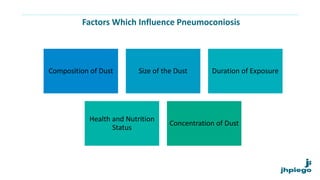
Factors Which Influence Pneumoconiosis
Composition of Dust Size of the Dust Duration of Exposure
Health and Nutrition
Status
Concentration of Dust
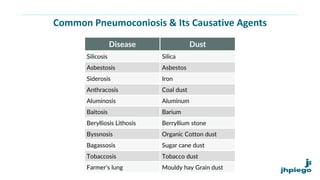
Common Pneumoconiosis & Its Causative Agents
Disease Dust
Silicosis Silica
Asbestosis Asbestos
Siderosis Iron
Anthracosis Coal dust
Aluminosis Aluminum
Baitosis Barium
Berylliosis Lithosis Berryllium stone
Byssnosis Organic Cotton dust
Bagassosis Sugar cane dust
Tobaccosis Tobacco dust
Farmer’s lung Mouldy hay Grain dust
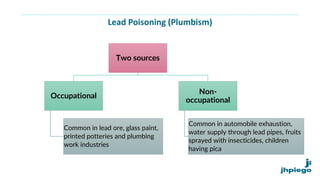
Lead Poisoning (Plumbism)
Two sources
Occupational
Common in lead ore, glass paint,
printed potteries and plumbing
work industries
Non-
occupational
Common in automobile exhaustion,
water supply through lead pipes, fruits
sprayed with insecticides, children
having pica
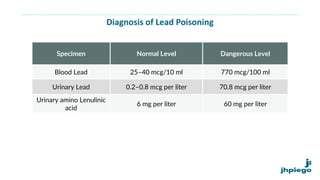
Diagnosis of Lead Poisoning
Specimen Normal Level Dangerous Level
Blood Lead 25–40 mcg/10 ml 770 mcg/100 ml
Urinary Lead 0.2–0.8 mcg per liter 70.8 mcg per liter
Urinary amino Lenulinic
acid
6 mg per liter 60 mg per liter
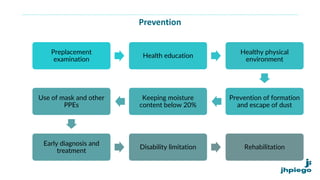
Prevention
Preplacement
examination
Health education
Healthy physical
environment
Prevention of formation
and escape of dust
Keeping moisture
content below 20%
Use of mask and other
PPEs
Early diagnosis and
treatment
Disability limitation Rehabilitation
Occupational Cancers
• The most common cancers due to occupational hazards are skin, lungs, blood forming
organs like bone marrow etc
• Cancer occurs on those sites where the action of carcinogens is constant, most intense and
prolonged
• They appear after prolonged exposure for about 10–15 years or after cessation of exposure
• It is more among male than in females
• The incidence of cancer due to occupation is much earlier than that for cancers in general
• Maintenance of high standards of personal hygiene is very important in prevention of
cancers
Occupational Hazards of Agriculture Workers
Zoonotic diseases:
• They are prone to develop diseases like anthrax, brucellosis, leptospirosis, tetanus, bovine
tuberculosis
Accidents:
• As result of increasing use of agriculture machinery
Toxic Hazards:
• Chemicals are being used increasingly in agriculture either as fertilizers, insecticides
Physical Hazards:
• Exposed to extremes of climatic conditions such as temperature, humidity, solar radiation
Respiratory Diseases:
• Exposure to dust of grains, husks, coconut fibres, tea, tobacco, cotton etc. leads to lung
diseases and farmer’s lung
Occupational Dermatitis
These include Dermatitis, Eczema, Folliculitis, Urticarial, Ulcers and even Cancers of the skin
Agent factors are:
Physical agents
• Heat and radiation
• Chemical agents
• Acids, alkalis, dyes, solvents, grease, tar, pitch and minerals
Biological agents
• Virus, bacteria, fungi and certain parasites
• Plant products
• Leaves, fruits, flowers, vegetables etc.
Sensitizing agents
• Allergens such as photo developing materials, formalin, insecticides etc.
Accidents in the Industries
• Accidents are common feature in most industries e.g. coal and other
mining industries, constructions work
• There are multiple causes of accidents like physical, physiological and
psychological causes
• Environmental factor also play and important role in causation of
accidents in the industry e.g. unsafe machines, noise pollution, excessive
light and high temperature are some of the factors
Preventive Measures to Combat
Occupational Hazards
Primary Prevention
• Pre placement examination
• Provision of healthy physical environment:
› Building should be safe from stress and stains of the machinery.
› Proper lightening, ventilation and temperature must be in between 25–27°C.
› Measures to control dust; by wet or oiling method, exhaust etc.
› Hygiene and needs proper water supply for the worker
› For every 25 workers there must be one lavatory and urinal for every 50 workers
• Welfare activities like recreational facilities, lunch room, family welfare services,
creche
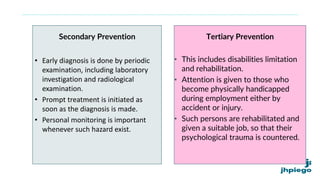
• This includes disabilities limitation
and rehabilitation.
• Attention is given to those who
become physically handicapped
during employment either by
accident or injury.
• Such persons are rehabilitated and
given a suitable job, so that their
psychological trauma is countered.
• Early diagnosis is done by periodic
examination, including laboratory
investigation and radiological
examination.
• Prompt treatment is initiated as
soon as the diagnosis is made.
• Personal monitoring is important
whenever such hazard exist.
Secondary Prevention Tertiary Prevention
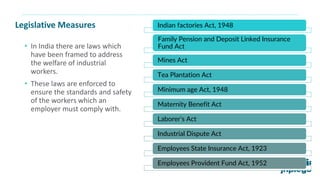
Legislative Measures
• In India there are laws which
have been framed to address
the welfare of industrial
workers.
• These laws are enforced to
ensure the standards and safety
of the workers which an
employer must comply with.
Indian factories Act, 1948
Family Pension and Deposit Linked Insurance
Fund Act
Mines Act
Tea Plantation Act
Minimum age Act, 1948
Maternity Benefit Act
Laborer’s Act
Industrial Dispute Act
Employees State Insurance Act, 1923
Employees Provident Fund Act, 1952
Employee State Insurance scheme
Benefits to Employees under the scheme are:
• Medical benefit
• Sickness benefit
• Maternity benefit
• Disability benefit
• Dependent’s benefit
• Funeral expenses
• Rehabilitation Allowance
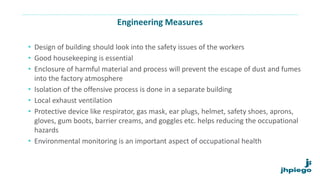
Engineering Measures
• Design of building should look into the safety issues of the workers
• Good housekeeping is essential
• Enclosure of harmful material and process will prevent the escape of dust and fumes
into the factory atmosphere
• Isolation of the offensive process is done in a separate building
• Local exhaust ventilation
• Protective device like respirator, gas mask, ear plugs, helmet, safety shoes, aprons,
gloves, gum boots, barrier creams, and goggles etc. helps reducing the occupational
hazards
• Environmental monitoring is an important aspect of occupational health
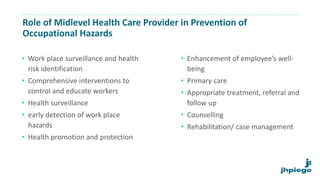
Role of Midlevel Health Care Provider in Prevention of
Occupational Hazards
• Work place surveillance and health
risk identification
• Comprehensive interventions to
control and educate workers
• Health surveillance
• early detection of work place
hazards
• Health promotion and protection
• Enhancement of employee’s well-
being
• Primary care
• Appropriate treatment, referral and
follow up
• Counselling
• Rehabilitation/ case management
Check your Progress
• Define Ergonomics
• Enumerate occupational hazards
• Name three types of interaction in work place
• Name the occupational diseases of agriculture worker
• Lead poisoning is also known as………………
• Enlist the occupational cancers
• What are the preventive measures to combat occupational hazards?
THANK YOU

Occupational Diseases.pptx

  • 1.
  • 2.
    Introduction • There are100 million occupational injuries causing 0.1 million deaths in the world according to WHO • In India it is estimated that 17 million (17% of global burden) occupational non-fatal injuries and 45,000 fatal injuries occur each year
  • 3.
    Objectives At the endof this unit, you will be able to: • Define occupational health, occupational diseases • Identify factors affecting health of workers • Enumerate occupational health hazards and occupational diseases • List preventive measures and compact occupational hazards
  • 4.
    Concept of OccupationalHealth • Occupational health: › The study and prevention of environmental problems in worker population with in the work place • The health of the worker is influenced by three factors: › Occupational environment › Domestic, social security and › Welfare measures
  • 6.
    Occupational Environment 1. Manwith machine: › Poor installation of machines, the unguarded protruding moving parts, poor maintenance etc. results in accidents. › Working for long hours result in fatigue, discomfort and decreased efficiency. 2. Second one is man with environment: › Interaction between man and environment 3. The third one is man with man: › Interaction between worker, his co-worker and employer. › This depends on many psychosocial factors like job satisfaction, payment, welfare conditions, incentive etc. which has influence on their safety, security and mental health. 6
  • 7.
  • 8.
    OCCUPATIONAL DISEASES • “Occupationaldiseases are those which arise out of or in the course of employment.”
  • 9.
    Aetiological Agents ofOccupational Diseases S No Causative Agent Disease Condition 1 Diseases due to Physical Agents Heat Heat hyperpyrexia, heat exhaustion, heat syncope, heat cramp, burns and local effects Cold Trench foot, frost bite, chilblains. Light Occupational Cataract, Miner’s nystagmus Pressure Caisson disease, air embolism, blast Noise Occupational deafness Radiation Cancer, leukemia, aplastic anaemic, Pancytopenia Mechanical factors Injuries and accidents Electricity Burns 9
  • 10.
    S No CausativeAgent Disease Condition 2 Diseases due to Chemical Agents Gases Gas Poisoning Inorganic dusts Pneumoconiosis, Bagassosis Organic dust Byssinosis, Tobocosis and farmers’ lung Metal their compounds Lead Mercury, Cadmium Poisoning Acids,Alkalis, Pesticides Poisoning and Burns 3 Diseases due to Biological Agent Brucellosis, leptospirosis, anthrax actinomycosis, tetanus, encephalitis etc. 10
  • 11.
    Pneumoconiosis and ItsPrevention • Pneumoconiosis is also known as DUST DISEASE occurs due to specific occupation, caused by inhalation of insoluble dust over a prolonged period of time • There is no treatment for pneumoconiosis, therefore, prevention is only intervention • Clinically characterised by persistent cough, progressive breathlessness followed by complication like pulmonary disease and even carcinoma in some cases
  • 12.
    Factors Which InfluencePneumoconiosis Composition of Dust Size of the Dust Duration of Exposure Health and Nutrition Status Concentration of Dust
  • 13.
    Common Pneumoconiosis &Its Causative Agents Disease Dust Silicosis Silica Asbestosis Asbestos Siderosis Iron Anthracosis Coal dust Aluminosis Aluminum Baitosis Barium Berylliosis Lithosis Berryllium stone Byssnosis Organic Cotton dust Bagassosis Sugar cane dust Tobaccosis Tobacco dust Farmer’s lung Mouldy hay Grain dust
  • 14.
    Lead Poisoning (Plumbism) Twosources Occupational Common in lead ore, glass paint, printed potteries and plumbing work industries Non- occupational Common in automobile exhaustion, water supply through lead pipes, fruits sprayed with insecticides, children having pica
  • 15.
    Diagnosis of LeadPoisoning Specimen Normal Level Dangerous Level Blood Lead 25–40 mcg/10 ml 770 mcg/100 ml Urinary Lead 0.2–0.8 mcg per liter 70.8 mcg per liter Urinary amino Lenulinic acid 6 mg per liter 60 mg per liter
  • 16.
    Prevention Preplacement examination Health education Healthy physical environment Preventionof formation and escape of dust Keeping moisture content below 20% Use of mask and other PPEs Early diagnosis and treatment Disability limitation Rehabilitation
  • 17.
    Occupational Cancers • Themost common cancers due to occupational hazards are skin, lungs, blood forming organs like bone marrow etc • Cancer occurs on those sites where the action of carcinogens is constant, most intense and prolonged • They appear after prolonged exposure for about 10–15 years or after cessation of exposure • It is more among male than in females • The incidence of cancer due to occupation is much earlier than that for cancers in general • Maintenance of high standards of personal hygiene is very important in prevention of cancers
  • 18.
    Occupational Hazards ofAgriculture Workers Zoonotic diseases: • They are prone to develop diseases like anthrax, brucellosis, leptospirosis, tetanus, bovine tuberculosis Accidents: • As result of increasing use of agriculture machinery Toxic Hazards: • Chemicals are being used increasingly in agriculture either as fertilizers, insecticides Physical Hazards: • Exposed to extremes of climatic conditions such as temperature, humidity, solar radiation Respiratory Diseases: • Exposure to dust of grains, husks, coconut fibres, tea, tobacco, cotton etc. leads to lung diseases and farmer’s lung
  • 19.
    Occupational Dermatitis These includeDermatitis, Eczema, Folliculitis, Urticarial, Ulcers and even Cancers of the skin Agent factors are: Physical agents • Heat and radiation • Chemical agents • Acids, alkalis, dyes, solvents, grease, tar, pitch and minerals Biological agents • Virus, bacteria, fungi and certain parasites • Plant products • Leaves, fruits, flowers, vegetables etc. Sensitizing agents • Allergens such as photo developing materials, formalin, insecticides etc.
  • 20.
    Accidents in theIndustries • Accidents are common feature in most industries e.g. coal and other mining industries, constructions work • There are multiple causes of accidents like physical, physiological and psychological causes • Environmental factor also play and important role in causation of accidents in the industry e.g. unsafe machines, noise pollution, excessive light and high temperature are some of the factors
  • 21.
    Preventive Measures toCombat Occupational Hazards
  • 22.
    Primary Prevention • Preplacement examination • Provision of healthy physical environment: › Building should be safe from stress and stains of the machinery. › Proper lightening, ventilation and temperature must be in between 25–27°C. › Measures to control dust; by wet or oiling method, exhaust etc. › Hygiene and needs proper water supply for the worker › For every 25 workers there must be one lavatory and urinal for every 50 workers • Welfare activities like recreational facilities, lunch room, family welfare services, creche
  • 23.
    • This includesdisabilities limitation and rehabilitation. • Attention is given to those who become physically handicapped during employment either by accident or injury. • Such persons are rehabilitated and given a suitable job, so that their psychological trauma is countered. • Early diagnosis is done by periodic examination, including laboratory investigation and radiological examination. • Prompt treatment is initiated as soon as the diagnosis is made. • Personal monitoring is important whenever such hazard exist. Secondary Prevention Tertiary Prevention
  • 24.
    Legislative Measures • InIndia there are laws which have been framed to address the welfare of industrial workers. • These laws are enforced to ensure the standards and safety of the workers which an employer must comply with. Indian factories Act, 1948 Family Pension and Deposit Linked Insurance Fund Act Mines Act Tea Plantation Act Minimum age Act, 1948 Maternity Benefit Act Laborer’s Act Industrial Dispute Act Employees State Insurance Act, 1923 Employees Provident Fund Act, 1952
  • 25.
    Employee State Insurancescheme Benefits to Employees under the scheme are: • Medical benefit • Sickness benefit • Maternity benefit • Disability benefit • Dependent’s benefit • Funeral expenses • Rehabilitation Allowance
  • 26.
    Engineering Measures • Designof building should look into the safety issues of the workers • Good housekeeping is essential • Enclosure of harmful material and process will prevent the escape of dust and fumes into the factory atmosphere • Isolation of the offensive process is done in a separate building • Local exhaust ventilation • Protective device like respirator, gas mask, ear plugs, helmet, safety shoes, aprons, gloves, gum boots, barrier creams, and goggles etc. helps reducing the occupational hazards • Environmental monitoring is an important aspect of occupational health
  • 27.
    Role of MidlevelHealth Care Provider in Prevention of Occupational Hazards • Work place surveillance and health risk identification • Comprehensive interventions to control and educate workers • Health surveillance • early detection of work place hazards • Health promotion and protection • Enhancement of employee’s well- being • Primary care • Appropriate treatment, referral and follow up • Counselling • Rehabilitation/ case management
  • 28.
    Check your Progress •Define Ergonomics • Enumerate occupational hazards • Name three types of interaction in work place • Name the occupational diseases of agriculture worker • Lead poisoning is also known as……………… • Enlist the occupational cancers • What are the preventive measures to combat occupational hazards?
  • 29.