Vocal nodules and polyp Rohit Kumar 128/06
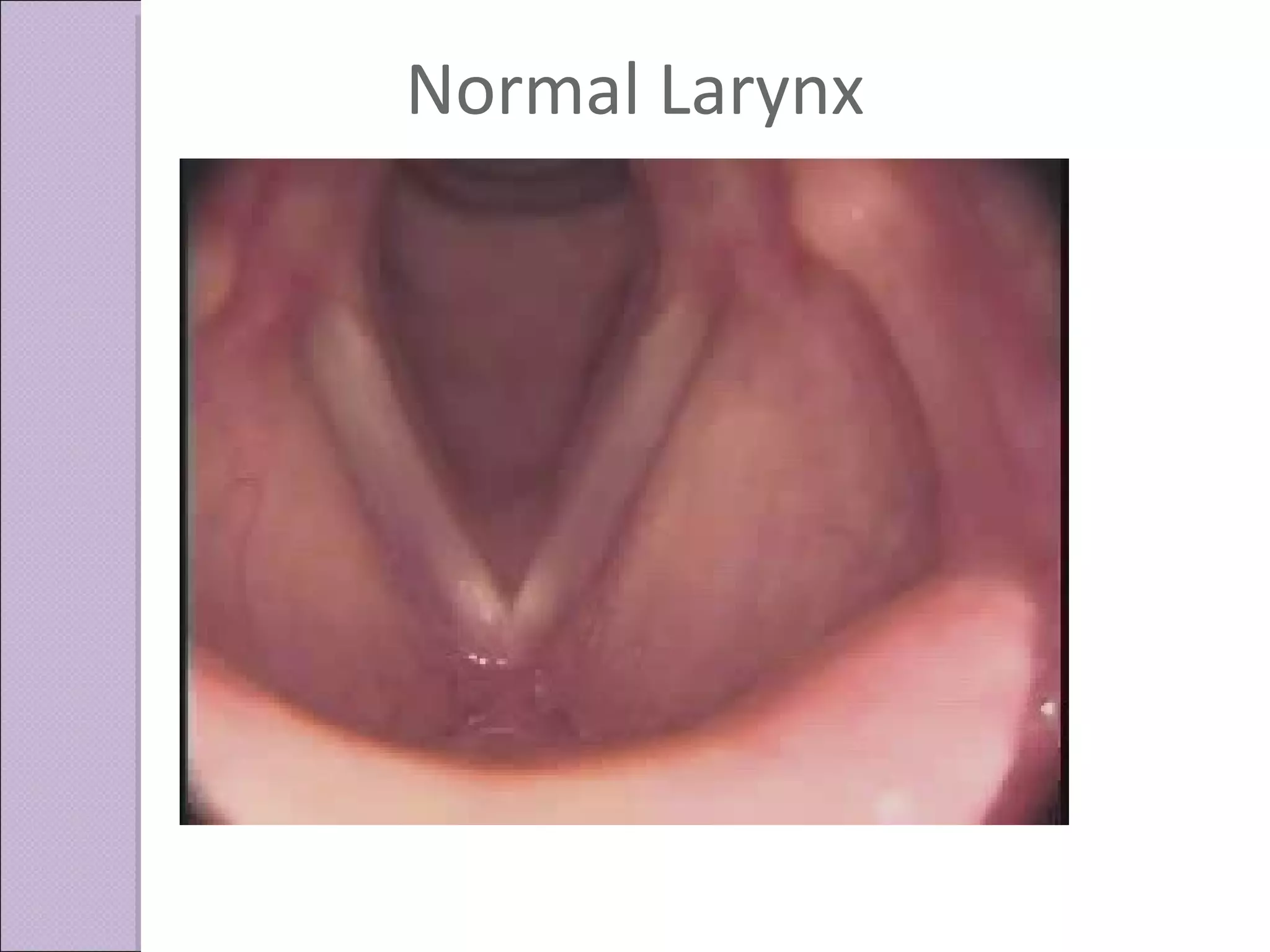
Normal Larynx
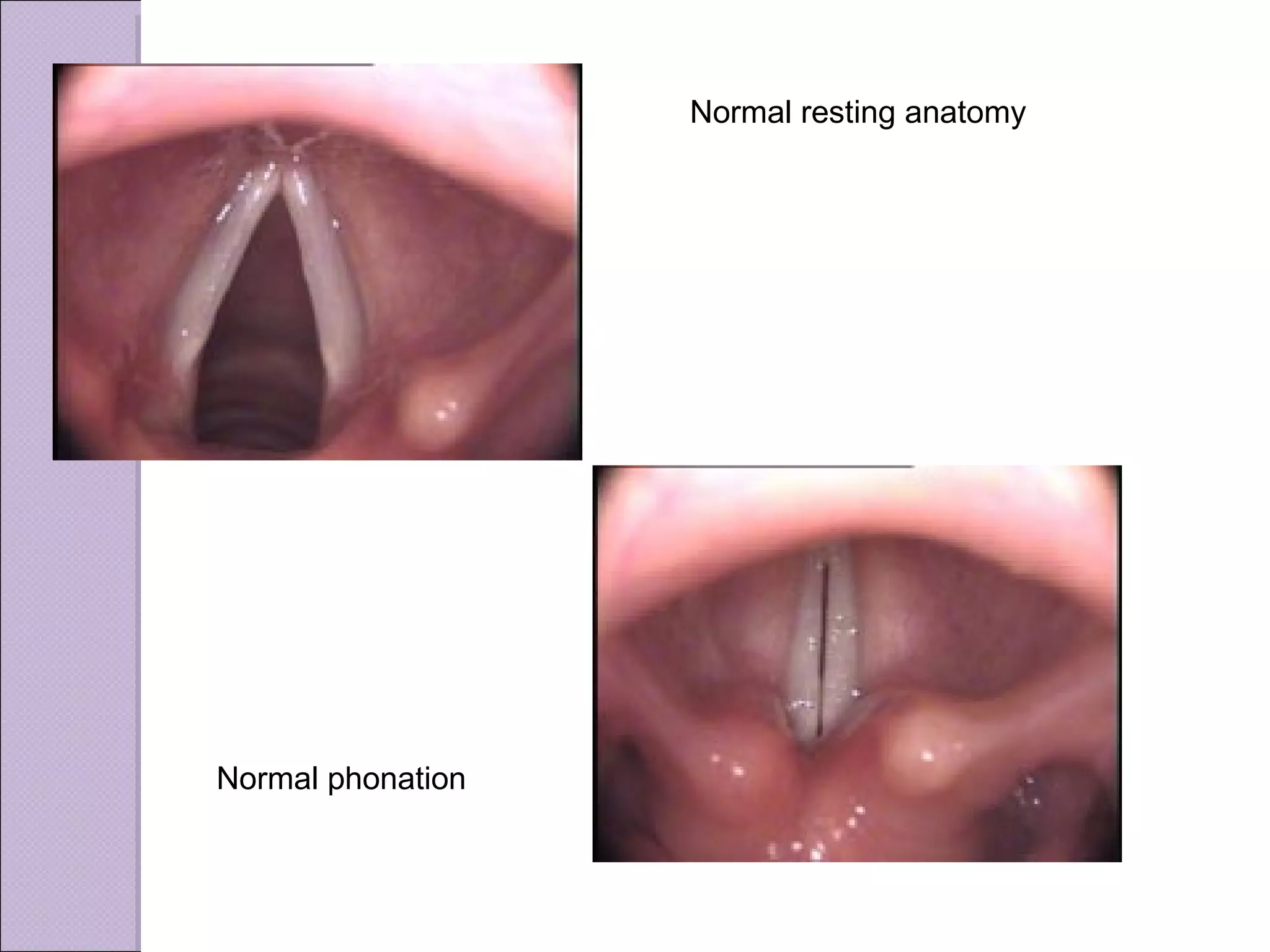
Normal resting anatomy Normal phonation
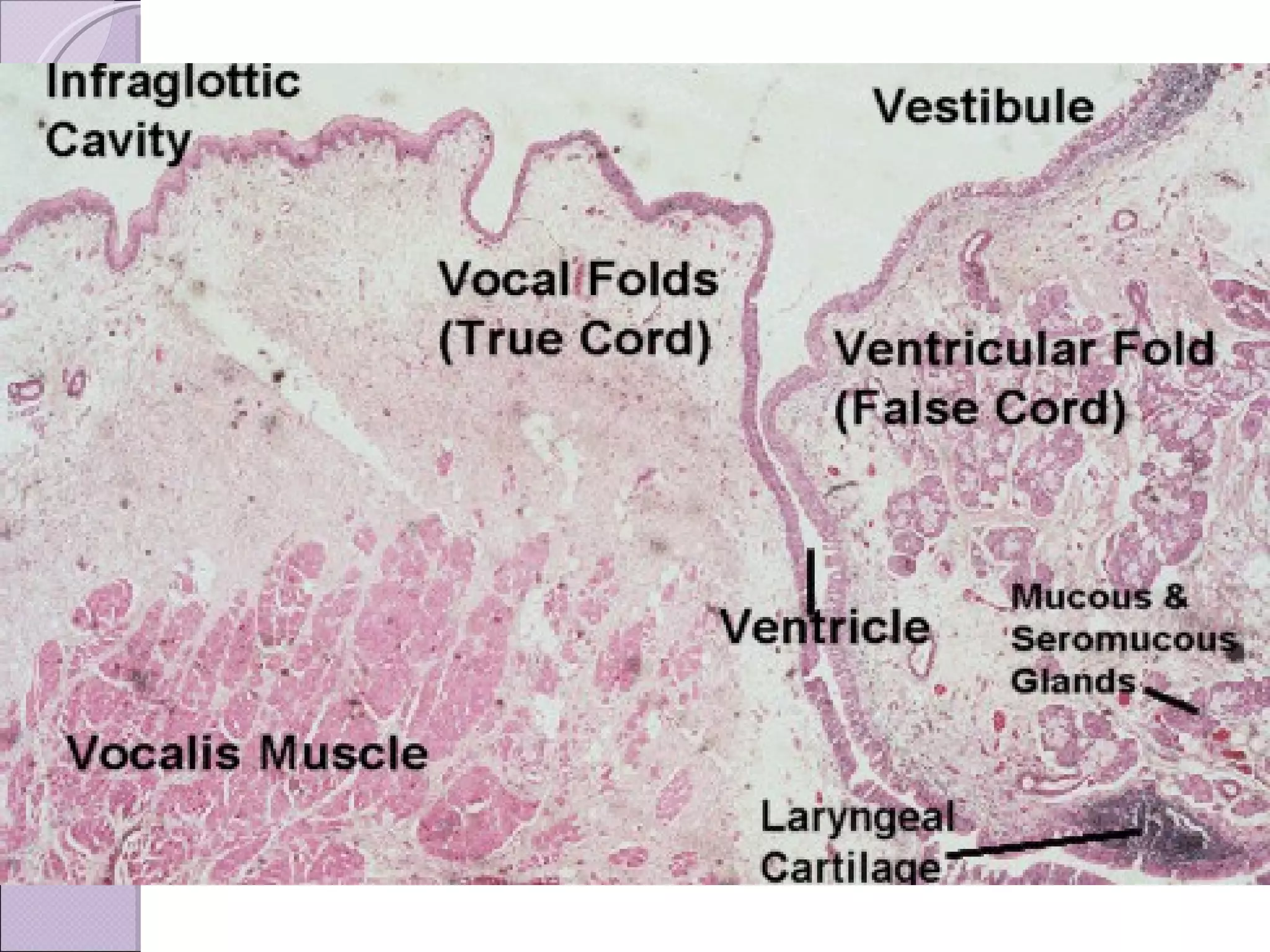
Histology of the Vocal Folds The true vocal folds have an epithelial lining that is composed of respiratory epithelium (pseudostratified squamous) on the superior and inferior aspects of the fold and nonkeratinizing squamous epithelium on the medial contact surface.   The subepithelial tissues are composed of a three-layered lamina propria based on the amount of elastin and collagen fibers.  Deep to the lamina propria is the thyroarytenoid (or vocalis) muscle.
 
Nodules  Definition :  VFNs are localized, benign, superficial growths on the medial surface of the true vocal folds that are commonly believed the result of  phonotrauma;  commonly affecting  singers,actors vendors,teachers,children (who are prone to shouting)etc Small benign lesions:size<3mm
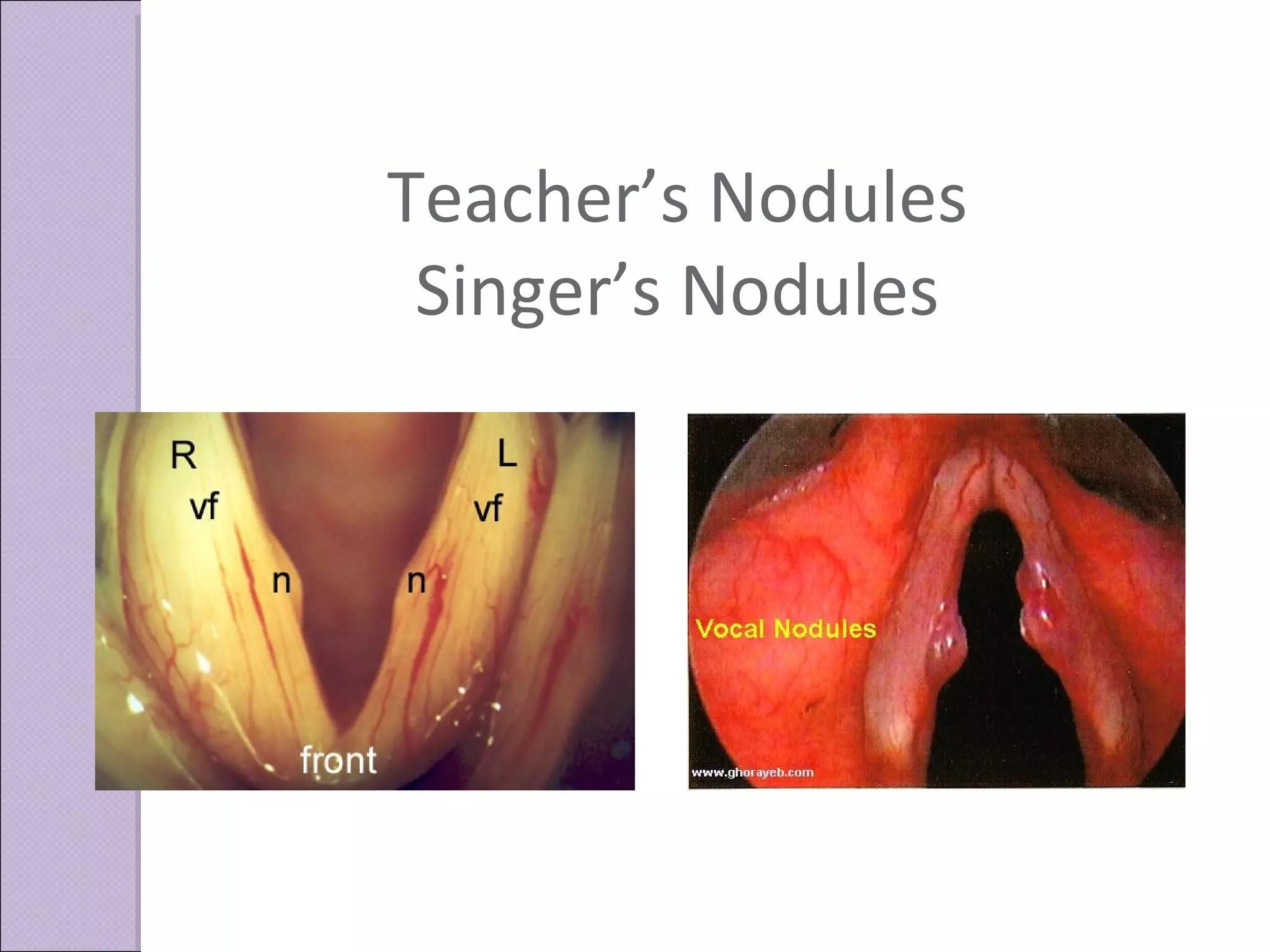
Teacher’s Nodules Singer’s Nodules
Location :  Nodules are  bilateral  with a classic location at the  junction of the  anterior one third and posterior two thirds   of the true vocal fold.  .   Etiology : Vocal abuse and misuse (screamer’s or singer’s nodes Pathogenesis :Vocal abuse    hemorrhage and submucosal edema   hyalinisation and fibrosis. Epithelium undergoes hyperplasia    nodule
Symptoms Hoarseness of voice Vocal fatigue  Pain in the neck Soreness in throat on long phonation Voice breaks at higher range
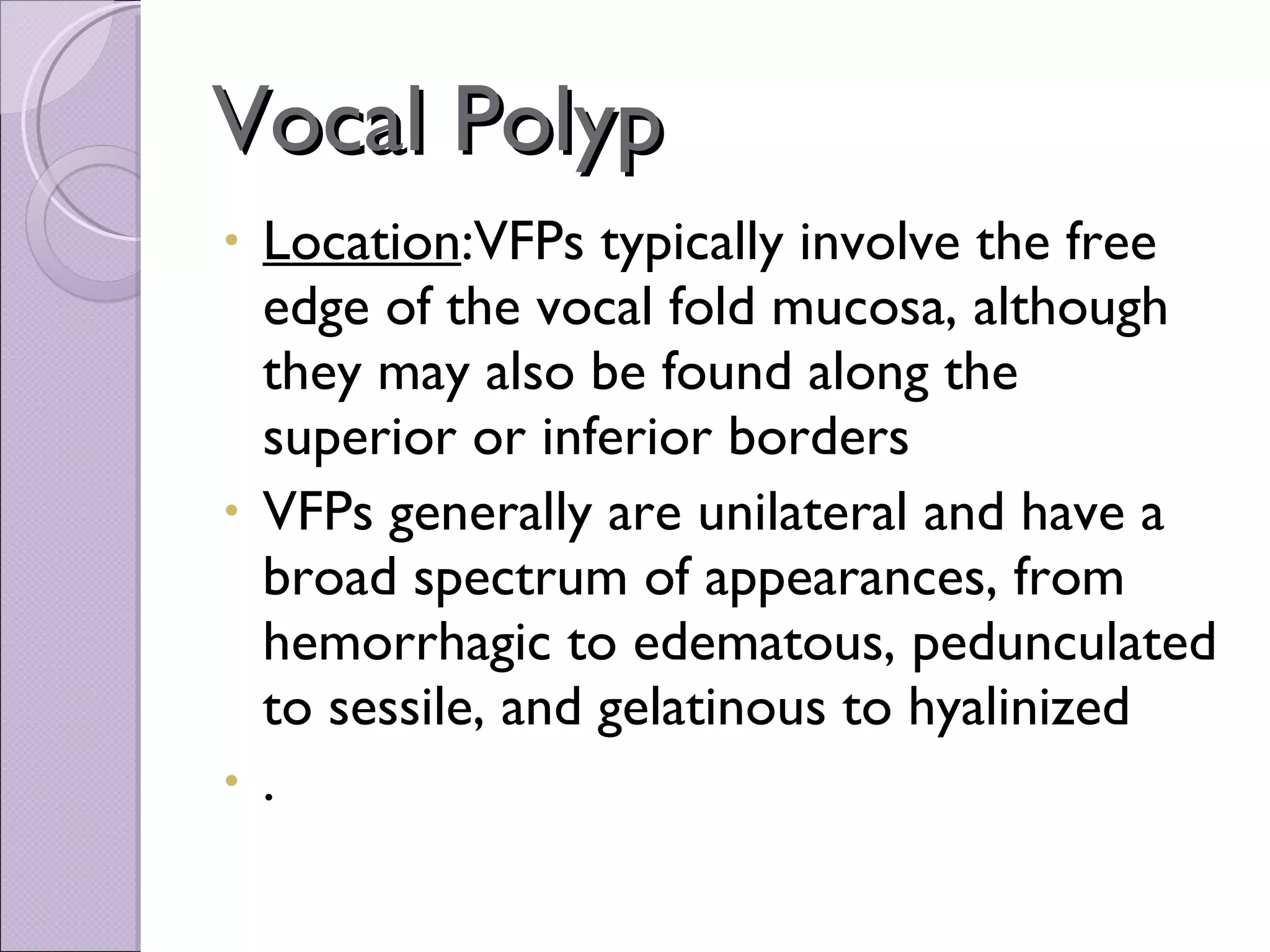
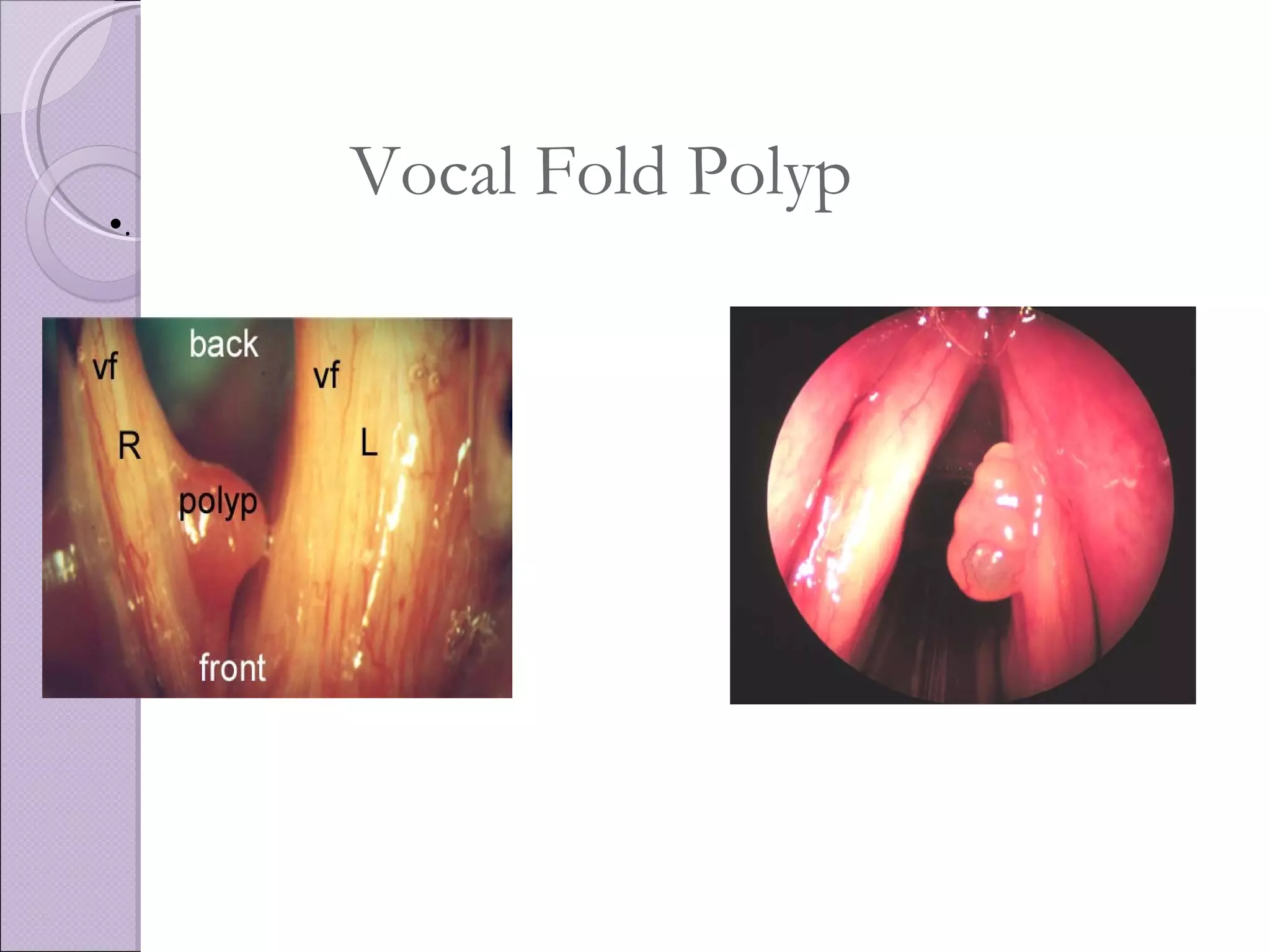
Vocal Polyp Definition –polyp is a well differentiated,hyperplastic,benign pathological structure of mucous membrane;size >3mm Etiology-Phonotrauma -Smoking -Allergy Males b/w 30 and 50yrs. pathogenesis-sudden shouting    hemorrhage    submucousal edema.
Vocal Polyp Location :VFPs typically involve the free edge of the vocal fold mucosa, although they may also be found along the superior or inferior borders VFPs generally are unilateral and have a broad spectrum of appearances, from hemorrhagic to edematous, pedunculated to sessile, and gelatinous to hyalinized .
Vocal Fold Polyp .
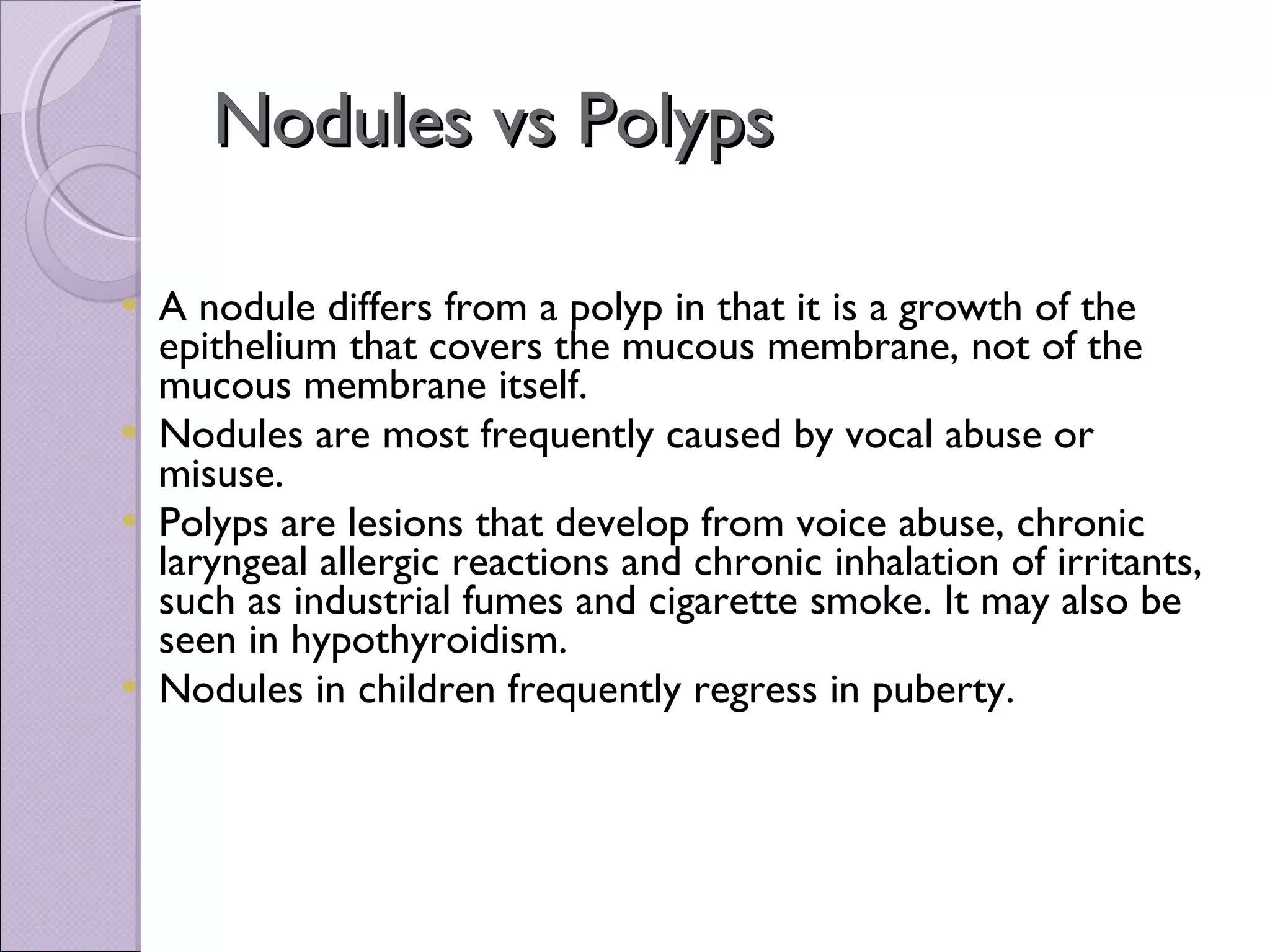
symptoms Hoarseness of voice Break in speech Lowered pitch Loss of part of voice range Strain during phonation diplophonia Stridor and choking(rarely)
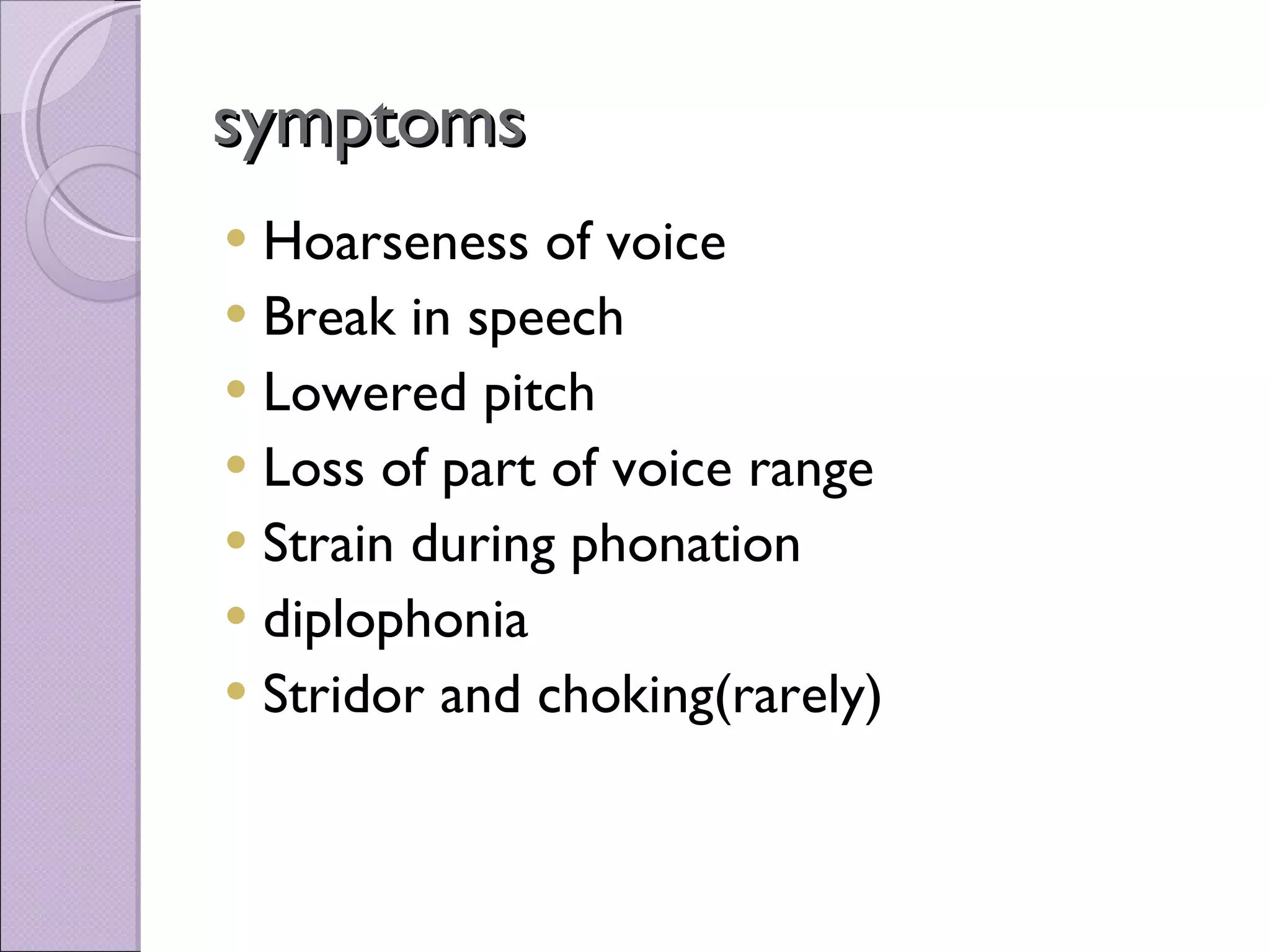
Nodules vs Polyps A nodule differs from a polyp in that it is a growth of the epithelium that covers the mucous membrane, not of the mucous membrane itself. Nodules are most frequently caused by vocal abuse or misuse.  Polyps are lesions that develop from voice abuse, chronic laryngeal allergic reactions and chronic inhalation of irritants, such as industrial fumes and cigarette smoke. It may also be seen in hypothyroidism. Nodules in children frequently regress in puberty.
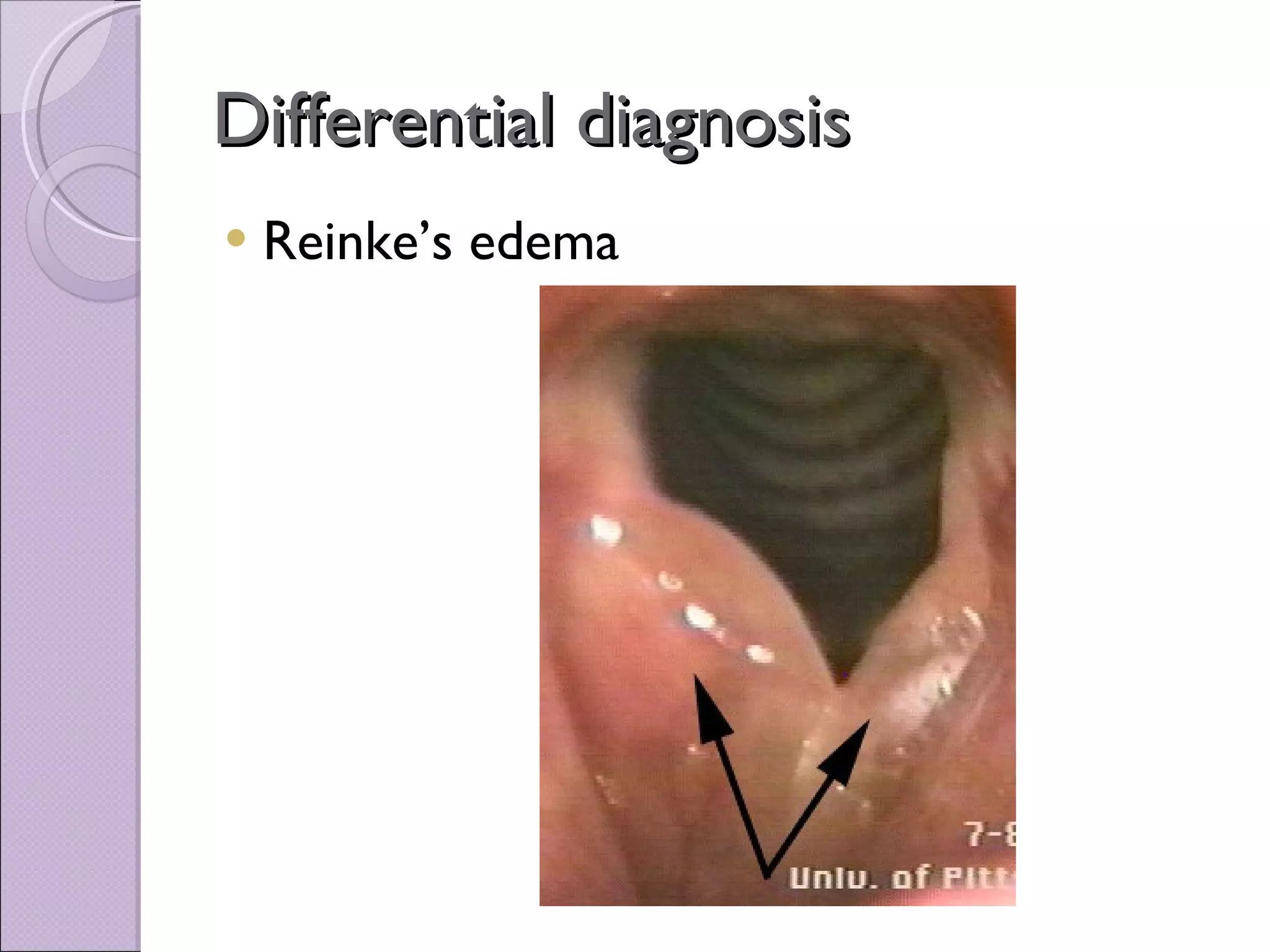
Differential diagnosis Reinke’s edema
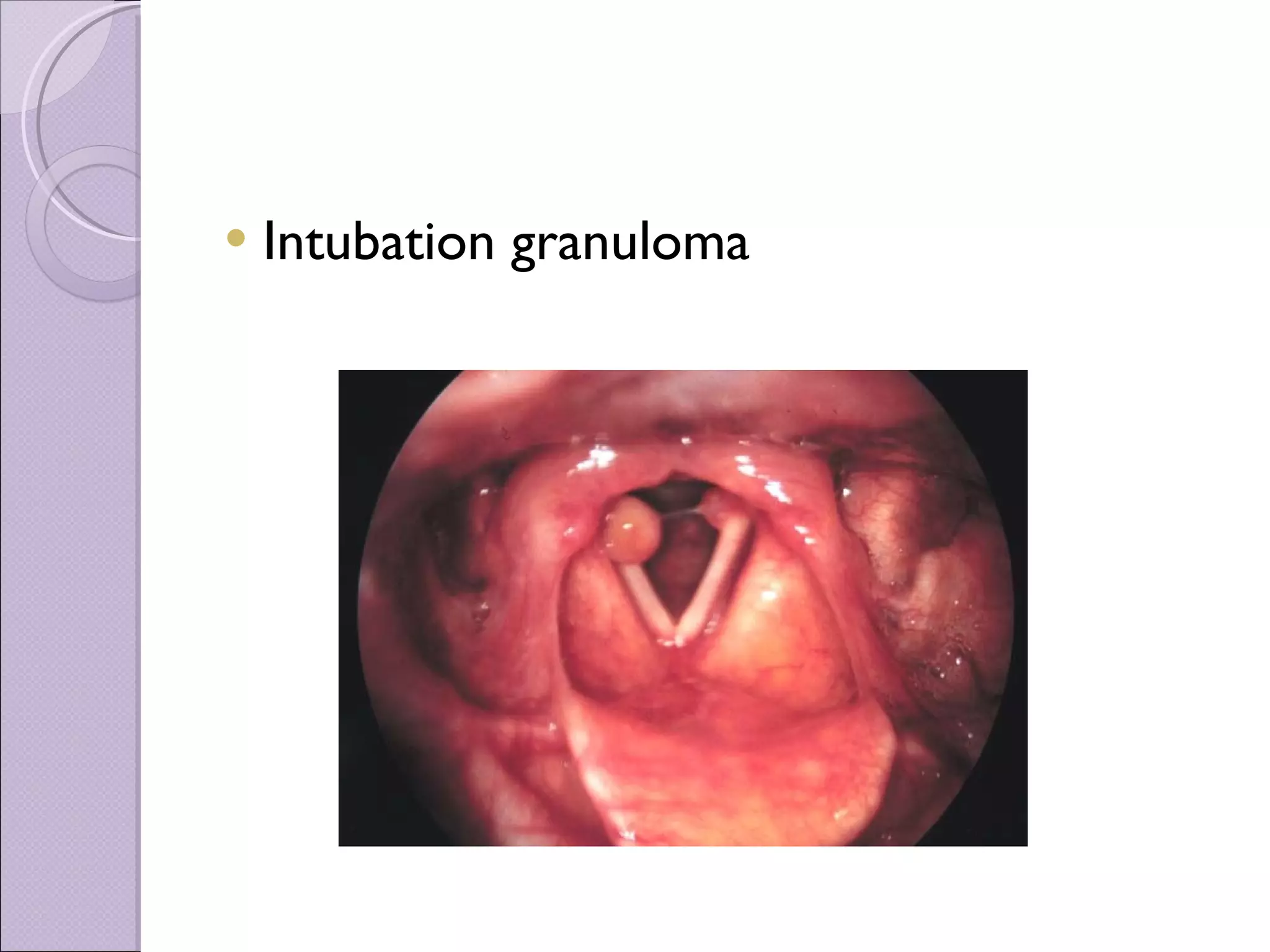
Intubation granuloma
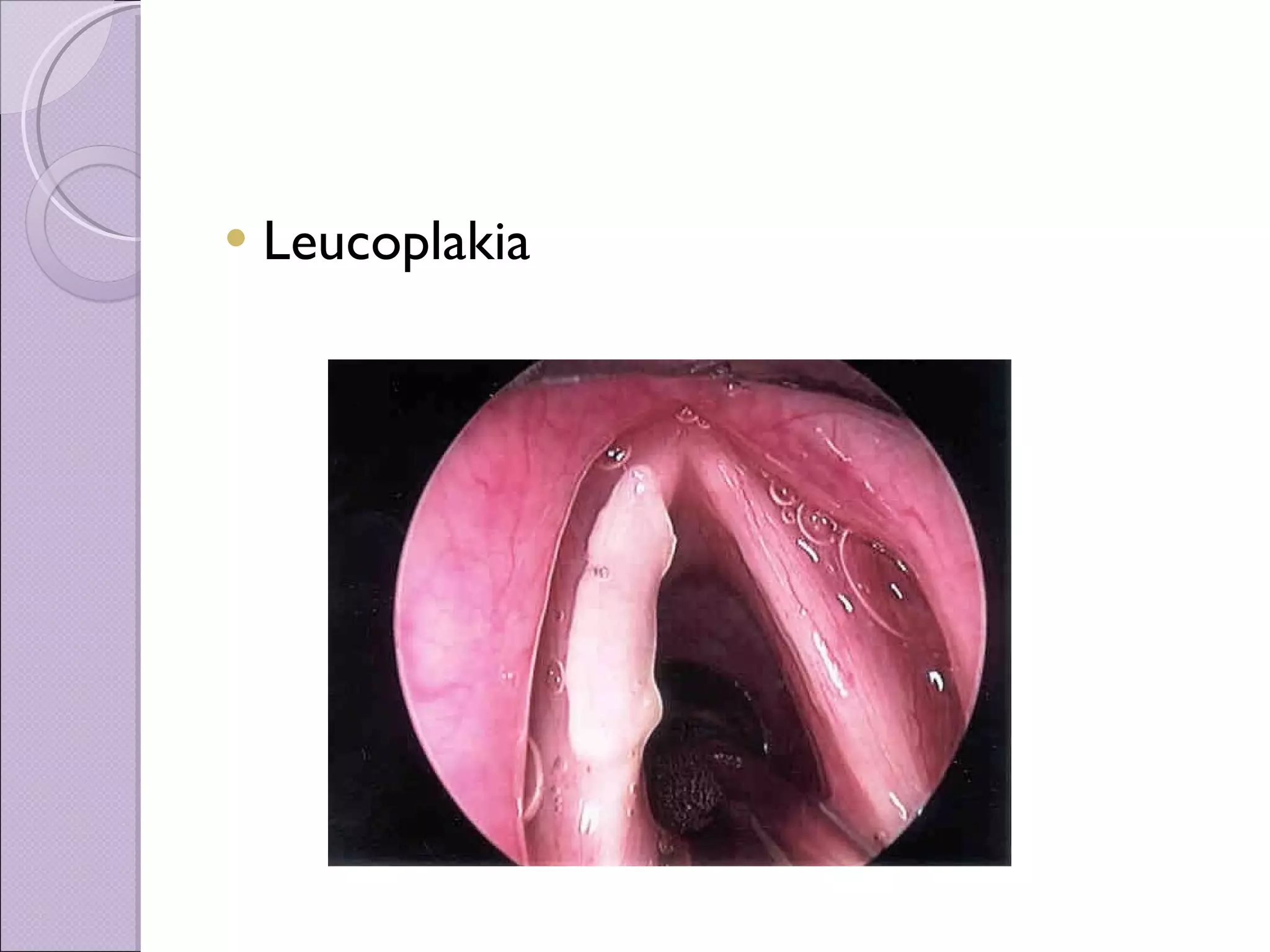
Leucoplakia
Contact ulcer Amyloid tumour
Examination Indirect laryngoscopy Rigid laryngoscopy Flexible laryngoscopy Stroboscopy microlaryngoscopy
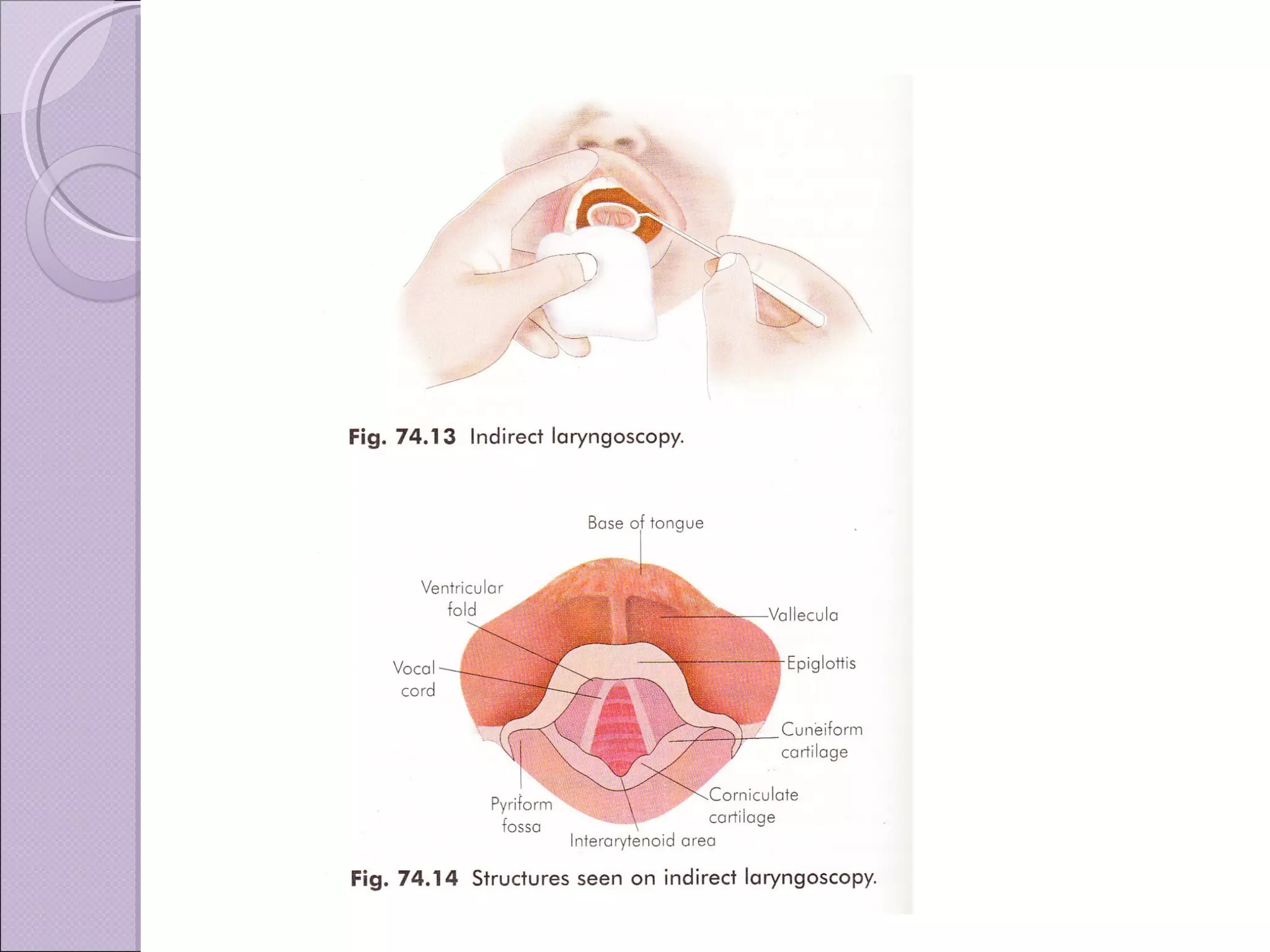
Indirect laryngoscopy The indirect mirror exam is the initial procedure used to view the larynx.  It is  quick, inexpensive , and only requires a mirror and external light source.   Gross abnormalities may be detected quickly, but subtle abnormalities may be missed.   Disadvantages  include the larynx not being in physiologic phonation position (the tongue is extended and the larynx is elevated), some anatomic features limit the exam, and a hyper-reflexive gag is present in 5-10% of patients.  
 
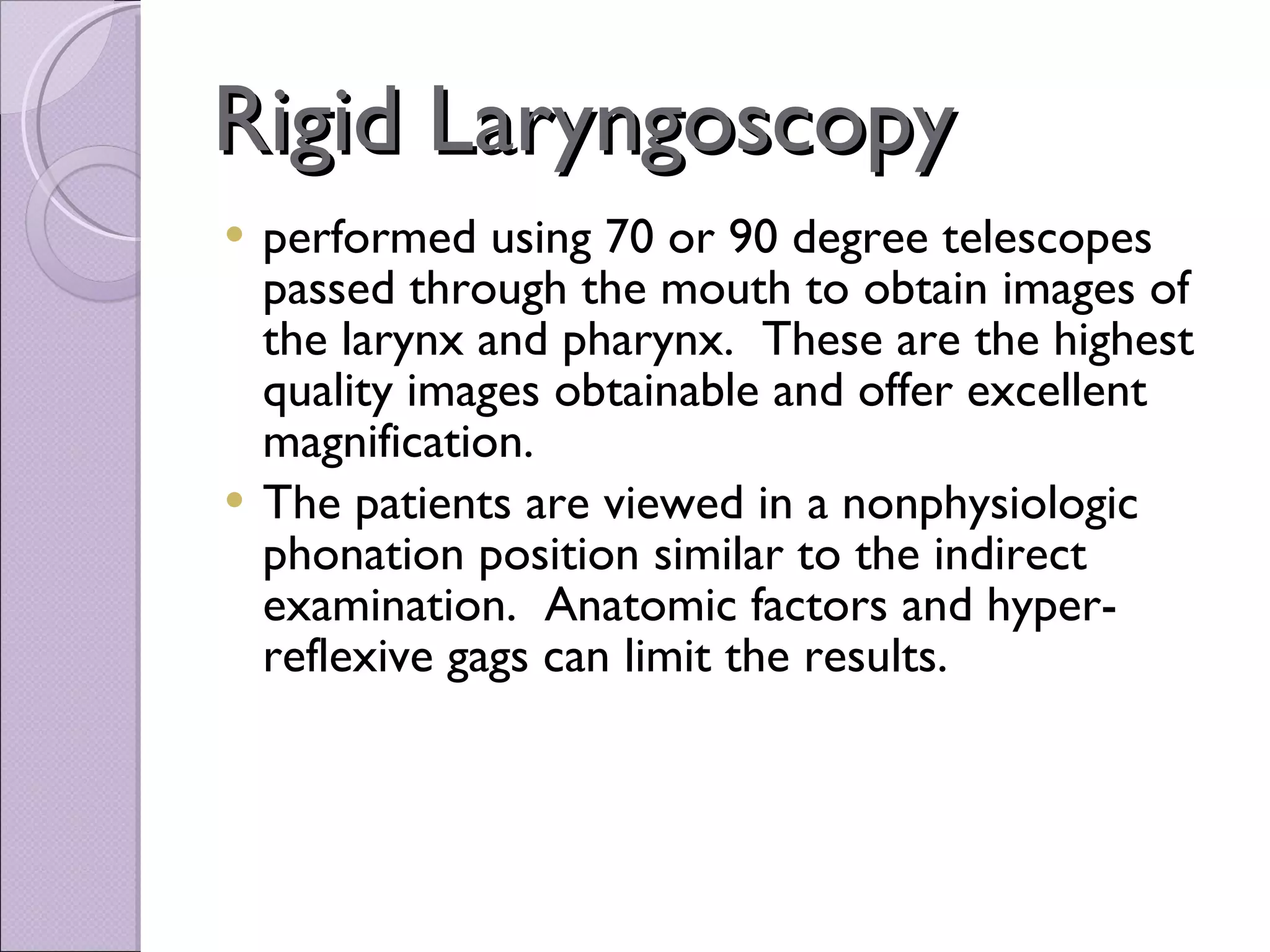
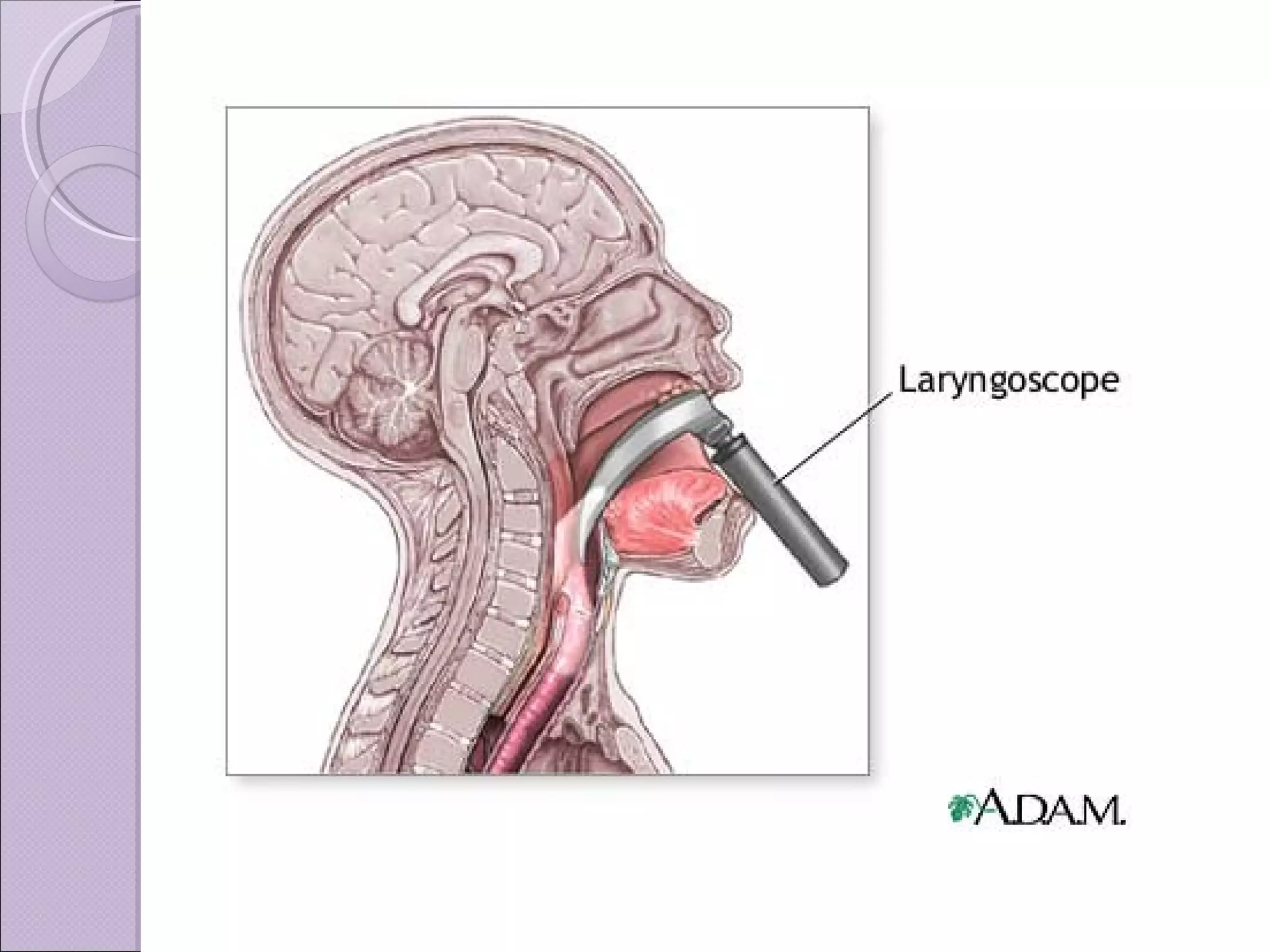
Rigid Laryngoscopy performed using 70 or 90 degree telescopes passed through the mouth to obtain images of the larynx and pharynx.  These are the highest quality images obtainable and offer excellent magnification.     The patients are viewed in a nonphysiologic phonation position similar to the indirect examination.  Anatomic factors and hyper-reflexive gags can limit the results. 
 
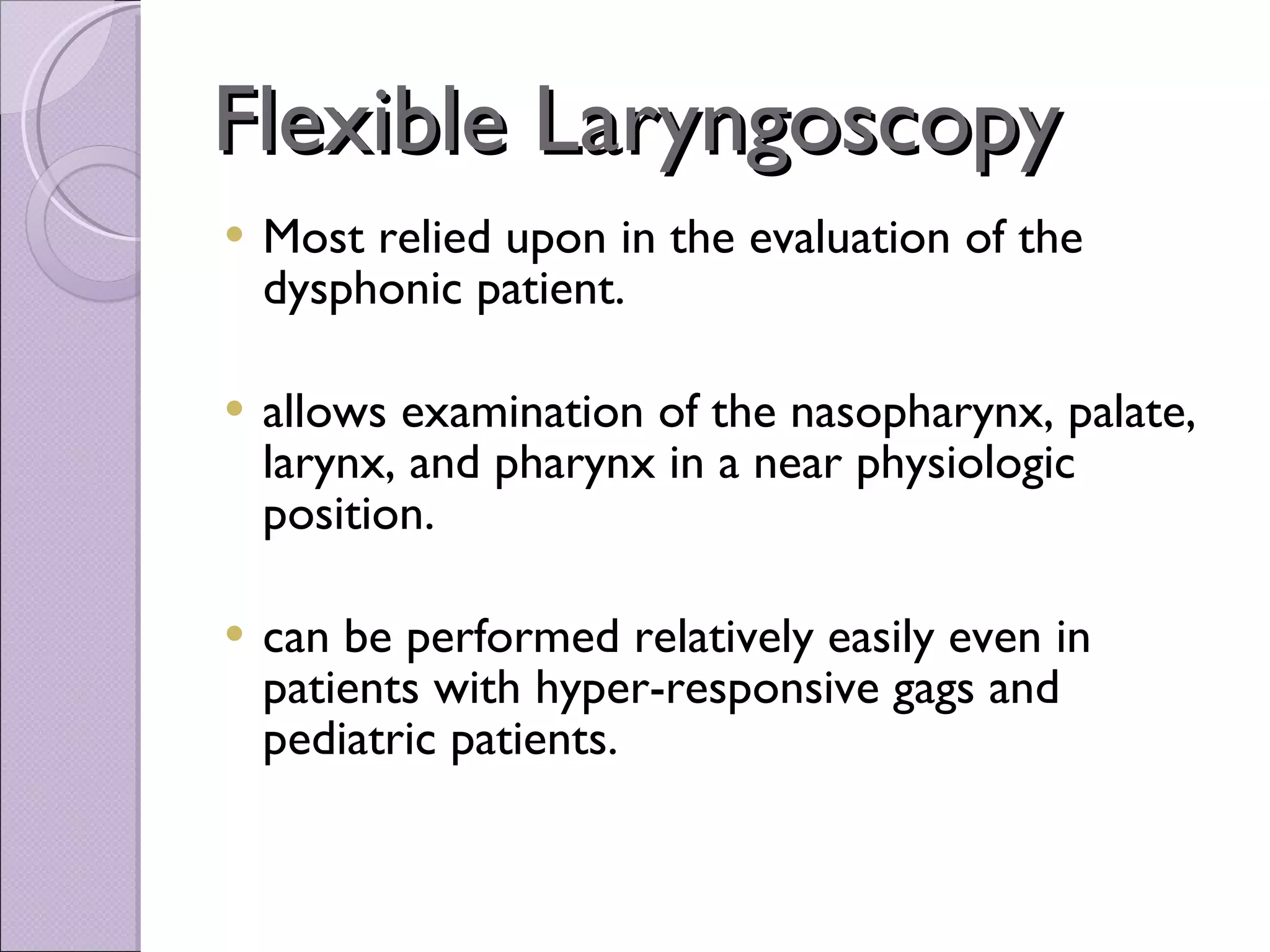
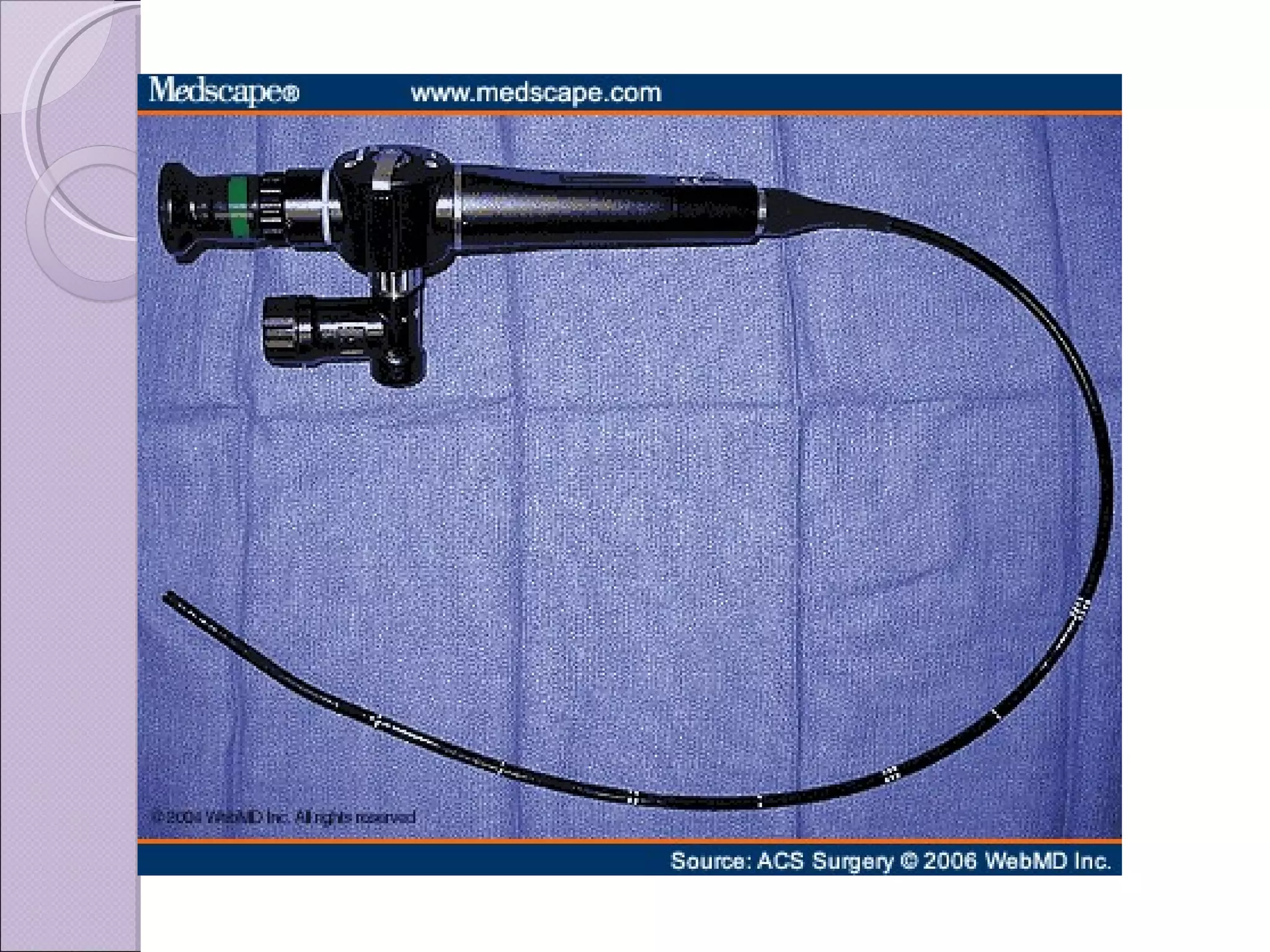
Flexible Laryngoscopy Most relied upon in the evaluation of the dysphonic patient. allows examination of the nasopharynx, palate, larynx, and pharynx in a near physiologic position. can be performed relatively easily even in patients with hyper-responsive gags and pediatric patients. 
 
Video Stroboscopy a  stroboscopic light  is used in conjunction with a laryngoscope to electronically slow down the motion of the vocal folds in order to identify subtle changes in vibratory patterns that are diagnostically significant.  Video stroboscopy is used to differentiate vocal fold nodules from vocal fold polyps.
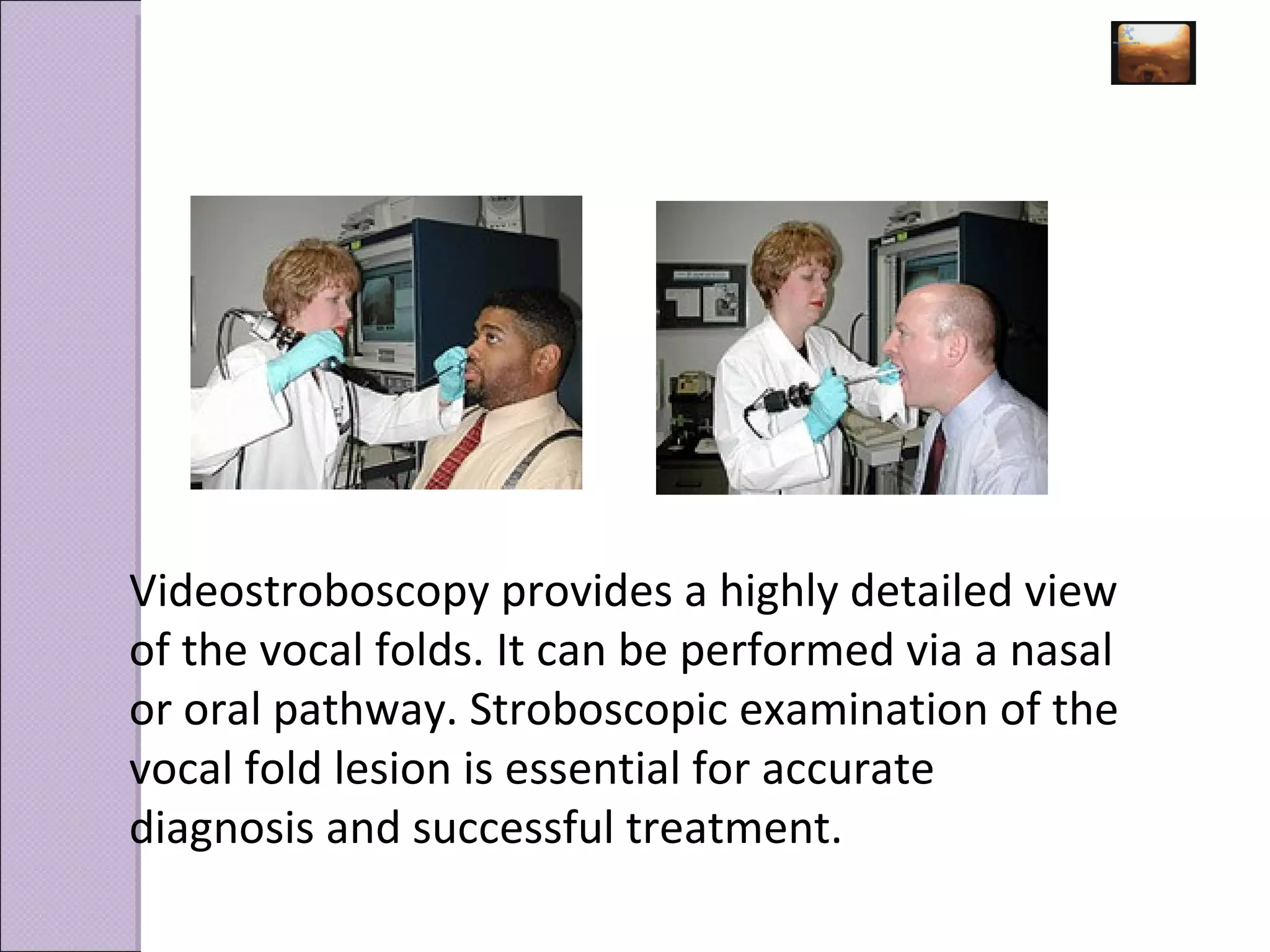
Videostroboscopy provides a highly detailed view of the vocal folds. It can be performed via a nasal or oral pathway.  Stroboscopic examination of the vocal fold lesion is essential for accurate diagnosis and successful treatment.
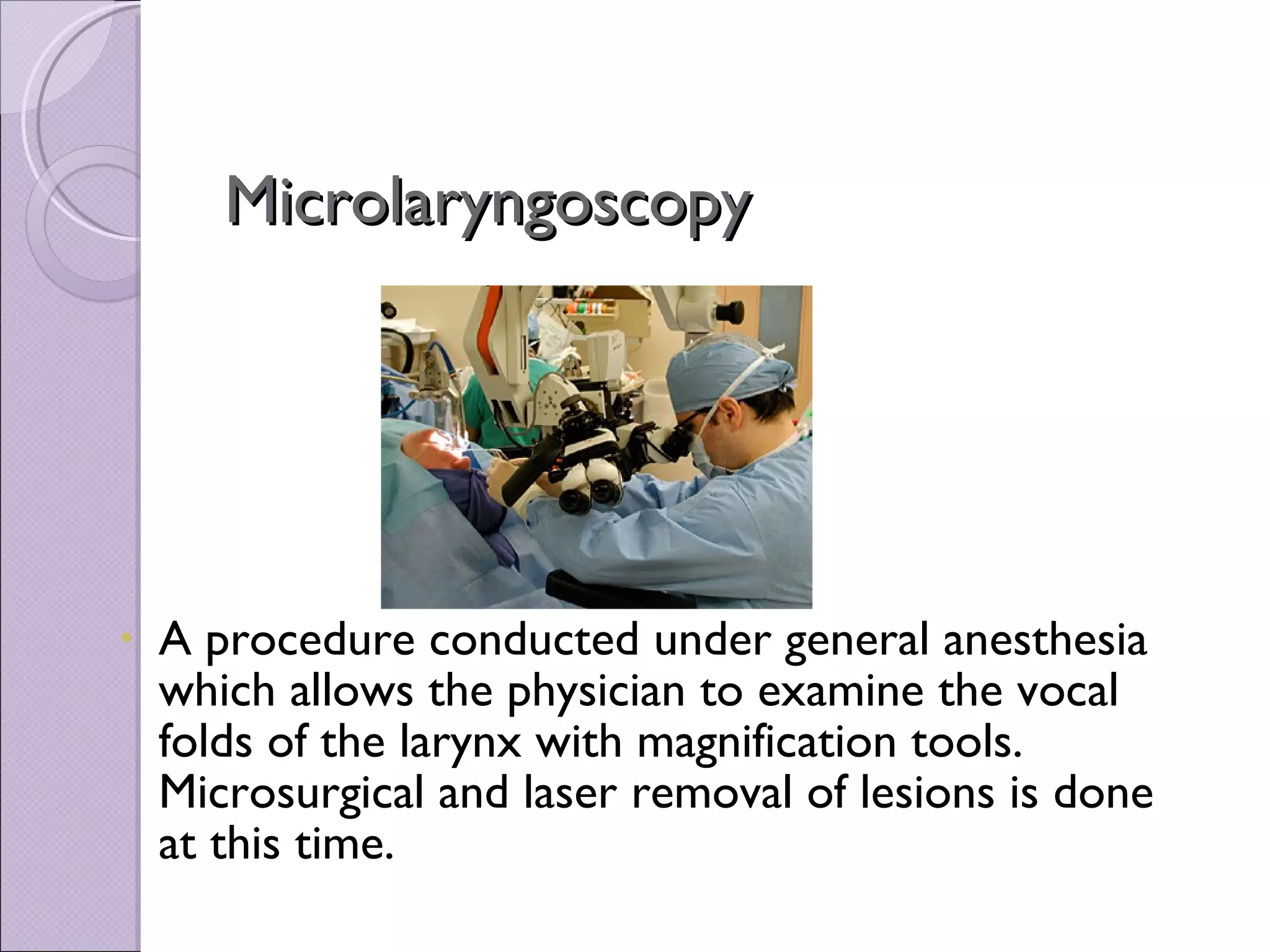
Microlaryngoscopy A procedure conducted under general anesthesia which allows the physician to examine the vocal folds of the larynx with magnification tools. Microsurgical and laser removal of lesions is done at this time.
Treatment Voice  therapy(vocal hygeine & behavioral treatment) Medical treatment Surgical treatment
Voice Therapy  Aim: to help the patient find a better voice quality which is stable,relaible and less effortful. Vocal hygiene .: 1.maintaining adequate hydration (6-8 glasses of water per day),  2.minimizing exposure to noxious chemicals, no smoking, and  3.avoiding  excessive shouting, screaming or other loud voice use. Voice therapy :   a behavioral intervention technique that makes use of vocal exercises, speaker awareness and proper postures and alignment when using the voice.
Medical Treatment Reflux may be a contributing factor and a two week trial of medication, dietary and life-style adjustments and perhaps bed positioning may be appropriate to determine reflux’s contribution. Steroid treatment reduces the overlying and sometimes camouflaging inflammation and swelling, thus making its diagnosis easier.   Patients may be placed on a 2-week period of vocal rest, perhaps accompanied by a high-dose corticosteroid.
Surgical Treatment Aim: removing only the mucosal lesion and preserving as much of the intermediate and deep layers of the vocal fold as possible. Indications: when the nodules or polyps are very large or have existed for a long time and if the lesion extends deeper into the layers of the vocal fold. rarely done in children. Patients experience a substantial improvement.  If deep lesions are present bilaterally, the physician needs to be extremely prudent. Waiting to see if  stiffness  develops from a deep dissection on one side.
Surgical Complications Related either to  laryngoscopy  or to vocal fold  mucosal injury .  Pressure effects from suspension laryngoscopy may result in tongue numbness, altered taste, and oropharyngeal, mucosal, and dental injuries.  Deep-plane dissection or exposure of the vocal ligament can result in scarring and fibrosis of the mucosa with loss of mucosal wave and glottal insufficiency.  Injudicious use of the laser can result in a wide zone of thermal damage with mucosal scarring and fibrosis, unintended burn injuries, and endotracheal tube fires.
  Thank you!!!

Symposium Vocal Nodules And Polyp

  • 1.
    Vocal nodules andpolyp Rohit Kumar 128/06
  • 2.
  • 3.
    Normal resting anatomyNormal phonation
  • 4.
    Histology of theVocal Folds The true vocal folds have an epithelial lining that is composed of respiratory epithelium (pseudostratified squamous) on the superior and inferior aspects of the fold and nonkeratinizing squamous epithelium on the medial contact surface.  The subepithelial tissues are composed of a three-layered lamina propria based on the amount of elastin and collagen fibers.  Deep to the lamina propria is the thyroarytenoid (or vocalis) muscle.
  • 5.
  • 6.
    Nodules Definition: VFNs are localized, benign, superficial growths on the medial surface of the true vocal folds that are commonly believed the result of phonotrauma; commonly affecting singers,actors vendors,teachers,children (who are prone to shouting)etc Small benign lesions:size<3mm
  • 7.
  • 8.
    Location : Nodules are bilateral with a classic location at the junction of the anterior one third and posterior two thirds of the true vocal fold. . Etiology : Vocal abuse and misuse (screamer’s or singer’s nodes Pathogenesis :Vocal abuse  hemorrhage and submucosal edema  hyalinisation and fibrosis. Epithelium undergoes hyperplasia  nodule
  • 9.
    Symptoms Hoarseness ofvoice Vocal fatigue  Pain in the neck Soreness in throat on long phonation Voice breaks at higher range
  • 10.
    Vocal Polyp Definition–polyp is a well differentiated,hyperplastic,benign pathological structure of mucous membrane;size >3mm Etiology-Phonotrauma -Smoking -Allergy Males b/w 30 and 50yrs. pathogenesis-sudden shouting  hemorrhage  submucousal edema.
  • 11.
    Vocal Polyp Location:VFPs typically involve the free edge of the vocal fold mucosa, although they may also be found along the superior or inferior borders VFPs generally are unilateral and have a broad spectrum of appearances, from hemorrhagic to edematous, pedunculated to sessile, and gelatinous to hyalinized .
  • 12.
  • 13.
    symptoms Hoarseness ofvoice Break in speech Lowered pitch Loss of part of voice range Strain during phonation diplophonia Stridor and choking(rarely)
  • 14.
    Nodules vs PolypsA nodule differs from a polyp in that it is a growth of the epithelium that covers the mucous membrane, not of the mucous membrane itself. Nodules are most frequently caused by vocal abuse or misuse. Polyps are lesions that develop from voice abuse, chronic laryngeal allergic reactions and chronic inhalation of irritants, such as industrial fumes and cigarette smoke. It may also be seen in hypothyroidism. Nodules in children frequently regress in puberty.
  • 15.
  • 16.
  • 17.
  • 18.
  • 19.
    Examination Indirect laryngoscopyRigid laryngoscopy Flexible laryngoscopy Stroboscopy microlaryngoscopy
  • 20.
    Indirect laryngoscopy Theindirect mirror exam is the initial procedure used to view the larynx.  It is quick, inexpensive , and only requires a mirror and external light source.  Gross abnormalities may be detected quickly, but subtle abnormalities may be missed.  Disadvantages include the larynx not being in physiologic phonation position (the tongue is extended and the larynx is elevated), some anatomic features limit the exam, and a hyper-reflexive gag is present in 5-10% of patients.  
  • 21.
  • 22.
    Rigid Laryngoscopy performedusing 70 or 90 degree telescopes passed through the mouth to obtain images of the larynx and pharynx.  These are the highest quality images obtainable and offer excellent magnification.    The patients are viewed in a nonphysiologic phonation position similar to the indirect examination.  Anatomic factors and hyper-reflexive gags can limit the results. 
  • 23.
  • 24.
    Flexible Laryngoscopy Mostrelied upon in the evaluation of the dysphonic patient. allows examination of the nasopharynx, palate, larynx, and pharynx in a near physiologic position. can be performed relatively easily even in patients with hyper-responsive gags and pediatric patients. 
  • 25.
  • 26.
    Video Stroboscopy a stroboscopic light is used in conjunction with a laryngoscope to electronically slow down the motion of the vocal folds in order to identify subtle changes in vibratory patterns that are diagnostically significant. Video stroboscopy is used to differentiate vocal fold nodules from vocal fold polyps.
  • 27.
    Videostroboscopy provides ahighly detailed view of the vocal folds. It can be performed via a nasal or oral pathway. Stroboscopic examination of the vocal fold lesion is essential for accurate diagnosis and successful treatment.
  • 28.
    Microlaryngoscopy A procedureconducted under general anesthesia which allows the physician to examine the vocal folds of the larynx with magnification tools. Microsurgical and laser removal of lesions is done at this time.
  • 29.
    Treatment Voice therapy(vocal hygeine & behavioral treatment) Medical treatment Surgical treatment
  • 30.
    Voice Therapy Aim: to help the patient find a better voice quality which is stable,relaible and less effortful. Vocal hygiene .: 1.maintaining adequate hydration (6-8 glasses of water per day), 2.minimizing exposure to noxious chemicals, no smoking, and 3.avoiding excessive shouting, screaming or other loud voice use. Voice therapy : a behavioral intervention technique that makes use of vocal exercises, speaker awareness and proper postures and alignment when using the voice.
  • 31.
    Medical Treatment Refluxmay be a contributing factor and a two week trial of medication, dietary and life-style adjustments and perhaps bed positioning may be appropriate to determine reflux’s contribution. Steroid treatment reduces the overlying and sometimes camouflaging inflammation and swelling, thus making its diagnosis easier. Patients may be placed on a 2-week period of vocal rest, perhaps accompanied by a high-dose corticosteroid.
  • 32.
    Surgical Treatment Aim:removing only the mucosal lesion and preserving as much of the intermediate and deep layers of the vocal fold as possible. Indications: when the nodules or polyps are very large or have existed for a long time and if the lesion extends deeper into the layers of the vocal fold. rarely done in children. Patients experience a substantial improvement. If deep lesions are present bilaterally, the physician needs to be extremely prudent. Waiting to see if stiffness develops from a deep dissection on one side.
  • 33.
    Surgical Complications Relatedeither to laryngoscopy or to vocal fold mucosal injury . Pressure effects from suspension laryngoscopy may result in tongue numbness, altered taste, and oropharyngeal, mucosal, and dental injuries. Deep-plane dissection or exposure of the vocal ligament can result in scarring and fibrosis of the mucosa with loss of mucosal wave and glottal insufficiency. Injudicious use of the laser can result in a wide zone of thermal damage with mucosal scarring and fibrosis, unintended burn injuries, and endotracheal tube fires.
  • 34.
    Thankyou!!!