Aircraft Communication System

K. Seetharamaraju (134103062)
CONTENTS
1)
2)
3)
4)
5)
6)
7)
8)
9)

Introduction
History
Basic Radio Principles
Frequency Bands
Transmitters
Receivers
Antennas
VHF Communication
HF Communication
INTRODUCTION
• Communication System involves voice transmission and reception between aircrafts or aircrafts and ground.
• For obvious reasons pilots can not use sound as a medium during the flight to interact with other pilots !
• So we need a specialized system which can play an efficient role of transmitting important data( voice, signals) and
simultaneously maintaining a good quality transmission.

• It can be said that safe aircraft operation is dependent to a large extent upon satisfactory performance of
communication system

• Radios are employed for fulfilling the purpose
History
• The First World War brought about an urgent need for communications. Voice
communications from ground-to-air and from aircraft to aircraft were established

• In the 1930s, the first all radio-controlled blind-landing was accomplished. By the end of
the decade, use of high frequency radio waves was explored and included the advent of
high-frequency radar.

• World War II injected urgency into the development of aircraft radio communication and
navigation. Communication radios, despite their size, were essential on board aircraft.
Very high frequencies were developed for communication and navigational purposes.
Basic Radio Principles
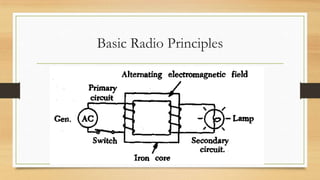
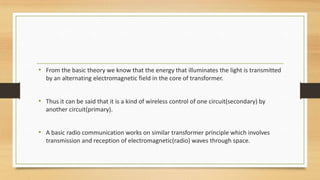
• From the basic theory we know that the energy that illuminates the light is transmitted
by an alternating electromagnetic field in the core of transformer.

• Thus it can be said that it is a kind of wireless control of one circuit(secondary) by
another circuit(primary).

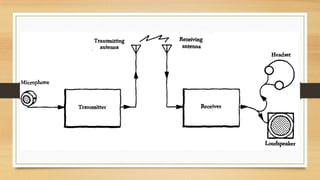
• A basic radio communication works on similar transformer principle which involves
transmission and reception of electromagnetic(radio) waves through space.
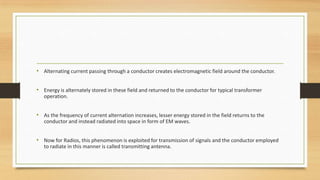
• Alternating current passing through a conductor creates electromagnetic field around the conductor.
• Energy is alternately stored in these field and returned to the conductor for typical transformer
operation.

• As the frequency of current alternation increases, lesser energy stored in the field returns to the
conductor and instead radiated into space in form of EM waves.

• Now for Radios, this phenomenon is exploited for transmission of signals and the conductor employed
to radiate in this manner is called transmitting antenna.
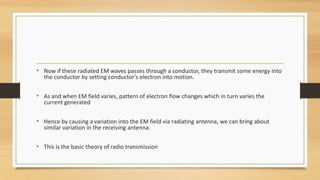
• Now if these radiated EM waves passes through a conductor, they transmit some energy into
the conductor by setting conductor’s electron into motion.

• As and when EM field varies, pattern of electron flow changes which in turn varies the
current generated

• Hence by causing a variation into the EM field via radiating antenna, we can bring about
similar variation in the receiving antenna.

• This is the basic theory of radio transmission
Frequency Band
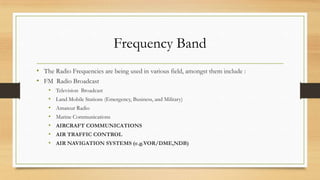
• The Radio Frequencies are being used in various field, amongst them include :
• FM Radio Broadcast
•
•
•
•
•
•
•

Television Broadcast
Land Mobile Stations (Emergency, Business, and Military)

Amateur Radio
Marine Communications
AIRCRAFT COMMUNICATIONS
AIR TRAFFIC CONTROL
AIR NAVIGATION SYSTEMS (e.g.VOR/DME,NDB)
Frequency Bands
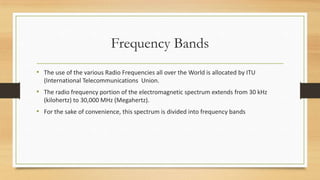
• The use of the various Radio Frequencies all over the World is allocated by ITU
(International Telecommunications Union.

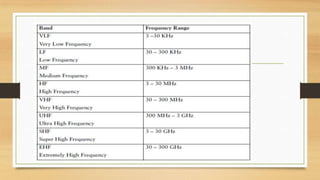
• The radio frequency portion of the electromagnetic spectrum extends from 30 kHz
(kilohertz) to 30,000 MHz (Megahertz).

• For the sake of convenience, this spectrum is divided into frequency bands
Transmitters
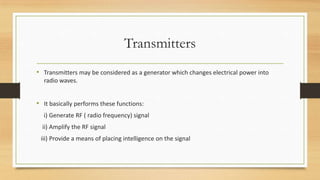
• Transmitters may be considered as a generator which changes electrical power into
radio waves.

• It basically performs these functions:
i) Generate RF ( radio frequency) signal
ii) Amplify the RF signal
iii) Provide a means of placing intelligence on the signal
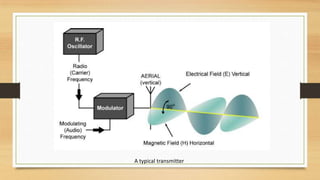
A typical transmitter
Components of Transmitter
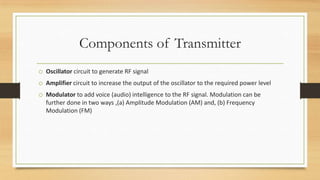
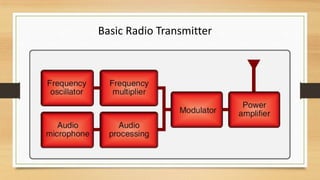
o Oscillator circuit to generate RF signal
o Amplifier circuit to increase the output of the oscillator to the required power level
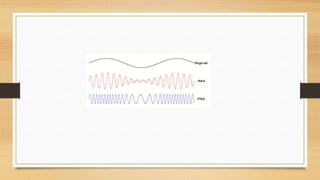
o Modulator to add voice (audio) intelligence to the RF signal. Modulation can be
further done in two ways ,(a) Amplitude Modulation (AM) and, (b) Frequency
Modulation (FM)
Basic Radio Transmitter
Receivers
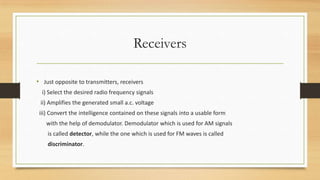
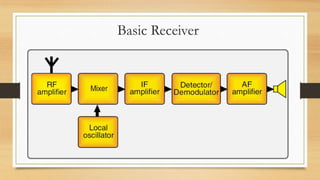
• Just opposite to transmitters, receivers
i) Select the desired radio frequency signals
ii) Amplifies the generated small a.c. voltage
iii) Convert the intelligence contained on these signals into a usable form
with the help of demodulator. Demodulator which is used for AM signals
is called detector, while the one which is used for FM waves is called
discriminator.
Basic Receiver
Antenna
• An antenna is a special type of electrical circuit designed to radiate and receive
electromagnetic energy.

• As mentioned earlier, a transmitting antenna is a conductor which radiates EM waves
when a radio frequency is passed through it, while receiving antenna intercepts the EM
waves that are present in the air.

• They come in various size and shapes depending upon the frequency to be transmitted.
• Generally for aircraft application, same antenna is used for both transmission and
reception of signals.
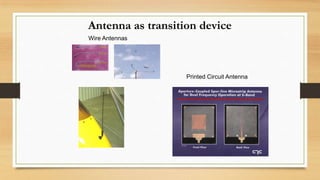
Antenna as transition device
Wire Antennas

Printed Circuit Antenna
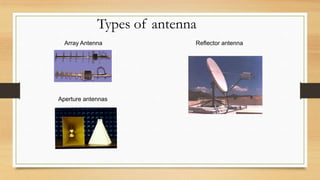
Types of antenna
Array Antenna

Aperture antennas

Reflector antenna
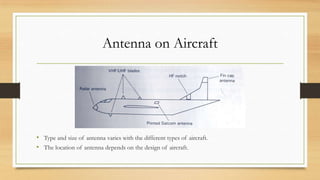
Antenna on Aircraft

• Type and size of antenna varies with the different types of aircraft.
• The location of antenna depends on the design of aircraft.
VHF and HF
• VHF and HF communication systems use transceivers.
• A transceivers is a self contained transmitter and receiver.
• The transmitter and receiver both operate at same frequency, and the
microphone button determines when there is an output from the transmitter.

• In the absence of transmission the receiver is sensitive to incoming signals.
• This combination of transmitters and receivers saves a lot of space and
weight and are hence largely used.
Very High Frequency
• Very High Frequency is a term used to describe the 30MHz. to 300MHz.
portion of the radio spectrum.

• This range of frequencies will provide short-range LOS (line of site)
communications.

• The range for VHF communications depends on equipment used, antenna
height, and terrain(typically 2 to 20 miles).
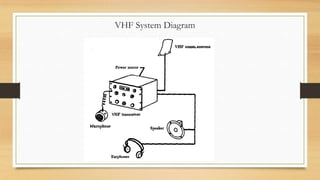
VHF System Diagram
HF communication.
• The frequency range is 3-30 MHz.
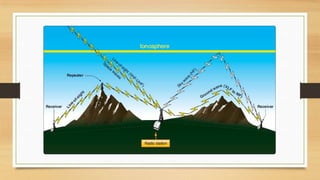
• This is used for long range communications because of its longer
transmission range.

• This is the basic band for long-range communications, mainly because its
transmissions are reflected from the ionosphere.

• HF transmitters have higher power outputs than VHF transmitters.
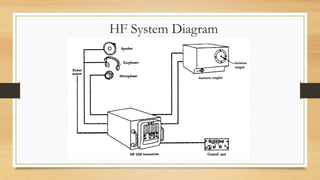
• A Tuner is used to match the impedance of the transceiver to the antenna.
• Use and installation of the HF communication system is same as that of the
VHF communication system.

• The advantage of using HF communication system over VHF
communication system is that it can transmit information over long distance
as the output power of the HF transmitter is higher than that of the VHF
transmitter.
HF System Diagram
THANK YOU

Aircraft communication-systems

  • 1.
    Aircraft Communication System K.Seetharamaraju (134103062)
  • 2.
    CONTENTS 1) 2) 3) 4) 5) 6) 7) 8) 9) Introduction History Basic Radio Principles FrequencyBands Transmitters Receivers Antennas VHF Communication HF Communication
  • 3.
    INTRODUCTION • Communication Systeminvolves voice transmission and reception between aircrafts or aircrafts and ground. • For obvious reasons pilots can not use sound as a medium during the flight to interact with other pilots ! • So we need a specialized system which can play an efficient role of transmitting important data( voice, signals) and simultaneously maintaining a good quality transmission. • It can be said that safe aircraft operation is dependent to a large extent upon satisfactory performance of communication system • Radios are employed for fulfilling the purpose
  • 4.
    History • The FirstWorld War brought about an urgent need for communications. Voice communications from ground-to-air and from aircraft to aircraft were established • In the 1930s, the first all radio-controlled blind-landing was accomplished. By the end of the decade, use of high frequency radio waves was explored and included the advent of high-frequency radar. • World War II injected urgency into the development of aircraft radio communication and navigation. Communication radios, despite their size, were essential on board aircraft. Very high frequencies were developed for communication and navigational purposes.
  • 5.
  • 6.
    • From thebasic theory we know that the energy that illuminates the light is transmitted by an alternating electromagnetic field in the core of transformer. • Thus it can be said that it is a kind of wireless control of one circuit(secondary) by another circuit(primary). • A basic radio communication works on similar transformer principle which involves transmission and reception of electromagnetic(radio) waves through space.
  • 7.
    • Alternating currentpassing through a conductor creates electromagnetic field around the conductor. • Energy is alternately stored in these field and returned to the conductor for typical transformer operation. • As the frequency of current alternation increases, lesser energy stored in the field returns to the conductor and instead radiated into space in form of EM waves. • Now for Radios, this phenomenon is exploited for transmission of signals and the conductor employed to radiate in this manner is called transmitting antenna.
  • 8.
    • Now ifthese radiated EM waves passes through a conductor, they transmit some energy into the conductor by setting conductor’s electron into motion. • As and when EM field varies, pattern of electron flow changes which in turn varies the current generated • Hence by causing a variation into the EM field via radiating antenna, we can bring about similar variation in the receiving antenna. • This is the basic theory of radio transmission
  • 10.
    Frequency Band • TheRadio Frequencies are being used in various field, amongst them include : • FM Radio Broadcast • • • • • • • Television Broadcast Land Mobile Stations (Emergency, Business, and Military) Amateur Radio Marine Communications AIRCRAFT COMMUNICATIONS AIR TRAFFIC CONTROL AIR NAVIGATION SYSTEMS (e.g.VOR/DME,NDB)
  • 11.
    Frequency Bands • Theuse of the various Radio Frequencies all over the World is allocated by ITU (International Telecommunications Union. • The radio frequency portion of the electromagnetic spectrum extends from 30 kHz (kilohertz) to 30,000 MHz (Megahertz). • For the sake of convenience, this spectrum is divided into frequency bands
  • 13.
    Transmitters • Transmitters maybe considered as a generator which changes electrical power into radio waves. • It basically performs these functions: i) Generate RF ( radio frequency) signal ii) Amplify the RF signal iii) Provide a means of placing intelligence on the signal
  • 14.
  • 15.
    Components of Transmitter oOscillator circuit to generate RF signal o Amplifier circuit to increase the output of the oscillator to the required power level o Modulator to add voice (audio) intelligence to the RF signal. Modulation can be further done in two ways ,(a) Amplitude Modulation (AM) and, (b) Frequency Modulation (FM)
  • 16.
  • 18.
    Receivers • Just oppositeto transmitters, receivers i) Select the desired radio frequency signals ii) Amplifies the generated small a.c. voltage iii) Convert the intelligence contained on these signals into a usable form with the help of demodulator. Demodulator which is used for AM signals is called detector, while the one which is used for FM waves is called discriminator.
  • 19.
  • 20.
    Antenna • An antennais a special type of electrical circuit designed to radiate and receive electromagnetic energy. • As mentioned earlier, a transmitting antenna is a conductor which radiates EM waves when a radio frequency is passed through it, while receiving antenna intercepts the EM waves that are present in the air. • They come in various size and shapes depending upon the frequency to be transmitted. • Generally for aircraft application, same antenna is used for both transmission and reception of signals.
  • 21.
    Antenna as transitiondevice Wire Antennas Printed Circuit Antenna
  • 22.
    Types of antenna ArrayAntenna Aperture antennas Reflector antenna
  • 23.
    Antenna on Aircraft •Type and size of antenna varies with the different types of aircraft. • The location of antenna depends on the design of aircraft.
  • 24.
    VHF and HF •VHF and HF communication systems use transceivers. • A transceivers is a self contained transmitter and receiver. • The transmitter and receiver both operate at same frequency, and the microphone button determines when there is an output from the transmitter. • In the absence of transmission the receiver is sensitive to incoming signals. • This combination of transmitters and receivers saves a lot of space and weight and are hence largely used.
  • 25.
    Very High Frequency •Very High Frequency is a term used to describe the 30MHz. to 300MHz. portion of the radio spectrum. • This range of frequencies will provide short-range LOS (line of site) communications. • The range for VHF communications depends on equipment used, antenna height, and terrain(typically 2 to 20 miles).
  • 26.
  • 27.
    HF communication. • Thefrequency range is 3-30 MHz. • This is used for long range communications because of its longer transmission range. • This is the basic band for long-range communications, mainly because its transmissions are reflected from the ionosphere. • HF transmitters have higher power outputs than VHF transmitters. • A Tuner is used to match the impedance of the transceiver to the antenna.
  • 28.
    • Use andinstallation of the HF communication system is same as that of the VHF communication system. • The advantage of using HF communication system over VHF communication system is that it can transmit information over long distance as the output power of the HF transmitter is higher than that of the VHF transmitter.
  • 29.
  • 31.