Africa South of the Sahara
Food Security Portal
Maximo Torero
Division Director, International Food Policy Research Institute
The European Commission represents the interests of the
European Union by proposing new legislation to the
European Parliament and the Council of the European
Union and ensuring that EU law is correctly applied by
member countries.
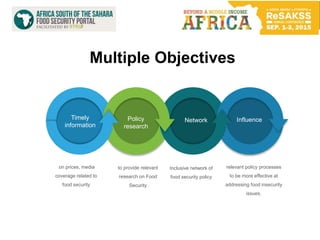
Multiple Objectives
on prices, media
coverage related to
food security
Inclusive network of
food security policy
relevant policy processes
to be more effective at
addressing food insecurity
issues.
to provide relevant
research on Food
Security
Timely
information
Policy
research
Network Influence
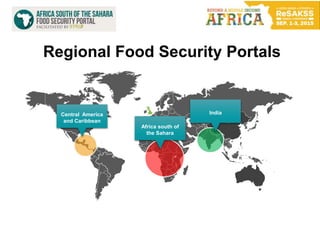
Regional Food Security Portals
Central America
and Caribbean
India
Africa south of
the Sahara
4
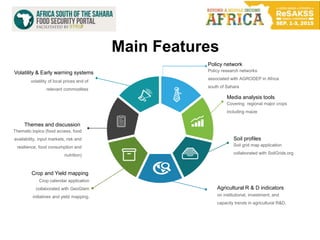
Features
Policy network
Policy research networks
associated with AGRODEP in Africa
south of Sahara
Media analysis tools
Covering regional major crops
including maize
Soil profiles
Soil grid map application
collaborated with SoilGrids.org
Agricultural R & D indicators
on institutional, investment, and
capacity trends in agricultural R&D.
Volatility & Early warning systems
volatility of local prices and of
relevant commodities
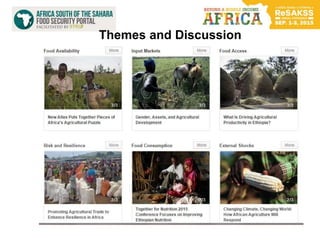
Themes and discussion
Thematic topics (food access, food
availability, input markets, risk and
resilience, food consumption and
nutrition)
Crop and Yield mapping
Crop calendar application
collaborated with GeoGlam
initiatives and yield mapping.
Main Features
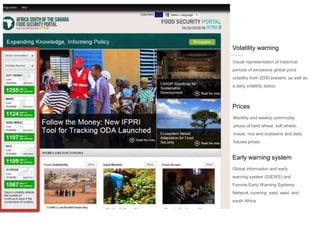
Prices
Monthly and weekly commodity
prices of hard wheat, soft wheat,
maize, rice and soybeans and daily
futures prices
Early warning system
Global information and early
warning system (GIEWS) and
Famine Early Warning Systems
Network covering east, west, and
south Africa
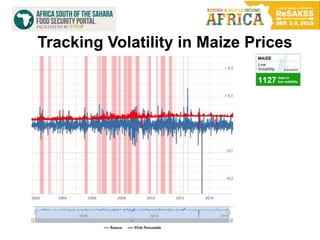
Volatility warning
Visual representation of historical
periods of excessive global price
volatility from 2000-present, as well as
a daily volatility status.
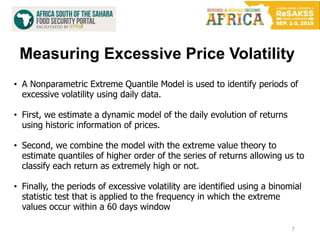
Measuring Excessive Price Volatility
7
• A Nonparametric Extreme Quantile Model is used to identify periods of
excessive volatility using daily data.
• First, we estimate a dynamic model of the daily evolution of returns
using historic information of prices.
• Second, we combine the model with the extreme value theory to
estimate quantiles of higher order of the series of returns allowing us to
classify each return as extremely high or not.
• Finally, the periods of excessive volatility are identified using a binomial
statistic test that is applied to the frequency in which the extreme
values occur within a 60 days window
8
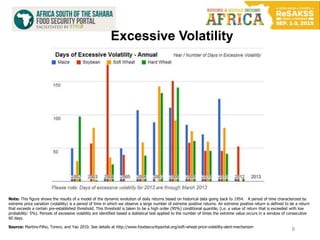
Note: This figure shows the results of a model of the dynamic evolution of daily returns based on historical data going back to 1954. A period of time characterized by
extreme price variation (volatility) is a period of time in which we observe a large number of extreme positive returns. An extreme positive return is defined to be a return
that exceeds a certain pre-established threshold. This threshold is taken to be a high order (95%) conditional quantile, (i.e. a value of return that is exceeded with low
probability: 5%). Periods of excessive volatility are identified based a statistical test applied to the number of times the extreme value occurs in a window of consecutive
60 days.
Source: Martins-Filho, Torero, and Yao 2010. See details at http://www.foodsecurityportal.org/soft-wheat-price-volatility-alert-mechanism.
Excessive Volatility
9
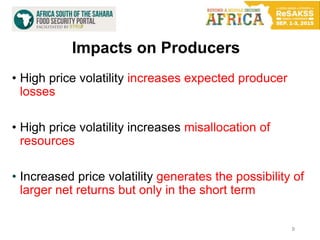
• High price volatility increases expected producer
losses
• High price volatility increases misallocation of
resources
• Increased price volatility generates the possibility of
larger net returns but only in the short term
Impacts on Producers
10
Tracking Volatility in Maize Prices
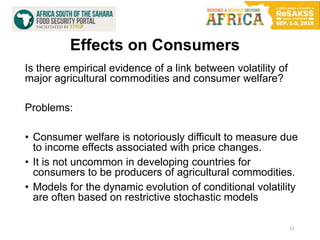
Effects on Consumers
11
Is there empirical evidence of a link between volatility of
major agricultural commodities and consumer welfare?
Problems:
• Consumer welfare is notoriously difficult to measure due
to income effects associated with price changes.
• It is not uncommon in developing countries for
consumers to be producers of agricultural commodities.
• Models for the dynamic evolution of conditional volatility
are often based on restrictive stochastic models
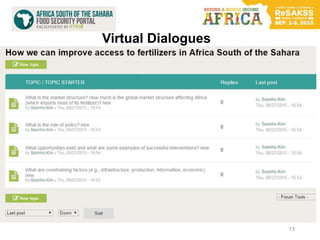
Themes and Discussion
13
Virtual Dialogues
14
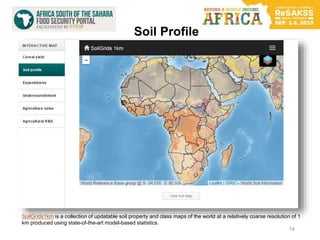
Soil Profile
SoilGrids1km is a collection of updatable soil property and class maps of the world at a relatively coarse resolution of 1
km produced using state-of-the-art model-based statistics.
15
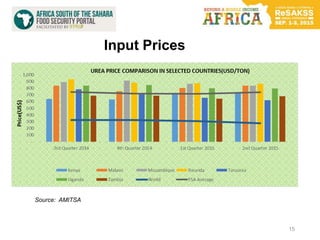
Source: AMITSA
Input Prices
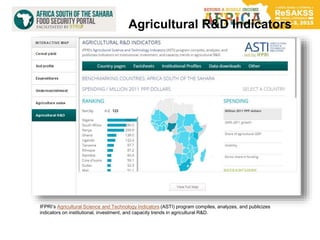
Agricultural R&D Indicators
IFPRI’s Agricultural Science and Technology Indicators (ASTI) program compiles, analyzes, and publicizes
indicators on institutional, investment, and capacity trends in agricultural R&D.
17
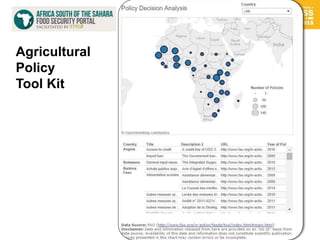
Agricultural
Policy
Tool Kit
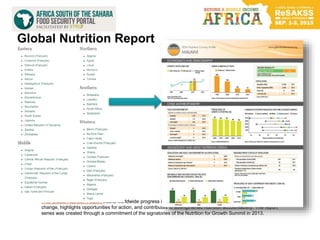
Global Nutrition Report
This Global Nutrition Report tracks worldwide progress in improving nutrition status, identifies bottlenecks to
change, highlights opportunities for action, and contributes to strengthened nutrition accountability. The report
series was created through a commitment of the signatories of the Nutrition for Growth Summit in 2013.
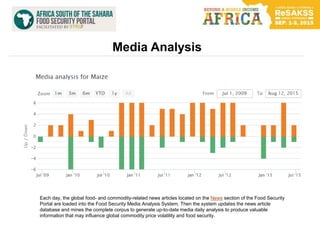
Media Analysis
Each day, the global food- and commodity-related news articles located on the News section of the Food Security
Portal are loaded into the Food Security Media Analysis System. Then the system updates the news article
database and mines the complete corpus to generate up-to-date media daily analysis to produce valuable
information that may influence global commodity price volatility and food security.
20
Partnerships and Network
21
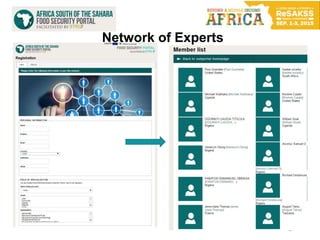
Network of Experts
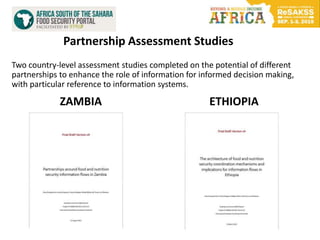
Partnership Assessment Studies
Two country-level assessment studies completed on the potential of different
partnerships to enhance the role of information for informed decision making,
with particular reference to information systems.
ZAMBIA ETHIOPIA
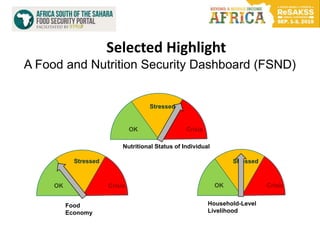
Stressed
OK Crisis
Food
Economy
Stressed
OK Crisis
Household-Level
Livelihood
Stressed
OK Crisis
Nutritional Status of Individual
A Food and Nutrition Security Dashboard (FSND)
Selected Highlight
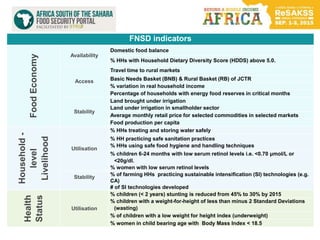
FNSD indicators
FoodEconomy
Availability
Domestic food balance
% HHs with Household Dietary Diversity Score (HDDS) above 5.0.
Access
Travel time to rural markets
Basic Needs Basket (BNB) & Rural Basket (RB) of JCTR
% variation in real household income
Percentage of households with energy food reserves in critical months
Stability
Land brought under irrigation
Land under irrigation in smallholder sector
Average monthly retail price for selected commodities in selected markets
Food production per capita
Household-
level
Livelihood
Utilisation
% HHs treating and storing water safely
% HH practicing safe sanitation practices
% HHs using safe food hygiene and handling techniques
% children 6-24 months with low serum retinol levels i.e. <0.70 μmol/L or
<20g/dl.
% women with low serum retinol levels
Stability
% of farming HHs practicing sustainable intensification (SI) technologies (e.g.
CA)
# of SI technologies developed
Health
Status
Utilisation
% children (< 2 years) stunting is reduced from 45% to 30% by 2015
% children with a weight-for-height of less than minus 2 Standard Deviations
(wasting)
% of children with a low weight for height index (underweight)
% women in child bearing age with Body Mass Index < 18.5
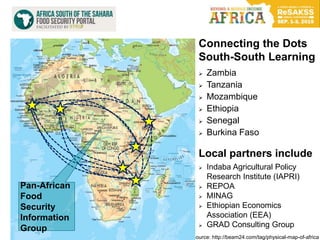
Source: http://beam24.com/tag/physical-map-of-africa
Connecting the Dots
South-South Learning
 Zambia
 Tanzania
 Mozambique
 Ethiopia
 Senegal
 Burkina Faso
Local partners include
 Indaba Agricultural Policy
Research Institute (IAPRI)
 REPOA
 MINAG
 Ethiopian Economics
Association (EEA)
 GRAD Consulting Group
Pan-African
Food
Security
Information
Group
Pan-African Food Security Information Group
Role
Advise FSP on issues related to food security
information systems and best practices to
reduce gaps.
Objectives
• Encourage collaboration
• Exploit synergies when possible
• Enhance South-South learning
26
27
Steps forwards
28
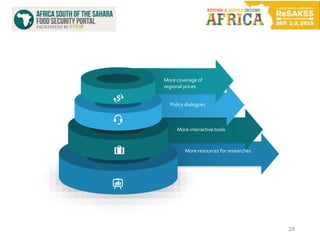
More coverage of
regional prices
More interactive tools
Policy dialogues
More resources for researches

2015 ReSAKSS Conference – Day 1 - Maximo Torero

  • 1.
    Africa South ofthe Sahara Food Security Portal Maximo Torero Division Director, International Food Policy Research Institute The European Commission represents the interests of the European Union by proposing new legislation to the European Parliament and the Council of the European Union and ensuring that EU law is correctly applied by member countries.
  • 2.
    Multiple Objectives on prices,media coverage related to food security Inclusive network of food security policy relevant policy processes to be more effective at addressing food insecurity issues. to provide relevant research on Food Security Timely information Policy research Network Influence
  • 3.
    Regional Food SecurityPortals Central America and Caribbean India Africa south of the Sahara
  • 4.
  • 5.
    Policy network Policy researchnetworks associated with AGRODEP in Africa south of Sahara Media analysis tools Covering regional major crops including maize Soil profiles Soil grid map application collaborated with SoilGrids.org Agricultural R & D indicators on institutional, investment, and capacity trends in agricultural R&D. Volatility & Early warning systems volatility of local prices and of relevant commodities Themes and discussion Thematic topics (food access, food availability, input markets, risk and resilience, food consumption and nutrition) Crop and Yield mapping Crop calendar application collaborated with GeoGlam initiatives and yield mapping. Main Features
  • 6.
    Prices Monthly and weeklycommodity prices of hard wheat, soft wheat, maize, rice and soybeans and daily futures prices Early warning system Global information and early warning system (GIEWS) and Famine Early Warning Systems Network covering east, west, and south Africa Volatility warning Visual representation of historical periods of excessive global price volatility from 2000-present, as well as a daily volatility status.
  • 7.
    Measuring Excessive PriceVolatility 7 • A Nonparametric Extreme Quantile Model is used to identify periods of excessive volatility using daily data. • First, we estimate a dynamic model of the daily evolution of returns using historic information of prices. • Second, we combine the model with the extreme value theory to estimate quantiles of higher order of the series of returns allowing us to classify each return as extremely high or not. • Finally, the periods of excessive volatility are identified using a binomial statistic test that is applied to the frequency in which the extreme values occur within a 60 days window
  • 8.
    8 Note: This figureshows the results of a model of the dynamic evolution of daily returns based on historical data going back to 1954. A period of time characterized by extreme price variation (volatility) is a period of time in which we observe a large number of extreme positive returns. An extreme positive return is defined to be a return that exceeds a certain pre-established threshold. This threshold is taken to be a high order (95%) conditional quantile, (i.e. a value of return that is exceeded with low probability: 5%). Periods of excessive volatility are identified based a statistical test applied to the number of times the extreme value occurs in a window of consecutive 60 days. Source: Martins-Filho, Torero, and Yao 2010. See details at http://www.foodsecurityportal.org/soft-wheat-price-volatility-alert-mechanism. Excessive Volatility
  • 9.
    9 • High pricevolatility increases expected producer losses • High price volatility increases misallocation of resources • Increased price volatility generates the possibility of larger net returns but only in the short term Impacts on Producers
  • 10.
  • 11.
    Effects on Consumers 11 Isthere empirical evidence of a link between volatility of major agricultural commodities and consumer welfare? Problems: • Consumer welfare is notoriously difficult to measure due to income effects associated with price changes. • It is not uncommon in developing countries for consumers to be producers of agricultural commodities. • Models for the dynamic evolution of conditional volatility are often based on restrictive stochastic models
  • 12.
  • 13.
  • 14.
    14 Soil Profile SoilGrids1km isa collection of updatable soil property and class maps of the world at a relatively coarse resolution of 1 km produced using state-of-the-art model-based statistics.
  • 15.
  • 16.
    Agricultural R&D Indicators IFPRI’sAgricultural Science and Technology Indicators (ASTI) program compiles, analyzes, and publicizes indicators on institutional, investment, and capacity trends in agricultural R&D.
  • 17.
  • 18.
    Global Nutrition Report ThisGlobal Nutrition Report tracks worldwide progress in improving nutrition status, identifies bottlenecks to change, highlights opportunities for action, and contributes to strengthened nutrition accountability. The report series was created through a commitment of the signatories of the Nutrition for Growth Summit in 2013.
  • 19.
    Media Analysis Each day,the global food- and commodity-related news articles located on the News section of the Food Security Portal are loaded into the Food Security Media Analysis System. Then the system updates the news article database and mines the complete corpus to generate up-to-date media daily analysis to produce valuable information that may influence global commodity price volatility and food security.
  • 20.
  • 21.
  • 22.
    Partnership Assessment Studies Twocountry-level assessment studies completed on the potential of different partnerships to enhance the role of information for informed decision making, with particular reference to information systems. ZAMBIA ETHIOPIA
  • 23.
    Stressed OK Crisis Food Economy Stressed OK Crisis Household-Level Livelihood Stressed OKCrisis Nutritional Status of Individual A Food and Nutrition Security Dashboard (FSND) Selected Highlight
  • 24.
    FNSD indicators FoodEconomy Availability Domestic foodbalance % HHs with Household Dietary Diversity Score (HDDS) above 5.0. Access Travel time to rural markets Basic Needs Basket (BNB) & Rural Basket (RB) of JCTR % variation in real household income Percentage of households with energy food reserves in critical months Stability Land brought under irrigation Land under irrigation in smallholder sector Average monthly retail price for selected commodities in selected markets Food production per capita Household- level Livelihood Utilisation % HHs treating and storing water safely % HH practicing safe sanitation practices % HHs using safe food hygiene and handling techniques % children 6-24 months with low serum retinol levels i.e. <0.70 μmol/L or <20g/dl. % women with low serum retinol levels Stability % of farming HHs practicing sustainable intensification (SI) technologies (e.g. CA) # of SI technologies developed Health Status Utilisation % children (< 2 years) stunting is reduced from 45% to 30% by 2015 % children with a weight-for-height of less than minus 2 Standard Deviations (wasting) % of children with a low weight for height index (underweight) % women in child bearing age with Body Mass Index < 18.5
  • 25.
    Source: http://beam24.com/tag/physical-map-of-africa Connecting theDots South-South Learning  Zambia  Tanzania  Mozambique  Ethiopia  Senegal  Burkina Faso Local partners include  Indaba Agricultural Policy Research Institute (IAPRI)  REPOA  MINAG  Ethiopian Economics Association (EEA)  GRAD Consulting Group Pan-African Food Security Information Group
  • 26.
    Pan-African Food SecurityInformation Group Role Advise FSP on issues related to food security information systems and best practices to reduce gaps. Objectives • Encourage collaboration • Exploit synergies when possible • Enhance South-South learning 26
  • 27.
  • 28.
    28 More coverage of regionalprices More interactive tools Policy dialogues More resources for researches