Options to combine AR and ARD in the
European AKIS
Krijn J. Poppe, LEI Wageningen UR & SCAR AKIS
with thanks to Floor Geerling – Eiff for interviews in WUR
My introduction
Co-chair Strategic Working Group AKIS
(Agricultural Knowledge and Innovation
Systems)
of the EU SCAR (Standing Committee
on Agricultural Research)
Economist and Research Manager at LEI Wageningen UR
My perspective:
• Wageningen UR has always integrated AR and ARD
• I approach the issue from the interests of AR: why
should AR welcome an integration with ARD
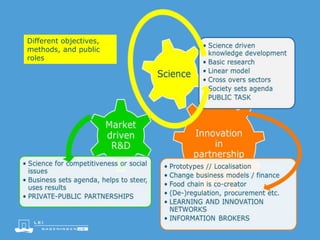
Different objectives,
methods, and public
roles
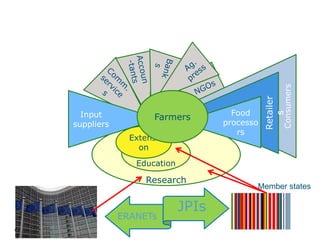
ERANETs
JPIs
Research
Education
Consumers
Retailer
s
Food
processo
rs
Extensi
on
Input
suppliers
Farmers
Member states
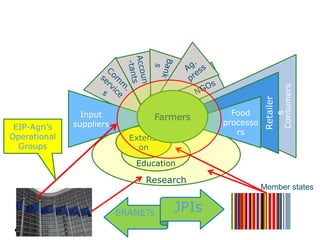
Research
Education
Consumers
Retailer
s
Food
processo
rs
Extensi
on
Input
suppliers
Farmers
Member states
ERANETs JPIs
EIP-Agri’s
Operational
Groups
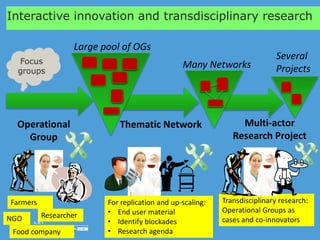
Interactive innovation and transdisciplinary research
Large pool of OGs
Many Networks
Operational
Group
Thematic Network Multi-actor
Research Project
Farmers For replication and up-scaling:
• End user material
• Identify blockades
• Research agenda
Transdisciplinary research:
Operational Groups as
cases and co-innovatorsNGO
Food company
Researcher
Several
Projects
Focus
groups
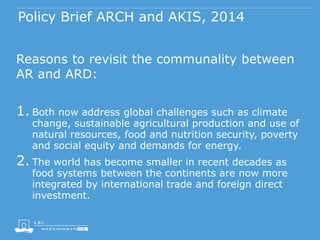
Policy Brief ARCH and AKIS, 2014
Reasons to revisit the communality between
AR and ARD:
1. Both now address global challenges such as climate
change, sustainable agricultural production and use of
natural resources, food and nutrition security, poverty
and social equity and demands for energy.
2. The world has become smaller in recent decades as
food systems between the continents are now more
integrated by international trade and foreign direct
investment.
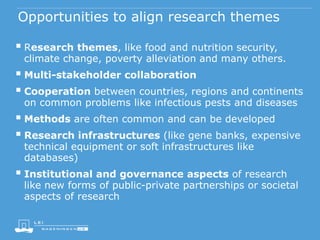
Opportunities to align research themes
 Research themes, like food and nutrition security,
climate change, poverty alleviation and many others.
 Multi-stakeholder collaboration
 Cooperation between countries, regions and continents
on common problems like infectious pests and diseases
 Methods are often common and can be developed
 Research infrastructures (like gene banks, expensive
technical equipment or soft infrastructures like
databases)
 Institutional and governance aspects of research
like new forms of public-private partnerships or societal
aspects of research
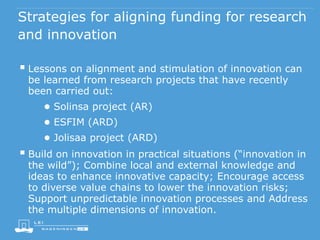
Strategies for aligning funding for research
and innovation
 Lessons on alignment and stimulation of innovation can
be learned from research projects that have recently
been carried out:
● Solinsa project (AR)
● ESFIM (ARD)
● Jolisaa project (ARD)
 Build on innovation in practical situations (“innovation in
the wild”); Combine local and external knowledge and
ideas to enhance innovative capacity; Encourage access
to diverse value chains to lower the innovation risks;
Support unpredictable innovation processes and Address
the multiple dimensions of innovation.
Other remarks in ARCH-AKIS policy brief
 Policy makers at national and EU levels should seek for
cross-policy collaboration to reduce barriers
 New bottom-up models have to be designed and
technology has to be adapted
 Promote private sector involvement - should be
elaborated and diversified.
 The added value of European international research
and innovation practices must be made explicit.
 Policy makers should discuss the desired flexibility in the
application of funding mechanisms
 Evaluation of research projects should be renewed
 New intercontinental innovation partnerships
should become part of a policy framework
Reasons to combine AR with ARD:
Grand societal challenges cross borders:
● Common interest
● The best and cheapest solution are not
necessarily in Europe
● Pests and diseases (human, animal, plant)
cross borders
Topics for international food chains (e.g. Seeds for
West Africa) especially if Europe
● supplies inputs or
● sources products from a developing country
● sees options for new commercialisation (e.g.
indeginous plants; “by-products” from
European slaughterhouses for e.g. China)
Reasons to combine AR with ARD: (2)
Developing countries are the economic motors of
tomorrow: invest in your market
Topics where there are not much differences in
research objective. Example: ICT for family farms
(Kenya’s M-Pesa leads in mobile payments)
Topics where variations in cases can help to solve
the research questions. Examples: family farming,
cooperatives.
 Widening of solution space (e.g. new methods for
cooling fruits in India can help energy saving in Europe)
 International standardisation (reference labs, standards
in ICT)
 Last but not least: efficiency
Some topics mentioned in interviews at
Wageningen UR (experience based)
 ICT and big data
 Water management
 Food security
 Biobased production and chain development
 Climate smart agriculture
 Integrated Pest Management - IPM
 Sustainable intensification including plant breeding
 Small family farms and innovation
Other suggestions from interviews
 More collaboration CGIAR and AR-system needed
 More policy coherence between DG-DEVCO and DG-RTD
(and DG-AGRI) is welcome. Why is Devco’s AR4D
agenda not integrated in H2020?
 Public-private partnerships are difficult in an
intercontinental context (in different cultures
multinationals, NGO, (local) sme are hard to bring
together) >> how to overcome ? More subsidies for
number of global innovation platforms ?
 lower transaction costs for research collaboration and
exchange
 Also Dutch PP-Partnerships need to look more to this
issue of integrating AR and ARD
Horizon 2020
 Relatively easy – see current call H2020 SC SFS18 on
family farming:
● “In line with the objectives of the EU strategy for
international cooperation in research and innovation
and in particular with the implementation of the EU-
Africa dialogue, proposals are encouraged to
include third country participants, especially those
established in Africa and Asia.´
JPI and ERAnets:
 More difficult ?
 Already complicated: member states provide capacity in
kind, not money.
● Contributes to widening participation
● But inefficient use of resources
● Pooling the money?
● Would lead to a more money driven system
● With more specialisation also based on
different labour costs
● Governments have to separate science for
solving a common issue and projects for
(local) innovation
Thank you for
your attention
krijn.poppe@wur.nl
www.lei.wur.nl
References
• Reflection paper AKIS 1
• Orientation paper AKIS 2
• Summarizing powerpoint
presentation available on SlideShare
• ARCH – AKIS Policy Brief, 2014
Innovation is a broad concept
 The implementation of a new or significantly
improved product (good or service), or process, a
new marketing method, or a new organisational
method in business practices, workplace organisation
or external relations. [source: OECD]
 Also the public sector can innovate !
(and public aspects of agriculture)
Knowledge & Innovation System:
7 functions
1.Knowledge development and diffusion
2.Influence on direction of search and identification
of opportunities
3.Entrepreneurial experimentation and management
of risk and uncertainty
4.Market formation
5.Resource mobilisation
6.Legitimation
7.Development of positive externalities
(c) M. Hekkert et al.
Innovation by interaction in networks
 Innovation as a process has strong learning aspects: learn
how to do new things, bottom-up.
● Alternative: force (or pay for) quality standards, mandates
 Thematically-focused learning networks of different actors can
help.
 Generating learning and innovation through interactions
between the involved actors.
● participation for all in the planning of work and
experiments, their execution up until the dissemination
of results and the demonstration phase
 Members can include farmers, extension workers, food
industry, researchers, government and ngo representatives
and other stakeholders.