Rising food prices and implications for information needsNicholas Minot (IFPRI)Presented at the seminar“Food security information systems”31 January 2011 Imperial Royale Hotel, Kampala
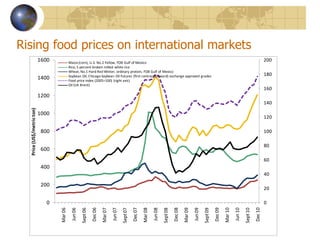
Rising food prices on international markets
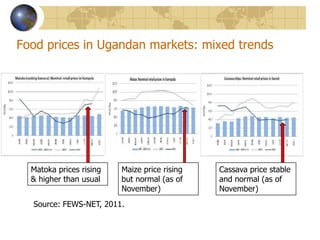
Food prices in Ugandan markets: mixed trendsMatoka prices rising & higher than usualMaize price rising but normal (as of November)Cassava price stable and normal (as of November)Source: FEWS-NET, 2011.
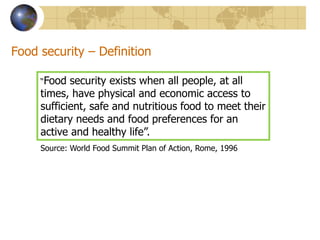
Food security – Definition “Food security exists when all people, at all times, have physical and economic access to sufficient, safe and nutritious food to meet their dietary needs and food preferences for an active and healthy life”.Source: World Food Summit Plan of Action, Rome, 1996
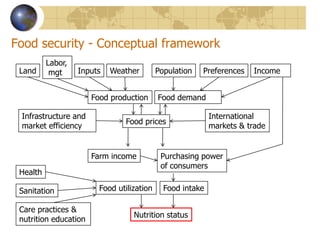
Food security - Conceptual frameworkLabor, mgtLandInputsWeatherPopulationPreferencesIncomeFood productionFood demandInternational markets & tradeInfrastructure and market efficiencyFood pricesFarm incomePurchasing power of consumersHealthFood intakeFood utilizationSanitationCare practices & nutrition educationNutrition status
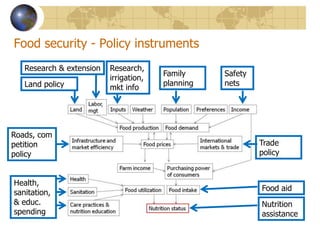
Food security - Policy instrumentsResearch & extensionResearch, irrigation,mkt infoFamily planningSafety netsLand policyRoads, competition policyTrade policyHealth,  sanitation, & educ.  spendingFood aid Nutrition assistance
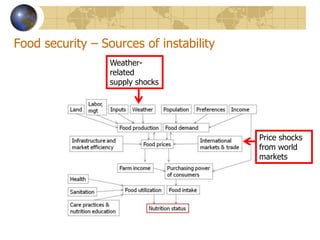
Food security – Sources of instabilityWeather-related supply shocksPrice shocks from world markets
Food security – Types of information needsMonitoring of food security indicatorsAnalysis and interpretation of food security indicatorsRelationships among food security indicatorsImpact of food & nutrition policy and programmes
1. Monitoring food security indicatorsFood security indicators (“boxes” in conceptual framework)Issues in monitoringHow frequent to monitor them?How many commodities to cover?How many locations to cover?What level of accuracy to seek given trade-off of cost & accuracyDecisions are often based on:Importance of indicator as a measure of food security Cost of collecting data
1. Monitoring food security indicatorsDaily or weekly monitoringDomestic and international food pricesWeatherMonthly monitoringInternational tradeSemi-annual or annualFood and agricultural productionUse of fertilizer and other inputsEvery 5-10 yearsFood consumption, expenditure, and incomeNutrition status at national levelPopulation
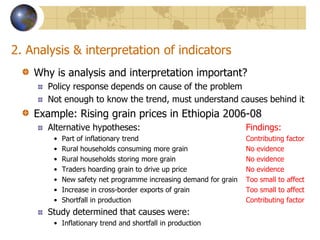
2. Analysis & interpretation of indicatorsWhy is analysis and interpretation important?Policy response depends on cause of the problemNot enough to know the trend, must understand causes behind itExample: Rising grain prices in Ethiopia 2006-08Alternative hypotheses:Part of inflationary trendRural households consuming more grainRural households storing more grainTraders hoarding grain to drive up priceNew safety net programme increasing demand for grainIncrease in cross-border exports of grainShortfall in production Study methodsFarm survey, trader survey, cross-border trade study, ag sector model
2. Analysis & interpretation of indicatorsWhy is analysis and interpretation important?Policy response depends on cause of the problemNot enough to know the trend, must understand causes behind itExample: Rising grain prices in Ethiopia 2006-08Alternative hypotheses:				Findings:Part of inflationary trend                                              	Contributing factorRural households consuming more grain                        	No evidenceRural households storing more grain                             	No evidenceTraders hoarding grain to drive up price                        	No evidenceNew safety net programme increasing demand for grain  	Too small to affectIncrease in cross-border exports of grain		Too small to affectShortfall in production 				Contributing factorStudy determined that causes were:Inflationary trend and shortfall in production
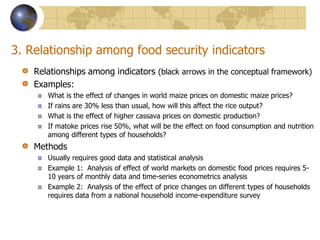
3. Relationship among food security indicatorsRelationships among indicators (black arrows in the conceptual framework)Examples: What is the effect of changes in world maize prices on domestic maize prices?If rains are 30% less than usual, how will this affect the rice output? What is the effect of higher cassava prices on domestic production? If matoke prices rise 50%, what will be the effect on food consumption and nutrition among different types of households?MethodsUsually requires good data and statistical analysisExample 1:  Analysis of effect of world markets on domestic food prices requires 5-10 years of monthly data and time-series econometrics analysisExample 2:  Analysis of the effect of price changes on different types of households requires data from a national household income-expenditure survey
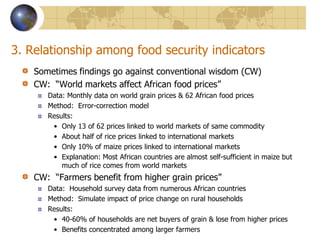
3. Relationship among food security indicatorsSometimes findings go against conventional wisdom (CW)CW:  “World markets affect African food prices”  Data: Monthly data on world grain prices & 62 African food prices Method:  Error-correction modelResults: Only 13 of 62 prices linked to world markets of same commodityAbout half of rice prices linked to international marketsOnly 10% of maize prices linked to international marketsExplanation: Most African countries are almost self-sufficient in maize but much of rice comes from world marketsCW:  “Farmers benefit from higher grain prices”  Data:  Household survey data from numerous African countriesMethod:  Simulate impact of price change on rural householdsResults:  40-60% of households are net buyers of grain & lose from higher prices Benefits concentrated among larger farmers
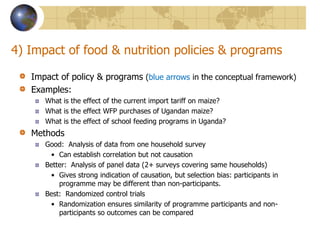
4) Impact of food & nutrition policies & programsImpact of policy & programs (blue arrows in the conceptual framework)Examples: What is the effect of the current import tariff on maize? What is the effect WFP purchases of Ugandan maize?What is the effect of school feeding programs in Uganda?MethodsGood:  Analysis of data from one household surveyCan establish correlation but not causationBetter:  Analysis of panel data (2+ surveys covering same households)Gives strong indication of causation, but selection bias: participants in programme may be different than non-participants.  Best:  Randomized control trialsRandomization ensures similarity of programme participants and non-participants so outcomes can be compared
ConclusionsFood security conceptual framework helps identify information needsData collection affected by cost of collecting indicatorsFour types of food security informationFood security indicatorsAnalysis and interpretation of indicatorsRelationship among indicatorsImpact of food & nutrition policies on indicatorsTrade-off between accuracy and costInformation needs depend on policy issues facing government

Rising food prices and implications for information needs

  • 1.
    Rising food pricesand implications for information needsNicholas Minot (IFPRI)Presented at the seminar“Food security information systems”31 January 2011 Imperial Royale Hotel, Kampala
  • 2.
    Rising food priceson international markets
  • 3.
    Food prices inUgandan markets: mixed trendsMatoka prices rising & higher than usualMaize price rising but normal (as of November)Cassava price stable and normal (as of November)Source: FEWS-NET, 2011.
  • 4.
    Food security –Definition “Food security exists when all people, at all times, have physical and economic access to sufficient, safe and nutritious food to meet their dietary needs and food preferences for an active and healthy life”.Source: World Food Summit Plan of Action, Rome, 1996
  • 5.
    Food security -Conceptual frameworkLabor, mgtLandInputsWeatherPopulationPreferencesIncomeFood productionFood demandInternational markets & tradeInfrastructure and market efficiencyFood pricesFarm incomePurchasing power of consumersHealthFood intakeFood utilizationSanitationCare practices & nutrition educationNutrition status
  • 6.
    Food security -Policy instrumentsResearch & extensionResearch, irrigation,mkt infoFamily planningSafety netsLand policyRoads, competition policyTrade policyHealth, sanitation, & educ. spendingFood aid Nutrition assistance
  • 7.
    Food security –Sources of instabilityWeather-related supply shocksPrice shocks from world markets
  • 8.
    Food security –Types of information needsMonitoring of food security indicatorsAnalysis and interpretation of food security indicatorsRelationships among food security indicatorsImpact of food & nutrition policy and programmes
  • 9.
    1. Monitoring foodsecurity indicatorsFood security indicators (“boxes” in conceptual framework)Issues in monitoringHow frequent to monitor them?How many commodities to cover?How many locations to cover?What level of accuracy to seek given trade-off of cost & accuracyDecisions are often based on:Importance of indicator as a measure of food security Cost of collecting data
  • 10.
    1. Monitoring foodsecurity indicatorsDaily or weekly monitoringDomestic and international food pricesWeatherMonthly monitoringInternational tradeSemi-annual or annualFood and agricultural productionUse of fertilizer and other inputsEvery 5-10 yearsFood consumption, expenditure, and incomeNutrition status at national levelPopulation
  • 11.
    2. Analysis &interpretation of indicatorsWhy is analysis and interpretation important?Policy response depends on cause of the problemNot enough to know the trend, must understand causes behind itExample: Rising grain prices in Ethiopia 2006-08Alternative hypotheses:Part of inflationary trendRural households consuming more grainRural households storing more grainTraders hoarding grain to drive up priceNew safety net programme increasing demand for grainIncrease in cross-border exports of grainShortfall in production Study methodsFarm survey, trader survey, cross-border trade study, ag sector model
  • 12.
    2. Analysis &interpretation of indicatorsWhy is analysis and interpretation important?Policy response depends on cause of the problemNot enough to know the trend, must understand causes behind itExample: Rising grain prices in Ethiopia 2006-08Alternative hypotheses: Findings:Part of inflationary trend Contributing factorRural households consuming more grain No evidenceRural households storing more grain No evidenceTraders hoarding grain to drive up price No evidenceNew safety net programme increasing demand for grain Too small to affectIncrease in cross-border exports of grain Too small to affectShortfall in production Contributing factorStudy determined that causes were:Inflationary trend and shortfall in production
  • 13.
    3. Relationship amongfood security indicatorsRelationships among indicators (black arrows in the conceptual framework)Examples: What is the effect of changes in world maize prices on domestic maize prices?If rains are 30% less than usual, how will this affect the rice output? What is the effect of higher cassava prices on domestic production? If matoke prices rise 50%, what will be the effect on food consumption and nutrition among different types of households?MethodsUsually requires good data and statistical analysisExample 1: Analysis of effect of world markets on domestic food prices requires 5-10 years of monthly data and time-series econometrics analysisExample 2: Analysis of the effect of price changes on different types of households requires data from a national household income-expenditure survey
  • 14.
    3. Relationship amongfood security indicatorsSometimes findings go against conventional wisdom (CW)CW: “World markets affect African food prices” Data: Monthly data on world grain prices & 62 African food prices Method: Error-correction modelResults: Only 13 of 62 prices linked to world markets of same commodityAbout half of rice prices linked to international marketsOnly 10% of maize prices linked to international marketsExplanation: Most African countries are almost self-sufficient in maize but much of rice comes from world marketsCW: “Farmers benefit from higher grain prices” Data: Household survey data from numerous African countriesMethod: Simulate impact of price change on rural householdsResults: 40-60% of households are net buyers of grain & lose from higher prices Benefits concentrated among larger farmers
  • 15.
    4) Impact offood & nutrition policies & programsImpact of policy & programs (blue arrows in the conceptual framework)Examples: What is the effect of the current import tariff on maize? What is the effect WFP purchases of Ugandan maize?What is the effect of school feeding programs in Uganda?MethodsGood: Analysis of data from one household surveyCan establish correlation but not causationBetter: Analysis of panel data (2+ surveys covering same households)Gives strong indication of causation, but selection bias: participants in programme may be different than non-participants. Best: Randomized control trialsRandomization ensures similarity of programme participants and non-participants so outcomes can be compared
  • 16.
    ConclusionsFood security conceptualframework helps identify information needsData collection affected by cost of collecting indicatorsFour types of food security informationFood security indicatorsAnalysis and interpretation of indicatorsRelationship among indicatorsImpact of food & nutrition policies on indicatorsTrade-off between accuracy and costInformation needs depend on policy issues facing government