



Mind Over
Media:
Teaching About
Propaganda
Renee Hobbs
University of
Washington
November 28, 2018
Misconceptions about propaganda
interfere with effective teaching and
learning
Critical analysis of contemporary
propaganda helps counter its
emotional power
Multi-perspectival dialogue about
global propaganda can activate
intellectual curiosity and promote
cultural understanding
By expressing opinions, creating and
commenting on propaganda, people
build citizenship skills that advance
democratic goals
Preview of Key Ideas
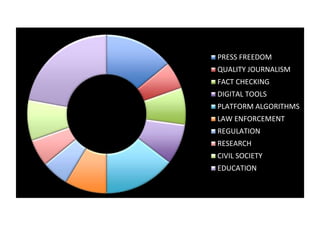
What can be done about rising propaganda
& misinformation around the world?
PRESS FREEDOM
QUALITY JOURNALISM
FACT CHECKING
DIGITAL TOOLS
PLATFORM ALGORITHMS
LAW ENFORCEMENT
REGULATION
RESEARCH
CIVIL SOCIETY
EDUCATION
www.mediaeducationlab.com
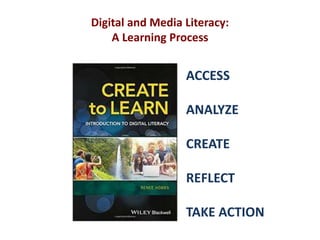
Digital and Media Literacy:
A Learning Process
ACCESS
ANALYZE
CREATE
REFLECT
TAKE ACTION
Rhetoric
Print Literacy
Visual Literacy
Information Literacy
Media Literacy
Computer Literacy
News Literacy
Digital Literacy
Literacy Expands in Relation to Culture, Technology & Society
Literacy is the sharing of meaning
through symbols
#chariholearns @reneehobbs
What do American teachers and students know about
propaganda?
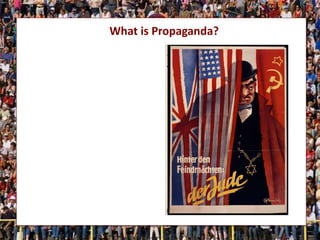
What is Propaganda?
What is Propaganda?
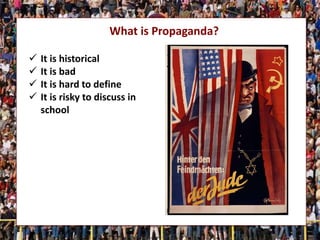
 It is historical
 It is bad
 It is hard to define
 It is risky to discuss in
school
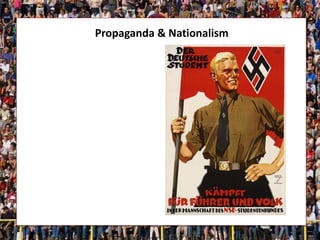
Propaganda & Nationalism
Hoaxes
Parody/Satire
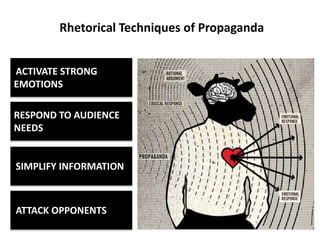
ACTIVATE STRONG
EMOTIONS
ATTACK OPPONENTS
SIMPLIFY INFORMATION
RESPOND TO AUDIENCE
NEEDS
Rhetorical Techniques of Propaganda
How have definitions of propaganda changed over time?
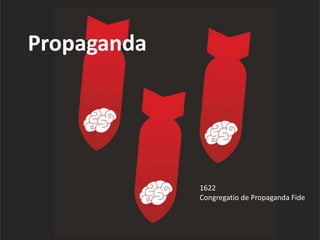
Propaganda
1622
Congregatio de Propaganda Fide
What is Propaganda?
Propaganda is one means by which large numbers
of people are induced to act together.
-Bruce Lannes Smith and Harold Lasswell,
authors of Propaganda, Communication and Public Opinion, 1946
What is Propaganda?
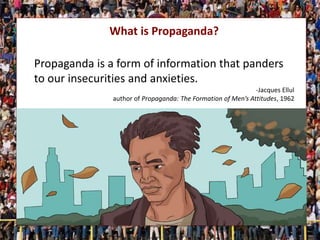
Propaganda is a form of information that panders
to our insecurities and anxieties.
-Jacques Ellul
author of Propaganda: The Formation of Men’s Attitudes, 1962
What is Propaganda?
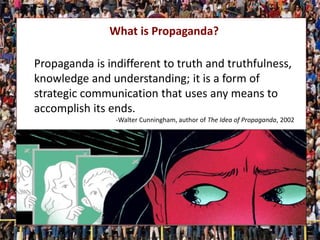
Propaganda is indifferent to truth and truthfulness,
knowledge and understanding; it is a form of
strategic communication that uses any means to
accomplish its ends.
-Walter Cunningham, author of The Idea of Propaganda, 2002
• Propaganda appears in a variety of forms
• Propaganda is strategic and intentional
• Propaganda aims to influence attitudes, opinions and
behaviors
• Propaganda can be beneficial or harmful
• Propaganda may use truth, half-truths or lies
• Propaganda uses any means to accomplish its goal
• To be successful, propaganda taps into our deepest
values, fears, hopes and dreams
Where is Propaganda Found?
Advertising
Activism
Journalism & Public Relations
Government
Education
Entertainment
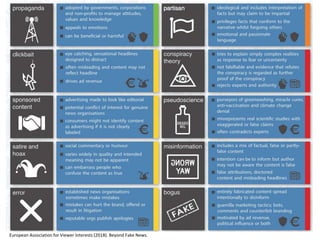
European Association for Viewer Interests (2018). Beyond Fake News.
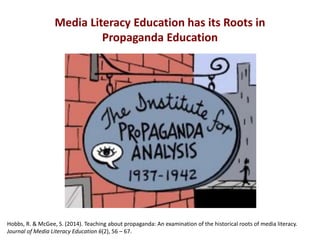
Media Literacy Education has its Roots in
Propaganda Education
Hobbs, R. & McGee, S. (2014). Teaching about propaganda: An examination of the historical roots of media literacy.
Journal of Media Literacy Education 6(2), 56 – 67.
Civic Education 101
“The vital task of preparing students to become citizens
in a democracy is complex. The social studies
disciplines are diverse, encompassing an expansive
range of potential content. This content engages
students in a comprehensive process of confronting
multiple dilemmas, and encourages students to
speculate, think critically, and make personal and civic
decisions on information from multiple perspectives.”
--National Council for the Social Studies
How can creating and commenting on contemporary
propaganda build citizenship and literacy skills?
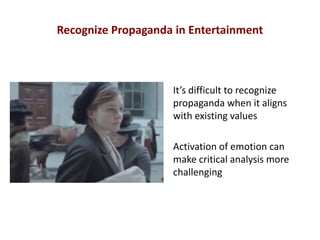
Recognize Propaganda in Entertainment
It’s difficult to recognize
propaganda when it aligns
with existing values
Activation of emotion can
make critical analysis more
challenging
Recognize Propaganda in Entertainment
It’s difficult to recognize
propaganda when it aligns
with existing values
Activation of emotion can
make critical analysis more
challenging
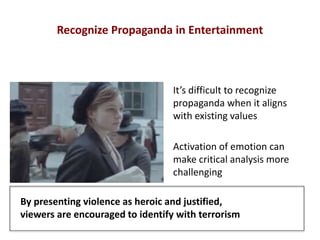
By presenting violence as heroic and justified,
viewers are encouraged to identify with terrorism
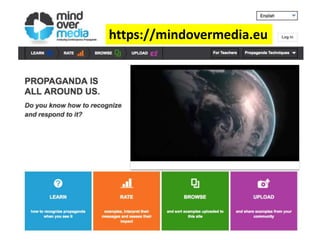
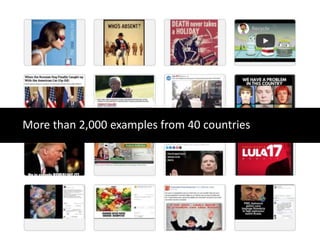
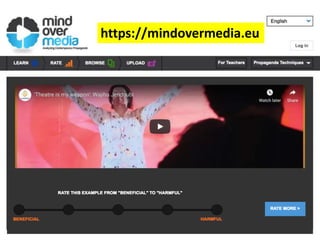
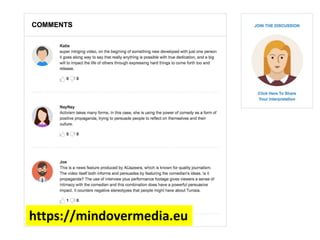
https://mindovermedia.eu
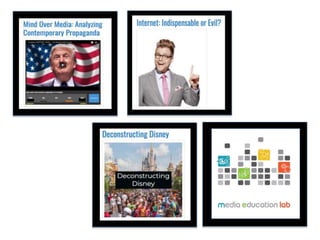
Mind Over Media
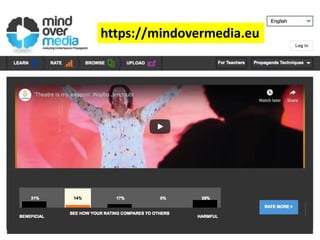
https://mindovermedia.eu
https://mindovermedia.eu/ro
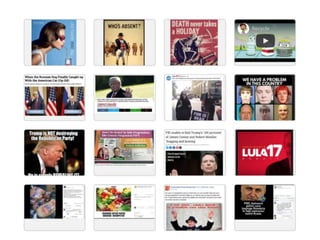
More than 2,000 examples from 40 countries
How does the examination of global propaganda activate
intellectual curiosity and promote cultural understanding?
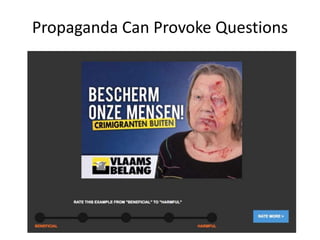
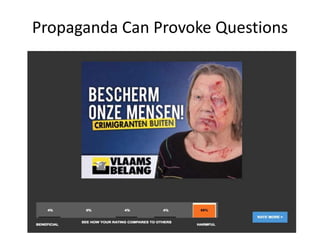
Propaganda Can Provoke Questions
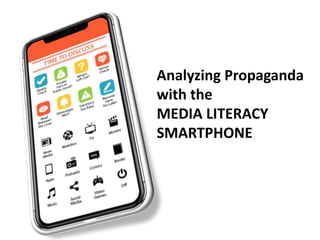
Analyzing Propaganda
with the
MEDIA LITERACY
SMARTPHONE
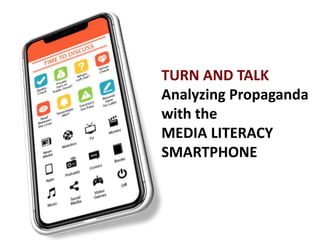
TURN AND TALK
Analyzing Propaganda
with the
MEDIA LITERACY
SMARTPHONE
https://mindovermedia.euhttps://mindovermedia.eu
https://mindovermedia.eu
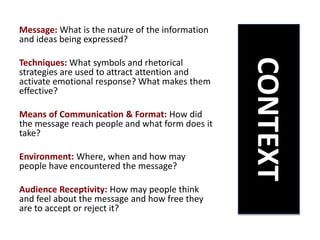
Message: What is the nature of the information
and ideas being expressed?
Techniques: What symbols and rhetorical
strategies are used to attract attention and
activate emotional response? What makes them
effective?
Means of Communication & Format: How did
the message reach people and what form does it
take?
Environment: Where, when and how may
people have encountered the message?
Audience Receptivity: How may people think
and feel about the message and how free they
are to accept or reject it?
CONTEXT
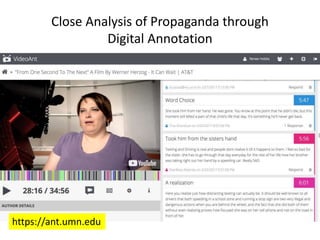
Close Analysis of Propaganda through
Digital Annotation
https://ant.umn.edu
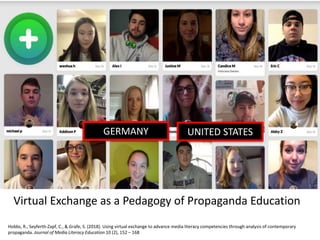
Virtual Exchange as a Pedagogy of Propaganda Education
Hobbs, R., Seyferth-Zapf, C., & Grafe, S. (2018). Using virtual exchange to advance media literacy competencies through analysis of contemporary
propaganda. Journal of Media Literacy Education 10 (2), 152 – 168
GERMANY UNITED STATES
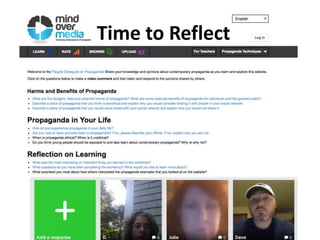
Time to Reflect
Misconceptions about propaganda
interfere with effective teaching and
learning
Critical analysis of contemporary
propaganda helps counter its
emotional power
Multi-perspectival dialogue about
global propaganda can activate
intellectual curiosity and promote
cultural understanding
By expressing opinions, creating and
commenting on propaganda, people
build citizenship skills that advance
democratic goals
Review of Key Ideas
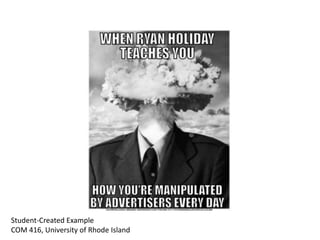
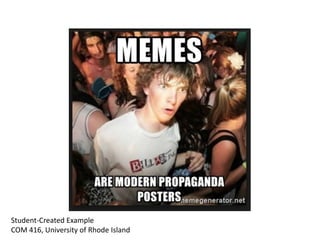
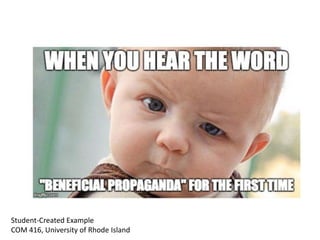
Should students create propaganda as part of their learning
experience?
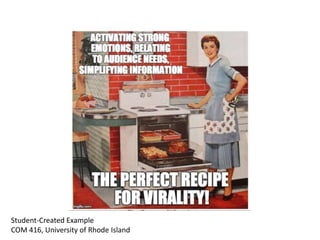
Student-Created Example
COM 416, University of Rhode Island
Student-Created Example
COM 416, University of Rhode Island
Student-Created Example
COM 416, University of Rhode Island
Student-Created Example
COM 416, University of Rhode Island
All That We Share - Denmark
Propaganda is both the
cause and the cure in
our polarized & fearful
world
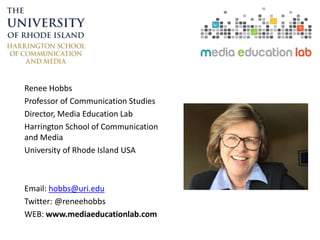
Renee Hobbs
Professor of Communication Studies
Director, Media Education Lab
Harrington School of Communication
and Media
University of Rhode Island USA
Email: hobbs@uri.edu
Twitter: @reneehobbs
WEB: www.mediaeducationlab.com

Mind Over Media: Teaching About Propaganda

Editor's Notes

  • #18 A term so volatile that it is rarely used in education…
  • #23 A term so volatile that it is rarely used in education…