Uses of sulphuric acid17/5/2010rebeccachoong@gmail.com4S8 Chemistry, Catholic High School, PJ (2010)
1. Manufacture of detergents17/5/2010rebeccachoong@gmail.com4S8 Chemistry, Catholic High School, PJ (2010)
2. Manufacture of fertiliser17/5/2010rebeccachoong@gmail.com4S8 Chemistry, Catholic High School, PJ (2010)
3. Manufacture of artificalfibres17/5/2010rebeccachoong@gmail.com4S8 Chemistry, Catholic High School, PJ (2010)
4. Manufacture of paint17/5/2010rebeccachoong@gmail.com4S8 Chemistry, Catholic High School, PJ (2010)
5. Leather tanning17/5/2010rebeccachoong@gmail.com4S8 Chemistry, Catholic High School, PJ (2010)
6. As electrolyte in car batteries17/5/2010rebeccachoong@gmail.com4S8 Chemistry, Catholic High School, PJ (2010)
7. Remove oxides from the surface of metals (metallurgy 冶金学)17/5/2010rebeccachoong@gmail.com4S8 Chemistry, Catholic High School, PJ (2010)
CONTACT ProcessManufacture of sulphuric acid17/5/2010rebeccachoong@gmail.com4S8 Chemistry, Catholic High School, PJ (2010)
The Manufacture of H2SO4, through the Contact Process17/5/2010rebeccachoong@gmail.com4S8 Chemistry, Catholic High School, PJ (2010)
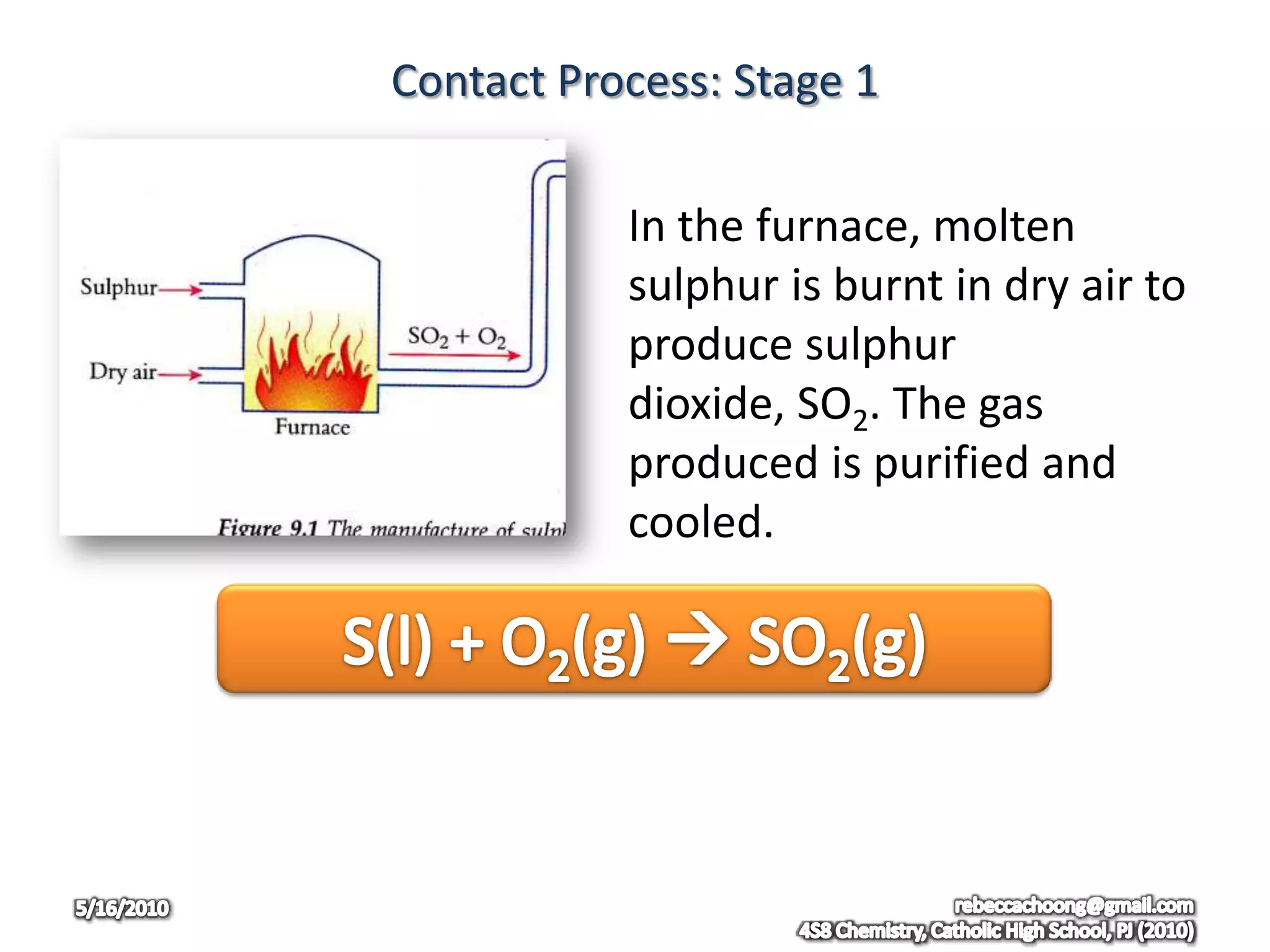
Contact Process: Stage 1In the furnace, molten sulphur is burnt in dry air to produce sulphur dioxide, SO2. The gas produced is purified and cooled.S(l) + O2(g)  SO2(g)17/5/2010rebeccachoong@gmail.com4S8 Chemistry, Catholic High School, PJ (2010)
Contact Process: Stage 2In the converter, SO2 and excess oxygen gas, O2 are passed over a few plates of vanadium (V) oxide, V2O5 catalyst at 450oC to produce sulphur trioxide, SO32SO2(l) + O2(g)  2SO3(g)17/5/2010rebeccachoong@gmail.com4S8 Chemistry, Catholic High School, PJ (2010)
Contact Process: Stage 2About 99.5% of the sulphur dioxide, SO2 is converted into sulphur trioxide, SO3 through this reversible reaction.2SO2(l) + O2(g)  2SO3(g)17/5/2010rebeccachoong@gmail.com4S8 Chemistry, Catholic High School, PJ (2010)
Contact Process: Stage 3In the absorber, the sulphur trioxide, SO3 is first reacted with concentrated sulphuric acid, H2SO4 to form a product called oleum, H2S2O7.SO3(g) + H2SO4(l)  H2S2O7(l)17/5/2010rebeccachoong@gmail.com4S8 Chemistry, Catholic High School, PJ (2010)
Contact Process: Stage 3The oleum, H2S2O7 is then diluted with water to produce concentrated sulphuric acid, H2SO4 in large quantities.H2S2O7(l)+ H2O(l)  2H2SO4(l)17/5/2010rebeccachoong@gmail.com4S8 Chemistry, Catholic High School, PJ (2010)
FAQ 1The two reaction in the third stage are equivalent to adding sulphur trioxide, SO3, directly to waterSO3 (g)+ H2O(l)  H2SO4(l)Then why can’t we just skipped concentrated sulphuric acid step [thus not forming oleum]?17/5/2010rebeccachoong@gmail.com4S8 Chemistry, Catholic High School, PJ (2010)
AnswerXSO3 (g)+ H2O(l)  H2SO4(l)This is not done in the industry, because sulphur trioxide, SO3 reacts too violently with water. This produces a lot of heat and a large cloud of sulphuric acid, H2SO4 mist.
The mist is corrosive, pollutes the air and is difficult to condense17/5/2010rebeccachoong@gmail.com4S8 Chemistry, Catholic High School, PJ (2010)
FAQ 2Why don’t we increase the pressure in the converter? So we can produce more sulphur trioxide per day?2SO2(l) + O2(g)  2SO3(g)Answer: Yes, high pressure increases the rate of reaction, but it cost very high also. So, the reaction is done at pressure close to atmospheric pressure. 17/5/2010rebeccachoong@gmail.com4S8 Chemistry, Catholic High School, PJ (2010)
Refresh again…Stage 1, in furnace**O2 = burningS(l) + O2(g)  SO2(g)Stage 2, in converter **O2 = passed over catalyst2SO2(l) + O2(g)  2SO3(g)Catalyst: Vanadium (V) oxideTemperature: 450oCStage 3, in absorberSO3(g) + H2SO4(l)  H2S2O7(l)H2S2O7(l)+ H2O(l)  2H2SO4(l)17/5/2010rebeccachoong@gmail.com4S8 Chemistry, Catholic High School, PJ (2010)
Sulphur dioxide and environmental pollution17/5/2010rebeccachoong@gmail.com4S8 Chemistry, Catholic High School, PJ (2010)
Sulphur dioxide, SO2Source:By-products of the contact processBurning of fossil fuels containing sulphur17/5/2010rebeccachoong@gmail.com4S8 Chemistry, Catholic High School, PJ (2010)
Sulphur dioxide, SO2Causes acid rain (pH2.4-5.0)Causes respiratory problems in humans2SO2(g)+ O2(g) + 2H2O  2H2SO4(aq)17/5/2010rebeccachoong@gmail.com4S8 Chemistry, Catholic High School, PJ (2010)
Ammonia nh3 and its salt17/5/2010rebeccachoong@gmail.com4S8 Chemistry, Catholic High School, PJ (2010)
1. Manufacture of fertilisers17/5/2010rebeccachoong@gmail.com4S8 Chemistry, Catholic High School, PJ (2010)
2. Manufacture of synthetic fibers17/5/2010rebeccachoong@gmail.com4S8 Chemistry, Catholic High School, PJ (2010)
3. Manufacture of explosives17/5/2010rebeccachoong@gmail.com4S8 Chemistry, Catholic High School, PJ (2010)
Haber processManufacture of Ammonia17/5/2010rebeccachoong@gmail.com4S8 Chemistry, Catholic High School, PJ (2010)
The Manufacture of Ammonia, NH3 through the Haber ProcessRatio 1:3N2(g) + 3H2(g)  2NH3(g)17/5/2010rebeccachoong@gmail.com4S8 Chemistry, Catholic High School, PJ (2010)
ALLOYS17/5/2010rebeccachoong@gmail.com4S8 Chemistry, Catholic High School, PJ (2010)
Metals are Ductile/Can be stretched (可延展的)The orderly arrangement of atoms in metals enables the layers of atoms to slide on another when force is applied17/5/2010rebeccachoong@gmail.com4S8 Chemistry, Catholic High School, PJ (2010)
Metals are MalleableThere are some inperfections in the orderly arrangement of atoms in metals that allow some empty space in between the atoms. When a metal is knocked, atoms slide.17/5/2010rebeccachoong@gmail.com4S8 Chemistry, Catholic High School, PJ (2010)
AlloyDefinition: A mixture of two or more elements with a certain fixed composition in which the major component is a metal.Properties of pure metals can be improved => stronger, harder, resistant to sorrosion, have a better furnish and lustre.17/5/2010rebeccachoong@gmail.com4S8 Chemistry, Catholic High School, PJ (2010)
GOLD (24K, 18K)Pure gold 24K (24-carat)18K Gold has 18 parts of gold and 6 parts of other metals17/5/2010rebeccachoong@gmail.com4S8 Chemistry, Catholic High School, PJ (2010)
Bronze (Copper + Tin) 青铜Statues, monumentsMedals, swords, artistic materials17/5/2010rebeccachoong@gmail.com4S8 Chemistry, Catholic High School, PJ (2010)
Brass (Copper + Zinc) 黄铜Musical instrumentKitchenware17/5/2010rebeccachoong@gmail.com4S8 Chemistry, Catholic High School, PJ (2010)
Steel (Iron + Carbon) 钢铁Buildings and bridgesBody of cars & railway tracks17/5/2010rebeccachoong@gmail.com4S8 Chemistry, Catholic High School, PJ (2010)
Stainless steel (Iron + Carbon + Chromium) 不锈钢CutlerySurgical Instruments17/5/2010rebeccachoong@gmail.com4S8 Chemistry, Catholic High School, PJ (2010)
Duralumin (Aluminium, Copper, Magnesium, Mangenese) 硬铝Body of aeroplanes & bullet trains17/5/2010rebeccachoong@gmail.com4S8 Chemistry, Catholic High School, PJ (2010)
Pewter (Tin, Copper, Antimony) 锡铅合金souvenirs17/5/2010rebeccachoong@gmail.com4S8 Chemistry, Catholic High School, PJ (2010)

Chapter 9: Contact Process, Haber Process and Alloy

  • 1.
    Uses of sulphuricacid17/5/2010rebeccachoong@gmail.com4S8 Chemistry, Catholic High School, PJ (2010)
  • 2.
    1. Manufacture ofdetergents17/5/2010rebeccachoong@gmail.com4S8 Chemistry, Catholic High School, PJ (2010)
  • 3.
    2. Manufacture offertiliser17/5/2010rebeccachoong@gmail.com4S8 Chemistry, Catholic High School, PJ (2010)
  • 4.
    3. Manufacture ofartificalfibres17/5/2010rebeccachoong@gmail.com4S8 Chemistry, Catholic High School, PJ (2010)
  • 5.
    4. Manufacture ofpaint17/5/2010rebeccachoong@gmail.com4S8 Chemistry, Catholic High School, PJ (2010)
  • 6.
    5. Leather tanning17/5/2010rebeccachoong@gmail.com4S8Chemistry, Catholic High School, PJ (2010)
  • 7.
    6. As electrolytein car batteries17/5/2010rebeccachoong@gmail.com4S8 Chemistry, Catholic High School, PJ (2010)
  • 8.
    7. Remove oxidesfrom the surface of metals (metallurgy 冶金学)17/5/2010rebeccachoong@gmail.com4S8 Chemistry, Catholic High School, PJ (2010)
  • 9.
    CONTACT ProcessManufacture ofsulphuric acid17/5/2010rebeccachoong@gmail.com4S8 Chemistry, Catholic High School, PJ (2010)
  • 10.
    The Manufacture ofH2SO4, through the Contact Process17/5/2010rebeccachoong@gmail.com4S8 Chemistry, Catholic High School, PJ (2010)
  • 11.
    Contact Process: Stage1In the furnace, molten sulphur is burnt in dry air to produce sulphur dioxide, SO2. The gas produced is purified and cooled.S(l) + O2(g)  SO2(g)17/5/2010rebeccachoong@gmail.com4S8 Chemistry, Catholic High School, PJ (2010)
  • 12.
    Contact Process: Stage2In the converter, SO2 and excess oxygen gas, O2 are passed over a few plates of vanadium (V) oxide, V2O5 catalyst at 450oC to produce sulphur trioxide, SO32SO2(l) + O2(g)  2SO3(g)17/5/2010rebeccachoong@gmail.com4S8 Chemistry, Catholic High School, PJ (2010)
  • 13.
    Contact Process: Stage2About 99.5% of the sulphur dioxide, SO2 is converted into sulphur trioxide, SO3 through this reversible reaction.2SO2(l) + O2(g)  2SO3(g)17/5/2010rebeccachoong@gmail.com4S8 Chemistry, Catholic High School, PJ (2010)
  • 14.
    Contact Process: Stage3In the absorber, the sulphur trioxide, SO3 is first reacted with concentrated sulphuric acid, H2SO4 to form a product called oleum, H2S2O7.SO3(g) + H2SO4(l)  H2S2O7(l)17/5/2010rebeccachoong@gmail.com4S8 Chemistry, Catholic High School, PJ (2010)
  • 15.
    Contact Process: Stage3The oleum, H2S2O7 is then diluted with water to produce concentrated sulphuric acid, H2SO4 in large quantities.H2S2O7(l)+ H2O(l)  2H2SO4(l)17/5/2010rebeccachoong@gmail.com4S8 Chemistry, Catholic High School, PJ (2010)
  • 16.
    FAQ 1The tworeaction in the third stage are equivalent to adding sulphur trioxide, SO3, directly to waterSO3 (g)+ H2O(l)  H2SO4(l)Then why can’t we just skipped concentrated sulphuric acid step [thus not forming oleum]?17/5/2010rebeccachoong@gmail.com4S8 Chemistry, Catholic High School, PJ (2010)
  • 17.
    AnswerXSO3 (g)+ H2O(l) H2SO4(l)This is not done in the industry, because sulphur trioxide, SO3 reacts too violently with water. This produces a lot of heat and a large cloud of sulphuric acid, H2SO4 mist.
  • 18.
    The mist iscorrosive, pollutes the air and is difficult to condense17/5/2010rebeccachoong@gmail.com4S8 Chemistry, Catholic High School, PJ (2010)
  • 19.
    FAQ 2Why don’twe increase the pressure in the converter? So we can produce more sulphur trioxide per day?2SO2(l) + O2(g)  2SO3(g)Answer: Yes, high pressure increases the rate of reaction, but it cost very high also. So, the reaction is done at pressure close to atmospheric pressure. 17/5/2010rebeccachoong@gmail.com4S8 Chemistry, Catholic High School, PJ (2010)
  • 20.
    Refresh again…Stage 1,in furnace**O2 = burningS(l) + O2(g)  SO2(g)Stage 2, in converter **O2 = passed over catalyst2SO2(l) + O2(g)  2SO3(g)Catalyst: Vanadium (V) oxideTemperature: 450oCStage 3, in absorberSO3(g) + H2SO4(l)  H2S2O7(l)H2S2O7(l)+ H2O(l)  2H2SO4(l)17/5/2010rebeccachoong@gmail.com4S8 Chemistry, Catholic High School, PJ (2010)
  • 21.
    Sulphur dioxide andenvironmental pollution17/5/2010rebeccachoong@gmail.com4S8 Chemistry, Catholic High School, PJ (2010)
  • 22.
    Sulphur dioxide, SO2Source:By-productsof the contact processBurning of fossil fuels containing sulphur17/5/2010rebeccachoong@gmail.com4S8 Chemistry, Catholic High School, PJ (2010)
  • 23.
    Sulphur dioxide, SO2Causesacid rain (pH2.4-5.0)Causes respiratory problems in humans2SO2(g)+ O2(g) + 2H2O  2H2SO4(aq)17/5/2010rebeccachoong@gmail.com4S8 Chemistry, Catholic High School, PJ (2010)
  • 24.
    Ammonia nh3 andits salt17/5/2010rebeccachoong@gmail.com4S8 Chemistry, Catholic High School, PJ (2010)
  • 25.
    1. Manufacture offertilisers17/5/2010rebeccachoong@gmail.com4S8 Chemistry, Catholic High School, PJ (2010)
  • 26.
    2. Manufacture ofsynthetic fibers17/5/2010rebeccachoong@gmail.com4S8 Chemistry, Catholic High School, PJ (2010)
  • 27.
    3. Manufacture ofexplosives17/5/2010rebeccachoong@gmail.com4S8 Chemistry, Catholic High School, PJ (2010)
  • 28.
    Haber processManufacture ofAmmonia17/5/2010rebeccachoong@gmail.com4S8 Chemistry, Catholic High School, PJ (2010)
  • 29.
    The Manufacture ofAmmonia, NH3 through the Haber ProcessRatio 1:3N2(g) + 3H2(g)  2NH3(g)17/5/2010rebeccachoong@gmail.com4S8 Chemistry, Catholic High School, PJ (2010)
  • 30.
  • 31.
    Metals are Ductile/Canbe stretched (可延展的)The orderly arrangement of atoms in metals enables the layers of atoms to slide on another when force is applied17/5/2010rebeccachoong@gmail.com4S8 Chemistry, Catholic High School, PJ (2010)
  • 32.
    Metals are MalleableThereare some inperfections in the orderly arrangement of atoms in metals that allow some empty space in between the atoms. When a metal is knocked, atoms slide.17/5/2010rebeccachoong@gmail.com4S8 Chemistry, Catholic High School, PJ (2010)
  • 33.
    AlloyDefinition: A mixtureof two or more elements with a certain fixed composition in which the major component is a metal.Properties of pure metals can be improved => stronger, harder, resistant to sorrosion, have a better furnish and lustre.17/5/2010rebeccachoong@gmail.com4S8 Chemistry, Catholic High School, PJ (2010)
  • 34.
    GOLD (24K, 18K)Puregold 24K (24-carat)18K Gold has 18 parts of gold and 6 parts of other metals17/5/2010rebeccachoong@gmail.com4S8 Chemistry, Catholic High School, PJ (2010)
  • 35.
    Bronze (Copper +Tin) 青铜Statues, monumentsMedals, swords, artistic materials17/5/2010rebeccachoong@gmail.com4S8 Chemistry, Catholic High School, PJ (2010)
  • 36.
    Brass (Copper +Zinc) 黄铜Musical instrumentKitchenware17/5/2010rebeccachoong@gmail.com4S8 Chemistry, Catholic High School, PJ (2010)
  • 37.
    Steel (Iron +Carbon) 钢铁Buildings and bridgesBody of cars & railway tracks17/5/2010rebeccachoong@gmail.com4S8 Chemistry, Catholic High School, PJ (2010)
  • 38.
    Stainless steel (Iron+ Carbon + Chromium) 不锈钢CutlerySurgical Instruments17/5/2010rebeccachoong@gmail.com4S8 Chemistry, Catholic High School, PJ (2010)
  • 39.
    Duralumin (Aluminium, Copper,Magnesium, Mangenese) 硬铝Body of aeroplanes & bullet trains17/5/2010rebeccachoong@gmail.com4S8 Chemistry, Catholic High School, PJ (2010)
  • 40.
    Pewter (Tin, Copper,Antimony) 锡铅合金souvenirs17/5/2010rebeccachoong@gmail.com4S8 Chemistry, Catholic High School, PJ (2010)
  • 41.
    The Formation ofAlloy17/5/2010rebeccachoong@gmail.com4S8 Chemistry, Catholic High School, PJ (2010)