

Links And Joints
Presented By
Raza Farooq
SP14-BME-001
LINKS, JOINTS, AND KINEMATIC
CHAINS
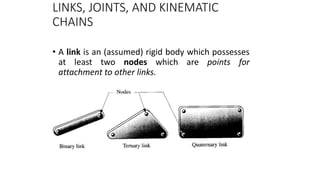
• A link is an (assumed) rigid body which possesses
at least two nodes which are points for
attachment to other links.
3
LINKS, JOINTS, AND KINEMATIC
CHAINS
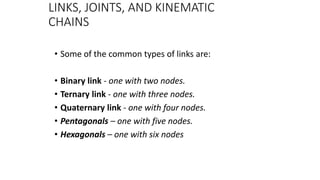
• Some of the common types of links are:
• Binary link - one with two nodes.
• Ternary link - one with three nodes.
• Quaternary link - one with four nodes.
• Pentagonals – one with five nodes.
• Hexagonals – one with six nodes
4
LINKS, JOINTS, AND KINEMATIC
CHAINS
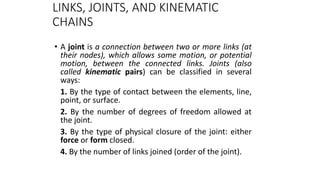
• A joint is a connection between two or more links (at
their nodes), which allows some motion, or potential
motion, between the connected links. Joints (also
called kinematic pairs) can be classified in several
ways:
1. By the type of contact between the elements, line,
point, or surface.
2. By the number of degrees of freedom allowed at
the joint.
3. By the type of physical closure of the joint: either
force or form closed.
4. By the number of links joined (order of the joint).
5
Classification of Joints
• 1. Classification by the Type of Contact
We can classify Joints by the type of contact as
Lower Pairs or Higher Pairs. If joints have surface
contact, they are called Lower pair (as with a pin
surrounded by a hole). If joints have point or line
contact, they are called Higher pair.
• The main practical advantage of lower pairs over
higher pairs is their better ability to trap lubricant
between their enveloping surfaces.
6
LINKS, JOINTS, AND KINEMATIC
CHAINS
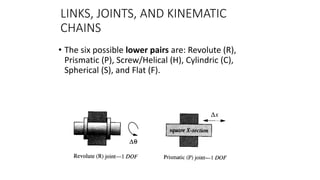
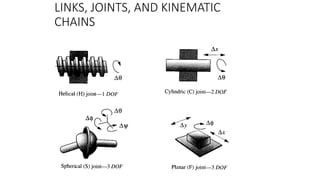
• The six possible lower pairs are: Revolute (R),
Prismatic (P), Screw/Helical (H), Cylindric (C),
Spherical (S), and Flat (F).
7
LINKS, JOINTS, AND KINEMATIC
CHAINS
8
LINKS, JOINTS, AND KINEMATIC
CHAINS
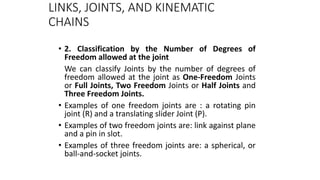
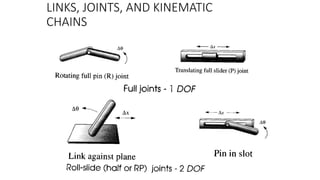
• 2. Classification by the Number of Degrees of
Freedom allowed at the joint
We can classify Joints by the number of degrees of
freedom allowed at the joint as One-Freedom Joints
or Full Joints, Two Freedom Joints or Half Joints and
Three Freedom Joints.
• Examples of one freedom joints are : a rotating pin
joint (R) and a translating slider Joint (P).
• Examples of two freedom joints are: link against plane
and a pin in slot.
• Examples of three freedom joints are: a spherical, or
ball-and-socket joints.
9
LINKS, JOINTS, AND KINEMATIC
CHAINS
10
LINKS, JOINTS, AND KINEMATIC
CHAINS
• 3. Classification by the Type of Physical Closure
of the Joint
We can classify Joints by the type of physical
closure of the joint as Force closed or Form
closed.
• A form-closed joint is kept together or closed by
its geometry. A pin in a hole or a slider in a two-
sided slot are form closed. In contrast, a force-
closed joint, such as a pin in a half-bearing or a
slider on a surface, requires some external force to
keep it together or closed. This force could be
supplied by gravity, a spring, or any external
means. 11
LINKS, JOINTS, AND KINEMATIC
CHAINS
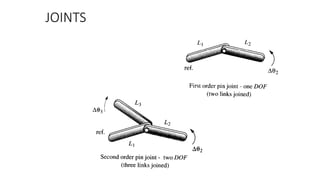
• 4. Classification by the Order of Joints
We can classify Joints by the order of joints as 1st
order, 2nd order and so on.
• Order is defined as the number of links joined
minus one.
• It takes two links to make a single joint; thus the
simplest joint combination of two links has order
one.
• Joint order has significance in the proper
determination of overall degree of freedom for
the assembly. 12
JOINTS
13

Links , Joints and its classification

  • 2.
    Links And Joints PresentedBy Raza Farooq SP14-BME-001
  • 3.
    LINKS, JOINTS, ANDKINEMATIC CHAINS • A link is an (assumed) rigid body which possesses at least two nodes which are points for attachment to other links. 3
  • 4.
    LINKS, JOINTS, ANDKINEMATIC CHAINS • Some of the common types of links are: • Binary link - one with two nodes. • Ternary link - one with three nodes. • Quaternary link - one with four nodes. • Pentagonals – one with five nodes. • Hexagonals – one with six nodes 4
  • 5.
    LINKS, JOINTS, ANDKINEMATIC CHAINS • A joint is a connection between two or more links (at their nodes), which allows some motion, or potential motion, between the connected links. Joints (also called kinematic pairs) can be classified in several ways: 1. By the type of contact between the elements, line, point, or surface. 2. By the number of degrees of freedom allowed at the joint. 3. By the type of physical closure of the joint: either force or form closed. 4. By the number of links joined (order of the joint). 5
  • 6.
    Classification of Joints •1. Classification by the Type of Contact We can classify Joints by the type of contact as Lower Pairs or Higher Pairs. If joints have surface contact, they are called Lower pair (as with a pin surrounded by a hole). If joints have point or line contact, they are called Higher pair. • The main practical advantage of lower pairs over higher pairs is their better ability to trap lubricant between their enveloping surfaces. 6
  • 7.
    LINKS, JOINTS, ANDKINEMATIC CHAINS • The six possible lower pairs are: Revolute (R), Prismatic (P), Screw/Helical (H), Cylindric (C), Spherical (S), and Flat (F). 7
  • 8.
    LINKS, JOINTS, ANDKINEMATIC CHAINS 8
  • 9.
    LINKS, JOINTS, ANDKINEMATIC CHAINS • 2. Classification by the Number of Degrees of Freedom allowed at the joint We can classify Joints by the number of degrees of freedom allowed at the joint as One-Freedom Joints or Full Joints, Two Freedom Joints or Half Joints and Three Freedom Joints. • Examples of one freedom joints are : a rotating pin joint (R) and a translating slider Joint (P). • Examples of two freedom joints are: link against plane and a pin in slot. • Examples of three freedom joints are: a spherical, or ball-and-socket joints. 9
  • 10.
    LINKS, JOINTS, ANDKINEMATIC CHAINS 10
  • 11.
    LINKS, JOINTS, ANDKINEMATIC CHAINS • 3. Classification by the Type of Physical Closure of the Joint We can classify Joints by the type of physical closure of the joint as Force closed or Form closed. • A form-closed joint is kept together or closed by its geometry. A pin in a hole or a slider in a two- sided slot are form closed. In contrast, a force- closed joint, such as a pin in a half-bearing or a slider on a surface, requires some external force to keep it together or closed. This force could be supplied by gravity, a spring, or any external means. 11
  • 12.
    LINKS, JOINTS, ANDKINEMATIC CHAINS • 4. Classification by the Order of Joints We can classify Joints by the order of joints as 1st order, 2nd order and so on. • Order is defined as the number of links joined minus one. • It takes two links to make a single joint; thus the simplest joint combination of two links has order one. • Joint order has significance in the proper determination of overall degree of freedom for the assembly. 12
  • 13.