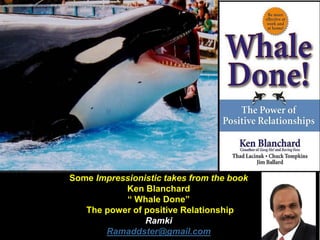

Some Impressionistic takes from the book
Ken Blanchard
“ Whale Done”
The power of positive Relationship
Ramki
Ramaddster@gmail.com
Ken Blanchard is the “Chief Spiritual Officer” and Chairman of
the Board of the Blanchard Companies, and the author of a
dozen bestselling books, including The One Minute Manager,
Raving Fans and Gung Ho!
His books have sold more than 12 million copies in more than
25 languages.
Thad Lacinak is VP and nationwide director of Animal Training
for Busch Entertainment Corporation, and has trained marine
mammals for more than 28 years.
Chuck Tompkins is VP and curator of Animal Training at
SeaWorld in Orlando, Florida, and has worked with killer whales
for more than 25 years.
Jim Ballard is an educator, corporate trainer and writer who
worked with Ken Blanchard on Mission Possible, Everyone’s a
Coach and Managing By Values
About the Author
Manager Wes Kingsley is married with two daughters. He visits Orlando to
attend a business conference, but the real reason is to escape from family and
the office, since he’s having trouble balancing the two.
With a view to relaxing he decides to visit the famed Killer Whales show at the
Shamu Stadium at SeaWorld. Here 11000-pound killer whales play in
harmony with their trusted trainers who weigh less than 200 pounds.
Wes starts to think about the interaction between the two and about what
might motivate the whales to put on such a mesmerizing show. His meeting
with the trainer of these whales gives him a surprising insight in this regard:
while it is natural to see man -- the most intelligent animal -- training other
animals like dogs, parrots, etc, what Wes sees here is a role reversal.
Obviously, as the trainer says, “When you are dealing with an eleven-
thousand-pound animal who does not speak English, you do a lot of learning.”
The patience required for convincing the whales to consistently co-operate,
trust and befriend their trainer involves a formula, which the authors term
as “accentuating the positive”.
Prelude
In different situations of our life, while dealing with people, we are always
eager to discover mistakes, errors and shortcomings. Maybe that’s why they
say “Love is blind” – after all it’s only when a person is in love that he sees or
looks for only his partner’s positive qualities. This is also because the goal
then is to keep the partner motivated to sustain the relationship and because
when you are in love, you watch over rather than be watchful of your partner.
But after some time greater attention is paid to the negative qualities of the
individual. Obviously that negativity gets repeated. This holds good for the
work environment as well.
But what Wes sees at SeaWorld is that the trainers pay more attention to
catching the whales doing something right and then they reward the whales.
But whenever they see some negative behavior, they either ignore it or
redirect the energy of the whales to something entirely different. Hence the
whales find their trainers always loving and adoring, and this is the
foundation for their trust in them. This poses a lot of questions to the reader
and hooking him to the book.
Prelude
Today’s organizations experience…….
 Increased service expectations from Customers
 High service standards amongst competitors
 The need to constantly increase efficiency &
effectiveness
 Challenges in retaining the employees
 Improving the employees loyalty, dedication &
engagement with the organization
Business Challenges
The Whale Done Approach
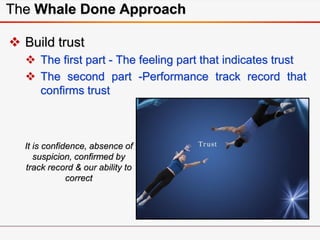
 Build trust
 The first part - The feeling part that indicates trust
 The second part -Performance track record that
confirms trust
It is confidence, absence of
suspicion, confirmed by
track record & our ability to
correct
The Whale Done Approach
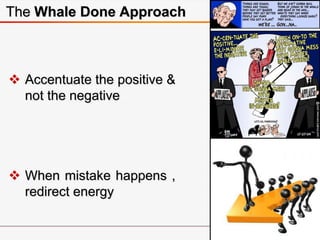
 Accentuate the positive &
not the negative
 When mistake happens ,
redirect energy
Creating a playful Learning Environment
 Another key to successful motivation and training is treating each
person as having “unlimited capacities for development and
accomplishment,” just as the trainers view the whales.
 They try to show the animals that they are trustworthy friends, and
they then use that friendship to create a playful environment.
 They turn the whole training process into a game, starting with
simple lessons the whales can learn easily. Starting slowly &
keeping the training fun and friendly works with people as well.
 Having key expectations helps, too, since people, just like the
whales, will adapt to what you expect of them.
 Expect more and they will do more.
 Then, as you guide them & redirect employee behavior, look for a
person doing something right and offer immediate praise.
 To accentuate positive behavior, the trainers give a whale a treat
as soon as it does something correctly.
Build ABC’s of good Management
 Encourage the behavior you want by providing clear
input on the consequences of different behaviors,
both desirable and undesirable.
 For example, try an exercise with a group of people
where you greet them as if they are not important.
For comparison, greet another group as long-lost
friends.
 You will see immediate differences. When people
feel welcome, they respond warmly and with
enthusiasm, whereas people have much lower
energy and are detached if they are treated as
unimportant.
The ABC of Performance
 A= Activator
 Whatever gets performance going
 B= Behavior
 The Performance that occurs
 C= Consequence
 Your response to the performance
Build ABC’s of good Management
 The activator can be a person, set of instructions,
training process or an incident or event.
 But goals, if they are set properly, are the most
common and effective activators.
 To produce good performance, goals have to be
clear and achievable.
 Once you motivate people to perform, observe the
behavior that results.
 For whales, the behavior might be a segment of a
show, such as jumping high out of the water; for
people, the behavior might be anything you want to
improve, such as sales volume
Four Types of Responses
 No Response
 Most popular one , People are accustomed to being ignored
 Negative Response
 The response people really pay attention to this
 Which comes in the form of angry look, Verbal criticism or a penalty
 Redirection
 Most effective way to address the undesirable behavior
 Redirect their energy & attention either back to what they were
suppose to do or onto something else
 Redirect to another task & observe their performance & catch them
doing something right
 Best way to turn countless low-morale situations around
 Positive Response
 Least used & very powerful
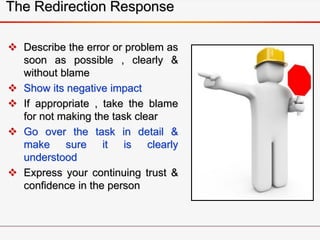
The Redirection Response
 Describe the error or problem as
soon as possible , clearly &
without blame
 Show its negative impact
 If appropriate , take the blame
for not making the task clear
 Go over the task in detail &
make sure it is clearly
understood
 Express your continuing trust &
confidence in the person
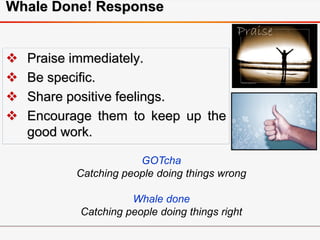
Whale Done! Response
 Praise immediately.
 Be specific.
 Share positive feelings.
 Encourage them to keep up the
good work.
GOTcha
Catching people doing things wrong
Whale done
Catching people doing things right
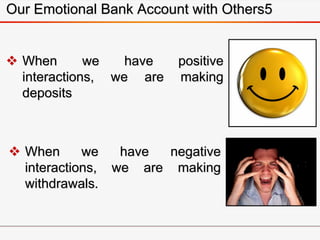
Our Emotional Bank Account with Others5
 When we have positive
interactions, we are making
deposits
 When we have negative
interactions, we are making
withdrawals.
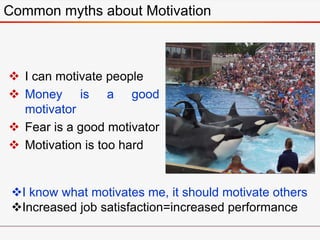
 I can motivate people
 Money is a good
motivator
 Fear is a good motivator
 Motivation is too hard
Common myths about Motivation
I know what motivates me, it should motivate others
Increased job satisfaction=increased performance
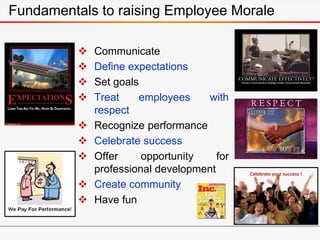
 Communicate
 Define expectations
 Set goals
 Treat employees with
respect
 Recognize performance
 Celebrate success
 Offer opportunity for
professional development
 Create community
 Have fun
Fundamentals to raising Employee Morale
18
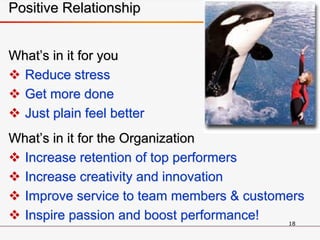
Positive Relationship
What’s in it for you
 Reduce stress
 Get more done
 Just plain feel better
What’s in it for the Organization
 Increase retention of top performers
 Increase creativity and innovation
 Improve service to team members & customers
 Inspire passion and boost performance!
Steps in training Killer Whales
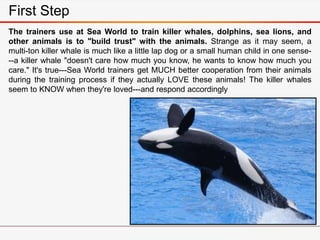
The trainers use at Sea World to train killer whales, dolphins, sea lions, and
other animals is to "build trust" with the animals. Strange as it may seem, a
multi-ton killer whale is much like a little lap dog or a small human child in one sense-
--a killer whale "doesn't care how much you know, he wants to know how much you
care." It's true---Sea World trainers get MUCH better cooperation from their animals
during the training process if they actually LOVE these animals! The killer whales
seem to KNOW when they're loved---and respond accordingly
First Step
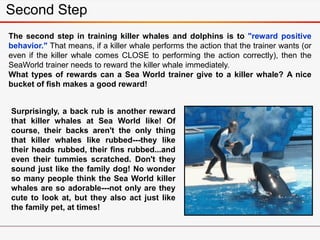
The second step in training killer whales and dolphins is to "reward positive
behavior." That means, if a killer whale performs the action that the trainer wants (or
even if the killer whale comes CLOSE to performing the action correctly), then the
SeaWorld trainer needs to reward the killer whale immediately.
What types of rewards can a Sea World trainer give to a killer whale? A nice
bucket of fish makes a good reward!
Second Step
Surprisingly, a back rub is another reward
that killer whales at Sea World like! Of
course, their backs aren't the only thing
that killer whales like rubbed---they like
their heads rubbed, their fins rubbed...and
even their tummies scratched. Don't they
sound just like the family dog! No wonder
so many people think the Sea World killer
whales are so adorable---not only are they
cute to look at, but they also act just like
the family pet, at times!
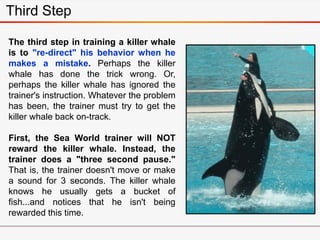
The third step in training a killer whale
is to "re-direct" his behavior when he
makes a mistake. Perhaps the killer
whale has done the trick wrong. Or,
perhaps the killer whale has ignored the
trainer's instruction. Whatever the problem
has been, the trainer must try to get the
killer whale back on-track.
First, the Sea World trainer will NOT
reward the killer whale. Instead, the
trainer does a "three second pause."
That is, the trainer doesn't move or make
a sound for 3 seconds. The killer whale
knows he usually gets a bucket of
fish...and notices that he isn't being
rewarded this time.
Third Step
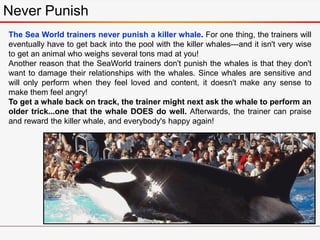
The Sea World trainers never punish a killer whale. For one thing, the trainers will
eventually have to get back into the pool with the killer whales---and it isn't very wise
to get an animal who weighs several tons mad at you!
Another reason that the SeaWorld trainers don't punish the whales is that they don't
want to damage their relationships with the whales. Since whales are sensitive and
will only perform when they feel loved and content, it doesn't make any sense to
make them feel angry!
To get a whale back on track, the trainer might next ask the whale to perform an
older trick...one that the whale DOES do well. Afterwards, the trainer can praise
and reward the killer whale, and everybody's happy again!
Never Punish
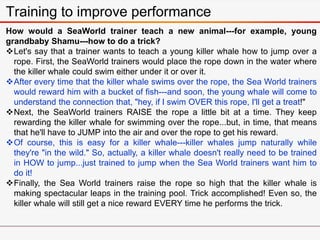
How would a SeaWorld trainer teach a new animal---for example, young
grandbaby Shamu---how to do a trick?
Let's say that a trainer wants to teach a young killer whale how to jump over a
rope. First, the SeaWorld trainers would place the rope down in the water where
the killer whale could swim either under it or over it.
After every time that the killer whale swims over the rope, the Sea World trainers
would reward him with a bucket of fish---and soon, the young whale will come to
understand the connection that, "hey, if I swim OVER this rope, I'll get a treat!"
Next, the SeaWorld trainers RAISE the rope a little bit at a time. They keep
rewarding the killer whale for swimming over the rope...but, in time, that means
that he'll have to JUMP into the air and over the rope to get his reward.
Of course, this is easy for a killer whale---killer whales jump naturally while
they're "in the wild." So, actually, a killer whale doesn't really need to be trained
in HOW to jump...just trained to jump when the Sea World trainers want him to
do it!
Finally, the Sea World trainers raise the rope so high that the killer whale is
making spectacular leaps in the training pool. Trick accomplished! Even so, the
killer whale will still get a nice reward EVERY time he performs the trick.
Training to improve performance
 Some of the techniques used to train Shamu and other killer whales at
SeaWorld can be used to train and motivate people.
 Pay attention and praise people when they do something right.
 If someone makes a mistake, redirect his or her energy to do it right or to do
something else.
 Accentuate the positive, rather than offering no response or a negative
response.
 Use the ABC’s of Performance, by starting with an Activator, observing the
Behavior that occurs and noticing the Consequences of that behavior.
 The least common responses, the Redirection Response and the Positive
Response, are the most powerful.
 Offer a positive response to any good performance, even if it is only partial.
 The Whale Done response is to praise people right away, clearly tell them
what they did right or almost right, and show you feel positive about their
performance.
 Use this response to praise someone strongly and clearly, with sincerity.
 Learn what motivates people by observing them or by asking what reward
matters to them.
Key Learning's/Take Away
Mail your comments to ramaddster@gmail.com

Summary of Whale Done Approach

  • 1.
    Some Impressionistic takesfrom the book Ken Blanchard “ Whale Done” The power of positive Relationship Ramki Ramaddster@gmail.com
  • 2.
    Ken Blanchard isthe “Chief Spiritual Officer” and Chairman of the Board of the Blanchard Companies, and the author of a dozen bestselling books, including The One Minute Manager, Raving Fans and Gung Ho! His books have sold more than 12 million copies in more than 25 languages. Thad Lacinak is VP and nationwide director of Animal Training for Busch Entertainment Corporation, and has trained marine mammals for more than 28 years. Chuck Tompkins is VP and curator of Animal Training at SeaWorld in Orlando, Florida, and has worked with killer whales for more than 25 years. Jim Ballard is an educator, corporate trainer and writer who worked with Ken Blanchard on Mission Possible, Everyone’s a Coach and Managing By Values About the Author
  • 3.
    Manager Wes Kingsleyis married with two daughters. He visits Orlando to attend a business conference, but the real reason is to escape from family and the office, since he’s having trouble balancing the two. With a view to relaxing he decides to visit the famed Killer Whales show at the Shamu Stadium at SeaWorld. Here 11000-pound killer whales play in harmony with their trusted trainers who weigh less than 200 pounds. Wes starts to think about the interaction between the two and about what might motivate the whales to put on such a mesmerizing show. His meeting with the trainer of these whales gives him a surprising insight in this regard: while it is natural to see man -- the most intelligent animal -- training other animals like dogs, parrots, etc, what Wes sees here is a role reversal. Obviously, as the trainer says, “When you are dealing with an eleven- thousand-pound animal who does not speak English, you do a lot of learning.” The patience required for convincing the whales to consistently co-operate, trust and befriend their trainer involves a formula, which the authors term as “accentuating the positive”. Prelude
  • 4.
    In different situationsof our life, while dealing with people, we are always eager to discover mistakes, errors and shortcomings. Maybe that’s why they say “Love is blind” – after all it’s only when a person is in love that he sees or looks for only his partner’s positive qualities. This is also because the goal then is to keep the partner motivated to sustain the relationship and because when you are in love, you watch over rather than be watchful of your partner. But after some time greater attention is paid to the negative qualities of the individual. Obviously that negativity gets repeated. This holds good for the work environment as well. But what Wes sees at SeaWorld is that the trainers pay more attention to catching the whales doing something right and then they reward the whales. But whenever they see some negative behavior, they either ignore it or redirect the energy of the whales to something entirely different. Hence the whales find their trainers always loving and adoring, and this is the foundation for their trust in them. This poses a lot of questions to the reader and hooking him to the book. Prelude
  • 5.
    Today’s organizations experience……. Increased service expectations from Customers  High service standards amongst competitors  The need to constantly increase efficiency & effectiveness  Challenges in retaining the employees  Improving the employees loyalty, dedication & engagement with the organization Business Challenges
  • 6.
    The Whale DoneApproach  Build trust  The first part - The feeling part that indicates trust  The second part -Performance track record that confirms trust It is confidence, absence of suspicion, confirmed by track record & our ability to correct
  • 7.
    The Whale DoneApproach  Accentuate the positive & not the negative  When mistake happens , redirect energy
  • 8.
    Creating a playfulLearning Environment  Another key to successful motivation and training is treating each person as having “unlimited capacities for development and accomplishment,” just as the trainers view the whales.  They try to show the animals that they are trustworthy friends, and they then use that friendship to create a playful environment.  They turn the whole training process into a game, starting with simple lessons the whales can learn easily. Starting slowly & keeping the training fun and friendly works with people as well.  Having key expectations helps, too, since people, just like the whales, will adapt to what you expect of them.  Expect more and they will do more.  Then, as you guide them & redirect employee behavior, look for a person doing something right and offer immediate praise.  To accentuate positive behavior, the trainers give a whale a treat as soon as it does something correctly.
  • 9.
    Build ABC’s ofgood Management  Encourage the behavior you want by providing clear input on the consequences of different behaviors, both desirable and undesirable.  For example, try an exercise with a group of people where you greet them as if they are not important. For comparison, greet another group as long-lost friends.  You will see immediate differences. When people feel welcome, they respond warmly and with enthusiasm, whereas people have much lower energy and are detached if they are treated as unimportant.
  • 10.
    The ABC ofPerformance  A= Activator  Whatever gets performance going  B= Behavior  The Performance that occurs  C= Consequence  Your response to the performance
  • 11.
    Build ABC’s ofgood Management  The activator can be a person, set of instructions, training process or an incident or event.  But goals, if they are set properly, are the most common and effective activators.  To produce good performance, goals have to be clear and achievable.  Once you motivate people to perform, observe the behavior that results.  For whales, the behavior might be a segment of a show, such as jumping high out of the water; for people, the behavior might be anything you want to improve, such as sales volume
  • 12.
    Four Types ofResponses  No Response  Most popular one , People are accustomed to being ignored  Negative Response  The response people really pay attention to this  Which comes in the form of angry look, Verbal criticism or a penalty  Redirection  Most effective way to address the undesirable behavior  Redirect their energy & attention either back to what they were suppose to do or onto something else  Redirect to another task & observe their performance & catch them doing something right  Best way to turn countless low-morale situations around  Positive Response  Least used & very powerful
  • 13.
    The Redirection Response Describe the error or problem as soon as possible , clearly & without blame  Show its negative impact  If appropriate , take the blame for not making the task clear  Go over the task in detail & make sure it is clearly understood  Express your continuing trust & confidence in the person
  • 14.
    Whale Done! Response Praise immediately.  Be specific.  Share positive feelings.  Encourage them to keep up the good work. GOTcha Catching people doing things wrong Whale done Catching people doing things right
  • 15.
    Our Emotional BankAccount with Others5  When we have positive interactions, we are making deposits  When we have negative interactions, we are making withdrawals.
  • 16.
     I canmotivate people  Money is a good motivator  Fear is a good motivator  Motivation is too hard Common myths about Motivation I know what motivates me, it should motivate others Increased job satisfaction=increased performance
  • 17.
     Communicate  Defineexpectations  Set goals  Treat employees with respect  Recognize performance  Celebrate success  Offer opportunity for professional development  Create community  Have fun Fundamentals to raising Employee Morale
  • 18.
    18 Positive Relationship What’s init for you  Reduce stress  Get more done  Just plain feel better What’s in it for the Organization  Increase retention of top performers  Increase creativity and innovation  Improve service to team members & customers  Inspire passion and boost performance!
  • 19.
    Steps in trainingKiller Whales
  • 20.
    The trainers useat Sea World to train killer whales, dolphins, sea lions, and other animals is to "build trust" with the animals. Strange as it may seem, a multi-ton killer whale is much like a little lap dog or a small human child in one sense- --a killer whale "doesn't care how much you know, he wants to know how much you care." It's true---Sea World trainers get MUCH better cooperation from their animals during the training process if they actually LOVE these animals! The killer whales seem to KNOW when they're loved---and respond accordingly First Step
  • 21.
    The second stepin training killer whales and dolphins is to "reward positive behavior." That means, if a killer whale performs the action that the trainer wants (or even if the killer whale comes CLOSE to performing the action correctly), then the SeaWorld trainer needs to reward the killer whale immediately. What types of rewards can a Sea World trainer give to a killer whale? A nice bucket of fish makes a good reward! Second Step Surprisingly, a back rub is another reward that killer whales at Sea World like! Of course, their backs aren't the only thing that killer whales like rubbed---they like their heads rubbed, their fins rubbed...and even their tummies scratched. Don't they sound just like the family dog! No wonder so many people think the Sea World killer whales are so adorable---not only are they cute to look at, but they also act just like the family pet, at times!
  • 22.
    The third stepin training a killer whale is to "re-direct" his behavior when he makes a mistake. Perhaps the killer whale has done the trick wrong. Or, perhaps the killer whale has ignored the trainer's instruction. Whatever the problem has been, the trainer must try to get the killer whale back on-track. First, the Sea World trainer will NOT reward the killer whale. Instead, the trainer does a "three second pause." That is, the trainer doesn't move or make a sound for 3 seconds. The killer whale knows he usually gets a bucket of fish...and notices that he isn't being rewarded this time. Third Step
  • 23.
    The Sea Worldtrainers never punish a killer whale. For one thing, the trainers will eventually have to get back into the pool with the killer whales---and it isn't very wise to get an animal who weighs several tons mad at you! Another reason that the SeaWorld trainers don't punish the whales is that they don't want to damage their relationships with the whales. Since whales are sensitive and will only perform when they feel loved and content, it doesn't make any sense to make them feel angry! To get a whale back on track, the trainer might next ask the whale to perform an older trick...one that the whale DOES do well. Afterwards, the trainer can praise and reward the killer whale, and everybody's happy again! Never Punish
  • 24.
    How would aSeaWorld trainer teach a new animal---for example, young grandbaby Shamu---how to do a trick? Let's say that a trainer wants to teach a young killer whale how to jump over a rope. First, the SeaWorld trainers would place the rope down in the water where the killer whale could swim either under it or over it. After every time that the killer whale swims over the rope, the Sea World trainers would reward him with a bucket of fish---and soon, the young whale will come to understand the connection that, "hey, if I swim OVER this rope, I'll get a treat!" Next, the SeaWorld trainers RAISE the rope a little bit at a time. They keep rewarding the killer whale for swimming over the rope...but, in time, that means that he'll have to JUMP into the air and over the rope to get his reward. Of course, this is easy for a killer whale---killer whales jump naturally while they're "in the wild." So, actually, a killer whale doesn't really need to be trained in HOW to jump...just trained to jump when the Sea World trainers want him to do it! Finally, the Sea World trainers raise the rope so high that the killer whale is making spectacular leaps in the training pool. Trick accomplished! Even so, the killer whale will still get a nice reward EVERY time he performs the trick. Training to improve performance
  • 26.
     Some ofthe techniques used to train Shamu and other killer whales at SeaWorld can be used to train and motivate people.  Pay attention and praise people when they do something right.  If someone makes a mistake, redirect his or her energy to do it right or to do something else.  Accentuate the positive, rather than offering no response or a negative response.  Use the ABC’s of Performance, by starting with an Activator, observing the Behavior that occurs and noticing the Consequences of that behavior.  The least common responses, the Redirection Response and the Positive Response, are the most powerful.  Offer a positive response to any good performance, even if it is only partial.  The Whale Done response is to praise people right away, clearly tell them what they did right or almost right, and show you feel positive about their performance.  Use this response to praise someone strongly and clearly, with sincerity.  Learn what motivates people by observing them or by asking what reward matters to them. Key Learning's/Take Away
  • 27.
    Mail your commentsto ramaddster@gmail.com