






Dan Bobinski's book 'Creating Passion Driven Teams' emphasizes the importance of understanding team roles and responsibilities to foster a passionate and effective work environment. It highlights the detrimental effects of micromanagement, encouraging managers to develop emotional intelligence and engage in regular communication to motivate their teams. Ultimately, the book advocates for leaders to create optimal working conditions and support team members in finding their own passions to achieve organizational goals.
Some Impressionistic takesfrom the book of
Dan Bobinski
“Creating Passion Driven Teams ”
by Ramki
ramaddster@gmail.com
2.
About the Author
Dan Bobinski is president of Leadership Development, Inc.,
and director of the Center for Workplace Excellence.
He has been providing management training and coaching to
Fortune 500 businesses, as well as small and mid-sized
businesses, since 1989.
In addition to being a dynamic public speaker, Bobinski is
also a prolific writer on workplace issues. His Workplace
Excellence blog (Workplace.excellence.com has been listed
among the top 100 daily must-reads for entrepreneurs, and
his newspaper column on workplace issues is syndicated
internationally.
Bobinski’s writing has also appeared in the Times of London,
CXO magazine, My Business magazine, the Journal of the
Institute of Management Services, and hundreds of business
newsletters, newspapers, and periodicals around the world.
3.
Key Concepts fromthe Book- 1/2
Great managers spend time being “Builders” who mentor team
members and build them up to become valued members of the
company with a passion for their work.
Organizations need clearly defined job duties and
responsibilities for all team members.
Positions should be classified as either leadership,
management, or front-line employees. Each classification
should understand what its raw product is, what its process is,
and what its outcome should be.
Micromanagers are often front-line employees who are
promoted to management and not given the training needed to
understand their new roles.
Micromanagers thrive on hearing that they are doing a good
job, and they often step in to fix things their employees should
be responsible for.
4.
Key Concepts fromthe Book- 1/2
To stop micromanagement, managers should be trained to think
differently about their roles and to understand that a new set of core
competencies are expected of them.
People with higher Emotional Intelligence scores are often better
managers than people with lower scores.
Regular communication, even casual “water cooler conversations,”
are good opportunities for managers to keep team members in the
loop and motivated.
When managers delegate tasks, they should delegate responsibility,
authority, and accountability.
Meetings should always have a purpose.
Good listening skills are essential in gaining the trust of team
members.
Conflict should never be allowed to fester; it should be dealt with
quickly and openly.
Good training programs can save companies hundreds of thousands
of dollars by reducing employee turnover rates.
Are you aBuilder or Climber ?
Experienced and new managers alike often dream of elevating their
teams to new levels. For teams to achieve these goals and aspirations,
they must be passionate and enthusiastic about the work they are
doing. Moreover, for this passion to exist, working conditions must be
just right.
Sadly, many work environments lack the structure, communication, and
well-defined roles and responsibilities to nurture that passion, and
teams end up being less effective than they could be.
To create a passion-driven team, leaders must understand the working
conditions needed on both a group and an individual level that will make
their team members happy and productive again. However, one cannot
force passion. Leaders must provide the right working conditions, tools,
and support for team members to find their own passions.
For leaders to create passion-driven teams requires a commitment to
lifelong learning. A leader who becomes a student of people, perhaps
by working with a mastermind group or management coach, does the
best at this task.
7.
Are you aBuilder or Climber ?
Dozens of different leadership styles have been studied over the
years, but there is one common factor present in all of them: how
people interact with and value the people they lead. Two different
labels have been assigned to the most and least extreme examples of
this trait:
Builders are the most successful at building passionate teams.
They are excellent mentors and coaches who strive to teach and
build up their team members.
They want their teams to be a good reflection of themselves and
strive to help them learn and grow. Builders understand that
people’s passions are engaged when they feel valued, respected,
and included.
Climbers are usually the least successful leaders in the long run.
They believe in the “sink or swim” approach and are most
concerned with doing whatever it takes to achieve their own goals,
including harming their own team members in the process.
Climbers often motivate their teams through fear.
8.
Are you aBuilder or Climber ?
Unfortunately, many Climbers think they are Builders.
However, a self-assessment will determine whether a
person truly is a Builder or a Climber. Those who
determine they are Climbers need to be committed to
both personal and professional growth, learning, and
change if they want to reignite their passion and improve
their team building efforts.
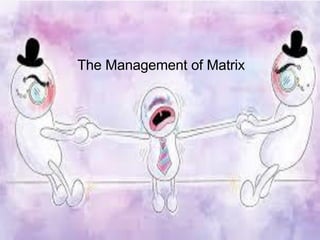
The Management ofMatrix
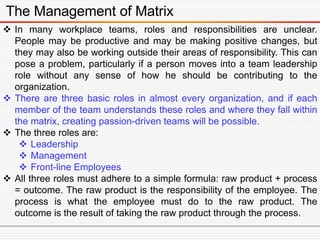
In many workplace teams, roles and responsibilities are unclear.
People may be productive and may be making positive changes, but
they may also be working outside their areas of responsibility. This can
pose a problem, particularly if a person moves into a team leadership
role without any sense of how he should be contributing to the
organization.
There are three basic roles in almost every organization, and if each
member of the team understands these roles and where they fall within
the matrix, creating passion-driven teams will be possible.
The three roles are:
Leadership
Management
Front-line Employees
All three roles must adhere to a simple formula: raw product + process
= outcome. The raw product is the responsibility of the employee. The
process is what the employee must do to the raw product. The
outcome is the result of taking the raw product through the process.
11.
The Management ofMatrix
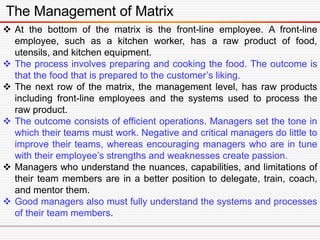
At the bottom of the matrix is the front-line employee. A front-line
employee, such as a kitchen worker, has a raw product of food,
utensils, and kitchen equipment.
The process involves preparing and cooking the food. The outcome is
that the food that is prepared to the customer’s liking.
The next row of the matrix, the management level, has raw products
including front-line employees and the systems used to process the
raw product.
The outcome consists of efficient operations. Managers set the tone in
which their teams must work. Negative and critical managers do little to
improve their teams, whereas encouraging managers who are in tune
with their employee’s strengths and weaknesses create passion.
Managers who understand the nuances, capabilities, and limitations of
their team members are in a better position to delegate, train, coach,
and mentor them.
Good managers also must fully understand the systems and processes
of their team members.
12.
The Management ofMatrix
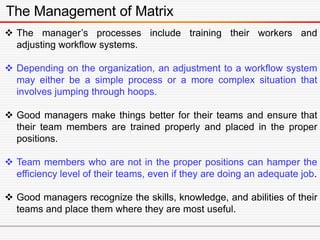
The manager’s processes include training their workers and
adjusting workflow systems.
Depending on the organization, an adjustment to a workflow system
may either be a simple process or a more complex situation that
involves jumping through hoops.
Good managers make things better for their teams and ensure that
their team members are trained properly and placed in the proper
positions.
Team members who are not in the proper positions can hamper the
efficiency level of their teams, even if they are doing an adequate job.
Good managers recognize the skills, knowledge, and abilities of their
teams and place them where they are most useful.
13.
The Management ofMatrix
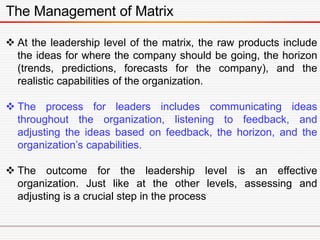
At the leadership level of the matrix, the raw products include
the ideas for where the company should be going, the horizon
(trends, predictions, forecasts for the company), and the
realistic capabilities of the organization.
The process for leaders includes communicating ideas
throughout the organization, listening to feedback, and
adjusting the ideas based on feedback, the horizon, and the
organization’s capabilities.
The outcome for the leadership level is an effective
organization. Just like at the other levels, assessing and
adjusting is a crucial step in the process
14.
The Management ofMatrix
At the leadership level of the matrix, the raw products include
the ideas for where the company should be going, the horizon
(trends, predictions, forecasts for the company), and the
realistic capabilities of the organization.
The process for leaders includes communicating ideas
throughout the organization, listening to feedback, and
adjusting the ideas based on feedback, the horizon, and the
organization’s capabilities.
The outcome for the leadership level is an effective
organization. Just like at the other levels, assessing and
adjusting is a crucial step in the process
15.
The idea thatpeople lack motivation is bad
psychology. It’s a myth. If we’re going to create
passion-driven teams, we need a clear
understanding about what drives people to do
what they do
Micro Management
TheCause of Micromanagement- A micromanager is someone who
dictates every action and every decision for everyone on the team.
Micromanagers are frequently frustrated that team members are not
taking things seriously enough.
They want constant status updates, even during normal operations, and
they quickly point out errors and mistakes. They are often very busy even
when their team members are not, and they frequently take back
assigned projects because they feel they can do a better job.
Micromanagement is common when an outstanding front-line employee
is promoted to a management position. Oftentimes, front-line employees
are internally driven to excel and want to hear that they are doing a good
job. They continue doing what they have been praised for in the past to
receive an ego boost.
For many, the phrase “good job” is like currency; the more they hear it,
they more they feel they are likely to get a raise or a promotion.
Therefore, when problems on the line arise, they step in to fix them since
that is what worked in the past.
18.
Micro Management
Undertreatingthe problem is another cause of micromanagement.
Most management training provides very little hands-on
experience. Learning the theories about how to manage are not
very useful without real world experiences.
Many business degree programs do not even touch on the
concepts of training people or adjusting systems as core
responsibilities of management.
The third cause of micromanagement is fear. When people are
told they are doing a “good job,” they are receiving positive
reinforcement. The fear of failure and the subsequent
consequences is the extreme opposite, and is a negative
motivator.
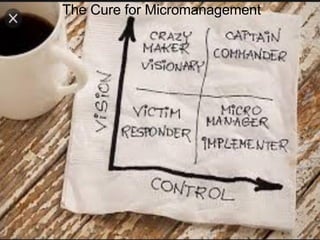
The Cure forMicromanagement
For organizations to stop micromanagement from are detected,
then strategies for improvement can be quickly implemented.
New managers and their supervisors should work together to
determine the best methods of training, mentoring, and
coaching for addressing any problems. Routine conversations
should include positive reinforcements along with addressing
any inefficiencies.
Mentors should ensure that they are not overly critical all the
time, are not too busy to meet, do not force new managers to
compromise their values, and do not allow managers to
become too dependent on them.
21.
The Cure forMicromanagement
If new managers find themselves in an organization that does
not provide help for micromanaging, a self-cure is possible.
People in this position should remember that their role as a
manager requires a totally new level of thinking and that their
responsibilities are now to train team members and monitor
system efficiencies.
If clear-cut job responsibilities are not available, they should be
persistent in getting clarification.
Constant self-analysis is important and hiring an outside coach
for help is something that should also be considered.
Emotional Intelligence
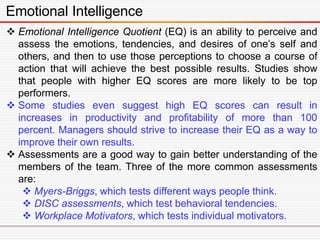
EmotionalIntelligence Quotient (EQ) is an ability to perceive and
assess the emotions, tendencies, and desires of one’s self and
others, and then to use those perceptions to choose a course of
action that will achieve the best possible results. Studies show
that people with higher EQ scores are more likely to be top
performers.
Some studies even suggest high EQ scores can result in
increases in productivity and profitability of more than 100
percent. Managers should strive to increase their EQ as a way to
improve their own results.
Assessments are a good way to gain better understanding of the
members of the team. Three of the more common assessments
are:
Myers-Briggs, which tests different ways people think.
DISC assessments, which test behavioral tendencies.
Workplace Motivators, which tests individual motivators.
24.
The Myths ofMotivation
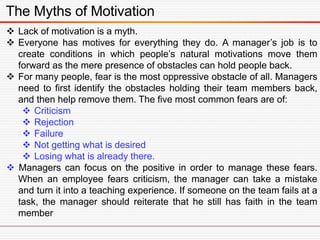
Lack of motivation is a myth.
Everyone has motives for everything they do. A manager’s job is to
create conditions in which people’s natural motivations move them
forward as the mere presence of obstacles can hold people back.
For many people, fear is the most oppressive obstacle of all. Managers
need to first identify the obstacles holding their team members back,
and then help remove them. The five most common fears are of:
Criticism
Rejection
Failure
Not getting what is desired
Losing what is already there.
Managers can focus on the positive in order to manage these fears.
When an employee fears criticism, the manager can take a mistake
and turn it into a teaching experience. If someone on the team fails at a
task, the manager should reiterate that he still has faith in the team
member
25.
The Myths ofMotivation
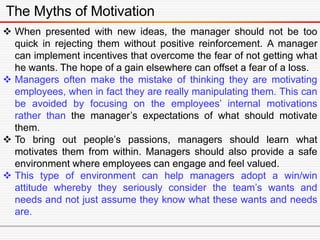
When presented with new ideas, the manager should not be too
quick in rejecting them without positive reinforcement. A manager
can implement incentives that overcome the fear of not getting what
he wants. The hope of a gain elsewhere can offset a fear of a loss.
Managers often make the mistake of thinking they are motivating
employees, when in fact they are really manipulating them. This can
be avoided by focusing on the employees’ internal motivations
rather than the manager’s expectations of what should motivate
them.
To bring out people’s passions, managers should learn what
motivates them from within. Managers should also provide a safe
environment where employees can engage and feel valued.
This type of environment can help managers adopt a win/win
attitude whereby they seriously consider the team’s wants and
needs and not just assume they know what these wants and needs
are.
26.
To truly “motivate”someone (using the colloquial
term), we must create conditions in which
employees engage for reasons that are important to
them.
The Power WaterCooler Conversations
People like to feel connected to one another and to know what
is going on around them.
Casual conversations with team members about everything
from projects that are in process, the company’s vision for the
future, and the team’s role in the company go a long way in
producing passion-driven teams.
When employees understand the company’s goals and how
their own work contributes to the achievement of those goals,
they are more likely to be productive and profitable members of
the team.
The brain is hardwired to resist change. Understanding how the
brain works can give the manager insights into how to get
people to modify habits and move in a common direction.
Informal water cooler conversations can help teams achieve top
performance.
29.
The Power WaterCooler Conversations
Managers need to use these conversations to improve
employees’ focus, expectations, and attention density.
To improve focus, managers should paint a positive picture of
the future. When dealing with an employee’s expectations,
managers should help the employee gain a different
perspective and understand that it is okay to be open to new
possibilities.
With attention density, it is a known fact that most people retain
information better if it is learned slowly over time.
Thus, regular water cooler conversations can slowly reinforce
new ideas.
30.
The Do’s &Don'ts of Delegating
Delegating work has many levels. When managers delegate,
they transfer responsibility, authority, and accountability. Without
transferring all three, the manager fails to maximize personal
ownership of the tasks.
Managers should know the preferences and limitations of each
of their team members. They should understand their
communication styles, problem solving abilities, and ability to
deal with pressure before they are ready to start delegating.
It is important that managers fully understand the big picture so
that they can carefully match up the work to the right person.
Once complete, a face-to-face explanation of the project is in
order, as is an agreement on what constitutes a finished
product. A timely follow-up is extremely important as well.
31.
The Do’s &Don'ts of Delegating
To transfer ownership of a large project for the first time,
managers can request that their employees spend time creating
a general outline of the project in their own terms.
It does not have to be complete, but it should demonstrate a
general understanding of what must be done.
Managers can go over the plan, fill in any blanks, or correct any
mistakes before completely turning over the project.
Once the outline is 85-90 percent where the manager thinks it
should be, the project can be turned over and follow-ups can be
scheduled.
A survey of well-respected delegators revealed a few consistent
ideas about delegating. They felt that managers should
delegate tasks that are possible to complete, build trust, give
the big picture, take their hands off the project, and give credit
where credit is due.
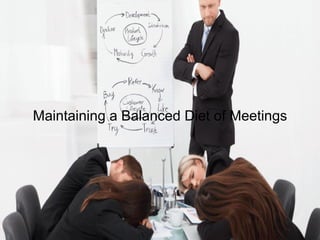
Maintaining a BalancedDiet of Meetings
Team leaders must schedule the right amount of meetings in order to
move their teams forward without weighing them down. Meetings are
meant to keep a team healthy and growing, to keep people on track
with company goals, and to help the team increase efficiencies and
effectiveness.
There are a few rules managers must consider when planning
meetings:
Team leaders must decide what type of meeting must take place:
informational, problem-solving, planning, or retreats/team
building.
Team leaders should make sure that there is a clearly stated
purpose for the meeting, as well as defined goals.
There should be a written agenda, and everyone who needs to
present should know about it ahead of time.
If status meetings are common in an organization, they should be
minimized.
34.
Maintaining a BalancedDiet of Meetings
Leaders should encourage team members to use tools, such as
email, wikis, and even old-fashioned bulletin boards, to
communicate about the status of a project as much as possible.
When a decision-making meeting is scheduled, the team leader
should distribute information ahead of time to speed up the
process. It should be made clear to participants that being
prepared is mandatory.
To determine the value of their meetings, team leaders should
regularly collect feedback from team members.
After three to twelve months of data collection, they should
meet with the team and determine the consensus on the value,
purpose, frequency, and length of meetings. They can then
adjust the schedules as necessary
35.
Each team isunique. A meeting that provides great
benefit to one team may be poisonous to another.
You must be in tune with your team’s unique needs.
Listen, or ThisWon’t Work
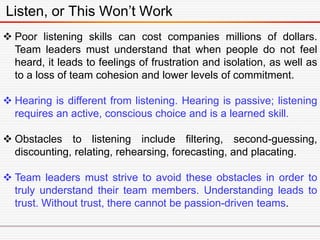
Poor listening skills can cost companies millions of dollars.
Team leaders must understand that when people do not feel
heard, it leads to feelings of frustration and isolation, as well as
to a loss of team cohesion and lower levels of commitment.
Hearing is different from listening. Hearing is passive; listening
requires an active, conscious choice and is a learned skill.
Obstacles to listening include filtering, second-guessing,
discounting, relating, rehearsing, forecasting, and placating.
Team leaders must strive to avoid these obstacles in order to
truly understand their team members. Understanding leads to
trust. Without trust, there cannot be passion-driven teams.
38.
Listen, or ThisWon’t Work
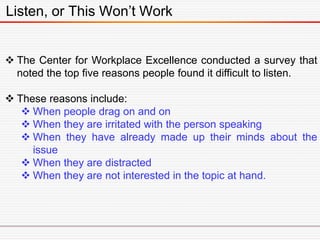
The Center for Workplace Excellence conducted a survey that
noted the top five reasons people found it difficult to listen.
These reasons include:
When people drag on and on
When they are irritated with the person speaking
When they have already made up their minds about the
issue
When they are distracted
When they are not interested in the topic at hand.
39.
Listening requires anactive, conscious choice. To
listen, you must have a purpose in your heart and
apply mental effort.
Think of listening as a goal—an objective. A task you
must accomplish.
Resolve to ResolveAll Conflict
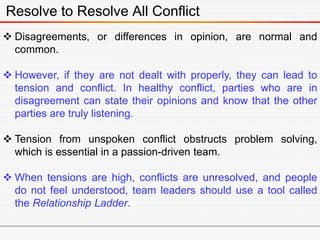
Disagreements, or differences in opinion, are normal and
common.
However, if they are not dealt with properly, they can lead to
tension and conflict. In healthy conflict, parties who are in
disagreement can state their opinions and know that the other
parties are truly listening.
Tension from unspoken conflict obstructs problem solving,
which is essential in a passion-driven team.
When tensions are high, conflicts are unresolved, and people
do not feel understood, team leaders should use a tool called
the Relationship Ladder.
42.
Resolve to ResolveAll Conflict
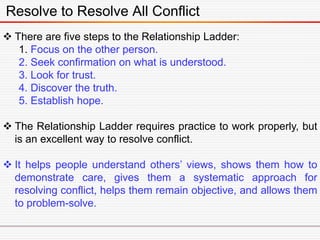
There are five steps to the Relationship Ladder:
1. Focus on the other person.
2. Seek confirmation on what is understood.
3. Look for trust.
4. Discover the truth.
5. Establish hope.
The Relationship Ladder requires practice to work properly, but
is an excellent way to resolve conflict.
It helps people understand others’ views, shows them how to
demonstrate care, gives them a systematic approach for
resolving conflict, helps them remain objective, and allows them
to problem-solve.
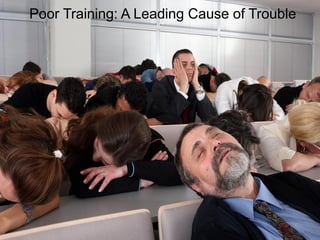
Poor Training –Leading Cause of Troubles
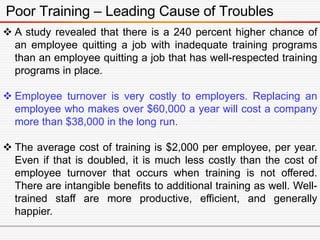
A study revealed that there is a 240 percent higher chance of
an employee quitting a job with inadequate training programs
than an employee quitting a job that has well-respected training
programs in place.
Employee turnover is very costly to employers. Replacing an
employee who makes over $60,000 a year will cost a company
more than $38,000 in the long run.
The average cost of training is $2,000 per employee, per year.
Even if that is doubled, it is much less costly than the cost of
employee turnover that occurs when training is not offered.
There are intangible benefits to additional training as well. Well-
trained staff are more productive, efficient, and generally
happier.
45.
Poor Training –Leading Cause of Troubles
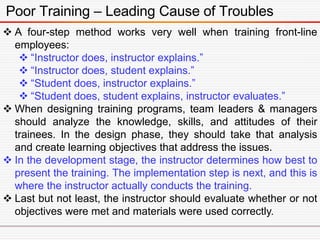
A four-step method works very well when training front-line
employees:
“Instructor does, instructor explains.”
“Instructor does, student explains.”
“Student does, instructor explains.”
“Student does, student explains, instructor evaluates.”
When designing training programs, team leaders & managers
should analyze the knowledge, skills, and attitudes of their
trainees. In the design phase, they should take that analysis
and create learning objectives that address the issues.
In the development stage, the instructor determines how best to
present the training. The implementation step is next, and this is
where the instructor actually conducts the training.
Last but not least, the instructor should evaluate whether or not
objectives were met and materials were used correctly.
Celebrate Failure &Achievement
All successful people have failed at some point in their lives.
Failure, or lack of success, is a learning experience.
To create a passion-driven team, team leaders must teach their
team members to move forward and learn from their mistakes.
While many companies say that employees are their greatest
assets, they do not always treat them as such.
Employee recognition programs do not have to cost much, but
they can really boost employee morale.
Management should provide a nurturing and encouraging
environment to keep employees protected and help them feel
celebrated.
Learning’s for Application
Teams who are motivated by passion can accomplish great things.
Managers cannot manufacture fervent enthusiasm. They must create a
trusting, sharing and committed environment – the perfect conditions for a
passionate work spirit.
Managers are either selfless “Builders” or selfish “Climbers.” Only builders
can develop zealous teams.
To build an ardent team, learn what motivates the team members.
Study your employees to see what makes them tick. Understand your
employees’ knowledge, skills, attitudes and processes.
Micromanagement will kill any enjoyment team members obtain from their
work.
Often, organizations are responsible for the evolution of micromanagers
since they don’t teach people how to manage properly.
To prevent a culture of micromanagement, coach and mentor new managers
thoroughly and perform personality tests to discover each manager’s style.
Teams often lack zest due to fear of criticism, rejection or failure.
Learn to listen actively to your staffers. This reduces conflict and boosts
passion.