CrackingThe ‘Situational Leadership’ Code
Balancing Flexibility and Control for OptimalTeam Performance
Effective leaders need to be
flexible, and must adapt
themselves according to the
situation”
Paul Hersey and Kenneth Blanchard
What is
Situational
Leadership?
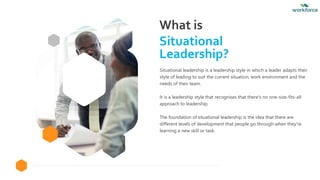
Situational leadership is a leadership style in which a leader adapts their
style of leading to suit the current situation, work environment and the
needs of their team.
It is a leadership style that recognises that there's no one-size-fits-all
approach to leadership.
The foundation of situational leadership is the idea that there are
different levels of development that people go through when they're
learning a new skill or task.
Situational leadership is a flexible and
adaptive leadership style that encourages
leaders to assess their teams, consider the
multiple variables at work, and select the
leadership style that best suits their
objectives and circumstances.Situational
leadership has become essential for leaders
to thrive in the current ever-changing work
environment.
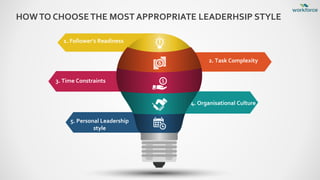
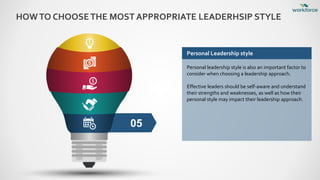
HOWTO CHOOSETHE MOST APPROPRIATE LEADERHSIP STYLE
2. Task Complexity
4. Organisational Culture
5. Personal Leadership
style
3. Time Constraints
1. Follower’s Readiness
HOWTO CHOOSETHE MOST APPROPRIATE LEADERHSIP STYLE
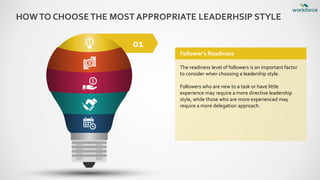
01
Follower’s Readiness
The readiness level of followers is an important factor
to consider when choosing a leadership style.
Followers who are new to a task or have little
experience may require a more directive leadership
style, while those who are more experienced may
require a more delegation approach.
HOWTO CHOOSETHE MOST APPROPRIATE LEADERHSIP STYLE
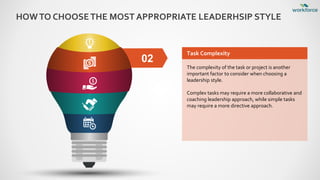
02
Task Complexity
The complexity of the task or project is another
important factor to consider when choosing a
leadership style.
Complex tasks may require a more collaborative and
coaching leadership approach, while simple tasks
may require a more directive approach.
HOWTO CHOOSETHE MOST APPROPRIATE LEADERHSIP STYLE
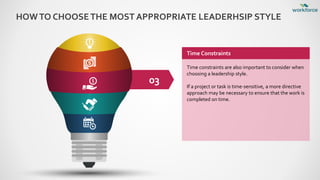
03
Time Constraints
Time constraints are also important to consider when
choosing a leadership style.
If a project or task is time-sensitive, a more directive
approach may be necessary to ensure that the work is
completed on time.
HOWTO CHOOSETHE MOST APPROPRIATE LEADERHSIP STYLE
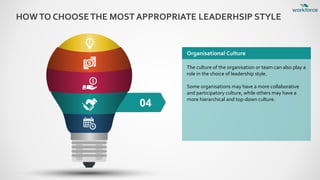
04
Organisational Culture
The culture of the organisation or team can also play a
role in the choice of leadership style.
Some organisations may have a more collaborative
and participatory culture, while others may have a
more hierarchical and top-down culture.
HOWTO CHOOSETHE MOST APPROPRIATE LEADERHSIP STYLE
05
Personal Leadership style
Personal leadership style is also an important factor to
consider when choosing a leadership approach.
Effective leaders should be self-aware and understand
their strengths and weaknesses, as well as how their
personal style may impact their leadership approach.
Leadership style is the reflection of your behavioural pattern that
enables you to manage your team by directing and motivating them
towards a shared vision. Your leadership styles also determine your
approach to strategising and implementing methods while fulfilling
the business’s expectations and focusing on your team’s growth.
Choosing a leadership style that works for you can make you a more
effective leader. Whether you manage a large or small team, your
leadership style heavily impacts how your team sees you.
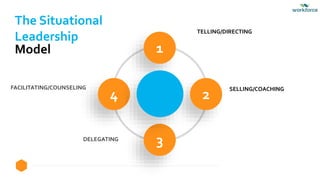
4 2
1
3
TELLING/DIRECTING
DELEGATING
SELLING/COACHING
FACILITATING/COUNSELING
The Situational
Leadership
Model
TELLING/DIRECTING
It involves providing clear and specific direction to
followers who are new to a task or have little experience.
This style is characterised by one-way communication in
which the leader defines the roles of followers and tells
them what, how, when and where to do various tasks.
This style is most appropriate when followers are not yet
skilled in a task and require a high degree of direction
and control.
01
The Situational
Leadership
Model
SELLING/COACHING
This style involves providing occasional guidance and
support to followers who have developed proficiency
in a task but may require occasional encouragement
and support.
The leader delegates since the followers are high in
readiness, have the ability, and are willing and able to
take responsibility for directing their own behaviour.
This style is most appropriate when the follower has
some experience and proficiency in a task but may
require occasional guidance and support to continue
developing their skills.
02
The Situational
Leadership
Model
DELEGATING
This style involves providing occasional guidance
and support to followers who have developed some
proficiency in a task, but may require occasional
encouragement and support.
The leader delegates since the followers are high in
readiness, have the ability, and are both willing and
able to take responsibility for directing their own
behavior.
This style is most appropriate when the follower
has some experience and proficiency in a task but
may require occasional guidance and support to
continue developing their skills.
03
The Situational
Leadership
Model
FACILITATING/COUNSELING
This style involves providing minimal direction and
support to highly skilled followers who can work
independently.
In this style, the leader and followers now share in
decision-making through two-way communication
and much-facilitating behaviour from the leader
since followers have the ability and knowledge to do
the task.
This style is most appropriate when the follower is
highly skilled and experienced and requires little
direction or support.
04
The Situational
Leadership
Model
This is a sample text. Insert your desired
text here.
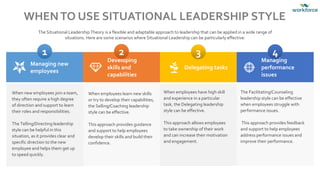
The Situational LeadershipTheory is a flexible and adaptable approach to leadership that can be applied in a wide range of
situations. Here are some scenarios where Situational Leadership can be particularly effective:
WHENTO USE SITUATIONAL LEADERSHIP STYLE
Managing new
employees
Developing
skills and
capabilities
Delegating tasks
Managing
performance
issues
1 2 3 4
When new employees join a team,
they often require a high degree
of direction and support to learn
their roles and responsibilities.
The Telling/Directing leadership
style can be helpful in this
situation, as it provides clear and
specific direction to the new
employee and helps them get up
to speed quickly.
When employees learn new skills
or try to develop their capabilities,
the Selling/Coaching leadership
style can be effective.
This approach provides guidance
and support to help employees
develop their skills and build their
confidence.
When employees have high skill
and experience in a particular
task, the Delegating leadership
style can be effective.
This approach allows employees
to take ownership of their work
and can increase their motivation
and engagement.
The Facilitating/Counseling
leadership style can be effective
when employees struggle with
performance issues.
This approach provides feedback
and support to help employees
address performance issues and
improve their performance.
Situational leadership is an approach that requires intuition, flexibility,
and adaptability. However, not all leaders possess the innate
characteristics or skills necessary to adjust their leadership style to meet
the needs of their team in different situations. That's why it's crucial for
leaders to undergo continuous learning and development to improve
their leadership skills and become more effective in leading their teams.
At Workforce Learning, we understand that leadership isn't a one-and-
done approach. It's an ongoing process of adapting and adjusting your
leadership style to match the development level of your team.
So, if you want to learn more about how we can help you build effective
and inspiring leaders, send an email to hello@workforcegroup.com. Our
team of experienced leadership development professionals will be happy
to answer your questions and provide you with more information about
our programmes.
Scale the advantage…
READY TO GET
STARTED?
Visit www.workforcegroup.com or
Send an email to –
hello@workforcegroup.com
YOUR BUSINESS YOUR PEOPLE OUR FOCUS
=
Workforce Group
… We go
beyond
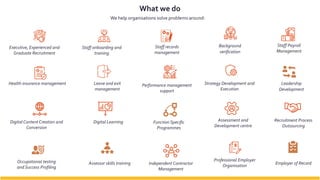
What we do
We help organisations solve problems around:
Staff Payroll
Management
Performance management
support
Health insurance management
Executive, Experienced and
Graduate Recruitment
Staff onboarding and
training
Staff records
management
Leave and exit
management
Background
verification
Strategy Development and
Execution
Digital Learning Function Specific
Programmes
Leadership
Development
Digital Content Creation and
Conversion
Assessment and
Development centre
Occupational testing
and Success Profiling
Independent Contractor
Management
Assessor skills training
Professional Employer
Organisation
Employer of Record
Recruitment Process
Outsourcing
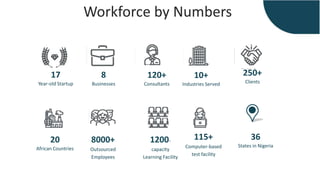
Workforce by Numbers
17
Year-old Startup
8
Businesses
120+
Consultants
20
African Countries
8000+
Outsourced
Employees
1200-
capacity
Learning Facility
115+
Computer-based
test facility
250+
Clients
10+
Industries Served
36
States in Nigeria

Cracking The Situational Leadership Code

  • 1.
    CrackingThe ‘Situational Leadership’Code Balancing Flexibility and Control for OptimalTeam Performance
  • 2.
    Effective leaders needto be flexible, and must adapt themselves according to the situation” Paul Hersey and Kenneth Blanchard
  • 3.
    What is Situational Leadership? Situational leadershipis a leadership style in which a leader adapts their style of leading to suit the current situation, work environment and the needs of their team. It is a leadership style that recognises that there's no one-size-fits-all approach to leadership. The foundation of situational leadership is the idea that there are different levels of development that people go through when they're learning a new skill or task.
  • 4.
    Situational leadership isa flexible and adaptive leadership style that encourages leaders to assess their teams, consider the multiple variables at work, and select the leadership style that best suits their objectives and circumstances.Situational leadership has become essential for leaders to thrive in the current ever-changing work environment.
  • 5.
    HOWTO CHOOSETHE MOSTAPPROPRIATE LEADERHSIP STYLE 2. Task Complexity 4. Organisational Culture 5. Personal Leadership style 3. Time Constraints 1. Follower’s Readiness
  • 6.
    HOWTO CHOOSETHE MOSTAPPROPRIATE LEADERHSIP STYLE 01 Follower’s Readiness The readiness level of followers is an important factor to consider when choosing a leadership style. Followers who are new to a task or have little experience may require a more directive leadership style, while those who are more experienced may require a more delegation approach.
  • 7.
    HOWTO CHOOSETHE MOSTAPPROPRIATE LEADERHSIP STYLE 02 Task Complexity The complexity of the task or project is another important factor to consider when choosing a leadership style. Complex tasks may require a more collaborative and coaching leadership approach, while simple tasks may require a more directive approach.
  • 8.
    HOWTO CHOOSETHE MOSTAPPROPRIATE LEADERHSIP STYLE 03 Time Constraints Time constraints are also important to consider when choosing a leadership style. If a project or task is time-sensitive, a more directive approach may be necessary to ensure that the work is completed on time.
  • 9.
    HOWTO CHOOSETHE MOSTAPPROPRIATE LEADERHSIP STYLE 04 Organisational Culture The culture of the organisation or team can also play a role in the choice of leadership style. Some organisations may have a more collaborative and participatory culture, while others may have a more hierarchical and top-down culture.
  • 10.
    HOWTO CHOOSETHE MOSTAPPROPRIATE LEADERHSIP STYLE 05 Personal Leadership style Personal leadership style is also an important factor to consider when choosing a leadership approach. Effective leaders should be self-aware and understand their strengths and weaknesses, as well as how their personal style may impact their leadership approach.
  • 11.
    Leadership style isthe reflection of your behavioural pattern that enables you to manage your team by directing and motivating them towards a shared vision. Your leadership styles also determine your approach to strategising and implementing methods while fulfilling the business’s expectations and focusing on your team’s growth. Choosing a leadership style that works for you can make you a more effective leader. Whether you manage a large or small team, your leadership style heavily impacts how your team sees you.
  • 12.
  • 13.
    TELLING/DIRECTING It involves providingclear and specific direction to followers who are new to a task or have little experience. This style is characterised by one-way communication in which the leader defines the roles of followers and tells them what, how, when and where to do various tasks. This style is most appropriate when followers are not yet skilled in a task and require a high degree of direction and control. 01 The Situational Leadership Model
  • 14.
    SELLING/COACHING This style involvesproviding occasional guidance and support to followers who have developed proficiency in a task but may require occasional encouragement and support. The leader delegates since the followers are high in readiness, have the ability, and are willing and able to take responsibility for directing their own behaviour. This style is most appropriate when the follower has some experience and proficiency in a task but may require occasional guidance and support to continue developing their skills. 02 The Situational Leadership Model
  • 15.
    DELEGATING This style involvesproviding occasional guidance and support to followers who have developed some proficiency in a task, but may require occasional encouragement and support. The leader delegates since the followers are high in readiness, have the ability, and are both willing and able to take responsibility for directing their own behavior. This style is most appropriate when the follower has some experience and proficiency in a task but may require occasional guidance and support to continue developing their skills. 03 The Situational Leadership Model
  • 16.
    FACILITATING/COUNSELING This style involvesproviding minimal direction and support to highly skilled followers who can work independently. In this style, the leader and followers now share in decision-making through two-way communication and much-facilitating behaviour from the leader since followers have the ability and knowledge to do the task. This style is most appropriate when the follower is highly skilled and experienced and requires little direction or support. 04 The Situational Leadership Model
  • 17.
    This is asample text. Insert your desired text here. The Situational LeadershipTheory is a flexible and adaptable approach to leadership that can be applied in a wide range of situations. Here are some scenarios where Situational Leadership can be particularly effective: WHENTO USE SITUATIONAL LEADERSHIP STYLE Managing new employees Developing skills and capabilities Delegating tasks Managing performance issues 1 2 3 4 When new employees join a team, they often require a high degree of direction and support to learn their roles and responsibilities. The Telling/Directing leadership style can be helpful in this situation, as it provides clear and specific direction to the new employee and helps them get up to speed quickly. When employees learn new skills or try to develop their capabilities, the Selling/Coaching leadership style can be effective. This approach provides guidance and support to help employees develop their skills and build their confidence. When employees have high skill and experience in a particular task, the Delegating leadership style can be effective. This approach allows employees to take ownership of their work and can increase their motivation and engagement. The Facilitating/Counseling leadership style can be effective when employees struggle with performance issues. This approach provides feedback and support to help employees address performance issues and improve their performance.
  • 18.
    Situational leadership isan approach that requires intuition, flexibility, and adaptability. However, not all leaders possess the innate characteristics or skills necessary to adjust their leadership style to meet the needs of their team in different situations. That's why it's crucial for leaders to undergo continuous learning and development to improve their leadership skills and become more effective in leading their teams. At Workforce Learning, we understand that leadership isn't a one-and- done approach. It's an ongoing process of adapting and adjusting your leadership style to match the development level of your team. So, if you want to learn more about how we can help you build effective and inspiring leaders, send an email to hello@workforcegroup.com. Our team of experienced leadership development professionals will be happy to answer your questions and provide you with more information about our programmes. Scale the advantage…
  • 19.
    READY TO GET STARTED? Visitwww.workforcegroup.com or Send an email to – hello@workforcegroup.com
  • 20.
    YOUR BUSINESS YOURPEOPLE OUR FOCUS = Workforce Group … We go beyond
  • 21.
    What we do Wehelp organisations solve problems around: Staff Payroll Management Performance management support Health insurance management Executive, Experienced and Graduate Recruitment Staff onboarding and training Staff records management Leave and exit management Background verification Strategy Development and Execution Digital Learning Function Specific Programmes Leadership Development Digital Content Creation and Conversion Assessment and Development centre Occupational testing and Success Profiling Independent Contractor Management Assessor skills training Professional Employer Organisation Employer of Record Recruitment Process Outsourcing
  • 22.
    Workforce by Numbers 17 Year-oldStartup 8 Businesses 120+ Consultants 20 African Countries 8000+ Outsourced Employees 1200- capacity Learning Facility 115+ Computer-based test facility 250+ Clients 10+ Industries Served 36 States in Nigeria