Dr. RAGHAVENDRA RAJU
INTRODUCTION
 In 1834, Smith - first description of a rupture of the
rotator cuff tendon .
 Among most common causes of shoulder pain and
instability.
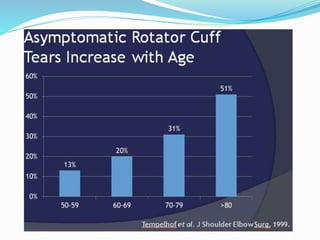
 Incidence 5-40% with increasing with advancing age (
>40 years).
 Normal senescence process
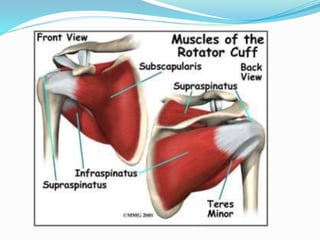
ANATOMY- ROTATOR CUFF
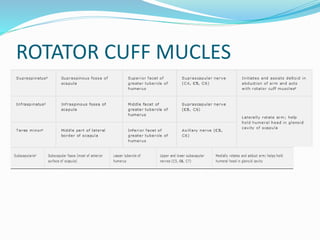
 Made up of 4 interrelated muscles arising from the
scapula and attaching to the tuberosities of humerus.
 supraspinatus
 infraspinatus
 teres minor
 subscapularis
 Long head of biceps – functional part
ROTATOR CUFF MUCLES
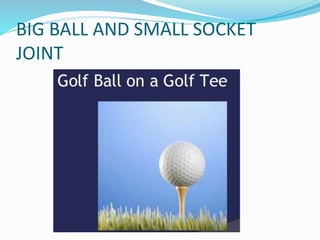
BIG BALL AND SMALL SOCKET
JOINT
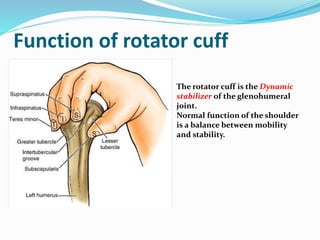
Function of rotator cuff
The rotator cuff is the Dynamic
stabilizer of the glenohumeral
joint.
Normal function of the shoulder
is a balance between mobility
and stability.
Function of rotator cuff
 Stabilisers of shoulder mainly anterior and posterior
cuff providing fixed fulcrum for concentric rotation of
the humeral head.
 Neutralises shearing forces of deltoid in early
abduction.
 Initiation of abduction.
 Rotation of shoulder.
ETIOLOGY
 IMPINGEMENT( MC )
 TRAUMA
 ATTRITION - AGING
 ISCHEMIC TENDON
 LACK OF NUTRITION TO JOINT
 IATROGENIC
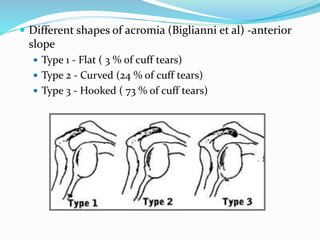
 Different shapes of acromia (Biglianni et al) -anterior
slope
 Type 1 - Flat ( 3 % of cuff tears)
 Type 2 - Curved (24 % of cuff tears)
 Type 3 - Hooked ( 73 % of cuff tears)
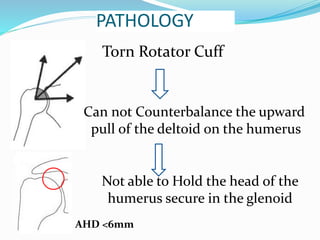
PATHOLOGY
Torn Rotator Cuff
Can not Counterbalance the upward
pull of the deltoid on the humerus
Not able to Hold the head of the
humerus secure in the glenoid
AHD <6mm
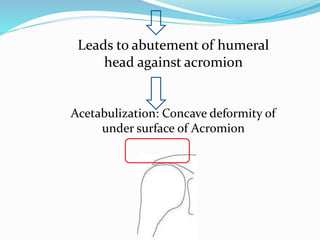
Leads to abutement of humeral
head against acromion
Acetabulization: Concave deformity of
under surface of Acromion
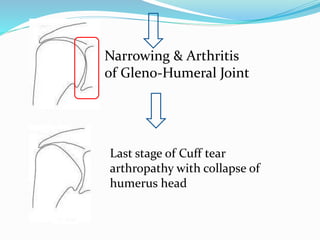
Narrowing & Arthritis
of Gleno-Humeral Joint
Last stage of Cuff tear
arthropathy with collapse of
humerus head
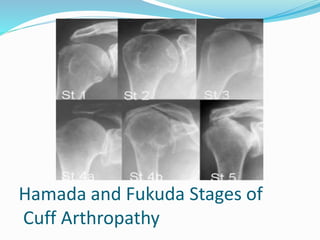
Hamada and Fukuda Stages of
Cuff Arthropathy
CLASSIFICATION
1. DURATION – ACUTE OR CHRONIC
2. DEGREE OF TEAR- PARTIAL OR FULL THICKNESS
TEAR.
3. ETIOLOGY- TRAUMATIC OR DEGENERATIVE.
4. COFIELD – BASED ON SIZE OF TEAR
SIZE OF TEAR DEGREE
<1 cm SMALL
1- 3 cms MEDIUM
3-5cms LARGE
>5 cms MASSIVE
 ELLMANS CLASSIFICATION
1.ARTICULAR
2.BURSAL
3.INTERSTITIAL
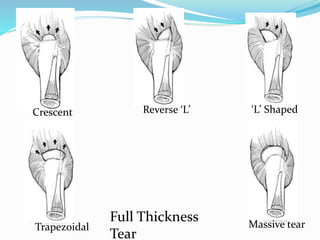
Crescent Reverse ‘L’ ‘L’ Shaped
Trapezoidal Massive tear
Full Thickness
Tear
SYMPTOMS
 Pain on the lateral aspect of the shoulder
 may radiate to deltoid insertion
 anterior (acromion )with impingement
 +/- biceps tendonitis
 Stiffness
 Cannot lie affected side.
 Weakness, instability, crepitus.
21
Assessing shoulder pain
Components of the assessment include
 Focused history
 physical examination
 Tests/studies
23
Focused History Questions
Onset of Pain
 When symptoms started*
 History of trauma/injury
24
Focused History Questions
 Mechanism of Injury
 Helps predict injured structure
Example: Fall directly onto anterior/superior
shoulderAC joint injury (shoulder separation)
Example: Arm forcefully abducted and externally
rotated  subluxation or anterior dislocation
Example: If chronic pain, note activity that triggers
pain, such as the cocking phase of throwing or the
pull-through phase of swimming
25
Focused History Questions
 Mechanism of Injury, continued
 Can determine radiological needs
 Likelihood of specific conditions varies
 Setting (work, recreation, sports, traumatic,
atraumatic)
 Age of the patient*
26
Focused History Questions
 Location of pain*
 Anterior
 Lateral
 Superior
 Posterior
 Radiation of pain
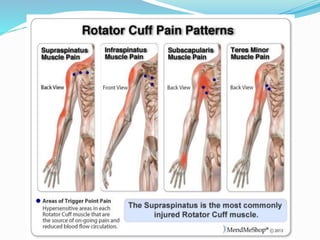
 Rotator cuff problems often include pain
radiating to upper arm
 If pain starts in neck and radiates to shoulder,
consider cervical spine disease
28
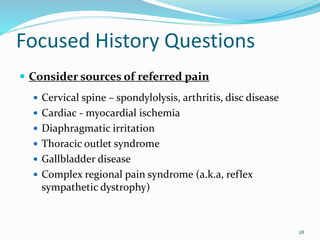
 Consider sources of referred pain
 Cervical spine – spondylolysis, arthritis, disc disease
 Cardiac - myocardial ischemia
 Diaphragmatic irritation
 Thoracic outlet syndrome
 Gallbladder disease
 Complex regional pain syndrome (a.k.a, reflex
sympathetic dystrophy)
Focused History Questions
29
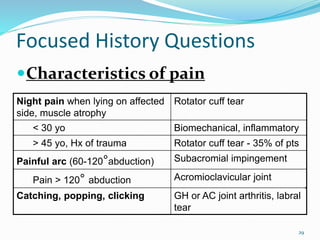
Characteristics of pain
Focused History Questions
Night pain when lying on affected
side, muscle atrophy
Rotator cuff tear
< 30 yo Biomechanical, inflammatory
> 45 yo, Hx of trauma Rotator cuff tear - 35% of pts
Painful arc (60-120°abduction) Subacromial impingement
Pain > 120° abduction Acromioclavicular joint
Catching, popping, clicking GH or AC joint arthritis, labral
tear
30
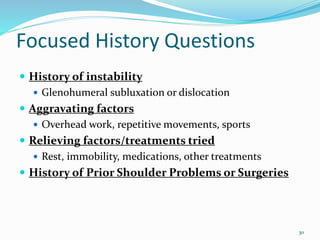
Focused History Questions
 History of instability
 Glenohumeral subluxation or dislocation
 Aggravating factors
 Overhead work, repetitive movements, sports
 Relieving factors/treatments tried
 Rest, immobility, medications, other treatments
 History of Prior Shoulder Problems or Surgeries
31
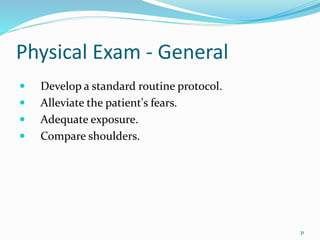
Physical Exam - General
 Develop a standard routine protocol.
 Alleviate the patient's fears.
 Adequate exposure.
 Compare shoulders.
32
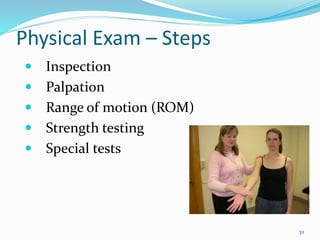
Physical Exam – Steps
 Inspection
 Palpation
 Range of motion (ROM)
 Strength testing
 Special tests
33
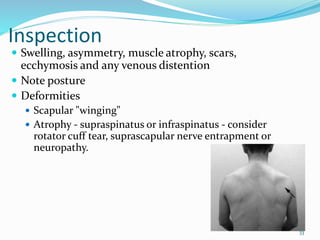
Inspection
 Swelling, asymmetry, muscle atrophy, scars,
ecchymosis and any venous distention
 Note posture
 Deformities
 Scapular "winging"
 Atrophy - supraspinatus or infraspinatus - consider
rotator cuff tear, suprascapular nerve entrapment or
neuropathy.
34
Palpation
 Sternoclavicular joint
 Clavicle
 Acromioclavicular joint
 Subacromial bursa
 Coracoid process
 Bicipital groove
 Greater tuberosity
 Lesser tuberosity
 Scapula (spinatus muscles)
35
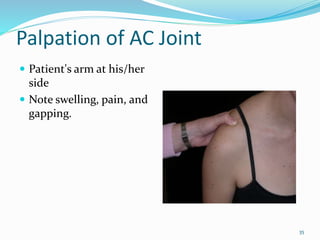
Palpation of AC Joint
 Patient's arm at his/her
side
 Note swelling, pain, and
gapping.
36
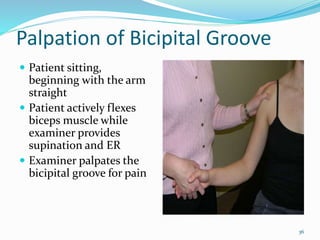
Palpation of Bicipital Groove
 Patient sitting,
beginning with the arm
straight
 Patient actively flexes
biceps muscle while
examiner provides
supination and ER
 Examiner palpates the
bicipital groove for pain
37
Range of Motion (ROM)
 Evaluate active ROM
 If movement limited by pain, weakness, or tightness,
assist passively
 Lack of full ROM with active and passive exam is
found in adhesive capsulitis and arthropathy
 Evaluate bilaterally for comparison
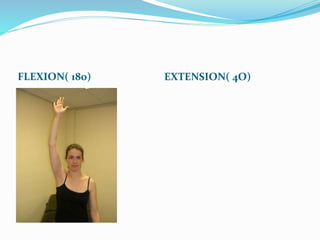
FLEXION( 180) EXTENSION( 4O)
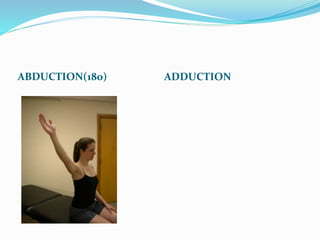
ABDUCTION(180) ADDUCTION
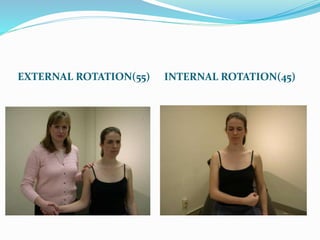
EXTERNAL ROTATION(55) INTERNAL ROTATION(45)
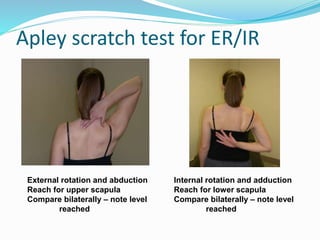
Apley scratch test for ER/IR
Internal rotation and adduction
Reach for lower scapula
Compare bilaterally – note level
reached
External rotation and abduction
Reach for upper scapula
Compare bilaterally – note level
reached
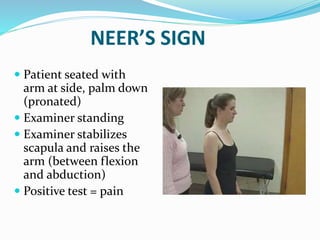
NEER’S SIGN
 Patient seated with
arm at side, palm down
(pronated)
 Examiner standing
 Examiner stabilizes
scapula and raises the
arm (between flexion
and abduction)
 Positive test = pain
NEERS’ TEST
 Most diagnostic test
 LA 10ml lignocaine into subacromial bursa
 >50% relief – rotator cuff tendinitis or partial tear of
bursal surface.
 Pain relief but weakness persists – full thickness tears
 No relief - incorrect diagnosis or wrong injection
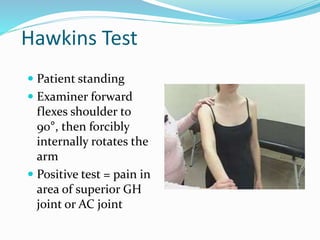
Hawkins Test
 Patient standing
 Examiner forward
flexes shoulder to
90°, then forcibly
internally rotates the
arm
 Positive test = pain in
area of superior GH
joint or AC joint
Sensitivity/Specificity
 Neer Impingement
 Sensitivity: 72%
 Specificity: 60%
 Hawkins-Kennedy Impingement
 Sensitivity: 79%
 Specificity: 59%
Hegedus. British J Sports Med, 2012.
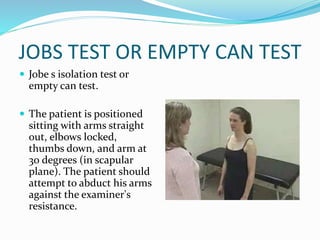
JOBS TEST OR EMPTY CAN TEST
 Jobe s isolation test or
empty can test.
 The patient is positioned
sitting with arms straight
out, elbows locked,
thumbs down, and arm at
30 degrees (in scapular
plane). The patient should
attempt to abduct his arms
against the examiner's
resistance.
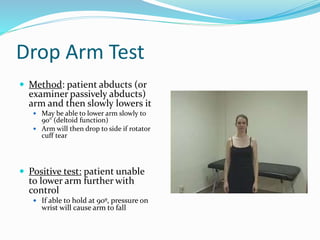
Drop Arm Test
 Method: patient abducts (or
examiner passively abducts)
arm and then slowly lowers it
 May be able to lower arm slowly to
90° (deltoid function)
 Arm will then drop to side if rotator
cuff tear
 Positive test: patient unable
to lower arm further with
control
 If able to hold at 90º, pressure on
wrist will cause arm to fall
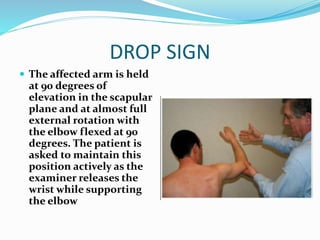
DROP SIGN
 The affected arm is held
at 90 degrees of
elevation in the scapular
plane and at almost full
external rotation with
the elbow flexed at 90
degrees. The patient is
asked to maintain this
position actively as the
examiner releases the
wrist while supporting
the elbow
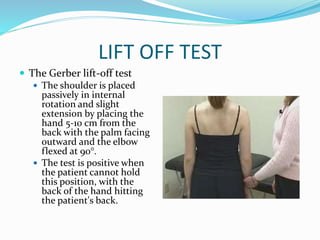
LIFT OFF TEST
 The Gerber lift-off test
 The shoulder is placed
passively in internal
rotation and slight
extension by placing the
hand 5-10 cm from the
back with the palm facing
outward and the elbow
flexed at 90°.
 The test is positive when
the patient cannot hold
this position, with the
back of the hand hitting
the patient's back.
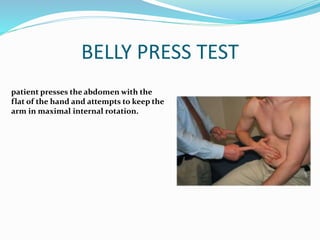
BELLY PRESS TEST
patient presses the abdomen with the
flat of the hand and attempts to keep the
arm in maximal internal rotation.
OTHER TESTS
 EXTERNAL ROTATION LAG SIGN- SUPRASPINATUS
AND INFRASPINATUS.
 EXTERNAL ROTATION STRESS TEST-
INFRASPINATUS AND TERES MINOR.
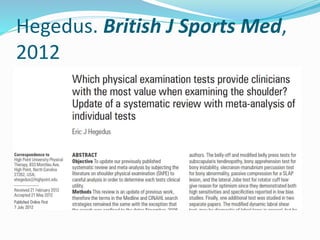
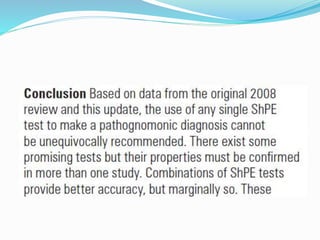
Hegedus. British J Sports Med,
2012
Cochrane Database Review 2013 –
Hanchard, et al.

 Physical tests for shoulder impingements and
local lesions of bursa, tendon or labrum that may
accompany impingement.
 33 studies involving 4002 shoulders
Cochrane Database Review 2013 –
Hanchard, et al.
 There is insufficient evidence upon which to base
selection of physical tests for shoulder impingements,
and local lesions of bursa, tendon or labrum that may
accompany impingement, in primary care. The large
body of literature revealed extreme diversity in the
performance and interpretation of tests, which
hinders synthesis of the evidence and/or clinical
applicability.
INVESTIGATIONS
 X RAY
 USG
 CT SCAN
 MRI
X RAY
 AP VIEW
 AXILLARY LATERAL VIEW
 SUPRASPINATUS OUTLET VIEW
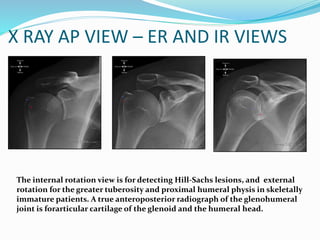
X RAY AP VIEW – ER AND IR VIEWS
The internal rotation view is for detecting Hill-Sachs lesions, and external
rotation for the greater tuberosity and proximal humeral physis in skeletally
immature patients. A true anteroposterior radiograph of the glenohumeral
joint is forarticular cartilage of the glenoid and the humeral head.
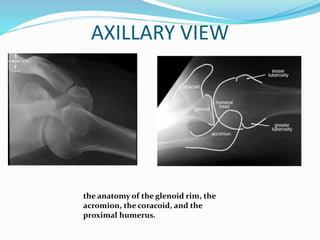
AXILLARY VIEW
the anatomy of the glenoid rim, the
acromion, the coracoid, and the
proximal humerus.
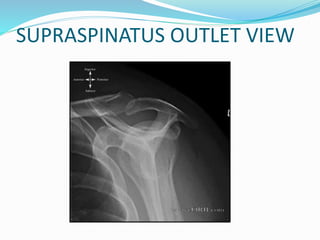
SUPRASPINATUS OUTLET VIEW
Ultrasound
 Cheap and quick to perform.
 Good definition of rotator cuff.
 Allows dynamic examination.
 Operator dependant.
 Findings:
 Nonvisualization of cuff
 Localized absence
 Discontinuity
 Focal abnormal echogenicity
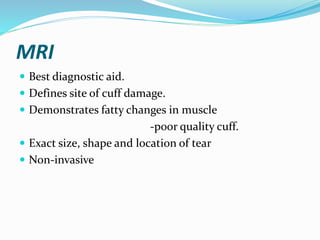
MRI
 Best diagnostic aid.
 Defines site of cuff damage.
 Demonstrates fatty changes in muscle
-poor quality cuff.
 Exact size, shape and location of tear
 Non-invasive
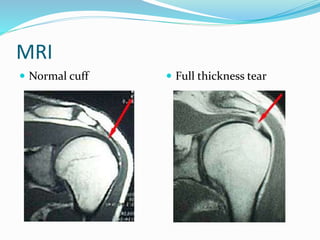
MRI
 Normal cuff  Full thickness tear
TREATMENT
 SEVERITY OF SYMPTOMS.
 AGE.
 ACTIVITY LEVEL.
 PATIENT REQUIREMENTS .
Conservative management
 McLaughlin in 1962 advanced reasons to avoid early
repair
 25 % of cadavers had torn cuff -most of them were
asymptomatic
 50 % of patients would recover comfortably
 Results of early and late repair are similar
 Repair did not always permit anatomic restoration
 Early diagnosis is difficult
NATURAL HISTORY IS UNPREDICTABLE
 Review of literature indicates that success rate of
nonoperative treatment ranges from 33% to 92%
 Bartolozzi et al (Clin orthop, 1994) reported 66-
75% good or excellent results (mean follow up 20
months). Unfavorable prognostic factors were
 Tear> 1 cm2
 Symptoms > 1yr
 Significant functional impairment
 REST
 ACTIVITY MODIFICATION
 NSAIDS
 PHYSIOTHERAPHY (streching and strenghtening
exercises).
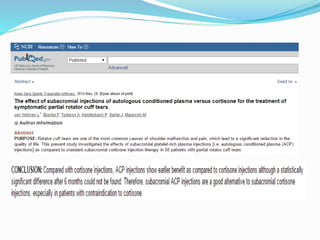
 INJECTION THERAPHY ( STEROID AND PRp)
Orthotherapy
 Term used by Michael Wirth (OCNA 1997)
 Interactive exchange between patient and orthopedic
surgeon directed at creating exercise regimen that
gradually improves motion and strength in shoulder girdle.
 Three phases:
 Phase 1- restore full, painless range of motion. Codman pendulum
exercise followed by passive movements in all direction
 Phase 2- designed to strengthened remaining muscles of rotator
cuff, deltoid & scapular muscles
 Phase 3- gradual reinstitution of normal activities including work,
hobby and sport.
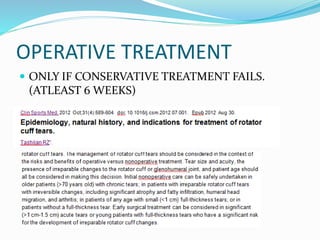
OPERATIVE TREATMENT
 ONLY IF CONSERVATIVE TREATMENT FAILS.
(ATLEAST 6 WEEKS)
Operative treatment
 Patient selection:
 Samilson & Binder :
 Patient physiologically younger than 60 yrs
 Clinically or arthrographically demonstrable full
thickness cuff tear.
 Failure to improve on nonoperative management for
minimum of 6 weeks
 Need to use shoulder in overhead elevation
 Full passive range of motion
 Ability & willingness to cooperate
Poor prognostic factors
 Old age group (physiological age >60 years)
 Long history
 No history of trauma
 Smoker
 Multiple steroid injection
 Diffuse osteopenia
 Grade 3 or less of external rotation
 Upward migration of humeral head.
Procedures
 Repair of tear
 open or arthroscopic
 Tendon to tendon or tendon to bone
 Arthroscopic debridement,SAD and acromioplasty
with mini-open repair.
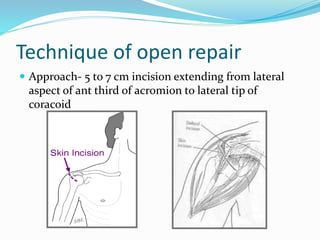
Technique of open repair
 Approach- 5 to 7 cm incision extending from lateral
aspect of ant third of acromion to lateral tip of
coracoid
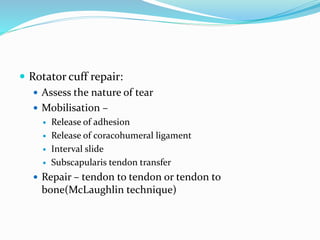
 Rotator cuff repair:
 Assess the nature of tear
 Mobilisation –
 Release of adhesion
 Release of coracohumeral ligament
 Interval slide
 Subscapularis tendon transfer
 Repair – tendon to tendon or tendon to
bone(McLaughlin technique)
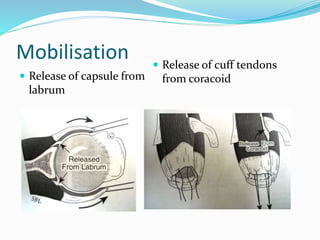
Mobilisation
 Release of capsule from
labrum
 Release of cuff tendons
from coracoid
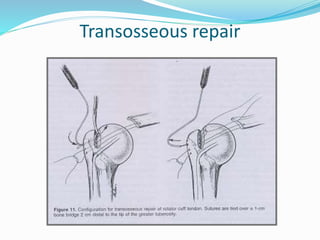
Transosseous repair
Advantages of open repair
 Easy to do
 No special equipment required
 Allows direct visualization of cuff repair and
acromioplasty
 Good long term follow-up
Disadvantages
 Deltoid detachment required
 False positive studies (arthrogram 2%, MRI 10%) will
lead to unnecessary open exploration
 Unrepairable tear will be opened.
 Significant intraarticular pathology will be missed
Arthroscopic repair of rotator cuff
 Advantages :
 Lesser morbidity
 Ability to identify and treat other pathology
 Truly outpatient
 Allows to address small undetected tears
 Patient acceptance
Disadvantages :
Technically difficult
Implant cost-needs anchor
Increased OR time
High failure rate during learning curve
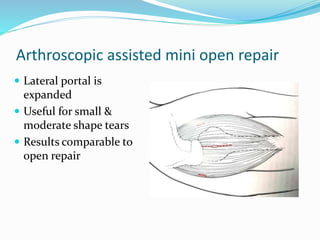
Arthroscopic assisted mini open repair
 Lateral portal is
expanded
 Useful for small &
moderate shape tears
 Results comparable to
open repair
Post operative plan.
 Arthroscopic
 Immd active and passive ROM
 Avoid active abduction >60 degree for 3-4 wks
 Then electrical stimulation, resisting exercises for 3-4
mths
 High demand activities within 4-6 mths
 Open
 Proceed slowly (deltoid detached)
 Avoid active flexion or abduction for 4 wks
 Requires 1-2 additional months
Partial thickness tear
 Surgical options:
 Debridement alone
 Debridement with arthroscopic subacromial
decompression
 Open repair with acromioplasty
 Arthroscopic repair
 Arthroscopic subacromial decompression with mini
open repair
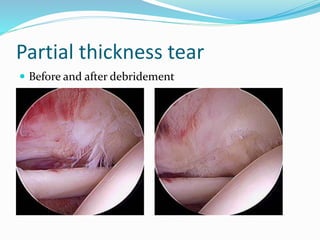
Partial thickness tear
 Before and after debridement
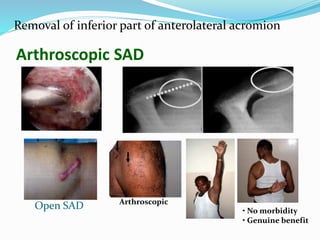
Arthroscopic SAD
Removal of inferior part of anterolateral acromion
Open SAD • No morbidity
• Genuine benefit
Arthroscopic
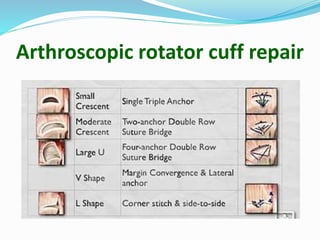
Arthroscopic rotator cuff repair
Irreparable tears
 Pre operative diagnosis
 AHI <3 mms
 Profound loss of external rotation
 MRI-fatty degeneration of muscle
Treatment options
 Debridement
 Tendon transposition
 Subscapularis
 Infraspinatus
 Muscle transfer
 Partial repair
 Allograft substitution
COMPLICATIONS
 PROGRESSION OF LESION
 ROTATOR CUFF ARTHROPATHY
 LONG HEAD OF BICEPS TENDON RUPTURE
 ANTEROPOSTERIOR INSTABILITY
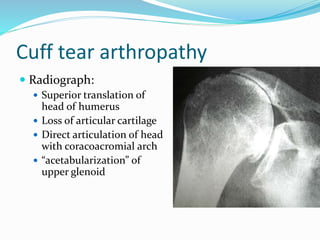
Cuff tear arthropathy
 Radiograph:
 Superior translation of
head of humerus
 Loss of articular cartilage
 Direct articulation of head
with coracoacromial arch
 “acetabularization” of
upper glenoid
Treatment
 Intractable pain unresponsive to conservative
treatment is the strongest indication for surgery
 Options :
 Shoulder arthrodesis
 Hemi replacement arthroplasty
 Total shoulder replacement
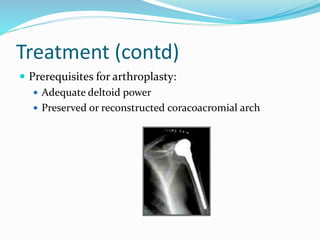
Treatment (contd)
 Prerequisites for arthroplasty:
 Adequate deltoid power
 Preserved or reconstructed coracoacromial arch
Conclusion
 Diagnosis is usually by good history and examination
 Non operative management remains the standard
initial care
 Surgery in selective active individuals
 Arthroscopy - early mobilization and decreased
morbidity
 Treatment according to patients functional needs
Rotator cuff injuries

Rotator cuff injuries

  • 1.
  • 2.
    INTRODUCTION  In 1834,Smith - first description of a rupture of the rotator cuff tendon .  Among most common causes of shoulder pain and instability.  Incidence 5-40% with increasing with advancing age ( >40 years).  Normal senescence process
  • 4.
    ANATOMY- ROTATOR CUFF Made up of 4 interrelated muscles arising from the scapula and attaching to the tuberosities of humerus.  supraspinatus  infraspinatus  teres minor  subscapularis  Long head of biceps – functional part
  • 6.
  • 7.
    BIG BALL ANDSMALL SOCKET JOINT
  • 8.
    Function of rotatorcuff The rotator cuff is the Dynamic stabilizer of the glenohumeral joint. Normal function of the shoulder is a balance between mobility and stability.
  • 9.
    Function of rotatorcuff  Stabilisers of shoulder mainly anterior and posterior cuff providing fixed fulcrum for concentric rotation of the humeral head.  Neutralises shearing forces of deltoid in early abduction.  Initiation of abduction.  Rotation of shoulder.
  • 10.
    ETIOLOGY  IMPINGEMENT( MC)  TRAUMA  ATTRITION - AGING  ISCHEMIC TENDON  LACK OF NUTRITION TO JOINT  IATROGENIC
  • 11.
     Different shapesof acromia (Biglianni et al) -anterior slope  Type 1 - Flat ( 3 % of cuff tears)  Type 2 - Curved (24 % of cuff tears)  Type 3 - Hooked ( 73 % of cuff tears)
  • 12.
    PATHOLOGY Torn Rotator Cuff Cannot Counterbalance the upward pull of the deltoid on the humerus Not able to Hold the head of the humerus secure in the glenoid AHD <6mm
  • 13.
    Leads to abutementof humeral head against acromion Acetabulization: Concave deformity of under surface of Acromion
  • 14.
    Narrowing & Arthritis ofGleno-Humeral Joint Last stage of Cuff tear arthropathy with collapse of humerus head
  • 15.
    Hamada and FukudaStages of Cuff Arthropathy
  • 16.
    CLASSIFICATION 1. DURATION –ACUTE OR CHRONIC 2. DEGREE OF TEAR- PARTIAL OR FULL THICKNESS TEAR. 3. ETIOLOGY- TRAUMATIC OR DEGENERATIVE. 4. COFIELD – BASED ON SIZE OF TEAR SIZE OF TEAR DEGREE <1 cm SMALL 1- 3 cms MEDIUM 3-5cms LARGE >5 cms MASSIVE
  • 17.
  • 18.
    Crescent Reverse ‘L’‘L’ Shaped Trapezoidal Massive tear Full Thickness Tear
  • 19.
    SYMPTOMS  Pain onthe lateral aspect of the shoulder  may radiate to deltoid insertion  anterior (acromion )with impingement  +/- biceps tendonitis  Stiffness  Cannot lie affected side.  Weakness, instability, crepitus.
  • 20.
    21 Assessing shoulder pain Componentsof the assessment include  Focused history  physical examination  Tests/studies
  • 22.
    23 Focused History Questions Onsetof Pain  When symptoms started*  History of trauma/injury
  • 23.
    24 Focused History Questions Mechanism of Injury  Helps predict injured structure Example: Fall directly onto anterior/superior shoulderAC joint injury (shoulder separation) Example: Arm forcefully abducted and externally rotated  subluxation or anterior dislocation Example: If chronic pain, note activity that triggers pain, such as the cocking phase of throwing or the pull-through phase of swimming
  • 24.
    25 Focused History Questions Mechanism of Injury, continued  Can determine radiological needs  Likelihood of specific conditions varies  Setting (work, recreation, sports, traumatic, atraumatic)  Age of the patient*
  • 25.
    26 Focused History Questions Location of pain*  Anterior  Lateral  Superior  Posterior  Radiation of pain  Rotator cuff problems often include pain radiating to upper arm  If pain starts in neck and radiates to shoulder, consider cervical spine disease
  • 27.
    28  Consider sourcesof referred pain  Cervical spine – spondylolysis, arthritis, disc disease  Cardiac - myocardial ischemia  Diaphragmatic irritation  Thoracic outlet syndrome  Gallbladder disease  Complex regional pain syndrome (a.k.a, reflex sympathetic dystrophy) Focused History Questions
  • 28.
    29 Characteristics of pain FocusedHistory Questions Night pain when lying on affected side, muscle atrophy Rotator cuff tear < 30 yo Biomechanical, inflammatory > 45 yo, Hx of trauma Rotator cuff tear - 35% of pts Painful arc (60-120°abduction) Subacromial impingement Pain > 120° abduction Acromioclavicular joint Catching, popping, clicking GH or AC joint arthritis, labral tear
  • 29.
    30 Focused History Questions History of instability  Glenohumeral subluxation or dislocation  Aggravating factors  Overhead work, repetitive movements, sports  Relieving factors/treatments tried  Rest, immobility, medications, other treatments  History of Prior Shoulder Problems or Surgeries
  • 30.
    31 Physical Exam -General  Develop a standard routine protocol.  Alleviate the patient's fears.  Adequate exposure.  Compare shoulders.
  • 31.
    32 Physical Exam –Steps  Inspection  Palpation  Range of motion (ROM)  Strength testing  Special tests
  • 32.
    33 Inspection  Swelling, asymmetry,muscle atrophy, scars, ecchymosis and any venous distention  Note posture  Deformities  Scapular "winging"  Atrophy - supraspinatus or infraspinatus - consider rotator cuff tear, suprascapular nerve entrapment or neuropathy.
  • 33.
    34 Palpation  Sternoclavicular joint Clavicle  Acromioclavicular joint  Subacromial bursa  Coracoid process  Bicipital groove  Greater tuberosity  Lesser tuberosity  Scapula (spinatus muscles)
  • 34.
    35 Palpation of ACJoint  Patient's arm at his/her side  Note swelling, pain, and gapping.
  • 35.
    36 Palpation of BicipitalGroove  Patient sitting, beginning with the arm straight  Patient actively flexes biceps muscle while examiner provides supination and ER  Examiner palpates the bicipital groove for pain
  • 36.
    37 Range of Motion(ROM)  Evaluate active ROM  If movement limited by pain, weakness, or tightness, assist passively  Lack of full ROM with active and passive exam is found in adhesive capsulitis and arthropathy  Evaluate bilaterally for comparison
  • 37.
  • 38.
  • 39.
  • 40.
    Apley scratch testfor ER/IR Internal rotation and adduction Reach for lower scapula Compare bilaterally – note level reached External rotation and abduction Reach for upper scapula Compare bilaterally – note level reached
  • 43.
    NEER’S SIGN  Patientseated with arm at side, palm down (pronated)  Examiner standing  Examiner stabilizes scapula and raises the arm (between flexion and abduction)  Positive test = pain
  • 44.
    NEERS’ TEST  Mostdiagnostic test  LA 10ml lignocaine into subacromial bursa  >50% relief – rotator cuff tendinitis or partial tear of bursal surface.  Pain relief but weakness persists – full thickness tears  No relief - incorrect diagnosis or wrong injection
  • 45.
    Hawkins Test  Patientstanding  Examiner forward flexes shoulder to 90°, then forcibly internally rotates the arm  Positive test = pain in area of superior GH joint or AC joint
  • 46.
    Sensitivity/Specificity  Neer Impingement Sensitivity: 72%  Specificity: 60%  Hawkins-Kennedy Impingement  Sensitivity: 79%  Specificity: 59% Hegedus. British J Sports Med, 2012.
  • 48.
    JOBS TEST OREMPTY CAN TEST  Jobe s isolation test or empty can test.  The patient is positioned sitting with arms straight out, elbows locked, thumbs down, and arm at 30 degrees (in scapular plane). The patient should attempt to abduct his arms against the examiner's resistance.
  • 49.
    Drop Arm Test Method: patient abducts (or examiner passively abducts) arm and then slowly lowers it  May be able to lower arm slowly to 90° (deltoid function)  Arm will then drop to side if rotator cuff tear  Positive test: patient unable to lower arm further with control  If able to hold at 90º, pressure on wrist will cause arm to fall
  • 51.
    DROP SIGN  Theaffected arm is held at 90 degrees of elevation in the scapular plane and at almost full external rotation with the elbow flexed at 90 degrees. The patient is asked to maintain this position actively as the examiner releases the wrist while supporting the elbow
  • 53.
    LIFT OFF TEST The Gerber lift-off test  The shoulder is placed passively in internal rotation and slight extension by placing the hand 5-10 cm from the back with the palm facing outward and the elbow flexed at 90°.  The test is positive when the patient cannot hold this position, with the back of the hand hitting the patient's back.
  • 54.
    BELLY PRESS TEST patientpresses the abdomen with the flat of the hand and attempts to keep the arm in maximal internal rotation.
  • 55.
    OTHER TESTS  EXTERNALROTATION LAG SIGN- SUPRASPINATUS AND INFRASPINATUS.  EXTERNAL ROTATION STRESS TEST- INFRASPINATUS AND TERES MINOR.
  • 56.
    Hegedus. British JSports Med, 2012
  • 58.
    Cochrane Database Review2013 – Hanchard, et al.  Physical tests for shoulder impingements and local lesions of bursa, tendon or labrum that may accompany impingement.  33 studies involving 4002 shoulders
  • 59.
    Cochrane Database Review2013 – Hanchard, et al.  There is insufficient evidence upon which to base selection of physical tests for shoulder impingements, and local lesions of bursa, tendon or labrum that may accompany impingement, in primary care. The large body of literature revealed extreme diversity in the performance and interpretation of tests, which hinders synthesis of the evidence and/or clinical applicability.
  • 60.
    INVESTIGATIONS  X RAY USG  CT SCAN  MRI
  • 61.
    X RAY  APVIEW  AXILLARY LATERAL VIEW  SUPRASPINATUS OUTLET VIEW
  • 62.
    X RAY APVIEW – ER AND IR VIEWS The internal rotation view is for detecting Hill-Sachs lesions, and external rotation for the greater tuberosity and proximal humeral physis in skeletally immature patients. A true anteroposterior radiograph of the glenohumeral joint is forarticular cartilage of the glenoid and the humeral head.
  • 63.
    AXILLARY VIEW the anatomyof the glenoid rim, the acromion, the coracoid, and the proximal humerus.
  • 64.
  • 65.
    Ultrasound  Cheap andquick to perform.  Good definition of rotator cuff.  Allows dynamic examination.  Operator dependant.  Findings:  Nonvisualization of cuff  Localized absence  Discontinuity  Focal abnormal echogenicity
  • 66.
    MRI  Best diagnosticaid.  Defines site of cuff damage.  Demonstrates fatty changes in muscle -poor quality cuff.  Exact size, shape and location of tear  Non-invasive
  • 67.
    MRI  Normal cuff Full thickness tear
  • 68.
    TREATMENT  SEVERITY OFSYMPTOMS.  AGE.  ACTIVITY LEVEL.  PATIENT REQUIREMENTS .
  • 69.
    Conservative management  McLaughlinin 1962 advanced reasons to avoid early repair  25 % of cadavers had torn cuff -most of them were asymptomatic  50 % of patients would recover comfortably  Results of early and late repair are similar  Repair did not always permit anatomic restoration  Early diagnosis is difficult NATURAL HISTORY IS UNPREDICTABLE
  • 70.
     Review ofliterature indicates that success rate of nonoperative treatment ranges from 33% to 92%  Bartolozzi et al (Clin orthop, 1994) reported 66- 75% good or excellent results (mean follow up 20 months). Unfavorable prognostic factors were  Tear> 1 cm2  Symptoms > 1yr  Significant functional impairment
  • 71.
     REST  ACTIVITYMODIFICATION  NSAIDS  PHYSIOTHERAPHY (streching and strenghtening exercises).  INJECTION THERAPHY ( STEROID AND PRp)
  • 73.
    Orthotherapy  Term usedby Michael Wirth (OCNA 1997)  Interactive exchange between patient and orthopedic surgeon directed at creating exercise regimen that gradually improves motion and strength in shoulder girdle.  Three phases:  Phase 1- restore full, painless range of motion. Codman pendulum exercise followed by passive movements in all direction  Phase 2- designed to strengthened remaining muscles of rotator cuff, deltoid & scapular muscles  Phase 3- gradual reinstitution of normal activities including work, hobby and sport.
  • 74.
    OPERATIVE TREATMENT  ONLYIF CONSERVATIVE TREATMENT FAILS. (ATLEAST 6 WEEKS)
  • 75.
    Operative treatment  Patientselection:  Samilson & Binder :  Patient physiologically younger than 60 yrs  Clinically or arthrographically demonstrable full thickness cuff tear.  Failure to improve on nonoperative management for minimum of 6 weeks  Need to use shoulder in overhead elevation  Full passive range of motion  Ability & willingness to cooperate
  • 76.
    Poor prognostic factors Old age group (physiological age >60 years)  Long history  No history of trauma  Smoker  Multiple steroid injection  Diffuse osteopenia  Grade 3 or less of external rotation  Upward migration of humeral head.
  • 77.
    Procedures  Repair oftear  open or arthroscopic  Tendon to tendon or tendon to bone  Arthroscopic debridement,SAD and acromioplasty with mini-open repair.
  • 78.
    Technique of openrepair  Approach- 5 to 7 cm incision extending from lateral aspect of ant third of acromion to lateral tip of coracoid
  • 79.
     Rotator cuffrepair:  Assess the nature of tear  Mobilisation –  Release of adhesion  Release of coracohumeral ligament  Interval slide  Subscapularis tendon transfer  Repair – tendon to tendon or tendon to bone(McLaughlin technique)
  • 80.
    Mobilisation  Release ofcapsule from labrum  Release of cuff tendons from coracoid
  • 81.
  • 82.
    Advantages of openrepair  Easy to do  No special equipment required  Allows direct visualization of cuff repair and acromioplasty  Good long term follow-up
  • 83.
    Disadvantages  Deltoid detachmentrequired  False positive studies (arthrogram 2%, MRI 10%) will lead to unnecessary open exploration  Unrepairable tear will be opened.  Significant intraarticular pathology will be missed
  • 84.
    Arthroscopic repair ofrotator cuff  Advantages :  Lesser morbidity  Ability to identify and treat other pathology  Truly outpatient  Allows to address small undetected tears  Patient acceptance Disadvantages : Technically difficult Implant cost-needs anchor Increased OR time High failure rate during learning curve
  • 85.
    Arthroscopic assisted miniopen repair  Lateral portal is expanded  Useful for small & moderate shape tears  Results comparable to open repair
  • 86.
    Post operative plan. Arthroscopic  Immd active and passive ROM  Avoid active abduction >60 degree for 3-4 wks  Then electrical stimulation, resisting exercises for 3-4 mths  High demand activities within 4-6 mths  Open  Proceed slowly (deltoid detached)  Avoid active flexion or abduction for 4 wks  Requires 1-2 additional months
  • 87.
    Partial thickness tear Surgical options:  Debridement alone  Debridement with arthroscopic subacromial decompression  Open repair with acromioplasty  Arthroscopic repair  Arthroscopic subacromial decompression with mini open repair
  • 88.
    Partial thickness tear Before and after debridement
  • 89.
    Arthroscopic SAD Removal ofinferior part of anterolateral acromion Open SAD • No morbidity • Genuine benefit Arthroscopic
  • 90.
  • 91.
    Irreparable tears  Preoperative diagnosis  AHI <3 mms  Profound loss of external rotation  MRI-fatty degeneration of muscle
  • 92.
    Treatment options  Debridement Tendon transposition  Subscapularis  Infraspinatus  Muscle transfer  Partial repair  Allograft substitution
  • 93.
    COMPLICATIONS  PROGRESSION OFLESION  ROTATOR CUFF ARTHROPATHY  LONG HEAD OF BICEPS TENDON RUPTURE  ANTEROPOSTERIOR INSTABILITY
  • 94.
    Cuff tear arthropathy Radiograph:  Superior translation of head of humerus  Loss of articular cartilage  Direct articulation of head with coracoacromial arch  “acetabularization” of upper glenoid
  • 95.
    Treatment  Intractable painunresponsive to conservative treatment is the strongest indication for surgery  Options :  Shoulder arthrodesis  Hemi replacement arthroplasty  Total shoulder replacement
  • 96.
    Treatment (contd)  Prerequisitesfor arthroplasty:  Adequate deltoid power  Preserved or reconstructed coracoacromial arch
  • 97.
    Conclusion  Diagnosis isusually by good history and examination  Non operative management remains the standard initial care  Surgery in selective active individuals  Arthroscopy - early mobilization and decreased morbidity  Treatment according to patients functional needs